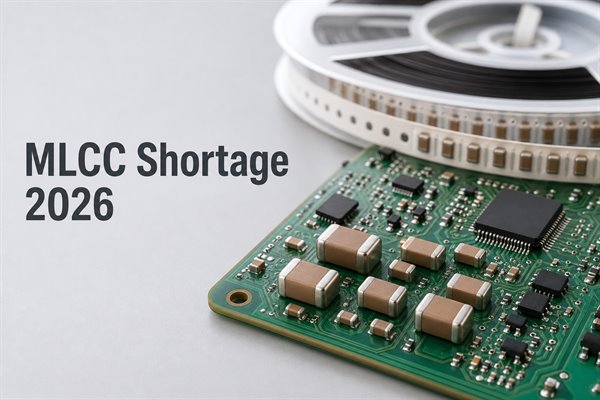
MLCC shortage 2026 data shows a split market: AI-oriented high-capacitance parts are absorbing premium capacity, while some mainstream consumer MLCC inventories have fallen below 30 days. TrendForce reported average distributor increases of 20%–25% in late July and spot prices as high as two to three times previous levels for some parts.
Those figures do not mean every MLCC, purchase contract, or PCBA quotation has risen by the same percentage. They describe different parts and channels at specific dates. Buyers need to identify exposed BOM lines, verify alternatives electrically and mechanically, and confirm current availability before releasing a production order.
What Is Driving the MLCC Shortage in 2026?
The shortage is being driven by specification concentration, capacity reallocation, channel stocking, and limited near-term expansion rather than by uniform demand growth across all electronics. AI accelerator boards require large numbers of small, high-capacitance capacitors for decoupling, filtering, and power integrity. Suppliers are therefore prioritizing difficult, higher-value X6S and X7R products.
This change reduces the production flexibility available for some consumer X5R parts. At the same time, distributors and customers are ordering earlier to protect second-half production, which can amplify apparent demand. The result is an unusual market in which end demand for some consumer electronics remains weak while channel prices for selected MLCCs rise.
- AI demand: custom ASIC and accelerator platforms consume many high-capacitance, low-voltage MLCCs.
- Capacity shift: production resources move from standard consumer specifications toward higher-end AI parts.
- Manufacturing constraints: advanced small-package, high-capacitance parts are difficult to produce at high yield.
- Preventive buying: early orders and channel stockpiling increase short-term pressure and the risk of duplicate demand.
Which MLCC Types Are Under the Most Pressure?
The clearest pressure is in high-capacitance, low-voltage, miniature MLCCs used by AI platforms and in selected consumer X5R values affected by the same capacity shift. TrendForce identified mainstream consumer parts from 1 µF to 22 µF with inventory below 30 days in late July, while certain high-capacitance X6S lead times had already extended from eight to as long as twenty weeks in June.
| Segment | 2026 Signal | BOM Concern |
| High-capacitance X6S/X7R for AI | Strong demand, difficult production and longer lead times | Limited qualified sources and spot premiums |
| Consumer X5R, 1 µF–22 µF | Mainstream inventory reported below 30 days | Capacity spillover and channel price volatility |
| Automotive-grade parts | Price adjustments reported for some ranges | Qualification requirements restrict substitutions |
| Other standard MLCCs | Availability varies by maker, package and value | Do not assume a market-wide shortage without checking the exact MPN |
For a refresher on dielectric classes, package sizes, values, and common manufacturers, see our MLCC capacitor guide. The relevant shortage risk always belongs to an exact manufacturer part number and approved specification, not to the word “capacitor” alone. MLCC capacitors with the same nominal value can still differ in dielectric, DC-bias behavior, termination, temperature range, and qualification level.
MLCC Price Increase in 2026: What Changed From April to July?
The reported MLCC price increase developed in stages, but the percentages are not cumulative because they cover different product groups and channels. TrendForce reported a 6%–13% adjustment for selected consumer low-capacitance and automotive parts in April, 15%–25% average increases for mainstream X5R distributor prices in China in June, and 20%–25% average distributor increases for affected consumer-grade products in late July.
| Date | Reported Change | Scope |
| April 2026 | 6%–13% | Selected consumer low-capacitance and automotive MLCCs from one major supplier |
| June 2026 | 15%–25% average | Mainstream consumer X5R pricing through distributors in China |
| Late July 2026 | 20%–25% average | Affected distributor-held consumer-grade MLCCs |
| Late July 2026 | 2–3× previous price | Some urgent spot-market transactions, not general contract pricing |
A spot-market premium can change quickly and may reflect a specific date code, package, maker, quantity, or delivery requirement. It should not be used as a universal multiplier for every MLCC or for an entire assembly quotation.
An MLCC capacitor price is therefore meaningful only when the manufacturer part number, authorized source, quantity, date code, packaging, inventory ownership, and quotation validity are known. A low online unit price and an urgent traceable production lot are not equivalent offers.
Why Is AI Demand Redirecting MLCC Capacity?
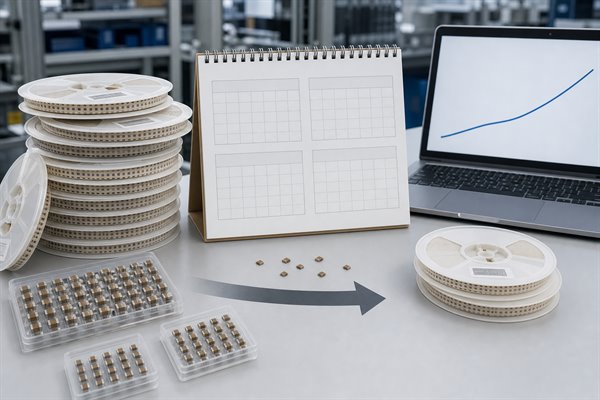
AI hardware concentrates demand on a limited set of MLCC specifications that must deliver high effective capacitance in a small area under demanding temperature and power conditions. That requirement is difficult to meet simply by running more standard capacitors through an existing line.
TrendForce cited one accelerator design in which the use of 47 µF, 2.5 V, X6S, 0402 capacitors increased from 1,440 to 10,544 pieces per board. Another platform increased its use of 100 µF, 4 V, X6S, 0805 parts from 320 to 500 pieces. These examples show why a small number of advanced specifications can absorb substantial effective capacity even when the broader electronics market is not booming.
New capacity also takes time to qualify and ramp. High-layer-count ceramic structures, thin dielectric layers, electrode alignment, termination quality, and yield all affect usable output. A factory expansion announcement therefore does not create immediately available qualified parts.
How Can the MLCC Supply Shortage Affect a PCBA BOM?
An MLCC supply shortage affects a PCBA BOM through line-item availability, quote validity, substitution workload, and schedule risk rather than through one fixed assembly-price formula. A low-cost capacitor can still stop a build if it is used many times, has only one approved source, or performs a critical power-integrity function.
- Allocation risk: the quoted quantity may disappear before the purchase order is released.
- Short quote validity: distributors may confirm price and stock for a limited period.
- Partial-kitting risk: one unavailable MPN can hold an otherwise complete kit.
- Engineering delay: a replacement may require electrical review, sample assembly, and functional testing.
- Cash and inventory trade-off: early buying protects supply but increases working capital and excess-stock exposure.
The impact on a PCBA price depends on how many affected parts are used, the order quantity, the approved manufacturer list, the sourcing channel, and whether redesign or validation is required. MLCC market percentages must never be transferred directly to the total assembly price.
Which Specifications Must Match Before Approving an Alternate?
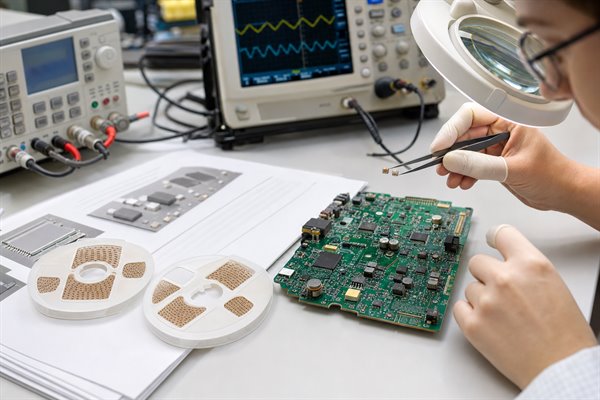
An alternate MLCC must match the circuit’s real electrical, environmental, mechanical, and qualification requirements—not just capacitance and case size. The same nominal value can behave very differently under DC bias, temperature, frequency, board flex, and reflow stress.
MLCC capacitor voltage derating cannot be checked from the printed voltage rating alone. Engineers should compare effective capacitance at the actual DC operating voltage and temperature, then confirm that the remaining capacitance still satisfies the circuit’s transient, filtering, and stability requirements.
| Check | Why It Matters | Evidence to Review |
| Capacitance and tolerance | Sets the nominal range before operating effects | Part number and datasheet limits |
| Rated voltage and DC bias | Effective capacitance may fall sharply under applied voltage | DC-bias or capacitance-change curve |
| Dielectric and temperature range | X5R, X6S, X7R and C0G/NP0 are not interchangeable by default | Temperature characteristic and application conditions |
| Package and termination | Affects footprint fit, solder joint geometry and flex-crack risk | Dimension drawing and termination construction |
| Impedance, ESR and ESL | Changes filtering, transient response and power integrity | Frequency curves and circuit simulation |
| Qualification level | Automotive, medical, safety or customer-controlled BOMs may restrict changes | Required qualification and customer approval records |
Our guide to selecting SMD electronic components explains how package, rating, environment, assembly process, and availability should be reviewed together.
How Should Engineering Teams Validate MLCC Substitutions?
Engineering teams should validate the replacement at part, board, and system levels before changing a controlled BOM. A distributor’s “cross” result is a sourcing lead, not automatic design approval.
Relevant MLCC capacitor failure modes include flex cracking, thermal-mechanical cracking, insulation-resistance degradation, and short-circuit failure. Package construction, termination type, land pattern, board strain, depaneling, and reflow conditions can therefore matter as much as the nominal electrical value.
- Compare manufacturer data: check capacitance, tolerance, rated voltage, dielectric, temperature, dimensions, termination, and reliability class.
- Check operating-point performance: compare effective capacitance under the board’s DC voltage and expected temperature.
- Review circuit function: assess impedance, ESR, ESL, ripple, transient response, and any timing or signal-path dependency.
- Confirm PCB compatibility: verify land pattern, component height, spacing, stencil design, and pick-and-place data.
- Build controlled samples: use the intended assembly profile and inspect solder joints for placement or wetting problems.
- Run functional tests: repeat the tests most sensitive to the capacitor’s role, including power-rail noise, startup, load transient, thermal, or environmental tests where applicable.
- Control the revision: document the approved MPN, test evidence, date code requirements, and customer approval if required.
If a preferred MPN is unavailable, our article on alternative electronic components provides a broader framework for AVL control and PCBA change review.
What Procurement Actions Can Reduce MLCC Shortage Risk?
Procurement teams can reduce risk by acting earlier on the exact exposed MPNs while avoiding panic buying across the whole passive BOM. The objective is controlled coverage, not unlimited inventory.
- Classify MLCC lines by usage quantity, approved-source count, current lead time, and circuit criticality.
- Ask for manufacturer-authorized or otherwise traceable supply before accepting an unfamiliar channel.
- Confirm stock ownership, date code, packaging, minimum order quantity, price validity, and shipment schedule in writing.
- Request engineering review of alternates before the preferred part becomes unavailable.
- Reserve supply against a realistic production forecast and define cancellation or excess-inventory responsibility.
- Avoid duplicate orders across multiple suppliers unless allocation and cancellation rules are controlled.
EBest Circuit’s component sourcing service can be used alongside PCB assembly planning so BOM availability, assembly requirements, and production timing are reviewed in the same project context.
What Should a PCBA RFQ Include During an MLCC Shortage?
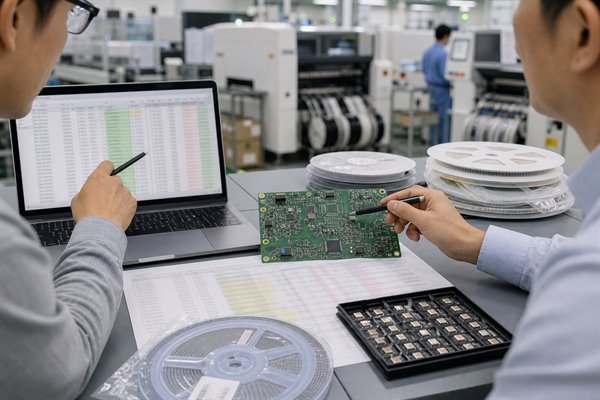
A useful PCBA RFQ should make both the technical requirement and the sourcing flexibility explicit. This allows the assembler to quote the intended design and identify supply risks without making unauthorized substitutions.
- Complete BOM with manufacturer and exact MPN for every MLCC.
- Approved alternate MPNs or an approved manufacturer list, if available.
- Gerber or ODB++ data, centroid file, assembly drawing, and schematic.
- Prototype and production quantities plus required delivery dates.
- Customer-supplied, pre-purchased, or consigned component information.
- Any automotive, medical, traceability, date-code, or change-approval requirement.
- Required functional test, programming, inspection, and acceptance criteria.
These files also help align component decisions with the complete PCBA manufacturing process, including SMT preparation, placement, reflow, inspection, testing, and final build control.
What Does the Rest of 2026 Look Like for MLCC Supply?
The second half of 2026 remains exposed to longer lead times and further pricing pressure in selected high-end and spillover consumer specifications, but a universal shortage is not inevitable. TrendForce identified the fourth quarter as an important point for judging whether high-end tightness becomes a full shortage.
Buyers should watch manufacturer lead times, distributor inventory, book-to-bill ratios, allocation notices, price validity, and whether new capacity produces qualified output. The MLCC shortage 2026 should therefore be managed as a part-number-level risk with frequent BOM checks, not as a reason to assume every capacitor will remain unavailable or expensive.
FAQ About the MLCC Capacitor Shortage
Is there really an MLCC shortage in 2026?
Yes, supply risk is real for selected high-end, high-capacitance, low-voltage MLCCs and for some consumer X5R values affected by capacity reallocation. The market is polarized, however, so availability must be checked by exact MPN rather than treating every MLCC as constrained.
Which MLCC values have the tightest inventory?
TrendForce reported mainstream consumer mid/high-capacitance inventory in the 1 µF–22 µF range below 30 days in late July. Advanced AI specifications such as small-package, high-capacitance X6S parts also showed extended lead times.
How much did MLCC prices increase in 2026?
Reported changes varied by date and channel: 6%–13% for selected parts in April, 15%–25% average distributor increases for mainstream X5R in June, and 20%–25% average increases for affected distributor inventory in late July. Some urgent spot transactions reached two to three times previous prices, but that was not a universal contract-price change.
Why does AI use so many MLCCs?
AI accelerators have dense, fast-changing power loads. Large MLCC arrays provide local energy storage, decoupling, filtering, and low-impedance current paths close to processors and power-delivery circuits.
Are X5R and X7R capacitors interchangeable?
Not automatically. Their temperature characteristics differ, and effective capacitance also depends on voltage, package, manufacturer construction, and circuit conditions. The replacement must be checked against the design’s operating limits and test requirements.
Can I use a higher-voltage MLCC as an alternate?
Sometimes, but only after checking case size, effective capacitance under DC bias, impedance, termination, fit, and qualification requirements. A higher printed voltage rating alone does not prove equivalence.
Does an MLCC price increase raise the total PCBA price by the same percentage?
No. Total PCBA cost includes the complete BOM, PCB fabrication, assembly, testing, quantity, yield, logistics, and other services. The effect depends on how many affected MLCCs are used and which sourcing route is available.
Should buyers stockpile MLCCs now?
Buyers should secure realistic coverage for verified at-risk MPNs, not buy every passive component indiscriminately. Excess stock can create cash, storage, cancellation, and obsolescence risk if demand or pricing changes.
How can counterfeit or relabeled MLCC risk be reduced?
Prefer traceable supply, verify packaging and labels, retain receiving records, and use incoming inspection appropriate to the project risk. Urgent spot buying should not bypass supplier qualification or change control.
When should a PCBA buyer approve alternate MLCCs?
Approve alternates before the preferred MPN becomes a production blocker. Engineering should review datasheets and operating curves, assemble samples when needed, run relevant functional tests, and document the controlled BOM change.
Market data note: price, inventory, shipment, book-to-bill, and lead-time figures in this article are attributed to TrendForce releases dated May 18, June 17, July 6, and July 28, 2026. Market conditions vary by manufacturer part number, quantity, channel, region, and quotation date.
How Can EBest Circuit Help Protect Your PCBA Schedule?
At EBest Circuit, we can review your Gerber files, BOM, approved alternates, quantities, and delivery requirements together so exposed MLCC lines are identified before production. For component sourcing and PCB assembly support, send your project files to sales@bestpcbs.com for technical review and a current quotation.