PCB manufacturing PCB manufacturing
Home > Blog

ipc-tm-650

IPC-TM-650 Test Methods for PCB Quality Control and Reliability
Tuesday, June 2nd, 2026

IPC-TM-650 is one of the most important test method references in PCB manufacturing, PCB inspection, and PCBA reliability evaluation. It is not a product certification by itself. It is a collection of standardized test methods used to evaluate printed boards, materials, solder masks, conductors, plated holes, surface cleanliness, insulation resistance, thermal stress, dimensional stability, and environmental durability.

For PCB engineers, IPC-TM-650 helps define how a test should be performed. For buyers, it helps verify whether a PCB supplier has a controlled and repeatable quality process. For manufacturers, it gives a shared technical language when discussing failure analysis, material qualification, process control, and customer acceptance.

What Is IPC-TM-650?

IPC-TM-650 is the IPC Test Methods Manual used for testing printed boards, electronic materials, and related interconnection products. It includes test methods related to reporting and measurement analysis, visual inspection, dimensional measurement, chemical performance, mechanical strength, electrical performance, environmental reliability, and connector evaluation.
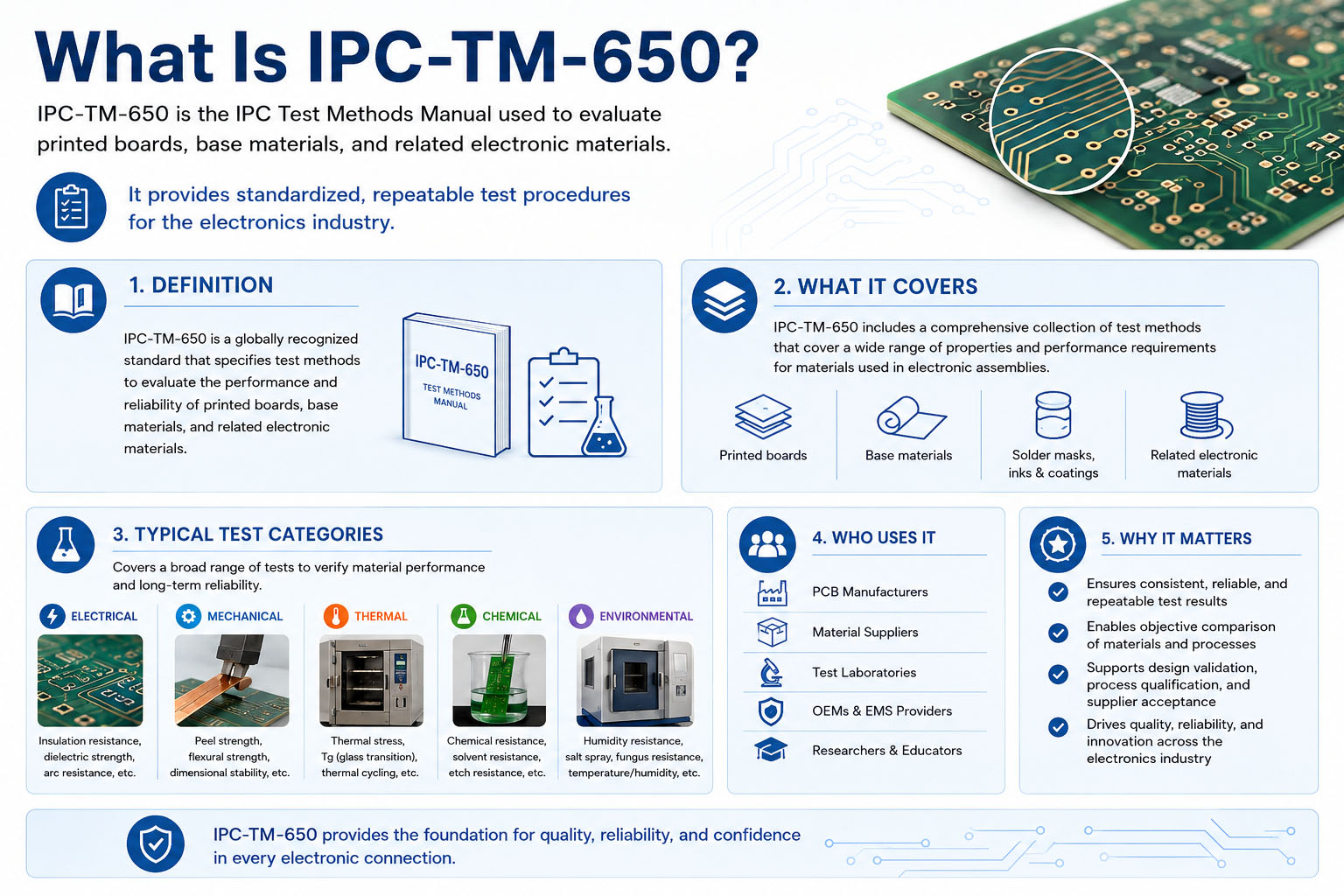
What Is IPC-TM-650

In simple terms, IPC-TM-650 tells engineers how to test a PCB-related property. It does not replace a product performance specification. Instead, it supports standards, drawings, purchase specifications, and customer requirements by defining repeatable test procedures.

For example, if a customer wants to verify solder mask cure, peel strength, insulation resistance, copper thickness, thermal stress resistance, or dimensional stability, IPC-TM-650 may provide the test method that explains the sample preparation, equipment, test conditions, procedure, and reporting format.

Why Is IPC-TM-650 Important for PCB Manufacturing?

PCB quality cannot be judged only by appearance. A board may look acceptable but still have weak plated-through holes, poor solder mask cure, unstable insulation resistance, ionic contamination, or weak copper adhesion. IPC-TM-650 helps manufacturers and customers evaluate these hidden quality risks through defined test methods.
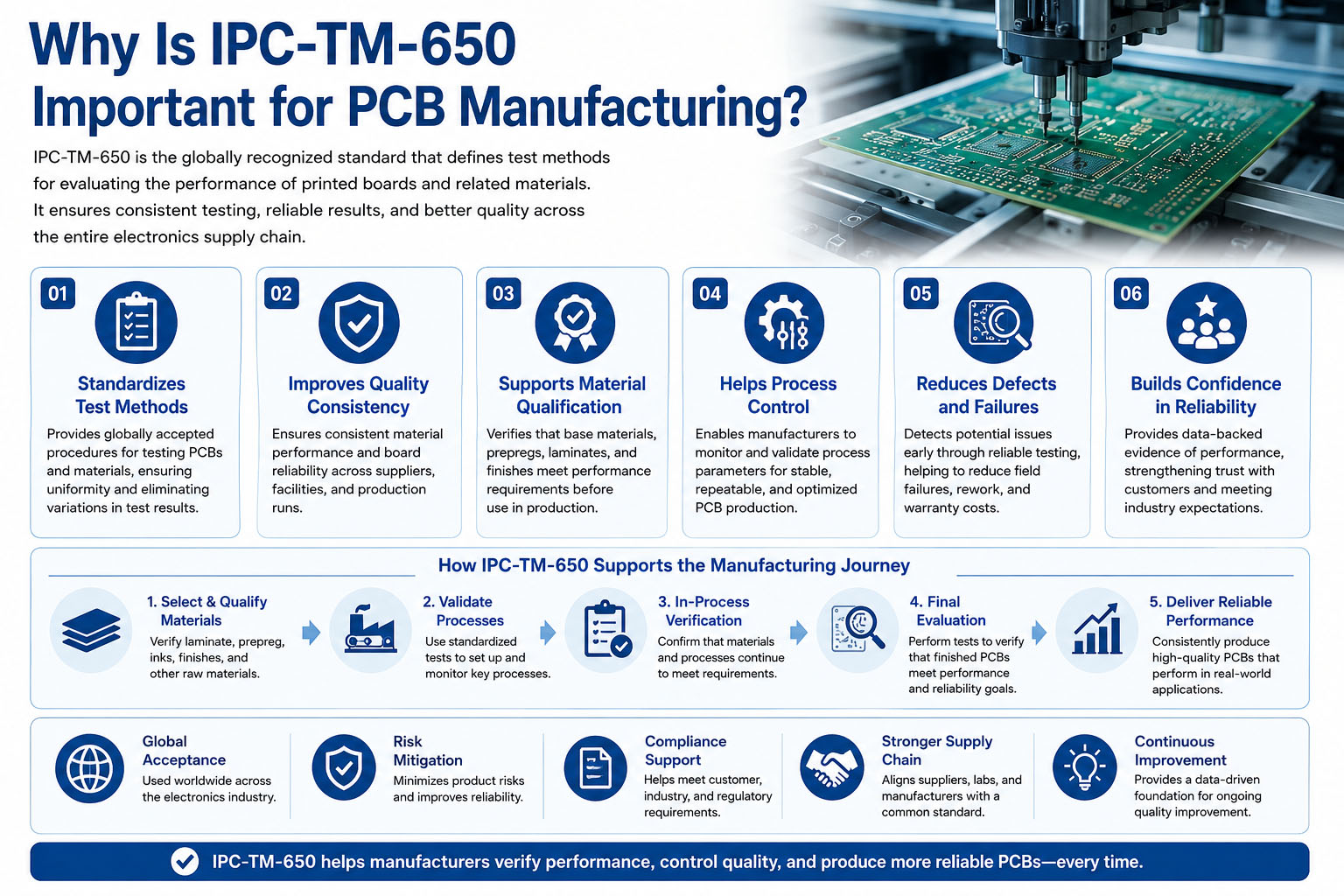
Why Is IPC-TM-650 Important for PCB Manufacturing

Its value is especially clear in high-reliability PCB projects, including medical electronics, automotive electronics, aerospace systems, industrial control, telecommunications, robotics, power electronics, and LED thermal management. These products often require more than basic electrical testing.

IPC-TM-650 helps answer practical production questions:

Production QuestionWhy IPC-TM-650 Helps
Is the solder mask properly cured?It supports chemical and physical verification.
Can plated holes survive thermal stress?It provides test methods for interconnection reliability.
Is the material dimensionally stable?It supports dimensional stability evaluation.
Is insulation resistance acceptable after humidity exposure?It supports electrical reliability testing.
Is copper adhesion strong enough?It helps evaluate peel strength and conductor bonding.
Is the board clean enough after processing?It supports contamination and cleanliness-related checks.

For buyers, this means quality becomes measurable rather than subjective. For suppliers, it helps reduce disputes by using recognized test procedures.

How Is IPC-TM-650 Organized?

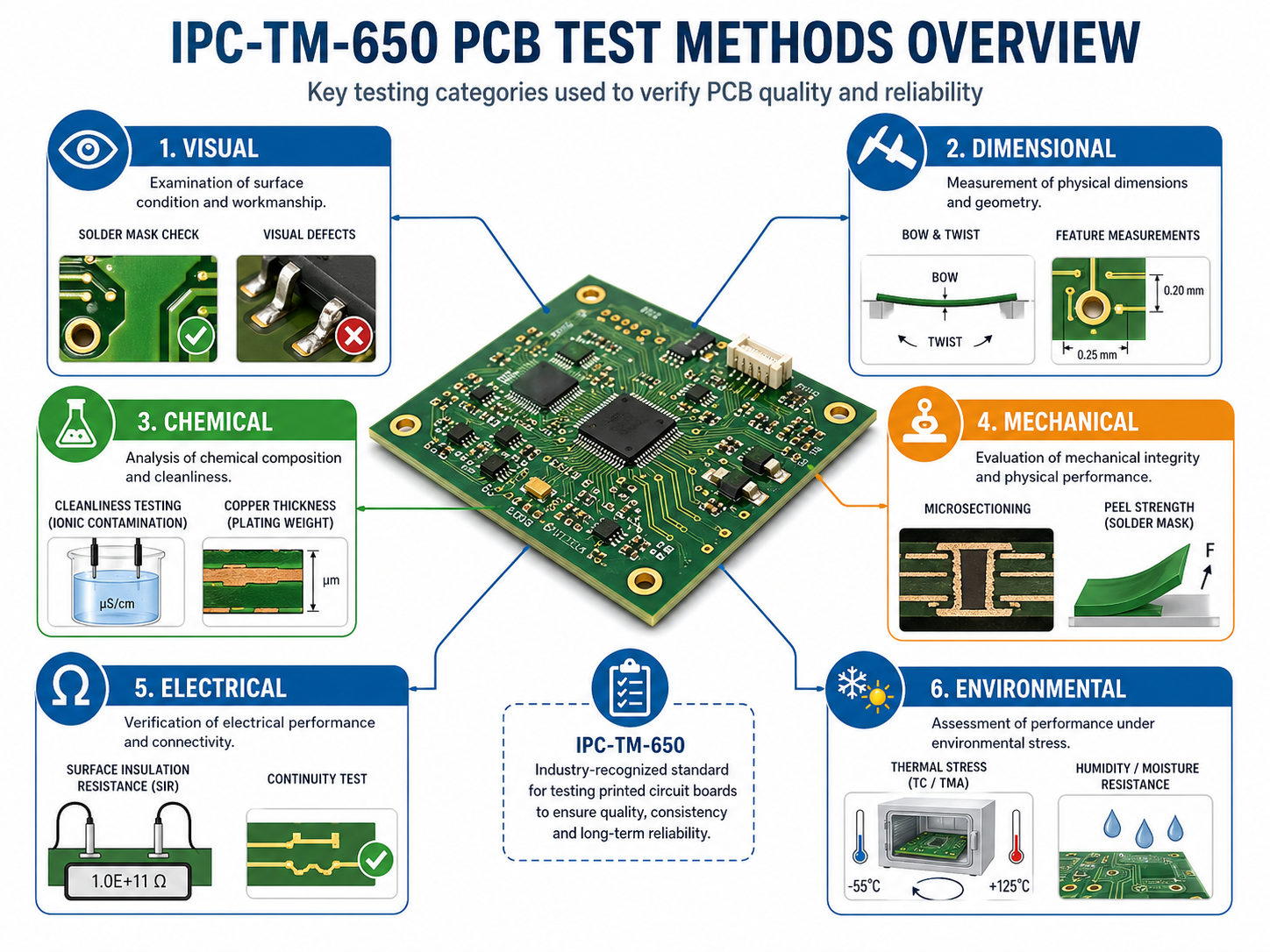
IPC-TM-650 is organized by test method category. Each category focuses on a different type of PCB property or reliability concern. The methods are commonly grouped into visual, dimensional, chemical, mechanical, electrical, environmental, and connector test methods.

IPC-TM-650 SectionMain FocusTypical PCB Relevance
1.0 Reporting and Measurement AnalysisCalibration, reporting, measurement formatTest consistency and documentation
2.1 Visual Test MethodsMicrosectioning, surface examination, hole structureInternal and external visual evaluation
2.2 Dimensional Test MethodsHole size, copper thickness, dimensional stabilityBoard geometry and manufacturing tolerance
2.3 Chemical Test MethodsSolder mask cure, chemical resistance, material propertiesMaterial and surface process reliability
2.4 Mechanical Test MethodsPeel strength, flex endurance, adhesionMechanical durability
2.5 Electrical Test MethodsInsulation resistance, dielectric properties, conductor resistanceElectrical performance and insulation quality
2.6 Environmental Test MethodsThermal shock, temperature cycling, humidity-related testingLong-term reliability under stress
3.0 Connector Test MethodsConnector-related evaluationInterconnection and assembly reliability

This structure is useful because PCB failure can come from many directions. A board may fail mechanically, electrically, chemically, thermally, or dimensionally. IPC-TM-650 gives engineers a method-based way to investigate each risk.

What Tests Are Included in IPC-TM-650?

IPC-TM-650 contains many test methods covering printed boards and related interconnection materials. These test methods support chemical, mechanical, electrical, environmental, visual, and dimensional evaluation for PCB manufacturing and reliability control.

Common test areas include:

  • Microsection evaluation
  • Plated-through hole structure inspection
  • Hole size measurement
  • Copper thickness measurement
  • Solder mask cure testing
  • Chemical resistance testing
  • Peel strength testing
  • Folding endurance for flexible materials
  • Dielectric constant and loss tangent testing
  • Insulation resistance testing
  • Dielectric withstand voltage testing
  • Resistance testing of plated-through holes
  • Thermal shock testing
  • Temperature cycling
  • Environmental insulation resistance testing
  • Surface insulation resistance testing
  • CAF-related reliability evaluation
  • Cleanliness and contamination-related testing

Not every PCB project needs every IPC-TM-650 test. The correct test plan depends on board type, material, reliability class, customer specification, product environment, and production volume.

How Does IPC-TM-650 Relate to IPC-A-600, IPC-6012, and IPC-J-STD-001?

IPC-TM-650 is often used together with other IPC standards. The relationship is important because many people confuse test methods, workmanship standards, and performance specifications.

StandardMain RoleHow It Relates to IPC-TM-650
IPC-TM-650Defines test methodsExplains how to perform specific tests
IPC-A-600Acceptability of printed boardsHelps visually judge acceptable and nonconforming board conditions
IPC-6012Performance specification for rigid printed boardsDefines qualification and performance requirements for rigid PCBs
IPC-J-STD-001Requirements for soldered electrical and electronic assembliesDefines process and acceptance requirements for soldered assemblies
IPC-A-610Acceptability of electronic assembliesUsed for PCBA visual inspection and workmanship acceptance

A simple way to understand the relationship is this:

  • IPC-6012 defines what a rigid PCB must meet.
  • IPC-A-600 helps inspectors judge what the board looks like.
  • IPC-TM-650 explains how to test a property.
  • IPC-J-STD-001 focuses on soldered electronic assemblies.

For a serious PCB project, these documents are not competitors. They work together.

Which IPC-TM-650 Tests Matter Most for PCB Fabrication?

The most important IPC-TM-650 methods depend on the board type. A simple two-layer FR4 PCB and a 16-layer HDI PCB do not carry the same risk. A rigid-flex PCB, heavy copper PCB, ceramic PCB, and high-frequency PCB also need different verification points.

For standard rigid PCB fabrication, common focus areas include:

Test FocusWhy It Matters
MicrosectioningChecks hole wall plating, inner-layer connection, voids, cracks, and dielectric condition.
Copper thicknessConfirms conductor and hole plating meet requirements.
Hole size measurementVerifies drilling, plating, and finished hole tolerance.
Peel strengthEvaluates copper adhesion to the base material.
Solder mask cureConfirms solder mask has reached proper chemical and mechanical stability.
Insulation resistanceChecks electrical isolation between conductors.
Dielectric withstand voltageEvaluates insulation under high voltage stress.
Thermal stressChecks plated holes and laminate stability after heat exposure.
Dimensional stabilityVerifies material movement after processing or thermal exposure.

For high-density boards, microsection quality becomes especially important because small vias, stacked vias, via-in-pad structures, and fine-pitch layouts leave less process margin.

How Does IPC-TM-650 Help with Material Selection?

Material selection is not only about Tg, dielectric constant, or price. A PCB material must survive fabrication, soldering, operating temperature, humidity, voltage stress, and mechanical loading. IPC-TM-650 gives manufacturers and customers a way to test whether material behavior supports the application.

For example:

  • FR4 materials may be checked for thermal stress resistance, dimensional stability, dielectric performance, and insulation resistance.
  • High-Tg materials may be selected when boards face lead-free assembly, repeated thermal cycles, or elevated operating temperature.
  • Polyimide materials may be evaluated for flexible PCB durability, bending performance, and dimensional behavior.
  • High-frequency laminates may require dielectric constant and loss tangent verification.
  • Solder mask materials may need cure, adhesion, chemical resistance, and insulation testing.

Material selection should be based on the full application environment. A material that works well for a consumer device may not be suitable for automotive, medical, aerospace, or power electronics. IPC-TM-650 helps turn material choice into a testable decision.

How Does IPC-TM-650 Support PCB Reliability Testing?

Reliability testing is about finding weak points before boards fail in the field. IPC-TM-650 supports this by defining repeatable ways to expose PCB samples to electrical, thermal, mechanical, and environmental stress.

Typical reliability concerns include:

  • Plated-through hole cracking
  • Inner-layer separation
  • Delamination
  • CAF growth
  • Insulation breakdown
  • Moisture-related leakage
  • Copper adhesion loss
  • Solder mask degradation
  • Dimensional movement
  • Thermal fatigue
  • Conductor resistance change

In production, reliability testing may be performed during material qualification, first article approval, process validation, periodic quality control, customer audits, or failure analysis. For critical industries, test planning should be defined before manufacturing starts, not after a problem appears.

What Is the Role of Microsection Testing in IPC-TM-650?

Microsectioning is one of the most valuable PCB evaluation methods because it reveals internal structures that cannot be judged from the surface. A microsection can show hole wall copper thickness, plating voids, resin recession, inner-layer separation, glass fiber condition, dielectric thickness, annular ring condition, and cracks after thermal stress.

In real factory work, microsection testing is often used for:

  • First article inspection
  • New material qualification
  • High-layer-count PCB validation
  • HDI microvia evaluation
  • Heavy copper process confirmation
  • Thermal stress analysis
  • Plating defect investigation
  • Customer complaint analysis

For high-reliability PCBs, a microsection report is more valuable than a simple surface photo. It shows whether the internal manufacturing process is stable.

How Does IPC-TM-650 Apply to HDI, Rigid-Flex, and Heavy Copper PCBs?

Advanced PCB structures need stricter process control because they have less tolerance for variation.

HDI PCB

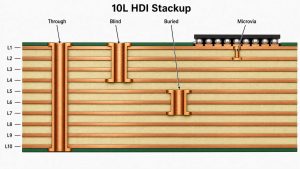
HDI boards may use microvias, blind vias, buried vias, fine lines, and via-in-pad structures. IPC-TM-650-related checks help evaluate plating quality, dielectric thickness, via reliability, and thermal stress performance. For stacked microvias, cross-section analysis is especially important.

Rigid-Flex PCB

Rigid-flex boards combine rigid sections and flexible circuits. Testing may focus on dimensional stability, bend endurance, copper adhesion, coverlay condition, and interconnection reliability between rigid and flexible zones.

Heavy Copper PCB

Heavy copper boards require strong etching control, copper plating control, thermal management, and solder mask coverage. IPC-TM-650-related tests can support copper thickness verification, peel strength evaluation, thermal stress checks, and microsection analysis.

High-Frequency PCB

High-frequency boards need stable dielectric performance and controlled impedance. IPC-TM-650 methods related to dielectric constant, loss tangent, copper quality, and dimensional stability may support material verification and production consistency.

What Are Common PCB Failures Found Through IPC-TM-650 Testing?

IPC-TM-650 testing helps identify defects that are easy to miss during routine inspection. These failures often affect long-term reliability rather than immediate board function.

Failure TypePossible CauseTest or Evaluation Direction
Plating voidsPoor desmear, weak activation, plating instabilityMicrosectioning and hole structure evaluation
Barrel cracksThermal fatigue, weak copper plating, CTE mismatchThermal stress and microsection analysis
DelaminationMaterial weakness, moisture, excessive thermal loadThermal stress and cross-section review
Low insulation resistanceContamination, moisture, spacing issueInsulation resistance and environmental testing
Solder mask liftingPoor surface preparation or cureSolder mask cure and adhesion evaluation
Copper peelWeak copper bonding or material mismatchPeel strength testing
Dimensional shiftMaterial instability or lamination stressDimensional stability testing
CAF riskGlass-resin interface weakness, moisture, voltage stressCAF-related environmental evaluation
High leakage currentIonic residue or insufficient cleaningCleanliness and electrical resistance testing
Poor solderabilitySurface finish degradation or contaminationSolderability-related evaluation

A useful failure analysis report should connect the defect to process history, material batch, design condition, and test evidence. The test result should not be treated as an isolated number.

How Should PCB Buyers Use IPC-TM-650 in Procurement?

Buyers do not need to request every IPC-TM-650 test for every PCB order. That can increase cost without adding meaningful value. A better approach is to define the test scope according to product risk.

For example:

Product TypeSuggested Test Attention
Consumer electronics PCBElectrical test, visual inspection, basic dimensional checks
Industrial control PCBCopper thickness, insulation resistance, thermal stress, microsection if needed
Medical PCBTraceability, cleanliness, insulation resistance, process validation, documentation
Automotive PCBThermal cycling, microsection, material stability, solderability, reliability records
Aerospace PCBIPC Class 3-level inspection, microsection, thermal stress, full documentation
High-frequency PCBDielectric properties, impedance, dimensional stability, material verification
Heavy copper PCBCopper thickness, microsection, thermal performance, solder mask coverage
Rigid-flex PCBFlex durability, bend area inspection, dimensional stability, interconnect reliability

A good purchase specification should not simply say “must meet IPC-TM-650.” It should specify which test methods, acceptance criteria, sample quantity, frequency, documentation format, and responsibility apply to the order.

What Should Be Included in an IPC-TM-650 Test Report?

A proper IPC-TM-650-related test report should be clear enough for engineering review, customer audit, and internal quality tracking.

A useful report should include:

  • Customer name or project number
  • PCB part number and revision
  • Lot number or batch number
  • Material type and thickness
  • Surface finish
  • Test method number
  • Sample quantity
  • Test equipment
  • Calibration status if applicable
  • Test conditions
  • Acceptance criteria
  • Test results
  • Photos or microsection images when needed
  • Operator and inspection date
  • Conclusion
  • Deviation notes, if any

For regulated industries, record control matters as much as the test itself. If a supplier cannot connect a test report to the correct production batch, the report has limited value.

How Does IPC-TM-650 Help with Supplier Evaluation?

IPC-TM-650 can reveal whether a PCB supplier has real process control or only basic production capability. A professional supplier should understand which tests are relevant, when to apply them, and how to interpret the results.

When evaluating a PCB manufacturer, buyers can ask:

  • Can you provide microsection reports for multilayer or HDI boards?
  • How do you verify copper thickness and plated hole quality?
  • Do you perform thermal stress testing for high-reliability boards?
  • Can you support insulation resistance or SIR testing when required?
  • How do you manage solder mask cure and adhesion issues?
  • Can you provide batch traceability for materials and process records?
  • Do you understand IPC-A-600 and IPC-6012 together with IPC-TM-650?
  • Can you support DFM review before production?
  • How do you handle customer-specific test requirements?
  • Can you keep test records for future audits?

The best supplier is not the one that claims every test is always necessary. The better supplier can recommend a practical test plan based on product risk, customer requirements, cost, and delivery schedule.

What Mistakes Should Engineers Avoid When Specifying IPC-TM-650?

A common mistake is using IPC-TM-650 as a general quality slogan instead of a defined test requirement. This creates confusion during quotation, production, inspection, and dispute resolution.

Avoid these mistakes:

  • Writing “IPC-TM-650 compliant” without naming test methods
  • Forgetting to define acceptance criteria
  • Requesting unnecessary tests for low-risk boards
  • Ignoring sample quantity and test frequency
  • Applying the wrong method to the wrong board type
  • Assuming IPC-TM-650 replaces IPC-6012 or IPC-A-600
  • Failing to provide test coupons when needed
  • Asking for reliability tests after boards are already produced
  • Comparing suppliers without matching the same test scope
  • Treating test results as pass/fail only without process analysis

A clear specification should say exactly what must be tested, how it should be tested, what result is acceptable, and what documentation is required.

What Affects the Cost of IPC-TM-650 Testing?

IPC-TM-650-related testing cost depends on test type, sample preparation, equipment, labor, report depth, and whether third-party laboratory testing is required.

Main cost factors include:

Cost FactorImpact
Test complexityEnvironmental and reliability tests usually cost more than dimensional checks.
Sample quantityMore samples increase labor and material cost.
Test durationTemperature cycling, humidity, and aging tests take longer.
Special equipmentX-section, SIR, thermal shock, and dielectric tests may need dedicated equipment.
Third-party labExternal testing adds lab fees and logistics time.
Reporting detailFormal reports with photos and traceability require more documentation work.
Board complexityHDI, rigid-flex, heavy copper, and high-frequency boards need more careful evaluation.
UrgencyExpedited testing may increase cost.

Testing should be treated as risk control, not only as an expense. The cost of one well-planned test can be much lower than the cost of field failure, delayed validation, or batch rejection.

Case Study: Using IPC-TM-650 Methods to Solve a Plated Hole Reliability Issue

A customer ordered a multilayer industrial control PCB with plated-through holes carrying both signal and power connections. The first prototype passed basic electrical testing, but after assembly and thermal exposure, several boards showed intermittent connections.

The issue was not visible from surface inspection. The engineering team selected representative coupons and performed microsection evaluation after thermal stress exposure. The cross-sections showed weak areas in plated hole copper and early signs of barrel cracking. Further review found that the plating process window and hole preparation needed adjustment.

The solution included tighter drilling control, improved desmear verification, plating process correction, and additional microsection checks during the next pilot batch. After the process update, the customer approved the board for small-batch production.

This case shows why IPC-TM-650-style testing matters. Electrical test confirms present connectivity, but reliability testing helps predict whether connectivity will remain stable after manufacturing and field stress.

FAQs About IPC-TM-650

What is IPC-TM-650 used for?

IPC-TM-650 is used to define test methods for printed boards, materials, connectors, and related electronic interconnection products. It helps engineers evaluate properties such as copper thickness, insulation resistance, solder mask cure, peel strength, thermal stress resistance, dimensional stability, and environmental durability.

Is IPC-TM-650 a certification?

No. IPC-TM-650 is not a product certification. It is a test methods manual. A PCB can be tested according to selected IPC-TM-650 methods, but the acceptance criteria usually come from customer specifications, IPC-6012, IPC-A-600, drawings, or project-specific quality requirements.

Does every PCB need IPC-TM-650 testing?

Not every board needs advanced IPC-TM-650 testing. Basic commercial PCBs may only require standard electrical test and visual inspection. High-reliability boards, HDI boards, automotive PCBs, medical PCBs, aerospace PCBs, and harsh-environment products often need deeper verification.

What is the difference between IPC-TM-650 and IPC-6012?

IPC-TM-650 explains how to perform tests. IPC-6012 defines qualification and performance requirements for rigid printed boards. In many projects, IPC-6012 may define what must be achieved, while IPC-TM-650 provides the method used to verify a specific property.

What is the difference between IPC-TM-650 and IPC-A-600?

IPC-A-600 is an illustrated acceptability guide for printed boards. It helps inspectors judge visible and microsectioned board conditions. IPC-TM-650 focuses on test methods. The two are often used together when evaluating PCB quality.

Which IPC-TM-650 tests are common for multilayer PCBs?

Common tests include microsectioning, copper thickness measurement, hole structure evaluation, thermal stress testing, insulation resistance testing, dimensional checks, and sometimes dielectric testing. The exact scope depends on the stack-up, via structure, reliability class, and customer specification.

Can IPC-TM-650 help with PCB failure analysis?

Yes. IPC-TM-650 methods can support failure analysis by providing structured ways to examine plating, insulation, thermal stress damage, dimensional movement, solder mask condition, material defects, and environmental reliability. The method helps turn a suspected defect into measurable evidence.

Should buyers request third-party IPC-TM-650 testing?

Third-party testing may be useful for qualification, customer audits, disputed defects, regulated industries, or high-risk products. For routine production, a capable PCB factory may perform many checks internally. The choice depends on risk level, customer requirement, and trust in the supplier’s lab capability.

Does IPC-TM-650 apply to PCBA assembly?

IPC-TM-650 mainly focuses on printed boards, materials, and related interconnection tests. PCBA assembly quality often involves IPC-J-STD-001 and IPC-A-610. However, some IPC-TM-650 methods can still support PCBA-related reliability concerns, such as cleanliness, insulation resistance, and environmental behavior.

What should a supplier provide with IPC-TM-650 test results?

A supplier should provide the test method number, sample information, lot number, test conditions, equipment details, acceptance criteria, measured results, photos where needed, inspector information, test date, and conclusion. The report should be traceable to the actual production batch.

Can IPC-TM-650 reduce PCB production risk?

Yes. It helps reduce risk by identifying weak materials, unstable processes, poor plating, insulation problems, solder mask issues, and thermal reliability concerns before boards enter critical use. It is most valuable when testing is planned before production, not added after failure.

How should IPC-TM-650 be written in a PCB drawing or purchase order?

The drawing or purchase order should name the specific IPC-TM-650 test method, acceptance criteria, sample quantity, test frequency, and reporting requirement. A vague note such as “meet IPC-TM-650” is not enough because the manual contains many different methods.

Conclusion

IPC-TM-650 is a practical test method foundation for PCB quality control, material qualification, reliability validation, and failure analysis. It helps engineers and buyers move from visual judgment to measurable evidence. The most important point is to use it correctly: select the right test method, define acceptance criteria, prepare suitable samples, and connect the result to the actual production batch.

For standard PCB projects, only a limited test scope may be needed. For HDI, rigid-flex, heavy copper, medical, automotive, aerospace, high-frequency, and industrial control boards, IPC-TM-650-related testing can provide stronger confidence before prototype approval and batch production.

A reliable PCB supplier should understand not only how to fabricate the board, but also how to verify it through controlled inspection, test reports, DFM review, traceable production records, and practical engineering support.

If you are looking for reliable OEM manufacturing, ODM production, prototype development, volume production, or custom engineering solutions, welcome to contact our engineering team for technical support and quotation service.
You may also like

IPC-TM-650: PCB Test Methods for Quality, Reliability, and Process Control
Monday, May 11th, 2026

IPC-TM-650 helps engineers understand how PCB materials, finishes, solder mask, and assembly surfaces behave under controlled tests. If you buy bare boards or assembled PCBAs, this standard gives you a common technical language.

However, many buyers only see method numbers on drawings or reports. This guide explains the practical meaning behind those tests. It also shows how EBest Circuit uses engineering review, process control, and testing support to reduce sourcing risk.

ipc-tm-650

What Is IPC-TM-650?

IPC-TM-650 is a test methods manual for printed boards and related electronics materials. It gives defined ways to test chemical, mechanical, electrical, and environmental performance.

In simple terms, IPC-TM-650 helps engineers avoid vague quality claims. Instead, you can ask for a known test method, a clear condition, and a measurable result.

What It Means

For example, a PCB supplier may say a solder mask has strong adhesion. That sounds useful, yet it needs proof. With the right method, you can compare results across batches, suppliers, and design revisions.

Also, IPC-TM-650 does not replace your full product standard. It supports your quality plan. So, engineers often use it together with IPC-A-600, IPC-6012, IPC-A-610, or customer drawings.

AreaWhat It Helps CheckTypical Engineering Concern
ElectricalInsulation and leakageLong-term signal stability
MechanicalPeel, adhesion, flatnessAssembly fit and durability
ChemicalCleanliness and residuesCorrosion and field failures
EnvironmentalHeat, humidity, and stressReliability in real use

Why Is IPC-TM-650 Important for PCB Manufacturing?

IPC-TM-650 matters because PCB quality cannot rely on appearance alone. A board can look clean and still carry ionic residue. Also, a board can pass visual inspection and still warp during assembly.

Because of this, engineers need practical test methods. These methods help control PCB reliability, material testing, process control, and quality assurance.

Quality Needs Evidence

First, the standard supports supplier communication. Your drawing can state a test method, limit, sample size, and acceptance rule. As a result, both teams work from the same baseline.

Next, it supports repeatable process control. If a process changes, the factory can compare old and new test data. This makes engineering review faster and more factual.

Engineer’s tip: Use IPC-TM-650 when a PCB feature affects reliability, assembly yield, or field service life.

Finally, these tests help during supplier qualification. For instance, medical, automotive, aerospace, and industrial projects often need stronger traceability. In those cases, IPC-TM-650 can support a deeper quality file.

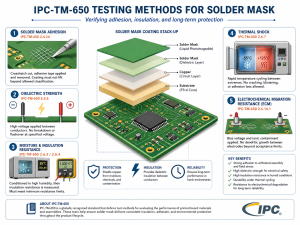
IPC-TM-650 Testing Methods for Solder Mask

IPC-TM-650 testing methods for solder mask help check how the mask protects copper and supports assembly. The solder mask must resist heat, chemicals, cleaning, and handling.

However, solder mask quality is not only about color or gloss. It also relates to adhesion, thickness, cure level, hardness, and ionic cleanliness.

Why Solder Mask Matters

Solder mask separates conductive features and helps reduce solder bridging. Also, it protects copper from oxidation during storage and use. This matters more on dense boards with small spacing.

For example, a fine-pitch medical sensor board may need stable mask registration. In contrast, a high-power LED board may need better thermal and surface durability.

Solder Mask CheckWhat It Looks ForWhy Engineers Care
AdhesionMask bond strengthLess peeling after assembly
Cure qualityProper hardeningBetter chemical resistance
RegistrationOpening alignmentStable pad exposure
CleanlinessResidue levelLower leakage risk

Therefore, solder mask testing is useful for boards with dense routing, fine-pitch parts, or harsh operating environments. It gives engineers more confidence before PCBA assembly starts.

How Does IPC-TM-650 Measure Bow and Twist?

IPC TM 650 bow and twist testing helps measure PCB flatness. This matters because warped boards can create placement, soldering, and final assembly problems.

In many cases, engineers refer to ipc tm 650 method 2.4 22 bow & twist. This method gives a structured way to check deviation from a flat plane.

Bow Versus Twist

Bow means the board curves along one direction. Twist means one corner rises while other areas remain lower. Both can affect SMT assembly.

For instance, a warped panel may not sit flat in the printer. Then solder paste height can vary. After that, components may shift or tombstone during reflow.

Also, bow and twist can become worse after thermal stress. High copper imbalance, uneven stack-up, and poor panel design can all add risk.

Flatness IssueCommon CauseAssembly Impact
BowLaminate stressPoor stencil contact
TwistUneven copper balancePlacement offset
Panel warpBad panel supportReflow variation
Thermal warpStack-up mismatchSolder joint stress

As a rule, review flatness early when your board is thin, large, or copper-heavy. This can prevent late-stage assembly delays.

How Is Surface Insulation Resistance Tested Under IPC-TM-650?

Surface insulation resistance testing under IPC-TM-650 checks how well a surface resists current leakage. Engineers often use it for reliability studies and contamination checks.

The keyword ipc-tm-650 2.6.3.7 surface insulation resistance often appears in technical searches. It relates to SIR testing under controlled conditions.

What SIR Shows

IPC TM 650 insulation resistance tests help reveal weak surface insulation. Moisture, flux residue, and ionic contamination can reduce the measured resistance.

Because of this, SIR matters in medical devices, industrial controls, sensors, and communication boards. These products often work in warm or humid settings.

For example, a board may pass electrical testing at room temperature. However, it may show leakage after humidity exposure. SIR testing helps find that risk earlier.

SIR FactorPossible SourceEngineering Risk
Flux residueIncomplete cleaningLeakage current
MoistureStorage or use environmentLower insulation resistance
Ionic saltsProcess chemicalsCorrosion path
Fine spacingDense PCB layoutHigher leakage sensitivity

In short, SIR testing gives more than a pass or fail result. It helps you understand process cleanliness and long-term board behavior.

IPC-TM-650 Cleanliness and Ionic Contamination Testing

IPC TM 650 cleanliness tests help control residues from fabrication and assembly. These residues can come from flux, plating chemistry, cleaning agents, or handling.

IPC TM 650 ionic contamination testing is especially important for high-reliability PCBA. It helps measure mobile ionic material that may affect electrical performance.

Residues Create Risk

Cleanliness is easy to underestimate. A board can look clean under normal light and still carry harmful residues. Therefore, visual inspection alone is not enough.

In particular, ionic residues can absorb moisture. Then they may form leakage paths between conductors. Over time, this can lead to corrosion or dendritic growth.

IPC TM 650 ionic contamination limits depend on the test method, product use, and customer requirement. So, engineers should define limits before production starts.

How EBest Circuit handles this: We review materials, flux type, cleaning process, and testing needs before PCBA production begins.

Cleanliness TopicWhat To DefineBest Time To Review
Flux chemistryNo-clean or washableBefore SMT setup
Cleaning processAgent and cycleBefore trial run
Ionic limitCustomer requirementBefore quotation
Sampling planLot and frequencyBefore mass build

Overall, cleanliness control works best when design, process, and inspection teams align early. This is more efficient than fixing failures later.

Common IPC-TM-650 Mechanical and Adhesion Tests

IPC-TM-650 mechanical tests help check whether the PCB can survive fabrication, assembly, and field handling. These tests can include peel strength, tape testing, and adhesion testing.

Engineers often search for ipc tm 650 tape test, ipc tm 650 adhesion test, and ipc tm 650 peel strength. These topics matter when copper, solder mask, or surface layers must stay stable.

Adhesion Affects Reliability

Adhesion is important because PCB layers work as a system. Copper must bond well to the laminate. Also, solder mask must stay attached through heat and cleaning.

For example, poor peel strength can affect heavy copper boards. It can also affect edge plating, press-fit zones, and high-current terminals.

On the other hand, a simple consumer board may not need the same test depth. The right test plan should match product risk, not just a checklist.

Test AreaUseful ForCommon Product Type
Peel strengthCopper bond checkPower and heavy copper PCB
Tape testSurface adhesion checkSolder mask and marking
Adhesion testLayer stability checkIndustrial and automotive PCB
Thermal stressHeat resistance checkReflowed PCBA

Most importantly, these tests should support the design goal. A strong test plan starts with your application, not with a random standard list.

IPC-TM-650 Solderability Test and Copper Foil Testing

IPC TM 650 solderability test methods help check whether PCB pads can accept solder properly. This matters during SMT, wave soldering, selective soldering, and manual rework.

Also, ipc-tm-650 thermal conductivity copper foil searches often relate to material behavior. Engineers may need copper data for power, thermal, or high-current designs.

Solderability Drives Yield

Solderability affects first-pass yield. If pads oxidize or the finish performs poorly, solder joints may look dull or incomplete. Then rework cost can rise.

For instance, ENIG, OSP, immersion silver, and HASL each need proper storage and process control. Therefore, surface finish choice should match your assembly path.

CheckWhat It SupportsTypical Concern
SolderabilityPad wettingPoor joint formation
Copper foilMaterial stabilityThermal or current load
Surface finishAssembly shelf lifeOxidation or handling
Thermal exposureReflow performanceDelamination or stress

In general, solderability review should happen before production. This is especially true when components have fine pitch, bottom termination, or high thermal mass.

IPC-TM-650 for Prototype and Low-Volume PCB Builds

IPC-TM-650 is not only useful for large production. It can also help prototype and low-volume PCB builds move faster with fewer surprises.

Prototype teams often change materials, stack-ups, finishes, or components. Because of this, they need fast engineering feedback before committing to a larger build.

Better Prototype Decisions

First, test data helps you compare design options. For example, you can review flatness risk on a thin board before assembly. Then you can adjust the stack-up or panel plan.

Next, cleanliness and SIR checks can support early reliability review. This is useful for medical, sensing, RF, and industrial products. These products often need stable field behavior.

Also, solderability review helps when your BOM includes fine-pitch ICs or hard-to-source parts. A small issue in surface finish can waste expensive components.

Prototype NeedHelpful IPC-TM-650 AreaPractical Outcome
Thin PCBBow and twistBetter SMT stability
Fine-pitch layoutCleanliness and SIRLower leakage risk
High-power boardCopper and adhesionStronger thermal design
New surface finishSolderabilityHigher assembly yield

As a result, prototype testing can reduce redesign time. It also helps your team decide what to control during the next production stage.

How EBest Circuit Supports IPC-TM-650 Based PCB Quality Control?

EBest Circuit supports IPC-TM-650 based quality control through engineering review, controlled fabrication, PCBA process planning, and traceable production data. We connect these steps before your order enters production.

However, we do not treat testing as a separate final step. Instead, we use test needs to guide DFM, material choice, process flow, and inspection planning.

1 Account Manager + 3 Engineers

Each project receives one account manager and three engineers. The team covers DFM review, process planning, and quality control. As a result, communication stays clear from RFQ to shipment.

DFM and BOM Review

We include a DFM pre-review report and BOM optimization list with every order. This helps you find layout, material, component, and process risks early.

Certified Manufacturing System

EBest Circuit works under ISO 9001, ISO 13485, IATF 16949, and AS9100D systems. Therefore, we can support medical, automotive, aerospace, and industrial electronics projects.

Own Factories and Supply Chain

We operate our own PCB factory and own PCBA factory. In addition, we work with more than 1,000 supply chain partners. This helps us control lead time, materials, and assembly flow.

Prototype to Volume Support

We support prototypes, small batches, and volume production. For PCBA prototypes, our typical turnaround is about 1.5 weeks from build to shipped tested boards.

Digital MES Traceability

Our digital MES supports fast material and batch traceability. In many cases, teams can trace key production data within 5 seconds. This helps regulated projects manage records better.

20 Years of PCBA Experience

EBest Circuit has 20 years of PCBA experience. We have served more than 10,000 engineers and 1,800 customers. Because of this, we understand both engineering detail and delivery pressure.

To get a quote, send your Gerber files and BOM to sales@bestpcbs.com. We respond with a DFM report and quote within 24 hours.

FAQs About IPC-TM-650 Test Methods

What is IPC-TM-650 used for in PCB manufacturing?

IPC-TM-650 is used to define test methods for PCB materials, solder mask, cleanliness, insulation resistance, bow and twist, adhesion, solderability, and other quality checks.

Is IPC-TM-650 required for every PCB order?

IPC-TM-650 is not needed for every basic PCB order. However, it is useful when your product needs stronger proof of reliability, process control, or material performance.

Which IPC-TM-650 test checks bow and twist?

Bow and twist are commonly linked with IPC-TM-650 method 2.4.22. This method helps check PCB flatness after fabrication or thermal stress.

How does ionic contamination affect PCBA reliability?

Ionic contamination can attract moisture and create leakage paths. As a result, it may reduce insulation resistance and affect long-term PCBA reliability.

Can EBest Circuit support prototypes with IPC-TM-650 based controls?

Yes. EBest Circuit supports prototypes, small batches, and volume builds with DFM review, process planning, PCBA testing, and traceability control.

How do I request IPC-TM-650 test support from EBest Circuit?

You can send your Gerber files, stack-up, drawings, and BOM to sales@bestpcbs.com. We will review the project and suggest suitable quality control steps.

You may also like

IPC-TM-650 PCB Test Methods Manual
Wednesday, April 29th, 2026

What Is the IPC-TM-650 Test Methods Manual?

IPC-TM-650 test methods manual is a collection of standardized test procedures used to evaluate printed circuit boards, PCB materials, assemblies, and connectors. It helps PCB manufacturers, quality engineers, and buyers use the same technical language when discussing cleanliness, plating quality, solder mask reliability, electrical insulation, environmental stress, and mechanical stability.

In simple words, IPC-TM-650 tells people how to test a PCB-related item. It does not always tell people whether the result is acceptable for every project. The pass/fail requirement often comes from customer specifications, IPC product standards, procurement documents, or industry-specific quality requirements.

For PCB production, IPC-TM-650 is often used for:

  • PCB cleanliness verification
  • Bow and twist measurement
  • Solder mask reliability testing
  • Microsection analysis
  • Surface insulation resistance testing
  • CAF resistance evaluation
  • Thermal stress and thermal shock testing
  • Material electrical and mechanical property checks
IPC-TM-650 PCB Test Methods Manual

Why Is IPC-TM-650 Important for PCB Manufacturing Quality?

IPC-TM-650 is important because it gives PCB manufacturers and customers a consistent way to verify quality. Without a shared test method, one supplier may test cleanliness in one way, another may use a different extraction method, and a customer may struggle to compare results fairly.

It supports quality control in several practical areas:

  • Process control: checking whether manufacturing steps remain stable from batch to batch
  • Failure analysis: identifying the possible cause of leakage, corrosion, delamination, or solder mask failure
  • Supplier qualification: checking whether a PCB supplier can meet reliability expectations
  • Design verification: confirming that stack-up, materials, hole structure, and solder mask choices fit the application
  • High-reliability production: supporting medical, automotive, aerospace, telecom, power electronics, and industrial control projects

A PCB factory that understands these testing methods can usually communicate better during DFM review, material selection, production validation, and quality troubleshooting.

What Test Categories Are Included in IPC-TM-650?

IPC-TM-650 covers multiple test categories, including visual, dimensional, chemical, mechanical, electrical, environmental, and connector-related test methods. These categories help users quickly find the right method for a specific quality concern.

IPC-TM-650 CategoryMain Test FocusPCB Manufacturing RelevanceTypical Examples
Visual Test MethodsInternal and external observationHelps inspect plating, holes, laminate structure, and visible defectsMicrosectioning, plated-through hole evaluation
Dimensional Test MethodsSize, thickness, flatness, hole positionHelps control board geometry and assembly fitBow and twist, thickness, hole location
Chemical Test MethodsResidues, contamination, chemical propertiesHelps evaluate cleanliness and process residuesROSE, ion chromatography, organic contamination
Mechanical Test MethodsStrength, adhesion, peel, material behaviorHelps validate copper adhesion, solder mask durability, and flexible material strengthPeel strength, adhesion, abrasion
Electrical Test MethodsResistance, dielectric strength, signal performanceHelps evaluate insulation, high-voltage behavior, and RF propertiesSIR, dielectric strength, impedance-related tests
Environmental Test MethodsHumidity, heat, thermal cycling, agingHelps predict long-term reliability under service conditionsThermal shock, CAF, moisture resistance
Connector Test MethodsConnector durability and electrical behaviorHelps validate connector-level reliabilityContact resistance, vibration, humidity

What Is IPC-TM-650 Cleanliness Testing?

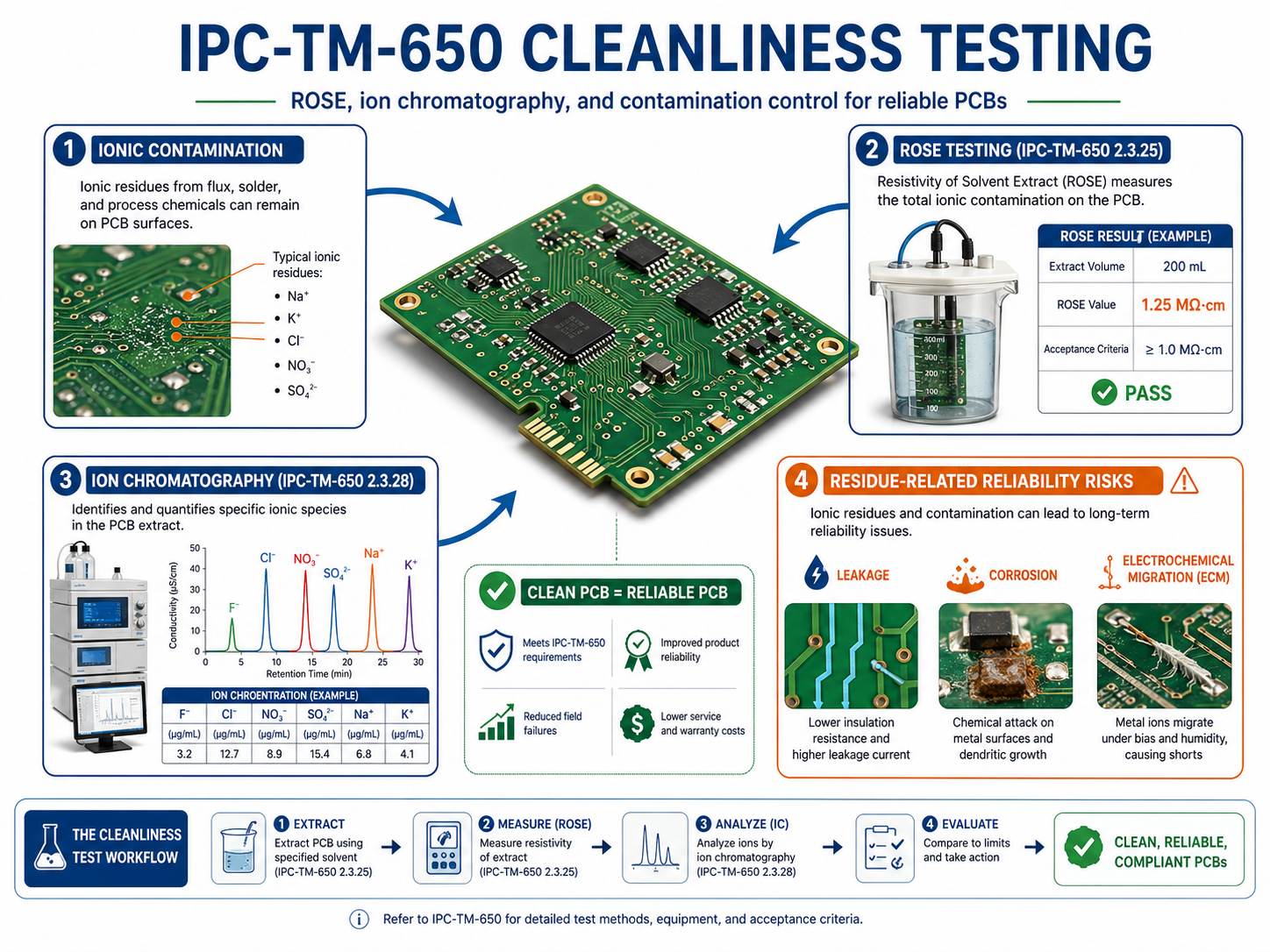
IPC-TM-650 cleanliness testing evaluates contamination, ionic residues, flux residues, process chemicals, and other materials that may remain on a PCB or PCBA surface. In PCB manufacturing, cleanliness is closely linked to insulation resistance, corrosion resistance, electrochemical migration, and field reliability.

Cleanliness is especially important when a board works in:

  • High humidity
  • High voltage
  • High impedance circuits
  • Medical monitoring equipment
  • Automotive control modules
  • Industrial sensors
  • Telecom infrastructure
  • Aerospace or defense electronics

A small amount of ionic residue may not create an immediate failure during final electrical testing. However, when moisture, voltage bias, and time are added, residues can support leakage paths, dendritic growth, corrosion, and unstable electrical behavior.

What Is IPC-TM-650 Cleanliness Testing?

IPC-TM-650 includes methods related to cleanliness and insulation performance, including surface insulation resistance and bare board cleanliness by SIR in the approved environmental test method list.

Cleanliness-Related TestWhat It ChecksBest Used ForPractical Value
ROSE TestOverall ionizable surface contaminationRoutine process controlFast cleanliness screening
Ion ChromatographySpecific ionic species and concentrationFailure analysis and high-reliability projectsFinds contamination source more precisely
SIR TestInsulation behavior under humidity and electrical biasCleanliness validation under stressShows reliability impact of residues
Visual InspectionVisible residue, staining, white marks, process contaminationInitial quality screeningSimple but not enough alone
Process AuditCleaning chemistry, rinse quality, drying, handlingManufacturing controlHelps prevent repeat issues

What Is IPC-TM-650 2.3.25 ROSE Testing for PCB Cleanliness?

IPC-TM-650 2.3.25 ROSE testing is commonly used to evaluate ionizable surface contaminants on PCB or PCBA surfaces. ROSE stands for Resistivity of Solvent Extract. It gives a fast cleanliness indicator, often reported as sodium chloride equivalent per unit area.

ROSE testing is useful because it is fast, repeatable, and suitable for production monitoring. If a PCB factory needs to compare different batches, check a cleaning process, or monitor contamination trends, ROSE can provide a practical baseline.

However, ROSE testing has a limitation. It measures total ionizable contamination, but it does not identify every individual ion. For example, a high ROSE reading may suggest contamination, but it may not tell whether the issue comes from chloride, bromide, weak organic acids, sodium, plating chemistry, flux residue, or handling contamination.

That is why ROSE is often used as a process control tool, while ion chromatography is used when a more detailed contamination profile is needed.

Good use cases for ROSE testing include:

  • Routine PCB cleanliness monitoring
  • PCBA cleaning process validation
  • Supplier quality comparison
  • Batch-to-batch contamination trend review
  • Quick screening before deeper analysis

For high-reliability products, ROSE alone may not be enough. It should be combined with ion chromatography, SIR, process traceability, and application-specific acceptance criteria.

What Is IPC-TM-650 2.3.28 Ion Chromatography Testing?

Ion chromatography is a more detailed cleanliness analysis method because it can identify and quantify specific ionic species. While ROSE gives an overall contamination value, ion chromatography helps show what type of contamination is present.

This matters in real PCB failure analysis. A board may show leakage current, corrosion, or dendritic growth after field use. A general contamination number may confirm that residue exists, but it may not explain the source. Ion chromatography can help identify whether the residue is related to process chemistry, flux activators, handling, water quality, or environmental exposure.

Typical ions that may be evaluated include:

  • Chloride
  • Bromide
  • Sulfate
  • Nitrate
  • Sodium
  • Potassium
  • Weak organic acids
  • Other process-related ionic species

Ion chromatography is especially valuable for medical electronics, automotive electronics, aerospace electronics, high-voltage PCB, and precision sensor circuits. In these products, contamination is not only a cosmetic concern. It can become a long-term electrical reliability risk.

What Is IPC-TM-650 2.6.3.7 Surface Insulation Resistance Testing?

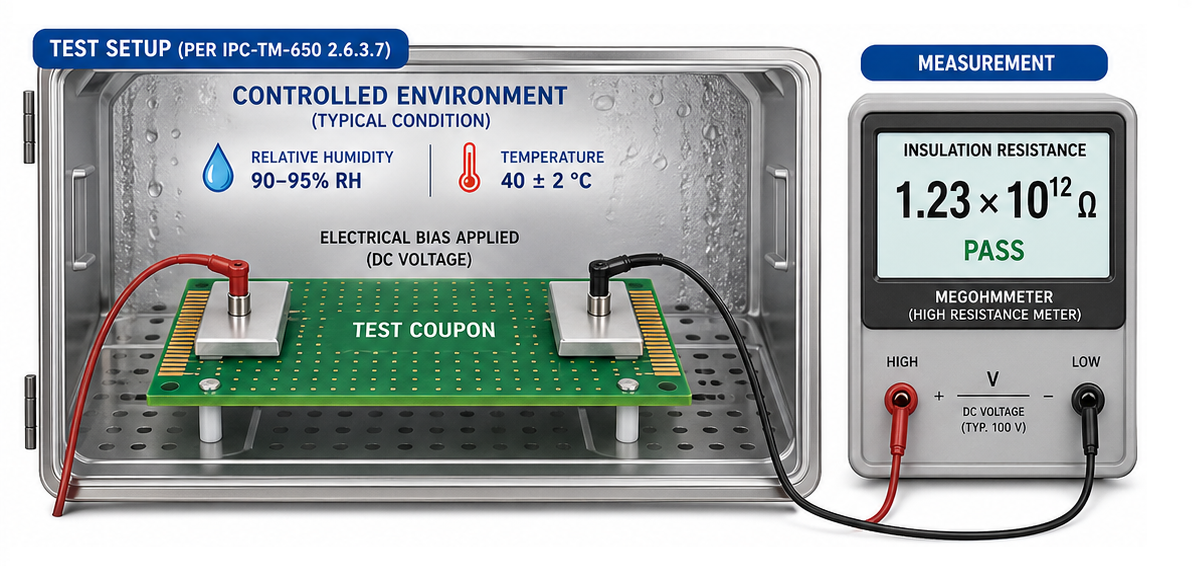
IPC-TM-650 2.6.3.7 surface insulation resistance (SIR) testing evaluates how well a PCB surface maintains electrical insulation under humidity, temperature, and electrical bias.

SIR testing is important because many contamination problems do not appear during normal room-temperature inspection. A board may pass final electrical testing immediately after production. But after exposure to moisture and voltage bias, residues may become conductive enough to reduce insulation resistance.

The official IPC TM-650 method list includes TM 2.6.3.7 as “Surface Insulation Resistance.”

IPC-TM-650 2.6.3.7 Surface Insulation Resistance Testing

In practical PCB production, SIR testing can help evaluate:

  • Whether a cleaning process is reliable
  • Whether solder mask materials maintain insulation under humidity
  • Whether residues create leakage paths
  • Whether no-clean flux residues are acceptable for the application
  • Whether high-impedance circuits will remain stable over time
  • Whether bare boards or assemblies are suitable for harsh environments

SIR should be considered when a PCB uses dense spacing, fine-pitch components, high voltage, no-clean processes, or sensitive analog circuits. It is also useful when qualifying a new solder mask, flux, cleaning process, or assembly supplier.

What Is IPC-TM-650 Bow and Twist Testing?

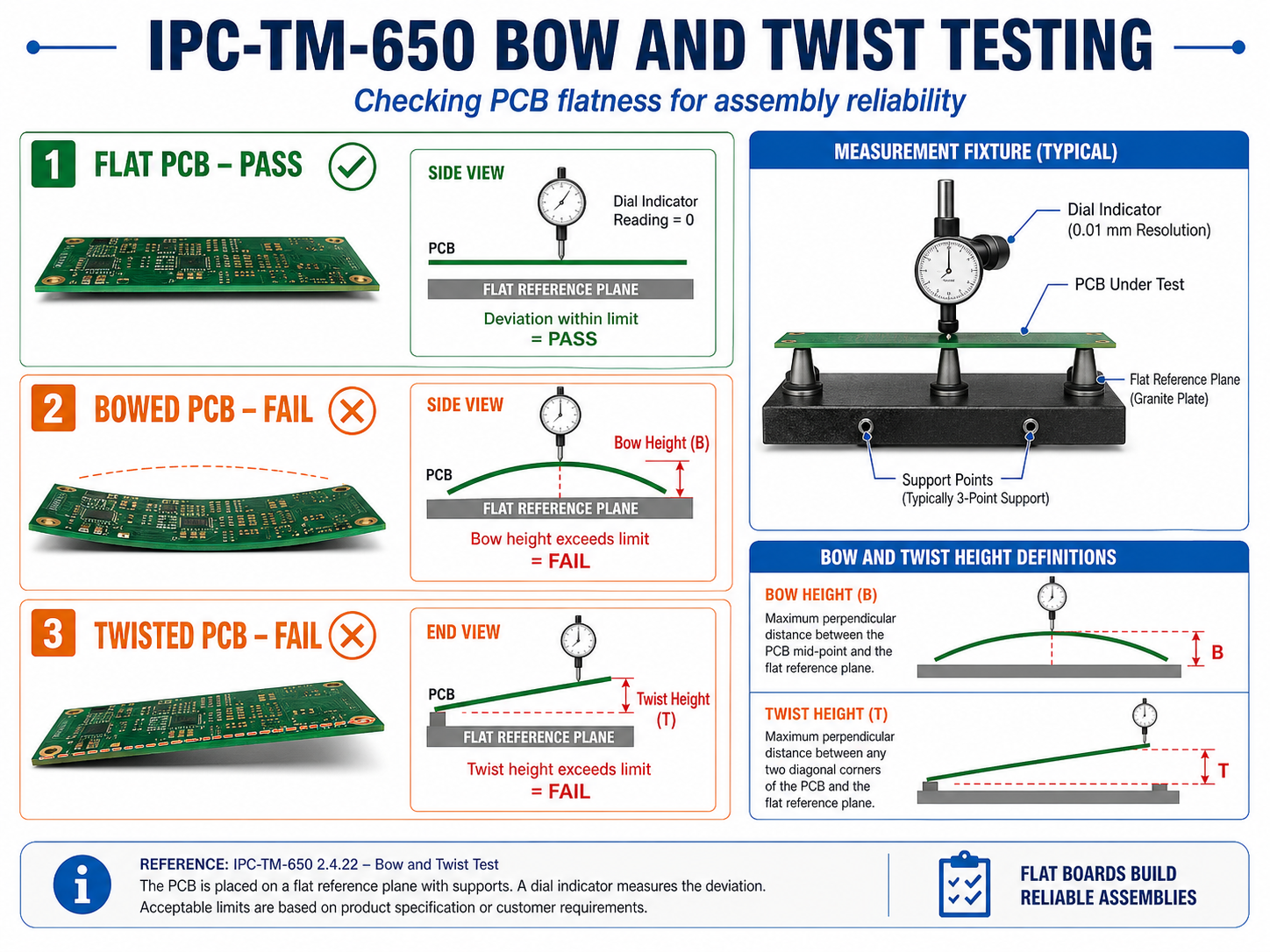
IPC-TM-650 bow and twist testing is used to evaluate PCB flatness. Bow refers to a board bending in a smooth curved shape, while twist refers to diagonal warpage where the corners are not on the same plane.

Flatness IssueWhat It Looks LikeMain Assembly RiskCommon Design or Process Cause
BowBoard bends like a shallow arcUneven solder paste transfer, placement offsetThin board, large panel, unbalanced copper
TwistBoard corners lift diagonallyConnector misalignment, BGA open jointsAsymmetric stack-up, laminate stress
Local WarpageOne area lifts or deformsFine-pitch soldering defectLocal copper imbalance or heat concentration
Panel WarpageFull production panel bendsRouting, depaneling, and handling issuesPanel size, material stress, thermal exposure

Bow and twist control is especially important for:

  • Thin PCB
  • Large-size PCB
  • HDI board
  • BGA assembly
  • Fine-pitch QFN and LGA packages
  • Press-fit connector boards
  • Automotive control boards
  • LED panels
  • Rigid-flex boards
  • Boards with uneven copper distribution
IPC-TM-650 Bow and Twist Testing

How Does Bow and Twist Affect PCB Assembly Reliability?

Excessive bow and twist can reduce assembly yield and long-term solder joint reliability. A PCB may still pass bare board electrical testing, but poor flatness can create serious problems during SMT assembly.

During solder paste printing, a warped board may not contact the stencil evenly. This can create insufficient solder paste in some areas and excess paste in others. During placement, small chip components may sit at different heights. During reflow, BGA or QFN packages may not maintain uniform contact with solder deposits.

The risks become more serious as component pitch becomes smaller. Common reliability problems caused by poor flatness include:

  • Open solder joints
  • Insufficient solder fillet
  • BGA non-wet open defects
  • Connector seating failure
  • Uneven mechanical stress after assembly
  • Housing fit problems
  • Local solder cracking during field vibration
  • Lower first-pass assembly yield

What Are IPC-TM-650 Testing Methods for Solder Mask?

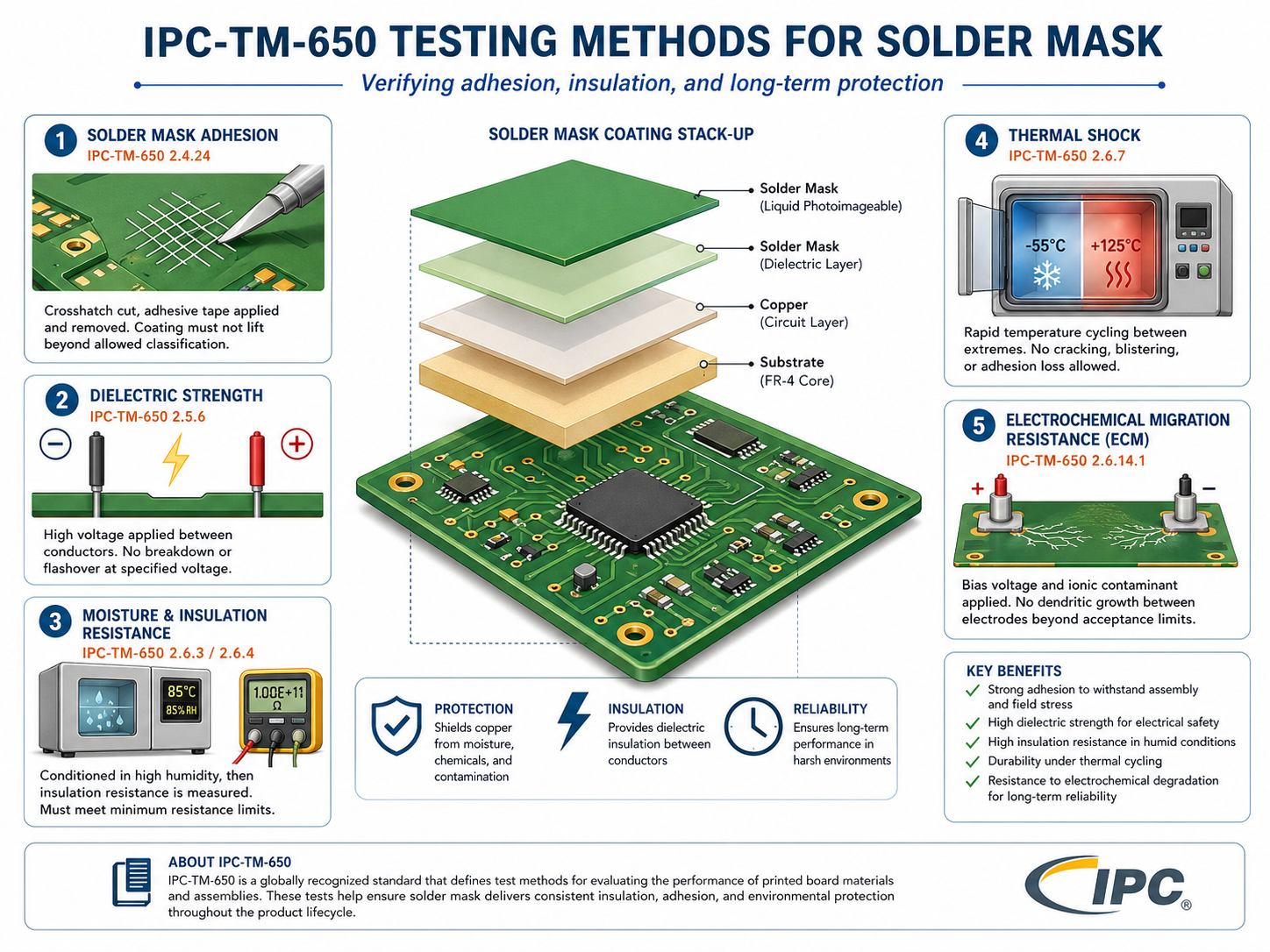
IPC-TM-650 testing methods for solder mask help evaluate whether the solder mask can protect copper, maintain insulation, resist humidity, withstand thermal stress, and support long-term PCB reliability.

Solder mask is more than the green, blue, black, white, or red coating seen on a finished PCB. It protects copper traces, defines solderable areas, reduces solder bridging, and supports electrical insulation between conductors.

Poor solder mask performance can cause:

  • Solder bridging
  • Copper exposure
  • Mask peeling
  • Blistering
  • Cracking after reflow
  • Chemical attack from cleaning agents
  • Leakage under humidity
  • Electrochemical migration risk

The IPC TM-650 method list includes solder-mask-related methods such as solder mask dielectric strength, solder mask moisture and insulation resistance, solder mask thermal shock, solder mask hydrolytic stability, and solder mask resistance to electrochemical migration.

What Are IPC-TM-650 Testing Methods for Solder Mask?

How Is IPC-TM-650 Different from IPC-A-600, IPC-6012, and IPC-A-610?

IPC-TM-650 explains how to test, while other IPC documents often define what is acceptable. This difference is important because many buyers ask for “IPC standard” without knowing which document applies to the problem.

DocumentMain PurposeSimple ExplanationCommon Use
IPC-TM-650Test methods manualExplains how to perform testsCleanliness, SIR, bow and twist, solder mask tests
IPC-A-600Acceptability of printed boardsShows acceptable and non-acceptable bare board conditionsVisual inspection of bare PCBs
IPC-6012Performance specification for rigid PCBsDefines rigid PCB performance requirementsRigid board procurement and quality control
IPC-A-610Acceptability of electronic assembliesDefines PCBA workmanship acceptanceSMT assembly and solder joint inspection
Customer SpecificationProject-specific acceptance requirementDefines what the customer expectsSpecial reliability, materials, and reporting needs

Which IPC-TM-650 Test Methods Should You Choose for Your PCB Project?

The right IPC-TM-650 test depends on the product application, failure risk, PCB structure, operating environment, and customer requirement. A simple consumer board does not always need the same test plan as a medical, automotive, aerospace, or power electronics PCB.

The goal is not to order every possible test. The goal is to choose the tests that reduce the most relevant risk.

PCB Project TypeRecommended IPC-TM-650 Related Tests
HDI PCBMicrosectioning, CAF, SIR, thermal stress
Automotive PCBBow and twist, CAF, thermal cycling, SIR
Medical PCBCleanliness, ion chromatography, SIR, traceability report
RF PCBDk/Df, signal loss, dimensional stability
Power PCBDielectric strength, thermal stress, CAF, solder mask insulation
Rigid-Flex PCBPeel strength, bend reliability, microsectioning
Fine-Pitch SMT PCBBow and twist, solder mask registration, cleanliness
Solder Mask Critical PCBSolder mask dielectric strength, moisture resistance, thermal shock

For early-stage prototypes, microsectioning and basic dimensional checks may be enough. For mass production, the test plan should be more structured.

How Should You Read an IPC-TM-650 Test Report?

A useful IPC-TM-650 test report should show more than a pass/fail result. It should tell the reader which method was used, how the sample was prepared, what condition was applied, what result was measured, and how that result connects to the project requirement.

A weak report says, “Passed.” While a strong report explains the evidence.

When reviewing an IPC-TM-650 test report, check the following items:

  • Test method number
  • Test method revision
  • Sample name and part number
  • Production lot number
  • Material type and stack-up
  • Surface finish
  • Sample quantity
  • Test condition
  • Test duration
  • Equipment used
  • Calibration status
  • Measurement result
  • Acceptance criteria source
  • Photos, charts, or microsection images
  • Technician or engineer review
  • Final conclusion
  • Traceability information

For high-value PCB projects, test reports should be stored as part of the quality record. They may become important during customer audits, field failure review, design changes, and supplier qualification.

How to Choose a PCB Manufacturer with IPC-TM-650 Testing Capability?

A capable PCB manufacturer should understand IPC-TM-650 as a practical quality tool, not just a document name. The supplier should know which test applies, when it should be used, what result format is expected, and how the result affects manufacturing decisions.

When selecting a PCB supplier, ask specific questions. Do not only ask, “Can you make IPC-quality boards?”

Ask:

  • Can you provide IPC-TM-650 cleanliness testing support?
  • Can you measure bow and twist for thin or large-size boards?
  • Can you support solder-mask-related reliability testing when needed?
  • Can you provide microsection images for plated holes and microvias?
  • Can you support SIR or CAF testing for high-reliability products?
  • Can you link test results to production lots and material batches?
  • Can your engineering team review stack-up, copper balance, and process risks before production?
  • Can you explain whether a test result meets our project-specific requirement?

A strong supplier will not recommend unnecessary testing just to increase cost. Instead, the supplier should help match the test plan to the project risk.

For example, a simple 2-layer prototype may need only basic electrical test and visual inspection. A 12-layer automotive control board may need microsectioning, thermal stress, CAF review, cleanliness control, and bow and twist monitoring. A medical sensing PCB may require cleanliness testing, SIR validation, and strict traceability.

Testing capability is part of reliability. Engineering judgment is the other part.

FAQs About IPC-TM-650 Test Methods

1. What is the IPC-TM-650 test methods manual?

IPC-TM-650 test methods manual is a collection of standardized testing procedures for printed circuit boards, materials, assemblies, and connectors. It covers visual, dimensional, chemical, mechanical, electrical, environmental, and connector-related testing. It helps PCB manufacturers and customers evaluate quality using consistent methods.

2. Is IPC-TM-650 the same as IPC-A-600?

No. IPC-TM-650 explains how to perform PCB-related tests. IPC-A-600 focuses on the acceptability of printed boards. In simple words, IPC-TM-650 is about testing procedures, while IPC-A-600 is about inspection and acceptance of bare PCB conditions.

3. When should I request IPC-TM-650 testing from a PCB supplier?

You should request IPC-TM-650 testing when your PCB has reliability-sensitive requirements, such as high voltage, fine spacing, high impedance, medical use, automotive use, harsh environment exposure, strict cleanliness needs, or complex multilayer construction. It is also useful during supplier qualification and failure analysis.

4. Does every PCB project need IPC-TM-650 testing?

Not every PCB project needs the full range of IPC-TM-650 testing. A simple prototype may only need basic inspection and electrical test. High-reliability boards, dense HDI boards, medical electronics, automotive electronics, power boards, and RF boards often need a more complete test plan.

You may also like