Aluminum nitride is a ceramic material used when an electronic design needs fast heat transfer and electrical insulation in the same structure. Its chemical formula is AlN, and in PCB-related applications it is most often discussed as an aluminum nitride substrate, AlN ceramic substrate, or high thermal conductivity PCB substrate for power electronics, LEDs, RF modules, and other heat-sensitive assemblies.
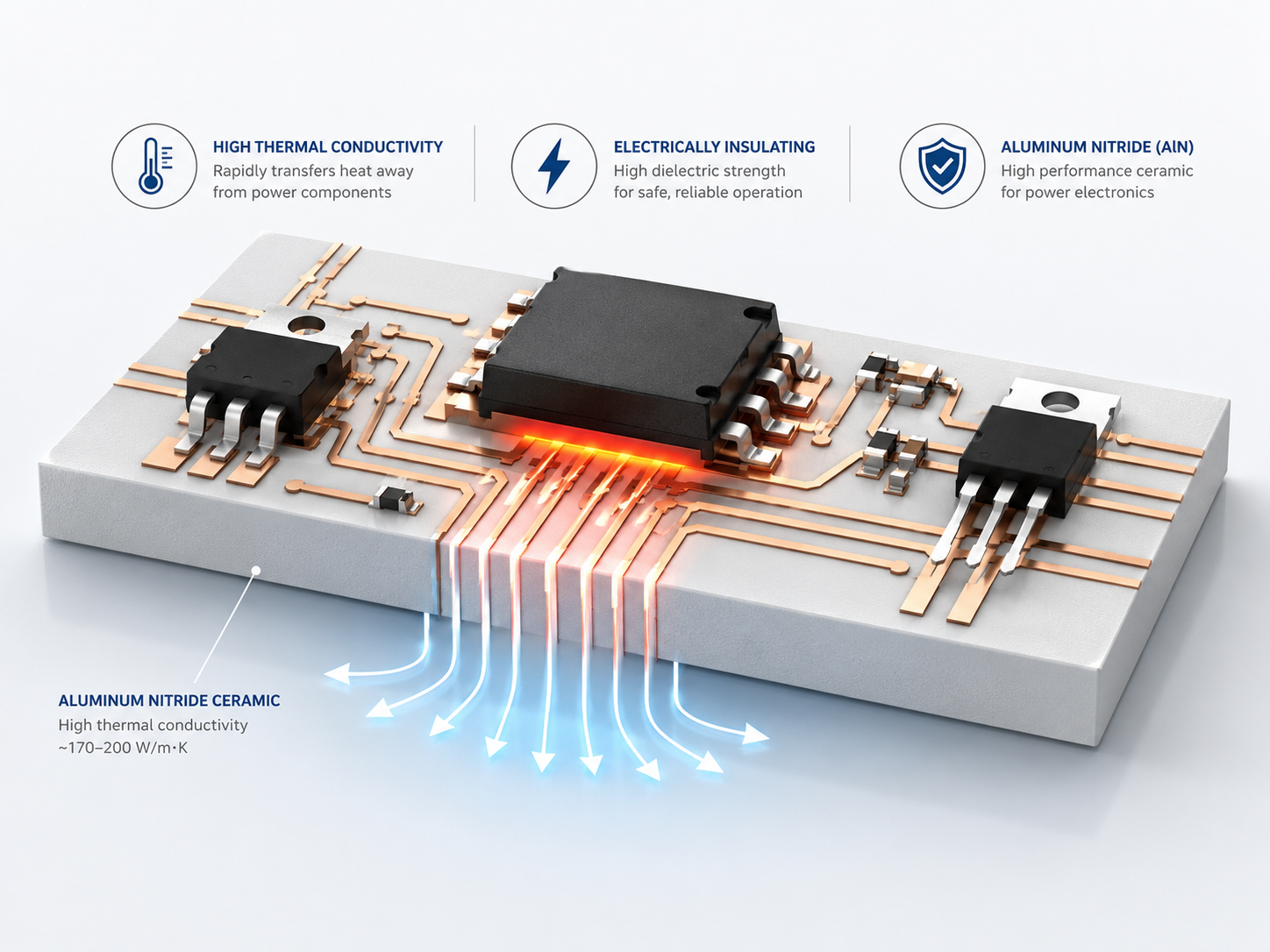
Aluminum nitride (AlN) is a ceramic material valued in electronics because it combines high thermal conductivity with electrical insulation. For high-power LEDs, RF modules, IGBT packages, laser diodes, and ceramic PCB substrates, AlN helps move heat away from components while keeping circuits electrically isolated.
What Is Aluminum Nitride?
Aluminum nitride, often written as AlN aluminum nitride, is an advanced ceramic material made from aluminum and nitrogen. In electronics, its main value is simple: it can conduct heat much better than many common insulating materials while still acting as an electrical insulator.
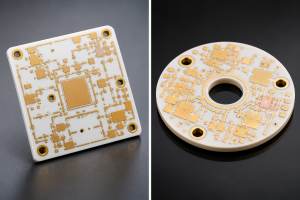
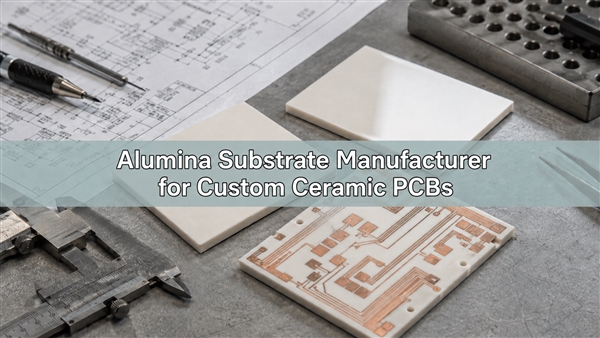
This combination makes aluminum nitride ceramic useful for substrates, carriers, heat spreaders, and electronic packages. In PCB manufacturing discussions, an aluminum nitride PCB usually means a ceramic PCB substrate or metallized AlN substrate, not a standard FR4 board.
What Is the Chemical Formula for Aluminum Nitride?
The chemical formula of aluminum nitride is AlN. This is also the most common abbreviation used in drawings, material datasheets, engineering notes, and RFQs.
| Term | Meaning | Practical Note |
|---|---|---|
| Aluminum nitride | Full material name | Used in articles, datasheets, and material selection discussions |
| AlN | Chemical formula and abbreviation | Used in drawings, RFQs, and technical specifications |
| Aluminum nitride ceramic | Dense ceramic form of AlN | Used for substrates, insulating plates, and thermal parts |
| Aluminum nitride substrate | AlN ceramic base for circuits or packages | Used in power, LED, RF, laser, and high-reliability electronics |
If a drawing only says “AlN,” confirm whether the customer needs bare ceramic, metallized ceramic, DBC aluminum nitride substrate, AMB aluminum nitride substrate, or a finished ceramic PCB substrate.
Why Aluminum Nitride Matters in PCB and Power Electronics?
Aluminum nitride matters when the thermal path is the limiting factor in an electronic product. A component may be electrically correct but still fail early if heat stays near the junction, solder joint, or package interface.
An AlN substrate helps when a design needs:
- Heat transfer from a small, high-power component area
- Electrical insulation between copper circuits and the mounting structure
- Better thermal performance than alumina ceramic
- More stable ceramic behavior than organic PCB materials
- A compact layout where adding more board area is not possible
- Support for copper metallization in power electronic structures
For EBest Circuit (Best Technology), this type of material discussion usually appears during early project review. Before quoting, the engineering team needs to understand whether the customer is solving a real heat problem or simply requesting AlN because it sounds like the highest-performance option.
Key Aluminum Nitride Properties
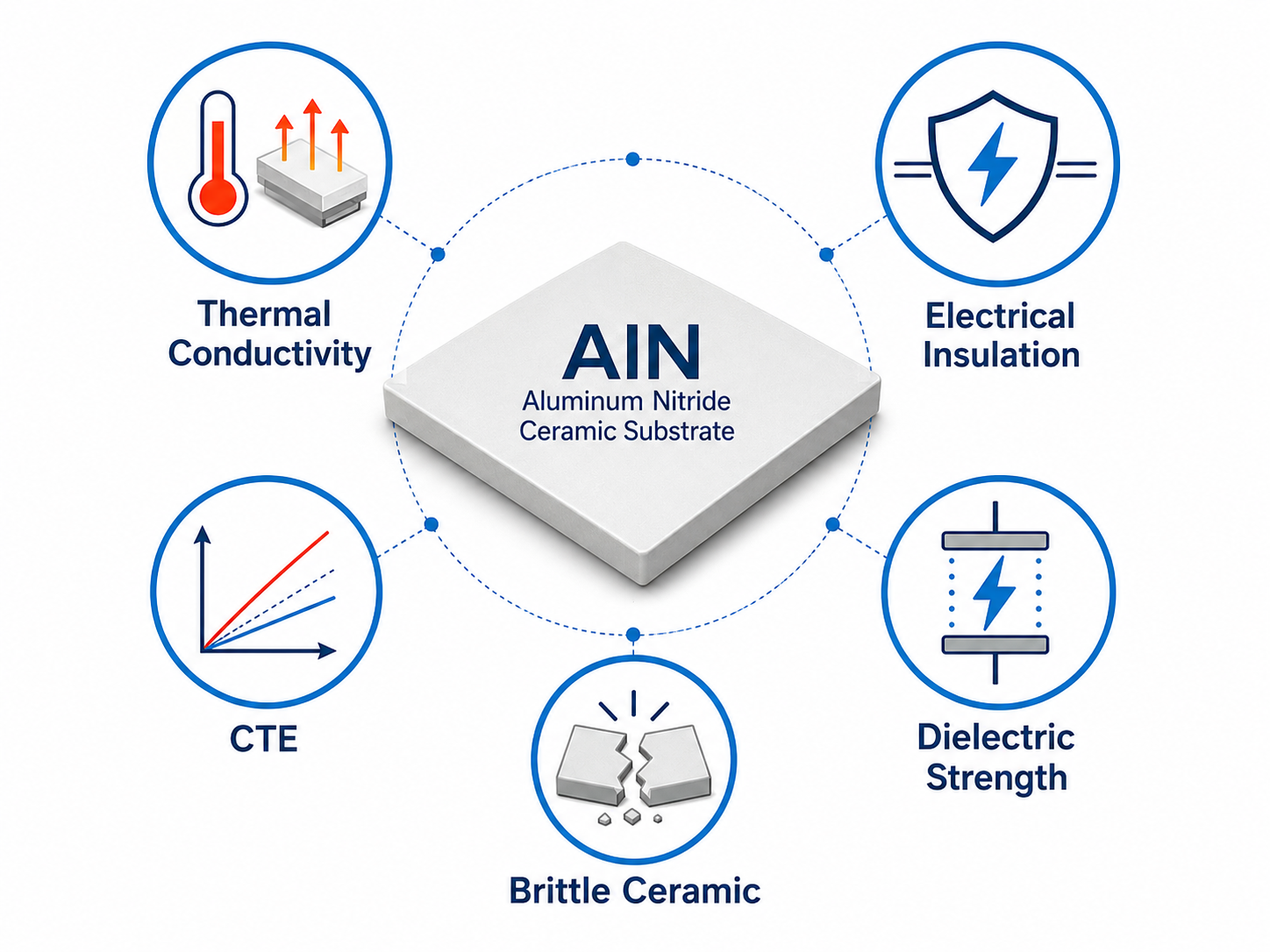
For electronics buyers, the most important aluminum nitride material properties are thermal conductivity, insulation behavior, expansion match, ceramic strength, and process sensitivity. The table below gives the practical meaning behind each property.
| Property | Typical Meaning for Electronics | Buyer Note |
|---|---|---|
| Thermal conductivity | Moves heat away from components faster than FR4 and commonly faster than alumina | Ask for the actual supplier grade and test value, not only a general material claim |
| Electrical insulation | Allows heat transfer while keeping circuits isolated | Important for power modules, RF circuits, LEDs, and high-voltage layouts |
| CTE | Affects stress between ceramic, copper, solder, and components during heating and cooling | Review thermal cycling risk when copper area is large or temperature swing is high |
| Dielectric strength | Indicates how well the substrate resists voltage breakdown | Provide operating voltage, isolation distance, and safety margin requirements |
| Mechanical brittleness | Ceramic can chip or crack under point load, bending, or rough handling | Avoid sharp stress points and confirm packaging for shipment and assembly |
| Moisture/hydrolysis sensitivity | AlN powder is moisture-sensitive; finished dense ceramic is more stable but still needs proper process control | Confirm cleaning, storage, and handling requirements for finished substrates |
For purchasing decisions, aluminum nitride thermal conductivity should be treated as a design input, not a marketing number. A higher grade may cost more, but it may not improve the final product if the heat bottleneck is solder, copper layout, interface material, or heat sink design.
Aluminum Nitride vs Alumina, BeO, Silicon Nitride, and FR4
The decision logic is straightforward: choose the material that meets the thermal, insulation, mechanical, cost, and reliability requirements without overengineering the product. AlN is strong for thermal performance, but it is not always the lowest-risk or lowest-cost option.
| Material | Thermal Conductivity | Electrical Insulation | Cost | Best Use |
|---|---|---|---|---|
| Aluminum nitride | High compared with alumina and FR4 | Yes | Higher | High-power LED, RF, laser diode, power module, and high thermal conductivity PCB substrate applications |
| Alumina | Moderate | Yes | Lower than AlN | Cost-sensitive ceramic circuits and moderate thermal applications |
| BeO | High | Yes | Specialized | High thermal applications where safety handling and compliance are properly controlled |
| Silicon nitride | Good, with strong mechanical reliability | Yes | Usually higher than standard alumina | Power modules needing strong mechanical toughness and thermal cycling reliability |
| FR4 | Low compared with ceramic materials | Yes | Low | Standard PCB applications with low or moderate heat density |
The practical takeaway: use aluminum nitride vs alumina analysis when heat is the key issue; use silicon nitride when mechanical cycling is the bigger concern; avoid FR4 for high heat flux designs unless the thermal path is handled elsewhere.
Common Applications of Aluminum Nitride Substrates
Aluminum nitride substrates are most useful in products where the circuit area is small, the power density is high, and electrical isolation is required. They are common in technical markets where heat directly affects performance or lifetime.
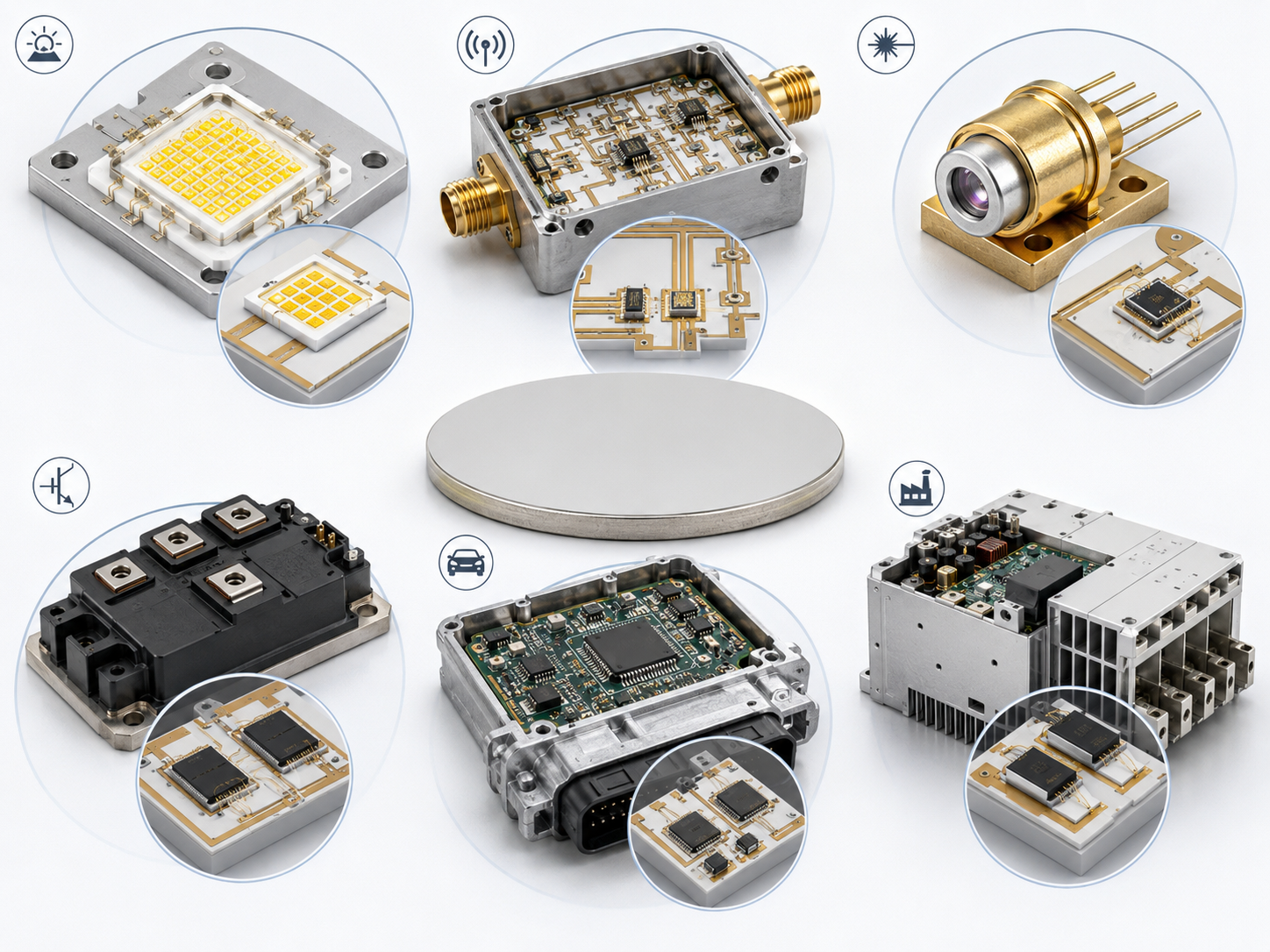
Common applications include:
- High-power LED modules
- Laser diode submounts
- RF and microwave circuits
- Power modules
- IGBT and MOSFET packages
- Automotive electronics
- Medical power devices
- Industrial power devices
- Semiconductor equipment components
- Compact aerospace-related electronic modules
For these applications, buyers should provide the operating power, thermal path, mounting method, and expected working environment. Without that information, it is difficult to judge whether AlN is necessary or whether alumina, metal core PCB, or another structure is more practical.
What Is Aluminum Nitride Used For?
Aluminum nitride is used for ceramic substrates, heat-spreading parts, electrically insulating thermal carriers, semiconductor equipment parts, LED packages, RF packages, laser submounts, and power electronic modules.
In PCB and PCBA projects, aluminum nitride is usually selected when the customer needs a substrate that can carry a circuit pattern and remove heat at the same time. This is different from using a simple heat sink. The substrate itself becomes part of the thermal and electrical design.
A typical use case is a high-power LED or power semiconductor module where heat must move from the component into copper, then through the AlN ceramic, and then into a baseplate or heat sink. If any part of that path is poorly designed, the benefit of using an AlN ceramic substrate will be reduced.
Can Aluminum Nitride Be Used in Aerospace?
Yes, aluminum nitride can be used in aerospace electronics, especially in RF modules, power converters, radar-related circuits, sensors, laser systems, and compact high-power packages where heat dissipation and insulation are required.
Aerospace use needs stricter review than ordinary industrial electronics. Before choosing AlN, engineers should confirm:
- Thermal cycling conditions
- Vibration and shock requirements
- Metallization adhesion
- Solder joint reliability
- Mechanical mounting stress
- Outgassing or cleanliness requirements
- Traceability and documentation needs
- Final system qualification requirements
Aluminum nitride can be a good aerospace material choice, but the finished substrate must match the full operating environment. Material selection alone does not guarantee aerospace suitability.
When Should You Choose an AlN PCB Substrate?
Choose an AlN PCB substrate when the product has a real thermal bottleneck and still needs electrical insulation. If the heat can be managed with FR4 plus heat sink, metal core PCB, or alumina, AlN may add cost without enough benefit.
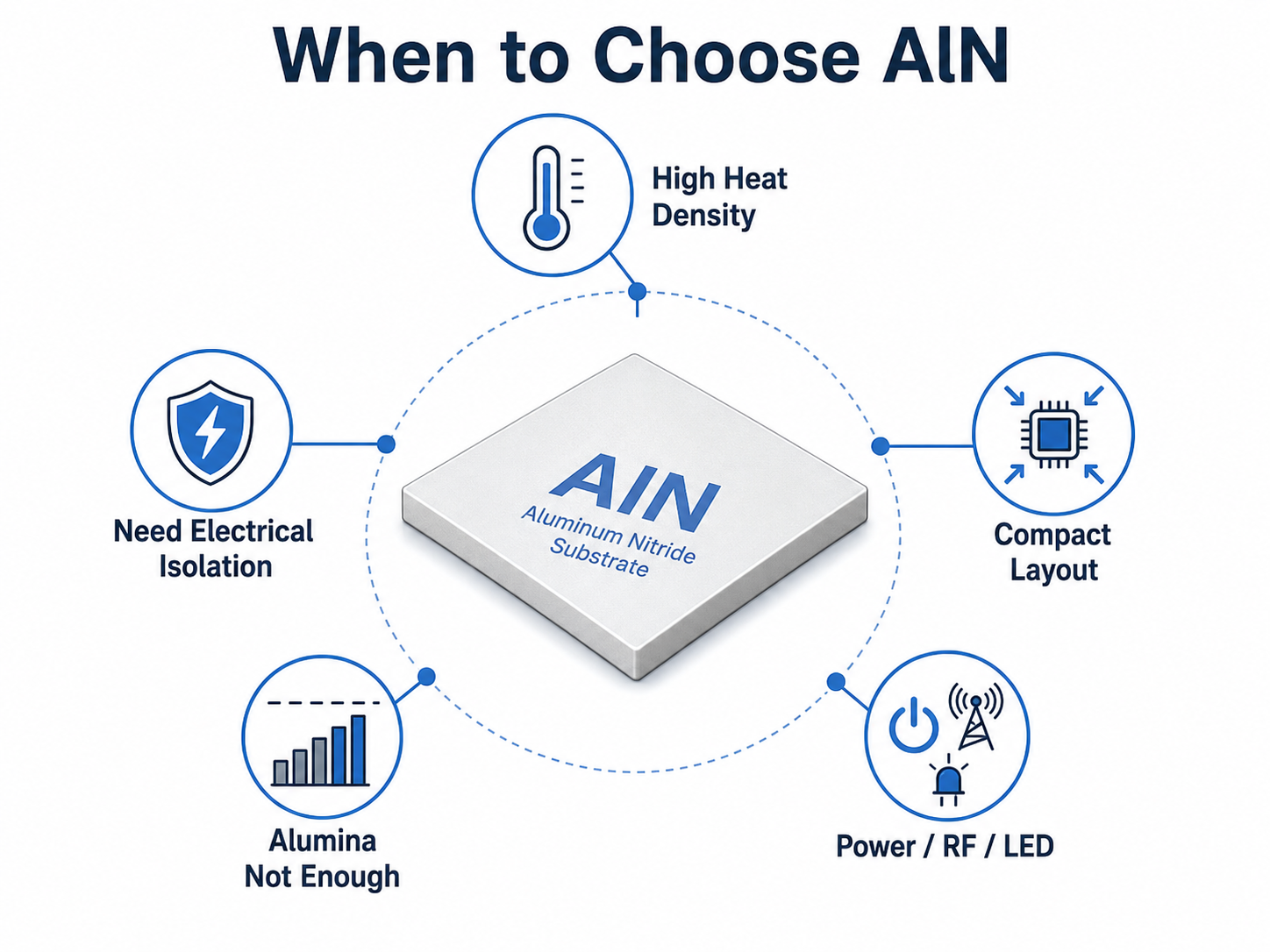
An AlN ceramic substrate is usually worth evaluating when:
- The component generates high heat in a small area
- The product needs high-voltage isolation
- Alumina does not provide enough heat transfer
- Metal core PCB cannot meet the insulation or structure requirement
- The design needs stable ceramic behavior under temperature stress
- The product uses LEDs, RF devices, laser diodes, IGBTs, MOSFETs, or power modules
- The available board area is limited and thermal density is high
At EBest Circuit (Best Technology), a practical review would start with the drawing, heat source location, copper area, substrate thickness, voltage requirement, and assembly method. This helps decide whether AlN is the right choice before the customer spends money on prototypes.
Design and Manufacturing Considerations
Aluminum nitride substrate design must consider ceramic behavior, copper structure, metallization, machining, and assembly reliability together. The most common mistake is treating AlN like a normal PCB material.
Key design and manufacturing factors include:
- Copper thickness for current carrying and heat spreading
- DBC aluminum nitride substrate or AMB aluminum nitride substrate selection
- Thick film or thin film metallization requirements
- Hole machining, edge cutting, and ceramic chipping risk
- Surface flatness and warpage control
- Dimensional tolerance and pattern registration
- Soldering reliability and copper adhesion
- Thermal cycling test requirements
- Packaging protection for shipment and assembly
For prototypes, customers should not only send a Gerber file. A usable review usually needs mechanical drawings, copper thickness, substrate thickness, operating temperature, assembly process, and expected test conditions.
Common Problems and How to Avoid Them
Most aluminum nitride substrate problems come from unclear specifications, over-specification, or mechanical stress that was not considered during design. These issues are easier to prevent before production than to fix after assembly.
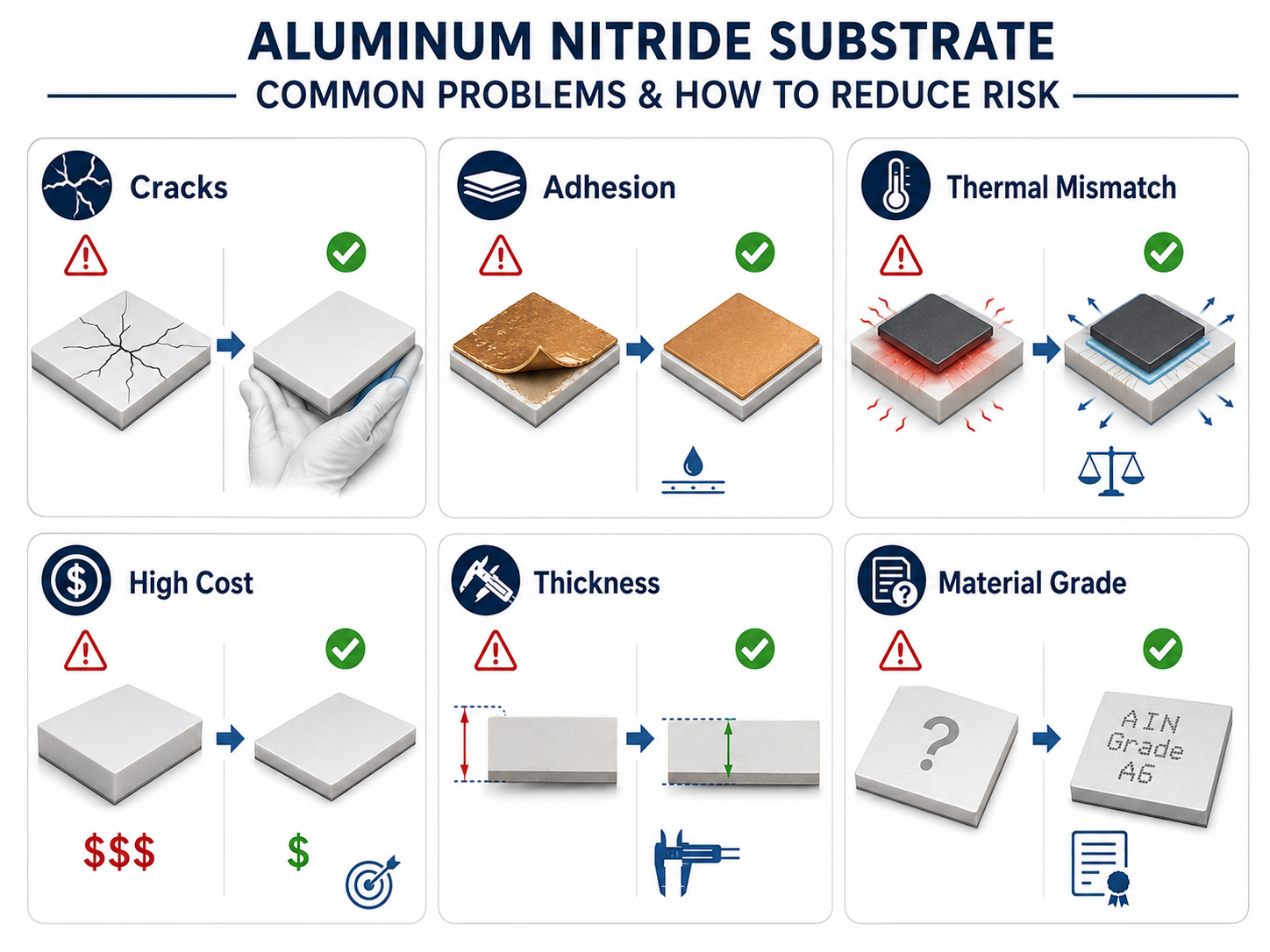
| Problem | Common Cause | How to Reduce the Risk |
|---|---|---|
| Cracks | Ceramic stress, rough handling, sharp corners, poor mounting support | Use suitable edge design, packaging, mounting pressure, and handling control |
| Poor metallization adhesion | Process mismatch or unsuitable copper structure | Confirm metallization method, copper thickness, and reliability test needs |
| Thermal mismatch | Different expansion behavior between ceramic, copper, solder, and components | Review copper balance, solder area, thermal cycling, and mounting structure |
| High cost from over-specification | Requesting the highest AlN grade without system-level need | Match material grade to the real heat path and product risk |
| Wrong substrate thickness | Choosing thickness without balancing heat transfer and mechanical strength | Review thermal target, handling risk, and assembly method together |
| Unclear thermal conductivity grade | RFQ only says “AlN” without grade or datasheet target | Specify expected grade or ask the supplier to recommend options with trade-offs |
A strong supplier review should identify these risks before quotation, especially for new designs, small prototypes, and high-power modules with large copper areas.
How to Specify Aluminum Nitride Substrates When Sending an RFQ?
A clear RFQ helps the supplier quote the correct aluminum nitride substrate and avoid assumptions that later cause delays, redesign, or cost changes. The RFQ should describe the product, not only the material.
Include these details:
- Substrate dimensions
- Substrate thickness
- Aluminum nitride thermal conductivity grade or expected datasheet target
- Copper thickness
- Circuit pattern or drawing
- Surface finish
- Tolerance requirements
- Quantity for prototype and mass production
- Application temperature
- Operating voltage and current
- Heat source location or power density
- Assembly and soldering process
- Mounting method
- Test requirements
- Drawing files and Gerber files if available
For EBest Circuit (Best Technology), this information supports faster engineering communication and more accurate quotation. It also helps the team advise whether an aluminum nitride substrate, alumina substrate, metal core PCB, or another PCB/PCBA solution is the most practical route.
FAQ
Is aluminum nitride electrically conductive?
No, aluminum nitride is generally used as an electrically insulating ceramic. Its value in electronics is that it can transfer heat while helping keep circuits electrically isolated.
Is aluminum nitride better than alumina?
Aluminum nitride is better than alumina when thermal conductivity is the main design requirement. Alumina is usually more cost-effective for moderate thermal loads, so the better choice depends on heat density, voltage isolation, reliability needs, and budget.
What is aluminum nitride used for?
Aluminum nitride is used for ceramic substrates, LED modules, laser diode submounts, RF and microwave circuits, power modules, semiconductor equipment parts, automotive electronics, medical devices, and industrial power electronics.
Is AlN suitable for PCB substrates?
Yes, AlN is suitable for ceramic PCB substrate applications where high thermal conductivity and electrical insulation are required. It is most useful in high-power or compact electronics, not ordinary low-cost PCB assemblies.
Why is AlN expensive?
AlN is expensive because ceramic powder processing, sintering, metallization, machining, copper bonding, inspection, and yield control are more demanding than standard FR4 PCB manufacturing or many alumina ceramic products.
Can aluminum nitride replace FR4?
Aluminum nitride can replace FR4 only in special applications where ceramic thermal performance is needed. It is not a direct general replacement because the cost, brittleness, manufacturing process, and design rules are very different.
What is the thermal conductivity of aluminum nitride?
Aluminum nitride thermal conductivity depends on the material grade and manufacturing process. Dense AlN ceramic substrates are selected because their thermal conductivity is much higher than FR4 and commonly higher than alumina.
What is the chemical formula of aluminum nitride?
The chemical formula of aluminum nitride is AlN. This abbreviation is widely used in drawings, RFQs, material specifications, and engineering discussions.
What is an aluminum nitride substrate?
An aluminum nitride substrate is a ceramic base used to support circuits, power devices, or electronic packages. It provides heat dissipation, electrical insulation, and mechanical support.
What is the difference between DBC aluminum nitride substrate and AMB aluminum nitride substrate?
DBC aluminum nitride substrate uses a direct bonding process to bond copper to ceramic. AMB aluminum nitride substrate uses active metal brazing. The right choice depends on copper thickness, thermal cycling reliability, current load, cost, and product application.
Can aluminum nitride be used in aerospace?
Yes, aluminum nitride can be used in aerospace electronics when the design needs heat dissipation, electrical insulation, and ceramic stability. The final substrate must still meet the project’s vibration, thermal cycling, mounting, documentation, and qualification requirements.
What should buyers provide before ordering AlN ceramic substrates?
Buyers should provide drawings, dimensions, substrate thickness, copper thickness, metallization requirements, surface finish, tolerance, quantity, working temperature, voltage/current conditions, thermal load, and test requirements.
Aluminum nitride is a strong choice when heat transfer and electrical insulation must work together in a compact electronic design. It is most useful for high-power LEDs, RF circuits, laser modules, power devices, automotive electronics, aerospace-related electronics, and industrial power modules. It is not necessary for every PCB project, so the best purchasing decision starts with thermal load, insulation need, mechanical risk, and cost target.
For aluminum nitride ceramic substrates, PCB/PCBA prototypes, OEM/ODM manufacturing, or engineering review before quotation, contact EBest Circuit (Best Technology) at sales@bestpcbs.com.