What Is 550mm to Inches?
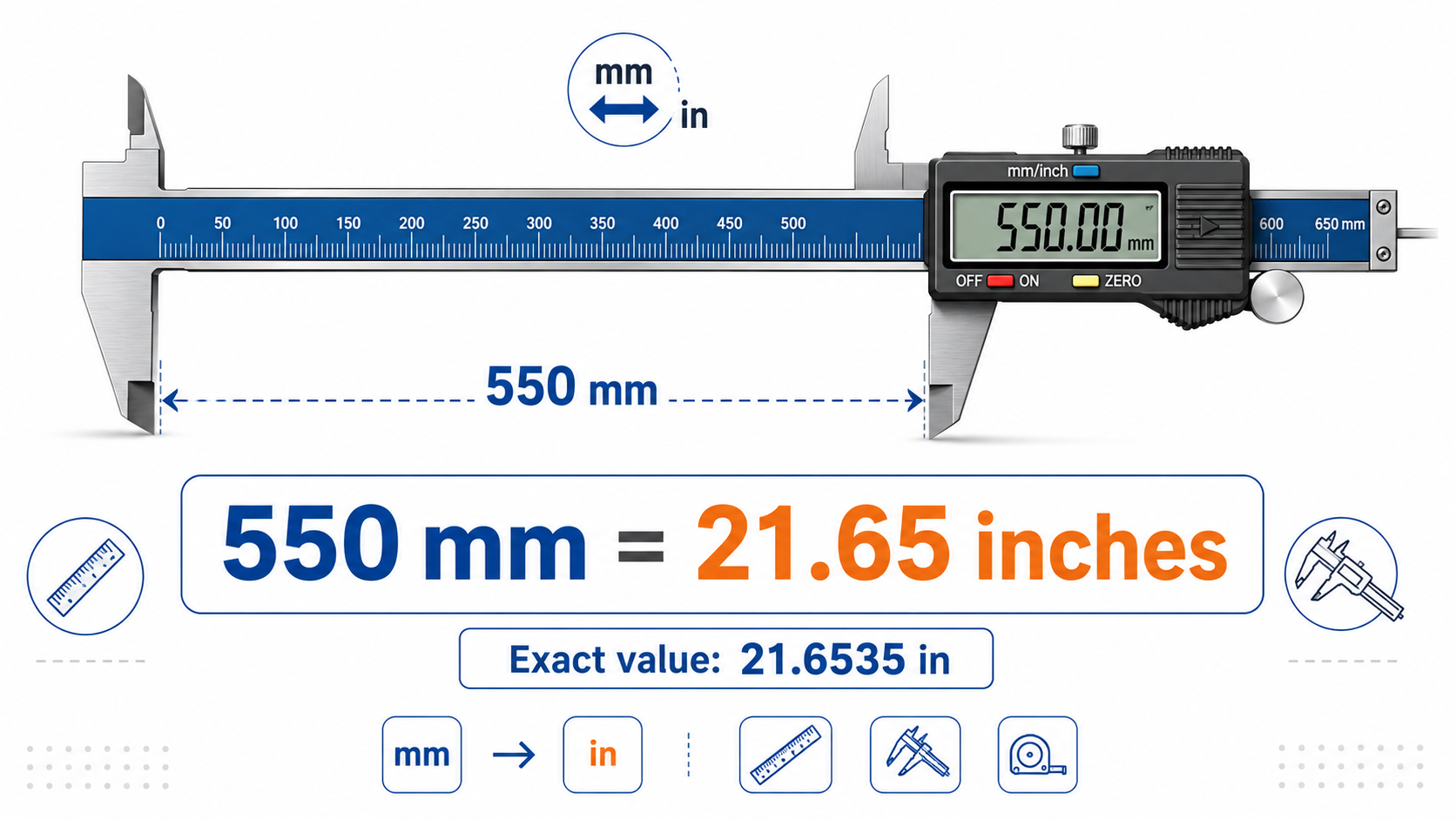
550mm to inches equals 21.6535 inches. If you need a clean rounded value, 550mm is usually written as 21.65 inches. For casual product descriptions, it can also be written as about 21.7 inches. However, for engineering drawings, PCB panel dimensions, mechanical parts, fixtures, and assembly work, it is better to keep the exact millimeter value or use the more accurate inch conversion.
The calculation is simple:
550 ÷ 25.4 = 21.6535 inches
This is because 1 inch equals exactly 25.4 millimeters. So, when you convert millimeters to inches, you divide the millimeter value by 25.4.
What Is 1 Inch Equal to in mm?
1 inch is equal to exactly 25.4mm. This is the standard conversion factor used for all inch-to-millimeter and millimeter-to-inch calculations. So, when you want to convert inches to millimeters, you multiply the inch value by 25.4. When you want to convert millimeters to inches, you divide the millimeter value by 25.4.
For example:
| Inches | Millimeters |
|---|---|
| 1 inch | 25.4mm |
| 2 inches | 50.8mm |
| 5 inches | 127mm |
| 10 inches | 254mm |
| 21.65 inches | About 550mm |
In PCB drawings, mechanical parts, enclosure design, and product specifications, this conversion factor is very important. A small rounding mistake can affect size matching, assembly clearance, fixture design, and packaging accuracy.
What Is the Formula to Convert 550mm to Inches?
The formula is: inches = millimeters ÷ 25.4. For 550mm, the calculation is:
550 ÷ 25.4 = 21.6535433071 inches
Rounded to two decimal places, the answer becomes 21.65 inches.
This formula works for any millimeter-to-inch conversion. You only need to replace 550 with the millimeter value you want to convert.
| Millimeters | Formula | Inches |
|---|---|---|
| 100mm | 100 ÷ 25.4 | 3.94 in |
| 250mm | 250 ÷ 25.4 | 9.84 in |
| 400mm | 400 ÷ 25.4 | 15.75 in |
| 550mm | 550 ÷ 25.4 | 21.65 in |
| 650mm | 650 ÷ 25.4 | 25.59 in |
| 1000mm | 1000 ÷ 25.4 | 39.37 in |
This formula is especially useful when working with drawings or specifications that mix metric and imperial values. In PCB manufacturing, for example, a customer may submit a board outline in millimeters, while an enclosure drawing or panel fixture may be discussed in inches. Using the correct formula prevents mismatch between design intent and production output.
Is 550mm the Same as 21.65 Inches?
Yes, 550mm is commonly written as 21.65 inches when rounded to two decimal places. The exact result is slightly longer: 21.6535 inches. The difference between 21.65 and 21.6535 inches is extremely small, so 21.65 inches is suitable for many general and technical descriptions.
However, the right level of rounding depends on the application.
For example, if you are describing the approximate width of a product on a webpage, 21.65 inches is fine. If you are preparing a PCB production drawing, panel layout, SMT stencil drawing, CNC fixture, or inspection jig, you should keep the original metric value and add inches only as a reference.
A good engineering format is:
550mm / 21.6535 in
A good product description format is:
550mm / 21.65 in
A good casual description format is:
About 21.7 inches
The more precise the part, the more carefully the conversion should be written.
Should 550mm Be Rounded to 21.7 Inches or 22 Inches?
550mm can be rounded to 21.7 inches for general reading, but it should not be rounded to 22 inches for engineering use. The value 22 inches is only an approximation. It is easy to read, but it is not dimensionally accurate.
The exact value is 21.6535 inches. If you round it to one decimal place, it becomes 21.7 inches. If you round it to the nearest whole inch, it becomes 22 inches. The problem is that 22 inches is actually 558.8mm, which is about 8.8mm larger than 550mm.
That difference may be acceptable for a rough estimate, but it can be too large for PCB, enclosure, display, fixture, or mechanical assembly applications.
| Rounded Format | Inch Value | Difference from Exact Value | Best Use |
|---|---|---|---|
| Exact value | 21.6535 in | 0 | Engineering data |
| 2 decimals | 21.65 in | Very small | Product specifications |
| 1 decimal | 21.7 in | About 0.0465 in | General reading |
| Whole inch | 22 in | About 0.3465 in | Rough estimate only |
| 22 inches in mm | 558.8mm | 8.8mm larger than 550mm | Not suitable for precision |
For PCB-related work, 8.8mm is not a small deviation. It can affect panel arrangement, board fitting, tooling holes, fixture size, packaging clearance, and final assembly compatibility.
How Long Is 550mm in Real Life?
550mm is 55cm, 0.55m, or about 21.65 inches. In feet and inches, it is about 1 foot and 9.7 inches.
This length is a little under 2 feet. It is longer than a standard sheet of paper and close to the width or length of many electronic assemblies, equipment housings, display modules, tooling frames, and medium-sized panels.
To make the size easier to imagine:
| Metric Size | Imperial Size | Practical Feeling |
|---|---|---|
| 550mm | 21.65 inches | A little less than 2 feet |
| 550mm | 55cm | Slightly over half a meter |
| 550mm | 0.55m | Medium product dimension |
| 550mm | 1 ft 9.7 in | Common for panels or frames |
In electronics, 550mm may appear in several places. It could be the length of a PCB production panel, a fixture base, a stencil frame, a machine working area, a cable harness reference, or the outer size of a device enclosure. Because the number is large enough to affect manufacturing efficiency, it should be converted carefully.
What Is 550mm in Feet and Inches?
550mm is about 1 foot and 9.7 inches. This format is useful when communicating with people who prefer imperial measurements.
The calculation works like this:
550mm equals 21.6535 inches.
There are 12 inches in 1 foot.
21.6535 inches equals 1 foot plus 9.6535 inches.
So the practical result is:
550mm = about 1 ft 9.7 in
| Millimeter Value | Inches | Feet and Inches |
|---|---|---|
| 300mm | 11.81 in | 0 ft 11.8 in |
| 450mm | 17.72 in | 1 ft 5.7 in |
| 550mm | 21.65 in | 1 ft 9.7 in |
| 650mm | 25.59 in | 2 ft 1.6 in |
| 800mm | 31.50 in | 2 ft 7.5 in |
This format is helpful for general communication, but it is not ideal for production drawings. Manufacturing teams usually prefer decimal inches or millimeters because they are easier to measure and control.
How Do You Convert Millimeters to Inches Step by Step?
To convert millimeters to inches, divide the millimeter value by 25.4. For 550mm, the answer is 21.6535 inches.
Here is the step-by-step process:
Step 1: Write the millimeter value
The value is 550mm.
Step 2: Use the conversion factor
1 inch = 25.4mm.
Step 3: Divide by 25.4
550 ÷ 25.4 = 21.6535433071.
Step 4: Round the result
For most uses, write it as 21.65 inches.
Step 5: Choose the right precision
Use more decimal places for engineering work. Use fewer decimal places for general reading.
This same method works for any size. For example, 650mm to inches is 650 ÷ 25.4 = 25.59 inches. A 450mm measurement equals 17.72 inches.
What Is 550mm × 650mm in Inches?
550mm × 650mm equals approximately 21.65 inches × 25.59 inches. This type of conversion is useful for PCB panels, SMT stencil frames, machine working areas, packaging boxes, aluminum plates, display modules, and mechanical enclosures.
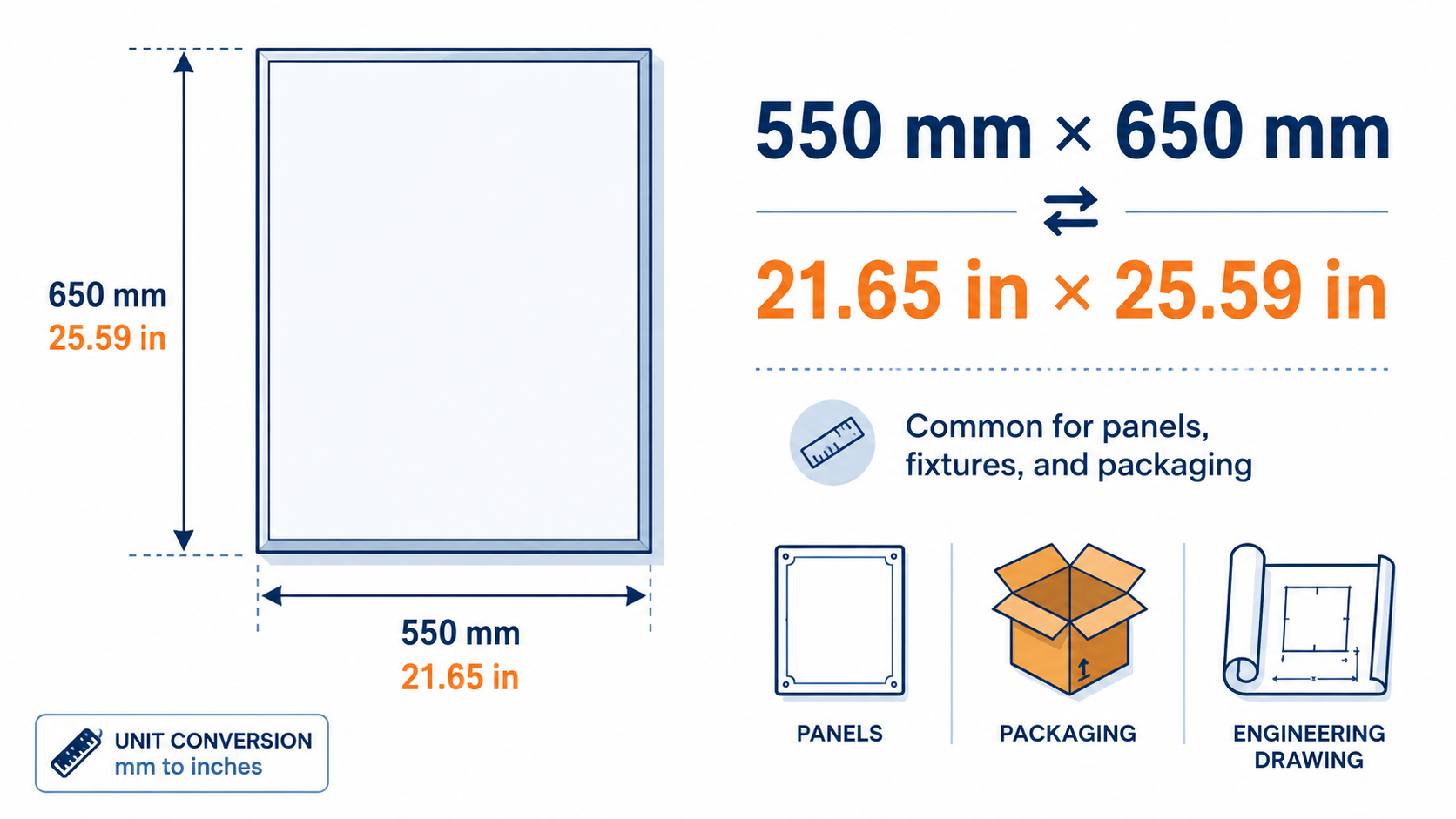
For rectangular sizes, convert each side separately:
550 ÷ 25.4 = 21.65 inches
650 ÷ 25.4 = 25.59 inches
So:
550mm × 650mm = 21.65 in × 25.59 in
| Metric Size | Inch Size | Rounded Size |
|---|---|---|
| 550mm × 550mm | 21.65 in × 21.65 in | 21.7 in × 21.7 in |
| 550mm × 650mm | 21.65 in × 25.59 in | 21.7 in × 25.6 in |
| 450mm × 550mm | 17.72 in × 21.65 in | 17.7 in × 21.7 in |
| 370mm × 470mm | 14.57 in × 18.50 in | 14.6 in × 18.5 in |
| 300mm × 550mm | 11.81 in × 21.65 in | 11.8 in × 21.7 in |
Why Does 550mm to Inches Matter in PCB and Electronics Manufacturing?
550mm to inches matters because PCB and electronics projects often move between metric and imperial dimensions. A board outline may be designed in millimeters, while an enclosure, equipment drawing, customer requirement, or packaging specification may refer to inches.
In PCB manufacturing, 550mm may relate to:
- PCB production panel length or width
- SMT stencil size
- Reflow carrier fixture size
- Wave solder pallet size
- CNC routing working area
- Electrical test fixture base
- Packaging carton dimension
- Large-format LED, power, or industrial control boards
- Mechanical enclosure matching
- Assembly line handling clearance
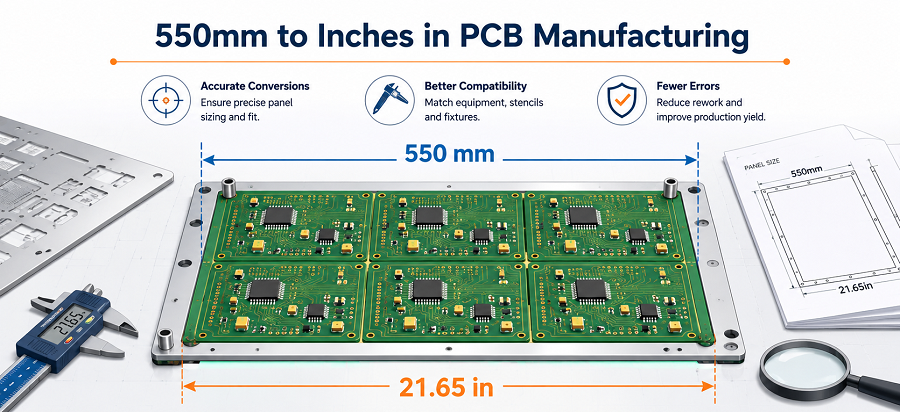
For example, if a PCB panel is designed as 550mm wide, the inch equivalent is 21.65 inches. If someone rounds it to 22 inches during communication, the difference becomes 8.8mm. That may influence panelization, fixture compatibility, or packaging accuracy.
What Mistakes Should You Avoid When Converting 550mm to Inches?
The most common mistake is rounding 550mm to exactly 22 inches and treating it as a precise value. It is close, but not exact. Another common mistake is confusing millimeters with centimeters.
Here are the main errors to avoid:
| Mistake | Why It Matters | Better Practice |
|---|---|---|
| Writing 550mm as exactly 22 inches | 22 inches is 558.8mm, not 550mm | Use 21.65 inches |
| Confusing mm and cm | 550mm is 55cm, not 550cm | Check unit labels carefully |
| Using 2.54 for mm conversion | 2.54 is centimeters per inch | Use 25.4 for millimeters |
| Removing decimals in drawings | May affect fit, clearance, or tooling | Keep accurate values |
| Ignoring tolerance | Real parts have manufacturing variation | Add tolerance where needed |
| Mixing rounded and exact values | Can confuse suppliers and inspectors | Define one primary unit |
For PCB and PCBA projects, the safest approach is to keep the original design unit as the master value. If the original file, Gerber data, mechanical drawing, or fabrication note uses millimeters, the inch value should be treated as a reference unless otherwise specified.
How Should You Write 550mm in Product Specifications?
The best product specification format is 550mm / 21.65 inches. This is clear, accurate, and easy for international readers to understand.
A clean product description might look like this:
Length: 550mm / 21.65 in
For a more detailed technical drawing, you can write:
Length: 550.00mm [21.6535 in]
For a general sales page, you can write:
Approx. 550mm / 21.7 in
In PCB manufacturing, consistency is very important. If the drawing uses millimeters, keep all related dimensions in millimeters. If inches are added, label them clearly as reference values.
What Are Similar Millimeter to Inch Conversions?
Similar conversions help users compare 550mm with nearby sizes. This is useful when selecting a panel size, enclosure, rack, fixture, or product housing.
| Millimeters | Inches | Rounded Value |
|---|---|---|
| 500mm | 19.6850 in | 19.69 in |
| 520mm | 20.4724 in | 20.47 in |
| 540mm | 21.2598 in | 21.26 in |
| 550mm | 21.6535 in | 21.65 in |
| 560mm | 22.0472 in | 22.05 in |
| 580mm | 22.8346 in | 22.83 in |
| 600mm | 23.6220 in | 23.62 in |
FAQs
1. How many inches is 550mm?
550mm is 21.6535 inches. Rounded to two decimal places, it is 21.65 inches.
2. Is 550mm equal to 22 inches?
No. 550mm is about 21.65 inches. By comparison, 22 inches equals 558.8mm, which is about 8.8mm longer than 550mm.
3. What is 550mm in feet and inches?
550mm is about 1 foot and 9.7 inches. This format is helpful for general size comparison.
4. What is the formula for converting 550mm to inches?
The formula is:
inches = millimeters ÷ 25.4
So: 550 ÷ 25.4 = 21.6535 inches
5. Is 550mm the same as 55cm?
Yes. 550mm equals 55cm, because 10mm equals 1cm.
6. Should PCB drawings use 550mm or 21.65 inches?
PCB drawings should usually keep 550mm as the primary dimension if the design was created in metric units. The inch value, 21.65 inches, can be added as a reference for international communication.
7. Is 21.65 inches accurate enough for 550mm?
For most product specifications, yes. 21.65 inches is accurate enough for general use. For high-precision engineering, use 21.6535 inches or keep the original 550mm value.
8. What is 550mm × 650mm in inches?
550mm × 650mm equals approximately 21.65 inches × 25.59 inches. This size format is common in panels, frames, fixtures, and packaging dimensions.