How Many Inches Is 340mm?
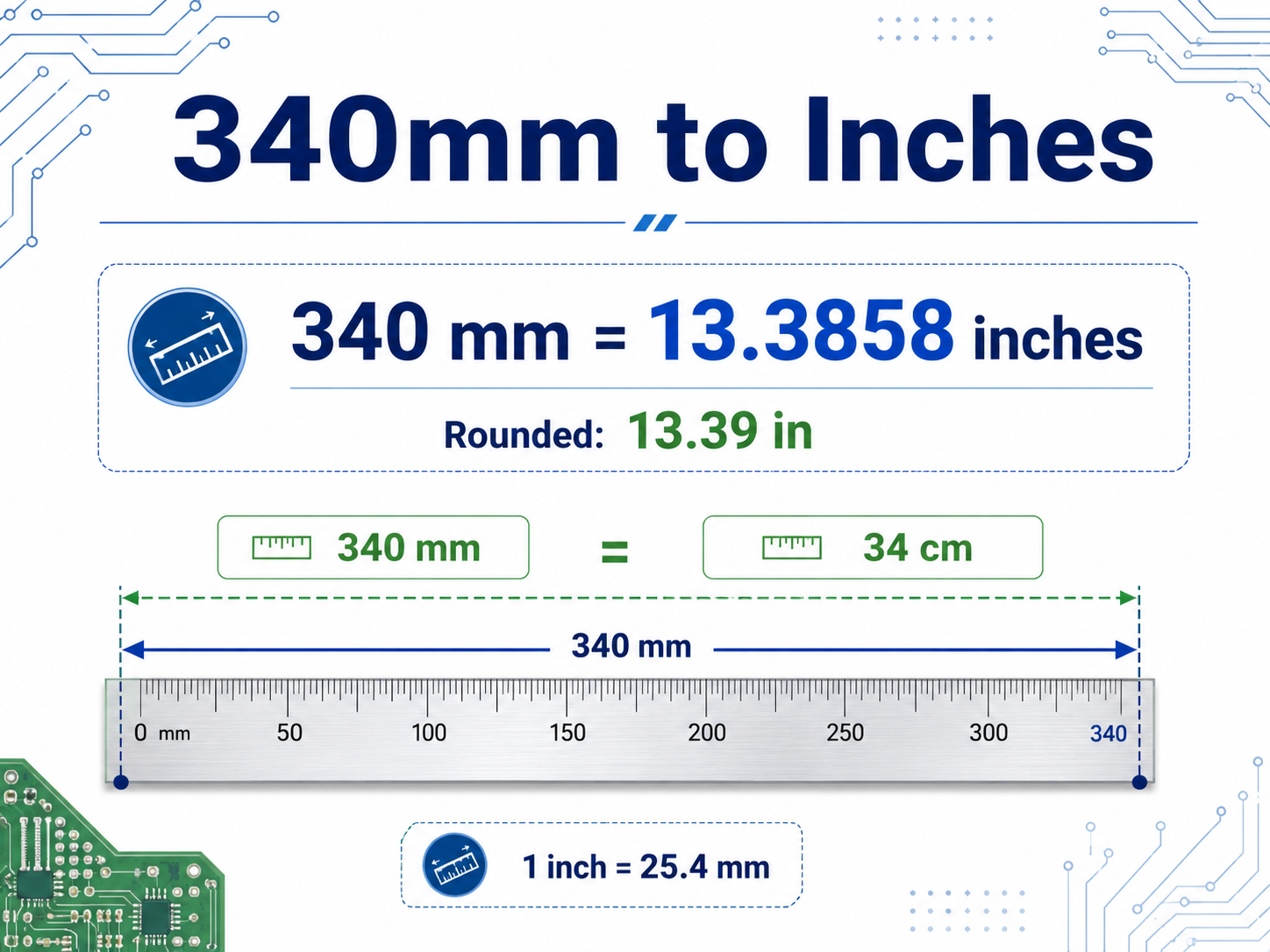
340mm to inches equals 13.3858 inches. For normal reading, you can round it to 13.39 inches. If you only need a quick approximate value, 340 mm is about 13.4 inches.
The conversion is simple because 1 inch is exactly 25.4 millimeters. So when you convert millimeters to inches, you divide the millimeter value by 25.4.
In practical use, the best way to write the result depends on the situation. A product page may use 13.4 inches because it is easier for buyers to understand. A PCB drawing, mechanical enclosure drawing, or fixture design may use 13.3858 inches or keep the original 340 mm dimension to avoid unnecessary rounding errors.
| Measurement | Result |
|---|---|
| 340 mm to inches | 13.3858 in |
| Rounded to 2 decimals | 13.39 in |
| Rounded to 1 decimal | 13.4 in |
| In centimeters | 34 cm |
| In feet and inches | 1 ft 1.39 in |
For most daily use, 13.39 inches is accurate enough. For engineering use, especially in PCB fabrication, assembly fixtures, aluminum substrate panels, or enclosure matching, keeping the original millimeter value is often the safer choice.
What Is the Exact Formula for 340mm to Inches?
The exact formula is:
Inches = Millimeters ÷ 25.4
So for 340 mm:
340 ÷ 25.4 = 13.38582677 inches
After rounding:
340 mm = 13.39 inches
This formula works for any millimeter-to-inch conversion. You only need to replace 340 with the millimeter value you want to convert.
| Step | Calculation | Result |
|---|---|---|
| Start with millimeters | 340 mm | 340 |
| Divide by 25.4 | 340 ÷ 25.4 | 13.38582677 |
| Round to 4 decimals | 13.3858 | 13.3858 in |
| Round to 2 decimals | 13.39 | 13.39 in |
| Round to 1 decimal | 13.4 | 13.4 in |
If you are preparing a technical document, it is better to keep more decimal places during calculation and round only at the final step. This helps reduce small measurement deviations, especially when multiple dimensions are being converted.
Is 340mm Equal to 13.39 Inches or 13.4 Inches?
Both can be correct, but they are used in different situations. The exact value is 13.3858 inches. When rounded to two decimal places, it becomes 13.39 inches. When rounded to one decimal place, it becomes 13.4 inches.
For general articles, online size descriptions, and simple explanations, 13.4 inches is easy to read. For product specifications, drawings, and PCB-related communication, 13.39 inches gives better accuracy.
| Use Case | Recommended Value | Why It Works |
|---|---|---|
| Quick explanation | 13.4 in | Easy to understand |
| Product size description | 13.39 in | Balanced accuracy |
| PCB outline reference | 13.3858 in | Keeps precision |
| Mechanical design | 13.386 in | Suitable for drawings |
| Customer communication | 340 mm / 13.39 in | Clear for both metric and imperial users |
A small rounding difference may look minor, but in manufacturing it can matter. For example, PCB panels, mounting holes, slots, mechanical edges, and enclosure clearances often rely on controlled dimensions. A rounded number should support communication, not replace the original design value.
What Is 340mm in Feet and Inches?
340 mm is about 1 foot and 1.39 inches.
Here is the simple breakdown:
- 340 mm = 13.3858 inches
- 12 inches = 1 foot
- 13.3858 inches = 1 foot + 1.3858 inches
- Rounded result: 1 ft 1.39 in
This format is useful when explaining size to readers who are more familiar with feet and inches. For example, if someone asks how long 340 mm is, saying “about 1 foot and 1.4 inches” may feel more natural than saying “13.3858 inches.”
However, for technical use, feet-and-inches format is usually less convenient. In PCB design, enclosure design, machining, and inspection reports, decimal inches or millimeters are much clearer.
What Is 340mm to Inches as a Fraction?
340 mm is approximately 13 3/8 inches as a common ruler fraction.
The exact value is 13.3858 inches. The common fraction 13 3/8 inches equals 13.375 inches, which is very close. The difference is only about 0.0108 inch, or roughly 0.27 mm.
| Decimal Inches | Common Fraction | Difference from 340 mm |
|---|---|---|
| 13.3858 in | 13 3/8 in | About 0.0108 in |
| 13.3858 in | 13 25/64 in | Very close |
| 13.3858 in | 13.39 in | Best simple decimal value |
For ruler reading, 13 3/8 inches is usually acceptable. For PCB manufacturing, do not use a ruler fraction as the final production dimension. Fractions are helpful for visual understanding, while decimal values are better for drawings, CAD files, and inspection documents.
How Long Is 340mm on a Ruler?
340 mm is 34 cm, or slightly longer than 13 3/8 inches on an imperial ruler. On a metric ruler, it is easy to find because 340 mm equals 34 centimeters.
On an inch ruler, 340 mm sits between 13 inches and 13.5 inches. More precisely, it is a little above 13 3/8 inches.
A simple way to visualize it:
- 300 mm = 30 cm, close to 11.81 inches
- 340 mm = 34 cm, close to 13.39 inches
- 350 mm = 35 cm, close to 13.78 inches
So, 340 mm is longer than a typical 12-inch ruler. You would need a ruler longer than one foot, a tape measure, or a caliper for a more accurate reading.
For PCB or mechanical parts, a caliper is more reliable than a printed ruler or tape measure. A ruler is useful for quick checking, but it is not ideal for confirming board outline tolerance, slot length, connector spacing, or heat sink fit.
What Common Objects Are Close to 340mm?
340 mm is about 13.4 inches, so it is slightly longer than a standard 12-inch ruler. It is close to the length of some laptop widths, small keyboard bodies, long LED light boards, or medium-sized electronic control panels.
Here are some size comparisons:
| Object or Size Reference | Approximate Length | Compared with 340 mm |
|---|---|---|
| Standard 12-inch ruler | 304.8 mm | 340 mm is longer |
| A4 paper long side | 297 mm | 340 mm is longer |
| 13-inch laptop width | Around 300–310 mm | 340 mm is slightly wider |
| Compact keyboard width | Around 300–350 mm | Similar range |
| Medium LED PCB strip section | Around 300–400 mm | Similar range |
| Control panel PCB | Varies widely | 340 mm is common in larger designs |
This kind of comparison helps readers understand the size quickly. In electronics, 340 mm is not a small dimension. It may appear in LED lighting boards, power control boards, display-related PCBs, industrial modules, metal-core PCB strips, and panelized production layouts.
How Do Similar Millimeter Sizes Convert to Inches?
If you are checking 340 mm, you may also need nearby sizes such as 330 mm, 335 mm, 345 mm, or 350 mm. These values often appear in product drawings, PCB panel planning, enclosure selection, and aluminum substrate design.
| Millimeters | Inches | Rounded Value |
|---|---|---|
| 300 mm | 11.8110 in | 11.81 in |
| 320 mm | 12.5984 in | 12.60 in |
| 330 mm | 12.9921 in | 12.99 in |
| 335 mm | 13.1890 in | 13.19 in |
| 340 mm | 13.3858 in | 13.39 in |
| 345 mm | 13.5827 in | 13.58 in |
| 350 mm | 13.7795 in | 13.78 in |
| 360 mm | 14.1732 in | 14.17 in |
A chart like this improves readability because users can compare nearby values without doing a new calculation every time. It is also useful for buyers, engineers, designers, and purchasing teams who often move between metric and imperial documents.
Why Is 340mm to Inches Useful for PCB Dimensions?
340 mm to inches is useful in PCB work because many projects involve customers, drawings, components, fixtures, and enclosures that may use different unit systems. A PCB outline may be designed in millimeters, while an enclosure drawing, mounting rack, or overseas customer specification may use inches.
In PCB manufacturing, 340 mm may appear as:
- A long board outline dimension
- A panel width or length reference
- An aluminum PCB strip size
- A fixture or carrier tray dimension
- A LED lighting board length
- A control board housing size
- A stencil frame or assembly tooling reference
For example, a customer may say the available space inside a housing is about 13.4 inches, while the PCB drawing shows 340 mm. These two values are close, but the manufacturing team still needs to confirm the original controlled dimension. This is especially important when the PCB has mounting holes, edge connectors, heat dissipation areas, or mechanical contact with the enclosure.
Good documentation often lists both units:
Board size: 340 mm × 120 mm
Reference size: 13.39 in × 4.72 in
This format helps both technical and purchasing teams understand the size clearly.
Should PCB Drawings Use Millimeters or Inches?
PCB drawings can use either millimeters or inches, but the safest choice is to keep the same unit system throughout the design file, fabrication drawing, and inspection document. Mixing units without clear labeling can create confusion.
Today, many PCB designs use millimeters because component datasheets, mechanical drawings, and fabrication processes often support metric values. However, inches are still common in some connector spacing, legacy designs, test fixtures, and customer documents.
| PCB Document Type | Better Unit Practice | Reason |
|---|---|---|
| Gerber files | Follow original CAD unit | Avoid data mismatch |
| Drill files | Use consistent units | Protect hole accuracy |
| Fabrication drawing | State mm or inch clearly | Reduces review time |
| Assembly drawing | Match component placement data | Supports SMT accuracy |
| Customer quotation | Show both units if needed | Improves communication |
| Mechanical enclosure drawing | Match enclosure supplier unit | Easier fit checking |
For a 340 mm PCB, using only “13.4 inches” may not be precise enough for production control. A better approach is to keep 340 mm as the main dimension and provide 13.39 inches as a reference.
What Conversion Mistakes Should You Avoid?
The most common mistake is rounding too early. If you convert 340 mm to 13.4 inches at the beginning and then use 13.4 inches for every later calculation, the final result may shift slightly. This may not matter for a simple blog article, but it can matter in PCB outline design, fixture machining, or enclosure matching.
Another common mistake is treating approximate values as exact values. 13.4 inches is not exactly the same as 340 mm. It is a rounded number. The exact result is 13.3858 inches.
Here are a few practical tips:
- Use 13.39 inches for normal product size explanation.
- Use 13.3858 inches when more precision is needed.
- Keep 340 mm as the controlled value if the original drawing uses metric units.
- Avoid using ruler fractions for final PCB production data.
- Always label units clearly in drawings, tables, and quotation sheets.
- When checking fit with an enclosure, include tolerance, not only nominal size.
A clear unit conversion makes communication smoother. It also helps prevent avoidable design review questions during PCB fabrication, component assembly, or final product integration.
FAQ About 340mm to Inches
1. How many inches is 340mm?
340 mm is 13.3858 inches. Rounded to two decimal places, it is 13.39 inches. Rounded to one decimal place, it is 13.4 inches.
2. What is the formula for converting 340mm to inches?
The formula is:
Inches = Millimeters ÷ 25.4
So:
340 ÷ 25.4 = 13.3858 inches
3. Is 340mm the same as 13 inches?
No. 340 mm is longer than 13 inches. It equals about 13.39 inches, so it is closer to 13.4 inches than 13 inches.
4. What is 340mm in feet and inches?
340 mm is about 1 foot and 1.39 inches. In simpler wording, it is a little more than one foot long.
5. What is 340mm in inches as a fraction?
340 mm is close to 13 3/8 inches. The exact decimal value is 13.3858 inches, which is slightly more than 13 3/8 inches.
6. Is 340mm equal to 34cm?
Yes. 340 mm equals 34 cm because 10 mm equals 1 cm. This is a direct metric conversion.
7. Is 340mm a large PCB size?
It depends on the product, but 340 mm is relatively long for many PCB applications. It may be used for LED boards, industrial control boards, power modules, display boards, or panelized production layouts.
8. Should I use 13.39 inches or 13.4 inches in a PCB drawing?
For a PCB drawing, use the original controlled value whenever possible. If the design is in millimeters, keep 340 mm as the main value. You can add 13.39 inches as a reference, but avoid using 13.4 inches as the production dimension.
Conclusion
340mm to inches equals 13.3858 inches, and the most common rounded value is 13.39 inches. For quick understanding, you can say 340 mm is about 13.4 inches. For ruler reading, it is slightly more than 13 3/8 inches. For feet-and-inches format, it is about 1 ft 1.39 in.
For everyday use, rounded values are convenient. For PCB design, fabrication drawings, assembly fixtures, and mechanical fit checks, keeping the original 340 mm dimension is usually the better practice. Clear unit control helps reduce confusion and supports smoother communication between design, manufacturing, purchasing, and quality teams.