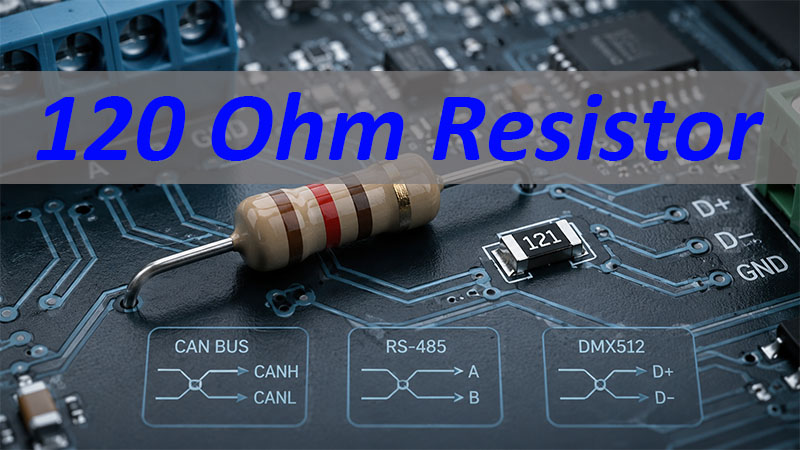
A 120 ohm resistor is a fixed resistor with a resistance value of 120Ω. It is widely used in electronic circuits for current limiting, signal control, voltage division, impedance matching, and communication bus termination.
For many users, the main question is not only “What is a 120 ohm resistor?” They also want to know the 120 ohm resistor color code, the SMD resistor code, the correct wattage, the suitable package size, and why a 120 ohm resistor is used in CAN bus, RS-485, and DMX termination.
In PCB and PCBA design, a 120Ω resistor may look like a simple component. But if the wrong value, package, power rating, tolerance, or placement is used, the circuit may suffer from communication errors, signal reflection, overheating, or assembly problems.
What Is a 120 Ohm Resistor?
A 120 ohm resistor is a resistor that limits current or controls signal behavior with a resistance value of 120 ohms. The symbol for ohms is Ω, so it may be written as:
- 120 ohm resistor
- 120Ω resistor
- 120R resistor
- resistor 120 ohm
The resistor value tells how strongly the component resists current flow. A 120Ω resistor has more resistance than a 100Ω resistor and less resistance than a 150Ω resistor.
In electronics, 120Ω is a common value. It can be used in simple circuits, LED circuits, signal lines, impedance matching, and communication networks. One of its most important uses is as a termination resistor in CAN bus, RS-485, and DMX systems.
A 120 ohm resistor can come in different forms, including through-hole resistors, SMD resistors, thick film resistors, thin film resistors, precision resistors, power resistors, and termination resistors.
The same 120Ω value can have different wattage ratings, tolerance levels, package sizes, and temperature ratings. This is why resistor selection should not be based on resistance value alone.
120 Ohm Resistor Specifications
Before selecting a 120 ohm resistor, it is useful to understand the main specifications. These parameters help determine whether the resistor is suitable for a specific circuit, PCB layout, and assembly process.
| Parameter | Common Option | Why It Matters |
|---|---|---|
| Resistance Value | 120Ω | The main electrical value used for current control or termination |
| 4-Band Color Code | Brown-Red-Brown-Gold | Helps identify through-hole 120Ω resistors |
| 5-Band Color Code | Brown-Red-Black-Black-Brown | Used for higher-precision 120Ω resistors |
| SMD Code | 121 / 120R | Helps identify 120Ω chip resistors |
| Tolerance | ±5%, ±1%, ±0.5% | Affects accuracy and termination consistency |
| Power Rating | 1/8W, 1/4W, 1/2W, 1W or higher | Determines heat handling capability |
| Package | 0402, 0603, 0805, 1206, axial | Affects PCB space, assembly, rework, and power dissipation |
| Resistor Type | Thick film, thin film, metal film | Affects cost, noise, stability, and precision |
| Common Applications | CAN, RS-485, DMX, signal lines | Defines how the resistor is used in real circuits |
These specifications are connected. For example, a 120Ω 0402 SMD resistor may save PCB space, but it usually has lower power handling than a larger 0805 or 1206 resistor. A precision thin film resistor may offer better tolerance and temperature stability than a standard thick film resistor, but it may cost more.
For simple circuits, a general-purpose 120Ω resistor may be enough. For communication termination, industrial control, automotive electronics, or compact PCBA projects, package, tolerance, placement, and reliability should be checked more carefully.
What Is the Color Code for a 120 Ohm Resistor?
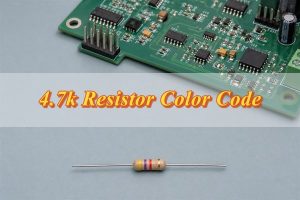
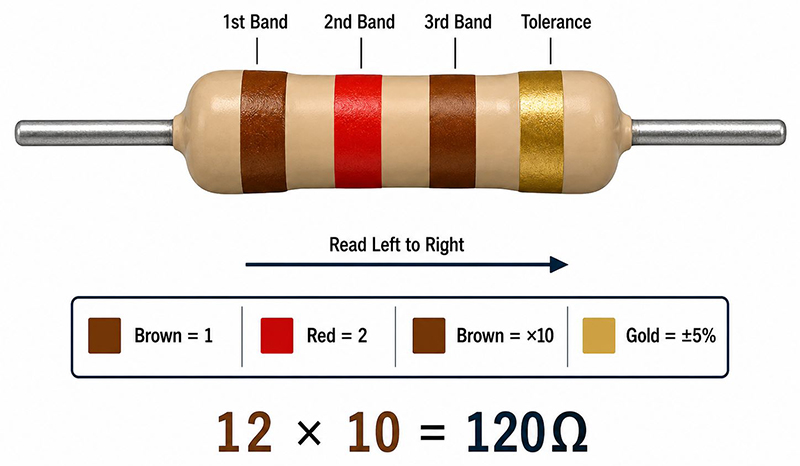
The most common 120 ohm resistor color code for a 4-band resistor is:
| Band | Color | Meaning |
|---|---|---|
| 1st Band | Brown | 1 |
| 2nd Band | Red | 2 |
| 3rd Band | Brown | ×10 |
| 4th Band | Gold | ±5% tolerance |
So the 4-band color code is:
Brown – Red – Brown – Gold
This means:
12 × 10 = 120Ω
The gold band means the tolerance is ±5%. This means the actual resistance may be slightly higher or lower than 120Ω.
For example, a 120Ω ±5% resistor may measure approximately between:
- 114Ω
- 126Ω
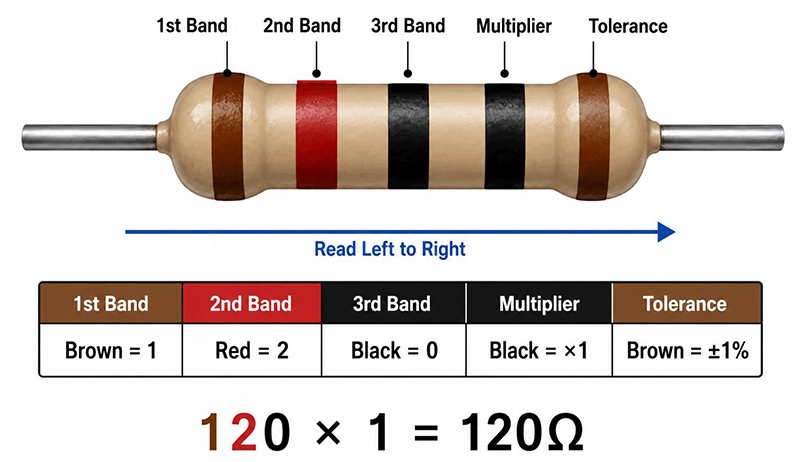
Some resistors use a 5-band color code for higher precision. A common 5-band 120 ohm resistor color code may be:
| Band | Color | Meaning |
|---|---|---|
| 1st Band | Brown | 1 |
| 2nd Band | Red | 2 |
| 3rd Band | Black | 0 |
| 4th Band | Black | ×1 |
| 5th Band | Brown | ±1% tolerance |
So the 5-band color code is:
Brown – Red – Black – Black – Brown
This means:
120 × 1 = 120Ω
The final brown band means the tolerance is ±1%.
How to Read a 120 Ohm Resistor Color Code?
To read a 120 ohm resistor color code, start from the correct side of the resistor. The tolerance band is usually separated slightly from the other bands. It is often gold, silver, brown, red, or another tolerance color.
For a 4-band resistor:
- Read the first band as the first digit.
- Read the second band as the second digit.
- Read the third band as the multiplier.
- Read the fourth band as the tolerance.
For a 120Ω 4-band resistor:
- Brown = 1
- Red = 2
- Brown = ×10
- Gold = ±5%
So the value is:
12 × 10 = 120Ω
For a 5-band resistor:
- Read the first three bands as the first three digits.
- Read the fourth band as the multiplier.
- Read the fifth band as the tolerance.
For a 120Ω 5-band resistor:
- Brown = 1
- Red = 2
- Black = 0
- Black = ×1
- Brown = ±1%
So the value is:
120 × 1 = 120Ω
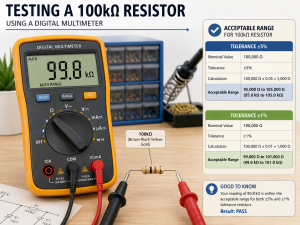
A common mistake is reading the bands from the wrong direction. If the result looks unusual, check the tolerance band position and confirm the value with a multimeter.
What Is the SMD Code for a 120 Ohm Resistor?
For SMD resistors, the value is often printed as a number or letter code on the component body. The most common SMD code for a 120 ohm resistor is:
121
This means:
12 + 1 zero = 120Ω
Some SMD resistors may use different markings depending on size, tolerance, and manufacturer.
| SMD Marking | How to Read | Meaning |
|---|---|---|
| 121 | 12 + 1 zero | 120Ω |
| 1200 | 120 × 10⁰ | 120Ω |
| 120R | 120 ohms | 120Ω |
| 120Ω | Direct marking | 120Ω |
| R120 | 0.120 ohms | 0.120Ω, not 120Ω |
The difference between 120R and R120 is important.
In resistor markings, the letter R is often used to replace the decimal point, especially for low-value resistors. When R appears in the middle or at the beginning of the number, it usually works like a decimal point. When R appears after the number, it usually means ohms.
For example:
| Marking | How to Read | Resistance |
|---|---|---|
| 120R | 120 ohms | 120Ω |
| R120 | 0.120 ohms | 0.120Ω |
| 1R20 | 1.20 ohms | 1.2Ω |
| 0R12 | 0.12 ohms | 0.12Ω |
| 4R7 | 4.7 ohms | 4.7Ω |
So:
- 120R usually means 120Ω.
- R120 usually means 0.120Ω.
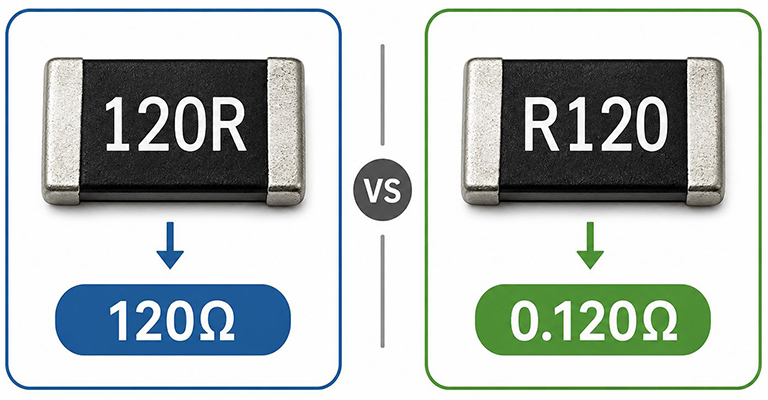
These are completely different resistance values. A 120Ω resistor is commonly used for signal control or termination. A 0.120Ω resistor is a very low-value resistor and may be used for current sensing or power circuits. Using the wrong marking can cause circuit failure.
Small SMD resistors, such as 0402 or 0201 packages, may not have visible markings. In that case, the value should be confirmed from the BOM, schematic, placement file, reel label, or measurement.
What Is a 120 Ohm Resistor Used For?
A 120 ohm resistor can be used in many electronic circuits. The exact function depends on where it is placed in the circuit.
Common uses include:
- Current limiting
- Signal conditioning
- Voltage division
- Pull-up or pull-down circuits
- LED current control
- Impedance matching
- Communication bus termination
- CAN bus termination
- RS-485 termination
- DMX termination
- Industrial control circuits
- Automotive electronics
- Embedded systems
- PCB signal lines
Among these applications, one of the most important uses is termination. In high-speed or long-distance communication lines, a termination resistor helps reduce signal reflection and improve signal integrity.
For example, CAN bus networks often use 120Ω termination resistors at both ends of the bus. RS-485 and DMX systems may also use 120Ω termination depending on cable impedance, network length, and data rate.
In PCB assembly, 120Ω resistors may be placed near connectors, transceivers, communication interfaces, or differential signal lines. Placement matters because a termination resistor should normally be located near the end of the transmission line, not randomly placed in the circuit.
Why Is a 120 Ohm Resistor Used in CAN Bus?
A 120 ohm resistor is used in CAN bus as a termination resistor. Its purpose is to match the characteristic impedance of the CAN bus cable or transmission line and reduce signal reflections.
CAN bus is a differential communication system. It uses two signal lines:
- CAN_H
- CAN_L
When signals travel along a cable or PCB trace, they can reflect back if the line is not properly terminated. These reflections may distort the signal and cause communication errors.
A 120Ω termination resistor is commonly placed across CAN_H and CAN_L at each end of the CAN bus. This helps absorb signal energy and reduce reflection.
A typical CAN bus uses:
- One 120Ω resistor at one end of the bus
- One 120Ω resistor at the other end of the bus
The 120Ω value is used because it is close to the typical characteristic impedance of many CAN bus twisted-pair cables. Correct termination helps the signal remain clean, especially in longer networks or noisy environments.
In automotive electronics, industrial control systems, battery management systems, and embedded devices, correct CAN bus termination is important for reliable communication.
What Is a 120 Ohm Termination Resistor?
A 120 ohm termination resistor is a resistor placed at the end of a transmission line to reduce signal reflections. It is commonly used in differential communication systems.
A termination resistor is not just a normal resistor placed anywhere. Its position matters.
It should usually be placed:
- At the end of the communication bus
- Across the differential signal pair
- Close to the connector or transceiver endpoint
- According to the communication standard and layout requirement
Common systems that may use 120Ω termination include:
- CAN bus
- RS-485
- Modbus over RS-485
- DMX512
- Industrial communication networks
- Automotive communication circuits
The goal is to make the transmission line behave more predictably. Without correct termination, the signal may reflect, ring, overshoot, undershoot, or become unstable.
A 120 ohm termination resistor is especially important when the cable is long, the signal speed is high, the environment is noisy, the bus has multiple nodes, or communication reliability is critical.
In PCB layout, the termination resistor should be placed carefully. Poor placement can reduce its effectiveness even if the resistor value is correct.
What Happens When Two 120 Ohm Resistors Are in Parallel?
When two 120 ohm resistors are connected in parallel, the equivalent resistance is 60 ohms.
This is an important point in CAN bus testing.
A standard CAN bus often has one 120Ω termination resistor at each end of the bus. Because these two resistors are connected across the same CAN_H and CAN_L pair, they appear in parallel when measured from the bus.
The equivalent resistance is:
120Ω || 120Ω = 60Ω
That is why technicians often measure about 60Ω between CAN_H and CAN_L when the system is powered off and both termination resistors are installed.
This does not mean each resistor is 60Ω. It means the two 120Ω resistors together create a 60Ω equivalent resistance.
| Network Condition | Measured Resistance Between CAN_H and CAN_L |
|---|---|
| One 120Ω termination resistor installed | About 120Ω |
| Two 120Ω termination resistors installed | About 60Ω |
| No termination resistor installed | Very high or open |
| Too many termination resistors installed | Lower than 60Ω |
If you measure around 60Ω on a CAN bus, it usually means both termination resistors are present. If the reading is around 120Ω, one termination resistor may be missing. If the reading is much lower than 60Ω, there may be extra termination or another fault.
120 Ohm Resistor for CAN Bus, RS-485 and DMX
A 120 ohm resistor is commonly used in several communication systems because many differential communication cables have characteristic impedance near 120Ω.
CAN Bus
In CAN bus, a 120Ω resistor is usually placed across CAN_H and CAN_L at each end of the bus. This reduces signal reflection and helps maintain reliable communication.
Typical applications include:
- Automotive control modules
- Battery management systems
- Industrial controllers
- Robotics
- Vehicle diagnostic systems
- Embedded communication boards

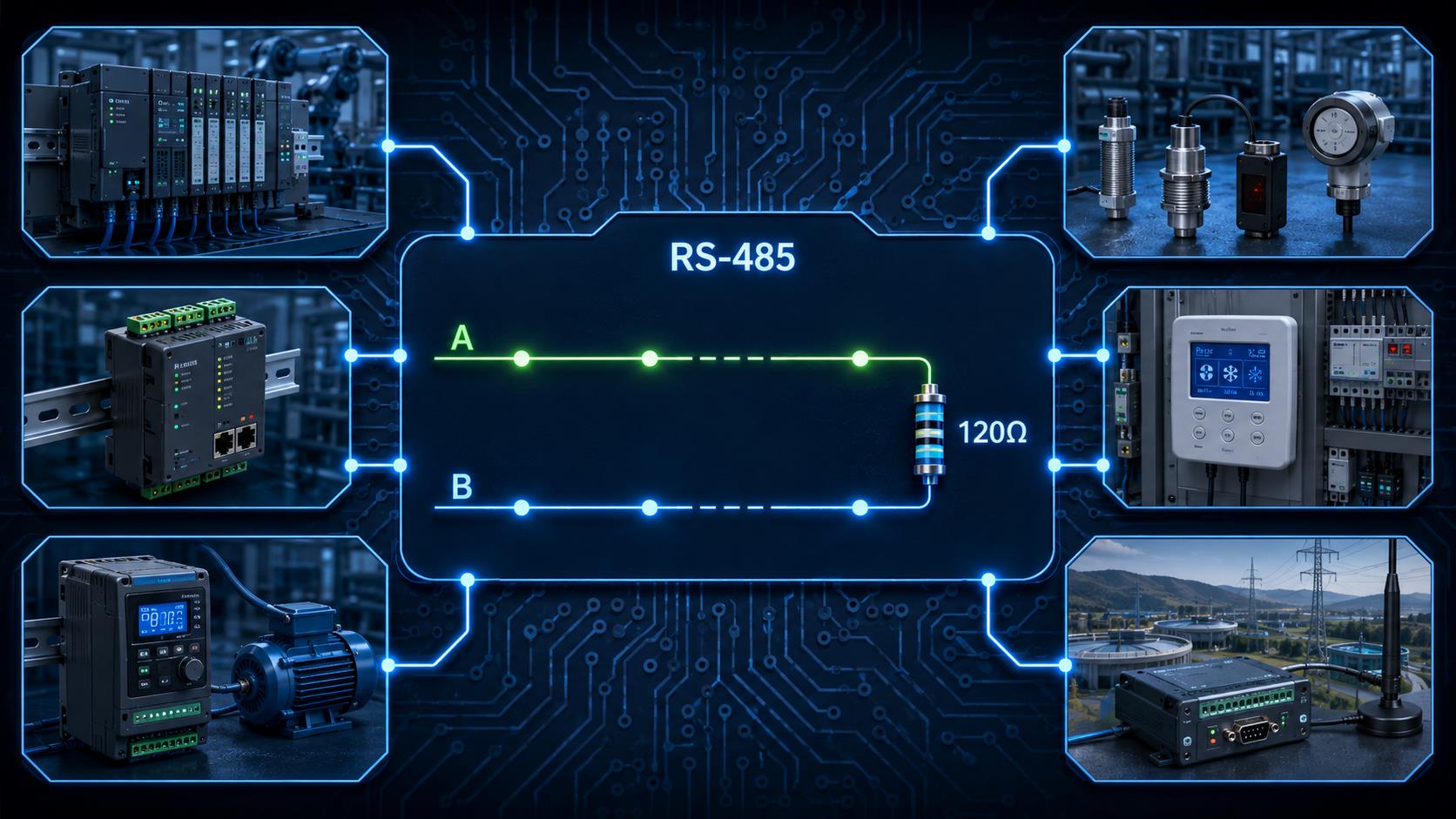
RS-485
RS-485 is also a differential communication standard. It may use a 120Ω termination resistor across the A and B lines at the end of the bus.
RS-485 is common in:
- Industrial automation
- Modbus networks
- Motor controllers
- Sensors
- Building control systems
- Long-distance serial communication
Not every RS-485 network needs termination, especially if the cable is short or the data rate is low. But for longer cables or higher speeds, termination becomes more important.
DMX
DMX512 lighting systems often use a 120Ω terminator at the end of the DMX line. This helps reduce signal reflection and improve communication stability.
DMX termination is common in:
- Stage lighting
- LED controllers
- Theater systems
- Architectural lighting
- Entertainment control systems
In all these systems, the resistor value is only one part of the design. Cable impedance, bus length, data rate, connector layout, and PCB routing also affect signal quality.

How to Choose a 120 Ohm Resistor: Wattage, Tolerance and Package
Choosing a 120 ohm resistor should not be based only on resistance value. You should also check wattage, tolerance, package size, resistor type, temperature rating, and application.
Wattage
Wattage tells how much power the resistor can safely dissipate as heat.
Common 120 ohm resistor power ratings include:
| Power Rating | Typical Use |
|---|---|
| 1/8 W | Small signal circuits |
| 1/4 W | General through-hole circuits |
| 1/2 W | Higher power margin |
| 1 W | Power or industrial circuits |
| 5 W or higher | Special power applications |
For many signal termination applications, the power is usually low. But the correct rating should still be checked based on voltage, current, duty cycle, thermal environment, and derating requirement.
The power can be estimated with:
P = V² / R
For example, if a 5V signal is continuously applied across a 120Ω resistor:
P = 5² / 120 = 25 / 120 = 0.208 W
In this case, a 1/4W resistor may be close to the limit, depending on real operating conditions and derating. A higher wattage may be safer.
The calculated power is only a starting point. In real PCB design, resistor temperature also depends on package size, copper area, airflow, nearby heat sources, ambient temperature, and how long the load is applied.
Tolerance
Tolerance tells how close the real resistance value is to the marked value.
Common tolerances include:
| Tolerance | Meaning |
|---|---|
| ±5% | General use |
| ±1% | More precise circuits |
| ±0.5% or lower | Precision applications |
For CAN bus, RS-485, DMX, and signal termination, ±1% or ±5% may be used depending on the design requirement. For precision analog circuits, tighter tolerance may be needed.
Package
A 120 ohm resistor can be made as a through-hole resistor or an SMD resistor. For PCB assembly, the package affects board space, power rating, assembly yield, inspection, and rework.
For SMD resistors, package numbers such as 0201, 0402, 0603, 0805, and 1206 refer to physical size. For example, a 0402 resistor is about 1.0 × 0.5 mm, while a 0603 resistor is about 1.6 × 0.8 mm. These numbers describe the resistor package size, not the resistance value. A 120Ω resistor can be supplied in many SMD packages.
| SMD Package | Dimensions (mm) | Dimensions (inch) | Typical Use | Selection Note |
|---|---|---|---|---|
| 0201 | 0.6 × 0.3 | 0.024 × 0.012 | Very compact electronics | Saves space but is difficult to assemble and rework |
| 0402 | 1.0 × 0.5 | 0.040 × 0.020 | Compact PCB layouts | Good for high-density boards but needs controlled SMT process |
| 0603 | 1.6 × 0.8 | 0.063 × 0.031 | General SMT assembly | Good balance of size, cost, and manufacturability |
| 0805 | 2.0 × 1.25 | 0.079 × 0.049 | Easier inspection and rework | Better process margin and higher power options |
| 1206 | 3.2 × 1.6 | 0.126 × 0.063 | Higher power margin | Useful when heat, reliability, or manual rework matters |
A smaller SMD package saves PCB space, but it usually has lower power handling and is harder to inspect or rework. A larger SMD package takes more board space, but it can provide better power margin, stronger solder joints, and easier manual handling.
Through-hole 120 ohm resistors are different. They do not use the same 0201/0402/0603 size code system. Their physical size usually depends on power rating, body style, lead spacing, and manufacturer specification. They are easier for manual soldering, prototypes, and repair, but they take more PCB space than SMD resistors.
Resistor Type
The resistor type also matters.
Common options include:
- Thick film resistor
- Thin film resistor
- Metal film resistor
- Current sense resistor
- Precision resistor
- Power resistor
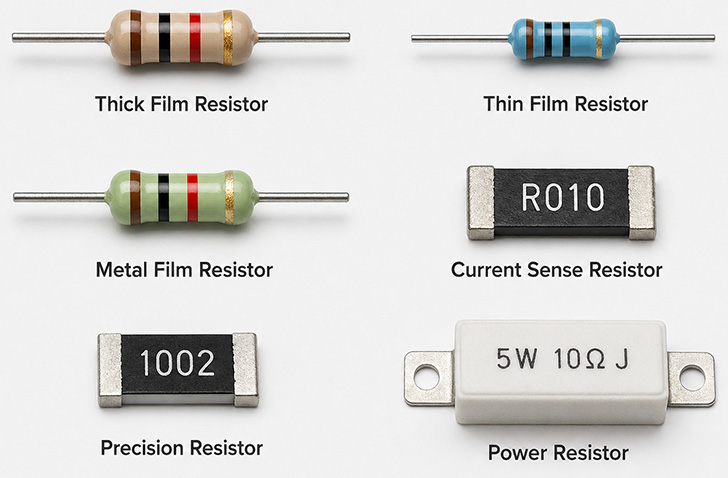
For most digital circuits and communication termination applications, a standard thick film or thin film resistor may be enough. For precision circuits, low-noise or tighter-tolerance resistors may be required.
Common Mistakes When Selecting a 120 Ohm Resistor
A 120Ω resistor is simple, but selection mistakes can still cause circuit problems.
Common mistakes include:
- Choosing only by resistance value and ignoring wattage
- Confusing 120R with R120
- Using 120kΩ instead of 120Ω
- Replacing 120Ω with 100Ω or 150Ω in termination circuits without checking the design
- Using too small a package for the required power
- Ignoring tolerance in communication or precision circuits
- Placing the termination resistor too far from the bus endpoint
- Assuming every RS-485 network needs termination without checking cable length and speed
- Not checking the BOM, schematic, datasheet, or layout before replacement
For simple current-limiting circuits, a nearby resistor value may sometimes work after calculation. For CAN bus, RS-485, DMX, impedance matching, and signal integrity applications, resistor replacement should be checked carefully.
FAQs About 120 Ohm Resistor
What Is a 120 Ohm Resistor?
A 120 ohm resistor is a resistor with a resistance value of 120Ω. It is used to limit current, control signals, divide voltage, and terminate communication lines.
What Is the Color Code for a 120 Ohm Resistor?
The common 4-band color code for a 120 ohm resistor is Brown – Red – Brown – Gold. This represents 12 × 10 = 120Ω with ±5% tolerance.
What Is the 5-Band Color Code for a 120 Ohm Resistor?
A common 5-band 120 ohm resistor color code is Brown – Red – Black – Black – Brown. This represents 120 × 1 = 120Ω with ±1% tolerance.
What Is the SMD Code for a 120 Ohm Resistor?
The most common SMD code for a 120 ohm resistor is 121. This means 12 followed by one zero, or 120Ω.
Is 120R the Same as 120 Ohm?
Yes. In resistor marking, 120R usually means 120Ω. The letter R is used as the ohm marker.
Is R120 the Same as 120 Ohm?
No. R120 usually means 0.120Ω, not 120Ω. In low-value resistor markings, the letter R is often used as a decimal point. That is why R120 is read as 0.120Ω.
Why Is a 120 Ohm Resistor Used in CAN Bus?
A 120 ohm resistor is used in CAN bus to terminate the differential signal line and reduce signal reflections. It is usually placed across CAN_H and CAN_L at both ends of the bus.
Why Does CAN Bus Measure 60 Ohms?
A CAN bus with two 120Ω termination resistors will measure about 60Ω between CAN_H and CAN_L because the two 120Ω resistors are connected in parallel.
Can I Replace a 120 Ohm Resistor with 100 Ohm or 150 Ohm?
It depends on the circuit. For simple current limiting, a nearby value may sometimes work after calculation. For CAN bus, RS-485, DMX, and impedance matching, do not replace 120Ω without checking the design requirement.
What Wattage Should a 120 Ohm Resistor Be?
The wattage depends on voltage, current, duty cycle, ambient temperature, and heat dissipation. Common choices include 1/8W, 1/4W, 1/2W, and 1W. Always calculate power and apply a safety margin.
Is a 120 Ohm Resistor Polarized?
No. A resistor is not polarized. It can be installed in either direction unless the package or circuit has a special mechanical requirement.
Where Is a 120 Ohm Termination Resistor Placed?
A 120 ohm termination resistor is usually placed at the end of a communication bus and across the differential signal pair, such as CAN_H and CAN_L or RS-485 A and B lines.
To sum up, a 120 ohm resistor is a common resistor value used in many electronic circuits. Its key points include color-code identification, SMD marking, resistor specifications, package selection, and communication bus termination.
For through-hole resistors, the common 120 ohm resistor color code is Brown – Red – Brown – Gold. For SMD resistors, the common marking is 121. In CAN bus, RS-485, and DMX systems, a 120Ω termination resistor helps reduce signal reflections and improve communication reliability.
When choosing a 120 ohm resistor, check more than the resistance value. Wattage, tolerance, package, resistor type, PCB placement, and application requirements all matter.
Need support with full turnkey PCB assembly, BOM review, resistor selection, or DFM checking? Pls feel free to send your Gerber files, BOM, stack-up, and project requirements to EBest Circuit (Best Technology) at sales@bestpcbs.com.