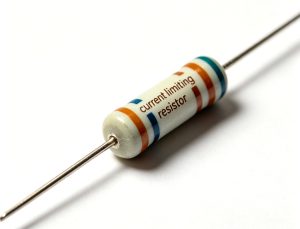
The 100k ohm resistor color code is one of the most common resistor markings used in electronics, PCB assembly, repair work, prototyping, and circuit learning. For a standard 4-band resistor, the color code is Brown, Black, Yellow, and Gold. This represents 100,000 ohms with a tolerance of plus or minus 5%.
For engineers, technicians, students, and buyers, knowing how to read this value correctly helps prevent wrong component placement, unstable circuit behavior, and unnecessary troubleshooting. A 100k resistor may look simple, but the wrong tolerance, package, power rating, or SMD code can still affect the final product.
What Is the 100k Ohm Resistor Color Code?
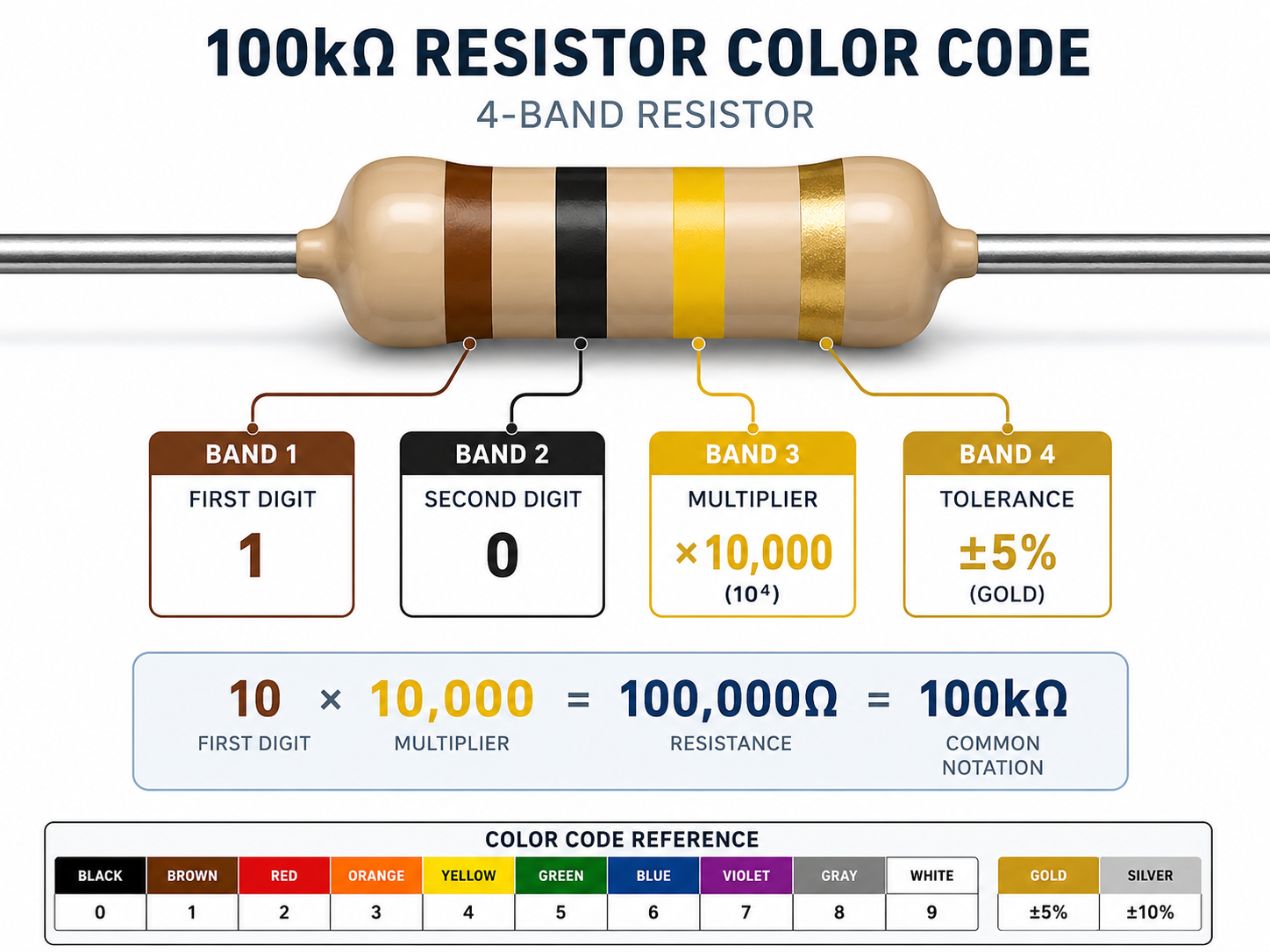
The 100k ohm resistor color code is the color-band marking used to identify a resistor with a resistance value of 100,000 ohms, also written as 100 kΩ. For the most common 4-band resistor, the color code is:
Brown – Black – Yellow – Gold
| Band | Color | Meaning |
|---|---|---|
| 1st Band | Brown | First digit: 1 |
| 2nd Band | Black | Second digit: 0 |
| 3rd Band | Yellow | Multiplier: ×10,000 |
| 4th Band | Gold | Tolerance: ±5% |
The calculation is:
10 × 10,000 = 100,000 ohms = 100kΩ
The gold band means the actual resistance may vary by ±5%. In real use, a 100kΩ resistor with gold tolerance can measure between 95kΩ and 105kΩ and still be acceptable.
Why Is the 100kΩ Resistor Color Code Important?
A 100kΩ resistor is widely used in bias circuits, pull-up and pull-down networks, voltage dividers, sensor inputs, feedback circuits, RC timing circuits, and low-current signal paths. Because it is a common value, it is also easy to confuse with nearby values such as 10kΩ, 120kΩ, 150kΩ, or 1MΩ.
Reading the color bands correctly helps engineers, technicians, students, and buyers avoid wrong-value placement during prototyping, repair, PCB assembly, and incoming material inspection.
Small axial resistors are commonly marked by color bands under the international resistor color-code system. Depending on the precision level, a resistor may use 3-band, 4-band, 5-band, or 6-band markings. The reading direction usually starts from the band closest to one end of the resistor body.
How Do You Read a 4-Band 100k Ohm Resistor?
A 4-band resistor uses two significant digits, one multiplier, and one tolerance band. For a standard 100kΩ ±5% resistor, the color bands are:
Brown – Black – Yellow – Gold
| Position | Color | Value |
|---|---|---|
| First digit | Brown | 1 |
| Second digit | Black | 0 |
| Multiplier | Yellow | ×10,000 |
| Tolerance | Gold | ±5% |
The first two bands form the number 10. The third band, yellow, adds the multiplier ×10,000. The final result is:
10 × 10,000 = 100,000Ω
The fourth band shows tolerance. Gold represents ±5%, brown represents ±1%, red represents ±2%, green represents ±0.5%, and silver represents ±10%.
What Is the 5-Band 100k Resistor Color Code?
A 5-band resistor gives three significant digits instead of two. This format is common on precision resistors. For a 100kΩ 5-band resistor, the first four bands are usually:
Brown – Black – Black – Orange
The fifth band shows tolerance.
| Band | Color | Meaning |
|---|---|---|
| 1st Band | Brown | First digit: 1 |
| 2nd Band | Black | Second digit: 0 |
| 3rd Band | Black | Third digit: 0 |
| 4th Band | Orange | Multiplier: ×1,000 |
| 5th Band | Brown / Red / Green / Gold | Tolerance |
The calculation is:
100 × 1,000 = 100,000Ω
| Resistance | Tolerance | 5-Band Color Code |
|---|---|---|
| 100kΩ | ±1% | Brown – Black – Black – Orange – Brown |
| 100kΩ | ±2% | Brown – Black – Black – Orange – Red |
| 100kΩ | ±0.5% | Brown – Black – Black – Orange – Green |
| 100kΩ | ±5% | Brown – Black – Black – Orange – Gold |
If the resistor has six bands, the sixth band usually indicates temperature coefficient, often shown in ppm/°C. This matters in precision analog circuits, measurement devices, automotive electronics, and temperature-sensitive designs.
100k Ohm Resistor Color Code Chart
| Resistor Type | Color Code | Resistance | Tolerance |
|---|---|---|---|
| 4-band 100kΩ | Brown – Black – Yellow – Gold | 100kΩ | ±5% |
| 4-band 100kΩ | Brown – Black – Yellow – Brown | 100kΩ | ±1% |
| 5-band 100kΩ | Brown – Black – Black – Orange – Brown | 100kΩ | ±1% |
| 5-band 100kΩ | Brown – Black – Black – Orange – Red | 100kΩ | ±2% |
| 5-band 100kΩ | Brown – Black – Black – Orange – Green | 100kΩ | ±0.5% |
| 5-band 100kΩ | Brown – Black – Black – Orange – Gold | 100kΩ | ±5% |
For quick checking, remember this:
4-band 100kΩ = Brown Black Yellow + tolerance
5-band 100kΩ = Brown Black Black Orange + tolerance
How Is a 100kΩ Resistor Different from 10kΩ, 1kΩ, and 1MΩ?
Many mistakes happen because similar resistor values use similar-looking color bands. The multiplier band is often the key difference.
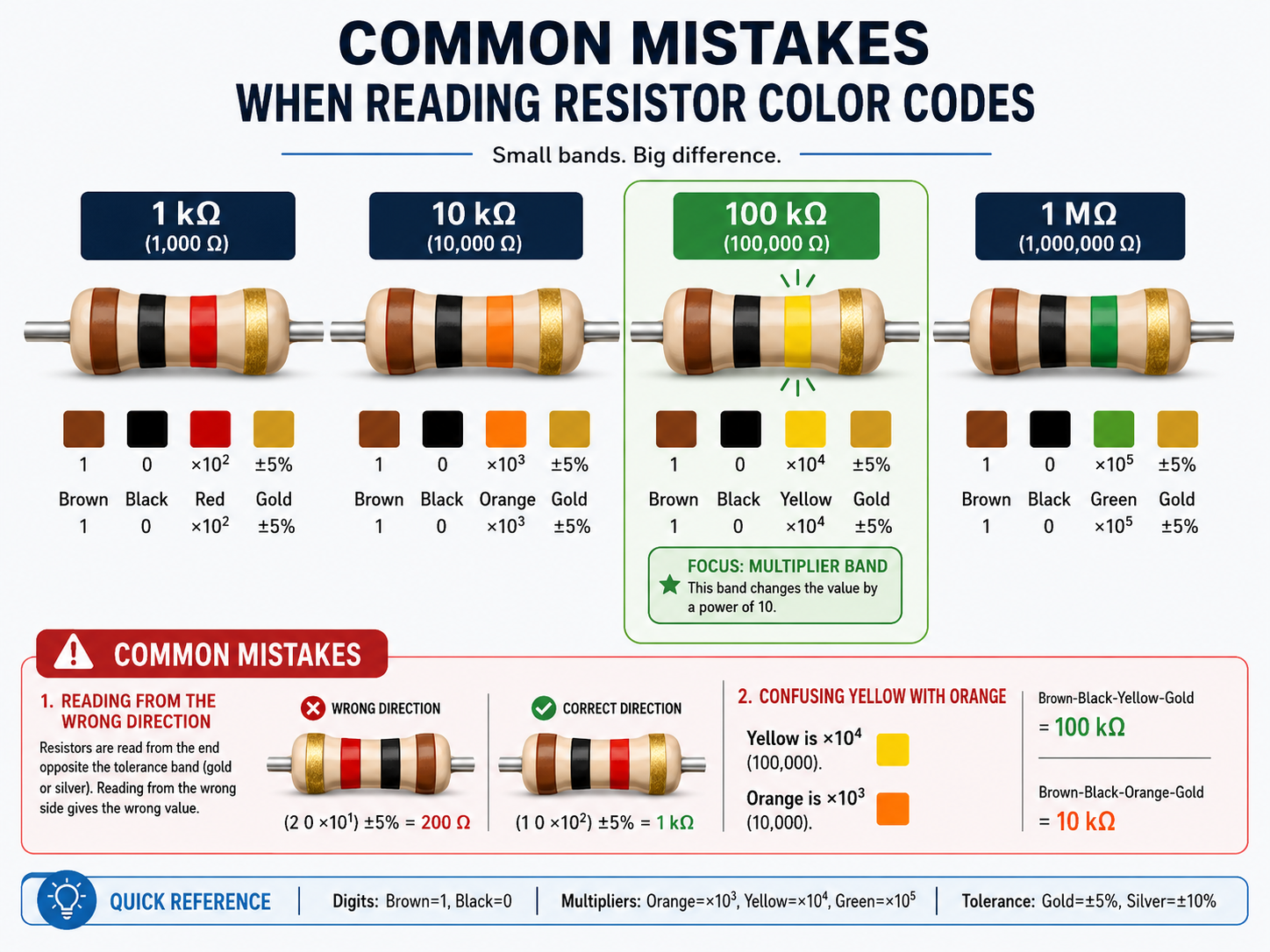
| Resistance | 4-Band Color Code | Calculation |
|---|---|---|
| 1kΩ | Brown – Black – Red – Gold | 10 × 100 |
| 10kΩ | Brown – Black – Orange – Gold | 10 × 1,000 |
| 100kΩ | Brown – Black – Yellow – Gold | 10 × 10,000 |
| 1MΩ | Brown – Black – Green – Gold | 10 × 100,000 |
The first two colors may stay the same, while the multiplier changes. That is why the third band is critical when reading 4-band resistors.
For 100kΩ, the multiplier band must be yellow in a standard 4-band code. If the third band is orange, the part is 10kΩ. If it is green, the part is 1MΩ.
Where Are 100kΩ Resistors Commonly Used?
A 100kΩ resistor is useful when a circuit needs a high resistance value with low current flow. It is not usually selected for power-heavy circuits. Instead, it is common in signal control, biasing, logic-level management, and sensing applications.
| Application | How 100kΩ Is Used |
|---|---|
| Pull-up / pull-down circuits | Sets a default logic state with low current consumption |
| Voltage dividers | Helps scale voltage for ADC, MCU, or sensing circuits |
| Transistor biasing | Sets base or gate bias in low-current circuits |
| RC timing circuits | Works with capacitors to create delay or filtering behavior |
| Sensor circuits | Supports signal conditioning and input impedance control |
| Feedback networks | Helps define gain, reference level, or response behavior |
| Battery-powered devices | Reduces standby current in low-power designs |
In PCB design, 100kΩ resistors often appear around microcontrollers, op-amps, MOSFET gates, reset pins, feedback loops, and analog input circuits.
What Materials Are Used for 100kΩ Resistors?
A 100kΩ resistor can be made with different resistor technologies. The right type depends on tolerance, stability, noise, cost, package size, and operating environment.
| Resistor Type | Typical Strength | Common Use |
|---|---|---|
| Carbon Film | Economical and widely available | General-purpose circuits |
| Metal Film | Better tolerance and lower noise | Analog and precision circuits |
| Thick Film Chip Resistor | Cost-effective for SMT assembly | Consumer, industrial, and control boards |
| Thin Film Chip Resistor | High precision and stable performance | Measurement, medical, instrumentation |
| High-Voltage Resistor | Better voltage handling | Power supplies, sensing, industrial equipment |
For most PCBA projects, a 100kΩ resistor is selected as a through-hole axial resistor or an SMD chip resistor. Through-hole parts often use color bands. SMD resistors usually use printed numeric codes, reel labels, or manufacturer part numbers.
How Do You Identify a 100kΩ SMD Resistor?
SMD resistors usually do not use color bands. Instead, they often use numeric markings. Common SMD markings for 100kΩ include:
| Marking | Meaning | Resistance |
|---|---|---|
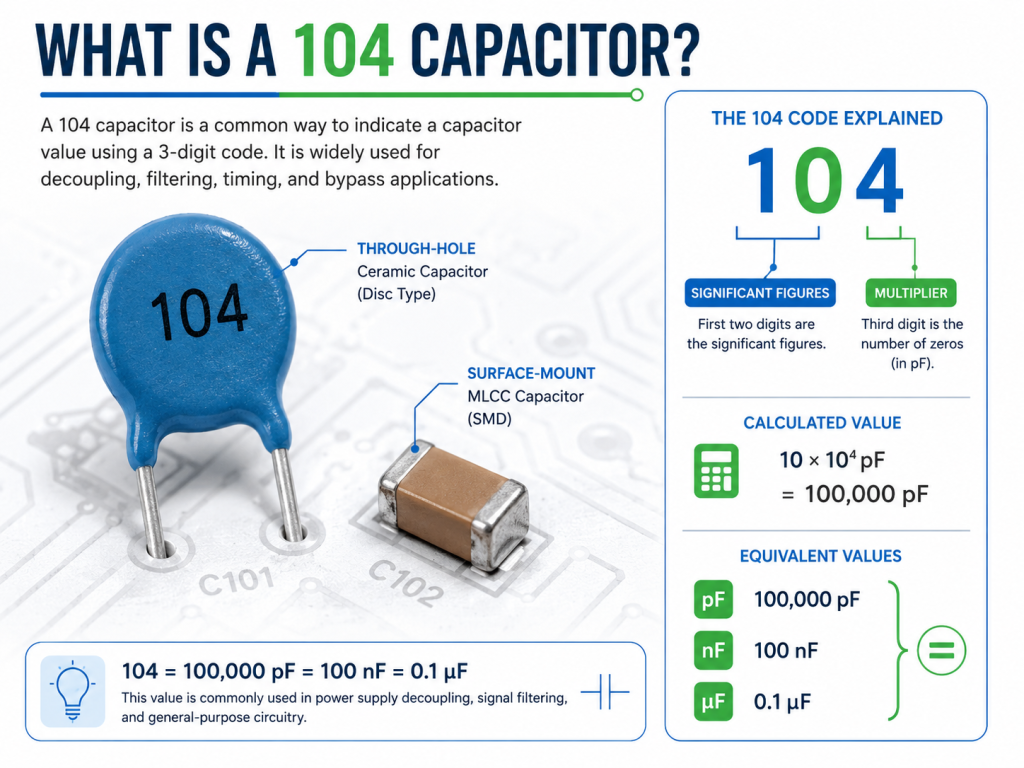
| 104 | 10 + 4 zeros | 100,000Ω |
| 1003 | 100 × 1,000 | 100,000Ω |
| 1002 | 100 × 100 | 10,000Ω |
| 105 | 10 + 5 zeros | 1,000,000Ω |
For a 3-digit code, the first two digits are significant figures, and the third digit is the multiplier. So 104 means 10 × 10,000 = 100kΩ.
For a 4-digit code, the first three digits are significant figures, and the fourth digit is the multiplier. So 1003 means 100 × 1,000 = 100kΩ.
On modern small packages such as 0402 or 0201, markings may be absent. In that case, the BOM, reel label, manufacturer datasheet, and measurement process become more important.
How Do You Test a 100kΩ Resistor?
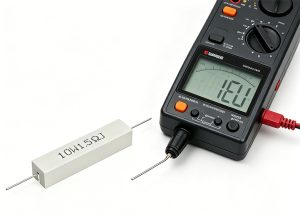
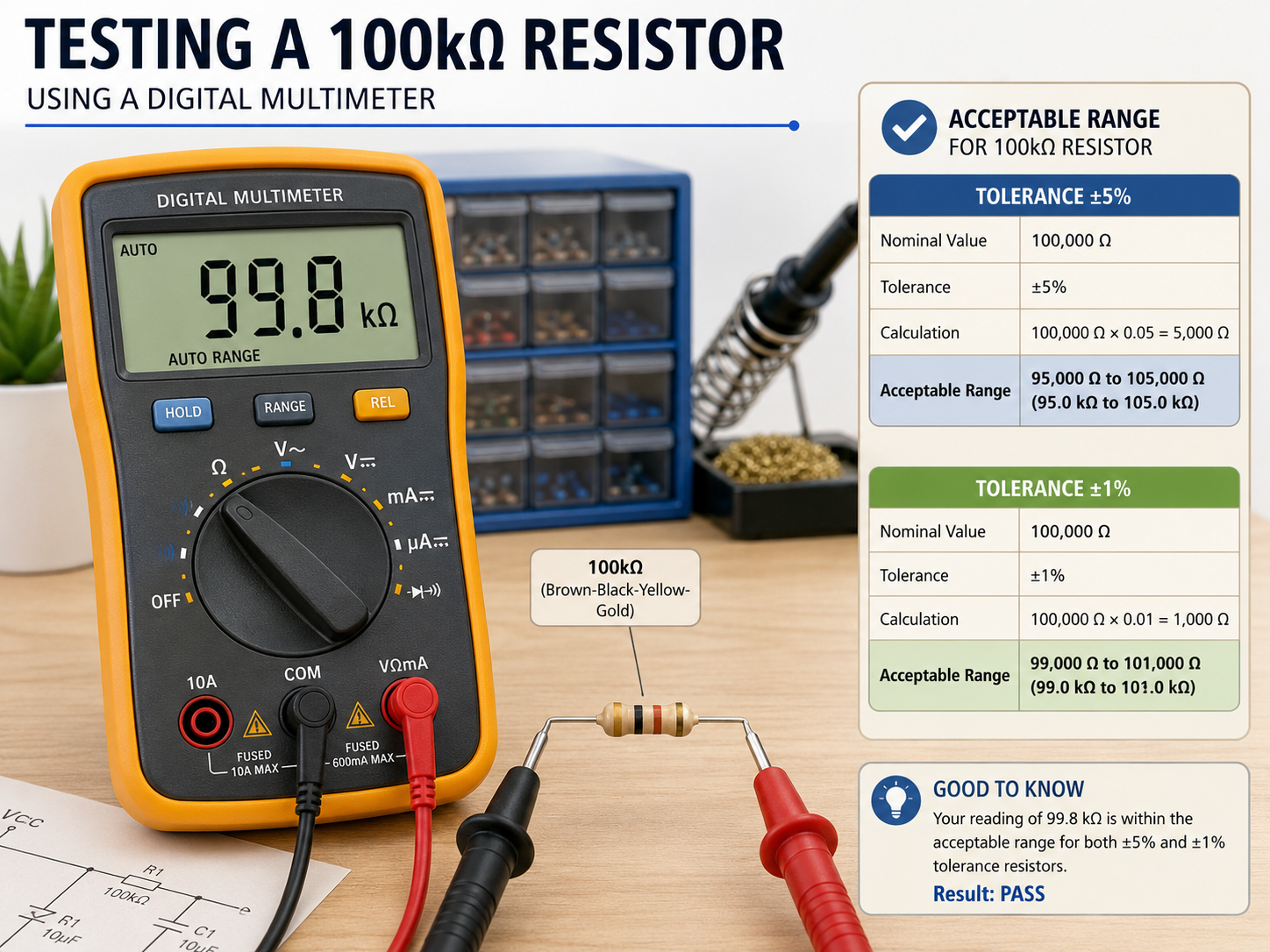
The simplest way to verify a 100kΩ resistor is to use a digital multimeter in resistance mode.
- Set the multimeter to resistance mode.
- Touch the probes to both resistor leads or pads.
- Read the measured value.
- Compare the result with the tolerance range.
For a 100kΩ ±5% resistor, the acceptable range is:
95kΩ to 105kΩ
For a 100kΩ ±1% resistor, the acceptable range is:
99kΩ to 101kΩ
When the resistor is already soldered onto a PCB, the reading may be affected by parallel circuit paths. If the measured value looks lower than expected, it does not always mean the resistor is defective. For accurate confirmation, remove one leg from the circuit or check the schematic first.
What Common Mistakes Happen When Reading a 100kΩ Resistor?
The most common mistake is reading the resistor from the wrong direction. The tolerance band is usually separated from the other bands by a slightly larger gap or positioned closer to one end. If the resistor is read backward, the value can be misidentified.
| Mistake | Result |
|---|---|
| Confusing yellow and orange | 100kΩ may be mistaken for 10kΩ |
| Confusing brown and red tolerance | ±1% may be mistaken for ±2% |
| Reading a 5-band resistor as 4-band | Precision value may be decoded incorrectly |
| Measuring in-circuit | Parallel components may lower the reading |
| Ignoring power rating | The resistor may overheat in operation |
| Using only color bands for procurement | Package, tolerance, and voltage rating may be missed |
A good engineering habit is to confirm the resistor value from three sources when possible: color code, BOM, and measurement.
What Failure Problems Can Happen with 100kΩ Resistors?
A 100kΩ resistor usually carries low current, but failures can still occur in real products. In PCB assembly and field operation, the issue is often not the nominal value itself. It is usually wrong placement, wrong tolerance, environmental stress, contamination, or circuit-level overstress.
| Failure Mode | Possible Cause | Practical Check |
|---|---|---|
| Wrong resistance value | Mixed reels, wrong BOM, manual placement error | Check BOM, reel label, AOI, and DMM reading |
| Open circuit | Mechanical crack, thermal stress, poor solder joint | Inspect solder joints and measure continuity |
| Resistance drift | Heat, humidity, aging, material instability | Compare with tolerance and datasheet limits |
| Noise in analog signal | Low-grade resistor technology | Use metal film or thin film type |
| Overheating | Power or voltage rating exceeded | Recalculate power dissipation |
| Leakage or unstable reading | Flux residue or contamination | Clean PCB and inspect surface insulation |
For mass production, the best control method is not only checking the color bands. It is to lock the approved part number, verify reel labels, use first-article inspection, and apply electrical testing when the circuit is value-sensitive.
How Should Engineers Choose a 100kΩ Resistor?
Selecting a 100kΩ resistor should not stop at resistance value. The circuit requirement decides the final specification.
| Parameter | What to Confirm |
|---|---|
| Resistance | 100kΩ / 100,000Ω |
| Tolerance | ±5%, ±1%, ±0.5%, or ±0.1%, depending on circuit need |
| Power Rating | 1/8W, 1/4W, 1/2W, or SMD package power rating |
| Package | Axial, 1206, 0805, 0603, 0402, 0201 |
| Temperature Coefficient | Important for precision and temperature-sensitive circuits |
| Voltage Rating | Important in high-voltage dividers and industrial circuits |
| Resistor Technology | Carbon film, metal film, thick film, thin film |
| Compliance | RoHS, REACH, AEC-Q200 when required |
| Operating Environment | Temperature, humidity, vibration, coating, and lifespan |
For a simple pull-up resistor, ±5% may be enough. For analog feedback, sensing, medical electronics, or industrial measurement circuits, ±1% or better is often more suitable.
What Should Buyers Check Before Ordering 100kΩ Resistors?
For purchasing teams, the color code is useful for identification, but it is not enough for sourcing. A purchase specification should include the complete electrical and mechanical requirement.
- Exact resistance value: 100kΩ
- Tolerance requirement
- Package size or through-hole body size
- Power rating
- Temperature coefficient
- Voltage rating
- Resistor technology
- Manufacturer part number
- Approved alternative brands
- RoHS / REACH compliance
- AEC-Q200 requirement for automotive projects
- Packaging format: tape and reel, cut tape, bulk, ammo pack
- MOQ, lead time, and lot traceability
- Required test report or CoC if needed
In OEM and ODM production, resistor substitution should be controlled. A 100kΩ part from another brand may look equivalent, but tolerance, TCR, voltage rating, noise, and reliability grade can still affect performance.
FAQs
What is the color code for a 100k ohm resistor?
The standard 4-band 100k ohm resistor color code is Brown – Black – Yellow – Gold. Brown means 1, black means 0, yellow means multiply by 10,000, and gold means ±5% tolerance. The final value is 100,000 ohms, or 100kΩ.
What is the 5-band color code for a 100kΩ resistor?
A common 5-band 100kΩ resistor uses Brown – Black – Black – Orange – Brown for ±1% tolerance. The first three bands form 100, the orange band means ×1,000, and the final brown band means ±1%. Other tolerance colors may be used depending on the part.
Is 100kΩ the same as 100,000 ohms?
Yes. 100kΩ means 100 kilo-ohms, and one kilo-ohm equals 1,000 ohms. So 100kΩ equals 100,000 ohms. In schematics and BOMs, it may also appear as 100K, 100 k, 100kR, or 100,000Ω.
What does the gold band mean on a 100k resistor?
The gold band usually means the resistor has ±5% tolerance. For a 100kΩ resistor, ±5% means the real measured value can range from 95kΩ to 105kΩ. This is acceptable for many general-purpose circuits, but precision circuits may need tighter tolerance.
How can I tell the reading direction of a resistor?
Start from the band closest to one end of the resistor body. The tolerance band is often slightly separated from the other bands and may be gold or silver. If the resistor has five or six bands, check the spacing carefully before decoding the value.
Can I measure a 100kΩ resistor while it is still on the PCB?
You can measure it, but the result may not be accurate because other components may be connected in parallel. If the measured value is lower than expected, check the schematic first. For reliable confirmation, lift one resistor lead or remove the part from the board.
What is the SMD code for a 100kΩ resistor?
A common 3-digit SMD marking for 100kΩ is 104. This means 10 followed by four zeros, or 100,000 ohms. A common 4-digit marking is 1003, meaning 100 × 1,000. Very small SMD resistors may have no visible marking.
Is a 100kΩ resistor suitable for pull-up circuits?
Yes, 100kΩ can be used as a pull-up or pull-down resistor when low current consumption is important. However, it may be too weak for noisy environments or fast signal transitions. Engineers should check the input leakage current, signal speed, and circuit noise margin.
Does resistor color code show power rating?
No. The color bands show resistance value and tolerance, and sometimes temperature coefficient on 6-band resistors. Power rating is determined by the resistor size, construction, package, and datasheet. A 100kΩ resistor must still be checked for power and voltage stress.
Why does my 100kΩ resistor measure 98kΩ?
A 98kΩ reading can be normal if the resistor tolerance allows it. For a ±5% 100kΩ resistor, any value from 95kΩ to 105kΩ is acceptable. For a ±1% resistor, 98kΩ would be outside the normal range and should be checked further.
What resistor type is best for precision 100kΩ circuits?
For precision analog, sensing, or feedback circuits, metal film or thin film resistors are usually better choices. They offer tighter tolerance, lower noise, and better stability than many general-purpose carbon film or thick film parts. Always confirm TCR and long-term drift in the datasheet.
Can a wrong 100kΩ resistor cause a PCB assembly failure?
Yes. A wrong value can affect timing, bias voltage, feedback ratio, signal level, and standby current. In mass production, even a small value mistake may create unstable startup, inaccurate sensing, or functional test failure. BOM control and first-article inspection help reduce this risk.
Conclusion
The 100k ohm resistor color code is simple once the band logic is clear. For a common 4-band resistor, Brown – Black – Yellow – Gold means 100kΩ ±5%. For a 5-band precision resistor, Brown – Black – Black – Orange gives the 100kΩ value, while the final band defines tolerance.
For engineering use, do not judge the part only by color. Confirm tolerance, package, power rating, voltage rating, temperature coefficient, resistor technology, and compliance requirements. For purchasing and production, use the BOM, approved manufacturer list, reel label, inspection process, and electrical testing together to reduce wrong-value risks.
If you are working on OEM manufacturing, ODM production, sample development, mass production, or custom engineering projects, resistor selection should be tied to the circuit function, product reliability target, and assembly quality plan.