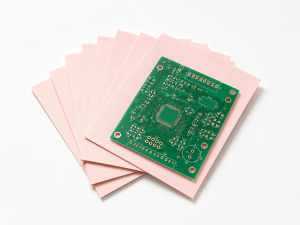
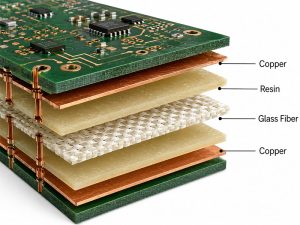
Isola 185HR is a high-Tg epoxy laminate and prepreg system for multilayer PCB designs that must handle thermal stress, dense vias and long service life. It is often selected when standard FR-4 cannot provide enough margin for lead-free assembly, controlled impedance or repeated thermal cycling.
This guide explains the Isola 185HR datasheet, material properties, dielectric constant, thermal conductivity, laminate thickness, PCB processing and stack-up design. It also compares this material with FR-4 and 370HR, so engineers and buyers can make a clearer decision before prototype or mass production.
What Is 185HR and Why Is It Used in PCBs?
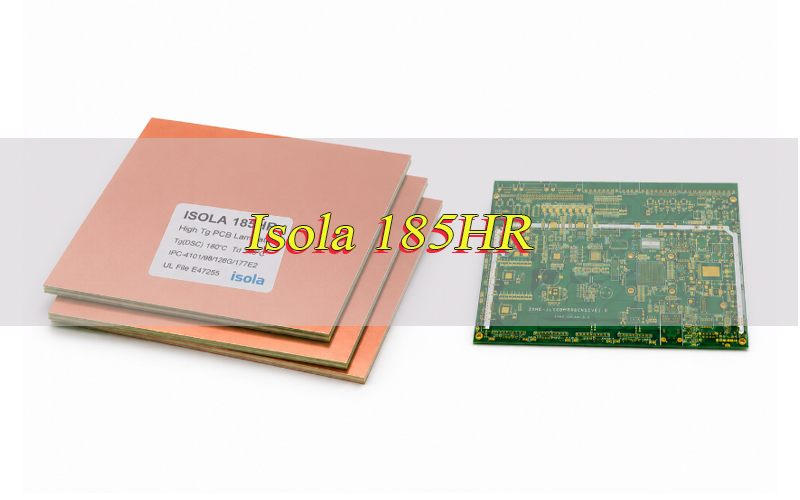
Isola 185HR is a high-reliability epoxy laminate and prepreg material with Tg 180°C and Td 340°C for multilayer PCB applications. It is reinforced with electrical-grade glass and designed to reduce Z-axis expansion during soldering, rework and thermal cycling.
The material is used because plated holes, resin systems and inner-layer structures can fail when a PCB faces repeated temperature changes. Therefore, this laminate is useful for high layer counts, dense vias, lead-free assembly and products that must remain stable in long-term field operation.
In practical PCB manufacturing, Isola 185HR gives the board better thermal margin, stronger plated-through-hole reliability and more stable multilayer performance than many standard FR-4 materials. This makes it a common choice for designs where failure cost is higher than the material upgrade cost.
What Applications Commonly Use Isola 185HR PCB Material?
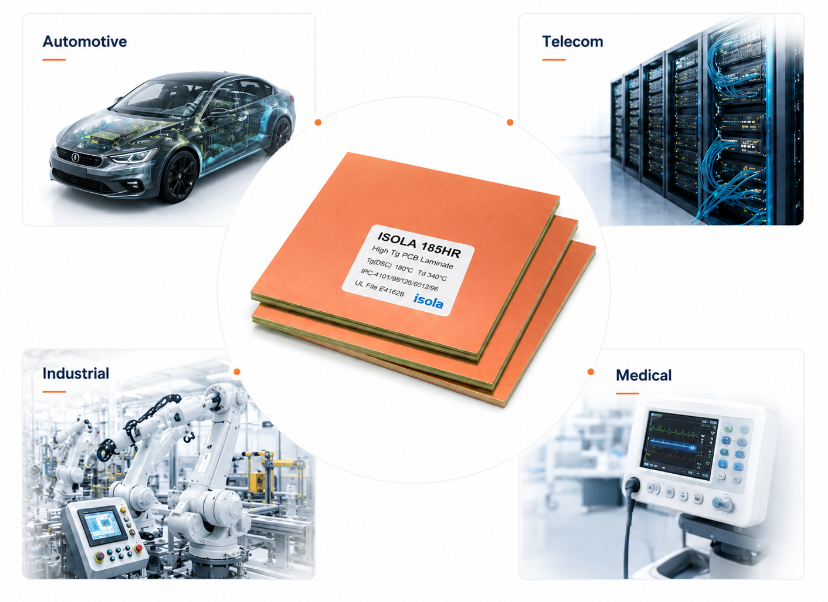
Isola 185HR PCB material is best used in multilayer applications where thermal cycling, via reliability and long-term field stability are critical. It fits projects that need stronger material performance without moving to much more expensive RF, ceramic or metal-based substrates.
Common applications include:
- Automotive electronics: Control units, battery systems, power modules and sensor boards that face heat, vibration and long service life requirements.
- Telecom and networking: Servers, routers, switches, communication backplanes and high-layer-count signal boards.
- Industrial electronics: Motor drives, automation controllers, power supplies and monitoring systems.
- Medical devices: Diagnostic instruments, monitoring equipment and control boards that require stable insulation and reliable assembly.
- Aerospace and defense: Control electronics where material stability, traceability and inspection requirements are stricter.
- Dense consumer electronics: Compact multilayer PCB designs with demanding soldering and reliability conditions.
These applications share the same requirement: the PCB must stay reliable after fabrication, assembly, testing and real operating stress. For this reason, material selection should be reviewed together with stack-up design, copper weight, via structure and inspection level.
What Does the Isola 185HR Datasheet Include?
The Isola 185HR datasheet includes the key thermal, electrical, mechanical, insulation and compliance data needed for PCB material selection. Engineers use these values to check whether the laminate can support the required assembly profile, impedance target, finished thickness and reliability class.
| Item | Typical Data |
|---|---|
| Material | High-performance epoxy laminate and prepreg |
| Tg | 180°C by DSC, 185°C by DMA |
| Td | 340°C at 5% weight loss |
| Dk | 4.01 at 2 GHz |
| Df | 0.0200 at 2 GHz |
| Thermal Conductivity | 0.4 W/m·K |
| Z-Axis CTE | 40 ppm/°C pre-Tg, 220 ppm/°C post-Tg |
| Moisture Absorption | 0.15% |
| Flammability | UL 94 V-0 |
| Recognition | IPC-4101 /98 /99 /101 /126, UL File E41625 |
The datasheet is the starting point, not the final design answer. Final PCB performance also depends on copper weight, resin content, glass style, stack-up balance, lamination control, drilling quality and inspection method.
For controlled impedance, thermal reliability or high-layer-count PCB production, the datasheet should be reviewed together with the manufacturer’s available core, prepreg and copper combinations. This avoids selecting a material value that cannot be matched in real production.
What Are the Properties of Isola 185HR?
The key Isola 185HR properties are high Tg, high Td, low Z-axis expansion, CAF resistance, lead-free compatibility and stable multilayer manufacturability. These properties help reduce the risk of barrel cracking, delamination, insulation failure and moisture-related assembly problems.
Core properties include:
- Tg 180°C: Improves thermal stability during lead-free soldering, rework and operating temperature changes.
- Td 340°C: Provides stronger resistance to resin decomposition during high-temperature PCB processing.
- Low Z-axis expansion: Helps protect plated-through holes from stress during thermal cycling.
- CAF resistance: Supports dense spacing and voltage-biased circuits where long-term insulation matters.
- Moisture absorption 0.15%: Helps reduce moisture-related blistering and insulation instability.
- FR-4 process compatibility: Allows practical PCB fabrication without moving to highly specialized laminate processing.
The material is not a dedicated low-loss RF laminate. Its main strength is the balance of thermal reliability, mechanical stability, electrical consistency and manufacturability for demanding PCB production.
What Is the Dielectric Constant of Isola 185HR?
The dielectric constant of Isola 185HR is typically 4.01 at 2 GHz, but the usable value changes with frequency, resin content, glass style and copper roughness. This matters because controlled impedance traces depend on dielectric thickness, Dk, copper thickness and trace geometry.
| Frequency | Dk | Df |
|---|---|---|
| 100 MHz | 4.13 | 0.0158 |
| 1 GHz | 4.04 | 0.0192 |
| 2 GHz | 4.01 | 0.0200 |
| 5 GHz | 3.88 | 0.0235 |
| 10 GHz | 3.88 | 0.0236 |
For accurate impedance control, engineers should not use one generic Dk value for every layer. The correct calculation should be based on the approved core, prepreg construction, resin percentage, copper thickness and final press-out thickness.
This is especially important for high-speed digital PCB designs, where small dielectric changes can affect impedance, signal timing and insertion loss. Therefore, impedance design should be confirmed before layout, not adjusted after fabrication problems appear.
What Is the Thermal Conductivity of Isola 185HR?
The thermal conductivity of Isola 185HR is typically 0.4 W/m·K, which is normal for glass-reinforced epoxy laminate. It improves material reliability under heat, but it should not be treated like aluminum PCB, copper base PCB or ceramic substrate material.
Therefore, heat management should rely on PCB structure. Wide copper areas, power planes, thermal vias, copper thickness, component placement and heat spreading paths usually affect thermal performance more than the dielectric itself.
For power electronics, Isola 185HR can support reliable board construction, but it cannot replace proper thermal design. If the project has high current, hot components or limited airflow, the PCB should use enough copper, suitable via arrays and a clear heat path to the mechanical enclosure or heat sink.
For extreme heat transfer, a metal core PCB, copper substrate or ceramic PCB may be more suitable. The best choice depends on heat density, electrical insulation requirements, mechanical structure and total project cost.
What Thickness Options Are Available for Isola 185HR Laminate?
Isola 185HR laminate thickness depends on core type, prepreg construction, glass style, resin content and copper weight. Common thin core options include 0.0025 inch, 0.003 inch, 0.0035 inch, 0.004 inch and 0.005 inch, with thicker core options also available for multilayer PCB designs.
| Construction | Thickness | Use Case |
|---|---|---|
| Thin Core | 0.0025–0.005 inch | HDI, impedance control, compact layer spacing |
| Medium Core | 0.006–0.014 inch | Standard multilayer signal layers |
| Thick Core | 0.018 inch and above | Power layers, stiffness, special stack-ups |
| Prepreg | Based on glass and resin | Bonding, dielectric spacing, resin fill |
| Copper Foil | 0.5–2 oz standard | Signal, power and plane layers |
For finished PCB thickness such as 1.0 mm, 1.6 mm, 2.0 mm or thicker boards, the final structure should be built from available cores, prepregs and copper weights. It is not selected from one fixed laminate thickness.
This is why stack-up approval is important before layout. If impedance, copper weight and finished thickness are fixed too late, the manufacturer may need to change dielectric spacing or prepreg selection, which can affect impedance and delivery time.
Isola 185HR vs FR4: Which Is Better?
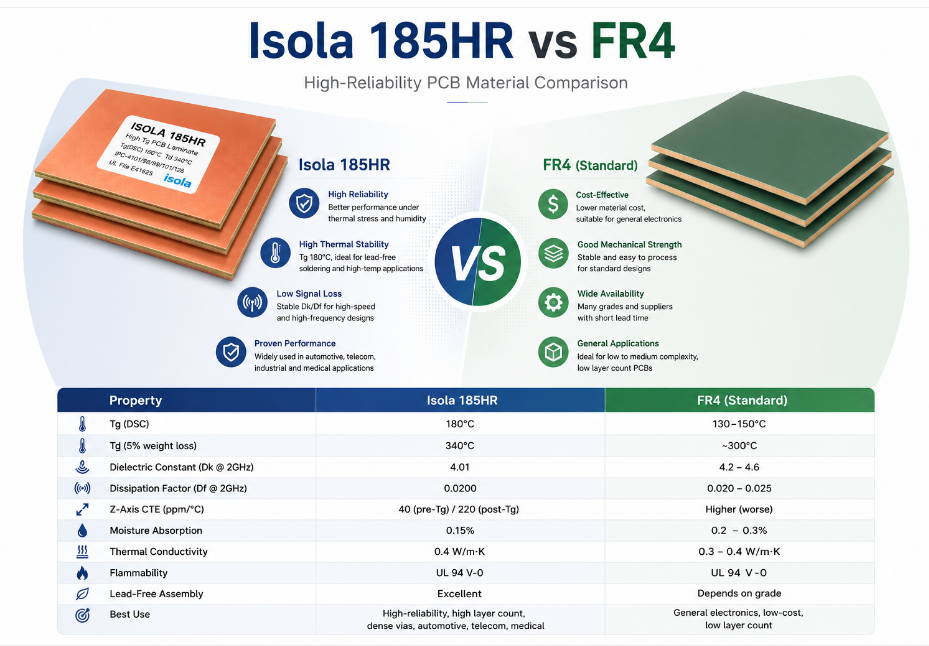
Isola 185HR is better for high-reliability multilayer PCB designs, while standard FR-4 is better for simple, low-cost and less demanding boards. The right choice depends on operating temperature, assembly profile, layer count, via density and expected service life.
| Factor | Isola 185HR | Standard FR-4 |
|---|---|---|
| Tg | 180°C | Often 130–150°C |
| Td | 340°C | Usually lower |
| Thermal Cycling | Stronger margin | Limited margin |
| Lead-Free Assembly | Better suited | Depends on grade |
| Via Reliability | Better for dense multilayer PCB | Suitable for simple boards |
| Cost | Higher | Lower |
| Best Fit | Automotive, telecom, industrial, medical | Consumer, basic control, low-cost boards |
Choose Isola 185HR when the PCB has dense vias, high layer count, repeated reflow, high operating temperature or strict reliability requirements. In these cases, the higher material cost can reduce the risk of field failure, rework and warranty problems.
Choose standard FR-4 when the product is low-temperature, low-layer-count and price-driven. For simple consumer electronics or basic control boards, standard FR-4 may be enough if the assembly and reliability requirements are not demanding.
Isola 185HR vs 370HR: Which PCB Material Should You Choose?
Both Isola 185HR and 370HR target high-reliability PCB applications, but the final choice should follow the approved material list, stack-up design, electrical requirements and supply availability. Both are high-Tg materials, but they may be preferred for different project histories and factory process preferences.
| Factor | Isola 185HR | Isola 370HR |
|---|---|---|
| Tg | 180°C | 180°C |
| Material Class | High-reliability epoxy laminate/prepreg | High-performance FR-4 epoxy laminate/prepreg |
| Thermal Reliability | Strong | Strong |
| CAF Resistance | Yes | Yes |
| Processing | FR-4 compatible | FR-4 compatible |
| Typical Use | Thermally robust multilayer PCB with stable electrical data | Broad high-reliability FR-4 replacement |
| Selection Basis | Dk/Df, stack-up, stock, cost | AVL history, process comfort, project preference |
If a customer already specifies 370HR in an approved design, it is usually safer to follow the approved material list unless engineering review supports a change. Material changes may affect impedance, qualification, procurement documents and repeat production consistency.
For a new project, compare both materials by Dk/Df, stack-up availability, lead time, lamination yield, reliability target and cost. The best option is the material that matches both design performance and stable production supply.
What Should You Know About Isola 185HR PCB Processing?
Isola 185HR PCB processing is close to standard FR-4 fabrication, but the factory must control lamination, drilling, moisture and plated hole reliability more carefully. The material can support stable multilayer PCB production when each process is matched to its high-Tg resin system.
- Material verification: Confirm the laminate, prepreg type, copper weight and production lot before cutting. This reduces the risk of wrong material substitution during prototype or mass production.
- Inner-layer control: Keep etching, line width, spacing and AOI inspection stable. Dense multilayer PCB designs need accurate inner-layer registration before lamination.
- Lamination control: Use the approved press cycle, vacuum, pressure, temperature ramp and cure condition. Poor lamination may cause resin voids, thickness deviation, delamination or weak bonding.
- Resin flow management: Check prepreg selection when the PCB has heavy copper, dense copper patterns or large copper-free areas. Resin shortage can cause voids, while excessive resin flow can affect thickness and impedance.
- Drilling quality: Use suitable drill parameters to reduce smear, rough hole walls and glass fiber damage. Stable drilling is important because plated-through holes often decide long-term PCB reliability.
- Desmear and plating: Control desmear, electroless copper and copper plating thickness. Weak hole plating can lead to barrel cracks after thermal cycling or lead-free soldering.
- Moisture control: Store and bake boards properly before assembly when required. Moisture inside the PCB can increase the risk of blistering, delamination or soldering defects.
- Final inspection: Use AOI, electrical test, impedance test, microsection and visual inspection according to project requirements. High-reliability PCB orders should not rely on appearance inspection alone.
In production, the process should move from material verification to inner-layer fabrication, lamination, drilling, desmear, plating, outer-layer imaging, solder mask, surface finish, routing, electrical test and final inspection. Each step should be controlled as part of one reliability chain, not treated as an isolated operation.
How Do You Design an Isola 185HR Stack-Up for Multilayer PCBs?
An Isola 185HR stack-up should be designed around impedance, dielectric spacing, copper balance, resin fill, via reliability and finished board thickness. The material gives better thermal reliability, but the stack-up still determines electrical stability and manufacturability.
- Start with the finished PCB thickness: Confirm whether the board target is 1.0 mm, 1.6 mm, 2.0 mm or a custom thickness. The final structure should be built from available cores, prepregs and copper weights.
- Confirm impedance before layout: Use the correct Dk value, dielectric thickness and copper thickness for impedance calculation. Do not route controlled impedance traces before the stack-up is approved.
- Place signal layers near reference planes: High-speed traces should have a nearby ground or power reference plane. This helps control return current, reduce EMI and improve impedance consistency.
- Balance copper on both sides: Uneven copper distribution can cause bow, twist and lamination stress. For multilayer PCB designs, copper balance should be reviewed layer by layer.
- Check prepreg resin fill: Heavy copper, dense planes and large etched areas may require different prepreg choices. Resin fill affects bonding strength, void control and finished thickness.
- Review via aspect ratio: Thick PCB boards and small holes increase plating difficulty. The stack-up should match the manufacturer’s drilling and plating capability.
- Plan power and ground layers early: Power integrity depends on plane location, copper thickness and decoupling paths. Good stack-up design improves both electrical performance and thermal spreading.
- Confirm manufacturability before routing: The PCB manufacturer should review material availability, minimum spacing, hole size, copper weight and impedance tolerance before layout is finalized. This helps avoid redesign, quotation changes and production delay.
For high-speed, thick or high-layer-count PCB projects, stack-up review should happen before routing starts. Once the PCB layout is complete, changing dielectric spacing or copper weight may affect impedance, via design, board thickness and mechanical fit.
How Do You Choose a Reliable PCB Manufacturer for Isola 185HR Boards?
A reliable PCB manufacturer for Isola 185HR boards should prove material traceability, multilayer process control, impedance capability and high-reliability testing. In sourcing searches, “Isola 185HR manufacturer” usually means a PCB factory that can build boards with genuine Isola material, not the laminate producer.
- Check material sourcing: The supplier should confirm genuine laminate and prepreg, not a vague “equivalent material” unless you approve the substitution. Material traceability is important for repeat orders and reliability-sensitive projects.
- Ask for stack-up review: A capable manufacturer should review core, prepreg, copper weight, finished thickness and impedance before production. This helps find manufacturability risks before layout or order release.
- Evaluate multilayer capability: Isola 185HR is often used in dense or high-layer-count boards, so the factory must control registration, lamination and drilling accuracy. Weak multilayer control can cause misregistration, voids and hole reliability problems.
- Confirm impedance testing: For controlled impedance PCB orders, the supplier should support impedance coupon design, test reports and tolerance control. This is critical for high-speed digital and communication PCB designs.
- Review hole reliability control: Ask whether the factory can provide microsection inspection, plating thickness checks and thermal stress testing when the project requires high reliability. Plated hole quality is one of the most important reliability points in thick multilayer PCB production.
- Check quality standards: IPC Class 2 is common for commercial electronics, while IPC Class 3 may be required for aerospace, medical, automotive or mission-critical PCB applications. The inspection class should match the real product risk.
- Look at engineering communication: A good supplier will point out risks in copper balance, drill aspect ratio, resin fill or surface finish before production, not after defects appear. Early DFM feedback can save time and reduce hidden cost.
- Confirm global delivery support: For overseas buyers, choose a real China source factory with clear export documents, stable lead time, custom production and no false overseas factory claims. A transparent supply chain is safer than a supplier that cannot explain material source or production capability.
FAQs About Isola 185HR PCB Material
Q1: Is Isola 185HR suitable for lead-free reflow assembly?
A1: Yes. Isola 185HR is suitable for lead-free reflow because it has Tg 180°C and Td 340°C, giving stronger thermal margin than many standard FR-4 materials. However, thick boards, large copper areas and repeated reflow cycles still require correct baking, storage and assembly profile control.
Q2: Can Isola 185HR be used for controlled impedance PCB designs?
A2: Yes. It can be used for controlled impedance PCB designs, but the impedance model should use the actual core, prepreg, copper thickness and dielectric spacing. A generic Dk value is not enough. For stable results, request impedance coupons and confirm the test tolerance before production.
Q3: Is Isola 185HR suitable for HDI PCB production?
A3: It can be used for HDI PCB production when the stack-up, laser drilling, microvia structure and lamination sequence are reviewed early. The manufacturer must verify resin fill, dielectric thickness, copper balance and via reliability before confirming mass production.
Q4: What surface finish is commonly used with Isola 185HR boards?
A4: ENIG, lead-free HASL, OSP, immersion silver and immersion tin can all be used depending on the assembly method. ENIG is often preferred for fine-pitch components, longer shelf life and stable solderability. The final choice should match component type, cost, storage time and reliability class.
Q5: Does Isola 185HR require special PCB storage before assembly?
A5: It should be stored in a dry, clean and controlled environment like other high-reliability PCB materials. If the boards are exposed to humidity or stored for a long time, baking may be required before assembly to reduce blistering, delamination and moisture-related soldering problems.
Q6: Can Isola 185HR replace standard FR-4 without changing the stack-up?
A6: Not always. It may replace FR-4 in many projects, but the stack-up should still be reviewed. Material change can affect Dk, impedance, finished thickness, drilling parameters, lamination behavior and cost. Direct replacement without engineering review may create unexpected differences.
Q7: What is the density of Isola 185HR?
A7: Density is not usually the main selection factor for this material because actual board weight depends on glass style, resin content, copper weight and finished thickness. For mechanical weight calculation, use the approved PCB stack-up and panel data instead of assuming one fixed density value.
Q8: What copper weight can be used with Isola 185HR laminate?
A8: Common copper weights include 0.5 oz, 1 oz and 2 oz, depending on available laminate and project requirements. Heavier copper may be possible, but it requires careful review of resin fill, etching tolerance, spacing, lamination pressure and finished board thickness.
Q9: Is Isola 185HR good for high-frequency RF circuits?
A9: It can support many high-speed digital PCB designs, but it is not a dedicated low-loss RF laminate. If the project has strict RF loss, phase stability or very high-frequency requirements, PTFE-based or specialized low-loss laminates may be more suitable.
Q10: What are common defects in poorly processed Isola 185HR PCBs?
A10: Common defects include delamination, voids, resin smear, weak hole plating, warpage, impedance drift and moisture-related soldering issues. These problems usually come from poor lamination control, wrong drilling parameters, insufficient baking, unbalanced copper or weak final inspection.
Q11: What documents should buyers request for high-reliability orders?
A11: Buyers can request material confirmation, stack-up drawing, impedance report, electrical test record, microsection report and final inspection data. For stricter projects, IPC class, UL requirement, RoHS compliance and special reliability tests should be confirmed before production release.
Q12: How does Isola 185HR affect PCB cost?
A12: It usually costs more than standard FR-4 because the laminate targets higher thermal and reliability performance. The final price also depends on layer count, board thickness, copper weight, impedance control, surface finish, testing level and order quantity.
Q13: Can buyers specify Isola 185HR prepreg and core separately?
A13: Yes. For controlled stack-ups, buyers may specify core thickness, prepreg type, copper weight and finished thickness. This is common in impedance-controlled, high-layer-count or approved material list projects. If details are not specified, the PCB manufacturer should propose a manufacturable stack-up for approval.
Q14: How can buyers avoid fake or substituted material?
A14: Buyers should state “Isola 185HR or approved equivalent only with written approval” in the purchase requirement. They can also ask for material traceability and laminate confirmation. A reliable PCB manufacturer should not replace the specified material without customer approval.
Q15: What information should be sent for an accurate quotation?
A15: Send Gerber files, drill files, stack-up, finished thickness, copper weight, surface finish, solder mask color, quantity, IPC class, impedance requirements and test requirements. For controlled impedance or reliability testing, include tolerance, reference layers and inspection expectations.
Final Summary
Isola 185HR is a practical material choice for multilayer PCB projects that require better thermal reliability, stable dielectric performance and stronger plated hole durability than standard FR-4. It is especially useful for automotive, industrial, telecom, medical and other high-reliability applications where assembly heat, via stress and long-term field performance matter.
For the best result, review the material, stack-up, copper weight, impedance, drilling and inspection requirements before production starts. EBest Circuit is a China source factory providing custom PCB manufacturing, OEM/ODM support and global delivery for high-reliability PCB projects. Send your Gerber files, stack-up, impedance requirements and quantity to sales@bestpcbs.com for a fast engineering review and quotation.