PCB manufacturing PCB manufacturing
Home > Blog

What Are the Different Types of Ceramic PCBs?

July 6th, 2024

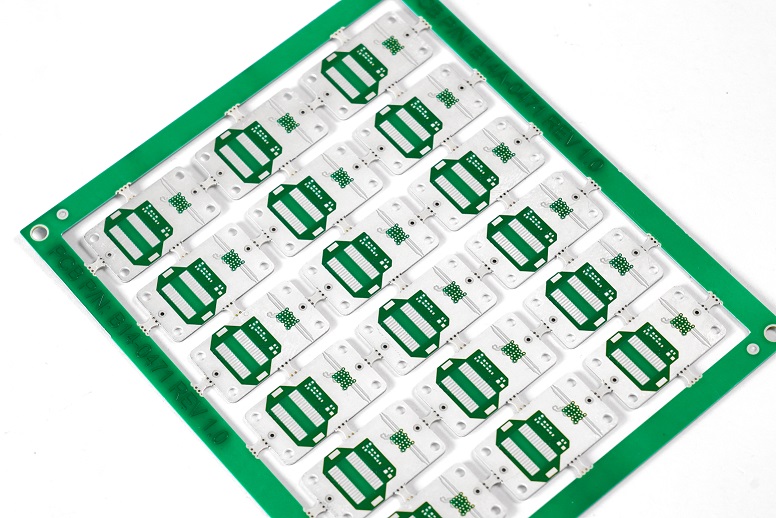
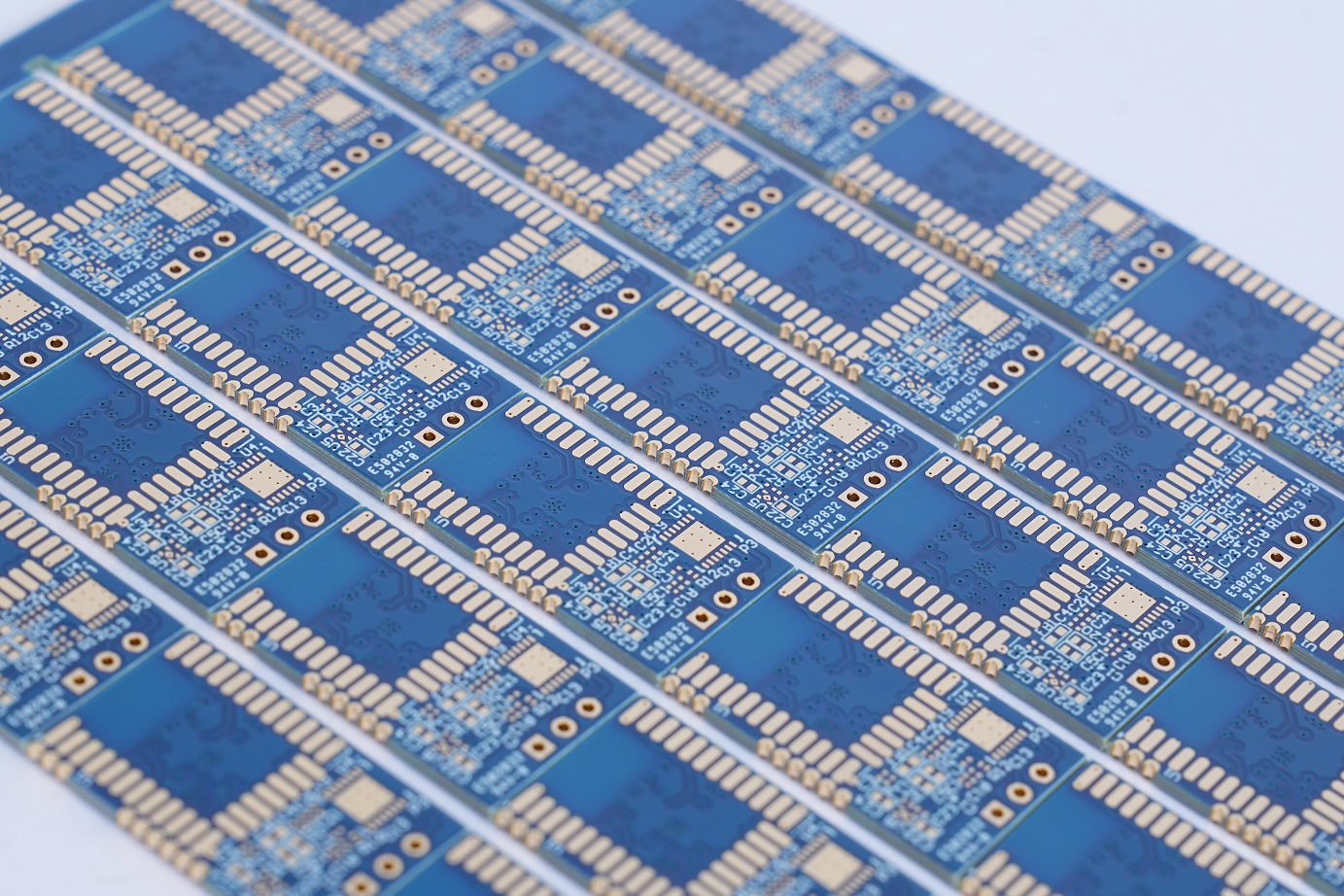
Ceramic PCBs are a special breed of printed circuit boards known for their exceptional thermal resistance and durability. These PCBs are used in industries where high performance is critical, such as aerospace, automotive, medical devices, and power electronics. Nowadays, the most common types of ceramic PCB are thick film, DCB, DPC, AMB, HTCC, LTCC and thin film. In this article, we will introduce each of them in details.

What are the different types of ceramic pcbs?

Thick Film Ceramic PCB

Thick film technology is a process by using screen printing conductor paste and directly deposit slurry (conductor) on the ceramic substrate. Then sintering it under high temperature to form conductive circuit traces and electrodes, which is suitable for most ceramic substrates.

After the material is sintered at high temperature, a strong adhesion film will be formed on the ceramic circuit board, repeat this step for many times, a multi-layer circuit is generated.

You can print resistor or capacitor on the surface to get a interconnected structure. At EBest Circuit (Best Technology), we can make all the resistors with the same value, or different value for different resistor on the same board.

What are the different types of ceramic pcbs?

Thick film ceramic PCB has advantages on the simple manufacturing process, but it has some drawbacks that can’t be ignored:

  • Limited by the conductive paste and screen size
  • Line width less than 100um is difficult to achieved
  • Three-dimensional patterns are not available
  • Not suitable for fine-trace project

DBC / DCB Ceramic PCB

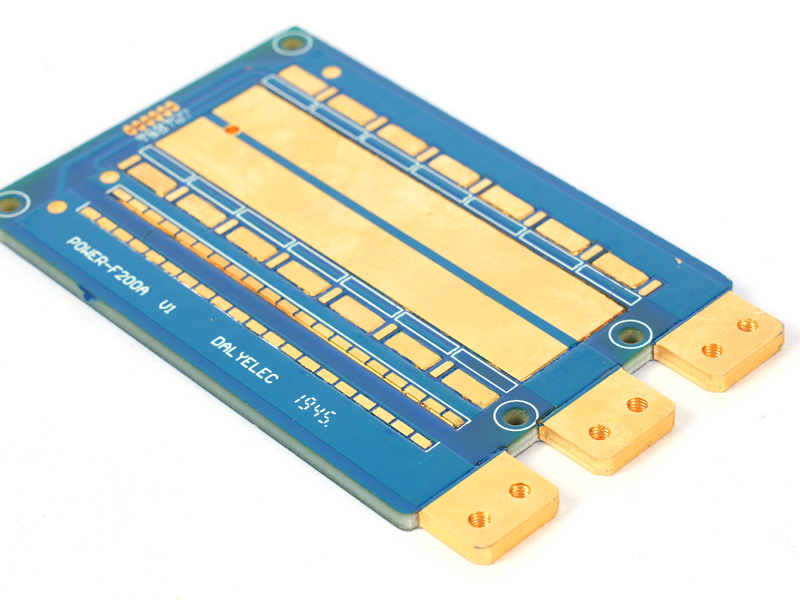
Direct Bonded Copper (DBC) or Direct Copper Bonded (DCB) ceramic PCBs are known for their excellent thermal conductivity. They are made by bonding a layer of copper directly onto a ceramic substrate, typically aluminum oxide or aluminum nitride. Due to the DBC technology is directly bond copper on the ceramic substrate, it can achieve thicker copper thickness to 300um. So, it is very suitable for high power applications.

The basic chemistry principle is to introduce an appropriate amount of oxygen between copper and ceramics before or during the application process. Copper and oxygen will form Cu-O eutectic liquid under 1065℃~1083℃. This is an important element in the manufacturing. DBC ceramic circuit board uses this eutectic solution to chemically react with the ceramic substrate to form CuAlO2 or CuAl2O4, achieving the combination between substrate and copper foil.

What are the different types of ceramic pcbs?

However, it is easy to generate micro-porosity between Al2O3 and Copper during the copper bonded process, and it doesn’t have a good solution by far. That is why the yield of DBC ceramic PCB is not good than DPC.

DPC (Direct Plated Copper Ceramic PCB)

DPC ceramic PCB utilizes direct copper plating technology, deposit copper foil on the alumina oxide (Al2O3) substrate. It is the most commonly used ceramic PCB in recent years. The circuit generated process is: pre-treatment – sputtering – exposure – develop – etch – strip – electroplating.

AMB (Active Metal Brazed Ceramic PCB)

AMB ceramic copper clad plate adopts the active brazing process, and the copper layer bonding force is higher than that of DPC, which is around 18n/mm – 21n/mm. AMB ceramic copper clad plate usually has a high binding force, usually makes thicker copper, between 100um and 800um. The AMB ceramic PCB generally rarely design traces or holes, even if there is a trace is very simple, the spacing is relatively wide.

HTCC (High Temperature Co-fired Ceramic PCB)

HTCC is a relatively early development technology, but due to the high sintering temperature (1300~1600℃), the choice of electrode materials is limited. Meanwhile, its cost is more expensive, these promotes the development of HTCC is relatively slow.

What are the different types of ceramic pcbs?

LTCC (Low Temperature Co-fired Ceramic PCB)

Although LTCC reduces the co-firing temperature to about 850 ° C, the disadvantage is that the dimensional accuracy and product strength are not easy to control.

Thin Film Ceramic Circuit Board

The thin film ceramic PCB is to deposit a metal layer directly on the surface of substrate by sputtering process. Through lithography, development, etching and other processes, the metal layer can also be graphed into a circuit pattern. Due to the low deposition speed of sputtering coating (generally less than 1ÎŒm/h), thin film substrate surface metal layer thickness is small and can prepare high pattern accuracy (line width/line space less than 10ÎŒm).

What are the different types of ceramic pcbs?

Common Ceramic Substrates

What are the different types of ceramic pcbs?

EBest Circuit (Best Technology) is a leading ceramic PCB manufacturer in Asia, our core members has over 20 years manufacturing experience in ceramic PCB fabricating. “High mixed, low volume, high quality, fast delivery” is our advantages and we always try our best to do that, make ourselves better and better. If you are interested in it, feel free to contact us, we are always online.

You may also like

Leading Ceramic PCB Board Manufacturer – EBest Circuit (Best Technology)

July 5th, 2024

With the gradual deepening of electronic technology in various application fields, the highly integrated circuit board has become an inevitable trend. Under this situation, the disadvantage of traditional circuit board FR-4 and CIM-3 in TC (thermal conductivity) has become a drawback to delay the development of electronic technology. Though the metal core PCBs are known for their good thermal management, they hard to meet the fast heat dissipation and miniaturization of the devices at the same time. This is why ceramic PCB stands out.

What is Ceramic PCB?

A ceramic PCB is a type of PCB made from ceramic materials, such as alumina (Al2O3), ALN (aluminum nitride), or Beryllium Oxide (BeO). These materials are prepared by using thermal conductive ceramic powder and organic adhesive under the condition of below 250℃. Ceramic powders are not easy to made, especially for aluminum nitride powder, this is one of reasons that why ALN ceramic PCB is more expensive.

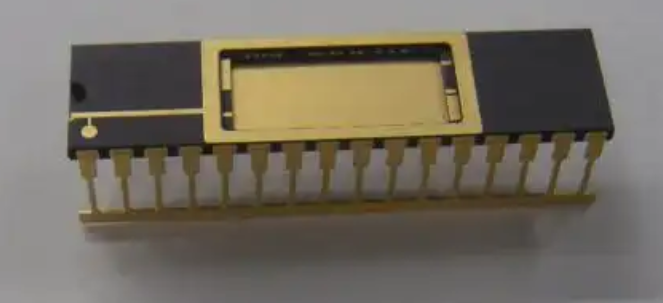
There are some different methods to make ceramic PCBs, commonly in the market are thick film, DBC, DPC and thin film technology. Different types of ceramic circuit boards have its unique characteristics. May you heard about HTCC, LTCC and AMB, they are also the ways to make ceramic PCBs, but there just a few manufacturers can make. Here is a HTCC ceramic PCB that we made.

HTCC ceramic PCB

Why Ceramic PCBs are popular used?

Different from the traditional FR-4 PCB (wave fiber), ceramic PCBs have good high-frequency properties, electrical properties that organic materials can’t achieved. It is a new generation of large-scale integrated circuits and power electronics module ideal packaging materials. The main advantages of ceramic circuit board including:

  • Higher thermal conductivity
  • More matched thermal expansion coefficient (CTE)
  • Lower resistance
  • Good weldability and can be used in high temperature
  • Good insulation
  • Lower high-frequency loss
  • High density assembly available
  • No organic ingredients, resistance to cosmic rays, high reliability in aerospace
  • No oxide layer in copper layer, so it can be used for a long time in a reducing atmosphere

Who is the Best Ceramic PCB Manufacturer?

There are so many PCB manufacturers in the domestic and aboard, but reliable ceramic PCB vendors with good quality and reasonable price are very few. If you are looking for an experienced one, then keep the change. We’re the best option! EBest Circuit (Best Technology) offers ceramic PCBs for our customers more than 100k every year, and we are high mixed from thick film ceramic PCB, DPC ceramic PCB, DBC/DCB ceramic PCB to AMB. Your PCBs need to use in automotives? Don’t worry, we gained IATF16949 and ISO13485 certifications, and all the manufacturing processes are strictly followed by ISO9001 quality control system. We welcome all the questions and inquiries from everyone.

Here is our ceramic PCB manufacturing capability for your reference.

Ceramic PCB Manufacturing Capability
No. ItemGeneral ParameterSpecial Process
1SubstrateHigh insulation, chemical corrosion resistance, high-temperature resistanceAl2O3Glass, quartz, sapphire, 99% , 92% Al2O3 (black)
2Excellent thermal conductivity, low thermal expansion coefficient, and high-temperature resistanceAIN
3Insulation performance and high-temperature stabilityZTA
4High strength, high hardness, high thermal conductivity, and low dielectric lossSi3N4
5ConductorTungstenLTCC/HTCC)、Au、Au&Pd、Au&Pb、Ag、Ag&Pd、Ag&Pb
6Layer CountDPCSingle – Double sided 
7DBCSingle – Double sided 
8AMBSingle – Double sided 
9Thick filmSingle – Double sided, 4L 
10LTCCSingle – Double sided, 4L, 6L6L – 14L
11HTCCSingle – Double sided, 4L, 6L 
12Copper ThicknessInner layer/ 
13Outer layerHoz-3oz (DPC), 3oz-12oz(DBC/AMB) 
14DimensionMax. dimension130*180Larger dimension available (pass evaluation)
15Min. dimension2*2Shipped in panel
16Substrate thicknessAl2O3/AIN 0.38. 0.635, 1.0mm, Si3N4 0.25、0.32mm>1.5
17Surface Treatment
(thickness)
OSP0.2-0.5um/
18ENIG1-3u”Au120-320u”Ni/
19Immersion silver6-12u”/
20Immersion tin≄1um/
21ENEPIGAu 2u”, Pd 1U”, Ni 100u”/
22Hard gold5-30u”AuïŒ‰ă€120-200u”Ni/
23DrillMin. PTH0.05MM/
24Min. NPTH0.05MM/
25Max. aspect ratio (PTH PCB)5:1/
26NTPH tolerance±0.05/
27PTH tolerance±0.05/
28Line width/ Line spacingInner layerLine width≄0.1mm; Line space≄0.1mm0.076/0.076mm
29Outer layer1OZ; Line width≄0.12mm; Line space≄0.12mm0.1/0.1mm
302OZLine width≄0.2mm; Line space≄0.2mm0.15/0.15mm
313OZLine width≄0.25mm; Line space≄0.25mm0.2/0.2mm
324OZLine width≄0.35mm; Line space≄0.35mm0.3/0.3mm
335OZLine width≄0.45mm; Line space≄0.45mm0.4/0.4mm
346OZLine width≄0.55mm; Line space≄0.55mm0.5/0.5mm
35Thick film; Line width≄0.1mm; Line space≄0.1mm0.076/0.076mm
36Line width tolerance±20%/
37Solder Mask (SM) /SilkscreenConductorGlass glaze, medium, solder mask ink/
38SM colorWhite, black, greenMixed color
39Silkscreen colorWhite, blackMixed color
40Silkscreen height, widthLine width≄0.13mm; Height≄0.8mm/
41SM thickness≄20um/

You may also like

High Speed PCB: How to Design It?

July 3rd, 2024

In today’s tech-driven world, creating efficient high speed PCB (Printed Circuit Board) is critical for ensuring devices can handle rapid data transfer without issues. These high speed PCBs are popular in the wireless devices which needs high signal transfer. Crafting high-speed circuits requires careful planning and precise execution to maintain signal quality and overall performance. In this blog, we introduced the basics of high-speed PCB design, offering practical tips and insights into the best materials and techniques for high-frequency applications.

What is a High Speed Circuit PCB?

High-speed PCB is a circuit board that can support signal transmission. High-speed signals usually refer to signals with frequencies higher than 50MHz, such as high-speed digital signals, high-speed analog signals, etc. These fast transitions can introduce challenges like signal reflections, electromagnetic interference (EMI), and crosstalk, which can disrupt performance if not properly managed.

Additionally, these signals will be affected by board materials, layout, wiring and other factors during transmission. Therefore, a specially designed circuit board is required to ensure the integrity and reliability of the signal. Here is a 4 layers high speed PCB for Iradar device with 50ohm single-ended impedance control.

high speed pcb for Iradar

Features of High-Speed PCB

  • High frequency
  • Low permittivity and low loss factor
  • Multilayer design
  • Strict impedance control
  • High-precision manufacturing
  • Low noise characteristic
  • High density circuit layout (micro-vias)
  • High performance

What is Considered High-Speed PCB Design?

High-speed PCB design focuses on managing the complexities that come with high-frequency signals and fast switching. Key considerations include:

– Signal Integrity: Ensuring signals travel without distortion or loss.

– Power Management: Distributing power effectively to minimize noise and voltage drops.

– Heat Handling: Managing heat from high-speed components to prevent overheating.

– Impedance Matching: Keeping impedance consistent to reduce signal reflections and loss.

– Differential Pair Routing: Reducing EMI and crosstalk by routing complementary signal pairs together.

This type of high speed pcb design requires a solid understanding of electromagnetic principles, advanced simulation tools, and precise manufacturing techniques. For those new to high-speed PCB design, EBest Circuit (Best Technology) offers expert guidance and solutions.

What’s the Best Material for High-Speed PCB Design?

Choosing the right material for high speed pcb is vital for maintaining signal integrity and achieving optimal performance. The material impacts the board’s dielectric constant (Dk), loss tangent, and overall signal quality. Common materials include:

– FR4: Widely used but not ideal for very high frequencies due to higher loss tangent.

– Rogers (RO4000 series): Preferred for high-speed designs thanks to its low dielectric constant and loss tangent.

– Teflon: Excellent for high-frequency applications but more expensive and harder to process.

Selecting the appropriate material ensures the PCB can handle high-speed signals without compromising performance.

Where is the High-Speed PCB Commonly Used in?

High-speed circuit boards are widely used in signal transmission applications, the typical fields are including:

1. Communication equipment – such as 5G base stations, optical fiber communication equipment, etc.

2. Data center – like high-performance computing, storage servers, etc.

3. Consumer electronics in our daily life – high-end smartphones, tablets, gaming devices, etc.

4. Aerospace and military – high speed are always used in high-end devices. For example, radar, navigation systems and other equipment with high reliability requirements.

What is the 3H Rule in High Speed PCB Design?

The 3H rule is a guideline suggesting that signal traces should be spaced at least three times the height of the dielectric (3H) between the signal layer and the adjacent ground or reference layer. This helps minimize crosstalk and maintain signal integrity, particularly for high-speed digital signals with rise times of 1 ns or less. Key aspects include:

– Trace Spacing: Keeping traces apart by at least 3H reduces electromagnetic coupling and interference.

– Signal Integrity: Adequate spacing helps maintain clear signals in high-speed circuits.

– Effectiveness: This rule is especially beneficial for fast digital signals, reducing the risk of crosstalk and interference.

For instance, if the dielectric height between the signal layer and the reference layer is 0.2 mm, traces should be at least 0.6 mm apart to follow the 3H rule.

How to Design a High-Speed Board?

Designing a high-speed PCB involves several strategies to ensure effective signal transmission, power distribution, and minimal EMI. Here’s a step-by-step approach:

Component Placement and Layer Stack-Up

Place high-speed components to minimize signal paths and interference. Group related components to simplify routing. In addition, create a layer stack-up that supports controlled impedance and reduces signal loss. Use ground planes between layers for a return path for high-frequency currents.

Trace Routing and Impedance Control

Keep high-speed traces short and direct, avoiding right-angle bends. Use microstrip or stripline configurations for controlled impedance and minimal noise. For impedance control, calculate and ensure consistent impedance for traces. Use differential pair routing for high-speed signals to reduce EMI and crosstalk.

High Speed PCB: How to Design It?

Power Distribution and EMI Mitigation

Use decoupling capacitors near high-speed components to filter noise and stabilize the power supply. Design a robust power distribution network to minimize impedance and ensure stable voltage. And employ proper grounding and shielding techniques. Route high-speed signals on inner layers between ground planes to reduce EMI and provide a consistent return path.
Simulation and Testing

Use signal integrity analysis tools like SI or PI to simulate the PCB layout, predicting signal behavior and identifying potential issues. Analyze aspects like eye diagrams to assess signal quality.
High-speed PCB design is a complex but rewarding endeavor that ensures your electronics perform efficiently in high-frequency environments. By understanding the fundamentals and applying the right techniques and materials, you can create robust, high-speed boards. EBest Circuit (Best Technology) is here to assist you with expert advice and solutions for your high-speed PCB needs.
You may also like

Video Decoder Hardware PCB Design Case Example

June 25th, 2024

A video decoder PCB design comprises several critical components that ensure efficient video signal processing. It includes the video decoder IC, memory modules (such as DDR RAM), power management units, and connectors for video input and output. You can see a video decoder pcb design example as following:

Video decoder

[1]: Xlinx: XC7K325T, Hisilicon: HI3521DV100_VI

[2]: Single pair differential line, 10G optical network, memory of DDR4

[3]: 12 layers PCB

Why choose us?

We are a China based fabricator with over 17 years experience, what we provide not only including PCB design service, but also PCB fabricating, PCB duplicating and component sourcing and so on. Choose EBest Circuit (Best Technology) you can enjoy:

  • Professional engineer evaluation
  • DFM analysis
  • One-time successully on prototyping
  • SI analysis of signal integrity
  • Electromagnetic compatibility (EMC) analysis

Contact us if you have any questions.

You may also like

High Speed PCB Design Guidelines, PCB Camera Design Case

June 25th, 2024

When designing high-speed PCBs, several critical factors must be considered to ensure optimal performance. These include signal integrity, impedance control, and minimizing electromagnetic interference (EMI). Below is an ultra high speed camera PCB solution made by EBest Circuit (Best Technology):

An ultra-high-speed camera rigid-flex circuit board

[1]: XCKU060 chip

[2]: 20A maximum current

[3]: Four DDR4 channels

[4]: 20 layers PCB

High Speed PCB Design Guidelines, PCB Camera Design Case

Camera PCB design considerations:

1. When the Camera adopts a connector: when the MIPI differential signal passes through the connector, the adjacent differential signal pairs must be isolated using GND pins; If it is not convenient to punch holes, the spacing between the difference pairs is at least 15mil.

2. If there is a reserved test point for the Camera connection seat, it should be close to the connection seat, and the Stub on the cable should be as short as possible.

3. Decoupling capacitors of AVDD/DOVDD/DVDD power supply need to be placed as close as possible to the Camera connection base.

4. The Camera layout needs to be far away from high-power radiation devices, such as GSM antennas.

5. CIF/MIPI and other signals, if there is a board to board connection through the connector, it is recommended that all signals be connected with a certain resistance value (between 2.2ohm and 10ohm, depending on the SI test), and reserve TVS devices.

EBest Circuit (Best Technology) offers one-stop solutions for our values customers. And we provide free technical support for our customers. If you have similiar requirements, welcome to contact us at any time!

You may also like

Differential Signal PCB Design, Fiber Optical SFP Module

June 25th, 2024

PCB design is one of an important process before the PCB manufacturing, it determines the overall performance of the whole product. We are an experienced PCB design and manufacturing vendor, with our professional technical team and advanced evaluated tools, we can make sure the PCB design one-time success. Today, we shared a example of fiber optical SFP modules design:

32X100G(QSFP28) large capacity convergence shunt

[1]: Marvell: 98CX8522

[2]: Single pair differential line, 25G optical network

[3]: 16 layers PCB

How to design a SFP optical module PCB?

SFP optical module interface PCB design depends on many aspects, including interface signal processing, timing control, power management and so on.

1. Determine the interface standard: SFP optical module interface standards, such as SFP, SFP+, QSFP and so on, you need to choose the appropriate interface standard according to the specific needs.

2. Choose the chip solution: According to the interface standard, choose the appropriate chip solution, usually including constant voltage source, amplifier, comparator, clock generator, EEPROM, etc.

3. Signal processing: For receiving and sending signals, filtering, amplification and comparison are required to ensure signal quality and stability.

4. Timing control: The timing and frequency of the clock signal need to be accurately controlled to ensure the correctness and stability of data transmission.

5. Power management: SFP optical module interface requires multiple power supplies, including Vcc, VCC-TX, VCC-RX, etc. Reasonable power management is required to ensure the stability and reliability of the power supply.

6. PCB design: According to the above requirements, PCB design is carried out, considering signal isolation, layering layout, status separation, signal integrity and other factors.

Feel freely to send message us if you are interested in PCB design.

You may also like

Motherboard Network Adapter PCB Design Solution Example

June 25th, 2024

A motherboard network adapter PCB comprises several key components, each playing a vital role in ensuring effective network connectivity. And between them, the PCB is the most important. Now, best technology is sharing an example about motherboard network PCB design.

10G/100G large capacity convergence shunt

[1]: Marvell: 98DX8548

[2]: 21A maximum current

[3]: Single pair differential line, 10G and 25G optical networks

[4]: 10 layers PCB

What are the considerations before PCB design?

PCB design involves several steps and some considerations need to be noticed. If you are a designer, think about these points before starting the design.

  • Manufacturing: prototyping study or mass production.
  • What it will be used in?
  • What kind of production technology it will used?
  • Material?
  • How many layers you want?
  • Whether need to do impedance control?

EBest Circuit (Best Technology) has more than 17 years in this industry, we have served for over 1200 customer all around the world. Our goal is to provide customer with best solutions and top notch quality products, and it is luckily that we did a good job. If you want to work with us or need a PCB manufacturer in Asia, contact us right now!

You may also like

High Speed PCB Design, Industrial PCB Case Sharing

June 25th, 2024

A high-speed circuit handles signals that switch quickly or operate at high frequencies, typically above 50 MHz, though some advanced systems may go into the GHz range. EBest Circuit (Best Technology) is a one-stop PCB manufacturer that covers pcb design, pcb layout, pcb diagram, DFM, SI, PI analysis, PCB manufacturing and so on. In the following, you can see a high speed pcb design solution for industrial switch that we cooperated with our customer.

32 x 400GE industrial switch

[1]: Marvell-400G chip

[2]: 200A maximum current

[3]: Single pair differential line 56G optical network

[4]: 24 layers high power PCB

What’s the Best Material for High-Speed PCB Design?

Choosing the right material is vital for maintaining signal integrity and achieving optimal performance. The material impacts the board’s dielectric constant (Dk), loss tangent, and overall signal quality. Common materials include:

  • FR4: Widely used but not ideal for very high frequencies due to higher loss tangent.
  • Rogers (RO4000 series): Preferred for high-speed designs thanks to its low dielectric constant and loss tangent.
  • Teflon: Excellent for high-frequency applications but more expensive and harder to process.

Selecting the appropriate material ensures the PCB can handle high-speed signals without compromising performance.

For the PCB design service, we can make sure the one-time success to save much time and money for customers. Our goal is to work with customers together and win more market with our clients. Just feel free to contact our technical team if you have similiar designs.

You may also like

Network Motherboard Design for Network Switching Cases

June 25th, 2024

Best technology offers numerous PCB design solutions for our customer, from HDI design, high speed device PCB design, AI optical module design and network motherboard design for network switching. Below is one of our network motherboard design solutions:

An ATCA network switching motherboard

[1]BCM88XXX, BCM55XXX chips

[2]60A maximum current

[3]8揣10 optical network

 [4]:  8 x DDR3 chips

Network Switching Differential Pair Design Guide

  • Each TrxP/TrxN signal group (where xcx0-3) shall be routed as a differential pair. This includes the entire length of wiring processing.
  • The individual differential correspondences are packed together as tightly as possible. Impedance calculations are usually started by selecting the smallest line blank (4-5mil). The tracking width is then adjusted to achieve the necessary impedance.
  • Differential line group resistance of Ethernet is calculated at 100 ohms.
  • In general, when routing the four differential pairs of the Gigabit Ethernet to the r45 connector, at least one pair will pass through to the opposite outer layer.
  • Priority should be given to differential pair wiring. Terminals should be added after the routing is determined
  • The values of all resistance terminals in the Ethernet front end should be 1.0% tolerance
  • All capacitor termination Ethernet front ends in the module should have strict tolerances and high quality product media (npo)

You are welcome to contact us if you want to get your DIY network switching PCB designs.

You may also like

Industrial Motherboard Design, Industrial PCB Case Sharing

June 24th, 2024

Best technology engaging in the PCB manufacturing and PCB design for more than 17 years. With a strong R&D team, we can provide customers with fast and valued PCB design solutions. Here is one of our industrial motherboard design & industrial PCB case sharing for your reference. If you want to get your own industrial PCB design, welcome to contact us.

A mITX architecture industrial control motherboard

[1] Intel Xeon E3, Coreℱ i7/i5, Celeron G3900E processors

[2]2x DDR4 SODIMM 2133 MHz (up to 32 GByte)

[3]4x SATA Gen 3.0

[4]1x PCIe x16 (Gen 3)

[5]2x USB 3.0 (Internal) + 1x USB 3.0 (Client) + 2x USB 3.0 (Rear I/O) + 2x USB 2.0 (Rear I/O) +

2x USB 2.0 (Front Header) + 1x USB 2.0 (mPCIe)

Industrial PCB Design Considerations

  • Control the length of the circuit: Minimize the length of the circuit, especially the key signal lines, to reduce signal attenuation and delay.
  • Avoid sharp angles and right angles: Right angles and sharp angles should be avoided when wiring, and rounded or 45 degree angles should be used as far as possible to reduce signal reflection and impedance discontinuity.
  • Line width: Determine the line width according to the current size and thermal requirements to ensure the reliability and stability of the circuit.
  • Inter-layer wiring: Rational use of multi-layer PCB inter-layer wiring, such as the signal line on the inner layer, power and ground wire on the outer layer.
  • Impedance control: For high-speed signals, it is necessary to control the line impedance to ensure signal integrity, and carry out impedance matching design if necessary.
  • Avoid cross and parallel wiring: Try to avoid cross and parallel wiring of signal lines to reduce crosstalk and electromagnetic interference.

Contact us if you have any questions and inquiry about industrial PCB design projects.

You may also like