When comparing tantalum capacitor vs electrolytic, the key choice is whether your PCB needs compact stability or stronger bulk power filtering. Tantalum capacitors are better for small, stable, low-voltage rails, while aluminum electrolytic capacitors are better for high capacitance, high ripple current, and cost-sensitive power circuits.
For PCB and PCBA projects, do not select a capacitor by capacitance value only. Check ESR, leakage current, rated voltage, voltage derating, ripple current, temperature grade, package size, polarity, soldering process, and supply stability before approving the part.
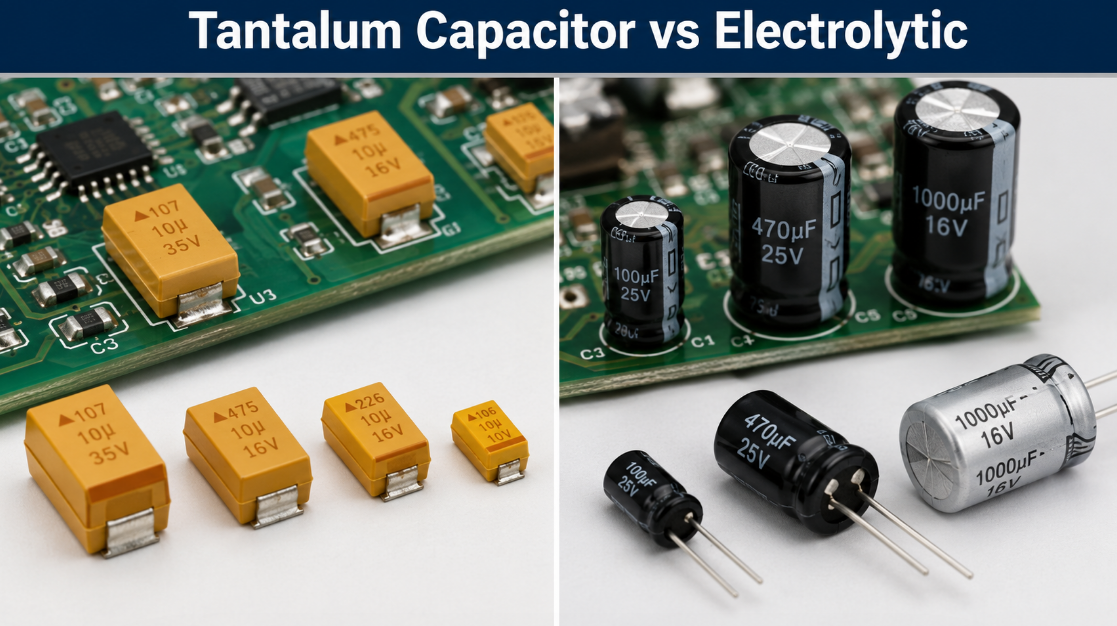
What Is a Tantalum Capacitor?
A tantalum capacitor is a polarized electrolytic capacitor made with a tantalum anode and tantalum pentoxide dielectric. It is used when a PCB needs high capacitance in a small package.
Tantalum capacitors are common in compact PCB assemblies, IoT modules, communication boards, medical electronics, portable devices, and stable low-voltage power rails. Their main strengths are small size, stable capacitance, low leakage current, and good performance density.
The main risk is electrical stress. Tantalum capacitors are sensitive to reverse polarity, voltage spikes, surge current, hot-plug input, and poor derating. They work best on regulated rails, not directly on unstable raw power inputs.
What Is an Electrolytic Capacitor?
An electrolytic capacitor is a polarized capacitor used for high capacitance, filtering, smoothing, and energy storage. In most PCB discussions, it usually refers to an aluminum electrolytic capacitor.
Aluminum electrolytic capacitors are widely used in power supplies, LED drivers, adapters, motor control boards, chargers, inverters, audio circuits, and industrial electronics. Their main strengths are large capacitance, higher voltage options, strong bulk filtering, and lower cost per µF.
Their limits are also clear. Aluminum electrolytic capacitors are usually larger, and their ESR, leakage current, capacitance stability, and lifetime can be affected by heat, ripple current, electrolyte drying, and long operating time.
Are Tantalum Capacitors the Same as Electrolytic Capacitors?
Tantalum capacitors are a type of electrolytic capacitor, but they are not the same as common aluminum electrolytic capacitors. In practical comparison, tantalum capacitor vs electrolytic usually means tantalum capacitor vs aluminum electrolytic capacitor.
Both types are usually polarized and can be used for filtering, smoothing, decoupling, and energy storage. The differences are material, dielectric structure, electrolyte system, ESR, leakage current, ripple current, size, cost, and failure mode.
The simple conclusion is this: tantalum is usually smaller and more stable, while aluminum electrolytic is usually cheaper and better for high capacitance and high ripple current applications.
Tantalum Capacitor vs Electrolytic: What Is Difference?
The main difference in tantalum capacitor vs electrolytic selection is compact stability versus bulk power capacity. Tantalum capacitors fit compact low-voltage rails, while aluminum electrolytic capacitors fit larger capacitance and power filtering positions.
The values below are common engineering ranges. Actual values depend on brand, series, voltage rating, case size, temperature grade, and application conditions.
| Parameter | Tantalum | Aluminum Electrolytic |
|---|---|---|
| Capacitance Range | 0.1µF–1,500µF common | 0.47µF–100,000µF+ common |
| Rated Voltage | 2.5V–50V common | 6.3V–450V common |
| ESR | 10mΩ–5Ω depending on type | 20mΩ–several Ω depending on size |
| Leakage Current | Often below 0.01CV | Often 0.01CV–0.03CV |
| Ripple Current | Tens of mA to several A | Hundreds of mA to several A+ |
| Temperature Range | -55°C to +125°C common | -40°C to +105°C / +125°C common |
| Lifetime | Long with proper derating | 1,000–10,000+ hours rated |
| Package Size | Compact SMD common | Radial, SMD, snap-in, larger sizes |
| Surge Tolerance | Sensitive to surge current | Better in many input circuits |
| Cost | Higher per µF | Lower per µF |
Do not choose by capacitance value alone. A capacitor near an IC pin, DC input, switching regulator, or bulk power rail may require different ESR, ripple current, voltage margin, and package limits.
Tantalum Capacitor vs Electrolytic: Which One Is More Stable?
Tantalum capacitors are usually more stable in capacitance, leakage current, and long-term electrical behavior. They are better for stable low-voltage rails, compact layouts, and low-leakage circuits.
Aluminum electrolytic capacitors are less stable over long use because heat and ripple current can dry the electrolyte and increase ESR. However, they can handle rough input filtering better when rated correctly.
For stable regulated rails, choose tantalum. For rough input filtering, high capacitance, or high ripple current, choose aluminum electrolytic. This is one of the most important engineering rules in a tantalum capacitor vs electrolytic decision.
Tantalum Capacitor vs Electrolytic: ESR, Leakage Current and Electrical Performance
Tantalum capacitors usually have lower ESR and lower leakage current than standard aluminum electrolytic capacitors. This helps reduce ripple and improve local power rail stability.
ESR affects ripple voltage, heat, transient response, and regulator stability. Lower ESR is not always safer. Some regulators require a specific ESR range, and the wrong capacitor can cause oscillation or unstable startup.
| Parameter | Tantalum | Aluminum Electrolytic |
|---|---|---|
| ESR Range | 10mΩ–5Ω common | 20mΩ–several Ω common |
| Leakage Current | Often ≤0.01CV | Often 0.01CV–0.03CV |
| Ripple Current | Tens of mA to several A | Hundreds of mA to several A+ |
| Capacitance Tolerance | ±10%, ±20% common | ±20% common |
| Frequency Use | Local rail filtering | Bulk smoothing, low-frequency ripple |
| Voltage Derating | 50% margin often used | 20%–30% margin common |
| Temperature Grade | +85°C, +105°C, +125°C | +85°C, +105°C, +125°C |
| Impedance Range | Low to medium | Medium to high |
For replacement, capacitance and voltage are not enough. Check ESR, leakage current, ripple current, impedance curve, temperature rating, and regulator requirements before changing capacitor type.
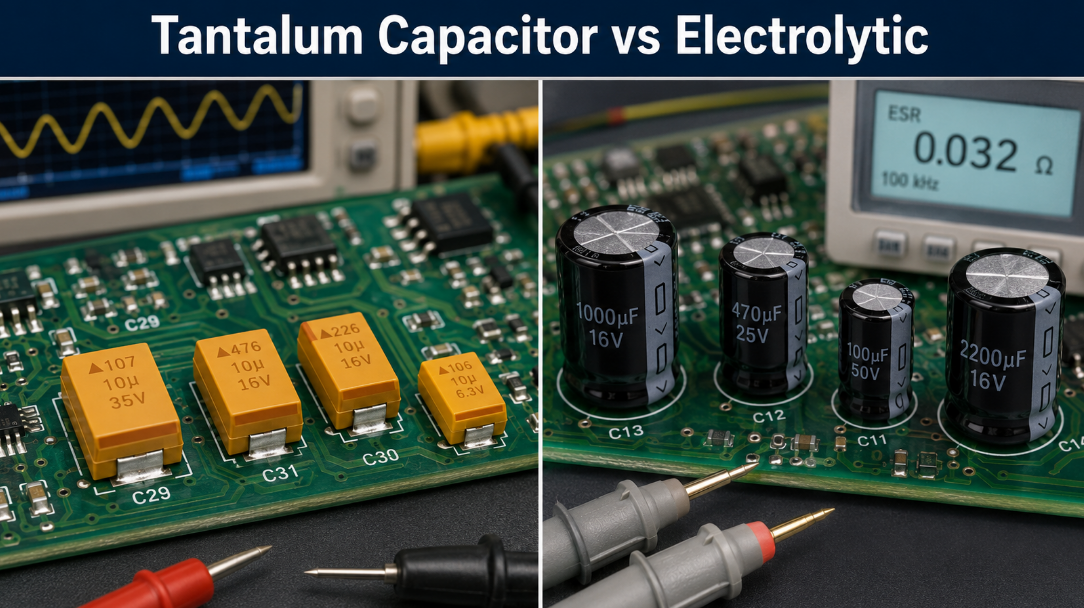
Tantalum Capacitor vs Electrolytic: Which Is Better for Power Filtering?
Aluminum electrolytic capacitors are usually better for bulk power filtering and high ripple current. They are common at DC inputs, rectifier outputs, power supply outputs, LED drivers, motor control boards, and DC bus circuits.
Their larger case size supports higher capacitance and better heat dissipation. If ripple current is too high, the capacitor can overheat, dry out faster, lose capacitance, or fail early.
Use this rule:
- Choose aluminum electrolytic for bulk capacitance, high ripple current, and lower cost.
- Choose tantalum for compact size, stable local rails, and lower leakage.
- Use ceramic capacitors for high-frequency decoupling near IC pins.
- Check regulator ESR requirements before replacement.
- Confirm ripple current with temperature rise testing.
Tantalum Capacitor vs Electrolytic: Which One Lasts Longer?
Tantalum capacitors can last longer in stable and well-derated circuits because solid tantalum types do not dry out like many aluminum electrolytic capacitors.
Aluminum electrolytic capacitors can also last long if selected with 105°C or 125°C rating, enough ripple current margin, and reliable brand quality. Their lifetime depends heavily on working temperature, ripple current, and rated hours.
The failure risks are different. Tantalum is more sensitive to surge current, voltage derating, and polarity mistakes. Aluminum electrolytic is more affected by heat, ripple current, electrolyte drying, and operating hours.
For stable compact circuits, tantalum usually lasts longer. For power circuits, aluminum electrolytic can be reliable if ripple and temperature margins are correct.
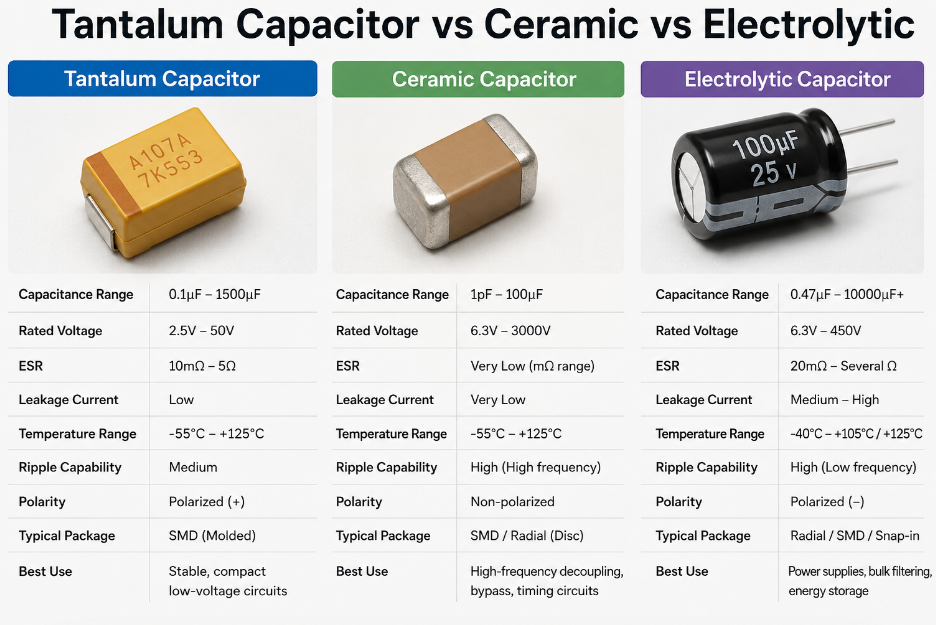
Tantalum Capacitor vs Ceramic vs Electrolytic: Which One Should You Choose?
Choose the capacitor by function: ceramic for high-frequency decoupling, tantalum for compact stable rails, and aluminum electrolytic for bulk filtering.
The values below are common engineering ranges. Actual values depend on dielectric, DC bias, package size, voltage rating, and series.
| Parameter | Ceramic | Tantalum | Aluminum Electrolytic |
|---|---|---|---|
| Capacitance Range | 1pF–100µF common | 0.1µF–1,500µF common | 0.47µF–100,000µF+ common |
| Rated Voltage | 6.3V–3kV common | 2.5V–50V common | 6.3V–450V common |
| ESR | Very low, mΩ range | 10mΩ–5Ω common | 20mΩ–several Ω common |
| Leakage Current | Very low | Low | Medium to high |
| Temperature Range | -55°C to +125°C common | -55°C to +125°C common | -40°C to +105°C / +125°C common |
| DC Bias Effect | Significant in MLCC | Low | Low |
| Ripple Capability | Good for high frequency | Medium | Good for low frequency |
| Package | SMD, radial disc | SMD, molded case | Radial, SMD, snap-in |
| Common Position | IC pins, high-frequency nodes | Local regulated rails | Power input, bulk filtering |
A practical PCB power network often uses ceramic capacitors near IC pins, tantalum capacitors for local rails, and aluminum electrolytic capacitors for bulk power filtering.
Can I Use an Electrolytic Capacitor Instead of a Tantalum Capacitor?
Yes, an aluminum electrolytic capacitor can replace a tantalum capacitor in some circuits, but only if capacitance, voltage rating, ESR, leakage current, ripple current, polarity, size, temperature rating, and lifetime are acceptable.
This replacement may work in low-frequency filtering or non-critical decoupling. It may fail if the original tantalum capacitor was chosen for low ESR, low leakage, compact size, or stable capacitance.
Before replacement, check:
- PCB footprint and height clearance.
- ESR range for regulator stability.
- Leakage current for battery or precision circuits.
- Ripple current rating.
- Polarity marking.
- Temperature and lifetime rating.
- Startup, ripple, and heating after sample testing.
Do not replace tantalum with aluminum electrolytic only by matching capacitance and voltage.
Can I Replace an Electrolytic Capacitor with a Tantalum Capacitor?
Yes, but replacing an electrolytic capacitor with a tantalum capacitor is safe only in selected circuit positions. The circuit should have stable voltage, controlled surge current, correct derating, compatible ESR, and acceptable ripple current.
This replacement is more suitable after a regulator, LDO, or DC-DC output where the voltage is controlled. It is less suitable at raw DC input, adapter input, rectifier output, or high-ripple power positions.
Before using tantalum as a replacement, confirm these points:
- Use enough voltage derating, often 50% or more in sensitive designs.
- Check surge current and hot-plug risk.
- Compare ESR with the original circuit requirement.
- Confirm ripple current rating.
- Match polarity and footprint.
- Test startup, ripple voltage, and temperature rise.
What Are the Risks of Replacing Tantalum and Electrolytic Capacitors Incorrectly?
Incorrect replacement can cause unstable power output, higher ripple voltage, overheating, short-circuit failure, poor startup, reduced battery life, or early field failure. The biggest mistake is replacing a capacitor only by capacitance and voltage while ignoring ESR, leakage current, ripple current, size, polarity, and circuit position.
Common risks include:
- Wrong ESR causing regulator instability
Some LDOs and switching regulators require a specific ESR range. If the replacement capacitor has much lower or higher ESR, the output may oscillate, create noise, or fail during startup. - Insufficient ripple current causing overheating
Aluminum electrolytic capacitors usually handle bulk ripple better than standard tantalum capacitors. If a tantalum capacitor is placed in a high-ripple power position without checking the rating, it may overheat or fail early. - Higher leakage current affecting battery products
Replacing tantalum with a standard aluminum electrolytic capacitor may increase leakage current. This can reduce standby time in IoT devices, portable equipment, and low-power control boards. - Surge current causing tantalum failure
Tantalum capacitors are more sensitive to surge current and voltage spikes. Using them at raw DC inputs, adapter inputs, or hot-plug positions without derating can lead to short-circuit failure. - Package size causing assembly problems
Aluminum electrolytic capacitors may be taller or wider than tantalum capacitors. Even if the electrical value matches, the replacement may conflict with enclosure height, nearby components, or automated assembly clearance. - Polarity mistakes causing immediate damage
Most tantalum and aluminum electrolytic capacitors are polarized. Wrong polarity during repair, redesign, or PCBA assembly can cause leakage, heating, venting, or short failure.
For production projects, do not approve replacement parts from the datasheet only. Confirm the change through sample assembly, power-on testing, ripple measurement, temperature rise testing, and functional verification.
When Should You Choose a Tantalum Capacitor Instead of an Electrolytic Capacitor?
Choose a tantalum capacitor when the circuit requires small size, stable capacitance, low leakage current, and reliable local low-voltage filtering. It is a better choice for compact regulated rails, but not for every power input position.
Good situations include:
- When PCB space is limited
Tantalum capacitors provide high capacitance in a compact SMD package. They are suitable for dense PCB layouts, slim products, modules, and boards with strict height limits. - When the circuit uses a stable regulated voltage rail
Tantalum capacitors work well after a DC-DC converter, LDO, or regulated power stage. In this position, voltage spikes and surge current are usually lower than at the raw input. - When low leakage current matters
Tantalum capacitors usually have lower leakage current than many standard aluminum electrolytic capacitors. This is useful for battery-powered devices, standby circuits, sensors, and low-power IoT products. - When capacitance stability is important
Tantalum capacitors offer more stable capacitance than many electrolytic capacitors over normal operating conditions. This helps in timing circuits, local power rails, communication modules, and precision control boards. - When long-term drying risk should be reduced
Solid tantalum capacitors do not dry out like many aluminum electrolytic capacitors. They can be useful in compact products where field repair is difficult. - When high-density SMT assembly is required
Tantalum capacitors are widely available in molded SMD packages. They fit automated SMT assembly better than many through-hole aluminum electrolytic capacitors. - When the circuit is a compact communication or IoT module
Wireless modules, GNSS boards, NB-IoT devices, Bluetooth modules, and control boards often benefit from stable local filtering in limited space.
Avoid standard tantalum capacitors on raw power inputs unless surge current, hot-plug voltage spikes, reverse polarity risk, and voltage derating are properly controlled.
When Should You Choose an Aluminum Electrolytic Capacitor Instead of Tantalum?
Choose an aluminum electrolytic capacitor when the circuit requires high capacitance, higher voltage, stronger ripple current handling, better surge tolerance, or lower cost. It is usually the better choice for power input, bulk filtering, and cost-sensitive PCB or PCBA production.
Good situations include:
- When the circuit needs large capacitance
Aluminum electrolytic capacitors are better when the design requires hundreds or thousands of microfarads. They are commonly used for power smoothing, energy storage, and low-frequency ripple reduction. - When the voltage rating is higher
Aluminum electrolytic capacitors are available in wider voltage ranges, commonly from 6.3V to 450V. This makes them more suitable for adapters, power supplies, inverters, and industrial power boards. - When ripple current is high
Power supplies, LED drivers, motor control boards, and DC bus circuits often generate continuous ripple current. Aluminum electrolytic capacitors usually handle this better, especially in larger case sizes. - When the capacitor is close to a raw power input
Input power lines may face hot-plugging, adapter overshoot, inrush current, or voltage spikes. Aluminum electrolytic capacitors are often more practical than standard tantalum capacitors in these positions. - When BOM cost matters
Aluminum electrolytic capacitors usually offer lower cost per µF. For mass production, they are often the better option when PCB space allows a larger component. - When the design needs easier sourcing
Aluminum electrolytic capacitors are widely available in many capacitance, voltage, lifetime, and temperature grades. This helps reduce sourcing risk during bulk production.
For industrial PCBA production, check rated lifetime, ripple current, ESR, operating temperature, package size, polarity, brand reliability, and supply stability before approval.
How to Choose the Right Capacitor for Your PCBA Project?
Choose the right capacitor by matching circuit function, electrical stress, PCB space, operating temperature, lifetime target, cost, and supply stability. The safest method is to start from the capacitor’s job in the circuit, not only from its capacitance value.
Use this selection guide:
- For bulk input filtering
Choose aluminum electrolytic or polymer aluminum capacitors. They are better for large capacitance, low-frequency ripple reduction, and power input smoothing. - For compact low-voltage rails
Choose tantalum or polymer tantalum capacitors when the rail is stable and PCB space is limited. They work well after DC-DC converters, LDOs, and regulated power stages. - For high-frequency decoupling
Choose ceramic capacitors near IC power pins. They provide low impedance at high frequency and help reduce switching noise, digital noise, and local voltage disturbance. - For battery-powered products
Check leakage current first. Tantalum capacitors or selected low-leakage parts may be better than standard aluminum electrolytic capacitors in standby and low-power circuits. - For switching regulators
Check the regulator datasheet for ESR and output capacitance requirements. Wrong ESR may cause oscillation, unstable startup, high ripple, or poor transient response. - For high-temperature products
Use capacitors with proper temperature grade, such as 105°C or 125°C, and confirm rated lifetime. Aluminum electrolytic capacitors need special attention because heat accelerates electrolyte aging. - For replacement or BOM alternatives
Do not approve parts only because capacitance and voltage match. Compare ESR, leakage current, ripple current, tolerance, lifetime, temperature grade, package size, reflow profile, and compliance.
Before mass production, confirm the capacitor through sample assembly, power-on testing, ripple measurement, temperature rise testing, and functional verification.
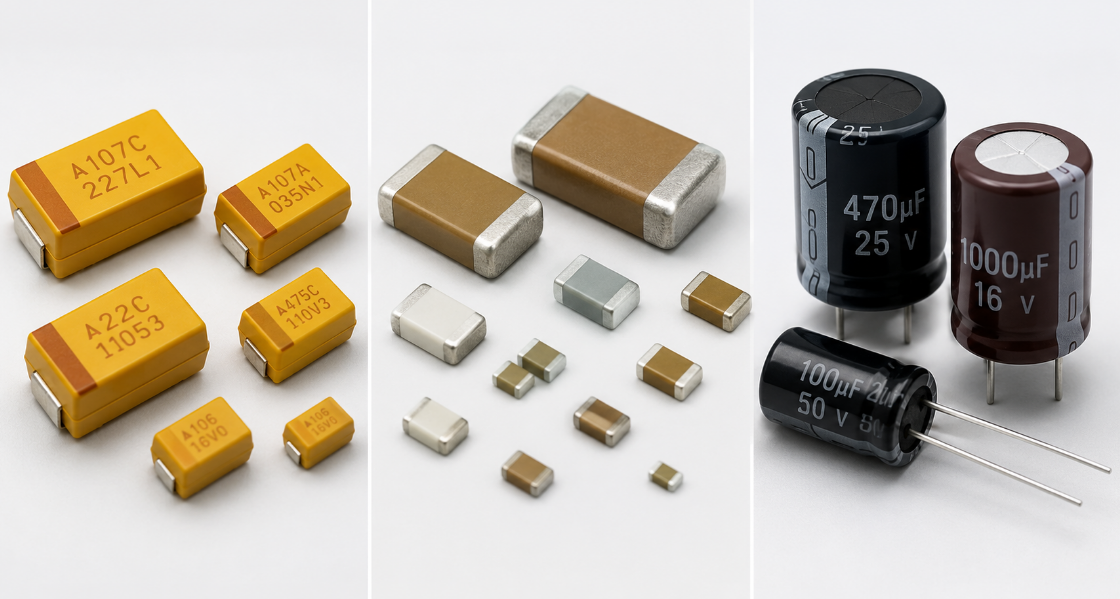
FAQs About Tantalum Capacitor vs Electrolytic
Q1: How do you identify the polarity of a tantalum capacitor?
A1: Most SMD tantalum capacitors mark the positive terminal with a stripe, bar, or “+” sign. This is different from many aluminum electrolytic capacitors, where the stripe usually marks the negative terminal. Always confirm the PCB marking before soldering.
Q2: Why do tantalum and aluminum electrolytic capacitors use different polarity markings?
A2: The marking convention is different because package structures and industry practices are different. The safest method is not guessing by shape. Check the component datasheet, PCB polarity symbol, and original circuit direction before replacement or repair.
Q3: Can tantalum capacitors be used in audio circuits?
A3: Yes, but they are not always the first choice for the audio signal path. Tantalum capacitors can be used in power filtering, but for coupling or tone circuits, check distortion, leakage current, ESR, and sound quality preference before selection.
Q4: Are tantalum capacitors suitable for high-frequency circuits?
A4: Tantalum capacitors are useful for local rail filtering, but ceramic capacitors are usually better for very high-frequency decoupling. A common layout uses ceramic capacitors near IC pins and tantalum capacitors slightly farther away for stable bulk support.
Q5: Do tantalum capacitors need special storage conditions?
A5: Tantalum capacitors should be stored in a dry, clean, controlled environment and kept away from high humidity, corrosive gas, and excessive heat. For SMT production, storage control helps reduce solderability issues and batch variation.
Q6: Can old tantalum capacitors be reused from removed circuit boards?
A6: Reuse is not recommended for production or reliable repair. Old capacitors may have hidden damage from heat, surge stress, soldering, aging, or unknown operating history. For PCBA repair, use new parts from traceable suppliers.
Q7: What happens if a polarized capacitor is installed backwards?
A7: Reverse installation can cause high leakage current, heating, venting, short circuit, or complete failure. Tantalum capacitors may fail quickly under reverse voltage, while aluminum electrolytic capacitors may bulge, leak, or vent depending on stress level.
Q8: Are polymer tantalum capacitors better than standard tantalum capacitors?
A8: Polymer tantalum capacitors usually have lower ESR, better ripple performance, and improved high-frequency behavior than traditional manganese dioxide tantalum capacitors. They are useful where compact size and low ESR are important.
Q9: Are polymer aluminum capacitors a better alternative to electrolytic capacitors?
A9: Polymer aluminum capacitors can be better when the circuit needs low ESR, higher ripple current, and longer stable performance. However, they may have different leakage current, voltage limits, cost, and availability compared with standard aluminum electrolytic capacitors.
Q10: Can capacitor color or body shape identify the correct replacement?
A10: No. Color and body shape are not reliable replacement rules. The correct replacement should be based on capacitance, voltage rating, ESR, leakage current, ripple current, temperature grade, package size, and polarity, not appearance.
Q11: How do you test ESR on a capacitor during repair?
A11: ESR is usually checked with an ESR meter or LCR meter at the proper test frequency. In-circuit readings may be affected by nearby components, so suspicious results should be confirmed after removing one lead or testing the capacitor separately.
Q12: Why does a capacitor pass capacitance testing but still fail in the circuit?
A12: A capacitor can pass capacitance testing but still fail because of high ESR, excessive leakage current, poor ripple rating, bad solder joints, or temperature-related degradation. Capacitance value alone does not prove the part is suitable for operation.
Q13: What certificates or compliance items should buyers check for capacitors?
A13: Buyers should check RoHS, REACH, halogen-free status, brand authorization, batch traceability, datasheet consistency, and project-specific compliance. For export PCBA orders, supplier traceability is important for quality control and customer audits.
Q14: How should capacitor alternatives be approved in a BOM?
A14: BOM alternatives should be approved by engineering review, not only by purchasing. Compare series, capacitance, voltage, ESR, leakage current, ripple current, package, temperature rating, lifetime, reflow profile, and test results before release.
Q15: Why do some capacitor replacements work in samples but fail in mass production?
A15: Sample success does not always prove production reliability. Failures can appear because of batch variation, soldering heat, ripple current, operating temperature, supplier changes, or weak derating margin. Mass production parts should pass controlled PCBA testing.
Conclusion
Tantalum capacitors are better for compact, stable, low-voltage circuits, while aluminum electrolytic capacitors are better for bulk filtering, high ripple current, and cost-sensitive production.
As a one-stop PCBA service provider, EBest supports component selection, BOM review, PCB fabrication, SMT assembly, through-hole assembly, testing, and mass production. For tantalum capacitor vs electrolytic selection, capacitor replacement, or PCBA reliability review, our team can help reduce production risk.
If you are looking for reliable OEM manufacturing, ODM production, sample development, mass production, or custom engineering solutions, please contact EBest Circuit for technical support and a quote: sales@bestpcbs.com.