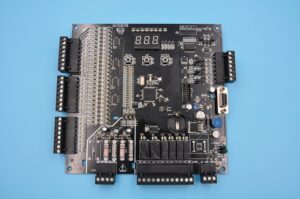
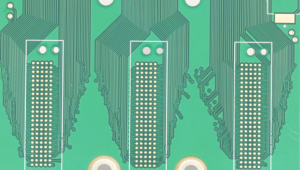
NRE stands for Non-Recurring Engineering, a one-time cost used to prepare a custom product, PCB, PCBA, mechanical part, or electronic device for stable production. This guide explains what NRE includes, why it matters, how it is calculated, how buyers can reduce unnecessary cost, and how to evaluate NRE charges before placing an OEM or ODM order.
For many buyers, NRE is confusing because it appears before mass production starts. It may include stencil fees, tooling, fixture design, test program development, engineering validation, documentation, prototyping, or process setup. The key point is simple: NRE is not a hidden fee when it is clearly explained. It is the engineering work that turns a design file into a manufacturable product.
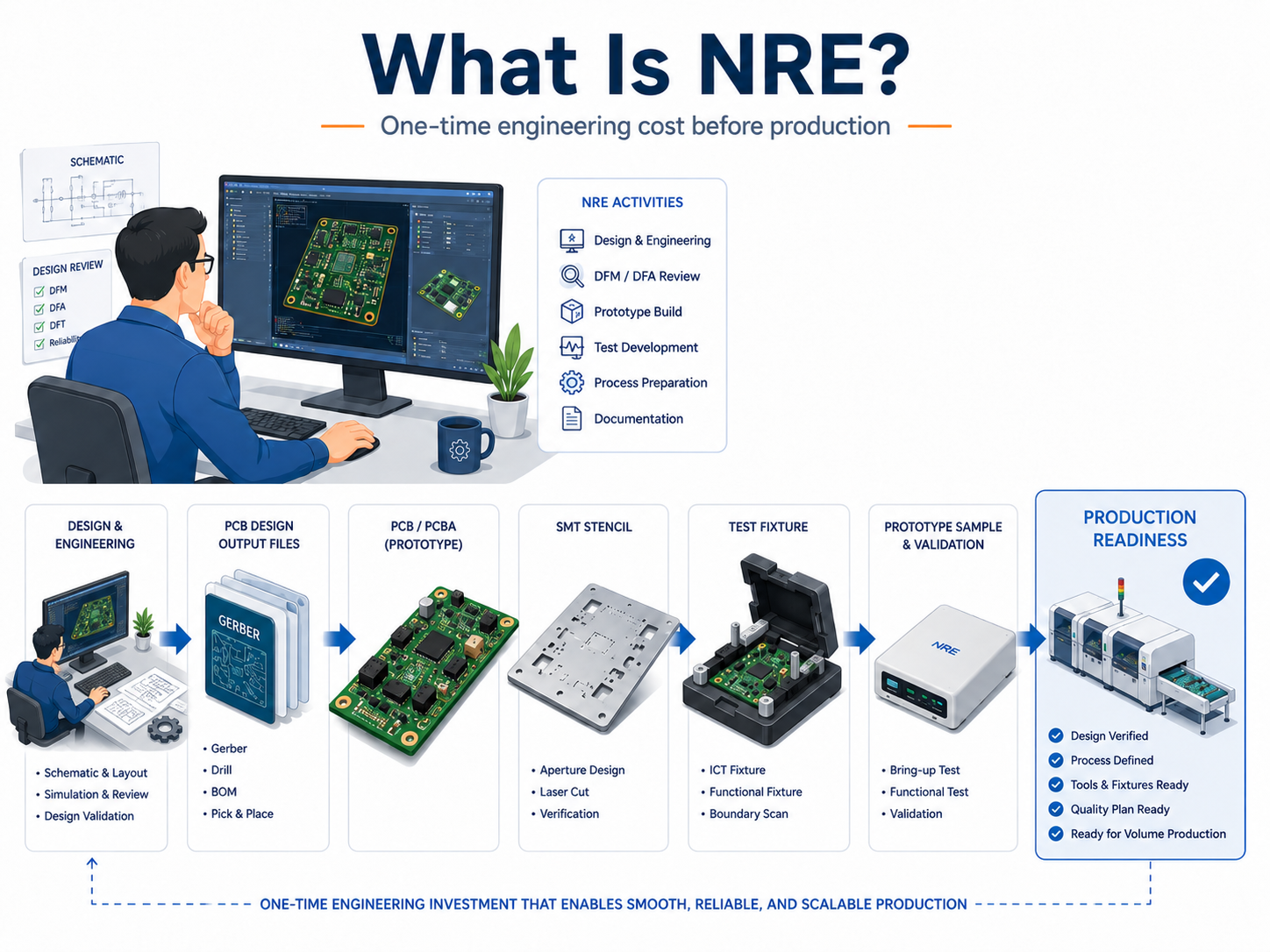
What Is NRE?
NRE, or Non-Recurring Engineering, refers to the one-time engineering cost required to design, develop, test, validate, or prepare a product before regular production begins. It is different from unit cost because it does not repeat with every production run.
In electronics manufacturing, NRE may cover PCB production setup, SMT stencil creation, fixture design, programming, DFM review, test jig development, sample validation, tooling, firmware support, or production documentation. In mechanical manufacturing, it may include molds, CNC fixtures, die tooling, or custom process development.
A simple way to understand it:
| Cost Type | Meaning | Example |
|---|---|---|
| NRE cost | One-time project setup cost | Tooling, stencil, fixture, engineering validation |
| Unit cost | Repeated product cost | PCB, components, assembly labor, packaging |
| Testing cost | May be one-time or recurring | Test jig development is NRE; each test operation may be recurring |
| Certification cost | Usually project-specific | CE, UL, RoHS-related documentation or third-party testing |
NRE is common in custom manufacturing because every new product needs preparation before it can be built consistently.
Why Is NRE Important?
NRE is important because it decides whether a product can move from design to production with fewer risks. A low unit price is not useful if the design has poor manufacturability, unstable yield, weak testing, or unclear documentation.
For PCB and PCBA projects, NRE often supports:
- Better DFM and DFA review
- More stable sample builds
- Correct solder paste stencil design
- Accurate ICT, FCT, or programming fixtures
- Better process repeatability
- Lower rework risk
- Faster transition from prototype to batch production
NRE also improves cost visibility. Instead of hiding engineering work inside the unit price, many manufacturers separate it so the buyer can see what is being charged and why.
In serious OEM and ODM production, NRE should be treated as an investment in production readiness, not just an extra fee.
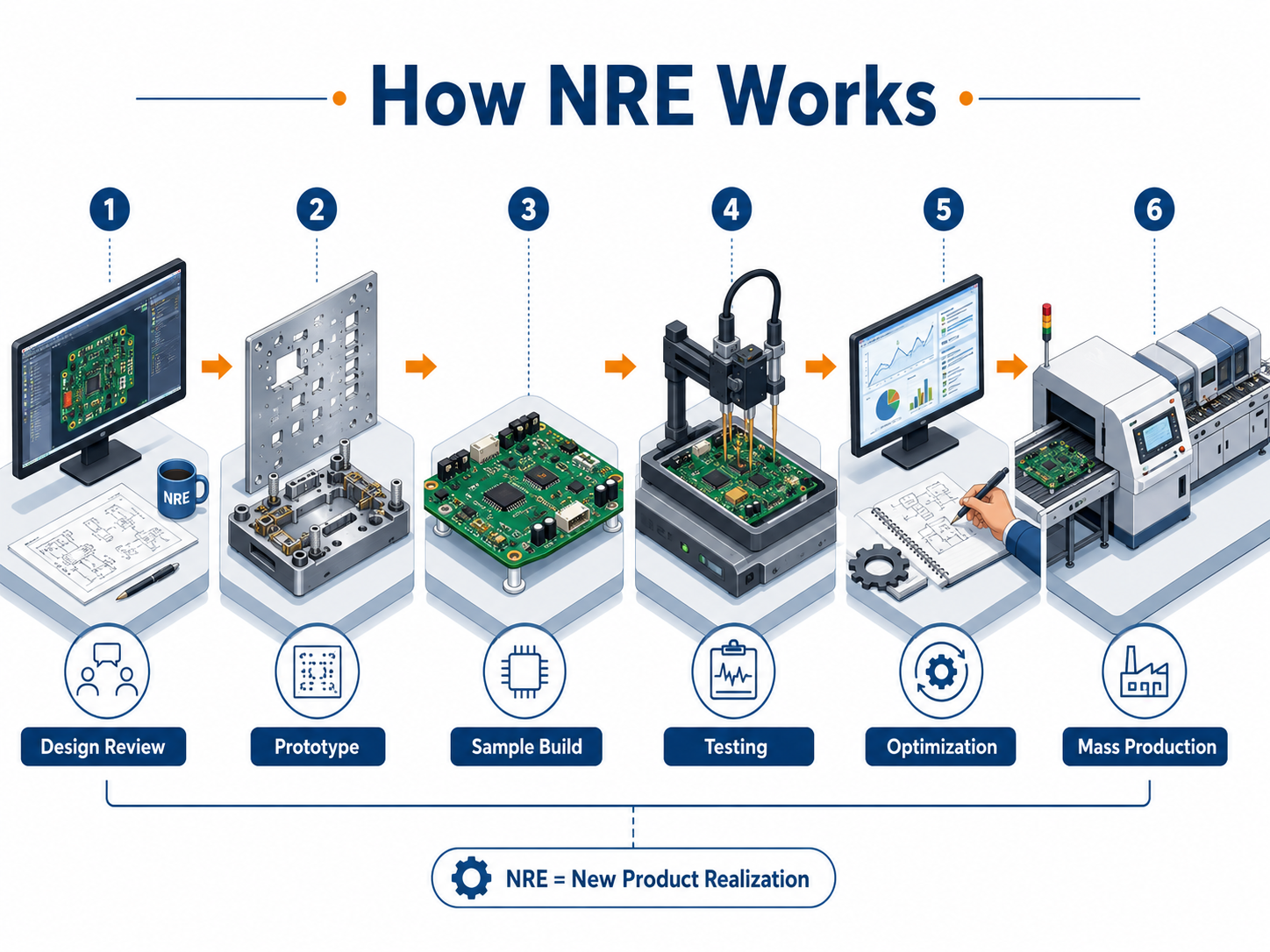
How Does NRE Work in a Manufacturing Project?
NRE usually appears at the beginning of a project. The manufacturer reviews the files, checks the production requirements, estimates the engineering workload, and provides a quotation.
A typical process looks like this:
| Stage | Main Work | NRE Involved |
|---|---|---|
| Design review | Check Gerber, BOM, drawings, stack-up, mechanical files | Engineering review |
| Prototype preparation | Create stencil, tooling, programming data, fixtures | Setup and tooling |
| Sample build | Build first samples for evaluation | Process validation |
| Testing | Develop inspection or functional test method | Test jig or test program |
| Optimization | Adjust process after trial build | Engineering time |
| Mass production transfer | Lock documents, process flow, inspection plan | Production setup |
Once the NRE work is completed, the same tooling, fixture, stencil, or engineering file can usually be reused for later batches of the same product version.
However, if the product design changes, extra NRE may be required. For example, changing the PCB layout, component package, enclosure, connector position, or firmware interface may require new tooling or test development.
What Does NRE Usually Include?
NRE may include different items depending on the product type and manufacturing process. In electronics manufacturing, the most common items are engineering review, production setup, tooling, test development, and documentation.
| NRE Item | Common Use | Typical Reason |
|---|---|---|
| PCB production setup | Bare board fabrication | CAM review, film/tooling data, panelization |
| SMT stencil | PCBA assembly | Solder paste printing for surface-mount parts |
| Test fixture | ICT/FCT testing | Stable electrical or functional test |
| Programming fixture | MCU, IC, memory programming | Batch programming efficiency |
| Assembly fixture | Mechanical or box-build assembly | Positioning, alignment, repeatability |
| Tooling | Custom shape, housing, metal part, plastic part | Production preparation |
| DFM/DFA review | PCB, PCBA, mechanical design | Reduce manufacturing risk |
| Process engineering | Custom process setup | Improve yield and consistency |
| Documentation | Work instructions, inspection plan, test report format | Production control |
What Is the Difference Between NRE and Unit Cost?
NRE is paid once for project preparation. Unit cost is paid for every product manufactured.
For example, if a PCBA project requires a 600 USD test fixture and the order quantity is 100 pieces, the NRE impact is 6 USD per board if divided across the first batch. If the total production volume reaches 10,000 pieces, the same fixture cost becomes only 0.06 USD per board.
This is why NRE looks expensive in prototype orders but becomes reasonable in mass production.
| Item | NRE Cost | Unit Cost |
|---|---|---|
| Payment pattern | One-time | Repeated |
| Related to quantity | Indirectly | Directly |
| Main purpose | Prepare production | Build each product |
| Example | Fixture, stencil, tooling | PCB, components, assembly |
| Best evaluated by | Total project value | Per-piece price |
For buyers, the right question is not only “Can you remove the NRE?” A better question is “What does this NRE cover, and can it reduce my later production risk?”
What Types of NRE Are Used in Electronics Manufacturing?
In electronics manufacturing, NRE can be divided into several practical categories. Each category supports a different part of production readiness.
| Type of NRE | Description | Example |
|---|---|---|
| Engineering NRE | Design review, process planning, technical adjustment | DFM report, stack-up review |
| Tooling NRE | Physical tooling used for production | SMT stencil, carrier, fixture |
| Testing NRE | Equipment or software for inspection and validation | ICT jig, FCT fixture |
| Programming NRE | Software or hardware setup for chip programming | MCU flashing fixture |
| Documentation NRE | Controlled files for repeatable production | Work instruction, QC checklist |
| Certification-related NRE | Support for compliance preparation | Material declarations, test support |
For PCB assembly, stencil and fixture fees are the most common. For box-build and electromechanical products, assembly fixtures and functional test systems become more important.
What Materials and Tools Are Involved in NRE?
NRE is not only an engineering service. It may also include physical materials, tooling parts, and dedicated equipment.
Common examples include stainless steel SMT stencils, aluminum or FR4 carriers, acrylic inspection fixtures, pogo pin test jigs, CNC-machined positioning tools, plastic injection molds, die-casting molds, cable harness boards, customized trays, programming adapters, and production gauges.
For PCB and PCBA projects, a test fixture may include:
- Pogo pins
- Fixture plate
- Wiring harness
- Control board
- Connector interface
- Pneumatic or manual press structure
- Test software or firmware interface
- Labeling and traceability setup
The more complex the test requirement, the higher the NRE may be. A simple continuity test fixture costs far less than a full functional test system with power loading, signal simulation, firmware communication, and automatic pass/fail judgment.
What Are the Key Features of NRE?
NRE has several features that buyers should understand before approving a quotation.
| Feature | Meaning for Buyers |
|---|---|
| One-time nature | Usually paid once for one product version |
| Project-specific | Cannot normally be reused for another customer’s product |
| Design-sensitive | Major design changes may create new NRE |
| Volume-dependent impact | Higher production volume reduces per-unit impact |
| Quality-related | Good NRE can reduce failure, rework, and unstable yield |
| Documentation-driven | Clear scope prevents disputes |
The most important feature is project specificity. A custom fixture, stencil, or test program is usually built for one product. It cannot be used freely on another design.
This is why NRE should be linked to clear files, revision numbers, tooling scope, and production requirements.
What Are the Advantages of Paying NRE?
NRE can feel uncomfortable at the quotation stage, especially for buyers comparing multiple suppliers. However, when used correctly, it brings clear value.
Main advantages include:
- More reliable first article production
- Lower hidden engineering risk
- Faster ramp-up to mass production
- Better inspection coverage
- More stable product quality
- Clearer production documentation
- Easier repeat orders
- Lower long-term failure cost
In PCBA manufacturing, a properly designed functional test fixture can detect wrong components, solder defects, reversed polarity, open circuits, firmware errors, and abnormal current before the product ships. That single NRE item may prevent expensive field failures later.
For high-reliability applications such as industrial control, medical electronics, automotive electronics, aerospace-related equipment, and power electronics, NRE is often necessary for process control.
What Are the Limitations of NRE?
NRE also has limitations. It does not automatically guarantee perfect production. It only creates the engineering foundation for better production control.
Common limitations include:
- It may increase early project cost
- It may not be refundable after tooling starts
- It may need to be updated after design revision
- It may not cover third-party certification unless clearly stated
- It may not include unlimited engineering changes
- It may not reduce unit cost in very small orders
For low-volume prototypes, buyers should control NRE carefully. A simple engineering sample may not need an expensive fixture. But for a product that will move into batch production, skipping all NRE may create higher cost later.
How Is NRE Calculated?
NRE is usually calculated based on engineering time, tooling material, fixture complexity, test coverage, process difficulty, and project risk.
Key cost factors include:
| Cost Factor | Impact on NRE |
|---|---|
| Product complexity | More parts, layers, interfaces, or tolerances increase engineering work |
| Design maturity | Unstable files create more review and revision work |
| Tooling requirement | Custom tooling increases upfront cost |
| Test requirement | ICT, FCT, burn-in, or calibration increases fixture cost |
| Production volume | Higher volume may justify better tooling |
| Quality class | Industrial, medical, automotive, or aerospace projects need tighter control |
| Documentation | More reports and traceability increase engineering workload |
| Certification support | Compliance-related preparation may add cost |
For electronics projects, NRE should be itemized whenever possible. Buyers should ask for a breakdown instead of accepting a single unclear line.
A clear NRE quote may show stencil cost, test fixture cost, programming fixture cost, engineering setup cost, and documentation cost separately.
How Can Buyers Reduce NRE Cost?
NRE cost can often be reduced through better preparation, clearer files, and smarter project planning. The goal is not to remove every NRE item. The goal is to avoid repeated, unnecessary, or poorly defined NRE.
Practical ways to reduce NRE include:
- Provide complete Gerber, BOM, CPL, schematic, drawings, and test requirements
- Confirm design revision before tooling starts
- Use standard components and common packages where possible
- Avoid unnecessary mechanical complexity
- Ask whether the stencil or fixture can be reused for later batches
- Separate prototype-stage NRE from mass-production-stage NRE
- Confirm whether the supplier can absorb small setup fees for larger orders
- Use modular test fixtures when suitable
- Review DFM feedback before sample production
- Lock key specifications before ordering tooling
For PCBA projects, an incomplete BOM is a common reason for extra engineering time. Missing MPNs, unclear substitutes, wrong footprints, and unconfirmed polarity markings can all increase setup work.
How Should NRE Be Compared Between Suppliers?
Comparing NRE only by price can be misleading. A lower NRE quote may exclude important items, while a higher NRE quote may include fixtures, documentation, and validation that another supplier charges later.
A better comparison method is shown below:
| Comparison Point | What to Ask |
|---|---|
| Scope | What exactly does the NRE include? |
| Ownership | Who owns the tooling or fixture after payment? |
| Reuse | Can it be reused for repeat orders? |
| Revision rule | What happens if the design changes? |
| Testing coverage | What failures can the fixture detect? |
| Documentation | Will test reports or work instructions be provided? |
| Lead time | How long does tooling or fixture development take? |
| Refund rule | Is any part refundable if the project stops? |
| Maintenance | Who maintains or replaces worn tooling? |
A reliable supplier should be able to explain NRE in plain language. If the explanation is vague, the buyer should ask for clarification before approving the order.
How Do You Choose the Right NRE Strategy?
The right NRE strategy depends on the project stage, order quantity, product complexity, and quality requirement.
For early prototypes, keep NRE lean. Focus on design validation, basic stencil, manual testing, and DFM feedback.
For pilot runs, add stronger process control. This may include dedicated fixtures, inspection plans, programming methods, and early functional testing.
For mass production, invest in stable tooling, automated or semi-automated testing, controlled documentation, traceability, and quality records.
| Project Stage | Recommended NRE Strategy |
|---|---|
| Concept prototype | Keep NRE low; validate basic function |
| Engineering sample | Add DFM, stencil, basic inspection |
| Pilot run | Add fixture, test method, process control |
| Mass production | Add robust tooling, traceability, quality documentation |
| Regulated product | Add compliance support and strict validation |
A practical rule: do not overinvest before the design is stable, but do not underinvest before mass production.
What Industries Commonly Use NRE?
NRE appears in almost every custom manufacturing industry. It is especially common when the product requires custom design, strict tolerance, testing, or controlled production.
Common industries include:
- PCB and PCBA manufacturing
- Consumer electronics
- Industrial automation
- Automotive electronics
- Medical devices
- Aerospace and defense-related electronics
- Telecommunications equipment
- LED lighting and power electronics
- IoT devices
- Robotics and smart hardware
- Energy storage and charging systems
- Mechanical parts and plastic enclosures
In PCB assembly, NRE is often linked to stencils, programming, test fixtures, and process engineering. In medical or automotive electronics, NRE may also include validation documentation, traceability setup, and stricter inspection procedures.
What Are Real Project Cases for NRE?
A practical example is a custom PCBA used in industrial control equipment. The first sample build may only need a stencil and manual inspection. After the customer confirms function, the project moves into pilot production. At that stage, a functional test fixture is added to check voltage, current, communication signals, relay output, and firmware response. The fixture increases NRE, but it also improves test speed and reduces shipment risk.
Another example is an LED power module. The PCB may use aluminum substrate, high-current copper design, thermal interface material, and special aging requirements. NRE may include production carrier design, thermal test setup, and aging fixture preparation. Without these controls, early samples may pass, but batch production may show unstable thermal performance.
A third example is a box-build project. The buyer may require PCB assembly, cable harness, enclosure assembly, labeling, and final function testing. NRE may include assembly fixtures, torque control tools, cable test boards, and packaging validation. This cost supports repeatable assembly rather than one-time manual work.
What Should Engineers Check Before Approving NRE?
Engineers should review whether the NRE scope truly supports the technical risk of the project.
Important checks include:
- Is the PCB revision final?
- Are the Gerber, BOM, CPL, and schematic consistent?
- Are critical components confirmed and available?
- Are test points enough for ICT or FCT?
- Are polarity markings clear?
- Are mechanical tolerances defined?
- Is firmware or programming required?
- Are high-voltage, high-current, RF, thermal, or impedance requirements included?
- Are acceptance standards clear?
- Is the first article inspection plan defined?
For PCB and PCBA projects, IPC-A-610 is widely used for electronic assembly acceptability, while IPC-J-STD-001 defines requirements for soldered electrical and electronic assemblies. These standards help manufacturers and customers align inspection expectations before production.
What Should Manufacturers Control During NRE Development?
Manufacturers should control NRE through engineering review, process planning, tooling validation, trial production, and documentation.
Key control points include:
| Control Point | Purpose |
|---|---|
| DFM review | Find manufacturability risks before production |
| Tooling verification | Confirm stencil, fixture, or mold accuracy |
| First article inspection | Verify first build quality |
| Test validation | Confirm the fixture detects defined failures |
| Process parameter setup | Lock soldering, assembly, or testing conditions |
| Revision control | Prevent wrong-file production |
| Traceability setup | Track materials, batches, and inspection data |
| Final approval | Confirm readiness before batch production |
For exported electronics, RoHS may also be relevant because the EU restricts hazardous substances in electrical and electronic equipment. Buyers selling into regulated markets should confirm material compliance and documentation before production.
What Failures Can Happen When NRE Is Skipped?
Skipping NRE can reduce early cost, but it may create hidden production risk. The most common failures are not always caused by poor assembly. Many come from weak preparation.
Typical failure modes include:
| Failure | Possible Cause | NRE-Related Prevention |
|---|---|---|
| Solder bridging | Poor stencil aperture design | Proper stencil engineering |
| Missing solder | Incorrect stencil thickness or aperture | Stencil optimization |
| Wrong component placement | Inaccurate CPL or unclear polarity | Engineering review |
| Functional failure | No dedicated test fixture | FCT jig development |
| Intermittent connection | Weak process control | Fixture and inspection plan |
| High rework rate | Poor DFM before production | DFM/DFA review |
| Wrong firmware | Manual programming error | Programming fixture |
| Mechanical mismatch | No assembly fixture | Positioning tool |
In a factory environment, NRE is often the difference between “we can build samples” and “we can build the same product repeatedly with stable quality.”
How Does NRE Affect Total Cost?
NRE affects total cost in two ways. It increases upfront cost, but it can reduce long-term production cost by improving yield, reducing rework, and preventing field returns.
For small orders, NRE may look expensive because the cost is spread across fewer units. For larger orders, the impact becomes smaller.
| Quantity | NRE Cost | NRE Impact Per Unit |
|---|---|---|
| 100 pcs | 800 USD | 8.00 USD |
| 1,000 pcs | 800 USD | 0.80 USD |
| 10,000 pcs | 800 USD | 0.08 USD |
This is why buyers should evaluate NRE together with expected production volume. For a one-time prototype, low NRE may be better. For a long-term product, stronger NRE investment usually makes more sense.
How Can Buyers Ensure NRE Quality?
Buyers can ensure NRE quality by asking for clear deliverables, not just a price.
Useful deliverables include:
- DFM report
- Stencil specification
- Fixture drawing or fixture description
- Test coverage list
- First article inspection report
- Sample test report
- Process flow
- Work instruction
- Quality control plan
- Material compliance documents
- Revision control record
For custom electronics, buyers should also confirm whether the supplier follows suitable inspection standards, whether operators are trained, and whether testing records can be provided during production.
A good supplier should not only charge NRE. The supplier should also explain how the NRE reduces risk.
How Should Global Buyers Source NRE-Based Manufacturing from China?
Many global buyers work with China-based OEM and ODM manufacturers because they need custom engineering, flexible production, cost control, and global delivery. The key is to evaluate the supplier’s engineering ability, not only the unit price.
For North American and European buyers, the focus is usually documentation, compliance, long-term reliability, and stable communication. For Southeast Asian buyers, the focus may include cost efficiency, shorter development cycles, flexible order quantity, and logistics planning. For global industrial buyers, the main concern is whether the supplier can support prototypes, pilot runs, batch production, and repeat orders without quality drift.
A China source factory should be transparent about NRE scope, file requirements, test method, lead time, revision rules, and quality records. It should not claim false overseas factories, warehouses, or local branches. Honest cross-border manufacturing is stronger when it is based on real engineering capability, controlled production, and clear communication.
How Do You Choose a Supplier for NRE Projects?
Choosing the right supplier is critical because NRE affects the whole product lifecycle. A supplier with weak engineering support may quote a low NRE but create problems during production.
Before choosing a supplier, check:
- Does the supplier understand the product application?
- Can they review design files before production?
- Can they explain each NRE item clearly?
- Do they support prototype, pilot run, and mass production?
- Do they provide testing and inspection records?
- Can they manage engineering changes?
- Can they support OEM and ODM customization?
- Do they have suitable quality systems?
- Can they provide stable global delivery?
- Are communication and response speed reliable?
For PCB, PCBA, and box-build projects, suppliers with in-house engineering, assembly, inspection, and testing capability usually provide better NRE value than suppliers who only quote based on file transfer.
What Should Buyers Check Before Placing an Order?
Before placing an order, buyers should confirm both commercial and technical details.
| Checklist Item | Why It Matters |
|---|---|
| Product revision | Prevent wrong tooling or fixture |
| NRE scope | Avoid hidden charges |
| Tooling ownership | Clarify future reuse |
| Fixture reuse rule | Reduce repeat-order cost |
| Lead time | Plan sample and production schedule |
| Test coverage | Confirm what defects can be detected |
| Acceptance criteria | Align quality expectations |
| Compliance documents | Support market entry |
| Change policy | Control future revision cost |
| Payment terms | Reduce commercial disputes |
The most important point is revision control. If the buyer changes files after tooling starts, additional NRE may be unavoidable. Clear file approval saves both time and cost.
FAQ About NRE
What does NRE mean?
NRE means Non-Recurring Engineering. It is a one-time cost used to prepare a custom product for production. In electronics manufacturing, it may include PCB setup, SMT stencil, test fixture, programming fixture, engineering review, sample validation, and production documentation. It is different from unit cost because it does not repeat with every production batch.
Is NRE the same as tooling cost?
NRE is broader than tooling cost. Tooling cost is one part of NRE when physical tools are needed, such as molds, fixtures, stencils, carriers, or test jigs. NRE can also include engineering time, DFM review, test program development, documentation, process setup, and validation work.
Why do manufacturers charge NRE?
Manufacturers charge NRE because custom products require preparation before production. Engineers need to review files, create tooling, prepare fixtures, develop test methods, and validate the first build. Without this work, the product may have higher risks during sample production, pilot runs, or mass production.
Is NRE refundable?
NRE is usually not refundable after engineering work, tooling, or fixture development has started. This is because the cost has already been spent on project-specific labor or materials. Buyers should confirm refund terms before payment, especially when the design is not final or the project may be delayed.
Can NRE be removed from a quotation?
Sometimes small setup fees can be reduced or absorbed, especially for larger orders. However, essential NRE items such as stencils, fixtures, molds, or test development cannot always be removed safely. Instead of asking only for removal, buyers should ask what each NRE item covers and whether it is truly needed.
How much does NRE cost?
NRE cost varies widely. A simple PCB or PCBA project may only need a stencil and basic setup. A complex product may require custom fixtures, programming, functional testing, tooling, and documentation. The final cost depends on design complexity, test requirements, production volume, quality class, and engineering workload.
Who owns the tooling after NRE is paid?
Tooling ownership should be confirmed in writing. In many custom manufacturing projects, the tooling is paid by the customer but stored and maintained by the manufacturer for production use. Buyers should ask whether the tooling can be transferred, reused, repaired, or replaced if the supplier relationship changes.
Does NRE apply to prototypes?
Yes, NRE can apply to prototypes, but the scope should match the project stage. Early prototypes usually need lean NRE, such as engineering review and basic stencil setup. Expensive test fixtures or production tooling are better added after the design becomes stable and the project moves closer to batch production.
Does every PCB order need NRE?
Not every PCB order needs significant NRE. Standard bare PCB prototypes may include basic setup in the quote. However, custom PCB assembly, special materials, controlled impedance, test fixtures, programming, or box-build assembly may require separate NRE. The more custom the project is, the more likely NRE will appear.
How can I reduce NRE for PCBA projects?
You can reduce NRE by providing complete and accurate files, including Gerber, BOM, CPL, schematic, drawings, firmware requirements, and test instructions. You should also confirm the revision before tooling starts, use standard components where possible, and separate prototype needs from mass-production fixture needs.
Final Thoughts
For early prototypes, keep NRE practical and focused. For pilot runs and mass production, invest in tooling, testing, documentation, and process control where they reduce quality risk. A reliable supplier should explain NRE clearly, protect revision control, support engineering validation, and provide repeatable manufacturing capability for OEM, ODM, sample development, batch production, and custom engineering projects.
If you are sourcing from a China-based source factory, choose a manufacturer that provides transparent NRE quotation, real engineering support, stable quality control, and global delivery without false local claims. The right NRE strategy can reduce long-term cost, shorten production transfer, and improve product reliability.