





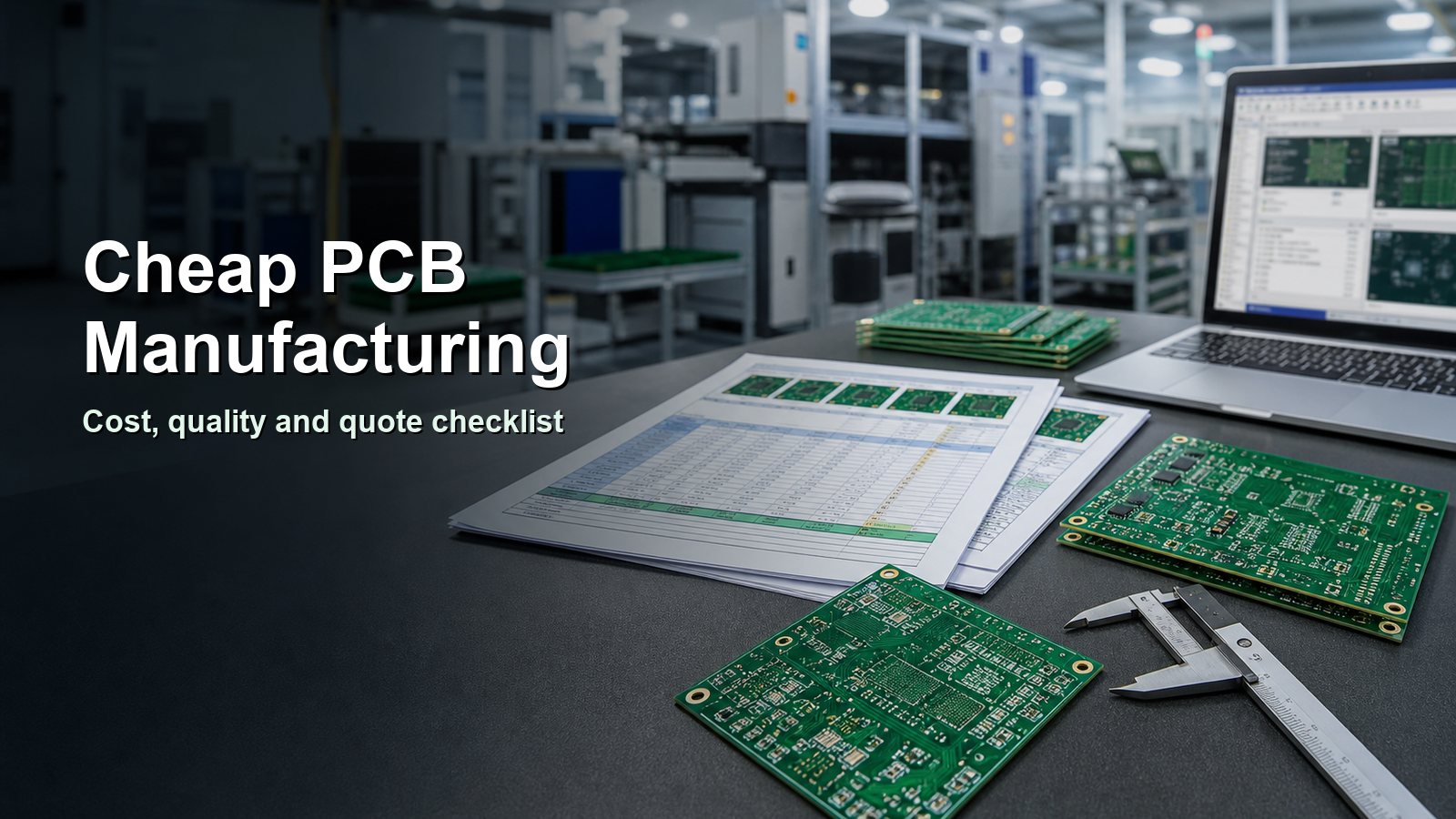
Cheap PCB manufacturing should mean a lower total build cost, not a board made with missing specifications, skipped checks or unclear freight terms. The safest way to reduce PCB cost is to keep the design manufacturable, quote every supplier from the same files, choose standard materials where they fit the application and keep essential quality controls in the quote.
This page is for buyers comparing low-cost PCB fabrication options for prototypes, small batches and early production. It focuses on practical sourcing decisions: what to include in an RFQ, which cost savings are usually reasonable, where cheap quotes create risk and when assembly or component sourcing changes the cost boundary.
What Does Cheap PCB Manufacturing Actually Mean?
Cheap PCB manufacturing means the board is specified, fabricated and checked at the lowest reasonable total cost for the job, not simply the lowest number shown on the first quote line.
A useful low-cost PCB quote includes board dimensions, layer count, material, copper, thickness, surface finish, solder mask, silkscreen, drilling, routing, quantity, electrical test needs, packaging, freight and delivery target. Without those inputs, two quotes may look comparable while covering different work.
How to Get a Low-Cost PCB Quote Without Removing Critical Quality Controls
The best low-cost PCB quote keeps the controls that protect function and removes only avoidable complexity, overspecification or purchasing waste.
Start with a clean Gerber or ODB++ package, drill data, stackup notes, finished thickness, copper weight, material preference, solder mask color, surface finish, quantity, panel requirements and electrical test requirement. If the project includes assembly, add BOM, CPL, assembly drawings and any polarity or programming notes.
Ask each supplier to confirm what is included and what is excluded. A quote that removes electrical test, changes material without approval or excludes freight may not be cheaper after rework or schedule loss. For a deeper explanation of cost drivers, use the existing custom PCB cost guide as a supporting reference.
Cheap PCB Prototype vs. Low-Cost Production: What Changes?
Prototype pricing is usually driven by setup, speed and engineering changes, while production pricing depends more on stable specifications, panel utilization, yield control and repeat ordering.
| Buying stage | Main cost pressure | Practical decision |
|---|---|---|
| First prototype | Setup, engineering review, small quantity and delivery choice | Keep the design simple enough to build, but do not remove checks needed to prove the circuit. |
| Design validation batch | Revision risk, test coverage and assembly readiness | Quote from the same complete files each time so cost changes can be traced to real design changes. |
| Low-volume production | Panelization, material consistency, inspection and repeatability | Use stable specifications and confirm whether tooling, test and packaging are included. |
| Ongoing production | Total landed cost, quality drift and supplier response time | Compare unit price with failure cost, communication speed and change-control discipline. |
The PCB Specifications That Change Price Most
The largest PCB price changes usually come from geometry, layer count, material choice, copper, drilling, finish, tolerances, testing and delivery requirements.
A two-layer FR4 board with ordinary dimensions and a common finish will normally quote differently from a dense multilayer board, HDI board, impedance-controlled board or metal-core board. BestPCBs’ internal capability records cover standard PCB, FR4, HDI, metal-core, ceramic and flex/rigid-flex categories, but exact manufacturability must still be confirmed against the files for each project.
When the application can use a standard rigid board, a page such as FR4 printed circuit board is a useful internal reference. If the layout needs higher wiring density or microvia structures, compare it with the HDI PCB capability path before assuming the same low-cost route applies.
How Quantity, Panelization and Yield Affect Unit Cost
Quantity can reduce unit cost only when the design, panel layout and process route are stable enough to spread setup and handling cost across more boards.
Buyers often compare prototype price and production price too early. A small board with awkward shape, strict outline routing or poor panel utilization can remain expensive even at a higher quantity. A larger board with stable rules may scale better once the supplier confirms panelization and fabrication flow.
Do not judge price only by the number of boards. Confirm finished board size, panel delivery option, breakaway tabs or V-score needs, tooling charges, electrical test method and whether scrap allowance or replacements are included in the commercial terms.
Standard Materials and Processes That Usually Reduce Cost
Low-cost PCB manufacturing usually becomes easier when the design uses standard materials, common thicknesses, ordinary copper weights, familiar solder mask colors and widely available surface finishes.
That does not mean every project should use the simplest option. High-current, high-temperature, RF, LED, ceramic, flex or rigid-flex designs may need a different material system. The cost-saving decision is valid only when the selected material still meets electrical, thermal, mechanical and assembly requirements.
- Use common stackups when impedance, thickness and mechanical constraints allow it.
- Avoid unnecessary tight tolerances that do not affect product function.
- Do not request special finishes, colors or build notes unless they serve the application.
- Keep drill sizes, trace spacing and copper rules inside the supplier’s normal process window.
- Confirm substitutions before release, especially for material and surface finish.
When a Cheap PCB Quote Becomes Expensive
A cheap PCB quote becomes expensive when important costs are excluded, when the board needs rework or when delays create downstream assembly and launch cost.
Common hidden-cost items include freight, import charges, bank fees, tooling, expedited service, repeated engineering questions, design changes after release, extra inspection, replacement boards, packaging requirements and delayed components for assembly projects. Community results in the SERP show that buyers often use peer feedback because vendor claims alone do not answer these risks.
Before approving a low quote, ask whether electrical test, final inspection, material confirmation, packing, freight method and delivery expectation are part of the number. A transparent quote is easier to compare than a very low number with vague exclusions.
Quality Checks That Should Not Be Removed to Save Money
Low price should not remove DFM review, material verification, basic inspection, electrical test where required or traceable handling of approved production files.
For bare PCB fabrication, quality control should match the board risk. A simple prototype may not need every optional report, but it still needs correct material, drill, copper, finish, outline and electrical continuity according to the released file. For assembly, the control set expands to BOM validation, component source, placement data, polarity, soldering, cleaning, inspection and functional test when specified.
BestPCBs maintains a dedicated PCB test equipment page that can support buyer checks around inspection and test capability. The specific inspection plan for a low-cost order should still be confirmed during RFQ.
How to Compare PCB Quotes on the Same Basis
Two PCB quotes are comparable only when they use the same files, specifications, quantity, delivery term, testing requirement and freight assumption.
| Comparison item | What to confirm | Why it matters |
|---|---|---|
| Board specification | Layer count, size, thickness, copper, drill, finish and solder mask | Small specification differences can change the process route and price. |
| Quantity and panel | Board count, panel delivery, tabs, V-score and array drawing | Unit price may change once the supplier sees the real panel requirement. |
| Quality controls | DFM review, electrical test, inspection and material confirmation | Removing controls may create field or assembly cost later. |
| Delivery and freight | Standard or expedited route, shipping method and destination terms | The cheapest ex-works price may not be the lowest landed cost. |
| Assembly boundary | Whether BOM, CPL, components, stencil and assembly are included | Bare-board cost and PCBA cost should not be mixed in one vague number. |
Low-Cost PCB Manufacturer Red Flags
A low-cost PCB manufacturer becomes risky when the quote is cheap but the specifications, quality checks, communication and change-control process are unclear.
- The quote does not list material, finish, copper, thickness or test assumptions.
- The supplier changes key specifications without written approval.
- Electrical test or inspection is excluded without explaining the risk.
- Delivery time is promised without checking file complexity or material availability.
- The supplier cannot explain how assembly files, polarity marks or BOM changes are handled.
- The price is compared only at unit level, with freight and rework ignored.
How Delivery Speed Changes the Total PCB Cost
Fast delivery can be worth paying for when it protects an engineering milestone, but it should be compared against the cost of errors, freight and incomplete review.
Cheap and fast are not always compatible. Expedite requests may compress engineering review time, narrow material options or increase freight cost. For urgent prototypes, ask the supplier to confirm which process steps remain unchanged, which checks are still included and whether delivery timing starts after file approval or after payment.
Bare PCB vs. PCB Assembly: Where the Cost Boundary Changes
Bare PCB manufacturing cost covers the fabricated circuit board; PCB assembly cost adds components, sourcing, stencil, placement, soldering, inspection and any functional test requirements.
This keyword is mainly about PCB fabrication and low-cost manufacturer comparison, but many buyers eventually need assembly. If you want a PCBA quote, include BOM, CPL, assembly drawing and test instructions with the fabrication files. For prototype assembly planning, the prototype PCB assembly page and component sourcing page are more relevant than a bare-board price alone.
Cheap PCB Manufacturing for Hobbyists, Engineers and Procurement Teams
Different buyers use the word cheap differently: hobbyists often want an affordable prototype, engineers want a design that can be built without surprises and procurement teams want a stable landed cost.
For hobby work, the priority may be a simple two-layer prototype and a clear online quote. For engineering validation, the priority is usually file accuracy, revision control and enough testing to learn from the board. For procurement, the priority is repeatability, documentation, communication and whether the supplier can support later revisions or assembly.
A single page should address all three groups because the SERP mixes manufacturer pages, forums, price comparison tools and buying guides. The common need is not just low price; it is confidence that the low-cost route will not create a worse cost later.
Cost-Saving Design Checks Before You Send an RFQ
The easiest PCB cost savings usually happen before the RFQ, when the designer can still simplify specifications without hurting function.
- Confirm the minimum layer count that still supports routing, current, impedance and mechanical needs.
- Use a standard board thickness and copper weight unless the design needs something else.
- Check whether fine line, tight spacing, small drill or via-in-pad features are actually necessary.
- Choose a surface finish for assembly and shelf-life needs, not only for appearance.
- Remove unused mechanical complexity from the outline and panel notes.
- Run DRC/ERC checks before sending the files.
- Include a fabrication drawing when tolerances, impedance or special notes matter.
Files Required for an Accurate Low-Cost PCB Quote
An accurate low-cost PCB quote needs enough files for the supplier to price the same real build you expect to receive.
- Gerber or ODB++ fabrication data
- NC drill file and drill table
- Stackup or material requirement when controlled
- Fabrication drawing with dimensions, tolerances and finish
- Quantity, panel delivery preference and target destination
- Surface finish, solder mask, silkscreen and copper requirement
- Electrical test requirement and any quality documentation request
- Target delivery date or milestone
- BOM, CPL, assembly drawing and test notes if assembly is also needed
Frequently Asked Questions About Cheap PCB Manufacturing
Is the cheapest PCB manufacturer always the best choice?
No. The cheapest visible quote may exclude testing, freight, material confirmation or assembly-related work. Compare total landed cost and quality risk before choosing.
Can a low-cost PCB still be reliable?
Yes, when the board uses suitable materials, stays inside a stable process window and keeps the quality checks required by the application. Low cost becomes risky when the quote removes controls without approval.
Why do prototype PCBs cost more per board than production boards?
Prototype orders spread setup, file review, tooling and handling across fewer boards. Production unit cost can fall after the design and process route become stable.
Should I choose HASL, ENIG or another finish to save cost?
Choose the finish based on assembly, shelf life, pad type and application requirements. A lower-cost finish is only a saving if it still fits the design and production plan.
What information makes a cheap PCB quote more accurate?
Gerber or ODB++, drill data, board size, layer count, material, thickness, copper, finish, quantity, testing requirement and delivery destination all make the quote more accurate.
Does PCB assembly belong in a cheap PCB manufacturing quote?
Only if you request PCBA. Bare PCB manufacturing does not include components, stencil, SMT/THT assembly, inspection or functional testing unless those items are quoted separately.
Request a PCB Cost and DFM Review
If you want a low-cost PCB quote without guessing what has been removed, send your Gerber or ODB++ files, drill data, stackup or fabrication drawing, quantity, material, copper, surface finish, electrical-test requirement, delivery destination and target schedule to sales@bestpcbs.com. If assembly is needed, include BOM, CPL, assembly drawings and test requirements as well. The BestPCBs team can review the files, confirm the quote basis and help identify cost-saving changes that do not weaken the board.