PCB manufacturing PCB manufacturing
Home > Blog

Double Sided MCPCB

Double Sided Metal Core PCB
Friday, March 20th, 2026

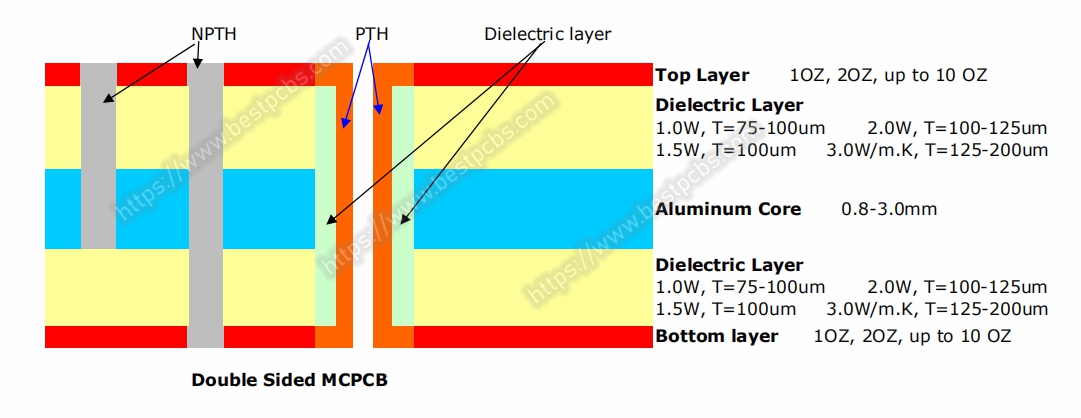
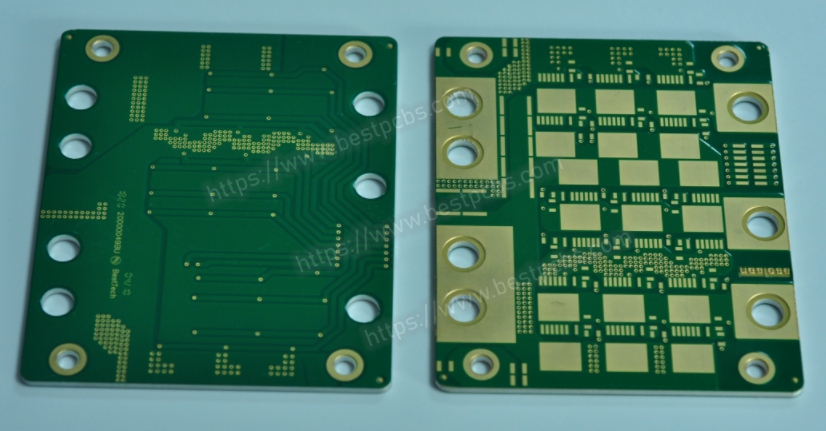
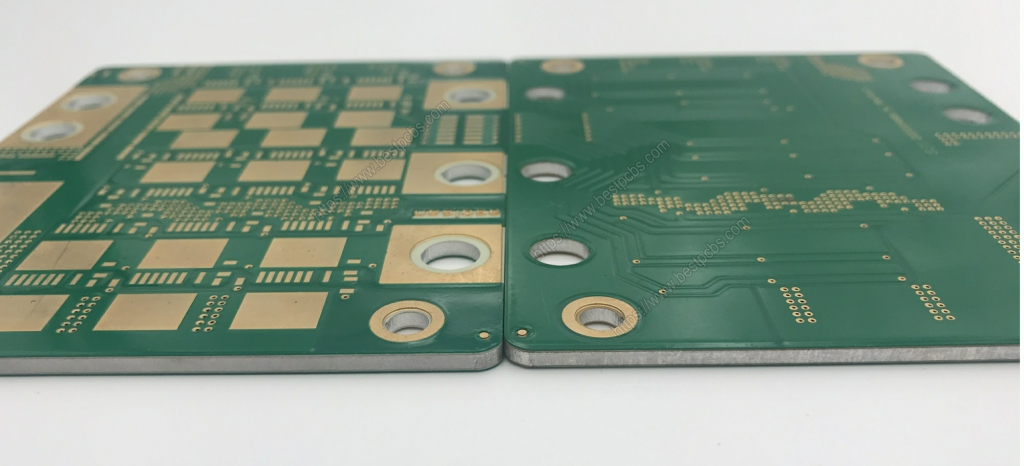
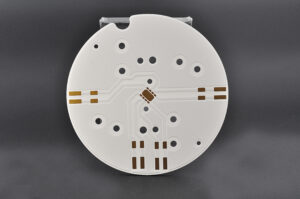
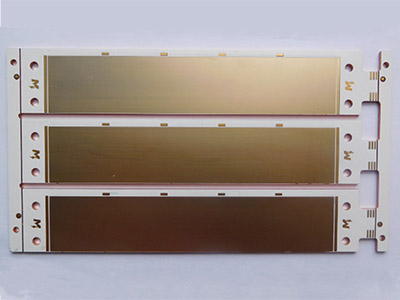
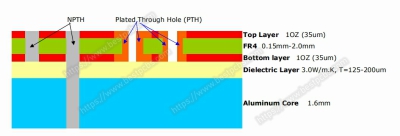
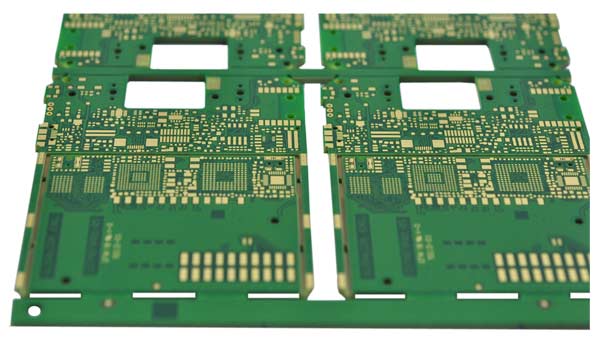
A double sided metal core PCB also has same two layers of copper conductor like Double layers MCPCB, but the metal core is in the middle of two conductor, so there’re conductors (trace) on both sides of metal core, and were connected to each other by Vias. So we named it “Double sided MCPCB”, and you can populated SMD on both top and bottom.

Different with Single layer MCPCB, double sided MCPCB also requires an additional pressing step to laminate the imaged thermal conductive laminate and metal core (also known as metal base) together. But sometimes, some raw Metal Clad material vendor will supply board material which already laminated.

Compared with normal FR4, this structure need more technology and experience on laminating of two layers together with metal core.

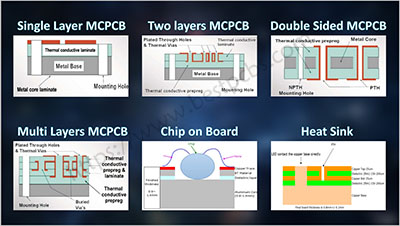
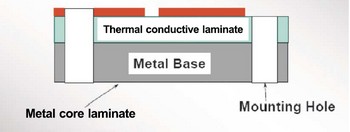
Structure of Double Sided MCPCB
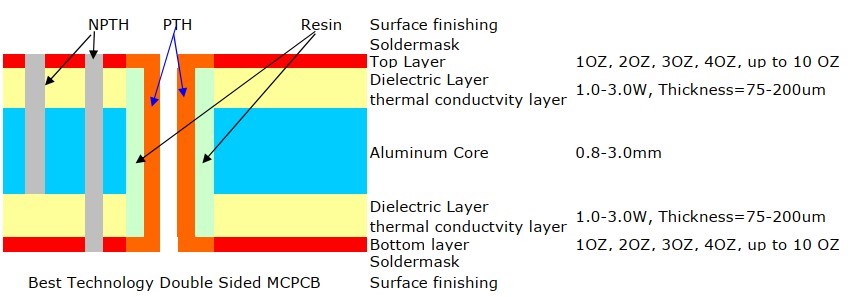
Structure of Double Sided MCPCB

Capability of Double Sided MCPCB

  • Base material: Aluminum/Copper/Iron Alloy
  • Thermal Conductivity (dielectric layer): 0.8, 1.5, 2.0, 3.0 W/m.K.
  • Board Thickness: 0.5mm~3.0mm (0.02″~0.12″)
  • Copper thickness: 0.5 OZ, 1.0 OZ, 2.0 OZ, 3.0 OZ, 4.0 OZ, 5.0 OZ
  • Outline: Routing, punching, V-Cut
  • Solder mask: White/Black/Blue/Green/Red Oil
  • Legend/Silkscreen Color: Black/White
  • Surface finishing: Immersion Gold, HASL, OSP
  • Max Panel size: 600*500mm (23.62″*19.68″)
  • Packing: Vacuum/Plastic bag
  • Samples L/T: 10~15 Days
  • MP L/T: 12~15 Days

FAQs about Double sided Metal Core PCB

1. What is a double-sided metal core PCB?

A double-sided MCPCB consists of two circuit layers (top and bottom) with a metal core—typically aluminum or copper—sandwiched in the middle. Unlike standard FR4 boards, the metal core acts as a high-efficiency heat sink. The layers are connected using insulated through-holes or thermal vias to ensure electrical signals pass through without shorting against the metal base.

2. How does a double-sided MCPCB differ from a single-sided one?

The primary difference lies in component density and routing complexity.

  • Single-Sided: Components are on one side; the metal base is on the back. It is simpler and cheaper but limited in space.
  • Double-Sided: Allows for components and traces on both sides of the metal core. This is necessary for complex designs where high power density requires cooling for components on both surfaces of the board.

3. What materials are used for the core in double-sided PCBs?

The three most common materials are:

  • Aluminum (6061 or 5052): The most cost-effective and popular choice, offering good thermal conductivity and mechanical stability.
  • Copper: Offers superior thermal conductivity (nearly double that of aluminum) but is significantly heavier and more expensive.
  • Stainless Steel: Used primarily for its mechanical strength and corrosion resistance, though its thermal performance is lower than aluminum.

4. Why are double-sided MCPCBs used instead of standard FR4?

Standard FR4 is a poor thermal conductor. In high-power applications, heat builds up and can cause component failure. Double-sided MCPCBs are used because the metal core can dissipate heat at rates of 1.0 W/mK to 9.0 W/mK (or higher), whereas FR4 typically manages only 0.25 W/mK. This allows for smaller form factors without overheating.

5. What are the main applications for double-sided metal core PCBs?

These boards are a staple in industries where heat management is critical:

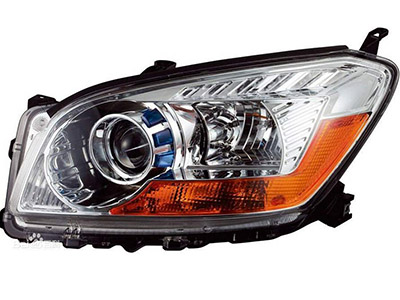
  • Automotive: LED headlights, power converters, and motor control modules.
  • Lighting: High-output street lights and industrial floodlights.
  • Power Electronics: Solid-state relays, rectifiers, and high-capacity power supplies.
  • Telecommunications: Signal amplifiers and high-frequency filtering equipment.

6. What are the manufacturing challenges of double-sided MCPCBs?

The most significant challenge is the drilling and insulation process. Because the core is conductive metal, every through-hole must be pre-drilled, filled with a specialized dielectric resin, and then re-drilled to prevent the copper pins from touching the metal core. This requires high precision and specialized lamination techniques to ensure the board does not delaminate under thermal stress.
What are the Differences between Double Sided MCPCB and Double/Two Layers MCPCB?
Friday, August 14th, 2020

Metal Core PCB are differentiated on the basis of their construction, which can be divided into following types: single layer, double/two layers, double sided, and multi layer. The double sided and double/two layers MCPCB are commonly used in advanced electronic circuits, some people may be confused about them due to their similar names. So in this blog I’d like to share with you the differences between the two types. 

Actually the main difference is the double sided and double/two layers MCPCB have different layout due to the positioning of the metal core.

Double/two layers MCPCB

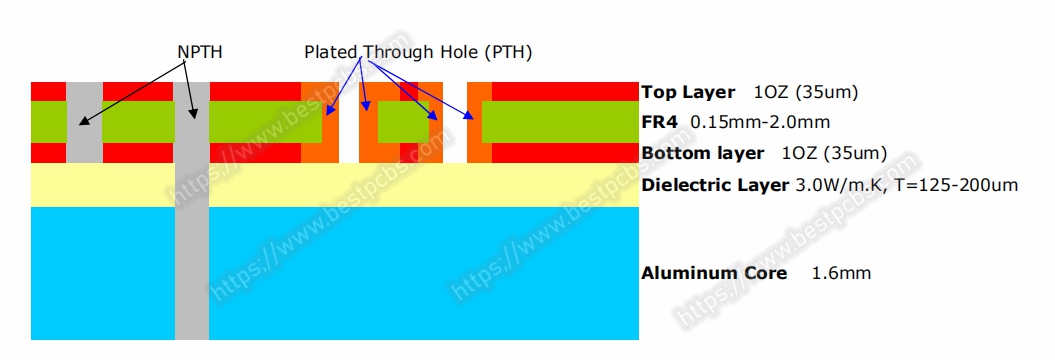
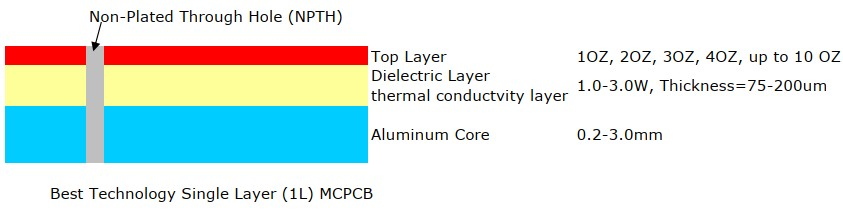
As you can see the following stack up, the metal core is at the bottom, with two copper layers on top side, the dielectric layer is between the copper layer and the bottom metal base. In short, the conductor layers is in same side of the metal core. The components can only be assembled on the top layer.

double/two mcpcb stack up
double/two mcpcb

Double sidedMCPCB

As you can see the following MCPCB stack up, the metal core is in the middle of two conductor layers. There is also a dielectric layer between the metal core and a copper layer. The metal core and conductors are connected to each other through PTH (Plated Through Hole). The components can be assembled on both the bottom and top.

double sided mcpcb stack up
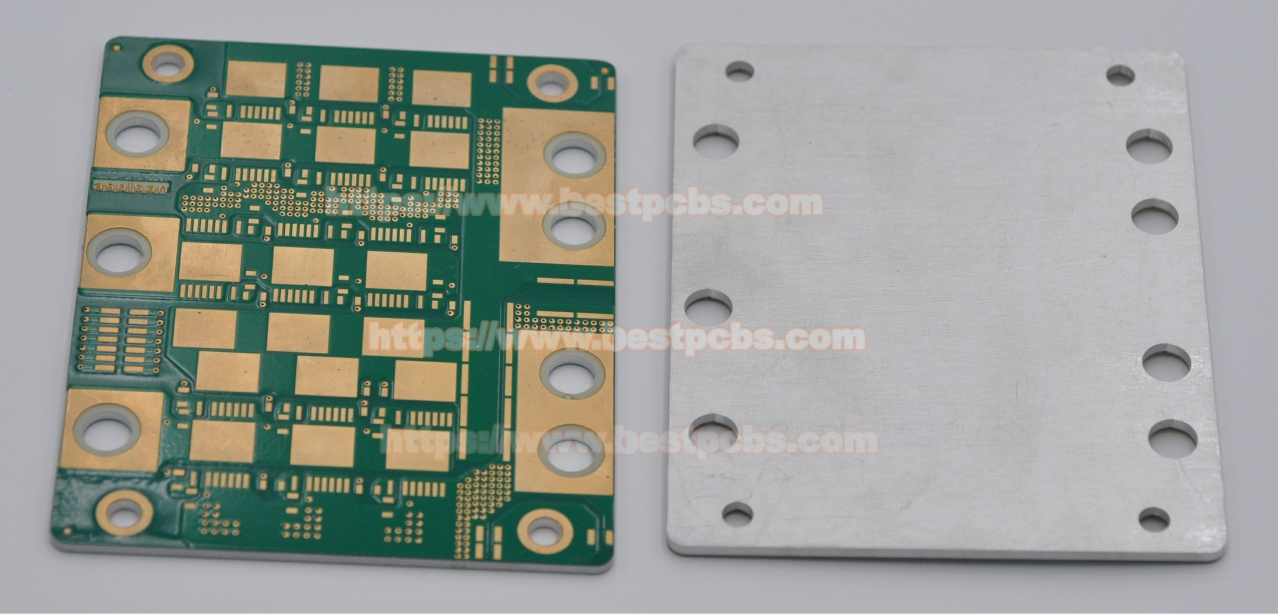
double sided mcpcb
Double sided MCPCB

Both double sided and double/two layers aluminum/copper core have the good heat dissipation, reliable performance at high temperatures and excellent thermal expansibility, according to our experience, for the same design, the heat dissipation on Double Sided MCPCB is a little better than Double Layers MCPCB.

The choice of the either type will depend on customer’s application requirements. If you are still confused about the two types and their benefits for your application, please feel free to contact Tammy (Email:sales9@www.bestpcbs.com), the Metal Core PCB International Sales in EBest Circuit (Best Technology).

Welcome to visit our website to learn more about us, we can provide different types of MCPCB in diverse specifications.

Difference between A Double Sided MCPCB and a Double Layer MCPCB
Monday, November 25th, 2019

Metal core printed circuit boards(mcpcb) are suitable alternatives for FR4/CEM1-3 variants. These circuit boards use metal as a core base material and are differentiated on the basis of their construction. There are a few types such as single layer, double layer, double sided, and multi-layer PCBs. What are heavily used in advanced electronic circuits are the double layer and double sided metal core printed circuit boards. These two types arise confusion due to their similar names. What are the differences between both? What advantages do they offer? Now you can get the answer from the following description.

Definition of a Double Sided and Double Layer MCPCB:

The double sided MCPCB and double layered MCPCB have different layout, due to the positioning of a metal core:

In a double sided MCPCB, the metal core lies in the middle of two conductor layers. There is also a dielectric layer between the metal core and a copper layer. The metal core and conductors are connected to each other through Vias. The SMD can be populated at the bottom and top.

A double layer MCPCB has a metal core at the bottom, with two conductor layers on its top. In short, the conductor layers lie in same side of the metal core. Generally, metals like aluminum, copper, and iron alloys are used as metal cores. The dielectric layer lies between a copper layer, and the bottom metal core. The SMD can only be populated on the top.

Advantages of Double Sided MCPCB and Double Layer MCPCBs:

Both these variants offer the same benefits as other metal core PCBs. They are as follows:

Reliable Performance at High Temperatures: Many double sided CEM3 or FR4 PCBs with high power and density face difficulties in heat dissipation. The CEM3 or FR4 material have weak thermal conductivity, which means the electronic components are destroyed at high temperatures. However, double sided metal core circuit boards feature a metal core, which has an excellent inter-layer insulation and thermal conductivity. Both these factors contribute to its reliable performance at high temperature.

Excellent Thermal Expansibility: Thermal expansion and contraction is an important feature of all objects. The ability to contract with cold, and expand with heat is termed as coefficient of thermal expansion. Most FR4 PCBs have low CTE, which means they cannot effectively deal with issues of contraction and expansion. However, both double sided and double layer PCBs can effectively deal with thermal expansibility. Thus, they are in demand.

Applications of Double Sided MCPCB and Double Layer MCPCBs:

LED lights

Street and general lighting

Industrial controls

Power monitoring devices

Automotive

Amplifiers

Test equipment

The choice of the either type will depend on your application requirements. If you are still confused about the two types and their benefits for your application, you can always approach an industry expert or a reliable metal core pcbs manufacturer like EBest Circuit (Best Technology), which provides different types of MCPCBs in diverse specifications.