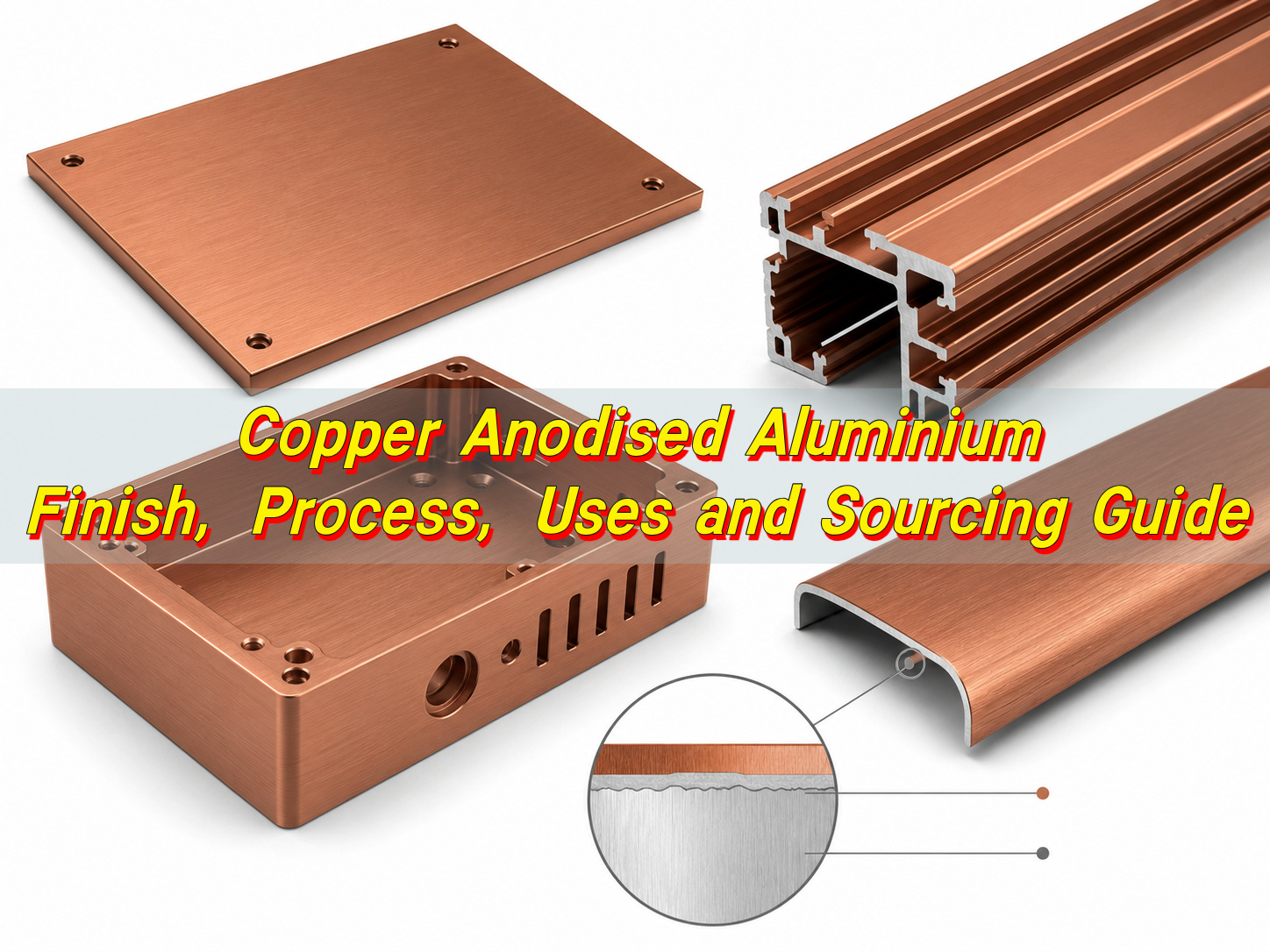
Copper anodised aluminium gives aluminium parts a warm copper-like appearance while keeping the light weight, corrosion resistance, and design flexibility of anodised aluminium. In most engineering and architectural sourcing contexts, this term refers to aluminium that has been anodised and coloured to look like copper, not pure copper that has been anodised. That distinction matters. If your project needs copper’s electrical or thermal conductivity, you may need copper, copper plating, copper-clad aluminium, or another conductive structure. If your project needs a durable copper-tone surface on lightweight aluminium, copper anodised aluminium is often a practical choice.
What Is Copper Anodised Aluminium?
Copper anodised aluminium is aluminium that has gone through an electrochemical anodising process and then received a copper-coloured finish. The base material remains aluminium. The surface becomes an aluminium oxide layer that is harder and more corrosion-resistant than untreated aluminium.
The word “copper” usually describes the colour effect. It may look like brushed copper, satin copper, bronze-copper, rose copper, or darker architectural copper. The exact appearance depends on alloy grade, surface pretreatment, anodising thickness, colouring method, sealing quality, and viewing angle.
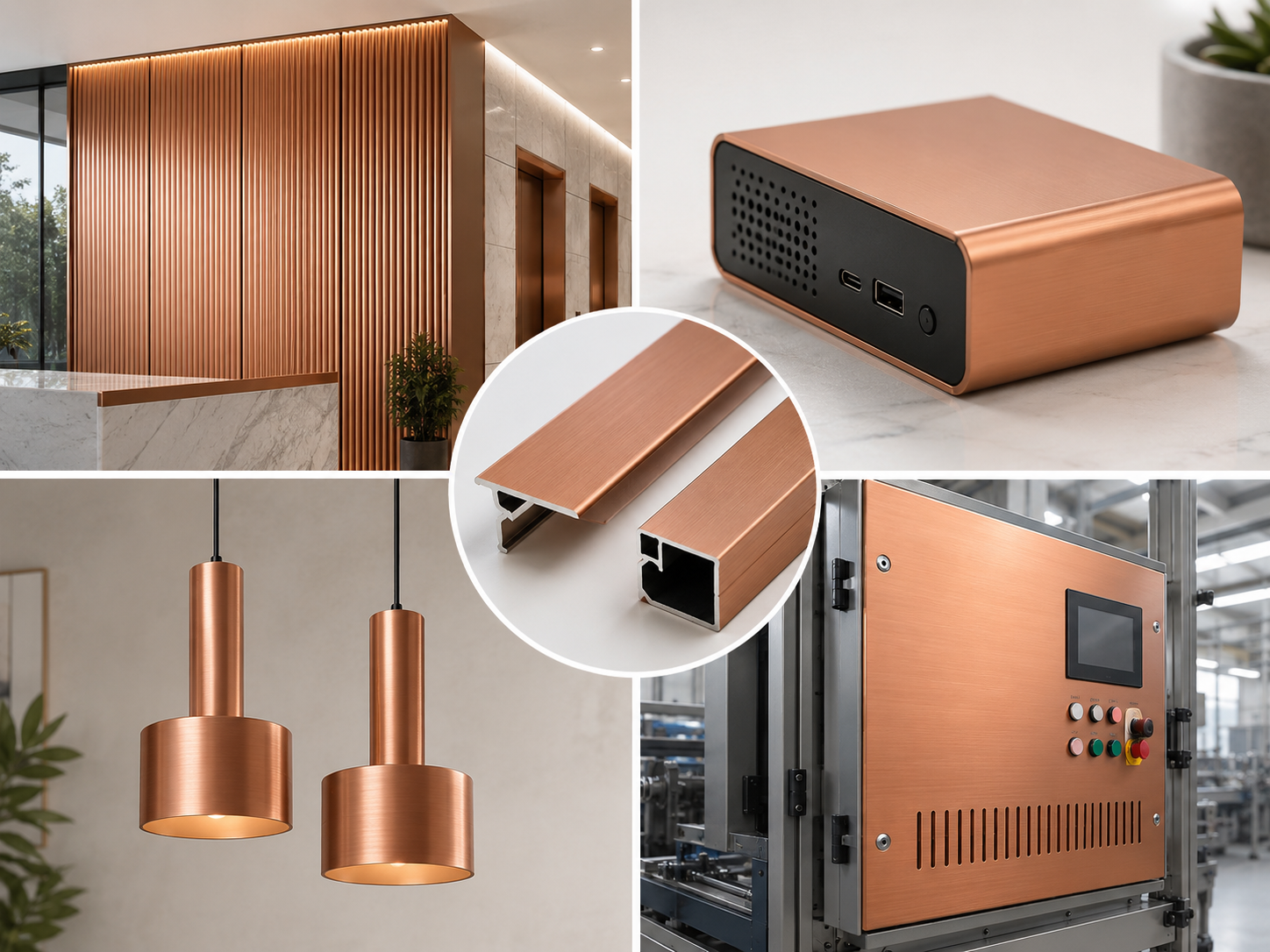
This finish is popular because it creates a premium metallic appearance without the weight, patina behaviour, and cost structure of solid copper. It is used for architectural trim, decorative panels, electronic housings, lighting parts, furniture hardware, industrial nameplates, control panels, and custom OEM aluminium components.
Anodising is widely used to thicken the natural oxide layer on aluminium and improve corrosion resistance, wear resistance, colour retention, and surface stability. ISO 7599:2018 also defines requirements and test methods for decorative and protective anodic oxidation coatings on aluminium and aluminium alloys.
Why Is Copper Anodised Aluminium Important?
Copper anodised aluminium solves a common design problem: many products need the visual warmth of copper, but pure copper is heavy, costly, reactive, and not always easy to maintain. Aluminium is lighter and easier to machine, extrude, bend, stamp, and assemble. When anodised properly, it can offer a durable decorative surface with a refined metallic texture.
For designers, the value is appearance and material efficiency. A product can look premium without using solid copper. For engineers, the value is surface protection, dimensional control, and repeatable production. For buyers, the value is stable cost, lower part weight, and better suitability for volume manufacturing.
In overseas B2B procurement, this finish is especially useful when brands want consistent colour across batches. Natural copper develops patina over time. Copper anodised aluminium can be specified to maintain a more controlled copper-tone appearance, depending on the anodising system and exposure environment.
How Does Copper Anodised Aluminium Work?
The anodising process turns the aluminium surface into a controlled aluminium oxide layer. The aluminium workpiece acts as the anode in an electrolytic bath. Under controlled current, temperature, and chemistry, the oxide layer grows from the surface. This layer is not a paint film sitting on top of the metal. It is integrated with the aluminium substrate, which helps improve durability.
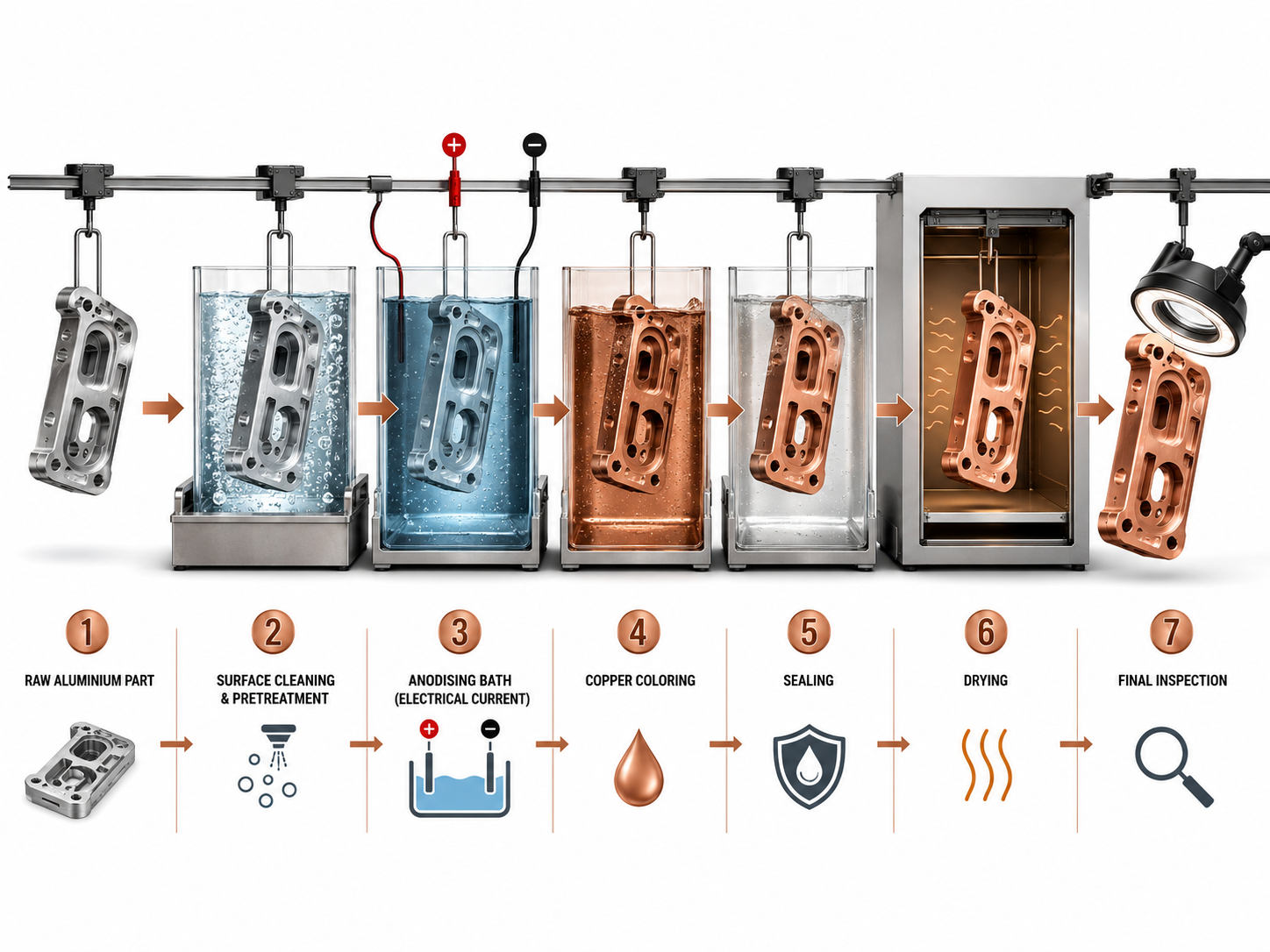
A typical process flow includes cleaning, alkaline etching, desmutting, anodising, colouring, sealing, drying, and inspection. For copper-coloured finishes, the colouring stage is critical. The manufacturer may use organic dyes, electrolytic colouring, or proprietary colouring systems to create the copper tone. After colouring, sealing closes the pores in the anodic coating and helps improve corrosion resistance, stain resistance, and colour stability.
The process must be controlled carefully. Small changes in alloy, surface texture, bath temperature, film thickness, dye concentration, sealing time, or rack position can affect the final colour. That is why professional production usually requires approved limit samples before bulk orders.
What Types of Copper Anodised Aluminium Are Available?
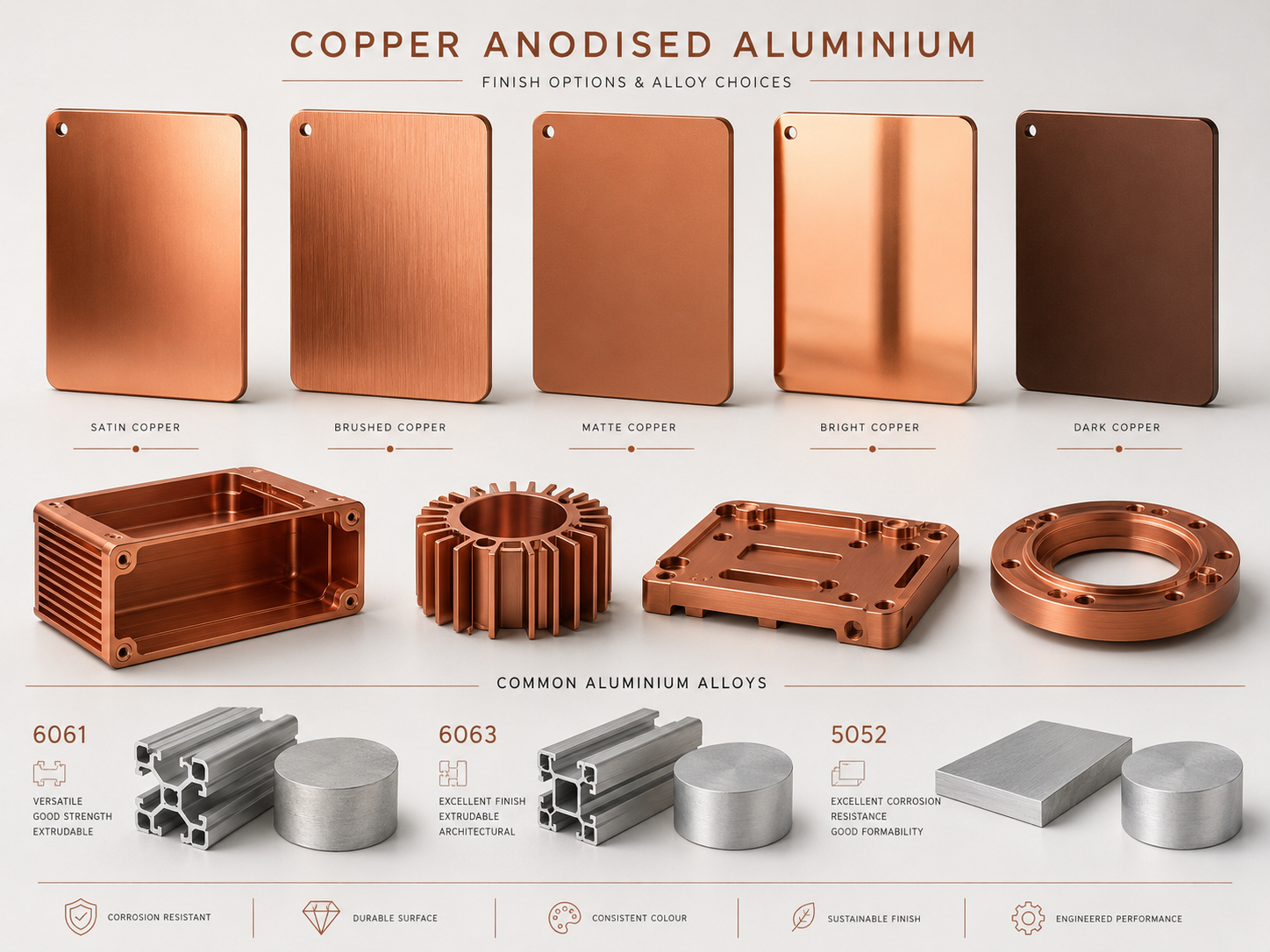
Copper anodised aluminium is not one single finish. It can be adjusted by colour depth, surface texture, gloss level, coating thickness, and performance requirement.
| Type | Typical Appearance | Common Use | Key Buying Note |
|---|---|---|---|
| Satin copper anodised aluminium | Soft brushed copper tone | Electronic housings, panels, trim | Good balance of appearance and fingerprint control |
| Bright copper anodised aluminium | More reflective metallic copper | Decorative parts, consumer products | Surface defects are easier to see |
| Matte copper anodised aluminium | Low-gloss industrial copper tone | Machinery panels, signage, architectural details | More forgiving for visual consistency |
| Dark copper anodised aluminium | Copper-bronze or antique copper effect | Façade parts, furniture, lighting | Needs strict colour sample control |
| Hard anodised copper-tone aluminium | Thicker, more wear-focused coating | Industrial components | Decorative colour choices may be more limited |
| Brushed copper anodised aluminium | Linear grain texture | Door trim, instrument panels, premium devices | Grain direction must be specified |
For decorative parts, Type II sulphuric acid anodising is common because it can accept colour well. For wear-focused parts, Type III hard anodising may be selected, but colour options can be less predictable. MIL-PRF-8625 covers different anodic coating types and classes for aluminium and aluminium alloys, including dyed and non-dyed classes for non-architectural applications.
Which Materials Are Suitable for Copper Anodised Aluminium?
Not all aluminium grades anodise the same way. The alloy strongly affects colour consistency, brightness, corrosion resistance, and surface texture. For visible copper-tone anodised parts, 5xxx and 6xxx series aluminium alloys are often easier to manage than high-copper or high-silicon alloys.
| Aluminium Alloy | Anodising Suitability | Typical Applications | Notes |
|---|---|---|---|
| 6063 | Excellent for decorative anodising | Extrusions, frames, trims | Often preferred for architectural profiles |
| 6061 | Good general-purpose option | CNC parts, housings, brackets | Stable strength and machinability |
| 5052 | Good corrosion resistance | Panels, sheet metal covers | Common for formed sheet parts |
| 6082 | Good mechanical strength | Structural machined parts | Colour may need sample confirmation |
| 7075 | More difficult for decorative consistency | High-strength parts | Colour can appear darker or less uniform |
| 2xxx series | Usually challenging | Aerospace and high-strength parts | Copper content may affect anodising appearance |
For high-appearance projects, do not choose the alloy only by mechanical strength. Choose it by both mechanical requirement and anodising response. A part that performs well mechanically may still produce a poor copper colour after anodising.
What Are the Key Features of Copper Anodised Aluminium?
Copper anodised aluminium offers a mix of decorative and functional features. The most important feature is that it gives aluminium a copper-like surface while keeping the base metal lightweight. It also improves surface hardness compared with untreated aluminium and provides better protection against oxidation and environmental exposure.
Another key feature is colour flexibility. The copper tone can be tuned from light rose-copper to deeper bronze-copper. Surface preparation can also change the final result. A brushed surface creates a different visual effect from a bead-blasted or polished surface.
The anodic layer is electrically insulating. This is useful in some products, but it can create grounding problems in electronic assemblies. If the aluminium part must provide electrical continuity, the drawing should clearly define masked areas, conductive contact points, threaded grounding locations, or post-machined contact surfaces.
What Are the Advantages of Copper Anodised Aluminium?
The main advantage is appearance-to-weight efficiency. Solid copper is much heavier than aluminium. Aluminium can reduce product weight while still giving a copper-style visual effect. This is useful for wall panels, enclosures, lighting products, handles, display frames, and portable devices.
Another advantage is controlled surface performance. Unlike paint, anodising becomes part of the aluminium surface. It is less likely to chip like a coating film. With proper sealing, it can resist staining and everyday handling better than raw aluminium.
It also supports volume manufacturing. Aluminium can be extruded, CNC machined, stamped, laser cut, bent, drilled, tapped, and assembled before anodising. This makes it suitable for OEM and ODM projects where the buyer needs both custom geometry and a controlled decorative surface.
For architectural aluminium, high-performance exterior anodised finishes are often specified according to AAMA 611 Class I requirements, especially when long-term outdoor durability, UV exposure, salt spray resistance, and abrasion performance are important.
What Are the Limitations of Copper Anodised Aluminium?
The first limitation is colour tolerance. Copper anodised aluminium is sensitive to alloy batch, surface pretreatment, anodising thickness, sealing, and viewing light. Even if two parts use the same dye, they may not look identical if the alloy or surface finish changes.
The second limitation is repair difficulty. Scratches that cut through the anodic layer are not easy to repair invisibly. Small surface marks may require rework or full refinishing. For visible consumer or architectural parts, packaging and handling are part of the quality plan, not an afterthought.
The third limitation is conductivity. Anodised aluminium has an insulating oxide layer. For electronic enclosures, heat sinks, grounding plates, or shielded housings, the manufacturer must reserve conductive areas where needed.
The fourth limitation is outdoor colour stability. Some colour systems are more suitable for indoor products, while others are designed for exterior architectural use. If the product will face sunlight, humidity, salt mist, or industrial air pollution, the buyer should specify the exposure environment before quotation.
How Does Copper Anodised Aluminium Compare With Other Copper-Look Finishes?
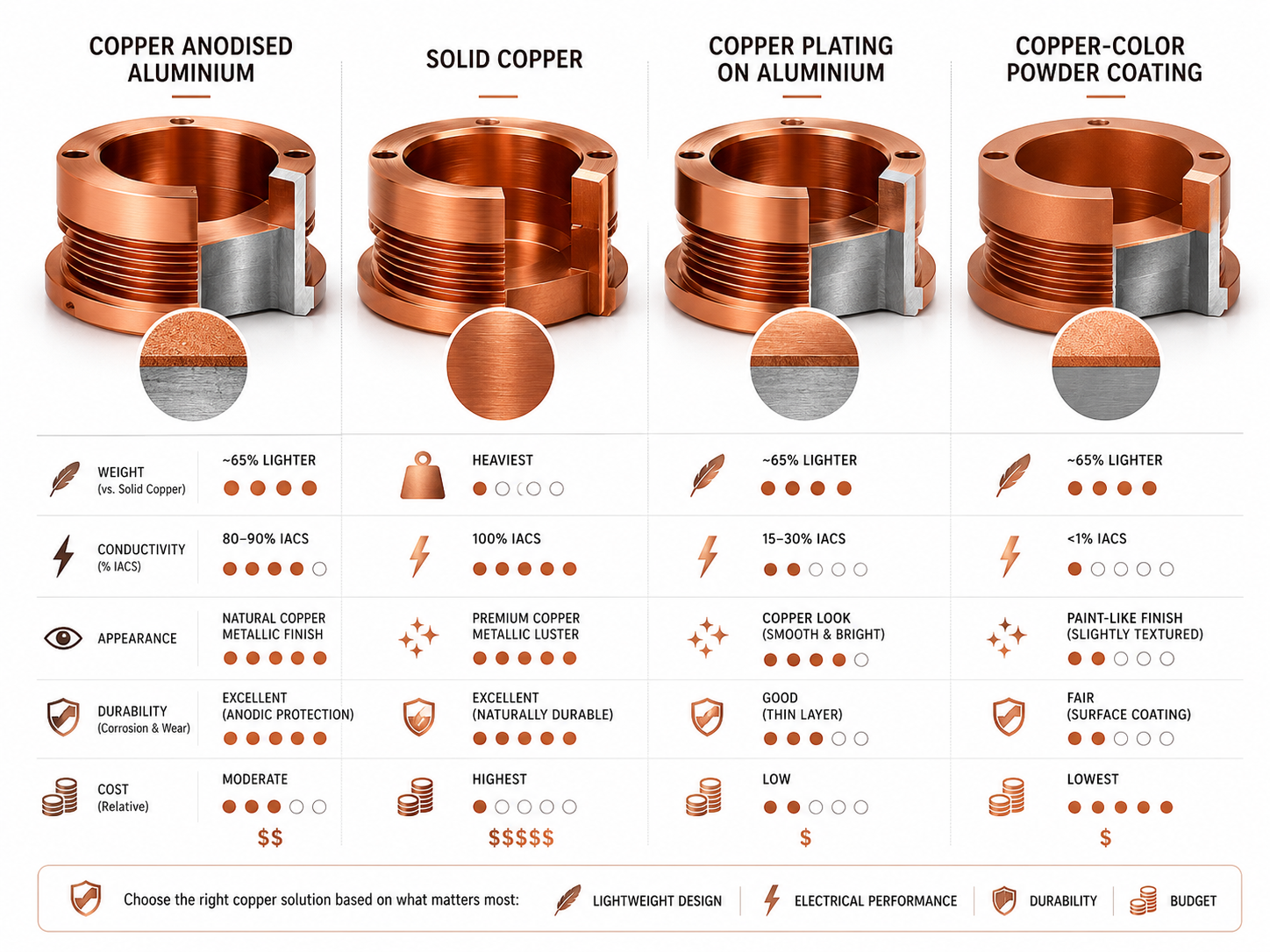
Different copper-look finishes serve different goals. Copper anodised aluminium is not always the best solution, but it is often the best balance when the project needs a durable metallic look on an aluminium base.
| Finish Option | Main Benefit | Main Concern | Best Fit |
|---|---|---|---|
| Copper anodised aluminium | Lightweight, metallic appearance, good durability | Colour control must be managed | Decorative aluminium parts and panels |
| Solid copper | Real copper conductivity and natural patina | Heavy, costly, changes colour over time | Electrical, heritage, premium metalwork |
| Copper plating on aluminium | Real copper surface layer | Adhesion and corrosion control are critical | Conductive or decorative plated parts |
| Powder-coated copper colour | Broad colour options and lower visual tolerance risk | Less metallic depth than anodising | Large panels, cost-sensitive projects |
| PVD copper coating | Premium appearance, thin hard coating | Higher cost and process limitation | Luxury hardware, small precision parts |
| Copper-colour paint | Easy colour matching | Lower scratch resistance | Low-cost decorative parts |
If your priority is electrical conductivity, copper anodised aluminium is usually not the right answer. If your priority is copper appearance, aluminium weight, and anodised surface durability, it can be a strong option.
How Should Engineers Choose the Right Specification?
A good specification should describe more than “copper anodised aluminium.” That phrase is too broad for production. Engineers should define the alloy, temper, surface texture, anodising type, coating thickness, colour target, gloss range, sealing method, masking areas, inspection method, and packing requirement.
A practical drawing note may include the aluminium grade, such as 6061-T6 or 6063-T5, followed by the required anodising type and finish colour. For example, a decorative enclosure may call for satin copper anodised finish with approved colour sample, coating thickness range, sealed surface, and masked grounding points.
For high-appearance projects, approved samples are essential. One “golden sample” is useful, but limit samples are better. Limit samples show the acceptable light, medium, and dark colour range. This helps reduce disputes during mass production.
For assembled products, engineers should also consider tolerance change. Anodising creates a surface layer that changes dimensions slightly. Threads, press-fit holes, tight sliding surfaces, and cosmetic edges should be reviewed before production.
Where Is Copper Anodised Aluminium Used?
Copper anodised aluminium is used wherever design teams want a warm metal appearance with lightweight aluminium performance. It appears in architecture, electronics, lighting, retail displays, furniture, transportation interiors, industrial equipment, and premium consumer products.
In architecture, it is used for curtain wall trims, door frames, ceiling profiles, decorative panels, elevator interiors, and signage. In electronics, it is used for aluminium enclosures, faceplates, control panels, amplifier housings, router shells, and instrument covers. In lighting, it is used for lamp bodies, reflectors, pendant housings, and decorative heat-dissipation structures.
For industrial equipment, the finish can be used on operator panels, machine covers, identification plates, knobs, handles, brackets, and exposed mechanical parts. For consumer products, it can support a premium copper-tone design without making the product too heavy.
What Practical Cases Show Its Value?
A lighting manufacturer may choose brushed copper anodised aluminium for pendant lamp housings. The aluminium body supports heat dissipation and weight reduction, while the copper-tone surface creates a warm interior design style. The key production risk is colour difference between spun, extruded, and machined parts, so all parts should use aligned pretreatment and approved colour limits.
An electronics brand may use copper anodised aluminium for a CNC-machined audio amplifier enclosure. The buyer wants a premium surface, clean edges, and stable colour. The engineering team should reserve un-anodised grounding points inside the enclosure and protect threaded holes where electrical bonding is required.
An architectural supplier may use dark copper anodised aluminium profiles for interior wall trims. The priority is batch consistency across long profiles. The supplier should control extrusion source, surface grain direction, anodising load, sealing, and packaging to avoid visible shade bands on installed walls.
A machinery manufacturer may use matte copper anodised aluminium nameplates and control panels. The finish improves appearance and surface protection, while laser engraving or screen printing can add durable markings. The buyer should test ink adhesion, engraving contrast, and cleaning resistance before batch order.
What Should Designers Consider Before Production?
Designers should start with the final environment. Indoor decorative parts have different requirements from outdoor building components or industrial equipment near chemicals. For outdoor use, weather resistance, UV exposure, salt mist, and cleaning chemicals must be discussed early.
Surface texture should be locked before colour approval. Brushing, polishing, sandblasting, bead blasting, and chemical etching all change how copper colour appears. Even the same anodising bath can look different on different textures.
Designers should avoid sharp edges where possible. Very sharp corners can anodise unevenly and become weak points for scratches. Radiused edges usually improve both appearance and handling durability.
Assemblies also need attention. If copper anodised aluminium parts are assembled with stainless steel screws, plastic clips, rubber pads, adhesives, or gaskets, the contact points should be tested. Friction during assembly can create scratches, pressure marks, or colour damage.
How Is Copper Anodised Aluminium Manufactured and Tested?
Manufacturing begins with stable raw material. The supplier checks alloy grade, surface condition, thickness, and mechanical processing requirements. After machining or forming, the parts are cleaned to remove oil, fingerprints, cutting fluid, and oxide contamination.
Pretreatment shapes the final appearance. Alkaline etching creates a matte surface. Mechanical brushing creates directional grain. Polishing increases brightness. After pretreatment, anodising builds the oxide layer. Colouring gives the copper tone. Sealing improves surface stability.
Testing should match the product’s risk level. Cosmetic indoor parts may need visual inspection, colour comparison, coating thickness check, and packaging review. Outdoor or industrial parts may need salt spray testing, abrasion testing, seal quality testing, UV resistance evaluation, and chemical resistance checks.
| Quality Item | Why It Matters | Common Control Method |
|---|---|---|
| Alloy verification | Prevents colour and performance variation | Material certificate, incoming inspection |
| Surface pretreatment | Controls texture and reflectivity | Sample approval, visual standard |
| Coating thickness | Affects durability and dimensions | Eddy current thickness measurement |
| Colour consistency | Prevents visible batch mismatch | Limit samples, colour meter, controlled lighting |
| Sealing quality | Improves stain and corrosion resistance | Dye spot, admittance, or mass-loss methods |
| Masking accuracy | Protects conductive or assembly areas | Fixture review and visual inspection |
| Scratch protection | Maintains cosmetic grade | Film, foam, tray, or individual packing |
ISO 2143 specifies a dye absorption method for checking sealed anodic oxidation coatings, especially where staining resistance or weather exposure is important.
What Failures Can Happen and How Can They Be Prevented?
Colour mismatch is one of the most common failures. It often comes from mixed alloy batches, uneven pretreatment, different surface roughness, or unstable anodising parameters. The solution is to control alloy source, use approved limit samples, and avoid mixing different material batches in one visible assembly.
Fading can happen when the colour system is not suitable for the application environment. For exterior parts, the buyer should ask about lightfastness, sealing method, and outdoor test data. For indoor parts exposed to strong sunlight, UV resistance still matters.
White spots or stains may come from poor cleaning, poor sealing, trapped chemicals, or contaminated rinse water. Better rinsing, stable sealing, and clean packaging help reduce this risk.
Pitting and corrosion may appear when the wrong alloy is used or when pretreatment exposes inclusions. This is more likely on low-quality raw material or parts used in marine and industrial environments.
Rack marks are another practical issue. Anodising requires electrical contact. The supplier should define rack locations before production, especially for visible parts.
Thread and fit problems can happen when anodising thickness is not considered. Critical holes, threads, sliding features, and press-fit areas may need masking or post-machining.
What Affects the Cost of Copper Anodised Aluminium?
The cost depends on raw material, part size, alloy grade, surface finish, anodising type, colour difficulty, tolerance, inspection level, order quantity, packaging, and logistics. Bright finishes usually need better raw material and more surface preparation. Dark copper shades may require tighter colour control. Long profiles need stable anodising tanks and careful handling.
Small orders often have higher unit costs because colour adjustment, racking, sampling, and process setup still take time. Bulk production can reduce unit cost, but only if the specification is stable.
Complex parts cost more when they need masking, two-sided cosmetic control, hidden rack positions, tight holes, or special packing. If the part has both cosmetic and functional requirements, such as an anodised housing with grounding points, the supplier must add process controls.
For global buyers sourcing from a China-based manufacturer, total landed cost should include tooling, samples, surface approval, packaging, freight, duty, inspection, and possible rework risk. A low surface-finishing quotation is not always lower cost if colour consistency and packing are weak.
How Can Buyers Choose a Reliable Supplier?
A reliable supplier should understand both aluminium manufacturing and anodising control. The buyer should ask whether the supplier can support CNC machining, extrusion, sheet metal fabrication, brushing, polishing, anodising, inspection, assembly, and export packing. For OEM and ODM projects, this integrated capability can reduce handover errors.
The supplier should be able to discuss alloy selection, surface pretreatment, coating thickness, masking, colour tolerance, and inspection methods before quoting. If a supplier only quotes by part weight or surface area without asking about appearance level, the project may carry hidden risk.
Buyers should request sample approval before mass production. For visible parts, limit samples are better than one perfect sample. For outdoor products, buyers should ask for the applicable standard, test method, and expected exposure environment.
A China source factory can be a strong option for custom copper anodised aluminium parts when the project needs flexible manufacturing, controlled batch production, and global shipment. The key is not to claim false local production. The real advantage is engineering communication, process integration, cost control, and stable export support.
What Should Be Checked Before Placing an Order?
Before placing an order, the buyer should check the full technical package. The drawing should include material grade, temper, dimensions, tolerance, surface finish, anodising type, copper colour requirement, coating thickness, sealing requirement, masking areas, visible surface definition, inspection standard, and packaging method.
The buyer should also confirm whether the part is for indoor or outdoor use. Outdoor architectural parts need stronger durability requirements than indoor decorative covers. Electronics housings may need conductive contact points. Lighting parts may need thermal and surface testing. Industrial panels may need chemical cleaning resistance.
A pre-production checklist can prevent most disputes:
| Checkpoint | Recommended Requirement |
|---|---|
| Colour | Approved golden sample and light/dark limit samples |
| Surface texture | Brushed, polished, matte, blasted, or custom texture defined |
| Alloy | Same alloy and batch control for visible assemblies |
| Thickness | Coating thickness range specified |
| Conductivity | Masked grounding or contact areas marked |
| Assembly | Screw holes, clips, adhesives, and gasket contact tested |
| Environment | Indoor, outdoor, marine, industrial, or high-UV use confirmed |
| Packaging | Scratch-proof packing and handling method approved |
This step is especially important for export orders. Once parts are shipped internationally, rework becomes expensive and slow.
Frequently Asked Questions About Copper Anodised Aluminium
Is copper anodised aluminium real copper?
Usually, no. It is normally aluminium that has been anodised and coloured to look like copper. The base metal is still aluminium. If your design needs copper’s electrical conductivity, antimicrobial behaviour, or natural patina, you should consider solid copper, copper plating, or copper-clad material instead.
Does copper anodised aluminium turn green like copper?
A properly anodised copper-coloured aluminium finish does not develop natural green copper patina in the same way as real copper. The surface is aluminium oxide with colour treatment. However, poor sealing, harsh chemicals, UV exposure, or unsuitable dye systems may still cause fading, staining, or colour change.
Can copper anodised aluminium be used outdoors?
Yes, but the specification must match the environment. Outdoor use requires better sealing, weather-resistant colour systems, suitable alloy selection, and proper testing. For architectural projects, buyers often consider recognised exterior aluminium finishing requirements and request durability evidence before approving bulk production.
What aluminium alloy is best for copper anodising?
6063 is often preferred for decorative extrusions, while 6061 is widely used for CNC parts and housings. 5052 is useful for sheet metal panels. High-copper or high-silicon alloys can be harder to colour consistently, so sample testing is important before production.
Is copper anodised aluminium conductive?
The aluminium core is conductive, but the anodised surface layer is electrically insulating. If the part needs grounding, EMI shielding, or electrical contact, the drawing should define masked areas, conductive contact pads, tapped grounding holes, or post-machined contact surfaces.
Can the copper colour be perfectly matched every time?
Perfect matching is difficult because anodising colour depends on alloy, surface texture, film thickness, bath control, sealing, and lighting. Professional suppliers manage this with approved colour samples, limit samples, controlled material batches, and consistent pretreatment.
What is the difference between copper anodised aluminium and copper plating?
Copper anodised aluminium has a coloured anodic oxide layer on aluminium. Copper plating deposits a real copper layer onto the surface. Anodising is often chosen for decorative durability on aluminium, while copper plating is chosen when a real copper surface or conductivity is required.
Can scratched copper anodised aluminium be repaired?
Minor surface marks may sometimes be polished or hidden, but deep scratches that cut through the anodised layer are difficult to repair invisibly. Visible parts should use protective film, careful handling, soft separators, and scratch-resistant packaging during production and shipping.
Is hard anodising available in copper colour?
Sometimes, but colour control can be more limited than decorative Type II anodising. Hard anodising is mainly selected for wear resistance and thicker coatings. If both strong wear resistance and copper appearance are required, sample validation is essential.
Why does copper anodised aluminium show colour difference between parts?
Colour variation may come from different alloy batches, different surface roughness, uneven etching, film thickness variation, poor dye control, inconsistent sealing, or mixed production loads. For assemblies, all visible parts should be processed under the same controlled conditions when possible.
What surface finish looks best with copper anodising?
Brushed and satin finishes are popular because they create a premium metallic look and hide minor handling marks better than mirror-bright surfaces. Matte blasted surfaces give a softer industrial look. Bright finishes can look attractive but require better raw material and stricter defect control.
What should buyers send for quotation?
Buyers should send 2D drawings, 3D files, alloy requirement, quantity, surface texture, copper colour target, coating thickness, application environment, visible surface definition, masking areas, and packing requirement. If possible, send a reference sample or colour target to reduce misunderstanding.
Is copper anodised aluminium suitable for electronic enclosures?
Yes, it is commonly used for electronic housings, audio equipment, control panels, and instrument covers. The key is to reserve conductive areas for grounding and assembly. Engineers should also check heat dissipation, thread tolerance, screw contact, and cosmetic protection.
How can buyers reduce cost without lowering quality?
Choose an anodising-friendly alloy, avoid unnecessary mirror polishing, define realistic colour tolerance, approve limit samples, combine similar parts in one production batch, and simplify masking where possible. Clear drawings and stable specifications help reduce sampling time, rework, and inspection disputes.
Conclusion:
Copper anodised aluminium is a practical finish for projects that need copper-like appearance, aluminium weight advantage, corrosion resistance, and scalable production. The most important technical point is simple: it is usually copper-coloured anodised aluminium, not anodised copper. This distinction helps engineers avoid wrong material decisions, especially in projects involving grounding, conductivity, thermal design, or outdoor exposure.
For selection, start with alloy, surface texture, anodising type, coating thickness, colour tolerance, sealing quality, and application environment. For procurement, ask for approved samples, limit samples, inspection methods, packing details, and clear communication about visible surfaces.