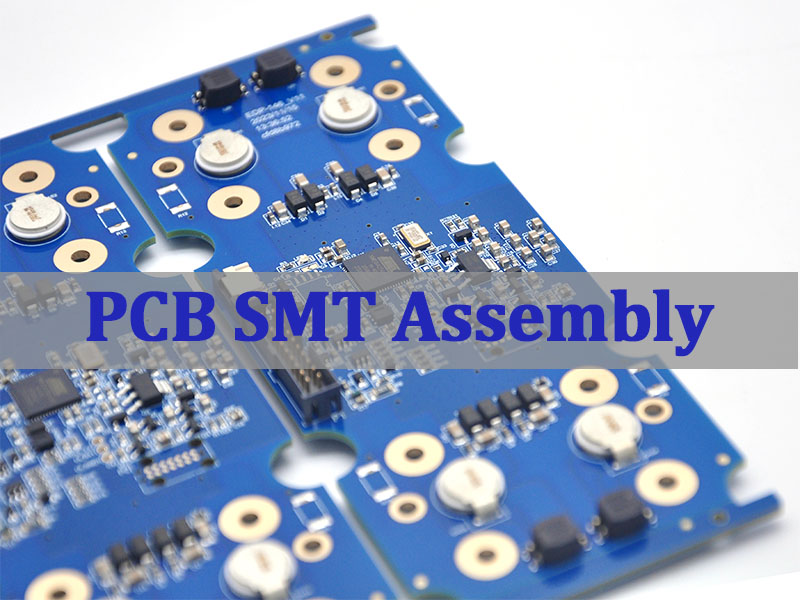
Billboard defect in SMT is a side-standing chip component defect that happens when a resistor, capacitor, or other small SMD part does not lie flat on the PCB pads after reflow soldering. The part may still touch the pads, but the solder joint is not formed in the correct position. This can raise concerns about electrical contact, mechanical strength, IPC acceptance, and long-term PCBA reliability.
This article explains what billboard defect in SMT means, how it differs from tombstone defect, whether it can be accepted under IPC workmanship standards, why it happens, and how a professional PCBA supplier should inspect and prevent it. The goal is not only to explain the defect, but also to help engineers, buyers, and quality teams judge whether their SMT assembly process is being controlled properly.
EBest Circuit (Best Technology) provides PCB fabrication, component sourcing, SMT assembly, PCBA manufacturing, testing, and box-build assembly support for customers from prototype to mass production. If you are preparing a PCB or PCBA project and want to reduce SMT assembly risks before production, please contact us at sales@bestpcbs.com.
What Is Billboard Defect in SMT?
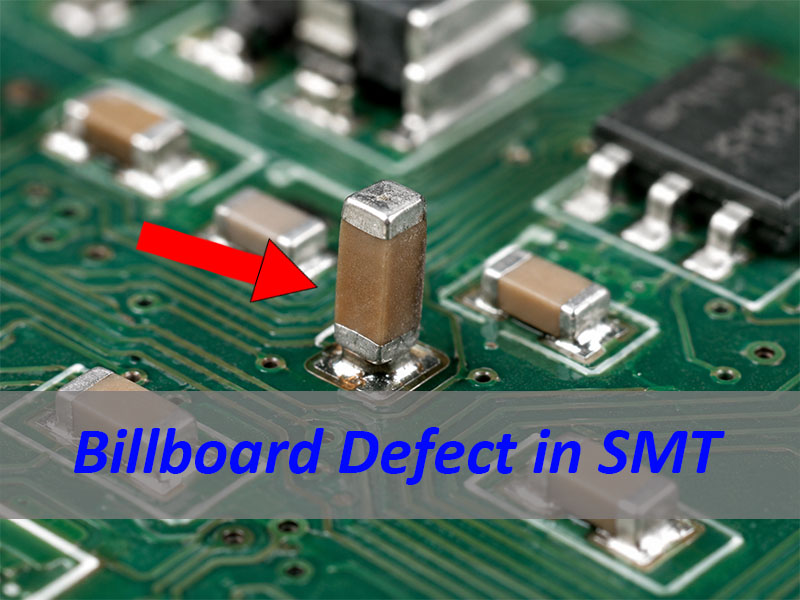
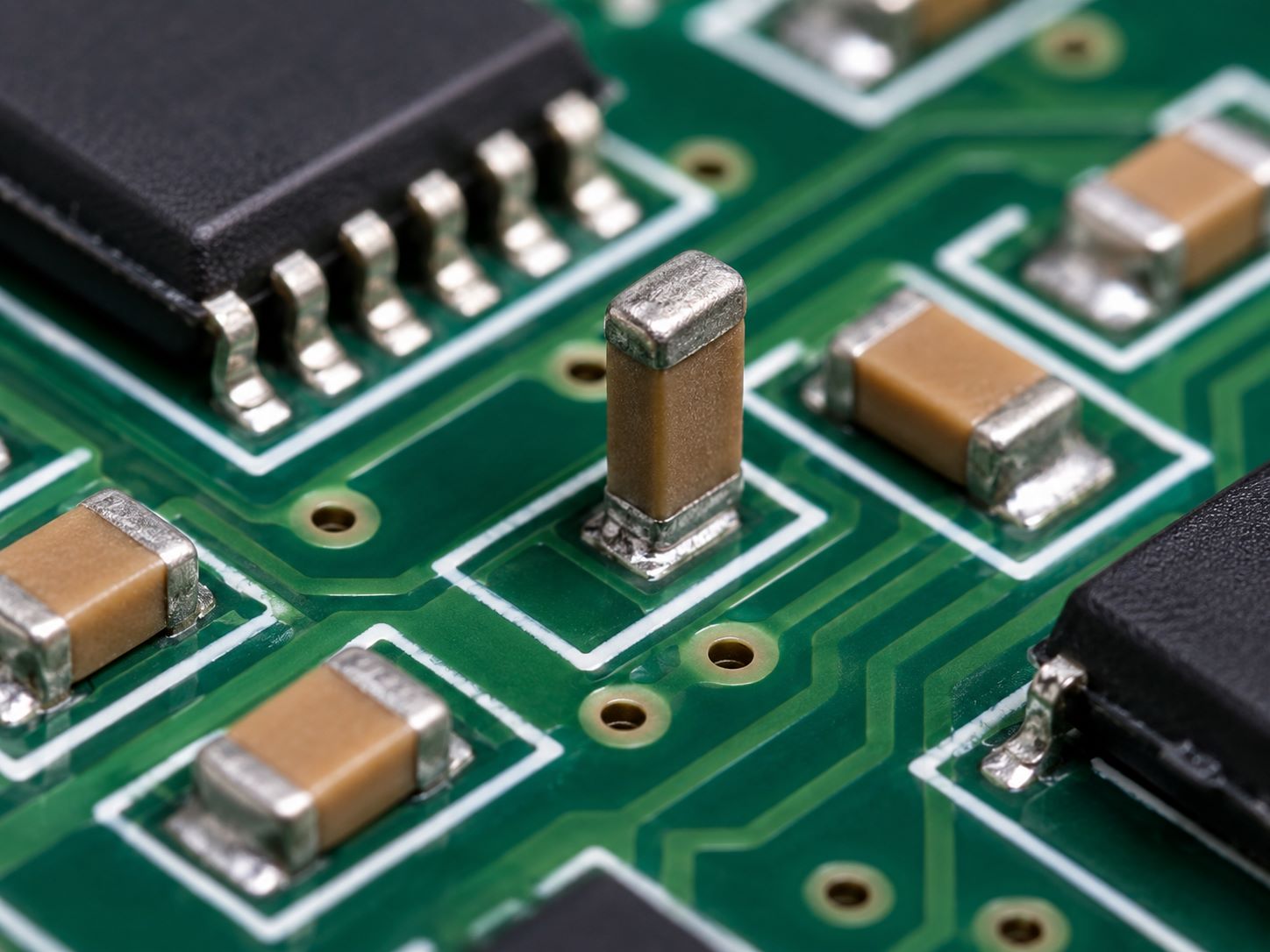
Billboard defect in SMT happens when a chip component stands on its side instead of lying flat on the PCB pads. The part looks like a small signboard, so this defect is often called billboarding or side stand.
It often appears on small chip resistors and capacitors. It is more common with 0402, 0201, and 01005 parts. These parts are light, small, and easy to move during solder reflow.
A billboarded part may still touch the pads. So, the board may pass a basic electrical test. But this does not mean the solder joint is reliable.
The contact area may be small. The solder joint may be weak. The part may fail later during vibration, heat cycling, handling, or final product use.
That is why a PCBA supplier should not treat billboard defect as a simple visual issue. It needs proper inspection, root cause analysis, and process control.
Billboard Defect vs Tombstone Defect: What Is the Difference?
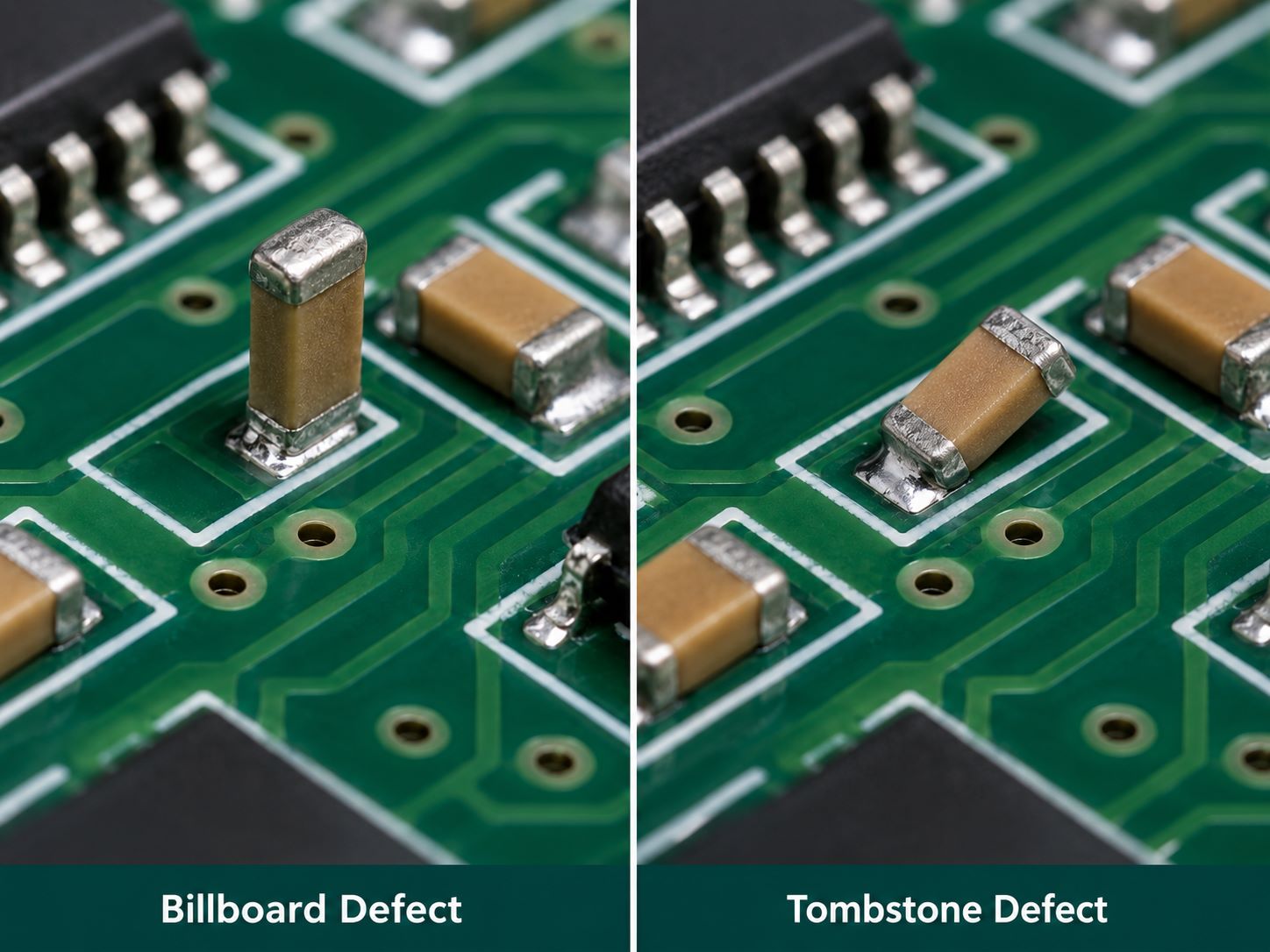
Billboard defect and tombstone defect are often confused. Both can happen during SMT assembly, but they are different defects.
| Item | Billboard Defect | Tombstone Defect |
|---|---|---|
| Appearance | Component stands on its side | One end lifts from the pad |
| Common name | Side stand | Drawbridge |
| Electrical risk | May still conduct | Often causes an open circuit |
| Main concern | Weak solder joint | Direct functional failure |
| Typical judgment | Needs further review | Usually more serious |
A tombstone defect usually means one end of the component has lifted away from the pad. This often creates an open circuit.
A billboard defect may still have contact with the pads. However, the solder joint is not formed as designed. The board may work during testing, but the joint may not survive long-term use.
This difference matters. A supplier should not mix these two defects in a quality report. The wrong defect name can lead to the wrong corrective action.
Is Billboard Defect in SMT Acceptable Under IPC Standards?
IPC-A-610 is widely used to judge PCBA workmanship. It helps define what is acceptable, what is a process indicator, and what is a defect.
However, billboard defect should not be judged by one simple rule. The final decision depends on several factors:
- Product class
- Customer standard
- Component size
- Defect quantity
- Solder contact condition
- Mechanical strength
- Circuit function
- Product application
For example, a low-risk consumer product and a medical control board should not be judged in the same way. Automotive, aerospace, medical, industrial, and communication products often need stricter control.
A key point is this: passing an electrical test does not always mean the defect is acceptable.
A billboarded part may still conduct electricity. But if the solder joint is weak, it can become a field failure risk.
A responsible supplier should provide clear evidence before asking the customer to accept the board. Useful evidence includes AOI images, defect location, affected quantity, IPC judgment basis, test results, and corrective action.
Why Does Billboard Defect Happen During SMT Assembly?
Billboard defect usually comes from imbalance. The imbalance may come from PCB design, solder paste, placement, reflow, or material quality.
Uneven pad design
- If one pad connects to a large copper area and the other pad connects to a thin trace, both sides heat at different speeds. One end may wet faster than the other. This can pull the part into the wrong position.
Unbalanced solder paste volume
- If one pad gets more solder paste than the other, the solder force becomes uneven. Small chip parts can rotate, lift, or stand on their side during reflow.
Poor stencil design
- Stencil openings control solder paste volume. If the aperture size or shape is not suitable, the paste deposit may become unbalanced. This is a common risk for small passive components.
Placement offset
- Small SMT parts need accurate placement. If the part is not centered on both pads, reflow may not correct the position. In some cases, it can make the defect worse.
Unsuitable reflow profile
- A fast heating rate or short soak time can create uneven wetting. One side may melt and pull first, while the other side is not ready. This can cause billboarding or tombstoning.
Poor solderability
- Oxidized component terminals or PCB pads can also cause uneven wetting. Old parts, poor storage, or exposed reels may increase this risk.
How to Find the Root Cause of Billboard Defect in SMT?
A good PCBA supplier should not only say, “This is an SMT issue.” They should find the real cause.
| Area to Check | What It May Show |
|---|---|
| PCB design | Uneven pads, large copper connection, missing thermal relief |
| Stencil design | Uneven solder paste volume |
| Solder paste printing | Paste offset, paste height issue, poor release |
| Placement process | Offset, wrong nozzle, feeder instability |
| Reflow profile | Fast ramp rate, weak soak stage, uneven heating |
| Material condition | Oxidation, poor solderability, bad storage |
| AOI data | Repeated defect at the same location |
The most useful question is:
Is this an isolated defect or a repeated process problem?
If the same location fails again and again, the issue may come from pad design, copper balance, or stencil opening.
If the defect appears randomly, the cause may be paste printing, placement, reflow, or material control.
This matters because it helps define the next action. A design issue may need a Gerber change. A printing issue needs stencil or process adjustment. A solderability issue needs material review.
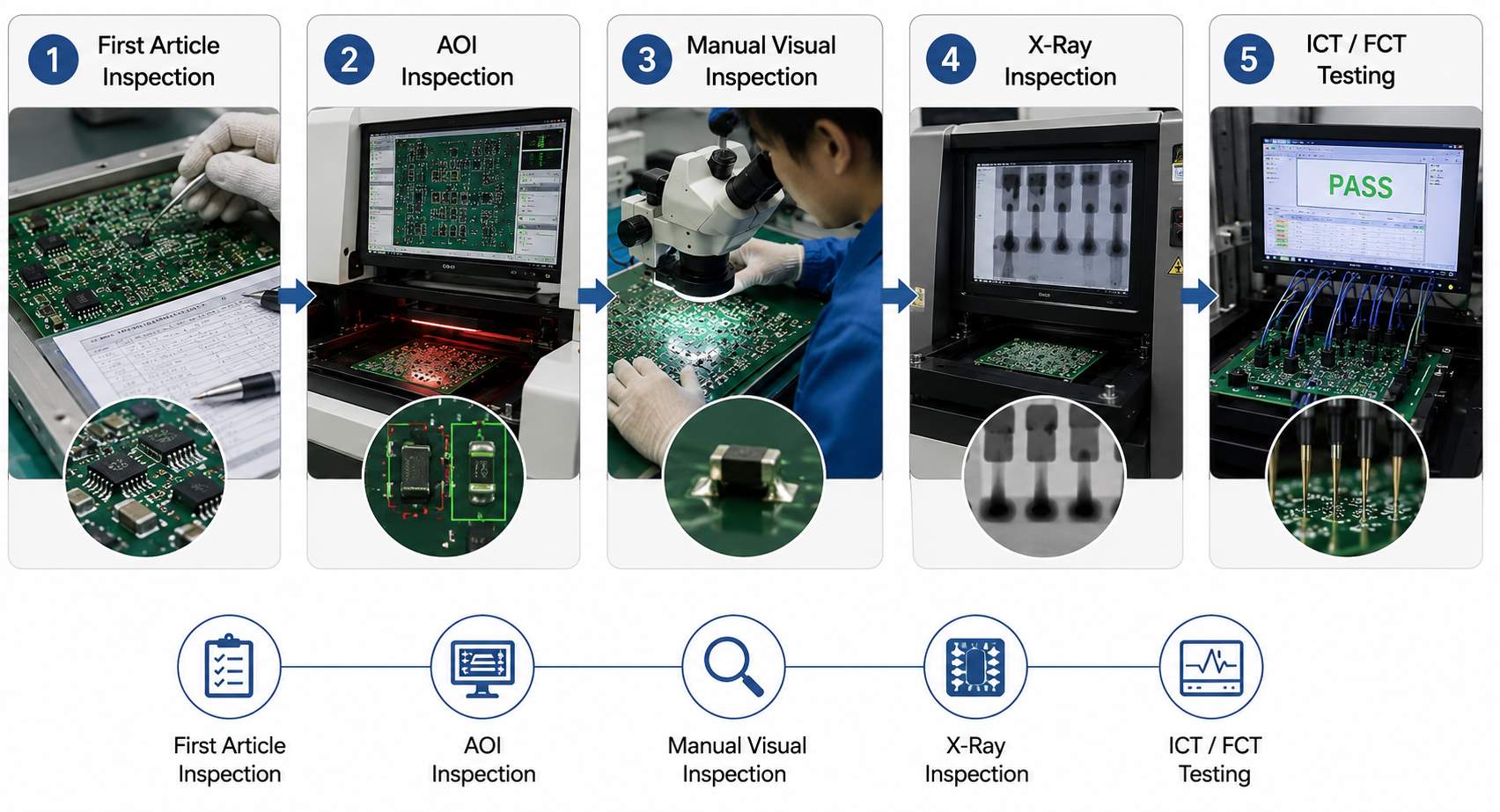
How Can EBest Circuit (Best Technology) Inspect Billboard Defect Before Shipment?
EBest Circuit (Best Technology) uses several inspection steps to reduce the risk of SMT defects before shipment.
First article inspection
- Before batch production, we check component value, position, polarity, orientation, and soldering condition. This helps find problems before they affect the full lot.
AOI inspection
- AOI is one of the main tools for finding billboard defect in SMT production. It can detect side-standing parts, missing parts, offset, skew, polarity errors, solder bridging, and poor solder joints.
Manual visual inspection
- For uncertain AOI results, trained inspectors review the board with magnification and proper lighting. This helps confirm real defects and reduce false calls.
X-Ray inspection
- X-Ray is mainly used for hidden solder joints, such as BGA, QFN, and LGA. For normal chip resistors and capacitors, AOI and visual inspection are usually more direct. Still, X-Ray is important for full PCBA quality control when hidden joints are present.
ICT and FCT testing
- ICT and FCT can find open circuits, shorts, wrong values, and function problems. But they cannot replace visual inspection.
A billboarded component may pass electrical testing. Yet the solder joint may still be weak. That is why visual inspection and electrical testing should work together.
How Does Billboard Defect Affect Electrical Performance and Long-Term Reliability?
Billboard defect may not cause instant failure. That is why it can be risky.
A side-standing part may still conduct. But the solder joint is not normal. The contact area may be small, and the joint may have lower strength.
This can lead to:
- Higher contact resistance
- Unstable electrical contact
- Weak mechanical strength
- Solder joint cracking
- Failure during vibration
- Failure after thermal cycling
- Open circuit during field use
The risk is higher in products that face heat, vibration, shock, or long service life. This includes automotive electronics, industrial controllers, medical devices, outdoor equipment, power products, and communication systems.
So the right question is not only:
Does the board work now?
The better question is:
Will the board stay reliable in real use?
How Can SMT Assembly Prevent Billboard Defect from Happening Again?
Prevention should start before SMT production. A reliable supplier should control both design and process factors.
DFM review
- Check pad size, pad symmetry, copper balance, solder mask opening, and component spacing. If one pad connects to a large copper area, thermal relief may be needed.
Stencil optimization
- Control solder paste volume on both pads. For small chip components, more paste is not always better. Balanced paste is more important.
Stable paste printing
- Control stencil cleaning, squeegee pressure, printing speed, paste condition, and PCB support. Good printing helps reduce solder imbalance.
Accurate placement
- Use the correct nozzle, feeder setup, component library, and placement data. Small parts need tighter placement control.
Proper reflow profile
- Avoid heating too fast. Give both sides of the component enough time to reach a balanced temperature. Adjust the profile based on board thickness, copper area, and component density.
Material control
- Store PCBs and components correctly. Prevent oxidation and moisture issues. Review old or exposed components before production.
AOI trend review
- AOI should not only catch defects. It should also help engineers find patterns. If the same location fails again, the team should review design, stencil, placement, and reflow together.
Why Choose EBest Circuit (Best Technology) for Reliable SMT Assembly and PCBA Manufacturing?
Customers searching for billboard defect in SMT usually need more than a definition. They need a supplier who can prevent the issue, inspect it, explain it, and fix it.
EBest Circuit (Best Technology) provides one-stop PCB and PCBA manufacturing support. Our services include PCB fabrication, component sourcing, SMT assembly, through-hole assembly, testing, and box-build assembly.
We support customers from prototype to mass production. Our team can review Gerber files, BOMs, assembly drawings, and test requirements before production.
Our PCBA support includes:
- DFM review before production
- PCB fabrication and PCBA assembly
- Component sourcing support
- SMT process control
- AOI, X-Ray, ICT, and FCT testing
- Engineering support for defect analysis
- Prototype and batch production support
- Quality control for demanding applications
For billboard defect, tombstone defect, solder bridging, poor wetting, and other SMT issues, our team reviews the issue from design, material, and process angles.
This helps customers reduce repeat defects, improve shipment quality, and build more reliable electronic products.
To sum up, billboard defect in SMT is not only a small visual issue. It can reflect pad design imbalance, solder paste variation, placement offset, reflow profile problems, or material solderability issues. For PCBA projects, the best approach is to prevent this defect before production through proper DFM review, stable SMT process control, and reliable inspection.
If your next PCB or PCBA project requires careful SMT assembly control, EBest Circuit (Best Technology) can support your project from early manufacturing review to final assembly and testing. To discuss your PCB fabrication or PCBA assembly requirements, contact us at sales@bestpcbs.com.
FAQs About Billboard Defect in SMT
1. Is billboard defect the same as tombstoning?
No. Billboard defect means the component stands on its side. Tombstoning means one end lifts from the pad. Tombstoning usually has a higher open-circuit risk.
2. Can a billboarded component pass electrical testing?
Yes. It may still touch the pads and pass testing. But the solder joint may still be weak. Visual inspection and reliability review are still needed.
3. Is billboard defect acceptable under IPC-A-610?
It depends on product class, component size, quantity, location, customer standard, and actual solder condition. The supplier should provide inspection evidence before making a judgment.
4. What causes billboard defect in SMT?
Common causes include uneven pad design, poor stencil design, unbalanced solder paste, placement offset, poor reflow profile, and weak solderability.
5. Which components are more likely to have billboard defect?
Small chip resistors and capacitors are more likely to have this defect. 0402, 0201, and 01005 packages need careful process control.
6. Can billboard defect be repaired?
Yes. Skilled technicians can repair it with proper tools and controlled heating. After repair, the board should go through visual inspection and electrical testing again.
7. How can a PCBA supplier prevent billboard defect?
The supplier should use DFM review, proper stencil design, stable solder paste printing, accurate placement, suitable reflow profile, and AOI inspection.
8. Why should customers care if the board still works?
Because the solder joint may be weak. The board may pass testing now but fail later during vibration, heat cycling, handling, or field use.
9. What should I ask my PCBA supplier about this defect?
Ask for the defect location, inspection images, IPC judgment basis, root cause, affected quantity, repair plan, and prevention action.
If you are preparing a PCB or PCBA project and want to reduce SMT assembly risks such as billboard defect, tombstoning, solder bridging, or poor wetting, EBest Circuit (Best Technology) can support you from the manufacturing stage. Our team can review your Gerber files, BOM, assembly drawings, and production requirements before PCB fabrication and PCBA assembly, helping you improve manufacturability and reduce avoidable process issues.
For PCB manufacturing, PCBA assembly, DFM review, component sourcing, and testing support, please contact us at sales@bestpcbs.com.