PCB manufacturing PCB manufacturing
Home > Blog

High Temperature PCB Materials

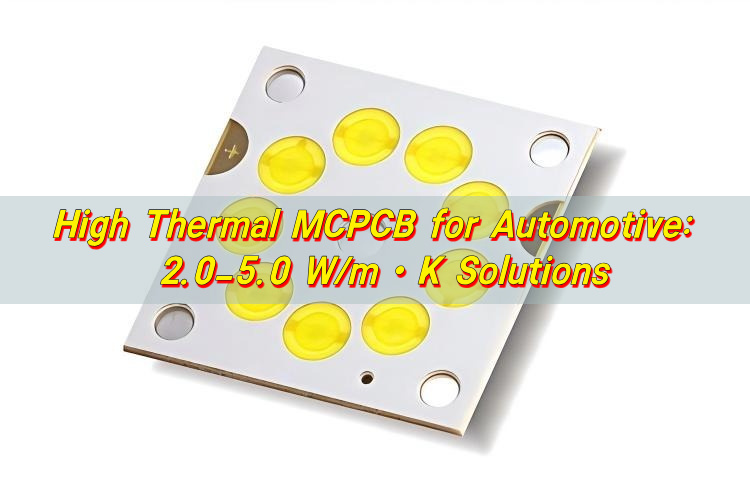
High Thermal MCPCB Automotive: 2.0–5.0 W/m・K Solutions
Thursday, April 16th, 2026

EBest’s High Thermal MCPCB Automotive delivers industry-leading thermal conductivity (2.0-3.0 W/m.K), IATF 16949, and other automotive-grade certifications, as well as reliable performance in extreme automotive environments (from -40°C to 150°C). Trusted for over 19 years, we solve your automotive thermal management challenges with turnkey solutions.

High Thermal MCPCB Automotive: 2.0–5.0 W/m・K Solutions

Why Choose EBest for Your High Thermal MCPCB Automotive Needs?

Our High Thermal MCPCB Automotive products are engineered to meet the toughest demands of automotive electronics, with core parameters that outperform industry standards—perfect for ECU, BMS, and ADAS modules.

Core parameters for High Thermal MCPCB Automotive: thermal conductivity up to 3.0 W/m.K, a maximum of 10 layers, thickness ranging from 12-157 mil, ±3 mil hole position tolerance, and a 94V-0 flammability rating. Partner with EBest today for your automotive MCPCB needs.

Why Choose EBest for High Thermal MCPCB Automotive?

  • Quality: 100% full inspection before delivery, automotive-grade materials, and strict compliance with all relevant certifications to ensure long-term reliability in harsh automotive conditions.
  • Lead Time: Urgent orders are shipped within 24 hours, regular orders are delivered on time, and our monthly capacity of 260,000 square feet allows us to handle any order size.
  • Service: One-stop solutions from design support to prototyping, production, and post-delivery support—we work with you to optimize your High Thermal MCPCB Automotive design for manufacturability.
  • Supply Chain: A stable, global supply chain for all electronic components (SMD, BGA, QFN, QFP) eliminates delays and ensures consistent product quality.

What Are the Key Pain Points of High Thermal MCPCB Automotive?

Many face challenges with thermal management failures, inconsistent quality, and supply chain disruptions when sourcing High Thermal MCPCB Automotive products—EBest addresses these head-on with proven solutions.

  • Thermal Failure: Our high thermal conductivity (2.0-3.0 W/m.K) and optimized PCB layout reduce hotspots by up to 25%, preventing component overheating in engine bays and other high-temperature areas.
  • Quality Inconsistency: We implement full-process quality control, from material selection to final inspection, ensuring every High Thermal MCPCB Automotive meets the same strict standards.
  • Supply Chain Risks: Our established global supply chain and in-house component sourcing eliminate delays, even for hard-to-find automotive-grade components.
  • Design Challenges: Our engineering team provides free design support to optimize your High Thermal MCPCB Automotive for thermal performance, signal integrity, and manufacturability.

For reliable, high-performance High Thermal MCPCB Automotive solutions that solve your biggest pain points, choose EBest—your trusted partner for automotive electronics.

What Is High Thermal MCPCB Automotive, and Why Is It Critical for Modern Cars?

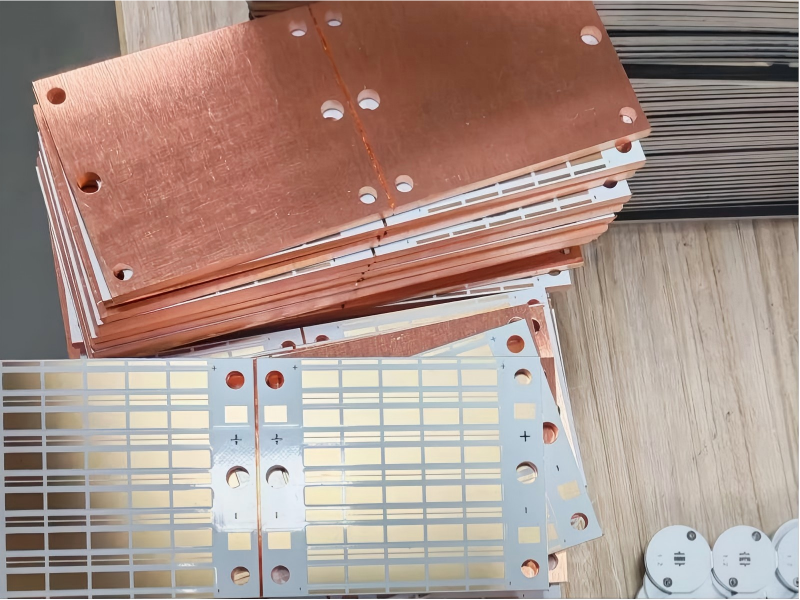
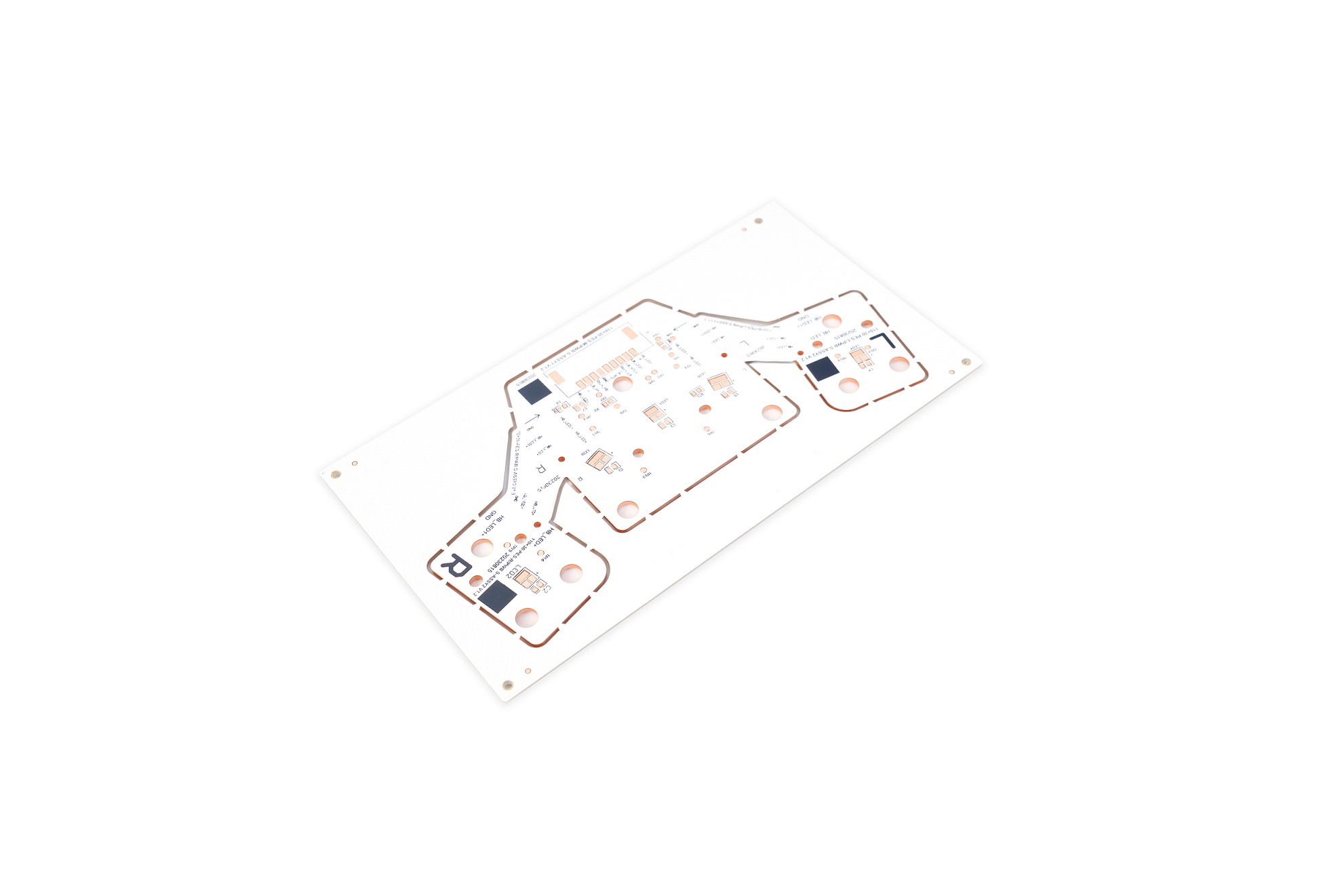
High Thermal MCPCB Automotive is a metal-core printed circuit board designed specifically for automotive applications, with enhanced thermal conductivity to dissipate heat from high-power components.

Modern cars—especially electric vehicles (EVs)—rely on high-power electronics (ECU, BMS, ADAS, infotainment) that generate significant heat. Without effective thermal management, these components fail faster, risking safety and performance.

EBest’s High Thermal MCPCB Automotive efficiently transfers heat away from critical components, extending their lifespan and ensuring consistent performance in extreme automotive environments.

High Thermal MCPCB Automotive: 2.0–5.0 W/m・K Solutions

How Does High Thermal MCPCB Automotive Improve Automotive Electronics Reliability?

High Thermal MCPCB Automotive improves reliability by reducing thermal stress on components, which is the leading cause of failure in automotive electronics.

Our MCPCBs feature thermal conductivity up to 3.0 W/m.K—far higher than standard MCPCBs (0.8-1.0 W/m.K)—ensuring heat is quickly dissipated, even in tight engine bay spaces.

Additionally, our strict quality control and automotive-grade materials ensure the MCPCBs resist vibration, temperature cycles, and chemical exposure common in automotive settings.

What Thermal Conductivity Do You Need for High Thermal MCPCB Automotive?

The ideal thermal conductivity for High Thermal MCPCB Automotive depends on the application, but 2.0-3.0 W/m.K is the sweet spot for most automotive electronics.

For high-power components like EV BMS modules or ADAS processors, 3.0 W/m.K is recommended to handle peak heat generation. For less demanding applications (infotainment), 2.0 W/m.K is sufficient.

EBest offers customizable thermal conductivity options for High Thermal MCPCB Automotive, ensuring you get the exact performance your application requires.

How to Design High Thermal MCPCB Automotive for Maximum Thermal Performance?

To maximize thermal performance, focus on three key design elements: thermal conductivity, copper thickness, and component placement.

Choose a thermal conductivity of 2.0-3.0 W/m.K for automotive applications. Opt for thicker copper (up to 10 OZ) to improve heat transfer and reduce resistance.

Place high-power components near thermal vias or heat sinks, and avoid clustering components to prevent hotspots. EBest’s engineering team can help optimize your High Thermal MCPCB Automotive design for peak performance.

High Thermal MCPCB Automotive: 2.0–5.0 W/m・K Solutions

What Certifications Matter for High Thermal MCPCB Automotive?

Automotive-grade certifications ensure your High Thermal MCPCB Automotive meets strict industry standards for quality, safety, and reliability. EBest holds all critical certifications for automotive applications.

CertificationActual Value for High Thermal MCPCB Automotive
IATF 16949Ensures full-process control, from design to delivery, eliminating quality risks and meeting automotive industry quality standards.
ISO 9001:2015Guarantees consistent quality management systems, ensuring every High Thermal MCPCB Automotive meets the same high standards.
ISO 13485:2016Validates compliance for medical-grade automotive electronics (e.g., in-car health monitoring systems), ensuring safety and reliability.
AS9100DMeets aerospace-grade standards, ideal for high-reliability automotive applications like autonomous driving systems.
REACHEnsures no harmful substances are used, complying with EU automotive environmental regulations.
RoHSRestricts hazardous materials, making our High Thermal MCPCB Automotive environmentally friendly and compliant with global standards.
ULVerifies fire safety (94V-0 rating), critical for preventing thermal-related fires in automotive electronics.

What Services Does EBest Offer for High Thermal MCPCB Automotive?

EBest provides one-stop solutions for High Thermal MCPCB Automotive, covering every stage from design to delivery, with a focus on quality and efficiency.

Core Services for High Thermal MCPCB Automotive

  • PCB Fabrication: Custom High Thermal MCPCB Automotive prototypes and low-volume production, with customizable substrates and materials to match your needs.
  • Component Supply: Stable sourcing for all automotive-grade components (SMD, BGA, QFN, QFP) to ensure your MCPCBs are fully equipped and ready for assembly.
  • Assembly Services: BGA Assembly, Through-Hole Assembly, and Full Turnkey Assembly for High Thermal MCPCB Automotive, with 100% full inspection before delivery.

Value-Added Services

  • Injection Molding: Mold structure, thread insert, pad printing, and final assembly to integrate your High Thermal MCPCB Automotive into complete modules.
  • CNC Machining: Precision CNC Milling and Turning for tight tolerances, ideal for custom enclosures for High Thermal MCPCB Automotive.
  • Sheet Metal: Low-waste, flexible sheet metal solutions for heat sinks and enclosures, optimizing thermal performance for your MCPCBs.

How Does EBest’s High Thermal MCPCB Automotive Compare to Standard MCPCBs?

EBest’s High Thermal MCPCB Automotive outperforms standard MCPCBs in thermal performance, durability, and compliance—critical for automotive applications.

FeatureEBest High Thermal MCPCB AutomotiveStandard MCPCBs
Thermal Conductivity2.0-3.0 W/m.K (high thermal)0.8-1.0 W/m.K (standard)
CertificationsIATF 16949, ISO 13485, AS9100D, RoHS, ULBasic ISO 9001, limited automotive compliance
Temperature Resistance-40°C to 150°C (extreme automotive environments)0°C to 100°C (limited to mild environments)
Copper ThicknessUp to 10 OZ (14mil) for enhanced heat transfer1-2 OZ (3.5-7mil) standard
Quality Control100% full inspection, APQP, FMEA processesBasic inspection, no automotive-specific processes

What Are the Common Applications of High Thermal MCPCB Automotive?

High Thermal MCPCB Automotive is used in a wide range of automotive electronics, where thermal management is critical for performance and safety.

  • EV Battery Management Systems (BMS): Dissipates heat from high-power battery cells, ensuring battery safety and extending lifespan.
  • Engine Control Units (ECU): Handles heat from processing components in the engine bay, preventing overheating and performance issues.
  • ADAS (Advanced Driver Assistance Systems): Ensures reliable performance of cameras, sensors, and processors in all environmental conditions.
  • Infotainment Systems: Manages heat from high-power chips, ensuring smooth operation of touchscreens, audio systems, and connectivity features.
  • Lighting Systems: Dissipates heat from LED headlights and taillights, extending LED lifespan and maintaining brightness.

How Does EBest Ensure Consistent Quality for High Thermal MCPCB Automotive?

EBest prioritizes quality at every stage of production, ensuring your High Thermal MCPCB Automotive meets the strictest automotive standards.

  • Material Selection: We use A+ grade automotive materials, with strict supplier vetting to ensure consistency and durability.
  • Process Control: Fully automatic assembly lines and real-time quality monitoring prevent defects and ensure consistent performance.
  • Final Inspection: 100% full inspection before delivery, including thermal testing, electrical testing, and visual inspection.
  • Certifications: Compliance with IATF 16949 and other automotive certifications ensures our processes meet industry best practices.

What Is the Lead Time for EBest’s High Thermal MCPCB Automotive?

EBest offers flexible lead times for High Thermal MCPCB Automotive, designed to meet your project deadlines—even for urgent orders.

  • Prototypes: Ready for shipping within 24-48 hours for urgent requests, ensuring you can quickly test and validate your design.
  • Low-Volume Production: 3-5 business days, ideal for small-batch testing or initial production runs.
  • High-Volume Production: 7-10 business days, with our monthly capacity of 260,000 square feet to handle large orders without delays.

High Thermal MCPCB Automotive Case Study: Solving EV BMS Thermal Issues

A leading EV manufacturer struggled with BMS module overheating, which caused frequent shutdowns and reduced battery lifespan.

Their existing MCPCBs (1.0 W/m.K thermal conductivity) could not dissipate heat efficiently in the tight BMS enclosure, leading to component failure at 85°C.

EBest provided High Thermal MCPCB Automotive with 3.0 W/m.K thermal conductivity and an optimized copper layout. We also added thermal vias to improve heat transfer to the heat sink.

After implementation, the BMS module’s maximum temperature dropped to 68°C, eliminating shutdowns and extending battery lifespan by 20%. The manufacturer now uses EBest as their exclusive High Thermal MCPCB Automotive supplier.

High Thermal MCPCB Automotive: 2.0–5.0 W/m・K Solutions

FAQ: Common Questions About High Thermal MCPCB Automotive

  • Q1: What is the maximum layer count for EBest’s High Thermal MCPCB Automotive?

A1: The maximum layer count for our High Thermal MCPCB Automotive is 10 layers. This supports complex automotive electronics like ADAS and BMS modules, providing enough space for high-density components while maintaining thermal performance.

  • Q2: Can EBest customize High Thermal MCPCB Automotive for specific automotive applications?

A2: Yes, we offer full customization for High Thermal MCPCB Automotive. We can adjust thermal conductivity (2.0-3.0 W/m.K), board thickness (12-157 mil), copper thickness, and surface treatment to match your exact application needs.

  • Q3: Does High Thermal MCPCB Automotive work in extreme cold automotive environments?

A3: Yes, our High Thermal MCPCB Automotive is designed to perform reliably in extreme cold (-40°C) and hot (150°C) environments. This makes it ideal for all climates, from arctic regions to desert areas.

  • Q4: How do I know if my automotive application needs High Thermal MCPCB instead of standard MCPCB?

A4: If your application uses high-power components (e.g., BMS, ECU, ADAS) that generate significant heat, or if it’s installed in the engine bay or other high-temperature areas, you need High Thermal MCPCB Automotive. Standard MCPCBs will struggle to dissipate heat, leading to component failure.

  • Q5: Does EBest provide design support for High Thermal MCPCB Automotive?

A5: Yes, our engineering team offers free design support for High Thermal MCPCB Automotive. We help optimize your design for thermal performance, signal integrity, and manufacturability, ensuring your MCPCBs meet your application’s requirements.

  • Q6: What surface treatments are available for High Thermal MCPCB Automotive?

A6: We offer a range of surface treatments for High Thermal MCPCB Automotive, including ENIG, Flash Gold, Hard Gold Finger, Gold Plating, ENEPIG, ENIPIG, HAL, HASL(LF), OSP, Silver Immersion, and Tin Immersion—all compliant with automotive standards.

  • Q7: How does EBest’s supply chain ensure consistent delivery of High Thermal MCPCB Automotive?

A7: We have a stable, global supply chain for all materials and components needed for High Thermal MCPCB Automotive. Our purchasing team works with trusted suppliers, and we maintain inventory of key materials to avoid delays, even for urgent orders.

How to Order High Thermal MCPCB Automotive from EBest?

EBest provides high-performance High Thermal MCPCB Automotive solutions tailored to your automotive application. We offer urgent prototype delivery (within 24 hours), bulk order exclusive support, and free design assistance to ensure your project stays on track.

Don’t let thermal management issues or supply chain delays hold back your automotive project—contact us today to place your order. For urgent requests or custom quotes, email us at sales@bestpcbs.com. EBest: Your trusted partner for High Thermal MCPCB Automotive in 2026 and beyond.

You may also like

How to Choose High Temperature PCB Material?
Friday, November 21st, 2025

How to choose high temperature PCB material? This blog is mainly about datasheet, types, selection guide, common supplier and cost for high temperature PCB material.

Are you troubled these issues with high temperature PCB?

  • High-temp PCBs cracking/delaminating above 150°C?
  • Signal distortions in hot-humid environments unsolved?
  • Copper migration/insulation failure after long-term heat exposure?

As a professional high temperature PCB manufacturer, EBest Circuit (Best Technology) can provide you service and solutions:

  • Custom 200°C+ Materials – Tailored substrates eliminate dielectric loss spikes, ensuring stable signals.
  • Stress-Resistant Design – Honeycomb cooling + thermal expansion compensation keeps deformation under 0.1mm at 180°C swings.
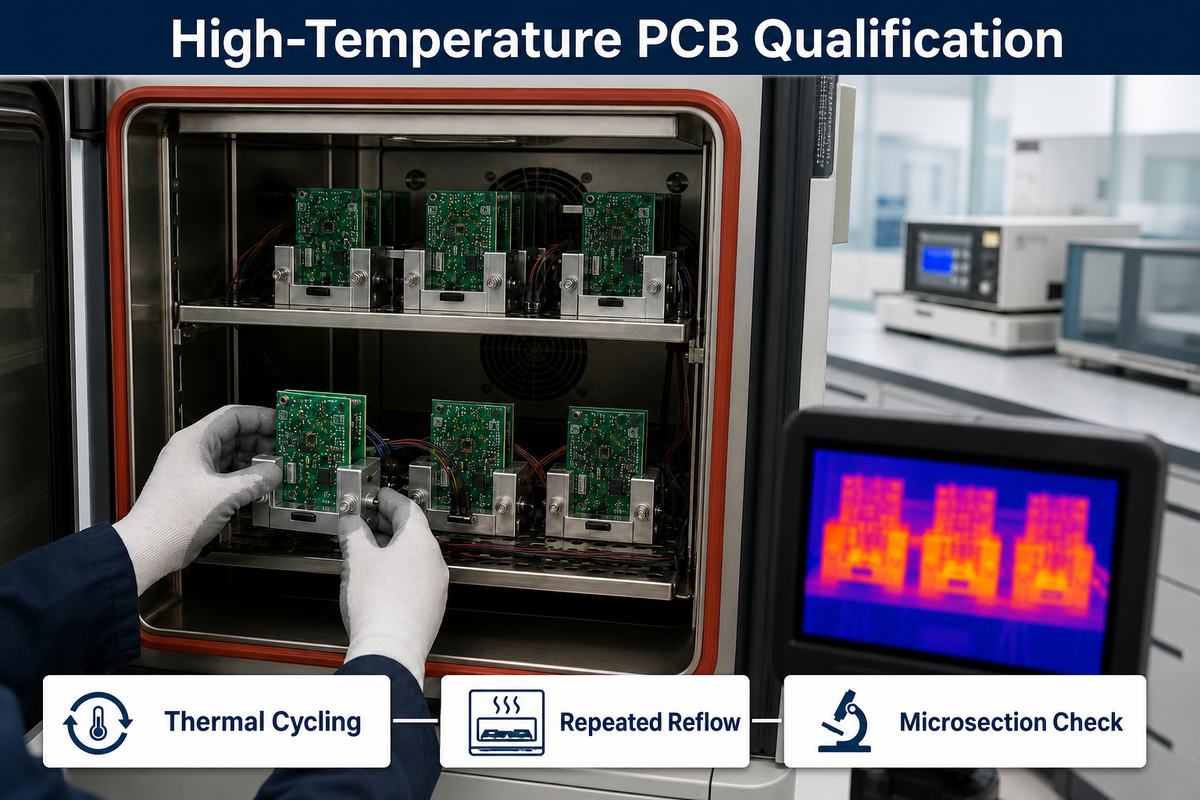
  • 2000-Hour Aging Validation – Full-cycle testing (heat/cold/humidity) provides traceable reliability data.
  • Twenty years of high-temp PCB expertise – solving “can’t use, can’t perform, can’t last” challenges directly.

Feel free to contact us if you have any inquiry for high temperature PCB board: sales@bestpcbs.com.

Why Choose High Temperature PCB Material?

Reasons Why Choose High Temperature PCB Material:

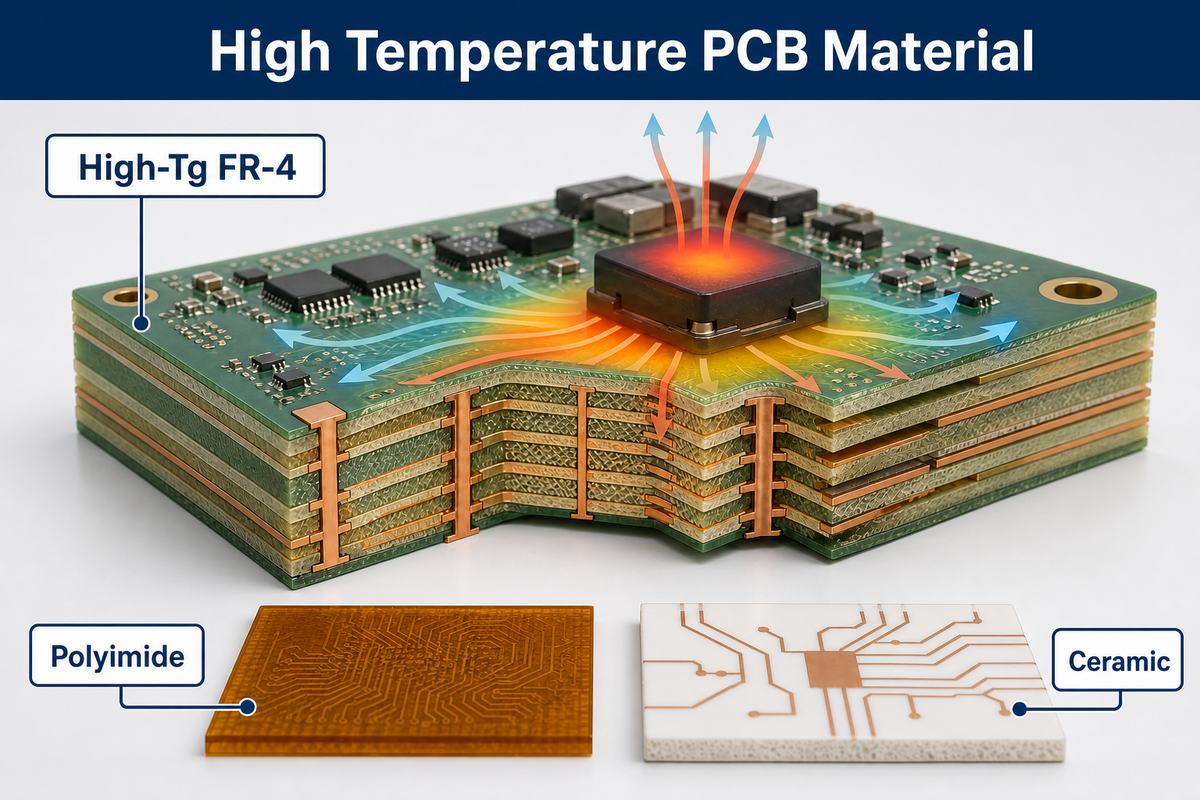
  • For extreme operating environments: Equipment requiring long-term operation above 150°C (e.g., automotive engine compartments, spacecraft, oil well drilling equipment) will soften and fail due to the presence of ordinary materials.
  • Ensuring structural stability at high temperatures: A high glass transition temperature (Tg≄170°C) prevents PCB deformation and delamination due to heat, avoiding solder joint cracking and component displacement.
  • Improving long-term reliability: A low coefficient of thermal expansion (CTE) reduces temperature cycling stress, preventing through-hole copper foil breakage (“barrel cracking”) and extending equipment life (critically used in aerospace and medical equipment).
  • Meeting lead-free soldering requirements: Lead-free solder has a high melting point (~217°C), and high-temperature materials (Tg >180°C) can withstand multiple soldering/rework processes without delamination.
  • Preventing conductive anode wire (CAF) failure: In high-temperature and high-humidity environments, special resin formulations (e.g., polyimide, modified epoxy) can inhibit short circuits caused by copper ion migration.
  • Supports high-power/high-density designs: High-power devices (such as electric vehicle motor controllers) generate localized high temperatures, requiring materials to maintain insulation and mechanical strength within the high-temperature internal layer.
  • Accommodates high-frequency/high-speed circuit requirements: Some high-temperature materials (such as PTFE and modified PPO) also possess low dielectric loss (Df), making them suitable for high-frequency applications such as 5G and radar.
  • Meets stringent industry certification standards: Automotive (AEC-Q), aerospace (MIL), and industrial applications require mandatory high-temperature reliability testing; specialized materials are a prerequisite for compliance.
Why Choose High Temperature PCB Material?

High Temperature PCB Material Datasheet

ParameterSpecification
Glass Transition Temperature (Tg)130°C, 150°C, 170°C, 180°C, 200°C+
Thermal Decomposition Temperature (Td)        300°C, 320°C, 340°C, 350°C+
Coefficient of Thermal Expansion (CTE)X/Y Axis: 12-16 ppm/°C
Z Axis40-70 ppm/°C
Thermal Conductivity    0.2-0.5 W/(m·K)
Water Absorption (24h Immersion)   <0.10%, <0.05%
Dielectric Constant (Dk)3.5-4.5 (1GHz-10GHz)
Dissipation Factor (Df)             0.002-0.008 (1GHz-10GHz)
Soldering Resistance≄3 cycles of lead-free reflow soldering (288°C)
Peel Strength≄0.8 N/mm (copper foil adhesion)
Volume Resistivity>10Âč⁎ Ω·cm
Surface Resistivity>10ÂčÂł Ω

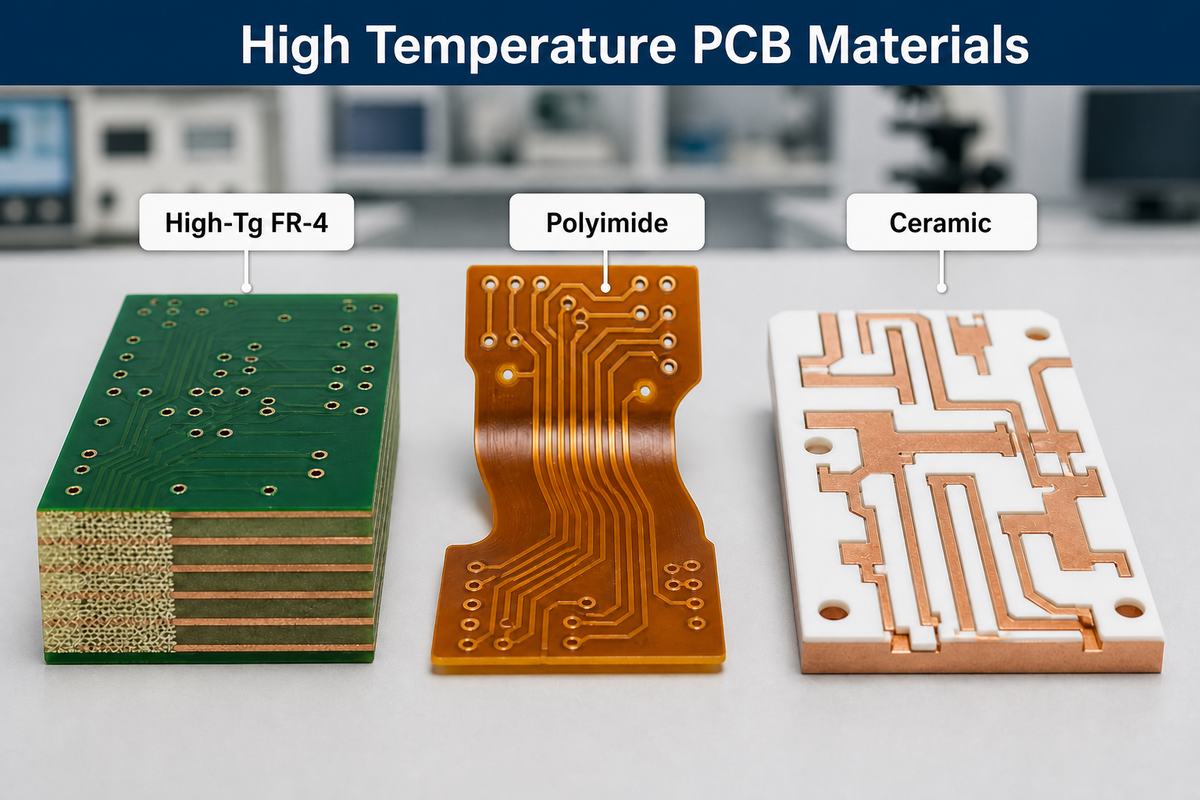
Common High Temperature PCB Materials Types

Polyimide (PI)

  • Features: Polyimide is one of the most widely used high-temperature PCB materials, with a glass transition temperature (Tg) typically exceeding 250°C and long-term operating temperatures up to 200°C or higher. It exhibits excellent heat resistance, mechanical strength, flexibility, and resistance to chemical corrosion and radiation.
  • Applications: Suitable for high-temperature environments such as aerospace, automotive electronics (e.g., engine control systems), military equipment, and medical instruments. Flexible versions are also applicable to wearable devices.
  • Advantages: High reliability, good dimensional stability, but higher costs and greater processing difficulty.

Polytetrafluoroethylene (PTFE)

  • Features: PTFE is a high-frequency material with a Tg of approximately 160°C, though it can withstand short-term temperatures up to 260°C. It is renowned for low dielectric constant and low loss factor, ideal for high-frequency and high-speed applications.
  • Applications: Primarily used in communication equipment (e.g., 5G base stations), radar systems, and RF modules. For high-temperature environments, it requires combination with reinforcing materials (e.g., ceramic fillers).
  • Advantages: Excellent electrical performance and chemical resistance, but poor adhesion, necessitating specialized processing techniques.

Ceramic Substrate Materials (e.g., Al₂O₃ and AlN)

  • Features: Ceramic materials offer extremely high thermal conductivity and heat resistance, with operating temperatures exceeding 300°C. Alumina (Al₂O₃) is cost-effective, while aluminum nitride (AlN) provides superior thermal conductivity for high-power density designs.
  • Applications: Common in power electronics, LED lighting, electric vehicles, and industrial control systems, used for critical heat-dissipating components.
  • Advantages: Outstanding thermal management and mechanical strength, but relatively brittle, requiring careful handling.

Epoxy Resin Composites (e.g., High-Temperature FR-4)

  • Features: Standard FR-4 has a Tg of 130-140°C, while high-temperature variants can elevate Tg to 170-180°C by incorporating fillers (e.g., brominated epoxy). It provides good electrical insulation and cost efficiency.
  • Applications: Suitable for moderate high-temperature environments in consumer electronics, household appliances, and general industrial equipment, commonly selected for economical high-temperature applications.
  • Advantages: Low cost, easy processing, but limited temperature resistance, unsuitable for extreme conditions.

Liquid Crystal Polymer (LCP)

  • Features: LCP has a Tg exceeding 280°C, featuring low moisture absorption, high dimensional stability, and exceptional high-frequency performance. It maintains stable performance in high-temperature and high-humidity environments.
  • Applications: Mainly used in high-frequency circuits, automotive sensors, and mobile communication devices, particularly suited for miniaturized designs.
  • Advantages: Balanced overall performance, suitable for complex environments, but higher raw material costs.

Phenolic Resin-Based Materials

  • Features: These materials typically have a Tg of 150-200°C, offering good heat resistance and mechanical hardness, but average electrical performance.
  • Applications: Common in older industrial equipment or low-cost applications such as power modules and transformers.
  • Advantages: Economical, practical, and readily available, but gradually being replaced by high-performance materials.
Common High Temperature PCB Materials Types

How to Choose High Temperature PCB Material?

Below Is A Detailed Selection Guide for High Temperature PCB Material:

1. Clarify Application Scenarios and Temperature Requirements

  • Scenario Identification: Precisely define the product operating environment (e.g., automotive engine compartments, aerospace, industrial controls, 5G base stations), as temperature gradients vary significantly across scenarios.
  • Temperature Threshold: Determine the maximum continuous operating temperature (e.g., automotive electronics ≄150°C, aerospace up to 300°C+), thermal shock tolerance range (e.g., -55°C to 200°C), and peak soldering temperature (260°C±5°C).
  • Lifespan Expectation: Reverse-engineer material long-term thermal stability thresholds based on product design lifespan (e.g., industrial-grade ≄10 years).

2. Match Substrate Type to Temperature-Resistant Parameters

  • FR-4 Series: Standard Tg 130-140°C (long-term operation ≀105°C), high-Tg variants ≄170°C (e.g., FR-5, polyimide-reinforced types), suitable for consumer electronics to mid-range industrial scenarios.
  • Polyimide (PI): Tg >250°C, withstands extreme environments (-269°C to 300°C), preferred for aerospace flexible circuits, combining dielectric stability and chemical resistance.
  • Ceramic Substrates: Alumina (Al₂O₃, thermal conductivity 24W/m·K), aluminum nitride (AlN, 170-230W/m·K), suitable for high-power RF modules and LED heat dissipation, withstanding >300°C.
  • Metal Substrates: Aluminum (1-3W/m·K thermal conductivity, cost-effective), copper (200-400W/m·K, high-power scenarios), copper-tungsten alloy (CTE matching semiconductor devices), balancing thermal conductivity and CTE differences.

3. Optimize Coefficient of Thermal Expansion (CTE) Matching

  • CTE Discrepancy Risks: FR-4 (12-18ppm/°C) and copper (16-17ppm/°C) have similar CTEs, but high-temperature interlayer stress may cause via fractures and solder joint fatigue.
  • Low-CTE Material Selection: High-Tg FR-4 (CTE ≀14ppm/°C), polyimide (10-15ppm/°C), ceramic (4-8ppm/°C), copper-tungsten alloy (6-8ppm/°C), matching semiconductor device CTEs (e.g., SiC 3-6ppm/°C).
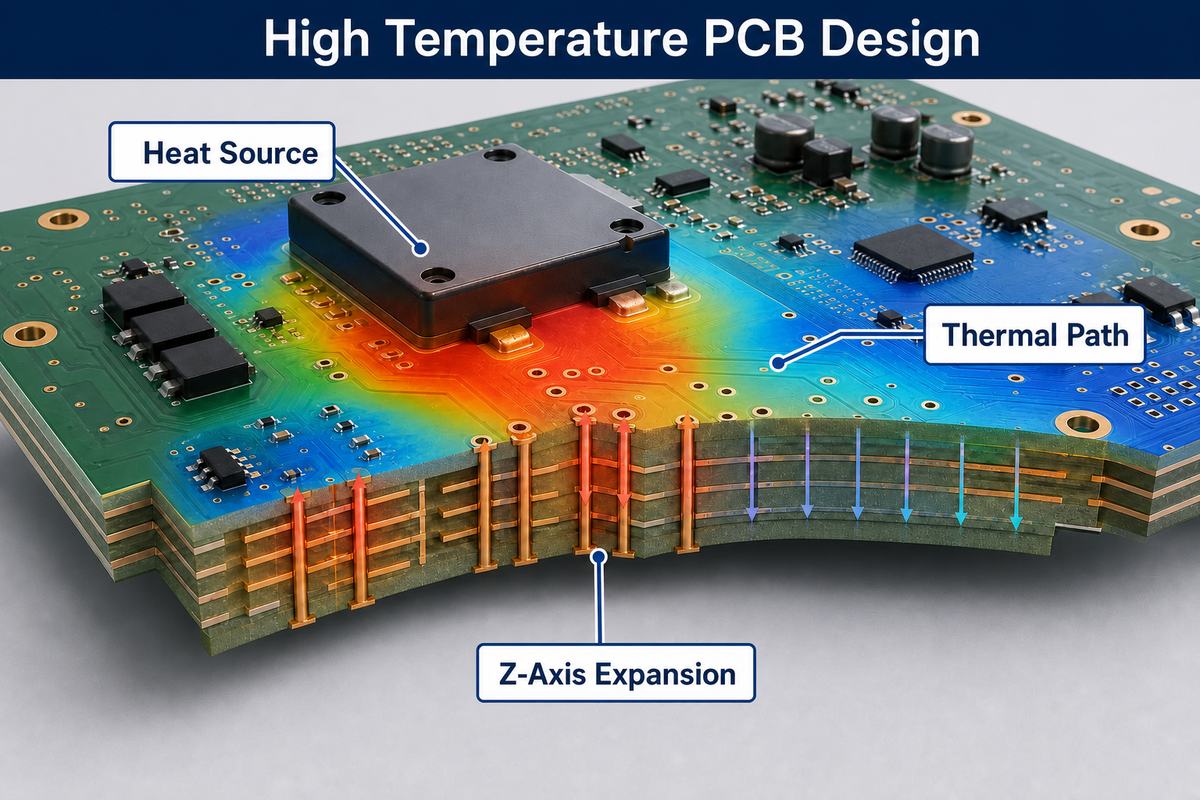
  • Design Compensation Strategies: Use stepped via structures, symmetric stack layouts, and additional heat-dissipating copper foils to reduce thermal cycling stress concentration.

4. Thermal Conductivity and Heat Dissipation Design

  • Thermal Conductivity (W/m·K): FR-4 (0.2-0.4), aluminum (1-3), copper (200-400), ceramic (20-230). High-thermal-conductivity materials require matching heat dissipation path designs.
  • Heat Dissipation Optimization: Increase copper layer thickness (≄2oz), implement thermal vias/heat-sink pads, and use thermal interface materials (TIMs), combined with finite element simulation to optimize heat flux density distribution.

5. Validate Dielectric Performance Stability

  • Dielectric Constant (Dk) Temperature Coefficient (TCDk): FR-4 TCDk -200 to -400ppm/°C (signal drift risks in high-frequency scenarios). Modified materials like Rogers RO4350B (TCDk +50ppm/°C) and Taconic TLY-5 (TCDk +10ppm/°C) offer greater stability.
  • Testing and Compensation: Measure Dk temperature characteristics via resonant cavity/transmission line methods. Design with impedance matching allowances. High-frequency circuits may require dynamic compensation algorithms (e.g., clock delay adjustment).

6. Chemical Resistance and Environmental Adaptability

  • Chemical Corrosion Resistance: Polyimide and ceramic substrates resist acid/base and solvent corrosion. FR-4 requires compatibility evaluation with conformal coatings to avoid CAF (cathodic anode filament) short-circuit risks.
  • Moisture and Humidity Resistance: Low-moisture-absorption materials (e.g., ceramic <0.1%), hermetic packaging designs, and validation of insulation performance via damp heat tests (85°C/85% RH). Salt spray corrosion resistance is critical for marine environments.

7. Certification Standards and Compliance Verification

  • International Certifications: UL certification (flammability ratings), RoHS/REACH (environmental compliance), IPC Class 2/3 (reliability grades), industry-specific standards like IATF 16949 (automotive) and AS9100 (aerospace).
  • Testing and Traceability: 100% electrical performance testing, thermal cycling/vibration impact testing, and accelerated life testing (HALT/HASS). Raw material traceability systems ensure batch consistency. Suppliers must be certified to ISO 9001/14001 standards.
How to Choose High Temperature PCB Material?

Common High Temperature PCB Material Suppliers

1. Rogers Corporation

Advantages

  • Glass transition temperature (Tg) up to 280°C (e.g., RO4350B, RO4003C), with long-term operating temperatures exceeding 200°C.
  • Low dielectric loss (Df as low as 0.0037) and stable dielectric constant, ideal for high-frequency/microwave circuits.
  • High thermal conductivity (0.5–2 W/m·K) and low coefficient of thermal expansion (CTE), enhancing dimensional stability in high-temperature environments.

Business

  • Full range of high-frequency laminates, prepregs, and custom materials (e.g., RO3000, RO4000, TMMÂź series).
  • Serves premium markets including 5G base stations, aerospace, automotive radar, and high-speed digital equipment.

2. Isola Group

Advantages

  • Tg ranges from 180–260°C (e.g., 370HR Tg=180°C, P95/P25 Tg=260°C), with decomposition temperatures up to 380°C.
  • Excellent CAF resistance and low Z-axis thermal expansion (Z-CTE ≀45 ppm/°C).
  • Halogen-free options compliant with RoHS, suitable for environmentally regulated applications.

Business

  • Epoxy and polyimide laminates/prepregs spanning medium-to-high loss (e.g., FR406, 370HR, I-SPEEDÂź, TachyonÂź 100G).
  • Focuses on automotive electronics, servers, industrial controls, and high-speed digital communication devices.

3. Panasonic (MEGTRON Series

Advantages

  • MEGTRON7 R-5785 achieves Tg of 200°C; MEGTRON6 R-5775 reaches 205°C (TMA method).
  • Ultra-low dielectric constant (Dk≈3.4–3.8) and loss factor (Df≀0.003), optimized for 5G/millimeter-wave applications.
  • High thermal resistance (Td>300°C) and robust insulation reliability for multi-layer (20+ layer) PCBs.

Business

  • MEGTRON2–MEGTRON8 high-speed/high-frequency laminates and prepregs.
  • Deployed in routers, servers, mobile base stations, and automotive radar systems requiring high temperature and reliability.

4. Shengyi Technology

Advantages

  • High-Tg portfolio: SI10US Tg=280°C, S1000-2 Tg=170°C, S7439G Tg=189°C.
  • Low moisture absorption (≀0.1%) and superior CAF resistance for enhanced humidity/thermal reliability.
  • Halogen-free designs compatible with lead-free soldering processes.

Business

  • Product lines include standard FR-4, mid-high-speed materials (Synamic series), and polyimide substrates (e.g., SH260 Tg>250°C).
  • Widely used in computing, telecommunications, automotive electronics, and consumer electronics.

5. Kingboard (Jian Tao Laminates)

Advantages

  • KB-6164 Tg=140°C with robust thermal performance and CAF resistance, meeting IPC-4101D/27 standards.
  • Cost-effective solutions competitive in mid-tier high-temperature applications.
  • Diverse options including yellow/white CEM-1 composite substrates and black FR-4.

Business

  • Supplies conventional and mid-performance laminates (FR-4, CEM-1, CEM-3).
  • Clients span consumer electronics, power equipment, and industrial control sectors.

How to Select A Reliable High Temperature PCB Material Supplier?

1. Define Core Performance Parameters for High-Temperature PCB Materials

  • Ensure precise matching of temperature resistance grades (e.g., Tg ≄ 180°C, Td ≄ 320°C, CTE ≀ 20ppm/℃) based on application scenarios (e.g., automotive engine compartments, aerospace).
  • Validate long-term thermal aging performance through accelerated aging tests (e.g., ≀3% dielectric constant variation, ≄90% insulation resistance retention after 1000 hours at 150°C).

2. Verify Supplier Quality Certifications and Compliance

  • Prioritize suppliers with international certifications such as ISO 9001, IATF 16949 (automotive), AS 9100 (aerospace), and UL 94 V-0 (flame retardancy) to meet target market regulations.
  • Require third-party test reports from SGS or TÜV Rheinland covering RoHS, REACH, HF compliance, and complete thermal/electrical/mechanical performance data.

3. Assess Customized Technical Support Capabilities

  • Evaluate the supplier’s ability to develop customized material formulations (e.g., high-frequency, chemical-resistant, ultra-thin substrates) and provide samples for validation.
  • Ensure process compatibility support, including optimized lamination temperature profiles, drilling parameters, and surface treatment processes.

4. Ensure Supply Chain Stability and Delivery Guarantees

  • Select suppliers with global logistics networks and local technical teams supporting trade terms like DDU/DDP, ensuring 7-14 day lead times and reduced international shipping risks.
  • Review inventory management systems and emergency response plans for urgent orders (e.g., 48-hour expedited delivery).

5. Validate Customer References and Reputation

  • Request case studies from automotive (e.g., Bosch, Continental), aerospace (e.g., Airbus, Boeing), and industrial control (e.g., Siemens, ABB) sectors, along with backdoor reference contacts.
  • Check independent reviews on platforms like Trustpilot or Google Reviews for quality consistency, technical response speed, and after-sales service quality.

6. Optimize Cost Efficiency and Long-Term Partnership Strategies

  • Demand transparent pricing (material costs, processing fees, logistics) and negotiate tiered pricing/annual rebates via long-term contracts.
  • Prioritize ESG-compliant partners with carbon footprint management, waste reduction practices, and sustainable supply chain initiatives to enhance corporate image.

7. Emphasize Environmental and Sustainability Practices

  • Choose suppliers using halogen-free, recyclable substrates compliant with EU ELV/WEEE directives to minimize lifecycle environmental impact.
  • Require carbon footprint reports and support carbon reduction through optimized packaging/logistics (e.g., sea freight over air freight) to align with client decarbonization goals.

How Much Does High Temperature PCB Materials Cost?

Specialty Copper Clad Laminates

  • High-Frequency, High-Speed ​​Copper Clad Laminates (e.g., Rogers series): $300 – $800/㎡ (Depending on dielectric constant and loss factor grades).
  • Ceramic-Based Copper Clad Laminates (High Thermal Conductivity): $180 – $500/㎡ (Alumina-based substrates are cheaper; aluminum nitride substrates can reach $450+/㎡).
  • High-Temperature Copper Foil (300℃+): $25 – $50/kg (For extreme environments such as all-solid-state batteries).

Resin Systems

  • Polyimide Resin (PI): $120 – $300/kg (ESA certified VT-901PI and other models are 30% more expensive).
  • High-Heat-Resistant Epoxy Resin (M9 grade): $80 – $150/kg (Domestic alternatives are 20%-30% cheaper).

Conformal Coating Materials:

  • Silicone-based: $40 – $80/L (High temperature resistance >200℃).
  • Polyurethane-based: $20 – Acrylic resin: $7 – $10/L (including solvent) $35/L.

Welcome to contact us if you need any help for high temperature PCB materials: sales@bestpcbs.com.

You may also like