PCB manufacturing PCB manufacturing
Home > Blog

circuit board stencil

Stencil Circuit Board: How to Choose the Right PCB Stencil for Reliable SMT Assembly
Wednesday, May 6th, 2026

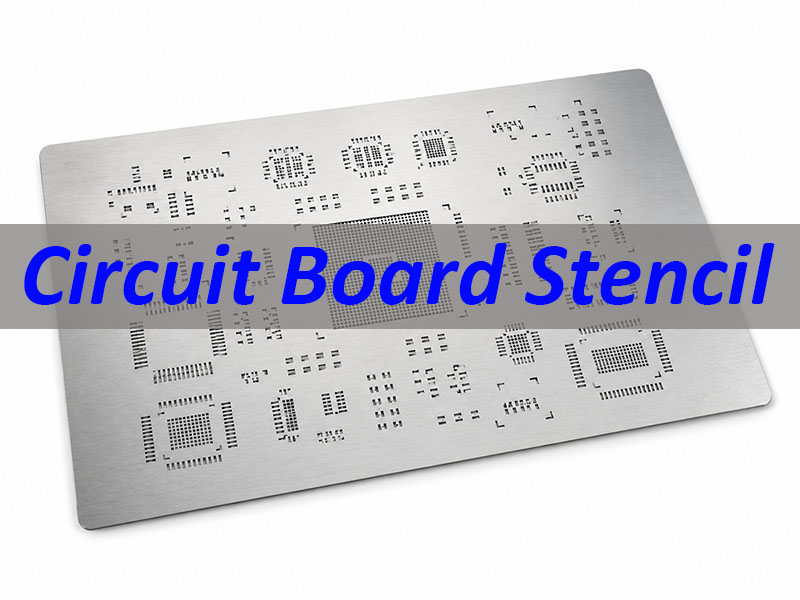
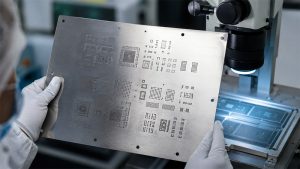
A stencil circuit board usually refers to a PCB solder paste stencil used to print solder paste onto a circuit board before SMT assembly. In this process, a thin stainless steel stencil is aligned over the PCB, and solder paste is pushed through small laser-cut openings onto the surface-mount pads. This step matters because solder paste volume and position directly affect solder joint quality, fine-pitch component reliability, and overall PCBA yield.

This guide covers PCB stencil basics, solder paste printing, stencil types, thickness selection, laser stencil benefits, common SMT defects, and practical design rules for better assembly quality.

At EBest Circuit, we treat stencil design as part of the complete SMT PCBA process, not as a separate accessory. Our team reviews Gerber files, BOM data, component packages, PCB surface finish, and assembly requirements to help customers reduce solder defects and improve production consistency from prototype to batch assembly. For stencil-related PCB assembly support, you can send your files or questions to sales@bestpcbs.comfor a practical engineering review.

Stencil Circuit Board

What Is a Stencil Circuit Board and How Is It Used in SMT Assembly?

A stencil circuit board usually refers to the solder paste printing process used before SMT assembly. In professional PCB manufacturing, the stencil is not the circuit board itself. It is a precision tool placed over the PCB to print solder paste onto the surface-mount pads.

In the PCB industry, this tool may also be called a PCB stencil, solder stencil, solder paste stencil, circuit board stencil, or printed circuit board stencil. These terms usually describe the same item when people are talking about SMT assembly.

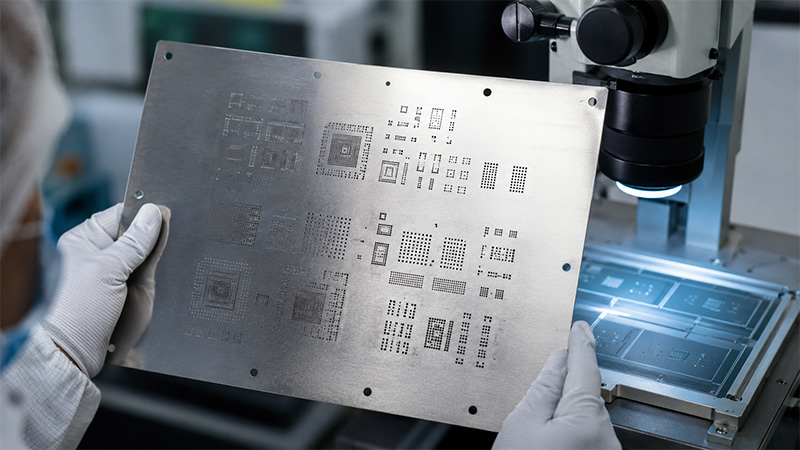
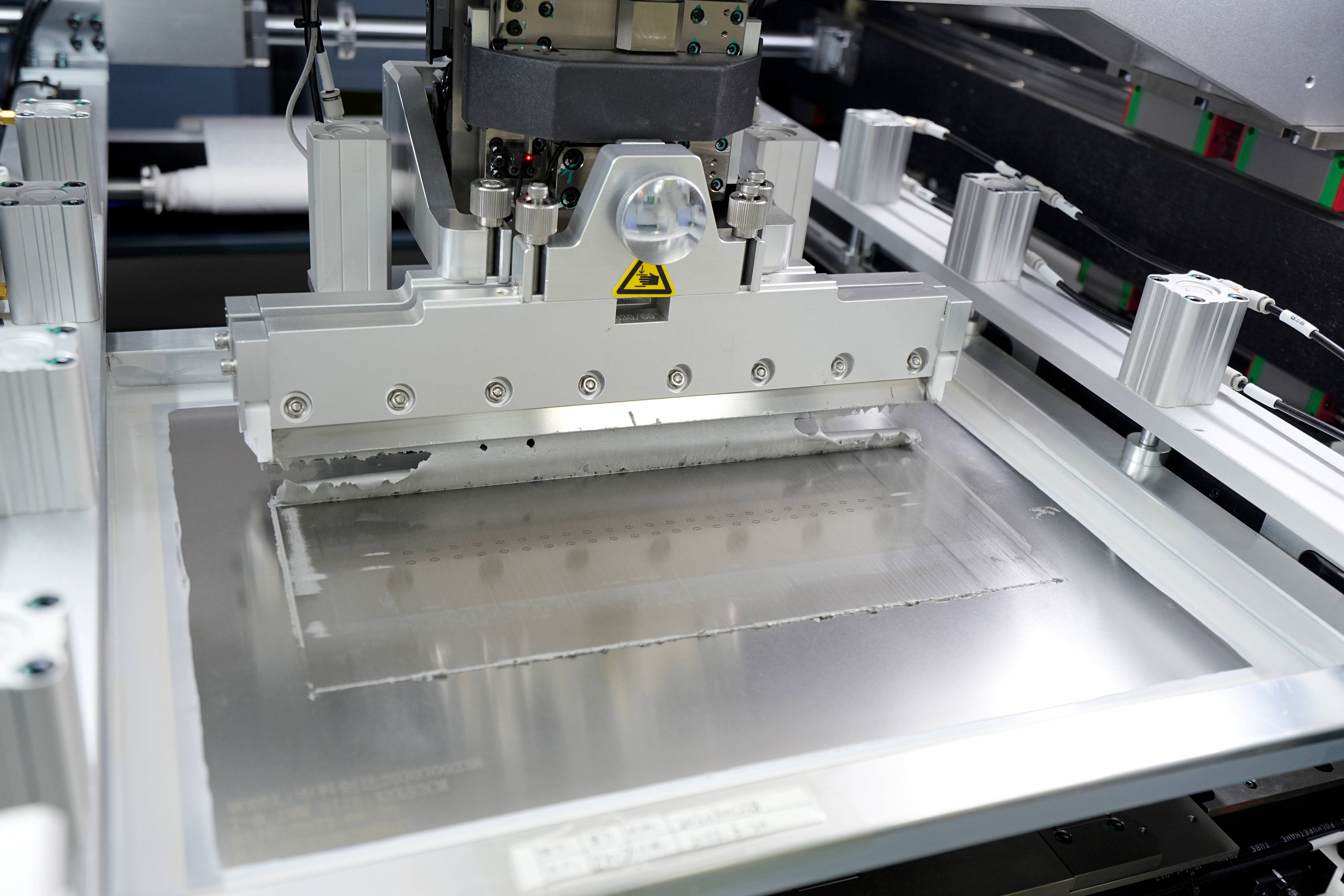
The stencil has small laser-cut openings called apertures. These apertures match the SMT pads on the printed circuit board. During printing, solder paste is pushed across the stencil with a squeegee. The paste passes through the apertures and forms controlled deposits on the PCB pads. After that, SMT components are placed onto the paste and soldered during the reflow process.

This step may look simple, but it directly affects solder joint quality. A good PCB stencil controls where the paste goes, how much paste is deposited, and how consistent the paste volume remains across the board. If the stencil design or printing process is not well controlled, defects such as solder bridging, insufficient solder, tombstoning, solder balls, open joints, or unstable fine-pitch assembly may appear.

A well-designed solder paste stencil helps improve:

  • Solder paste position accuracy
  • Solder paste volume consistency
  • Fine-pitch component assembly
  • Reflow solder joint reliability
  • First-pass yield
  • SMT production repeatability
  • Rework reduction

For prototype boards, engineers may use a frameless solder stencil and apply paste manually. For medium and high-volume production, a framed laser stencil and a printed circuit board stencil printer are more suitable because they provide better tension, alignment, and repeatability.

In commercial PCB assembly, the stencil should be reviewed together with the PCB layout, BOM, component package types, board finish, and assembly process. A PCB stencil is not only a paste application tool. It is part of the SMT process control system. A well-designed stencil gives the assembly line a cleaner starting point and helps the whole production flow run more smoothly.

What Are the Main Types of PCB Stencils?

Different PCB projects need different stencil types. The right choice depends on production volume, component density, pad geometry, board size, and printing method.

PCB Stencil TypeBest ForMain AdvantageTypical Application
Framed PCB stencilMedium to high-volume productionStable tension and repeatable printingAutomatic SMT stencil printer
Frameless PCB stencilPrototype and small batch assemblyLower cost and easy storageManual printing or reusable frame
Laser stencilMost professional SMT projectsAccurate apertures and clean paste releaseFine-pitch SMT assembly
Step stencilMixed component paste volume needsDifferent thickness in selected areasBoards with small ICs and large connectors
Nano-coated stencilDense or high-reliability boardsBetter paste release and easier cleaning0201, QFN, BGA, fine-pitch ICs
Rework stencilLocal component repairApplies paste to one selected areaBGA, QFN, connector repair

For most modern SMT projects, a stainless steel laser stencil is the preferred option. It offers better aperture accuracy than low-cost plastic or manually cut stencils. This matters when the board includes fine-pitch ICs, small passives, QFNs, BGAs, or compact modules.

For early prototypes, a simple solder stencil may be enough. For repeat production, a more controlled stencil design is usually worth the investment.

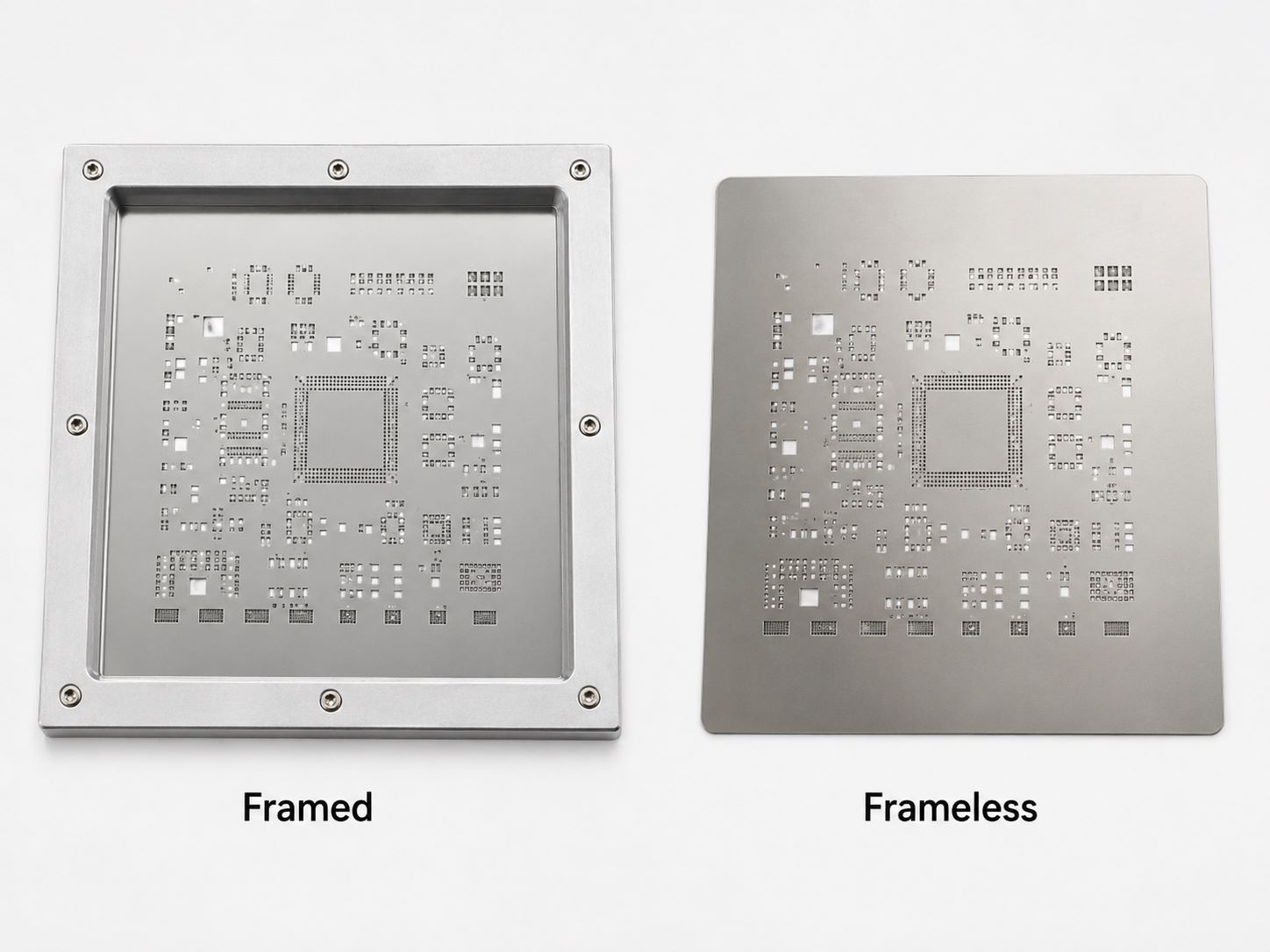
Framed vs. Frameless PCB Stencil: Which One Should You Choose?

One of the most common decisions is whether to choose a framed or frameless PCB stencil.

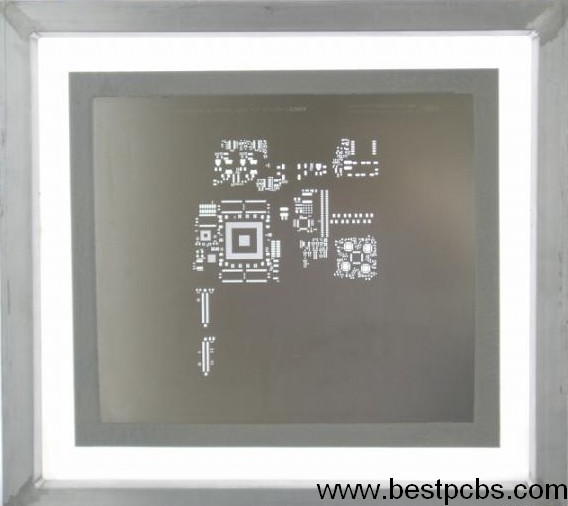
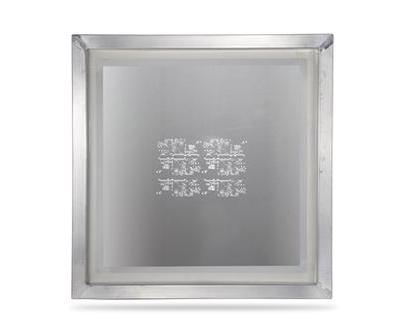
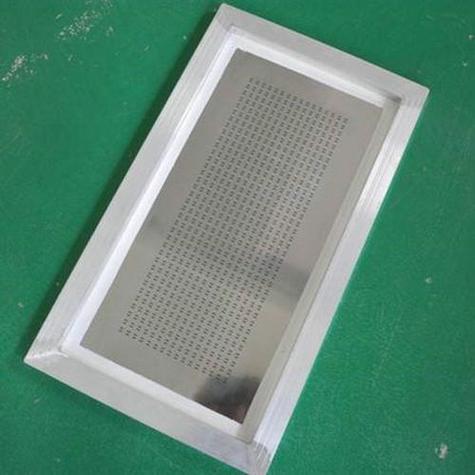
A framed PCB stencil is mounted permanently inside an aluminum frame. The frame keeps the stencil under tension, which helps maintain flatness during printing. This type is widely used with automatic or semi-automatic stencil printers.

A frameless PCB stencil is a stainless steel sheet without a permanent frame. It is lighter, easier to ship, and usually more affordable. It can be used manually or placed into a reusable tensioning frame.

ItemFramed PCB StencilFrameless PCB Stencil
CostHigherLower
Printing stabilityExcellentGood with proper fixture
Storage spaceLargerCompact
Best volumeMedium to high volumePrototype to small batch
Typical methodAutomatic stencil printerManual or semi-automatic printing
RepeatabilityStrongDepends on fixture and operator
ShippingHeavierEasier and cheaper

Choose a framed stencil if your project needs repeat production, stable paste printing, and automated SMT assembly.

Choose a frameless stencil if your project is still in prototype validation, small batch testing, or engineering verification.

For companies moving from prototype to volume production, it is common to start with a frameless stencil and later switch to a framed laser stencil once the PCB design is stable.

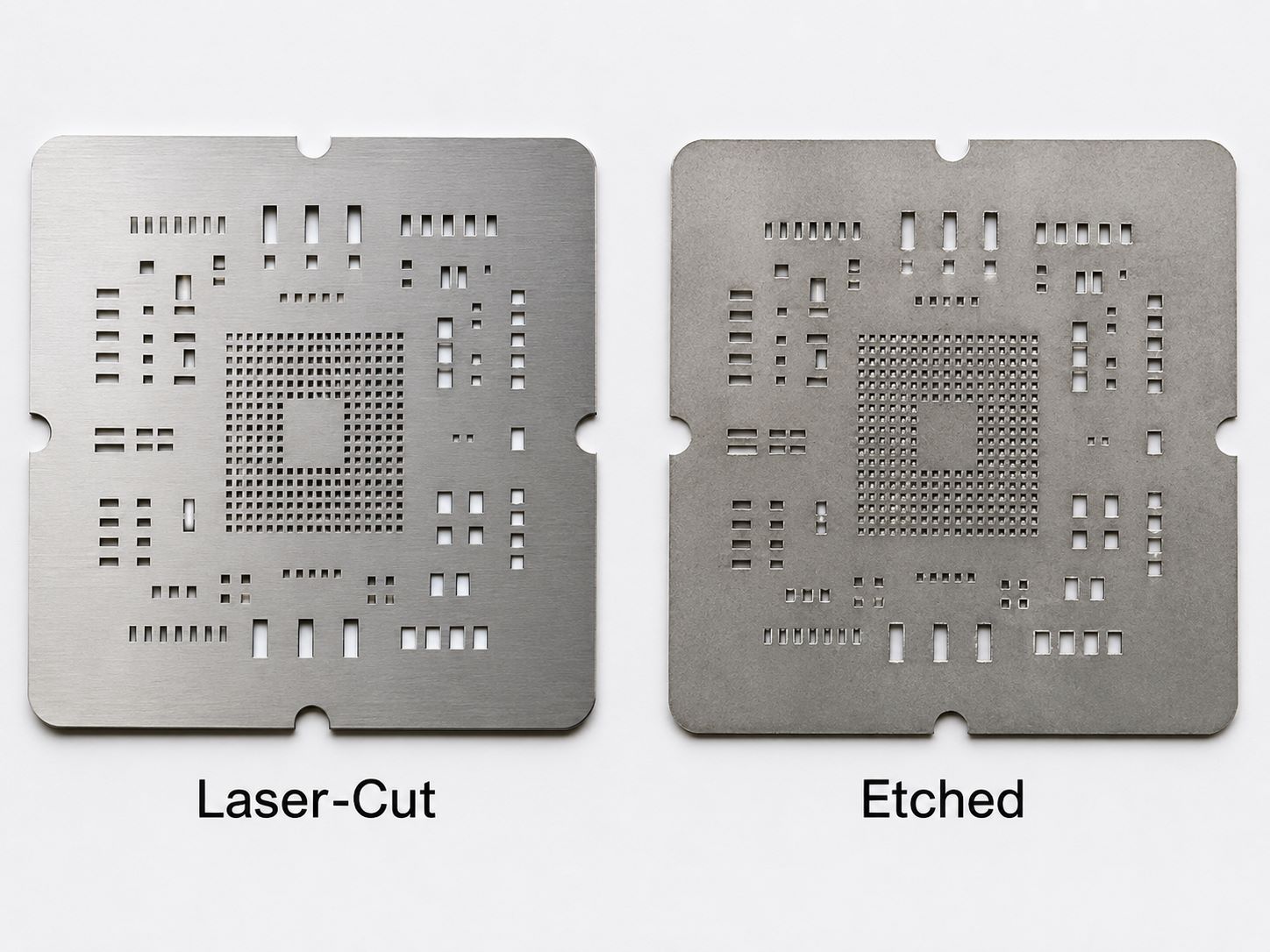
Why Are Laser-Cut Stencils Preferred for Fine-Pitch SMT Components?

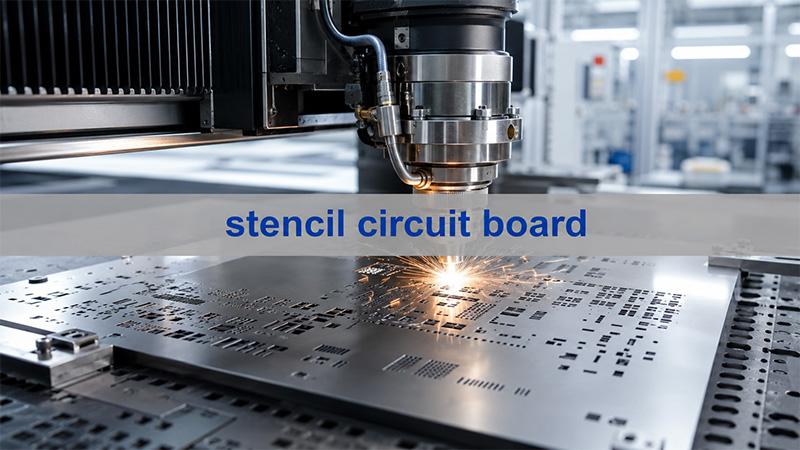
A laser-cut stencil is made by cutting apertures into stainless steel according to the PCB paste layer. Compared with simple plastic stencils or low-precision cutting methods, laser cutting provides much cleaner aperture geometry.

Fine-pitch SMT components need very controlled solder paste deposits. If the aperture is rough, too large, or poorly shaped, paste release becomes unstable. This can affect IC pins, small passive components, QFN pads, BGA pads, and high-density layouts.

Laser-cut PCB stencils are preferred because they offer:

  • More accurate aperture size
  • Cleaner aperture walls
  • Better solder paste release
  • Improved fine-pitch printing
  • Stronger repeatability
  • Better support for small SMT packages
  • Less risk of paste smearing

For 0201 components, 01005 components, QFNs, BGAs, and fine-pitch connectors, aperture wall quality matters. Smooth aperture walls help solder paste release cleanly from the stencil instead of sticking inside the openings.

For advanced assemblies, nano-coating can also be added to the stencil surface. This improves paste release and reduces cleaning frequency, especially when the stencil has many small apertures.

What Stencil Thickness Should You Use for a Circuit Board?

Stencil thickness controls solder paste volume. A thicker stencil deposits more paste. A thinner stencil deposits less paste and is often better for fine-pitch components.

There is no single stencil thickness that fits every PCB. The right thickness depends on component package types, pad size, board design, and assembly requirements.

Stencil ThicknessCommon Use
0.08 mm / 3 milUltra-fine pitch, 01005, very small pads
0.10 mm / 4 milFine-pitch ICs, 0201 components
0.12 mm / 5 milGeneral SMT assembly with moderate density
0.15 mm / 6 milStandard SMT boards with larger components
0.18 mm / 7 mil or aboveHigh paste volume pads, larger terminals, special applications

For many standard SMT boards, 0.12 mm or 0.15 mm is common. However, boards with very small components may need thinner stencils to avoid excess paste. Boards with large connectors, power components, or shield pads may need more paste.

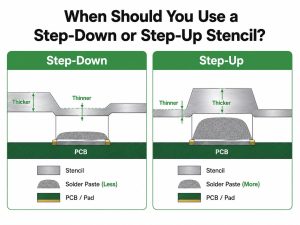
This creates a challenge when one PCB has both tiny fine-pitch components and large pads. In that case, a step stencil may be a better choice. A step stencil allows selected areas to be thinner or thicker, so each component receives the right paste volume.

Stencil thickness should not be selected only by habit. It should be reviewed according to the actual PCB design.

What Are Common SMT Printing Defects and How Can a Quality Stencil Fix Them?

Many SMT defects begin during solder paste printing. A quality stencil cannot replace good process control, but it gives the assembly process a much better starting point.

SMT Printing DefectCommon CauseHow a Better Stencil Helps
Solder bridgingToo much paste or poor aperture designReduces excess paste and improves aperture control
Insufficient solderSmall aperture, poor paste transfer, clogged openingsImproves paste release and deposit consistency
TombstoningUneven paste volume or thermal imbalanceSupports balanced paste deposits on both pads
Solder ballsExcess paste, smearing, poor cleaningImproves edge definition and print cleanliness
Open jointsLow paste volume or poor contactHelps maintain proper paste height
QFN voidingPoor thermal pad paste designUses windowpane aperture design for better outgassing
Paste misalignmentPoor stencil positioning or unstable fixtureFramed stencil and printer alignment improve repeatability

For example, QFN thermal pads should not always be printed as one large solder paste block. A segmented windowpane pattern can improve paste control and reduce voiding. Fine-pitch IC pads may need aperture reduction to prevent bridging. Large pads may need modified openings to avoid floating or excessive solder.

Good stencil design is practical engineering work. It is not only file processing.

Manual vs. Automatic PCB Stencil Printing: Which Method Fits Your Project?

PCB stencil printing can be done manually, semi-automatically, or with an automatic printed circuit board stencil printer. The best method depends on your project stage and production volume.

Manual printing is common for prototypes. The operator aligns the stencil with the PCB, applies solder paste, and uses a squeegee to spread the paste across the stencil. This method is flexible and affordable, but it depends heavily on operator skill.

Automatic stencil printing is used in professional SMT production. A printed circuit board stencil printer controls alignment, squeegee pressure, print speed, stencil separation, and cleaning cycles. For dense boards or repeated production, this method gives much better consistency.

Printing MethodBest ForAdvantageLimitation
Manual stencil printingPrototypes and simple boardsLow cost and quick setupOperator-dependent
Semi-automatic printingSmall to medium batchesBetter control than manual printingStill needs setup skill
Automatic stencil printingVolume SMT productionHigh repeatability and throughputHigher equipment cost

Some search terms describe this equipment as an SMT PCB solder paste stencil printing circuit board printing machine. In production language, it is usually called an SMT stencil printer or solder paste printer.

For commercial PCB assembly, automatic stencil printing is usually preferred because it reduces variation between boards. This is especially important for medical electronics, industrial control boards, communication modules, automotive electronics, and other reliability-focused applications.

How Should You Use a Solder Stencil Squeegee Correctly?

The solder stencil squeegee has a direct effect on paste filling and print quality. Even with a good stencil, poor squeegee technique can cause incomplete deposits, smearing, or inconsistent paste height.

Several factors should be controlled during the solder stencil squeegee circuit board process.

Squeegee angle
A typical angle is around 45° to 60°. This helps the solder paste roll smoothly across the stencil and fill the apertures properly.

Printing pressure
Pressure should be enough to wipe the stencil surface clean and fill the apertures. Too much pressure may scoop paste out of openings or damage the stencil over time.

Printing speed
A stable speed helps maintain a smooth paste roll. Very fast printing may leave incomplete deposits, while very slow printing may affect paste behavior.

Paste condition
Solder paste should be stored, warmed, and mixed according to supplier recommendations. Paste that is too dry or poorly handled can affect release quality.

PCB support
The board should be fully supported under the stencil. If the PCB flexes during printing, solder paste thickness may become uneven.

Stencil separation
After printing, the stencil should lift away cleanly. Good separation helps keep the paste deposit shape intact.

For manual prototype printing, it is helpful to use a flat fixture, proper board stops, and steady squeegee movement. For production, the printer should control pressure, speed, alignment, and cleaning cycle.

What PCB Stencil Design Rules Should Engineers Check Before Ordering?

Before ordering a circuit board stencil, engineers should review more than the paste layer. The stencil must match the actual assembly process.

Important checks include:

  • Correct Gerber paste layer
  • Accurate PCB outline
  • Proper fiducials for alignment
  • Suitable stencil thickness
  • Aperture reduction for fine-pitch ICs
  • Rounded aperture corners for better paste release
  • Windowpane design for QFN thermal pads
  • Paste opening adjustment for large pads
  • Step stencil requirement for mixed components
  • Panelized PCB compatibility
  • Tooling holes and rail clearance
  • Nano-coating requirement for dense apertures
  • Component package review
  • Special notes for selective assembly

A PCB stencil should not always copy the CAD paste layer exactly. Some apertures need adjustment to improve manufacturability. For example, large exposed pads may need segmented openings, while fine-pitch pads may need reduced aperture width.

Engineers should also check the aperture area ratio. If the aperture is too small relative to stencil thickness, solder paste may not release well. This is one reason thin stencils are often used for small components.

For complex PCB assemblies, stencil review should be included in DFM before production begins.

How Should PCB Stencils Be Cleaned and Maintained?

Stencil cleaning and storage affect long-term printing quality. Even a well-made stencil can create defects if solder paste dries inside the apertures or residue remains on the surface.

Good stencil maintenance includes:

  • Clean the stencil after use
  • Use compatible cleaning solvents
  • Remove paste from aperture walls
  • Avoid scratching the stencil surface
  • Store the stencil flat or in a protected rack
  • Keep framed stencils away from impact
  • Inspect for damaged apertures
  • Follow printer cleaning intervals
  • Control paste drying during long print runs

Fine-pitch stencils need closer cleaning control because small apertures clog more easily. If paste does not release fully, the printed pads may receive less solder than expected.

For production lines, under-stencil cleaning is often scheduled after a certain number of prints. The interval depends on solder paste type, stencil design, aperture density, and process requirements.

A clean stencil supports more stable solder paste deposits and better SMT yield.

Why Choose EBest Circuit for PCB Stencil and SMT Assembly Support?

Choosing the right PCB stencil is important, but stencil quality works best when it is connected with the full SMT assembly process. The stencil, solder paste, PCB finish, component package, printer setup, placement accuracy, reflow profile, and inspection plan all need to work together.

EBest Circuit, also known as Best Technology, supports PCB fabrication, PCB assembly, component sourcing, DFM review, SMT assembly, testing, and box-build services. For stencil-related projects, the engineering team can review Gerber files, BOM, pick-and-place files, and assembly drawings before production.

EBest Circuit can support:

  • Custom PCB fabrication
  • Solder paste stencil preparation
  • Laser stencil support
  • SMT assembly
  • Component sourcing
  • BOM optimization
  • DFM review
  • AOI inspection
  • X-ray inspection
  • Functional testing
  • Prototype and batch production
  • Engineering support for fine-pitch assembly

For customers working on medical electronics, industrial control, communication devices, automotive electronics, battery charger PCBs, IoT products, and power electronics, stencil design is part of the broader manufacturing quality plan. If your PCB has fine-pitch components, QFNs, BGAs, 0201 parts, dense routing, or strict reliability requirements, it is better to review stencil requirements before production starts. For custom PCB stencil or SMT assembly support, please feel free to send your Gerber files, BOM, and assembly requirements to sales@bestpcbs.com. The EBest Circuit team will be glad to review your project and provide a practical quotation.

FAQs About Stencil Circuit Board

1. What is a stencil circuit board?

A stencil circuit board usually refers to the solder paste printing process used for SMT assembly. A PCB stencil is placed over the board, and solder paste is printed through the stencil openings onto the SMT pads.

2. Is a PCB stencil necessary for SMT assembly?

Yes, a PCB stencil is strongly recommended for SMT assembly. It helps apply solder paste accurately and consistently, especially when the board has fine-pitch ICs, small passive components, QFNs, or BGAs.

3. What is the difference between a solder stencil and a PCB stencil?

In most SMT assembly discussions, solder stencil and PCB stencil mean the same thing. Both refer to the stencil used to apply solder paste onto printed circuit board pads.

4. What is a laser stencil?

A laser stencil is a stainless steel PCB stencil with apertures cut by laser. It provides accurate openings, smooth aperture walls, and reliable solder paste release for SMT assembly.

5. What stencil thickness should I choose?

Common PCB stencil thickness ranges from 0.08 mm to 0.18 mm. Standard SMT boards often use 0.12 mm or 0.15 mm, while fine-pitch boards may need thinner stencils.

6. What is a framed PCB stencil?

A framed PCB stencil is mounted inside an aluminum frame. It provides stable tension and is commonly used with automatic stencil printers for repeat production.

7. What is a frameless PCB stencil?

A frameless PCB stencil is a stainless steel stencil sheet without a permanent frame. It is often used for prototypes, small batches, or reusable frame systems.

8. Can I use a DIY solder paste stencil?

A DIY stencil may work for simple hobby boards with large components. For professional PCB assembly, a stainless steel laser-cut stencil is usually better because it provides stronger accuracy and repeatability.

9. How do you cover unused openings in a PCB stencil?

Unused stencil openings can be temporarily covered with Kapton tape. For repeat production, it is better to revise the paste layer and make a corrected stencil.

10. What causes solder bridging during stencil printing?

Solder bridging may happen when too much paste is printed, stencil thickness is unsuitable, aperture design is not optimized, or the stencil is misaligned.

11. What files are needed to order a PCB stencil?

Most suppliers need the Gerber paste layer, PCB outline, fiducial information, and panel data. For full SMT assembly review, BOM and pick-and-place files are also useful.

12. Are circuit board paint stencils the same as PCB solder stencils?

No. A circuit board paint stencil or circuit board airbrush stencil is usually used for decoration or artwork. A PCB solder stencil is a manufacturing tool used to apply solder paste during SMT assembly.

You may also like

What Is a Circuit Board Stencil? PCB Stencil Material
Monday, January 26th, 2026

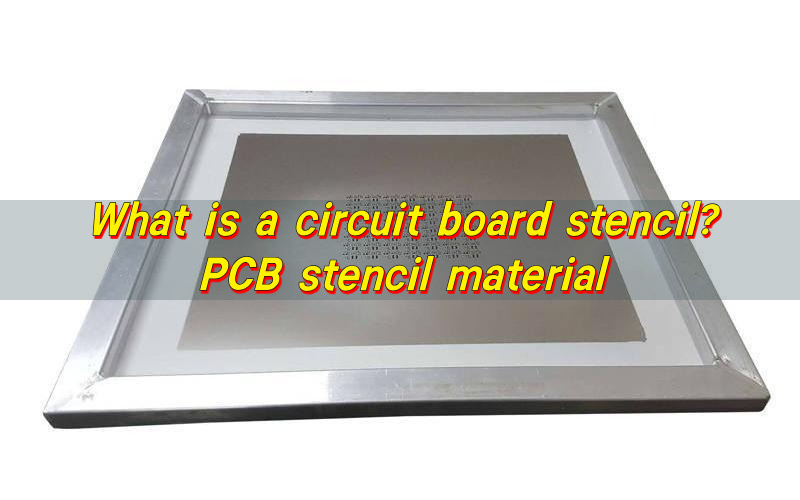
Circuit board stencil — also called a PCB stencil or SMT stencil—is a thin sheet with laser-cut openings that align with the solder pads on a printed circuit board. During surface-mount assembly, solder paste is swept across the stencil so precise, repeatable amounts are deposited only where components will be placed.

What Is a Circuit Board Stencil? PCB Stencil Material

What Is a Stencil Mask in PCB?

Stencil mask in PCB assembly is a thin sheet with precisely cut openings that match the solder pad layout of the board. During SMT production, solder paste is applied through these openings onto the pads before component placement.

Stencil circuit board defines where solder paste goes and, just as importantly, where it does not. Without a stencil, paste deposition would rely on manual methods or uncontrolled dispensing.

Printed circuit board stencils are used in nearly all automated SMT lines because they support repeatability. Once aligned, the same stencil can be used for hundreds or thousands of print cycles with minimal variation.

In manufacturing environments like EBest Circuit (Best Technology), stencil data is reviewed together with Gerber files during DFM checks. This coordination ensures the stencil design supports the real assembly conditions rather than simply matching the PCB layout on paper.

What Material Is Used for PCB Stencils?

The most common PCB stencil material is stainless steel, chosen for its durability, flatness, and resistance to corrosion. Stainless steel stencils can maintain sharp aperture edges over many print cycles, which helps deliver consistent solder paste release.

Within stainless steel options, there are two main surface conditions. Standard stainless steel offers reliable performance for general applications. Polished or nano-coated steel improves paste release, especially for small apertures and fine-pitch components.

Nickel stencils provide smoother walls and are sometimes used for ultra-fine features. Polymer or Mylar stencils are used mainly for low-volume prototyping, where cost and speed matter more than longevity.

From a production standpoint, stainless steel remains the default choice for professional assembly. At EBest Circuit (Best Technology), stainless steel stencils are standard for customer projects because they balance print quality, lifespan, and cost efficiency across both prototype and mass production runs.

What Are the Different Types of Stencils?

Circuit board stencils can be classified by structure and usage method. Each type serves a specific production scenario.

Common stencil types include:

  • Framed stencils, which are permanently mounted in a rigid aluminum frame. These are ideal for high-volume SMT lines because they maintain flatness and alignment over repeated use.
  • Frameless stencils, also known as foil stencils. These are tensioned in a reusable frame system and are popular for flexible production environments.
  • Prototype stencils, usually smaller and sometimes made from polymer materials. These support quick setup for early design validation.
  • Step stencils, which have varying thicknesses in different areas to accommodate mixed component sizes on the same board.

The choice of stencil type depends on production volume, board size, and process stability requirements. For example, a framed stencil offers excellent consistency in mass production, while a frameless stencil provides faster changeover in multi-project lines.

What Is a Circuit Board Stencil? PCB Stencil Material

EBest Circuit (Best Technology) frequently recommends frameless stencils for low-to-medium volume projects because they reduce storage costs and allow faster adjustments without compromising print quality.

What Is a PCB Stencil Made Of?

At its core, a PCB stencil is made of a flat metal sheet with laser-cut apertures. Stainless steel is the dominant base material, but what differentiates stencils is not just the metal itself.

Laser cutting is the preferred method for modern stencils. It produces clean aperture edges and tight tolerances, which directly affect paste release. After cutting, stencils may undergo electro-polishing to smooth the aperture walls.

Some stencils include surface coatings. Nano-coatings reduce paste adhesion, making cleaning easier and extending the time between maintenance cycles. While coatings add cost, they often pay for themselves in reduced downtime and improved consistency.

In professional assembly operations, stencil selection is treated as part of the overall process design. At EBest Circuit (Best Technology), stencil specifications are aligned with solder paste type, squeegee parameters, and reflow profiles to create a balanced, predictable system.

How to Make PCB Stencil?

Creating a circuit board stencil starts with accurate PCB design data. The stencil is derived directly from the solder paste layer in the design files, not from the copper layer.

The typical stencil fabrication process includes several steps:

  • Extracting the paste layer from the PCB design files.
  • Adjusting aperture sizes to match component needs.
  • Laser cutting the apertures into the stencil material.
  • Polishing or coating the stencil surface if required.
  • Inspecting the stencil for flatness and dimensional accuracy.

At EBest Circuit (Best Technology), stencil design is reviewed as part of the PCBA preparation stage. This review ensures that stencil data reflects real assembly conditions rather than relying solely on default design outputs.

How to Cover Up Holes in a Stencil Circuit Boards?

Sometimes, certain pads or vias should not receive solder paste. In these cases, covering or blocking stencil openings becomes necessary.

Several practical methods are used:

  • Modifying the stencil design to remove specific apertures.
  • Applying stencil tape to temporarily block openings.
  • Using removable masks designed for repeated use.

Design-level solutions are preferred whenever possible because they eliminate manual intervention. Temporary blocking methods are useful during prototyping or when accommodating last-minute changes.

In controlled production environments, EBest Circuit (Best Technology) typically addresses these needs at the design stage. This approach reduces operator error and maintains consistency across production batches.

What Is a Circuit Board Stencil? PCB Stencil Material

How Thick Should a PCB Stencil Be?

PCB stencil thickness directly influences solder paste volume. Choosing the right thickness is one of the most critical stencil decisions because it affects both solder joint quality and defect rates.

Common stencil thickness values include 0.10 mm, 0.12 mm, and 0.15 mm. Thinner stencils are used for fine-pitch components, while thicker stencils support larger components and connectors.

Thickness selection depends on several factors:

  • Smallest component pitch on the board.
  • Pad size and shape.
  • Solder paste type.
  • Target production yield.

In mixed-technology boards, step stencils are often used to balance competing requirements. EBest Circuit (Best Technology) frequently recommends step stencils for boards combining fine-pitch ICs with large power components.

How to Choose the Correct Stencil?

Choosing the correct stencil requires a holistic view of the assembly process. It is not just about matching pad layouts but about supporting stable printing under real conditions.

Key considerations include:

  • Board complexity and component mix.
  • Production volume and changeover frequency.
  • Cleaning and maintenance capabilities.
  • Cost versus lifespan expectations.

How to Use PCB Stencil?

Using a PCB stencil correctly involves careful setup, alignment, and process control. The typical usage process includes:

  • Securing the PCB in the printing fixture.
  • Aligning the stencil apertures with the PCB pads.
  • Applying solder paste evenly across the stencil.
  • Using a controlled squeegee stroke to print the paste.
  • Inspecting the paste deposits before component placement.

Squeegee speed, pressure, and angle should remain stable throughout production. Regular cleaning prevents paste buildup that can distort print quality.

At EBest Circuit (Best Technology), stencil printing is treated as a controlled process step. Operators follow standardized parameters, and SPI inspection is used to verify paste quality before placement begins.

What Is a Circuit Board Stencil? PCB Stencil Material

Conclusion:

Circuit board stencil is more than a simple metal sheet. It is a precision tool that directly affects solder quality, assembly yield, and long-term reliability.

If you would like guidance on stencil selection, PCB fabrication, or turnkey PCBA services, contact sales@bestpcbs.com for professional support tailored to your project requirements.

You may also like