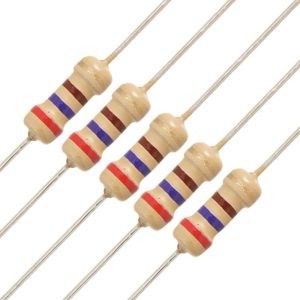
A 220 ohm resistor is one of the most widely used passive components in electronics. Whether you are building a simple LED circuit, repairing a PCB, or designing an embedded control system, you will likely encounter this resistor value. It is inexpensive, easy to source, and suitable for many low-current applications.
From hobby electronics to industrial PCB assemblies, 220 ohm resistors help control current, protect sensitive components, and stabilize circuits. In this guide, we will explain how to identify a 220 ohm resistor, how resistor color codes work, why this resistor is commonly paired with LEDs, and where it is used in practical electronic designs.

220 Ohm Resistor Color Code, LED Applications & Common Uses
What Is 220 Ohm Resistor?
A 220 ohm resistor is an electronic component designed to limit electrical current flow within a circuit. The resistance value is 220Ω.
The main purpose of this resistor is to reduce current to a safe level. Without a resistor, components such as LEDs, microcontrollers, sensors, and transistors may receive excessive current and become damaged.
In electronic circuits, the resistor follows Ohm’s Law:
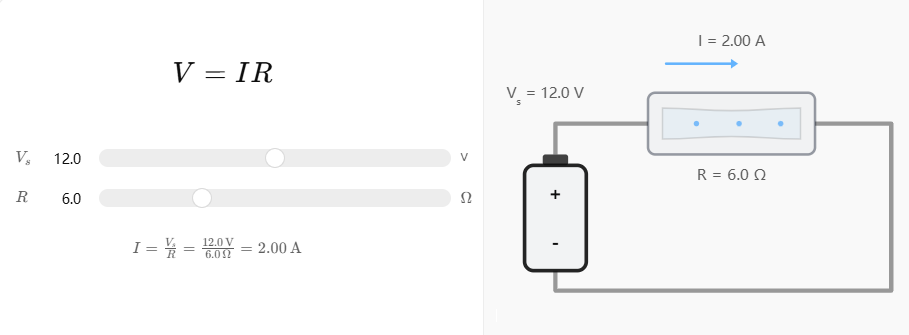
Where:
- V = Voltage
- I = Current
- R = Resistance
A 220 ohm resistor is commonly available in:
- Through-hole axial type
- SMD resistor packages
- Carbon film resistors
- Metal film resistors
- Precision resistors
How to Identify a 220 Ohm Resistor?
The easiest way to identify a 220 ohm resistor is by reading its resistor color code or printed SMD marking.
For through-hole resistors, colored bands are printed around the body.
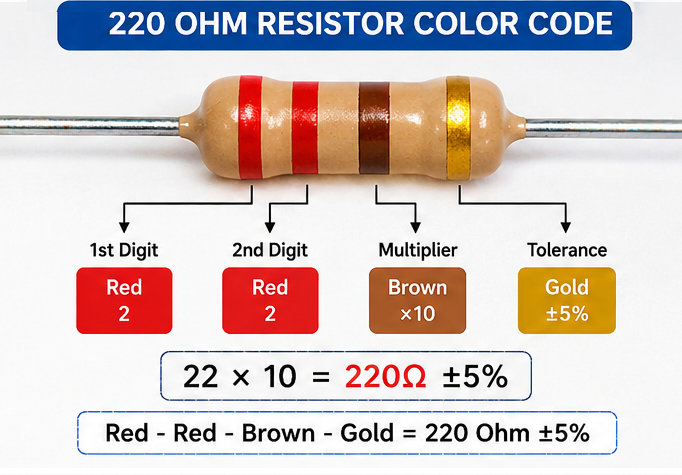
A standard 4-band 220 ohm resistor uses:
- Red
- Red
- Brown
- Gold
This represents:
- 2
- 2
- ×10 multiplier
- ±5% tolerance
Calculation:
22 × 10 = 220Ω
For SMD resistors, common markings include:
| Marking | Resistance |
|---|---|
| 221 | 220Ω |
| 2200 | 220Ω precision format |
You can also use:
- Digital multimeter
- Resistance tester
- Resistor color code chart
to confirm the resistance value.
What Is the Voltage Rating of a 220 Ohm Resistor?
Resistors are normally specified by resistance and power rating rather than direct voltage rating.
The maximum safe voltage depends on the resistor’s wattage.
Power dissipation follows this equation:
P = V² / R
For a standard 1/4W 220 ohm resistor:
V = √PR
Substituting values:
V = √(0.25 × 220) ≈ 7.4V
This means continuous operation above this level may overheat the resistor.
However, actual resistor voltage limits also depend on:
- Resistor material
- Physical size
- PCB spacing
- Pulse duration
- Ambient temperature
For low-voltage electronics like LED circuits, Arduino boards, and logic systems, a 220 ohm resistor works very safely.
What Is the Color Code for a 220 Ohm Resistor?
The standard 220 ohm resistor color code is:
| Band Position | Color | Meaning |
|---|---|---|
| 1st Band | Red | 2 |
| 2nd Band | Red | 2 |
| 3rd Band | Brown | ×10 |
| 4th Band | Gold | ±5% |
Therefore:
22 × 10 = 220Ω
For 5-band precision resistors, the colors may differ slightly depending on tolerance.
Common tolerance bands include:
| Color | Tolerance |
|---|---|
| Gold | ±5% |
| Silver | ±10% |
| Brown | ±1% |
| Red | ±2% |
How to Read Resistor Color Code?
Reading resistor color codes becomes simple once you understand the sequence.
The first bands represent digits, while another band acts as the multiplier.
Common resistor color values:
| Color | Number |
|---|---|
| Black | 0 |
| Brown | 1 |
| Red | 2 |
| Orange | 3 |
| Yellow | 4 |
| Green | 5 |
| Blue | 6 |
| Violet | 7 |
| Gray | 8 |
| White | 9 |
Basic reading process:
- Identify the tolerance band
- Read from left to right
- Convert color to number
- Apply multiplier
- Add tolerance
For example:
- Red = 2
- Red = 2
- Brown multiplier = ×10
Result:
220Ω
Many engineers also use resistor calculators or multimeters for verification during PCB assembly and troubleshooting.
What Is the Function of the 220 Ohm Resistor?
The main function of a 220 ohm resistor is current limiting.
It helps:
- Protect LEDs
- Control signal current
- Reduce inrush current
- Stabilize voltage levels
- Prevent component damage
- Limit transistor base current
In LED applications, the resistor prevents excessive current from flowing through the LED.
For example, using a 5V supply with a standard red LED:
I = (5V – 2V) / 220Ω ≈ 13.6mA
This current is safe for many standard LEDs.
220 ohm resistors are also widely used in:
- Arduino circuits
- Raspberry Pi projects
- Sensor boards
- PCB prototypes
- Digital electronics
- Embedded systems
Is 220 Ohm Resistor Enough for LED?
In many cases, yes. A 220 ohm resistor is one of the most common resistor choices for LEDs running from 5V supplies.
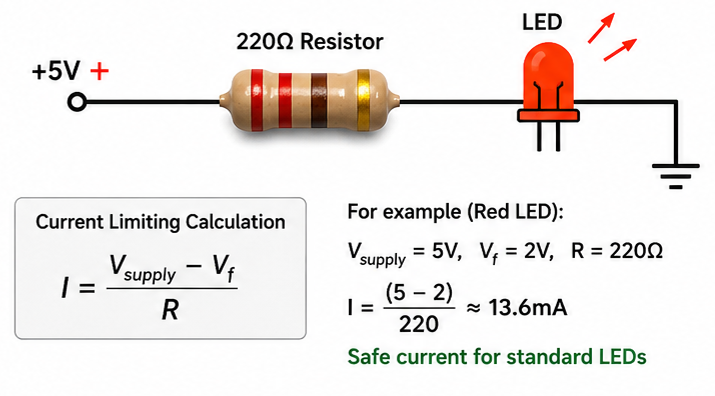
Typical LED forward voltages:
| LED Color | Approximate Voltage |
|---|---|
| Red | 1.8V–2.2V |
| Green | 2V–3V |
| Blue | 3V–3.5V |
| White | 3V–3.5V |
Using a 220 ohm resistor usually provides safe LED current between 8mA and 15mA depending on supply voltage and LED type.
Advantages include:
- Prevents LED burnout
- Extends LED lifespan
- Reduces heat
- Improves reliability
However, LED brightness may vary based on:
- Supply voltage
- LED type
- Desired brightness
- Power efficiency requirements
For high-power LEDs, 220 ohm may not be suitable.
What Are the Common Uses of a 220 Ohm Resistor?
220 ohm resistors appear in many electronic products and PCB assemblies.
Common applications include:
| Application | Purpose |
|---|---|
| LED circuits | Current limiting |
| Microcontroller GPIO | Protection |
| Signal conditioning | Current control |
| Audio circuits | Noise reduction |
| Transistor circuits | Base current limiting |
| Pull-up/pull-down networks | Signal stabilization |
| Prototype boards | General resistance use |
In PCB manufacturing, these resistors are frequently placed near:
- LEDs
- IC outputs
- Logic signals
- Communication interfaces
They are especially common in consumer electronics, automotive electronics, industrial control systems, and embedded boards.
What Is the Difference Between 220 and 330 Resistor?
The main difference is resistance value and resulting current flow.
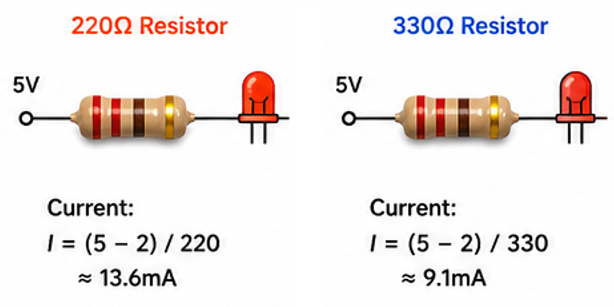
According to Ohm’s Law:
I = V / R
Higher resistance means lower current.
For LED circuits:
- 220Ω gives brighter illumination
- 330Ω reduces power consumption
- 330Ω generates less heat
- 220Ω is more common for standard indicator LEDs
Engineers select the resistor value based on:
- LED brightness target
- Battery life
- Thermal performance
- Signal safety margin
What Happens If a Resistor Fails?
A resistor may fail due to:
- Overheating
- Excessive voltage
- Excessive current
- PCB contamination
- Poor soldering
- Mechanical stress
In LED circuits, a failed resistor may cause:
- LED not lighting
- LED overheating
- Flickering
- Circuit malfunction
In PCB assembly, resistor reliability depends on:
- Proper power derating
- Correct soldering process
- Quality component sourcing
- Thermal management
At EBest Circuit, resistor placement and solder joint reliability are carefully verified during PCBA manufacturing using AOI inspection and electrical testing procedures.
FAQs
1. Can I use a 220 ohm resistor instead of 330 ohm?
Yes, but the current will be higher. LEDs may appear brighter and consume more power.
2. Is a 220 ohm resistor polarized?
No. Standard resistors are non-polarized components and can be installed in either direction.
3. What does 221 mean on an SMD resistor?
“221” means:
22 × 10¹ = 220Ω
4. Can a 220 ohm resistor work with 12V LEDs?
It depends on the LED type and current requirement. For standard LEDs on 12V supplies, a higher resistor value is often required.
5. How do I test a 220 ohm resistor?
Use a digital multimeter in resistance mode. A healthy resistor should measure close to 220Ω within its tolerance range.
6. Why is my 220 ohm resistor getting hot?
Possible reasons include:
- Excessive current
- Incorrect wattage
- Short circuit
- Wrong circuit design
7. Are 220 ohm resistors common in PCB assembly?
Yes. They are widely used in LED control, signal conditioning, and embedded electronic designs.