





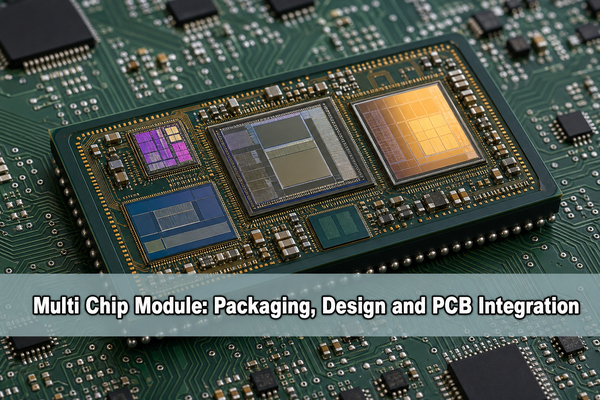
A multi-chip module is an advanced electronic package that integrates two or more chips into one compact module. These chips may include logic dies, memory, RF devices, power ICs, sensors, or other semiconductor components.
Instead of mounting every chip separately on a large PCB, a multi-chip module places multiple chips close together on a shared substrate. This helps reduce signal distance, save board space, improve performance, and support higher functional density.
For engineers working on high-speed electronics, RF modules, medical devices, aerospace systems, automotive electronics, or compact embedded products, understanding multi chip module design and multi chip module packaging is becoming increasingly important.
What Is a Multi-Chip Module?
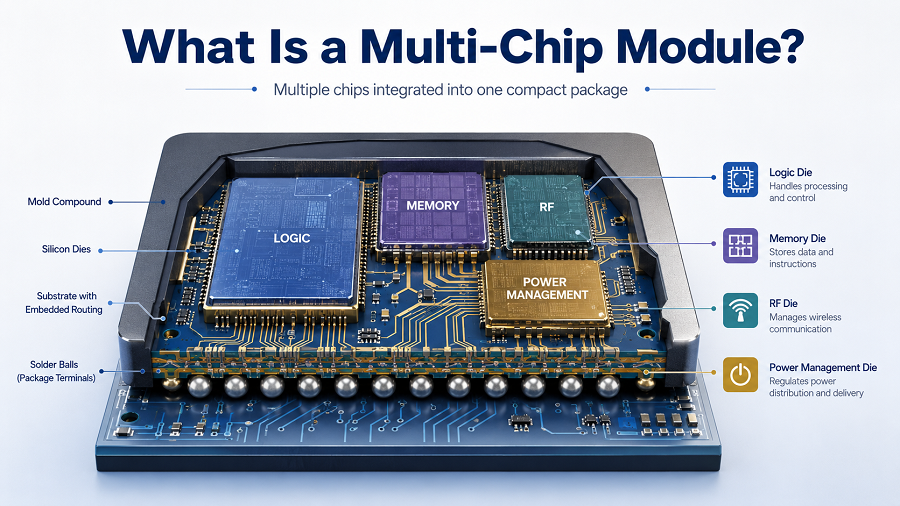
A multi-chip module, often called an MCM, is an electronic package that contains multiple semiconductor chips inside one module. These chips are mounted on a common substrate and connected through wire bonding, flip-chip bumps, solder bumps, redistribution layers, or interposer routing.
The chips inside an MCM can perform different functions. One module may include a processor die, memory die, RF chip, sensor die, power management IC, and passive components.
In simple terms, a multi-chip module allows several chips to work together as one compact electronic unit. Compared with traditional PCB assembly, MCM packaging brings chips much closer together.
How Does a Multi-Chip Module Work?
A multi-chip module works by placing several chips on a shared substrate. The substrate acts as a high-density circuit platform. It routes power, ground, clock signals, control signals, and high-speed data lines between the chips.
For example, a compact wireless module may contain an RF chip, microcontroller, memory, power management circuit, and passive matching components. These parts communicate through short internal connections instead of long PCB traces.
This shorter signal path can bring several benefits:
- Lower signal delay
- Better high-speed performance
- Reduced parasitic inductance and capacitance
- Smaller PCB footprint
- More controlled electrical behavior
- Higher system integration
After internal assembly, the complete MCM is mounted onto the main PCB through BGA balls, LGA pads, pins, or other package terminals.
Why Is Multi-Chip Module Packaging Used in Advanced Electronics?
Multi chip module packaging is used because advanced electronics need more functions in less space. It also helps engineers combine different semiconductor technologies in one compact structure.
A single chip may not be the best choice when different functions require different manufacturing processes. Digital logic, RF circuits, memory, power devices, and MEMS sensors may each need a different process to perform well. MCM packaging allows each chip to use the technology that suits it best.
Main advantages include:
- Smaller size
- Shorter interconnects
- Flexible integration
- Higher performance density
- Better design modularity
- Potential yield benefit
This is why MCM technology is widely used in processors, RF modules, aerospace electronics, medical devices, automotive radar, power modules, and compact IoT products.
Types of Multi-Chip Module Packaging
Multi-chip module packaging can be classified by substrate material and interconnection method. The common types include MCM-L, MCM-C, MCM-D, 2.5D packaging, and 3D packaging.
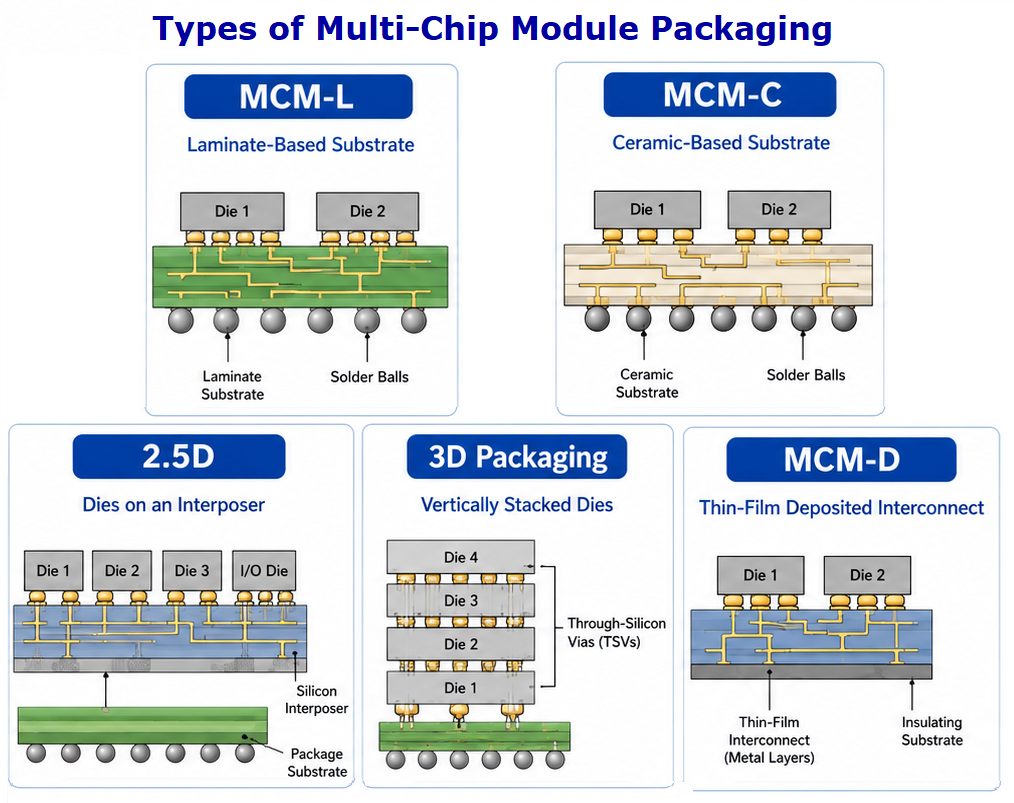
MCM-L uses organic laminate substrates. It is often selected when cost, scalability, and volume production matter.
MCM-C uses ceramic substrates such as alumina or aluminum nitride. It is preferred for high-reliability, high-temperature, RF, and power applications.
MCM-D uses deposited thin-film layers to achieve very fine interconnects. It is suitable for demanding high-density and high-frequency designs.
2.5D and 3D packaging are more advanced forms of integration. They are common in high-performance computing and chiplet-based architectures.
What Is the Difference Between MCM and SoC?
An MCM and an SoC both integrate multiple functions, but they do it in different ways.
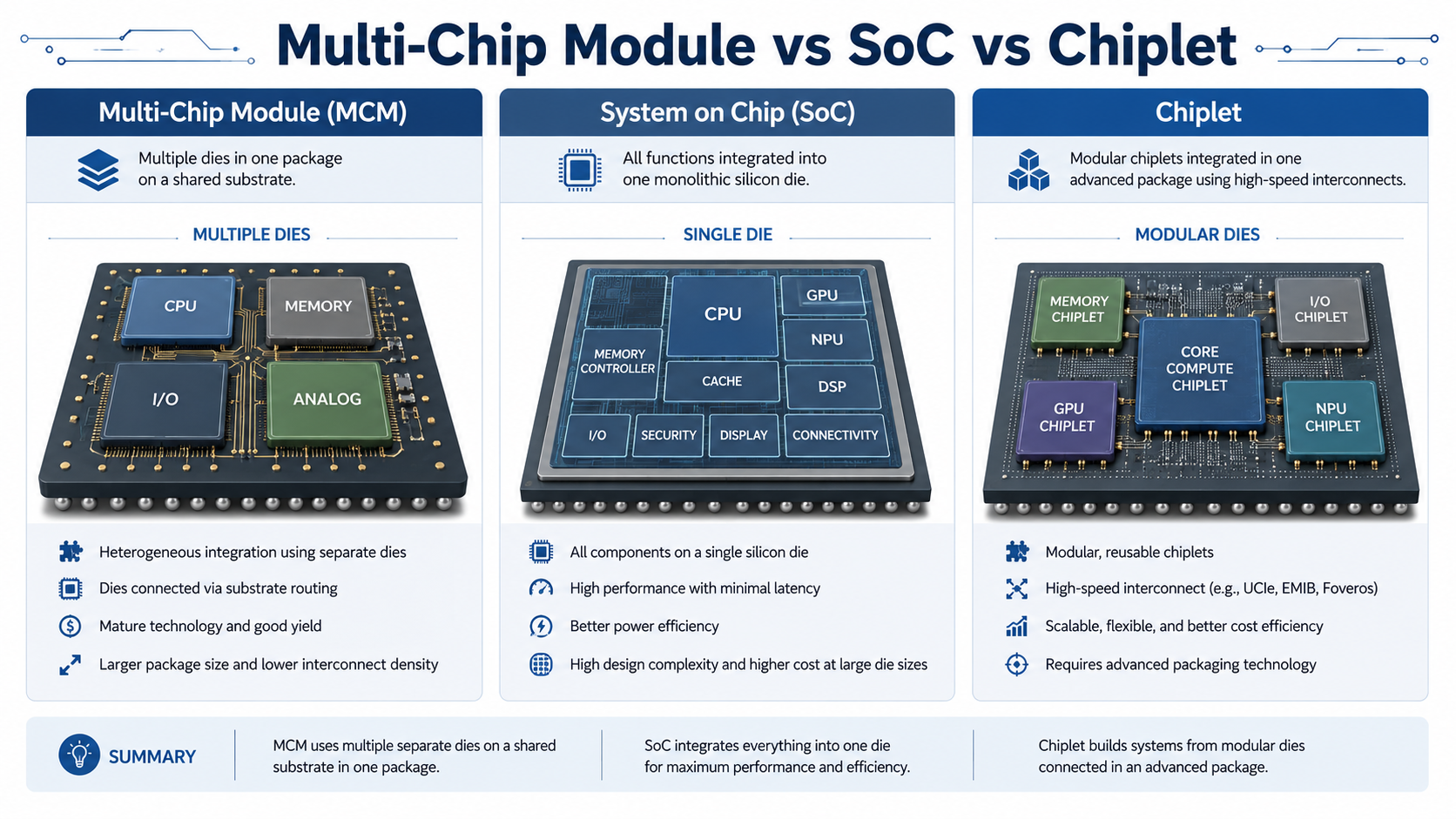
An SoC, or System on Chip, integrates many functions into one single silicon die. A multi-chip module integrates multiple separate chips into one package.
| Comparison | Multi-Chip Module | SoC |
|---|---|---|
| Structure | Multiple dies in one package | One die with many functions |
| Technology flexibility | Can combine different chip processes | Usually uses one semiconductor process |
| Design flexibility | Easier to mix and update functional dies | Harder to change after chip design |
| Development cost | Practical for mixed technologies | Can be expensive for complex large dies |
| Yield strategy | Individual dies can be tested before assembly | One large die may have yield challenges |
| Typical use | RF, power, HPC, aerospace, medical modules | MCUs, processors, mobile chips, embedded ICs |
An SoC is suitable when all functions can be efficiently built on one die. An MCM is often better when the product needs different chip technologies, compact size, high performance, or modular integration.
Multi-Chip Module vs Chiplet: Key Differences
The terms multi-chip module and chiplet are related, but they are not the same.
A multi-chip module is the package that contains multiple chips. A chiplet is a smaller functional die designed to work with other dies in a modular architecture.
| Item | Multi-Chip Module | Chiplet |
|---|---|---|
| Meaning | A package containing multiple chips | A small functional semiconductor die |
| Main role | Physical integration platform | Functional building block |
| Scope | Broad packaging concept | Specific modular chip architecture |
| Relationship | Can contain chiplets | Can be assembled inside an MCM |
| Example | RF module with several dies | CPU chiplet, I/O chiplet, memory chiplet |
The simplest way to understand it is this: an MCM is the package, while a chiplet is one possible building block inside that package.
Not every multi-chip module uses chiplets. For example, a ceramic RF module with amplifier dies and passive components is an MCM, but it may not be called a chiplet system.
What Substrate Materials Are Used in Multi-Chip Modules?
The substrate is one of the most important parts of a multi-chip module. It affects signal routing, thermal performance, mechanical reliability, and manufacturing cost.
Common substrate materials include organic laminate, ceramic, silicon interposer, glass, and metal-based substrates.
| Substrate Material | Strengths | Typical Applications |
|---|---|---|
| Organic laminate | Cost-effective, mature, suitable for volume production | Digital modules, communication devices |
| Ceramic | High reliability, good thermal stability, strong insulation | Aerospace, RF, medical, power electronics |
| Silicon interposer | Very fine routing and high-bandwidth connection | 2.5D advanced packaging |
| Glass substrate | Good dimensional stability and electrical behavior | Emerging advanced packaging |
| Metal-based substrate | Excellent heat spreading | Power modules and high-current applications |
For cost-sensitive applications, organic laminate may be enough. For RF, medical, aerospace, and power electronics, ceramic substrates are often more suitable. For very high-density die-to-die communication, silicon interposers are commonly used.
Key Design Rules for Multi-Chip Module Design
Good multi chip module design requires more than placing several dies together. Electrical performance, thermal behavior, assembly process, material compatibility, and testing access must be considered from the beginning.
Plan the system architecture first
Before layout, define what each chip does, which chips communicate most frequently, and which signals are high-speed, noise-sensitive, or power-heavy.
Optimize die placement
Place high-speed dies close to each other. Keep heat-generating dies near effective thermal paths. For RF modules, also consider isolation, shielding, and impedance matching.
Control signal integrity
Short interconnects are helpful, but routing still matters. High-speed lines may need controlled impedance, matched lengths, clean return paths, and low-crosstalk spacing.
Design stable power distribution
Each die may need different voltage rails. Use proper decoupling, low-inductance power paths, and well-planned grounding.
Manage thermal performance
Heat can build up quickly when several dies are packed together. Thermal vias, heat spreaders, metal lids, ceramic substrates, or copper base structures may be needed.
Consider material expansion
Silicon, ceramic, organic laminate, solder, molding compound, and metal lids expand differently under temperature changes. This CTE mismatch can affect long-term reliability.
Design for manufacturability
Trace width, spacing, via structure, pad size, bonding clearance, die attach method, inspection access, and testing points must match real manufacturing capability.
A successful MCM is not only a circuit design, it is a complete packaging, material, thermal, and manufacturing project.
What Is MCM Used For?
MCM technology is used in advanced electronic systems where space, speed, reliability, or integration density matters.
Common applications include:
- High-performance computing modules
- AI processors and accelerator packages
- RF and microwave modules
- Aerospace and defense electronics
- Medical imaging and monitoring devices
- Automotive radar and ADAS electronics
- Power modules
- Wireless communication devices
- Compact IoT modules
- Industrial control electronics
In these applications, MCM packaging helps reduce size while improving system-level performance.
How to Choose a Multi-Chip Module Assembly Manufacturer?
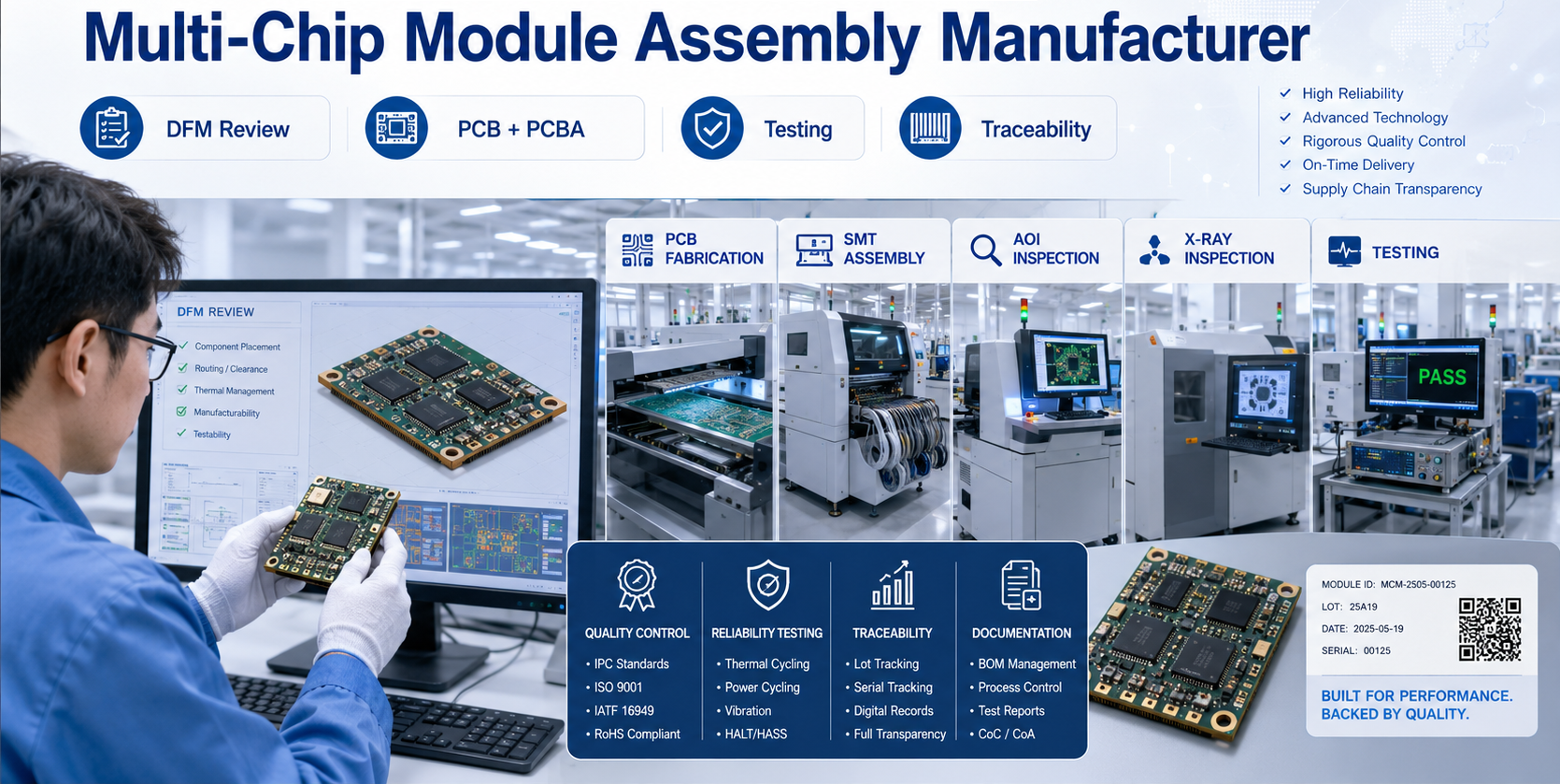
Choosing the right multi-chip module assembly manufacturer is important because MCM-related projects often involve compact layouts, fine-pitch components, thermal control, stable signal paths, and strict process quality. A good manufacturer should support both assembly and early engineering review.
For compact electronic modules, RF boards, sensor modules, medical electronics, automotive control boards, industrial devices, and high-reliability PCB assemblies, EBest Circuit provides practical support from PCB fabrication to PCBA assembly and testing.
Why choose EBest Circuit?
- Integrated PCB and PCBA service
- Early DFM engineering review
- Advanced PCB manufacturing capability
- FR-4, high-Tg, HDI, rigid-flex, high-frequency, ceramic, aluminum, and copper substrate PCB support
- Strong thermal management support
- SMT assembly and turnkey component sourcing
- AOI, X-ray, ICT, flying probe, functional test, and visual inspection
- Material batch traceability and production process tracking
- Quality documentation for high-reliability electronics projects
- Experience in medical, automotive, industrial, communication, and aerospace-related electronics
- Responsive engineering communication
If you are developing a compact electronic module, high-density PCB assembly, or multi-chip module-related project, you are welcome to send your Gerber files, BOM, drawings, and technical requirements to sales@bestpcbs.com for engineering review and quotation.
FAQs About Multi-Chip Module
What does multi-chip module mean?
A multi-chip module is an electronic package that integrates two or more chips into one compact module. The chips are mounted on a shared substrate and connected internally.
Is a multi-chip module the same as a chiplet?
No. A multi-chip module is the package structure. A chiplet is a small functional die that may be used inside a multi-chip package.
What is the main advantage of a multi-chip module?
The main advantage is compact integration. It can reduce board space, shorten signal paths, and improve system performance.
What is the difference between MCM and SoC?
An MCM uses multiple separate dies in one package. An SoC integrates many functions into one single silicon die.
What materials are used for MCM substrates?
Common materials include organic laminate, ceramic, silicon interposer, glass, and metal-based substrates.
Where are multi-chip modules used?
They are used in high-performance computing, RF modules, aerospace electronics, medical devices, automotive systems, power modules, and compact embedded products.
Why is ceramic used in some MCM packages?
Ceramic is used when the design needs high reliability, good thermal stability, strong insulation, and better performance in harsh environments.
How do I choose a multi-chip module assembly manufacturer?
Choose a manufacturer with engineering review capability, advanced PCB manufacturing experience, reliable assembly process, testing support, traceability control, and responsive communication. EBest Circuit supports PCB fabrication, PCBA assembly, DFM review, component sourcing, testing, and quality documentation for high-reliability electronic module projects.
You may also like
Tags: Multi chip module, multi chip module design, multi chip module manufacturers, multi chip module packaging, multi chip module vs chiplet