PCB manufacturing PCB manufacturing
Home > Blog

active components

What Is Active and Passive Components?
Wednesday, March 18th, 2026

Understanding active and passive components is essential for designing reliable circuits. Whether you work in consumer electronics, automotive, or industrial systems, mastering active and passive components helps you choose the right parts for performance, cost, and longevity. This guide breaks down everything you need to know about active and passive components, from definitions to real-world applications.
What Is Active and Passive Components?

What Are Active Components in Electronics? Definition & Examples

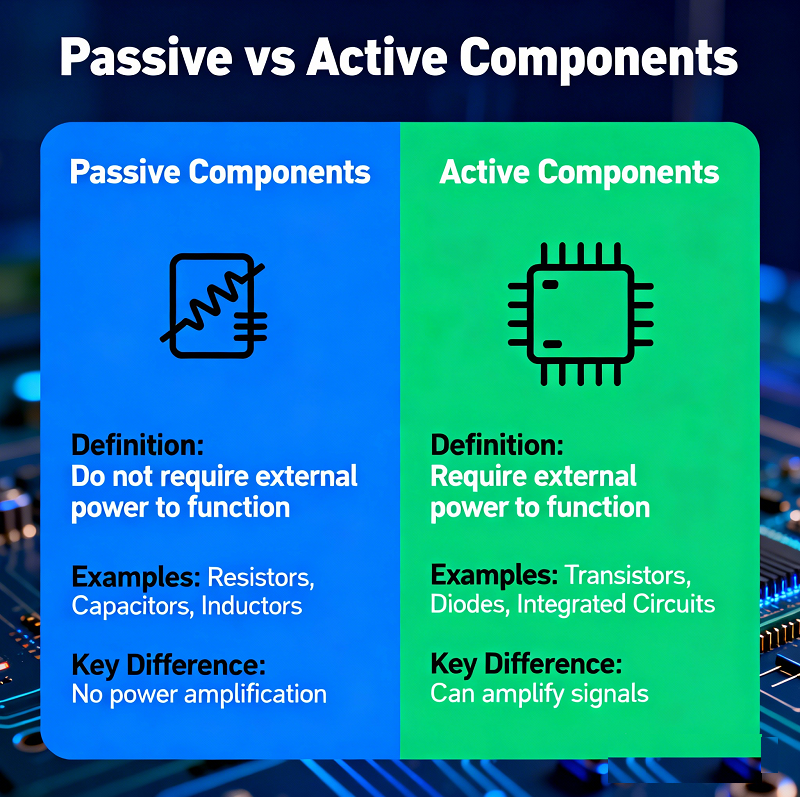
Active components need an external power source to function. They control or amplify electrical signals, making them critical for circuit performance.

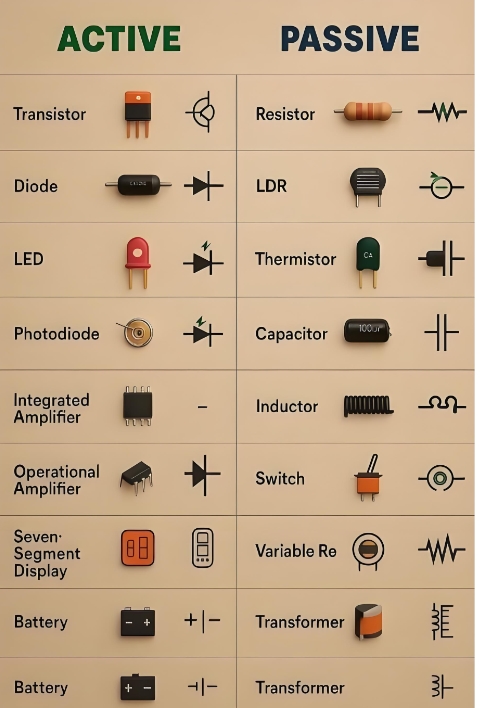
Common examples of active components include transistors, ICs (integrated circuits), diodes, LEDs, and relays.

These components are the “workhorses” of active and passive components in PCB design, enabling signal amplification and precise control in all electronic devices.

What Are Passive Components in Electronics? Definition & Examples

Passive components do not need external power to operate. They store or dissipate energy without amplifying signals, supporting the core function of active components.

Common examples of passive components include resistors, capacitors, inductors, and transformers.

They are essential for active and passive components for circuit design, handling filtering, timing, load matching, and energy storage.

What Is the Difference Between Active and Passive Components? Comparison Table

Knowing the key differences between these components ensures you select the right parts for your project. Below is a detailed comparison of active vs passive components.

FeatureActive ComponentsPassive ComponentsCommon Use Case
Power RequirementNeeds external power to operateNo external power requiredAll electronic circuits
Core FunctionAmplify, switch, or control electrical signalsStore, dissipate, or transfer energySignal management and power regulation
ExamplesTransistors, ICs, diodes, LEDs, relaysResistors, capacitors, inductors, transformersPCB design and circuit assembly
Energy RoleSupplies energy to the circuitUses or reserves energy from the circuitPower systems and signal processing

What Are the Advantages and Disadvantages of Active Components?

Understanding the advantages of active components and their limitations helps you make informed design decisions.

Advantages: High performance, signal amplification, precise control over circuit behavior, and ability to switch signals quickly.

Disadvantages: Higher cost compared to passive components, requires external power, and adds complexity to PCB design.

What Are the Advantages and Disadvantages of Passive Components?

The advantages of passive components make them indispensable for reliable, cost-effective circuits.

Advantages: Low cost, simple design, high reliability, no external power needed, and long service life.

Disadvantages: No signal amplification capability, limited function, and fixed electrical parameters that cannot be adjusted.

How to Choose Between Active and Passive Components?

Selecting between active and passive components depends on your circuit’s specific needs.

Use active components for amplification, switching, or signal control—ideal for circuits that need to boost or modify signals.

Use passive components for filtering, timing, load matching, or energy storage—critical for stabilizing circuits and managing power flow.

Active and Passive Components in PCB Design (Top 4 Industries)

Consumer Electronics

Smartphones, tablets, and wearables rely on active and passive components in consumer electronics.

ICs (active) and capacitors (passive) are used to ensure small size, low power consumption, and stable performance.

Automotive Electronics

EV controllers, infotainment systems, and safety modules use active and passive components in automotive electronics.

Transistors (active) and power resistors (passive) meet high reliability and temperature resistance standards for vehicle environments.

Industrial Control & Automation

PLCs (Programmable Logic Controllers) and factory automation systems use active and passive components in industrial electronics.

Relays (active) and inductors (passive) provide signal isolation and stability in harsh factory conditions.

Medical Electronics

Patient monitors, diagnostic devices, and medical implants use active and passive components in medical devices.

Op-amps (active) and precision passive components comply with strict safety and accuracy regulations for medical applications.

How to Identify Active and Passive Components?

Identifying active and passive components is simple with these key indicators.

Active components: Require a power pin or connection (e.g., ICs with VCC pins, transistors with base/emitter pins).

Passive components: No power connection needed (e.g., resistors with two leads, capacitors with two terminals).

Common Failures of Active & Passive Components & Fixes

Even high-quality active and passive components can fail—here’s how to troubleshoot and fix common issues.

Active components: Overheating or voltage damage → Use proper cooling solutions and voltage protection circuits.

Passive components: Parameter drift or short circuits → Select high-quality, rated parts from reliable suppliers.

How Do Active & Passive Components Affect PCB Quality & Supply Chain?

The quality of active and passive components directly impacts PCB performance and supply chain stability.

Quality: Choose certified components to ensure long-term reliability and compliance with industry standards.

Supply chain: Select widely available parts to avoid delays—EBest ensures a stable supply chain for electronic components.

Latest Trends for Active and Passive Components (2026)

The types of active and passive components with examples are evolving to meet industry demands in 2026.

Miniaturization: Smaller component packages for compact PCBs in consumer and medical devices.

High reliability: Automotive and medical grade components with enhanced durability and performance.

Sustainability: Low-power active components and eco-friendly passive components to reduce energy consumption.

FAQ: Frequently Asked Questions About Active and Passive Components

Is a transistor active or passive component?

A transistor is an active component. It requires external power to amplify or switch electrical signals, which is a key characteristic of active components.

Is a resistor active or passive component?

A resistor is a passive component. It dissipates energy as heat and does not require external power to operate, fitting the definition of passive components.

Is a capacitor active or passive?

A capacitor is a passive component. It stores electrical energy and releases it as needed, without requiring external power to function.

Do active components need power?

Yes, active components need external power. They cannot amplify or control signals without a power source, unlike passive components.

Do passive components need a power supply?

No, passive components do not need a power supply. They operate using the energy available in the circuit, such as storing or dissipating energy from active components.

Why are active and passive components important?

Active and passive components are important because they work together to create functional electronic circuits. Active components provide control and amplification, while passive components stabilize and support signal flow.

Active vs passive components which is better?

Neither is “better”—they serve different purposes. Active components are essential for signal control/amplification, while passive components are critical for stability and energy management. Both are required for most circuits.

Summary: Master Active and Passive Components for Better PCBs

active and passive components form the foundation of all electronic circuits. The function of active and passive components works in harmony to ensure circuits perform reliably, efficiently, and cost-effectively.

Correct selection of active and passive components improves PCB quality, reduces failures, and ensures your device meets industry standards.

EBest provides high quality PCB with active and passive components and reliable active and passive components for PCB manufacturing. We specialize in PCB manufacturing with active and passive components and custom PCB using active and passive components, with a stable supply chain and on-time delivery. If you need high-quality components and PCB solutions, place your order with us. Email us at sales@bestpcbs.com for inquiries and quotes.


What Are the Differences Between Active and Passive Components?
Wednesday, July 3rd, 2024

In PCB electronics, components are classified into two main categories: active and passive components. Understanding these differences is crucial for anyone working with electronic circuits. Active components control electricity flow and require an external power source. Passive components do not control electricity and do not need an external power source.

What are active and passive components meaning?

Active and passive components, simply say, the device that needs an energy (electrical) source is called an active device, and the device that does not need an energy source is a passive device. Active components, such as transistors and diodes, require external power to function. They can control the flow of electricity. Passive components, like resistors and capacitors, do not need external power. They cannot control electrical flow but can store, resist, or filter energy. Both passive and active components are common useful in PCB assembly and SMT technology.

Active components play a dynamic role in circuits. They can amplify signals, switch currents, and perform various complex functions. These components rely on an external power source to operate and influence the behavior of the circuit. For instance, a transistor can amplify a weak signal, making it stronger and more useful for further processing.

What Are the Differences Between Active and Passive Components?

Passive components, on the other hand, are more static in nature. They cannot amplify signals or control current flow but are essential for other functions like energy storage and signal filtering. Resistors, capacitors, inductors, and transformers are common examples. Each of these components has a specific role in maintaining the stability and functionality of an electronic circuit.

What are the key differences between active and passive components?

The main difference between active and passive components is their ability to control electricity. Active components can amplify signals and perform complex tasks. Passive components can only store, resist, or filter energy. They cannot amplify signals or control current.

Active components are energy-dependent. They require an external source of power to function and can influence the flow of electricity within the circuit. For example, an integrated circuit (IC) can perform multiple functions like amplification, switching, and signal modulation, all of which require external power.

Passive components, in contrast, do not require an external power source. They can only perform their functions passively. For instance, a resistor can limit the current flowing through a circuit without needing additional power. Similarly, a capacitor can store electrical energy and release it when needed, all without external energy input.

Common active components in electronics

Active devices are the main components of electronic circuits. From the physical structure, circuit function and engineering parameters, active devices can be divided into discrete devices and integrated circuits.

1. Discrete devices

  • Bipolar transistor, generally referred to as transistor or BJT
  • Field effective transistor
  • Thyristor
  • Semiconductor resistors and capacitors – resistors and capacitors manufactured by integrated technology are used in integrated circuits.

2. Integrated circuit

Integrated circuit can be divided into analog IC and digital IC. Analog integrated circuits mainly deal with continuous analog signals, such as sound, light, temperature, etc., and retain the continuity and accuracy of the signal through amplification, filtering, mixing and other operations. In contrast, digital integrated circuits are used to process discrete time digital signals, convert the signal into binary digital form, and then perform logical operations and processing.

Basic analog integrated circuit devices generally include:

  • Integrated operational amplifier (operation amplifier)
  • Comparator
  • Logarithmic and exponential amplifiers
  • Multiplier/divider
  • Analog switching circuit (analog switch)
  • Phase lock loop
  • Integrated voltage regulator
  • Reference source
  • Wave-form generator
  • Power amplifier

Digital integrated circuit including:

  • Logic gate circuit
  • Flip-flop
  • Register
  • Decoder
  • Data comparator
  • Driver
  • Counter
  • Shaping circuit
  • Programmable Logic Device (PLD)
  • Microprocessor (MPU)
  • Microcontroller (MCU)
  • Digital signal processor (DSP)

Common passive components in electronics

Passive devices in electronic systems can be divided into circuit components and connection components according to the circuit functions they play. These components are essential for functions like energy storage, filtering, and impedance matching in electronic circuits. The common passive components are including:

Circuit components

  1. Diode
  2. Resistor
  3. Resistor network
  4. Capacitor
  5. Inductor
  6. Transformer
  7. Relay
  8. Key
  9. Speaker
  10. Switch

Connection components

  • Connector
  • Socket
  • Cable
  • PCB (printed circuit board)

Why are active components crucial in modern electronics?

The ability of active components to control and manipulate electrical signals makes them indispensable in a wide range of applications.

In computers, for example, active components such as processors and memory chips perform complex calculations and store large amounts of data. In communication systems, active components amplify weak signals, making long-distance transmission possible. Without these amplifiers, the signal would decay with distance, leading to a decline in communication quality. Power electronics, another key area of modern development, relies heavily on active components. Devices like power converters, inverters, and motor controllers use transistors and integrated circuits to efficiently convert and control electrical energy. This efficiency is crucial for applications ranging from renewable energy systems to electric vehicles.

It’s fair to say that without active components, devices like computers, smartphones, and TVS wouldn’t function the way they do today, and our era of big data wouldn’t be moving as fast as it is today.

How do passive components complement active components?

Both active and passive components are indispensable in a circuit. They depend on each other and complement each other. Without active components, the circuit cannot be activated or perform a specific work. Without passive components, the circuit cannot be controlled and adjusted, nor can it achieve a stable operating state. Such a relationship between the two is like the relationship between the “dynamic” and the “static” of a circuit.

What Are the Differences Between Active and Passive Components?

For example, in an audio amplifier circuit, the power supply and amplifier are the active components, and the load and resistance are the passive components. The power supply provides energy, the amplifier amplifies the signal, and controls and limits it through load and resistance, and finally realizes the amplification and regulation of the audio signal. In signal processing, inductors filter out high-frequency noise and protect sensitive active components from interference. Transformers, on the other hand, enable efficient power transfer between different parts of the circuit, allowing active components to operate within their optimal voltage range.

Comparing the Energy Requirements of Active and Passive Elements

Active components need an external power source to function. They consume energy during operation. Passive components do not need external power and generally do not consume energy, except for minor resistive losses. This difference impacts the design and efficiency of electronic circuits.

Active components, such as transistors and integrated circuits, rely on external power to operate. This power requirement means that active components consume energy during their operation. The amount of energy consumed depends on the specific component and its application. For instance, a power amplifier consumes more energy than a simple transistor switch.

Passive components, in contrast, do not need external power to function. They operate solely based on the electrical energy present in the circuit. Resistors, capacitors, and inductors do not consume significant energy, except for minor resistive losses in resistors. This low energy requirement makes passive components more efficient in certain applications.

What Are the Differences Between Active and Passive Components?

The difference in energy requirements between active and passive components impacts the overall efficiency of electronic circuits. Designers must carefully balance the use of active and passive components to achieve optimal performance and energy efficiency. For example, using passive filters instead of active ones can save energy in low-power applications.

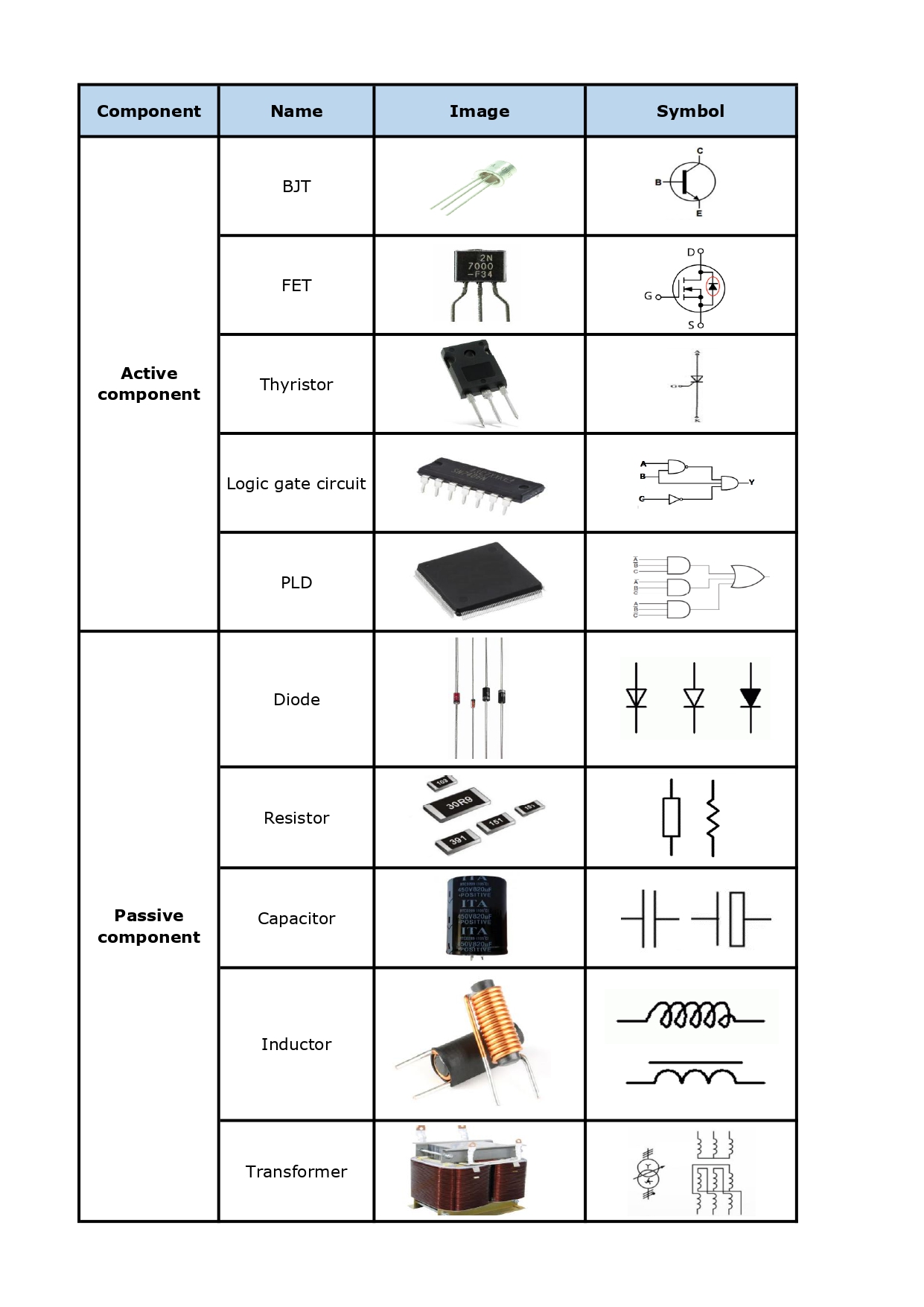
Active and Passive Component Images and Symbols

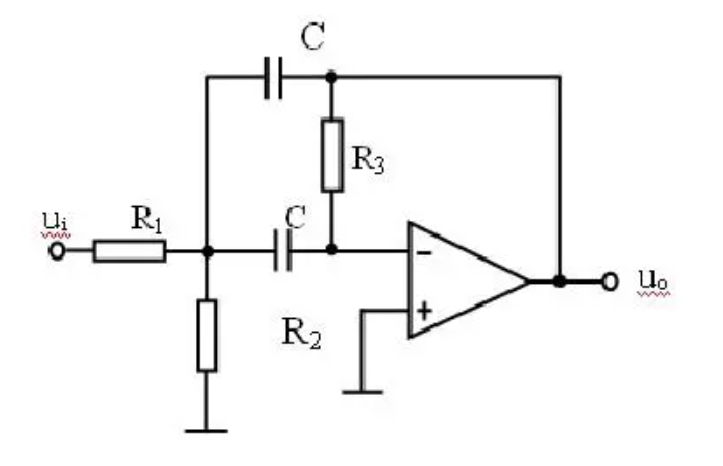
Recognizing symbols are essential for reading and designing circuit diagrams. They provide a visual representation of the components and their functions, helping designers understand the overall structure and operation of the circuit. Recognizing these symbols is a fundamental skill for anyone involved in electronics. Here is a detailed images and symbols listing of common active and passive components.

Above all is the introduction to passive and active components, hope it is useful for every engineers. EBest Circuit (Best Technology) is a professional PCB and PCBA manufacturer in Asia. We have our own factory in China and Vetnam. Welcome to contact us if you have any questions about components and PCB assembly.