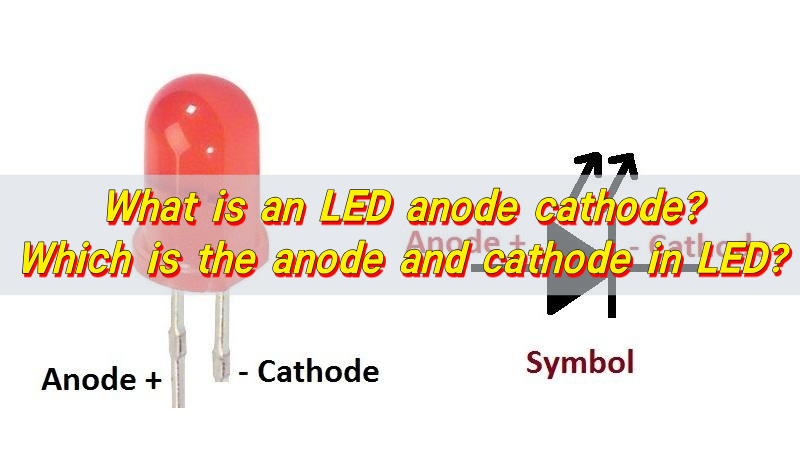
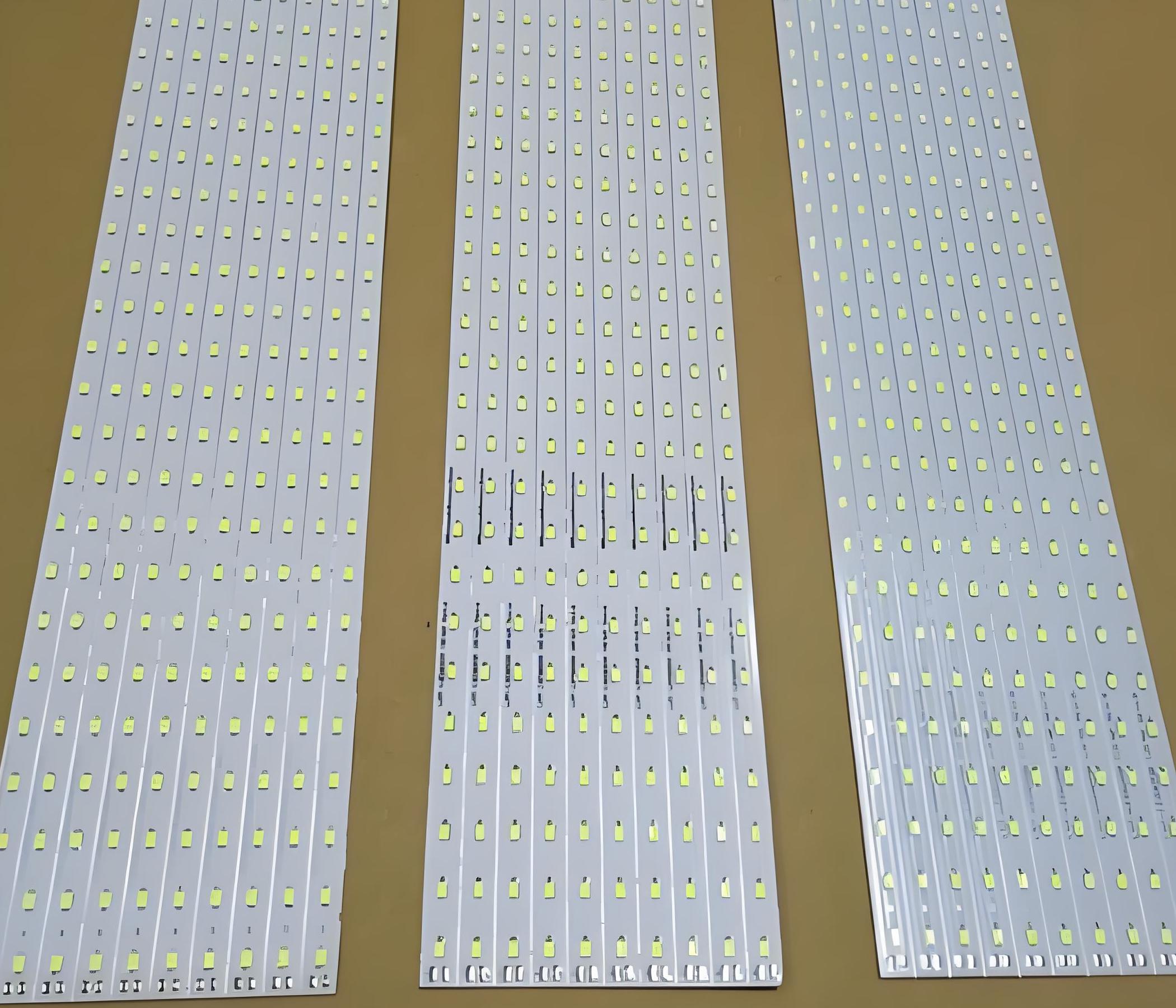
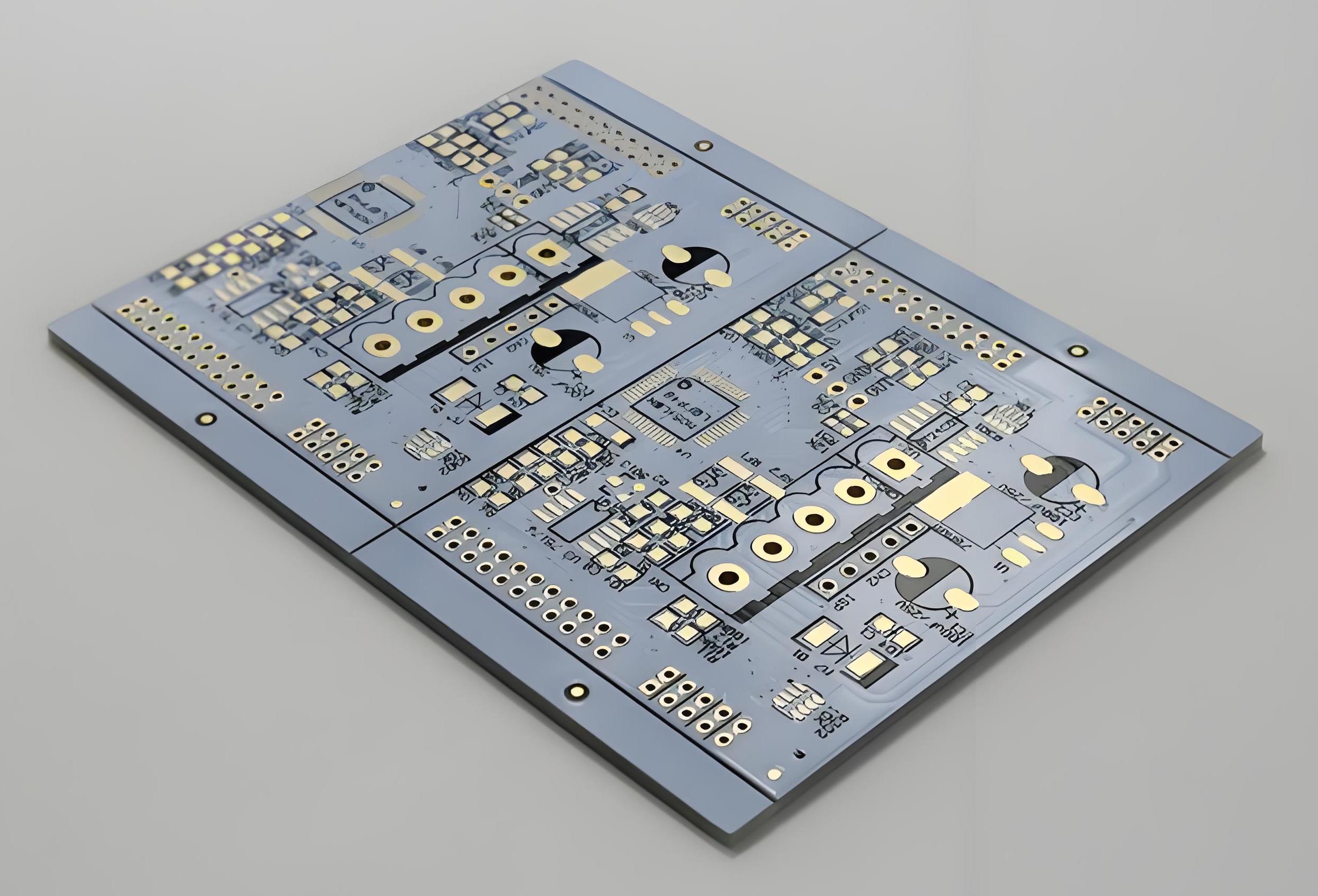
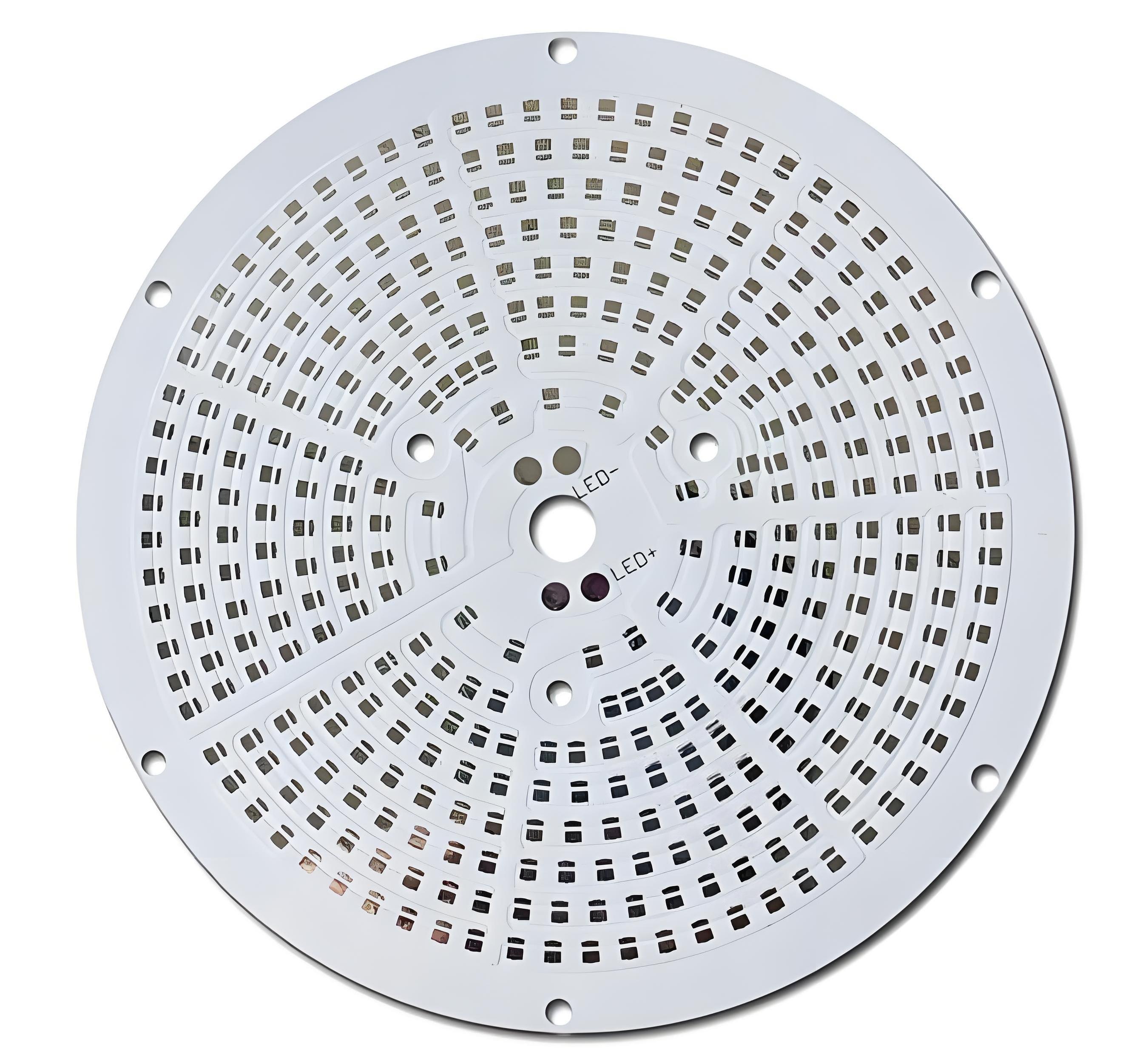
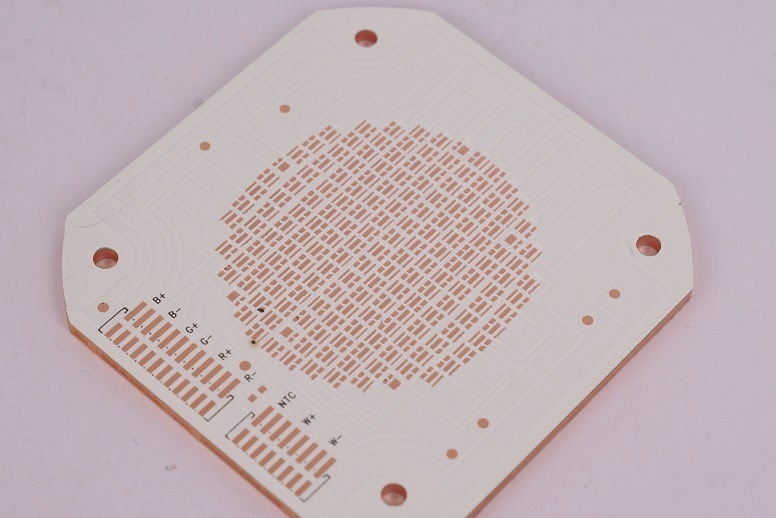
LED anode cathode describes the two terminals that control how an LED works. The anode is the positive side, and the cathode is the negative side. An LED only lights when current flows from anode to cathode, so this polarity decides whether the LED glows or stays dark.
How to Identify LED Anode and Cathode?
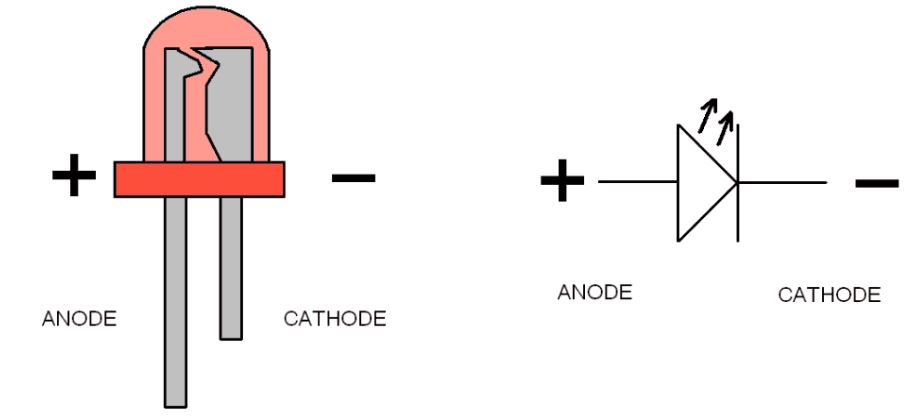
Every LED has two sides: the anode and the cathode. The anode is the positive side. The cathode is the negative side. Without knowing which is which, the LED will not turn on. So the first step is to identify them.
For through-hole LEDs, this is easy. One leg is longer. One leg is shorter. The longer leg is the anode. The shorter leg is the cathode.
There is also a second clue. If you look inside the clear LED body, the two metal parts are not the same. One of them is bigger and shaped like a small âcup.â This internal cup is the cathode. The smaller internal part is the anode.
For surface-mount LEDs, you will not see long legs or cups. You may see a small notch, a line, or a dot printed near the cathode. The board footprint often has a shape to guide placement as well.
Which Side Is Cathode and Anode on LED?
The rule stays the same for every LED type. The anode connects to the positive side of your power source. The cathode connects to the negative or ground.
If you hold an LED in your hand and check the legs, the longer one is always the anode. The shorter one is always the cathode.
When the LED is mounted in a circuit, the PCB often includes a silkscreen mark. A small triangle or flat edge on the LED outline usually points toward the cathode.
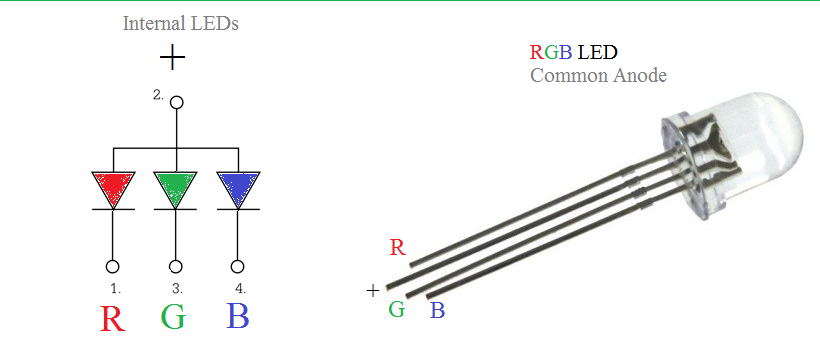
In RGB LEDs, the pattern may change slightly. You might find a âcommon anodeâ or a âcommon cathode.â But the idea is still the same. There is always one shared pin and three separate pins for red, green, and blue.
Do LED Lights Need Correct Polarity?
Yes. LED lights always need correct polarity. LEDs are diodes. A diode only conducts current in one direction. That means power flows from the anode to the cathode.
If you reverse the polarity, the LED will not light. It does not glow halfway. It does not flicker. It simply stays off. But in most cases, the issue is just reversed polarity.
Correct polarity keeps the LED bright, stable, and long-lasting. When you supply current in the right direction, the LED performs at its best.
How to Connect LED Cathode and Anode?
You place the anode toward the positive voltage. You place the cathode toward ground. Between the LED and the power source, you add a current-limiting resistor. This protects the LED from getting too much current.
If you place multiple LEDs in series, the polarity of each LED must line up in the same direction. All anodes face the same way. All cathodes face the same way. The flow of current becomes steady.
If the LEDs are connected in parallel, each LED still needs its own resistor. This keeps brightness even. It also prevents one LED from drawing more current than the others.
Which Leg of LED Is to Ground?
The cathode leg goes to ground. The short leg. The inner metal cup. The side marked with a flat edge on the LED housing.
Ground provides a safe return path for current. When the cathode is tied to ground, the LED behaves predictably. Your brightness level remains stable. The circuit stays safe and balanced.
When you see âGNDâ or a ground symbol on a schematic, that line always connects to the LEDâs cathode.
What Are the Pins of a Common Anode RGB LED?
A common anode RGB LED contains four pins:
A shared anode
A red cathode
A green cathode
A blue cathode
The shared anode connects to the positive voltage. Each individual color channel is controlled by pulling its cathode toward ground through a resistor. When you energize one channel, you get a single color. When you energize two or three, you blend colors to create new ones.
Because the shared anode handles all three diodes inside the LED, wiring stays clean. You can create calm pastels, bright neon tones, or smooth gradients. You can pulse the colors slowly. You can flash them fast.
What Happens If LED Polarity Is Wrong?
If you reverse the LED anode and cathode, the LED will not light up. This behavior protects the LED in many cases. However, in more powerful circuits, reverse polarity may stress the LED. At high voltage or high reverse current, the LED may face damage.
Most of the time, the LED simply stays dark. You correct the polarity. It lights up again.
What Are Common LED Polarity Mistakes?
These mistakes are simple. Here are the most common ones:
1. Cutting the LED legs too short
The longer leg marks the anode. When both legs become equal after trimming, it becomes harder to tell which is which.
2. Ignoring the LED flat edge
Most round LEDs have a small flat spot on the cathode side. If you overlook this sign, you may place the LED backward on the board.
3. Rushing during placement
When you wire many LEDs at once, small polarity mistakes stack up fast.
4. Mixing LED types
Through-hole LEDs and SMD LEDs use different marking systems. If you switch back and forth without checking the datasheet, you may align them the wrong way.
5. Misreading PCB silk marks
Some boards use a triangle, dot, or line to mark polarity. A quick double-check prevents mistakes.
If you require guidance, support, or high-quality PCB solutions for electronic products, please feel free to contact us at sales@bestpcbs.com
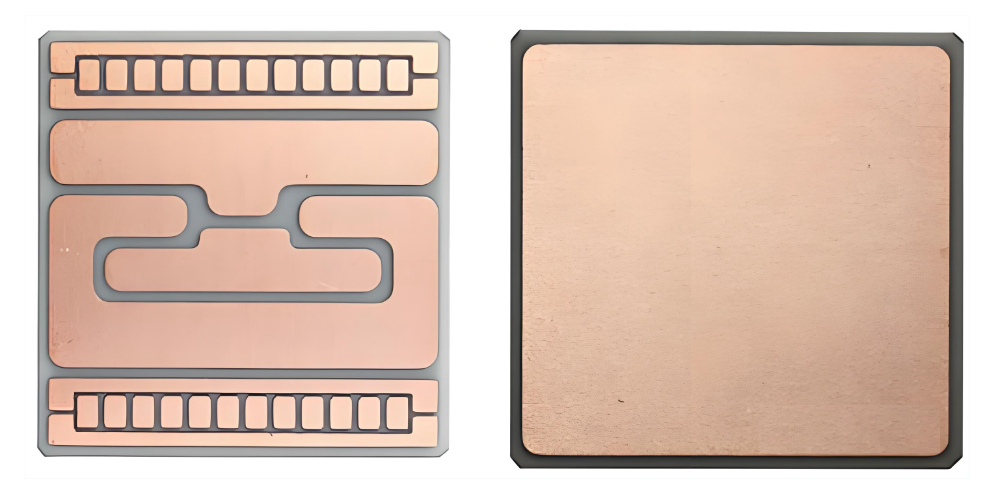
Active metal brazing (AMB) has become a cornerstone technology for bonding ceramics to metals in high-demand industries. From power electronics and aerospace to automotive applications, this process delivers strong, hermetic joints that conventional methods canât match. Unlike typical soldering or standard brazing, AMB uses filler alloys containing active elements that directly react with ceramics, creating a chemical bond rather than relying only on mechanical adhesion.
As design engineers pursue lighter, stronger, and more thermally stable components, active metal brazing substrate technology offers unmatched reliability. Letâs explore how this process works, what materials are commonly used, and the recent advances that continue to refine its performance.
What Is Active Metal Brazing (AMB) and How Does It Work?
At its core, active metal brazing is a joining method that bonds ceramics to metals using a special filler alloy that contains âactiveâ elements such as titanium, zirconium, or hafnium. These elements react chemically with the ceramic surface when heated, creating an ultra-strong bond.
The process usually happens inside a vacuum or inert atmosphere, at temperatures between 850°C and 1000°C. As the alloy melts, it wets the ceramic surface, and the active element forms reaction layersâlike titanium oxide or titanium nitrideâright at the interface. This reaction is what gives AMB its exceptional strength.
For example, a typical active metal brazing ceramic substrate might use aluminum nitride (AlN) or aluminum oxide (AlâOâ) bonded with copper. This combination provides high thermal conductivity, electrical insulation, and strong adhesionâperfect for applications like power inverters and IGBT modules.
What Are the Main Materials Used in Active Metal Brazing Substrate?
The performance of active metal brazing amb depends heavily on material selection. Both the filler metal and the base materials (ceramic and metal) must be carefully chosen to ensure thermal expansion compatibility and chemical stability.
Common Ceramic Materials
Aluminum Oxide (AlâOâ):
Known for its mechanical strength and cost-effectiveness, AlâOâ is often paired with copper or molybdenum. Itâs widely used in power devices and insulators.
Aluminum Nitride (AlN):
Offers higher thermal conductivity than alumina and lower dielectric loss, ideal for high-power applications such as IGBT modules and power inverters.
Silicon Nitride (SiâNâ):
Exhibits excellent thermal shock resistance and mechanical strength, often used in automotive and aerospace applications.
Common Metal Materials
Copper (Cu): Excellent thermal and electrical conductor, widely used for substrates.
Molybdenum (Mo): Offers better thermal expansion match with ceramics.
Tungsten (W): Used where high-temperature resistance is crucial.
Active Brazing Alloys (ABA)
Filler alloys used in AMB typically consist of silver (Ag), copper (Cu), or nickel (Ni) base combined with active elements. For example:
AgâCuâTi alloy is one of the most popular systems.
CuâSnâTi or NiâTi alloys are used for high-temperature applications.
Each alloy composition determines the wetting behavior and joint reliability. Choosing the right system depends on the ceramicâs chemistry and the operational environment.
Why Are Active Metal Brazing Ceramic Substrates So Popular?
The bond isnât just surface-levelâitâs chemical. This means the ceramic and metal essentially become one unit, able to handle mechanical and thermal stress for years without failure.
2. Great Heat Management
AMB substrates are made for high-power environments. They conduct heat quickly and efficiently, preventing hot spots that could damage components.
3. Natural Electrical Insulation
Ceramics act as built-in insulators, allowing for compact layouts without risking electrical short circuits.
4. Hermetic Sealing
Because AMB joints are dense and void-free, they perform well in vacuum or pressurized systems where leaks canât be tolerated.
5. Custom Design Flexibility
AMB supports a wide range of materials and geometries, so engineers can design modules that perfectly fit their thermal and electrical needs.
Simply put, AMB substrates make devices stronger, cooler, and more dependable.
AMB Ceramic Substrate vs. DBC Ceramic Substrate
Both AMB and DBC ceramic PCBs combine excellent heat dissipation with strong electrical insulation, making them ideal for automotive, industrial, and power module applications. However, the difference lies in how the copper layer bonds to the ceramic substrate and how each method performs under thermal, mechanical, and environmental stress. Below is a detailed comparison that highlights how these two technologies stack up in performance, reliability, and cost.
Parameter
AMB Ceramic PCB
DBC Ceramic PCB
Full Name
Active Metal Brazed Ceramic PCB
Direct Bonded Copper Ceramic PCB
Bonding Method
Copper is bonded to ceramic using active metal brazing (usually Ti or Zr-based alloys)
Copper is bonded directly to ceramic through an oxidation and diffusion process
Bonding Temperature
~850â1000°C
~1065°C
Bonding Strength
Very high (strong metallurgical bond due to active elements)
High, but slightly lower than AMB
Ceramic Material Options
AlN, SiâNâ, AlâOâ
AlâOâ, AlN
Thermal Conductivity
Excellent, especially with AlN or SiâNâ substrates
Good, depends on ceramic type (AlN > AlâOâ)
Electrical Insulation
High
High
Thermal Expansion (CTE Match)
Better matched with power devices due to flexible alloy layer
Slightly less matched, may stress under thermal cycling
Copper Thickness Range
0.2â1.0 mm
0.3â0.8 mm
Surface Flatness
Very smooth, suitable for high-precision mounting
Smooth, but not as ideal for thin layers
Typical Applications
High-power automotive, EV inverters, power modules, IGBT substrates
Power modules, LEDs, RF devices, industrial control
Reliability Under Thermal Cycling
Excellent (superior resistance to cracking)
Good, but can degrade under repeated cycling
Manufacturing Cost
Higher due to complex brazing process
Lower, mature and cost-effective
Main Advantage
Exceptional reliability and thermal performance for demanding environments
Cost-effective and widely available
Main Limitation
Higher cost and more complex fabrication
Limited in high-stress or high-current conditions
AMB Substrate Applications
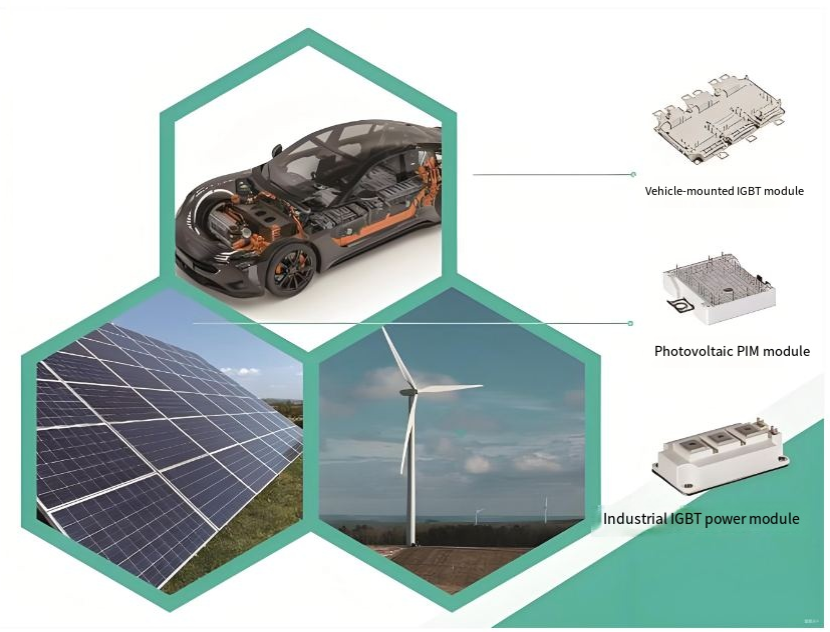
Power Modules: Used in EVs, renewable energy, and industrial drives. They keep heat under control and extend lifespan.
LED Lighting: High-power LEDs need strong heat dissipation, and AMB substrates handle that with ease.
Automotive Inverters: As electric vehicles evolve, AMB provides thermal stability and vibration resistance.
Aerospace Components: Critical systems require joints that wonât fail under pressure or temperature extremes.
Medical Devices and RF Equipment: Their hermetic sealing and precision bonding support sensitive, high-frequency electronics.
What Are the Challenges in Active Metal Brazing?
Even with its many benefits, active metal brazing does come with challenges. The biggest one is managing the thermal expansion difference between metal and ceramic. If not balanced properly, it can create internal stress that leads to cracking.
The process also demands an extremely clean and controlled environment. Even a small trace of oxygen or moisture can interfere with the reaction between the active metal and ceramic surface.
Another consideration is the thickness of the interfacial reaction layer. If it becomes too thick, it may reduce ductility and make the joint brittle. Thatâs why tight temperature control and precise timing are so important.
Still, with the right design and quality control, these issues can be easily managed.
Recent Advances in Active Metal Brazing of Ceramics and Process
The field of active metal brazing has seen big improvements in recent years. Researchers and manufacturers are constantly exploring ways to make joints even stronger, cleaner, and more consistent. Some of the latest developments include:
1. Nano-Enhanced Alloys
Adding nanoparticles like TiC or TiBâ to the brazing filler improves how the molten alloy wets the ceramic. It also reduces voids and creates smoother interfaces, boosting long-term reliability.
2. Improved Surface Treatments
Using plasma or ion cleaning before brazing makes the ceramic surface more reactive. This promotes better wetting and stronger chemical bonding without damaging the base material.
3. Low-Temperature Brazing Alloys
New filler compositions allow brazing at lower temperatures, which minimizes residual stress from thermal expansion differences. This is a huge advantage for thinner or more fragile components.
4. Process Simulation Tools
Finite element analysis (FEA) now helps predict how the interface will behave under stress and temperature changes, reducing the need for trial runs.
5. Greener Manufacturing
Modern AMB techniques favor lead-free, flux-free systems that are safer for the environment and easier to manage in clean production lines.
Together, these recent advances in active metal brazing of ceramics and process design have helped manufacturers produce cleaner, stronger, and more stable jointsâsupporting the next generation of high-performance electronics.
Why Partner with EBest Circuit (Best Technology) for Active Metal Brazing Substrates?
At EBest Circuit (Best Technology), we take pride in producing reliable active metal brazing ceramic substrates tailored for the most demanding applications. Our AMB products are used in automotive power modules, aerospace equipment, medical systems, and industrial electronics worldwide.
From selecting the right ceramic-to-metal pair to optimizing brazing parameters, we help clients achieve designs that balance performance, reliability, and cost. Whether itâs aluminum oxide or aluminum nitride with copper, molybdenum, or tungsten, our active metal brazing amb technology delivers long-term stability and consistent quality.
Weâre certified under ISO9001, ISO13485, IATF16949, and AS9100D, ensuring every process meets strict global standards. Our vacuum brazing systems and MES-controlled production lines guarantee full traceability from raw material to finished substrate. If youâre seeking dependable substrates for your high-power projects, EBest Circuit (Best Technology) can be your trusted partner.
FAQs
1. What temperature does active metal brazing use?
Typically between 850°C and 1000°C, depending on the alloy and materials used.
2. Why is titanium important in AMB?
Titanium is the âactiveâ element that reacts with ceramics, creating a strong chemical bond.
3. Can AMB join both aluminum oxide and aluminum nitride?
Yes, both are popular choices for AMB substrates due to their strength and insulation.
4. How is AMB different from DBC substrates?
DBC (Direct Bonded Copper) relies on oxidation bonding, while AMB uses a reactive alloy for a stronger chemical interface.
5. How does EBest Circuit (Best Technology) ensure AMB quality?
Through vacuum brazing, 100% inspection, full MES traceability, and globally recognized quality certifications.
PCB Italy refers to printed circuit board manufacturing, assembly, and supply services provided for clients or projects based in Italy. This blog explores PCB Italy solutions, highlighting reliable suppliers, pricing insights, project considerations, and how EBest Circuit (Best Technology) supports Italian PCB manufacturing needs.
Are you struggling to find a reliable âPCB Italianâ partner who can balance quality, cost, and timely delivery? Below are common pain points:
Unclear or inflated âPCB Italy priceâ structures with hidden costs.
Long lead times and logistical delays from international suppliers.
Difficulty in sourcing specialized boards like âflexible PCB cable PCB Italyâ or âPCB HDI Italia.
Lack of local technical support and poor communication.
Inconsistent quality and compliance issues with non-specialized manufacturers.
These challenges can derail projects and increase costsâbut they are avoidable with the right partner. As a professional PCB manufacturer, EBest Circuit (Best Technology) provides targeted solutions:
Transparent and competitive âPCB Italy priceâ models with no hidden fees.
Optimized production and logistics to ensure on-time delivery.
Extensive capabilities in specialized boards, including âflexible PCB cable PCB Italyâ and âPCB HDI Italia.
Dedicated local support and clear communication throughout the project.
Strict quality control and compliance with international standards.
EBest Circuit (Best Technology) is a trusted PCB manufacturer with a strong focus on innovation and customer-centric service. We specialize in custom PCB solutions, including high-density interconnect (HDI), flexible PCBs, and rigid-flex boards, ensuring high performance and reliability for diverse applications. Contact us at âsales@bestpcbs.comâ to discuss your project needs.
What Are the Advantages of PCB Supplier Italy?
Working with a âPCB supplier Italyâ offers several benefits for electronics manufacturers looking for reliability, quality, and localized service. Italian PCB suppliers are known for their technical expertise, adherence to international standards, and ability to support both prototype and volume production.
Key advantages include:
âProximity to European Markets: Local suppliers reduce shipping times and costs for companies within Europe, enabling faster turnaround.
âHigh Manufacturing Standards: Italian PCB producers often comply with strict quality certifications (e.g., ISO, UL), ensuring reliable and durable boards.
âTechnical Expertise: Many Italian suppliers have strong engineering support for complex designs, including âPCB HDI Italiaâ and âflexible PCB cable PCB Italy.
âCustomization Capabilities: Suppliers offer tailored solutions, from material selection to finishes, meeting specific project requirements.
âSupply Chain Stability: Sourcing locally minimizes risks related to global logistics disruptions.
In summary, partnering with a âPCB supplier Italyâ enhances supply chain resilience, provides access to skilled engineering support, and ensures consistent qualityâcritical for success in competitive markets.
Who Makes PCB in Italy?
Italy hosts a significant and specialized electronics manufacturing sector within the European Union. While not competing with high-volume mass production in Asia, the Italian PCB industry is renowned for its focus on âhigh-quality, precision-engineered, and specialized circuit boards. Key strengths include serving demanding fields such as âindustrial automation, automotive, aerospace, defense, and medical technology. This outline will introduce the landscape of PCB manufacturing in Italy and highlight three prominent manufacturers that exemplify the sector’s capabilities.
Cirmakerâ
Cirmaker is one of Italy’s most well-known and established PCB manufacturers, operating since 1973. They have built a strong reputation for reliability and technical expertise, offering services from prototype to medium-volume production.
They specialize in a wide range of PCB technologies, including multilayer, HDI (High-Density Interconnect), and flexible/rigid-flex boards. They serve a diverse clientele across industrial, telecommunications, and automotive sectors.
R.G.V. Elettronicaâ
Based in the Marche region, R.G.V. is a highly specialized manufacturer focused on high-reliability and complex PCBs. They are particularly strong in the aerospace, defense, and transportation industries.
The company is known for its advanced manufacturing capabilities, including PCBs for high-frequency applications, heavy copper boards for power electronics, and products that must meet stringent international quality standards (e.g., ISO, ATEX, IRIS).
RIMA Groupâ
RIMA Group presents a comprehensive “one-stop-shop” solution, offering integrated services from PCB design and fabrication to full box-build assembly. This vertical integration makes them a valuable partner for complex projects.
Their ability to manage the entire production process in-houseâfrom the bare board to the fully assembled and tested electronic unitâprovides significant advantages in quality control, supply chain management, and time-to-market for their customers in industrial automation and professional electronics.
âThe Italian PCB manufacturing landscape is characterized by its emphasis on âquality, specialization, and technological sophisticationâ rather than low-cost, high-volume output. Companies like Cirmaker, R.G.V. Elettronica, and RIMA Group demonstrate the sector’s capacity to produce advanced, reliable circuit boards for the most demanding global markets. For businesses seeking high-performance PCBs supported by engineering expertise and a commitment to standards, Italy remains a compelling and competitive manufacturing destination within Europe.
How is the PCB Italy Price?
The âPCB Italy priceâ varies based on design complexity, layer count, materials, quantity, and turnaround time. Generally, Italian PCB suppliers offer competitive pricing within the European market, balancing cost and quality.
Factors influencing price include:
âDesign Complexity: Boards with âPCB HDI Italiaâ features (microvias, fine lines) cost more due to advanced processes.
âMaterials: High-frequency or flexible materials increase costs compared to standard FR-4.
âQuantity: Unit prices drop significantly with higher volumes.
While initial quotes from âPCB Italianâ suppliers may be higher than those from Asia, the total cost of ownership often proves lower thanks to reduced shipping, fewer quality issues, and better supply chain stability.
What Are Considerations When Supporting PCB Italian Projects?
Supporting âPCB Italianâ projects requires attention to technical, logistical, and regulatory aspects to ensure smooth execution and customer satisfaction.
Key considerations:
âClear Specifications: Provide detailed design files, material requirements, and compliance standards.
âCommunication: Maintain regular updates and have Italian-speaking support if needed.
âTesting and Validation: Plan for rigorous prototyping and testing phases, especially for âPCB HDI Italiaâ or high-frequency boards.
âLogistics: Factor in shipping and customs for international collaborations.
âRegulatory Compliance: Ensure boards meet EU regulations (e.g., RoHS, REACH).
By addressing these areas, manufacturers can build strong partnerships and successfully deliver âItalian PCBâ projects on time and within budget.
How Flexible PCB Cable PCB Italy Impacts Project Costs?
âFlexible PCB cable PCB Italyâ solutions impact project costs in several ways. While initial costs may be higher than rigid PCBs due to specialized materials and processes, they often reduce overall expenses by simplifying assembly, saving space, and improving reliability.
Cost factors include:
âMaterial Costs: Flexible substrates like polyimide are more expensive than FR-4.
âDesign Complexity: More layers and bends increase manufacturing difficulty and cost.
âVolume: Economies of scale apply; per-unit costs decrease in large production runs.
Despite higher upfront costs, âflexible PCB cable PCB Italyâ can lower total project expenses by minimizing connectors, reducing weight, and enhancing durabilityâespecially in compact or dynamic applications.
Case Study: Delivering the Custom PCB HDI Italia Project at EBest Circuit (Best Technology)â
This high-specification 4-layer FR4 PCB is engineered for applications where thermal resilience, power handling, and signal integrity are critical. The combination of a â1.6mm standard thickness, high Tg material (170°C), heavy 53”m copper, and controlled 90-ohm impedanceâ makes it suitable for demanding environments across various industries.
âDiversified Application Scenariosâ
âIndustrial Motor Drives and PLCs:ââ
This board is ideal for the main control unit of servo drives or Programmable Logic Controllers (PLCs). The high Tg value ensures stability in the high-temperature environments typical of industrial settings. The thick 53”m copper layers are capable of handling the high currents required by motors, while the controlled 90-ohm impedance guarantees the integrity of critical control signals.
âAutomotive Power Electronics:ââ
Well-suited for under-the-hood applications such as Engine Control Units (ECUs), Transmission Control Modules, or Battery Management Systems (BMS) for electric vehicles. The board’s construction can withstand automotive temperature fluctuations and vibrations. The ENIG surface finish provides excellent solderability and flatness for reliable connections.
Applicable for the mainboard of portable diagnostic equipment or patient monitoring systems. The ENIG finish offers superior oxidation resistance and reliability for long-term use. The comprehensive test reports, including impedance data, provide critical documentation for meeting stringent medical safety standards.
âElectrical Test:ââ 100% Flying Probe / Fixture Test
âDeliverables:ââ Impedance test coupon and a comprehensive test report including impedance results.
Why Choose EBest Circuit (Best Technology) for Italian PCB?
EBest Circuit (Best Technology) stands out as your ideal partner for âItalian PCBâ needs thanks to our expertise, flexibility, and customer-first approach. We offer:
Wide range of capabilities: From âPCB semi flex in Italiaâ to âPCB HDI Italia.
Competitive âPCB Italy priceâ without compromising quality.
Quick turnaround and dependable logistics.
Dedicated support team for seamless collaboration.
Choose us for reliable, high-performance PCBs tailored to your specifications.
âTo conclude, PCB Italyâ encompasses the dynamic and skilled PCB manufacturing ecosystem within Italy, vital for electronics innovation and production. This article has outlined the benefits, key players, pricing, and best practices for successful PCB projects in Italy. From design to delivery, EBest Circuit (Best Technology) stands by your side. Pls feel free to reach us at sales@bestpcbs.com to begin your project.
How to assembly a IC board? Let’s discover components, function, application, design spec and guide, assembly process for IC circuit board.
Are you worried about these problems?
Miss market opportunities due to delivery delays?
Struggle with high costs squeezing profits?
Face technical barriers in design realization?
As a IC board manufacturer, EBest Circuit (Best Technology) can provide you service and solutions:
Reliability assurance: Full-spectrum testing including high-temp/humidity, thermal shock, and vibration extends product life by over 30%, backed by verifiable data.
Flexible customization: Agile production scales from 50-piece small batches to large-volume manufacturing, with precise BOM traceability to meet diverse needs.
Eco-compliance guarantee: Full compliance with RoHS 2.0/REACH standards using lead-free solder and recyclable materials, ensuring smooth entry into EU/US markets.
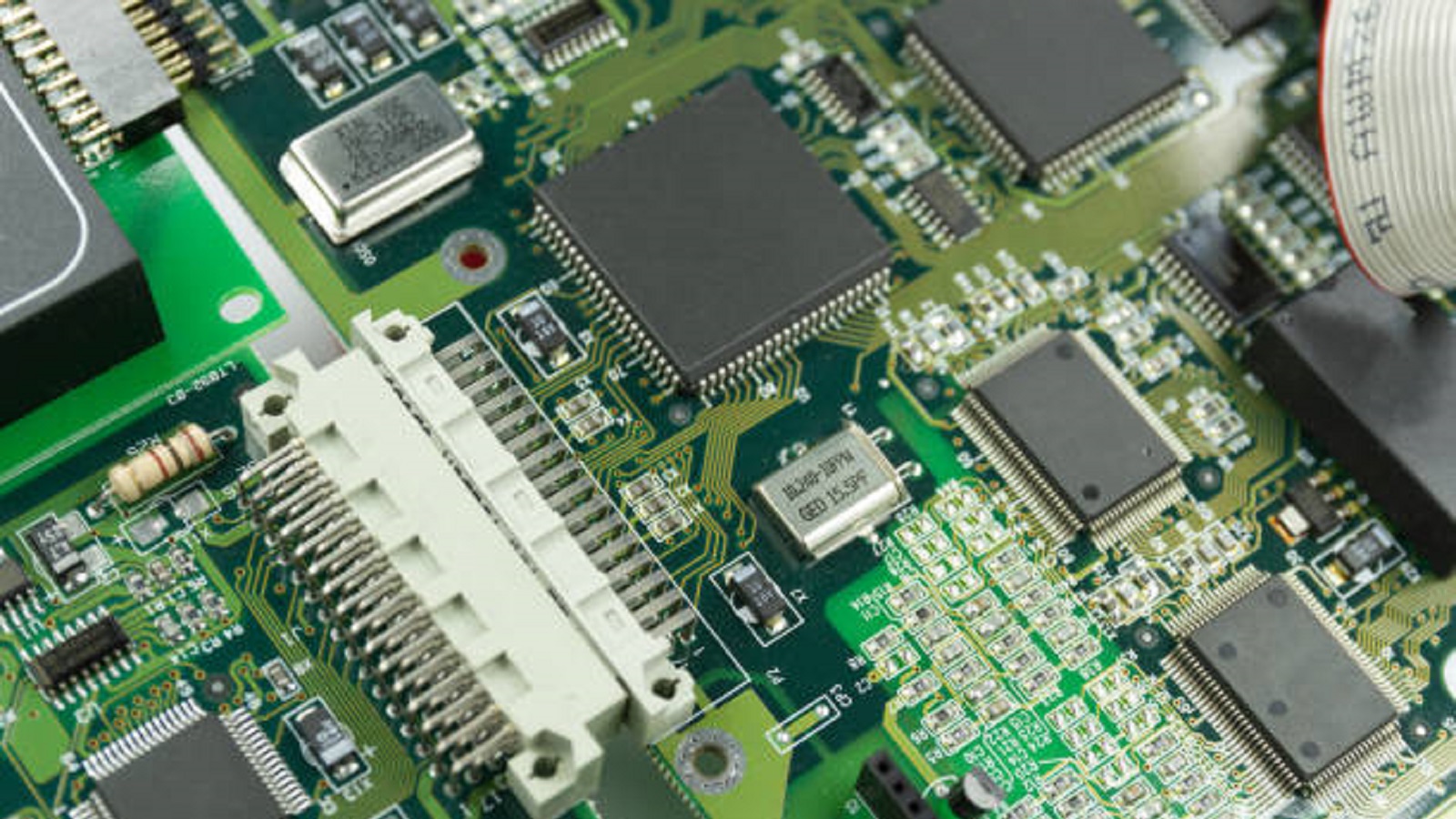
AnIC board (also called as Integrated Circuit Board) is a substrate made from insulating materials such as fiberglass epoxy resin, featuring finely etched metal traces (wiring) on its surface. It is used to mount integrated circuit chips (ICs) and other electronic components, providing mechanical support, electrical connection pathways, and forming complete circuits to serve as the core circuit board enabling electronic device operation.
Substrate Material: The core carrier, commonly made of fiberglass epoxy resin (FR-4), BT resin, ABF film, ceramic substrate (alumina/aluminum nitride), or silicon wafer, providing mechanical support, insulation, and thermal dissipation pathways.
Metal Wiring Layer: Precisely etched copper or aluminum traces forming a multi-layer electrical network (e.g., power planes, ground planes) with interlayer connections via vias (conductive/non-conductive), enabling signal transmission.
Component Mounting Areas: Pads, sockets, and surface-mount points for securing chips, resistors, capacitors, and other components while ensuring reliable electrical contact.
Packaging Structure: Standard formats such as DIP, SOIC, QFN, etc., which protect internal circuits from environmental damage and provide external interfaces (e.g., pins, solder balls).
Solder Mask: Coating non-solder regions (e.g., green/red oil) to prevent short circuits.
Silkscreen Layer: Labels indicating component positions, models, and functional identifiers for maintenance and assembly.
Surface Finish Layer: Processes like HASL (hot air solder leveling), ENIG (electroless nickel immersion gold), or immersion silver to prevent copper oxidation and enhance solder reliability.
Thermal Management System: Heat-conductive materials, heat sinks, or thermal via designs to efficiently dissipate chip heat and ensure stable operation.
Insulation/Dielectric Layer: Insulating materials (e.g., epoxy resin) within the substrate to isolate conductive layers and maintain electrical safety.
Functional Module Integration: Internal circuits including transistors (MOSFET/BJT), logic gates, arithmetic logic units (ALU), caches, and I/O interfaces, enabling core functions like computation and control.
Package Substrate (IC Substrate): Serving as a bridge between the chip and PCB, it employs high-density wiring (e.g., ABF/BT substrate) to connect micron-scale pads to PCBs while providing mechanical support and thermal pathways.
What Are Functions of IC Circuit Board?
Functions of IC Circuit Board:
Mechanical Support and Fixation: Provides a stable physical installation platform for integrated circuit chips, resistors, capacitors, and other electronic components, ensuring they remain securely positioned and undamaged during device operation.
Electrical Connection and Signal Transmission: Enables electrical interconnection between components through surface-etched metal traces and multi-layer wiring structures, efficiently transmitting power, control signals, and data signals.
Thermal Management: Utilizes substrate materials (such as ceramic or metal substrates) or built-in thermal structures (like thermal vias or heat sinks) to rapidly dissipate heat generated by chips, maintaining stable operating temperatures.
Environmental Protection: Employs packaging structures (e.g., DIP, QFN) and solder mask layers (green/red oil) to shield internal circuits from environmental hazards such as moisture, dust, and chemical corrosion.
Interface and External Connection: Offers standardized interfaces (e.g., pins, solder balls, connectors) for reliable electrical connections to external circuits, power supplies, or other devices.
Functional Integration and Modularity: Integrates core circuit modules including transistors, logic gates, memory cells, etc., supporting computation, control, storage, and other essential functions of electronic devices while enabling highly compact designs.
Cost Control and Scalable Production: Reduces manufacturing costs per unit through standardized designs, batch production, and automated assembly, while improving production efficiency and yield rates.
Signal Integrity Assurance: Minimizes signal loss, crosstalk, and electromagnetic interference during transmission via precision wiring design, impedance matching, and shielding measures, ensuring stable high-speed signal transmission.
1. Requirement Analysis and Specification Formulation
Scene-specific demand refinement: For consumer electronics (e.g., smartphone main frequency â„3GHz), industrial control (temperature resistance -40~125â), automotive electronics (AEC-Q100 certification) and other scenarios, quantify specific indicators (e.g., power noise â€2% VCC).
Standard and regulatory alignment: Clarify IPC-A-610 soldering standards, RoHS environmental requirements, EMC/EMI testing specifications (e.g., CISPR 25), and reserve design margins to address process fluctuations.
2. Architecture Design and Planning
Modular design strategy: Adopt IP core reuse (e.g., CPU soft core, DDR controller), define clear interface protocols (I2C/SPI/PCIe), and evaluate module-level power distribution (e.g., dynamic power proportion â€70%).
Process-material-package collaboration: Select substrates based on signal rate (FR4 for â€1GHz, PTFE/ceramic for high-frequency scenarios), match packaging forms (QFN/BGA), and verify thermo-mechanical reliability (e.g., CTE matching).
3. Circuit Design and Simulation
Mixed-signal design: Distinguish digital/analog regions, adopt isolation strips (â„3 times line width) to reduce crosstalk; analog circuits require separate power/ground planes and decoupling capacitor gradients (1ÎŒF+10nF).
Multidimensional simulation verification: Pre-simulation includes functional verification (Verilog-AMS models), timing analysis (setup/hold checks), signal integrity (eye diagram margin â„20% UI); post-simulation incorporates parasitic parameter extraction (R/C/L) to verify actual delay â€10% of clock cycle.
4. Physical Layout Design
Intelligent layout algorithm: Use automatic layout tools (e.g., Cadence Innovus) to optimize component positions, manually adjust critical paths (e.g., clock tree) to reduce delay; place thermally sensitive components (e.g., power transistors) near heat sinks and reserve thermal via arrays.
Wiring rule deepening: High-speed differential pairs (e.g., USB3.0) adopt equal-length routing (error â€5mil), spacing â„2 times line width; power plane segmentation avoids sharp angles, copper foil thickness â„2oz for enhanced current capacity.
5. Layout Implementation and Verification
Advanced process adaptation: For processes below 28nm, adopt double patterning technology (DPT) to resolve lithography limits; incorporate dummy fills to improve uniformity and guard rings to suppress noise.
Multi-round verification closed loop: After DRC/ERC/LVS checks, perform power integrity analysis (IR-Drop â€50mV), signal integrity review (reflection/crosstalk â€5%); modify netlists via ECO if necessary and re-verify.
6. Post-Simulation and Parameter Extraction
Thermal-electrical coupling analysis: Use Ansys Icepak for thermal simulation, combine electrical parameters (e.g., on-resistance) to evaluate hotspot distribution; critical devices (e.g., MOSFETs) maintain junction temperature â€125â with thermal allowance.
Reliability accelerated testing: Validate long-term reliability through high-temperature operating life (HTOL), temperature cycling (TC); package-level tests (e.g., solder ball shear force â„10N) ensure mechanical strength.
7. Manufacturing File Output
Process file standardization: Generate manufacturing instructions including layer stack structures (layer thickness/material), impedance control tables, drilling parameters (hole diameter/tolerance), and confirm process capabilities (e.g., minimum line width/spacing) with foundries.
Supply chain full-process management: Establish BOM lists, audit supplier qualifications (e.g., ISO certification), plan SMT process parameters (temperature curves), and design test fixtures (e.g., JTAG interfaces) for mass production testing.
8. Testing and Validation
Multi-stage testing strategy: Prototype phase includes functional testing (e.g., I/O level verification), boundary scan (JTAG chain detection); mass production employs statistical process control (SPC) to monitor yield, and samples undergo environmental stress tests (e.g., 85â/85%RH constant humidity).
Document digital archiving: Use PDM systems to manage design files (layouts/simulation reports), test data (eye diagrams/temperature rise curves), and change records, supporting traceability and iterative optimization.
IC Board Assembly Processes
1. Wafer Dicing and Selection
Dicing Technology Evolution: Mechanical blade dicing uses diamond-coated blades for wafers over 100ÎŒm, while laser dicing employs UV/IR lasers for contactless cutting of ultra-thin wafers (<100ÎŒm) and complex patterns. Post-dicing cleaning involves deionized water rinsing to remove silicon debris and UV exposure to reduce blue tape adhesion for easier die picking.
Die Selection Process: Utilizes vacuum suction or robotic arms with high-precision vision systems to select qualified chips, rejecting edge-defective dies. Yield control integrates AOI detection for real-time feedback.
2. Die Attach
Adhesive Systems: Conductive adhesives (e.g., silver paste) for high thermal conductivity applications, non-conductive adhesives for insulation, and solder pastes (Sn-Ag-Cu) for high-temperature reliability. Curing profiles match material propertiesâthermal curing at 175â185°C or UV curing for 90â120 seconds.
Precision Alignment: High-precision die bonders achieve ±0.05mm positional accuracy using dual-vision systems and pressure sensors to control bonding force, preventing chip damage.
3. Wire Bonding
Material Selection: Gold wires (20â30ÎŒm) for high-frequency reliability, aluminum wires for cost efficiency (lower strength), and copper wires with nitrogen protection for oxidation resistance. Bonding methods include thermosonic (gold) or ultrasonic (aluminum) techniques, ensuring bond strength â„5g without non-stick bonds.
Process Optimization: Bonding parameters (force, temperature, time) are optimized via DOE experiments. X-ray inspection confirms void-free bonds, while SEM analyzes microstructural integrity.
4. Surface Mount Technology (SMT)
Solder Paste Printing: Stencil printing maintains solder paste thickness deviation â€Â±15%, with SPI verification for uniformity. High-density PCBs use stepped stencils (0.03mm local thickening) to compensate solder volume.
Placement and Reflow: High-speed pick-and-place machines achieve 0201 component placement accuracy ±25ÎŒm. Reflow uses 10-zone nitrogen-protected furnaces, peak temperature 235â245°C for 40â60 seconds, monitored by thermocouples. AOI checks 11 solder joint criteria, with 3D detection for BGA shadow elimination.
5. Through-Hole Technology (THT)
Wave Soldering: Turbulent waves break through oxidation layers, while smooth waves form solder joints. Process parameters: 2â5 seconds at 240â260°C. Flux spray systems precisely control coating volume, and preheat gradients minimize thermal shock.
Lead Forming: DIP/PGA component leads are bent using precision dies to match PCB hole dimensions, with tolerance â€0.1mm.
6. Encapsulation and Protection
Material Selection: Plastic molding (epoxy) for cost efficiency (limited thermal resistance), ceramic for high-frequency/high-power, and metal for optimal thermal conductivity. Underfill materials use capillary action to fill BGA gaps, eliminating thermal stress.
Process Refinement: Transfer molding pressure 10â20MPa, curing time 90â120 seconds. Vacuum degassing reduces encapsulation voids, with solder paste oxidation <1% for enhanced joint reliability.
7. Testing and Validation
Electrical Testing: ICT checks opens/shorts, flying probe tests cover high-density boards, and functional tests verify system performance. DC tests measure terminal voltage/current, while AC tests evaluate gain/distortion.
Reliability Testing: High-temperature/humidity (85°C/85% RH), thermal cycling (-40°C to 125°C), and vibration (5â2000Hz) screen for latent defects. AEC-Q standards apply to automotive electronics, supporting 2000V/200A high-power testing.
8. Quality Control Essentials
Statistical Process Control: SPC charts monitor solder paste thickness, placement accuracy, and soldering temperature. Process capability indices (Cp/Cpk) assess stability via Minitab visualization.
Solder Joint Defects: Reflow profile optimization with extended preheat and nitrogen protection reduces oxidation. Metallographic analysis ensures IMC layer thickness â€5ÎŒm for reliability.
Die Warpage Control: Substrate warpage <0.75% using high-Tg materials. Vacuum degassing and <1% solder paste oxidation minimize voids.
10. Environmental Compliance
Lead-Free Processes: Compliant with RoHS using Sn-Ag-Cu solder (lead content <1000ppm). Waste management includes segregated recycling of solder dross and adhesive waste, with emissions treated via activated carbon adsorption and combustion.
Circular Economy: Metal/plastic waste repurposed into recycled products; agricultural waste converted to organic fertilizer or bioenergy for full lifecycle sustainability.
Why Choose EBest Circuit (Best Technology) as IC Board Assembly Manufacturer?
Proven Industry Expertise: With 15 years of deep expertise in IC board assembly, serving over 200 Fortune 500 companies globally. Certified success stories across automotive electronics (AEC-Q100), industrial control, and consumer electronics, empowering client value upgrades through professional experience.
5-Year Warranty Assurance: Backed by industry-leading warranty terms, providing clients with long-term reliability confidence without compromising service quality.
Cost Optimization: Leverage economies of scale and intelligent supply chain optimization to reduce raw material costs by 15%-20%. Combined with lean production models, this minimizes process waste, delivering highly competitive pricing that boosts client profit margins.
Rigorous Quality Control: Implement AOI+X-ray dual-inspection systems for 100% solder joint verification. SPC statistical process control ensures critical parameters achieve Cp/Cpk â„1.67, maintaining yield rates above 99.8% to slash post-sale repair costs and return risks.
Lightning-Fast Delivery: Innovative “3-5-7” rapid delivery systemâ3 days for prototype validation, 5 days for pilot production, and 7 days for mass production launch. Dynamic capacity allocation reduces emergency order lead times by 40%, empowering clients to seize market opportunities swiftly.
Comprehensive Technical Support: Dedicated 20-member engineering team provides end-to-end technical accompaniment from DFM design to mass production troubleshooting. Capable of handling ultra-precision processes like 0201 component placement and 01005 micro-resistor welding, ensuring 100% design realizability.
Global Environmental Compliance: Full compliance with RoHS 2.0 and REACH standards using lead-free solder (Pb content <1000ppm) and recyclable materials. Certified under ISO 14001 environmental management system, facilitating smooth customs clearance for European and American markets.
Flexible Customized Production: Supports agile switching from low-MOQ (as low as 50 pieces) multi-variety batches to large-scale production. Smart material management systems enable precise BOM traceability, meeting diverse customization demands.
Comprehensive Reliability Validation: Rigorous testing includes high-temperature/humidity (85°C/85%RH), thermal shock (-40°C~125°C for 1000 cycles), and mechanical vibration (5-2000Hz) to extend product lifespan by over 30% and enhance market reputation.
Welcome to contact us if you have any request for IC board assembly: sales@bestpcbs.com.
A âPCB producerâ does more than just make boards; they bring electronic concepts to life. This article breaks down everything you need to know about selecting a partner for your project. We will cover technical capabilities, quality control, and what sets the best apart.
Finding a reliable âPCB board manufacturerâ can be tricky. Have you ever felt overwhelmed choosing a manufacturing partner?
âInconsistent Quality:ââ Boards arrive with defects. This causes project delays and extra costs.
âSlow Prototyping Turnaround:ââ Waiting weeks for a prototype kills innovation speed.
âPoor Communication:ââ Getting a clear answer from a âPCB factoryâ can be difficult. This leads to misunderstandings.
âLimited Capabilities:ââ The producer cannot handle complex designs. This includes HDI or specific materials.
âUnclear Pricing:ââ Hidden fees make budgeting a nightmare. The final cost is often a surprise.
Fortunately, these challenges have viable solutions. A professional âPCB producerâ addresses these issues directly. Here is how a reliable partner can help.
âThey implement rigorous quality control.ââ This ensures every board meets exact specifications.
âThey offer fast and reliable prototyping services.ââ This accelerates your time to market.
âThey provide dedicated customer support.ââ You get clear, consistent communication.
âThey invest in advanced technology.ââ This allows them to handle a wide range of needs.
âThey believe in transparent, upfront pricing.ââ You know the cost before you order.
At EBest Circuit (Best Technology), we are a specialized âprinted circuit board factoryâ built on these principles. We understand that your success depends on the quality of your components. Our team is committed to providing not just boards, but reliable partnerships. From simple designs to complex âHDI PCB board factoryâ projects, we have the expertise. Feel free to reach out to us at âsales@bestpcbs.comâ to discuss your specific needs.
Technical Capability for a PCB Producerâ
The foundation of a superior PCB manufacturer lies in its deep technical and process capabilities. It’s not just about possessing advanced machinery; it’s about the expertise to transform complex, unique designs into reliable, high-performance physical boards. A top-tier manufacturer, EBest Circuit (Best Technology) distinguishes itself through a comprehensive and quantifiable command of the entire manufacturing process.
â1. Advanced Manufacturing & Precision Engineeringâ We leverage state-of-the-art equipment like Laser Direct Imaging (LDI) and Automated Optical Inspection (AOI) to achieve exceptional precision. Our capabilities include:
âFine Lines/Spacing:ââ Down to â2.5/2.5 milâ for advanced samples.
âMicro-Vias:ââ Laser drill diameters as small as â0.07mm.
âHigh-Density Interconnects:ââ Capable of handling aspect ratios up to â25:1â for through-holes.
âBGA Support:ââ Minimum BGA pad diameter of â8mil.
â2. Comprehensive Material Expertise & Selectionâ We possess deep knowledge of material properties and offer an extensive range to meet specific electrical and thermal demands. Our material portfolio includes:
âStandard & High-Performance FR-4:ââ Including mid-Tg (150), high-Tg (170-180), and high-CTI grades.
âHigh-Speed/Low-Loss Laminates:ââ Such as M-series, TU-series, and Isola materials for signal integrity-critical applications.
âHigh-Frequency/RF Materials:ââ Expertise in processing Rogers, Taconic, PTFE, and other ceramic-filled substrates for RF/microwave designs.
â3. Proficiency in Complex, Multi-Layer Structuresâ We have extensive experience in manufacturing highly complex multi-layer boards with strict control over registration and thickness.
âLayer Count:ââ Standard production for â1 to 50 layers, with an advanced capability of up to â100 layers.
âBoard Thickness:ââ Range from â0.4mm to 6.0mmâ (standard), extending to â0.15mm to 10.0mmâ (advanced).
â4. Diverse Surface Finish Options for Every Applicationâ We provide a complete suite of surface finishes to ensure optimal solderability, durability, and performance for your specific end-use.
âControlled Thickness:ââ Strict process controls ensure consistent results, e.g., ENIG with âAu: 0.025-0.125”m / Ni: 3-8”m.
âIn summary, our detailed and quantifiable technical capability is the engine that drives our manufacturing excellence.ââ It empowers us to reliably and precisely turn your most challenging designs into physical realities, ensuring performance, quality, and reliability.
How Does a PCB Producer Ensure Quality?
Quality is not an accident. It is a deliberate process. For a âPCB producer, quality control is embedded in every step. It is a culture of precision. Here is a breakdown of their typical process.
âDesign Rule Check (DRC):ââ It all starts with the design file. Automated software checks your design against manufacturing rules. This catches errors before production begins.
âIn-Process Inspection:ââ Quality is checked throughout manufacturing. Operators and machines inspect the boards after each major step. This includes after lamination, plating, and etching.
âAutomated Optical Inspection (AOI):ââ After the pattern is etched, an AOI machine scans the board. It compares the board to the original digital design. It finds defects like shorts, opens, or nicks.
âElectrical Testing:ââ Every board undergoes electrical testing. A flying probe or fixture test checks for connectivity. It verifies that the netlist is correct and there are no open or short circuits.
âFinal Quality Audit:ââ Before shipping, a technician performs a final visual inspection. They check for cosmetic issues, solder mask quality, and surface finish.
This multi-layered approach is how the âbest pcb manufacturersâ guarantee reliability. They leave nothing to chance.
What are the Features of a PCB Design Factory?
Some companies, like EBest Circuit (Best Technology), act as a âPCB design factory. This is a powerful integrated service. It means they handle both the design and the manufacturing under one roof. This offers distinct advantages.
âSeamless Handoff:ââ There is no gap between design and production. The design team understands manufacturing constraints. This prevents costly design revisions later.
âDesign for Manufacturability (DFM):ââ Engineers review your design with manufacturing in mind. They suggest improvements for yield and cost. This results in a more robust and easier-to-produce board.
âFaster Time-to-Market:ââ Integrating design and production streamlines the entire process. You avoid the back-and-forth between separate design houses and manufacturers.
Essentially, a âPCB design factoryâ simplifies your workflow. It creates a collaborative environment focused on producing the best possible board efficiently.
How to Design a PCB Circuit Board?
Designing a PCB is a fascinating process. It is where function meets form. While complex, the basic steps are straightforward. Here is a simplified overview.
âSchematic Capture:ââ This is the blueprint. You use software to create a diagram of your circuit. It shows how components are connected logically.
âComponent Placement:ââ Next, you place the physical components on the board layout. Good placement is critical. It affects performance, heat, and manufacturability.
âRouting:ââ This is where you draw the copper traces. These traces connect the components as defined in the schematic. You must consider signal integrity and power needs.
âGenerating Output Files:ââ The final step is creating the Gerber files. These are standard files that a âPCB producerâ uses to manufacture your board. They include data for every layer.
Remember, a good design always considers manufacturing. Partnering with your âPCB board printerâ early in the design phase is a smart move.
How to Produce a PCB?
Production is where the digital design becomes a tangible product. The âpcb manufacturing processâ is precise and multi-stage. Here is a look inside the factory.
âPrinting the Design:ââ The Gerber data is used to create phototools. A laser plotter images the design onto a transparent film.
âEtching the Copper:ââ A laminate panel is coated with a light-sensitive film. The phototool is placed on it and exposed to UV light. The unexposed areas are then chemically removed. This leaves the desired copper pattern.
âLamination and Layer Alignment:ââ For multi-layer boards, inner layers are stacked with insulating material. Heat and pressure bond them into a single panel.
âDrilling:ââ Precision drills create holes for vias and component leads. This is a highly accurate process.
âPlating and Coating:ââ The holes are plated with copper to connect layers. Then, a solder mask is applied (usually green, but also blue, black, or white). The final step is applying a surface finish like ENIG.
This process transforms raw materials into a functional printed circuit board. It is a testament to modern engineering.
Who Are the Leading PCB Producers?
âThe global PCB market is vast and diverse. The “best” manufacturer is not a single company, but the one that best matches your specific project needs. Leaders differentiate themselves by specializing in certain regions, technologies, or end-products. Let’s break down the landscape by some key specializations.
âYour choice of region often balances cost, speed, and supply chain priorities.
âPCB Manufacturing USA & PCB Board Factory in USA:ââ US-based producers excel in rapid prototyping, complex technology, and strong IP protection. They are ideal for defense, aerospace, and fast-moving R&D projects.
âTTM Technologies:ââ A true global leader headquartered in the US. They offer a massive range of technologies, from simple boards to advanced HDI and semiconductor packages. They are a go-to for large-scale, high-reliability applications in aerospace and networking.
âSanmina Corporation:ââ Known for high-quality manufacturing and engineering support. Sanmina operates as a full-scale âPCB board factory in USAâ and also provides full product assembly, making them a strong partner for complex, low-to-medium volume products.
âAPCT (Advanced Circuits):ââ Now part of the WĂŒrth Elektronik group, APCT is a well-known âPCB board factory California. They are particularly recognized for their excellent customer service and reliable quick-turn prototype services, making them a favorite among engineers and startups.
âPCB Manufacturing Europe:ââ European manufacturers are renowned for precision engineering, high-quality standards, and expertise in automotive and industrial applications.
âWĂŒrth Elektronik (WE):ââ A German-based global player known for exceptional quality and a huge selection of materials. They are a top choice for demanding automotive, industrial, and medical applications, offering everything from standard PCBs to specialized solutions.
âAT&S:ââ An Austrian company that is a world leader in high-end PCBs. They specialize in sophisticated technologies for mobile devices, automotive, and medical industries, particularly known for their work in substrate-like PCBs (SLP) and IC substrates.
âElvia PCB:ââ A European manufacturer respected for its reliable service and high-quality production, especially in the industrial and automotive sectors. They provide robust solutions that meet strict European quality and safety norms.
âPCB Factory China:ââ Chinese producers dominate high-volume, cost-effective manufacturing and offer an unparalleled breadth of capabilities.
EBest Circuit (Best Technology) Co., Ltd:ââ One of the most famous âPCB factory Chinaâ for prototypes and small batches.
âShenzhen Shengyi Electronics Co., Ltd. (SYE):ââ A major manufacturer that also produces its own laminate materials (Shengyi Materials). This vertical integration allows them to control quality and cost effectively for a wide range of volumes, from prototypes to mass production.
âUnimicron Technology Corp.:ââ A Taiwanese giant and a top-tier global supplier. They are a leader in HDI, flexible circuits, and IC substrates, serving major players in the consumer electronics, computing, and communication industries.
âSome factories lead by mastering complex board architectures.
âHDI PCB Board Factory:ââ HDI (High-Density Interconnect) technology is essential for compact, high-performance devices like smartphones and advanced medical equipment.
âUnimicron (mentioned above):ââ A definitive leader in HDI technology, producing the extremely complex boards found in the world’s most popular smartphones and servers.
âTripod Technology Corp.:ââ Another major Taiwanese manufacturer with strong capabilities in HDI and multi-layer boards. They are a key supplier to the data center and networking markets.
âAT&S (mentioned above):ââ Their focus on high-end, miniaturized solutions makes them a leading âhdi pcb board factoryâ for the European automotive and medical markets.
âMotherboards PCB Board Factory:ââ Manufacturing PCBs for computer motherboards requires handling high layer counts, complex impedance control, and large panel sizes.
âCompeq Manufacturing Co., Ltd.:ââ A long-standing major supplier to the global PC industry. They have deep expertise in the high-layer count, large-format boards used in servers and desktop computers.
âZhen Ding Technology (ZDT):ââ A leading producer of PCBs for the electronics industry, with a significant share of the motherboard and server market. They are known for their advanced manufacturing capabilities.
âUnimicron (mentioned above):ââ Again, a key player in this space, producing high-end motherboards and server boards for leading computer brands.
âThe best producers also cater to specific visual and functional needs.
âSolder Mask Color Specialists (Black, Blue, Green, White PCB Board Factory):ââ While green is standard, specialized colors like black, blue, and white are popular for aesthetics and specific applications (e.g., white for LED lighting boards).
âPCBWay:ââ A leading Chinese âPCB board factoryâ known for its online instant quoting system. They offer an exceptionally wide range of options, including all standard and exotic solder mask colors, making them a top choice for hobbyists and developers who want a specific look.
âMacroFab:ââ A US-based platform that operates as a âblue PCB board factoryâ and more. They are great for both prototyping and small-batch production runs with custom color requirements, coupled with assembly services.
âOshpark:ââ A US-based âpurple PCB board factoryâ (their signature color) popular with hobbyists and small startups. They are renowned for high-quality, low-cost prototype boards with a very simple ordering process.
âHeating and Cooling PCB Board Factory:ââ This refers to PCBs used in thermal management systems, like controllers for HVAC units, which require high reliability.
âEBest Circuit (Best Technology):ââ We have extensive experience as a trusted âheating and cooling PCB board factory. We understand the need for boards that can operate reliably in varying thermal conditions and are certified for safety and performance in consumer and industrial appliances.
âApex PCB:ââ Specializes in quick-turn prototypes and low-volume production for industrial controls, making them a good fit for thermal management system prototypes.
âSunstone Circuits:ââ Another US-based provider strong in serving the industrial and technology sectors, which includes applications for environmental control systems.
In conclusion, the leading PCB producers are defined by their focus. Whether your priority is a local âUSA PCB board factoryâ for rapid prototyping, a specialized âHDI PCB board factoryâ for a complex design, or a high-volume âPCB factory Chinaâ for cost-effective production, there is a expert partner ready to bring your project to life.
Why Choose EBest Circuit (Best Technology) as Your Trusted Television PCB Board Factory?
âThe television market is fiercely competitive. Manufacturers need a âtelevision PCB board factoryâ that guarantees not just low costs, but unwavering reliability and the capacity to scale. EBest Circuit (Best Technology) has been a trusted partner to consumer electronics brands for over 19 years. Our focus on advanced materials, rigorous quality control, and full turnkey services makes us an ideal choice.
Here is a detailed look at why we excel in this field:
â1. Proven Experience and Substantial Manufacturing Capacityâ With a foundation dating back to June 28, 2006, EBest Circuit (Best Technology) brings over 19 years of dedicated PCB manufacturing experience. We have evolved to meet the high-volume demands of consumer electronics. Our monthly production capability of â260,000 square feetâ means we can seamlessly scale from your initial prototype runs to full mass production, ensuring a stable supply for your television lines.
â2. Expertise in High-Performance Materials for Demanding Applicationsâ Televisions, especially high-end models, require boards that manage heat and signal integrity effectively. We are specialists in:
âMetal Core PCBs (MCPCBs):ââ Excellent for LED backlighting units, effectively dissipating heat from high-power LEDs to ensure longevity and consistent brightness.
âHeavy Copper PCBs (up to 20 oz):ââ Essential for power supply units within televisions, providing robust current handling.
âHigh-Frequency Materials:ââ Expertise in Rogers and Taconic laminates for superior signal performance in smart TV and RF modules.
â3. Rigorous Quality Systems Certified for Consumer Electronicsâ We hold âISO9001:2015, IATF 16949, and RoHS certifications, which validate our commitment to consistent quality and compliance with international safety standards. Our strict quality control procedures cover every stage, from raw material inspection to final testing, ensuring the long-term reliability your television products require.
â4. Full Turnkey Solution: Simplifying Your Supply Chainâ We are more than just a âPCB board manufacturer; we are a one-stop partner. Our services include:
âComponent Sourcing & Management:ââ We handle the complex logistics of procuring components.
âIn-House PCB Assembly (PCBA):ââ We provide Surface Mount Technology (SMT) and full box-build assembly.
âEngineering Support (DFM):ââ Our team offers Design for Manufacturability feedback to optimize your television PCB designs for cost and reliability before production begins.
â5. Commitment to Speed and Dependabilityâ We understand that time-to-market is critical. We offer:
âRapid Prototyping:ââ Urgent PCB prototypes can be shipped within â24 hours.
âOn-Time Delivery:ââ We maintain a â97% on-time delivery rateâ and provide online Work-In-Progress (WIP) updates so you can track your order in real-time.
In summary, EBest Circuit (Best Technology) combines the advanced capabilities of a specialized âHDI PCB board factoryâ with the volume capacity and reliability needed for the television industry. Our integrated turnkey approach, backed by certified quality systems, ensures your products are built to perform and last.
Case of PCB Board Fabrication at EBest Circuit (Best Technology)
âProduct:ââ 6-Layer Heavy Copper FR4 PCB âApplication Overview:ââ This case study details the manufacturing of a sophisticated 6-layer PCB designed for demanding applications where exceptional reliability and high power handling are critical. The combination of a thick board, 3-ounce copper weight, and high-temperature materials indicates this board is engineered for severe operating conditions.
The primary application scenarios for this PCB typically include:
âAutomotive Power Control Systems:ââ Engine control units (ECUs), power distribution modules, and LED driving systems that require robust construction to withstand high currents, thermal stress, and vibration.
âIndustrial Power Electronics:ââ Motor drives, power inverters, uninterruptible power supplies (UPS), and industrial automation controls where high current carrying capacity and thermal management are essential.
âHigh-Power LED Lighting Systems:ââ Particularly for architectural, industrial, or outdoor lighting, where managing the significant heat generated is crucial for performance and longevity.
âRenewable Energy Systems:ââ Components for solar power inverters or charge controllers that must operate reliably in harsh environments with high electrical loads.
EBest Circuit (Best Technology) successfully delivered this complex board by leveraging our expertise in heavy copper and multilayer PCB fabrication, adhering to the most stringent quality standards to ensure ultimate performance and reliability for the end product.
In conclusion, a âPCB producerâ is a vital partner in electronics innovation. Choosing the right one affects your product’s cost, quality, and launch timeline. This guide has outlined key factors to consider. Look for technical skill, a strong quality culture, and clear communication.
EBest Circuit (Best Technology) embodies these principles. We are a professional âPCB board manufacturing companyâ ready to support your projects. From prototyping to full production, we ensure your success. Pls feel free to reach our team at âsales@bestpcbs.com.
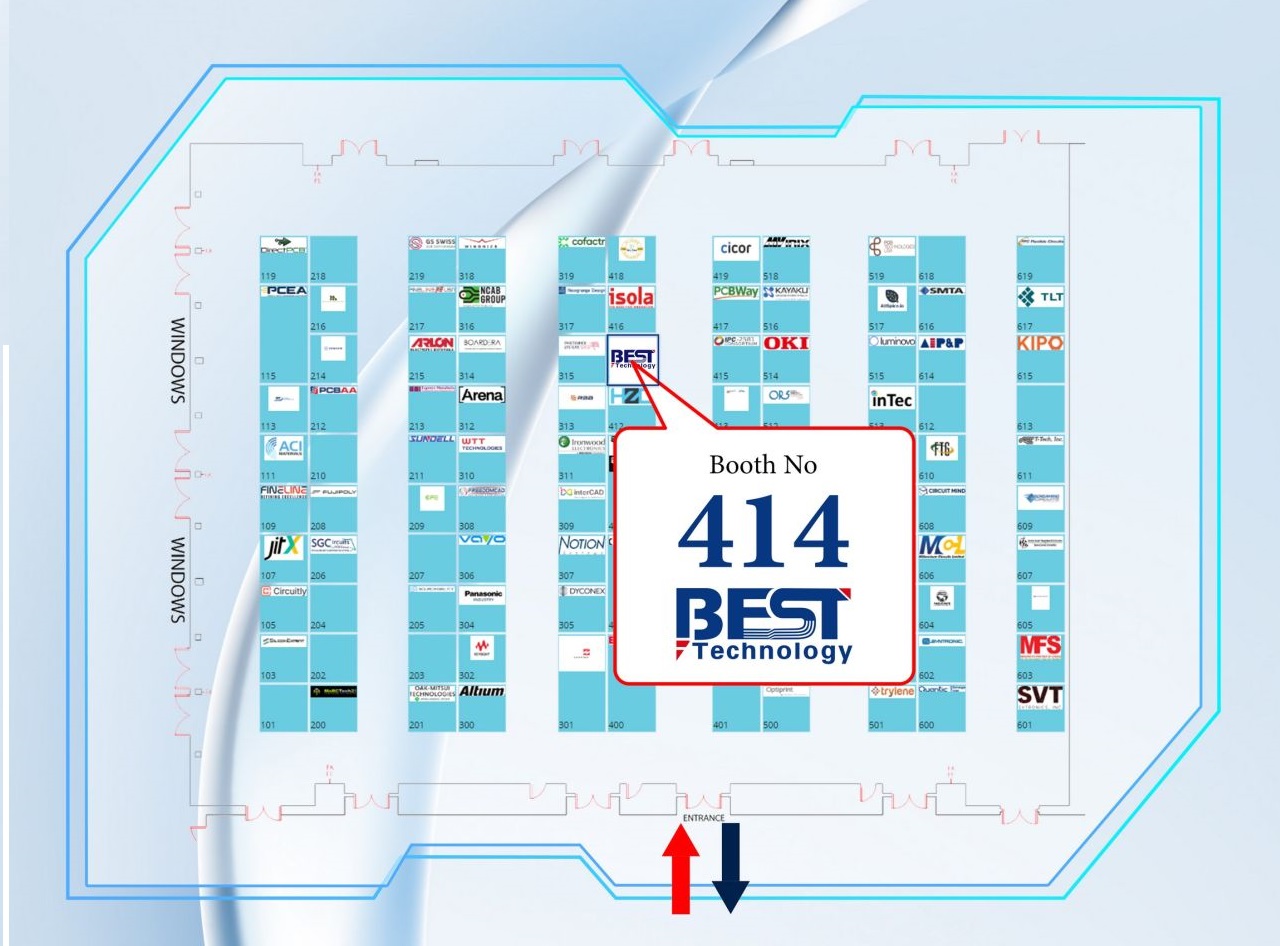
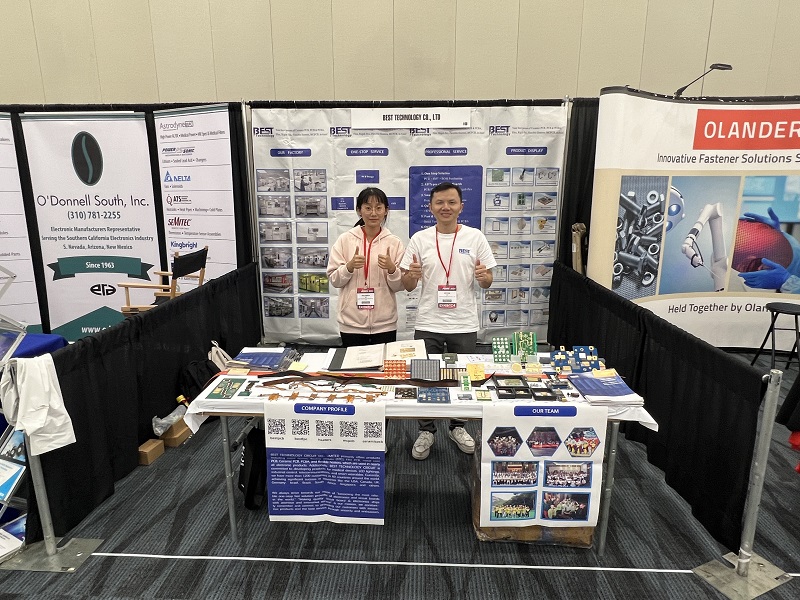
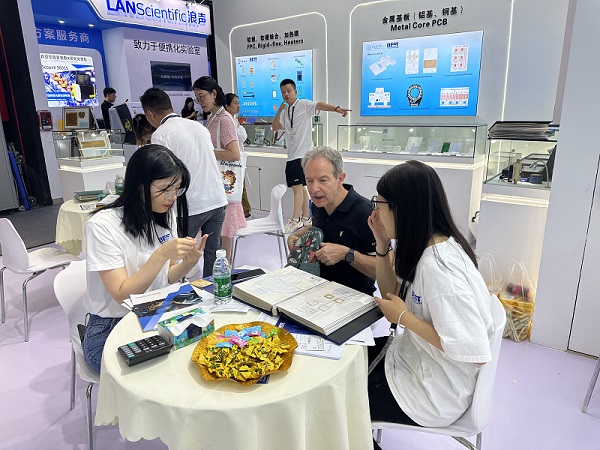
Exciting News! EBest Circuit (Best Technology), a leading PCB assembly manufacturer from China, will be exhibiting at PCB West in Santa Clara California. Join us at Booth No. 414 on Oct 1st (Wednesday). If you missed us at New Tech or Expo Electronica, this is your chance!
At our booth, you’ll have the opportunity to explore our advanced PCB manufacturing and assembly technologies. For reference, here is a booth location detail.
In the exhibition, our team of experts will be available to share in-depth knowledge about PCB assembly, from prototyping to low and high-volume production. We invite all interested professionals/engineers to visit and discover our capabilities in flexible circuit boards, rigid-flex circuits (2 to 50 layers), copper weights from 1/2 OZ to 30 OZ, and ultra-thin PCBs (0.15mm FR4) to heavy copper options. EBest Circuit (Best Technology) offers a full turn-key service including component sourcing, board fabrication (FPC, PCB, MCPCB, Ceramic PCB), final assembly, programming, testing, and more.
We welcome you to explore how we manage component wastage and boost efficiency, helping you save time, money, and resources.
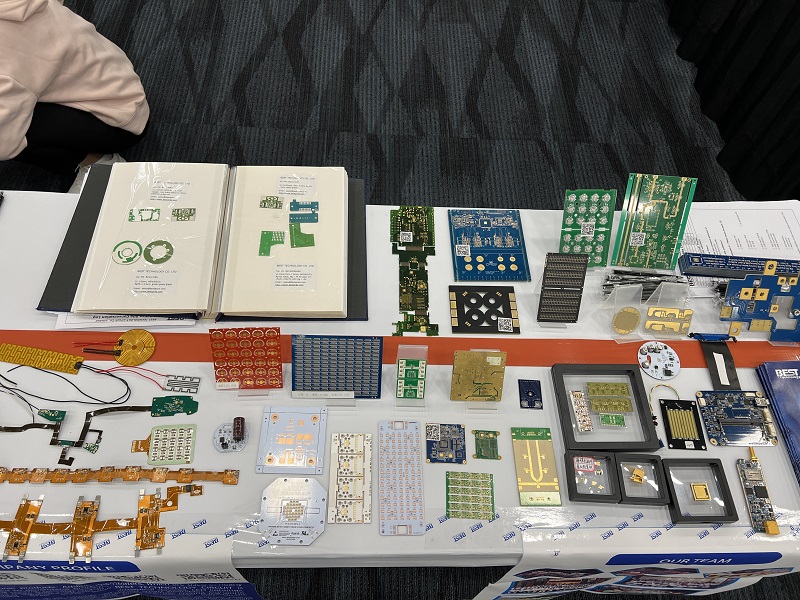
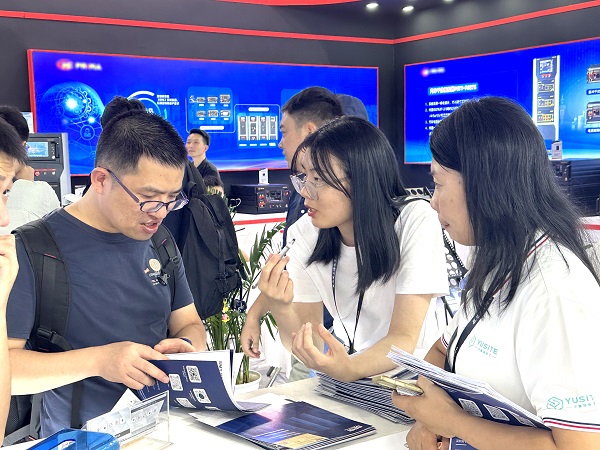
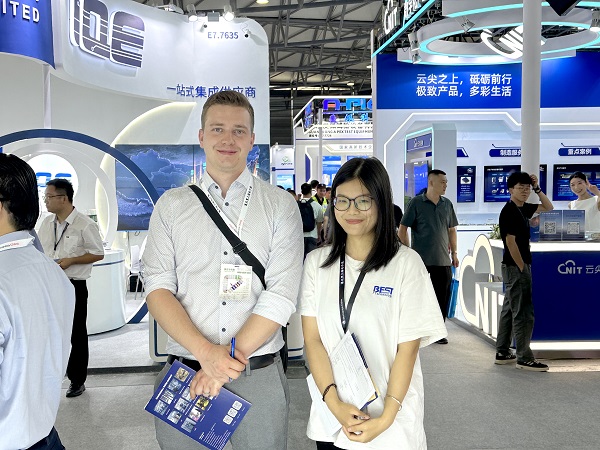
Here are some pictures that we attending PCB west last time:
Be sure to visit us at Booth 414 to see how we optimize efficiency, reduce component wastage, and help you save on time, money, and energy.
PTFE copper clad laminate is one of the most important base materials in high-frequency printed circuit boards. It is made by bonding copper foil with PTFE, also known as polytetrafluoroethylene. This material is widely used in microwave, RF, and high-speed digital circuits where low signal loss and stable performance are critical.
While FR-4 laminates serve well in general electronic devices, PTFE laminates take performance to another level. Their unique dielectric properties and stability in harsh conditions have made them the preferred choice in aerospace, defense, 5G communication, radar, and advanced automotive systems.
In this blog, we will explore what PTFE copper clad laminate is, its electrical characteristics, why industries rely on it, and how EBest Circuit (Best Technology) can support you with reliable supply and engineering expertise.
What is PTFE Copper Clad Laminate in PCB Manufacturing?
PTFE copper clad laminate is a composite base material created by pressing a thin copper sheet onto a PTFE substrate. PTFE is well known for its chemical resistance and low dielectric constant. When combined with copper, it forms a highly stable laminate for circuit fabrication.
This material serves as the foundation for etching circuit patterns and creating transmission lines in PCBs. Because PTFE exhibits excellent electrical insulation and thermal stability, it is the go-to choice for applications requiring precision in high-frequency ranges.
Unlike traditional laminates, PTFE-based materials are engineered specifically to handle sensitive signals. They support microstrip lines, stripline designs, and other controlled impedance circuits that are essential for RF engineering.
How Does PTFE Differ from FR4 in PCB Laminates?
The biggest difference between PTFE and FR4 laminates lies in their dielectric and thermal performance. FR4, made of woven fiberglass and epoxy resin, offers sufficient electrical insulation for consumer electronics, but it falls short when frequencies increase.
FR4 typically has a dielectric constant (Dk) around 4.2â4.5, while PTFE laminates maintain values as low as 2.0â2.2. This lower Dk allows signals to travel faster with reduced delay.
Another key point is loss tangent, or dissipation factor (Df). FR4 materials may reach 0.02 or higher, whereas PTFE stays around 0.0009â0.002, which is far more efficient for high-frequency circuits.
Thermal stability is also superior. FR4 begins to degrade around 130â150°C, while PTFE-based laminates can withstand much higher ranges without major performance shifts. This is vital for aerospace and military systems exposed to extreme conditions.
Simply put, when precision, speed, and minimal loss matter, PTFE laminates outperform FR4 by a wide margin.
What Are the Electrical Properties of PTFE Copper Clad Laminate?
The electrical properties of PTFE laminates are the reason they are so valuable. Some key characteristics include:
Property
Typical Value
Significance in PCB Design
Dielectric Constant (Dk)
2.0 â 2.2 (stable across frequency)
Lower Dk allows faster signal propagation with reduced delay.
Dissipation Factor (Df)
0.0009 â 0.002
Extremely low loss, minimizing signal attenuation in high-frequency circuits.
Dielectric Strength
> 500 V/mil
Provides strong insulation, preventing electrical breakdown under stress.
Moisture Absorption
< 0.01%
Almost zero water uptake, ensuring stable performance in humid environments.
Maintains excellent insulation resistance even under thermal or electrical stress.
Thermal Stability
High (usable above 200°C)
Supports reliable operation in aerospace, automotive, and defense electronics.
Why is PTFE Copper Clad Laminate Important for High-Frequency PCBs?
At high frequencies, even small material imperfections can distort signals. PTFE laminates minimize these risks with their stable dielectric constant and low loss tangent. This results in clear signal transmission, which is crucial for RF and microwave devices.
In applications such as radar, phased-array antennas, and satellite communication, accuracy cannot be compromised. PTFE laminates deliver repeatable performance even when exposed to temperature shifts, high power levels, or mechanical stress.
Another reason for their importance is impedance control. Designing circuits at GHz frequencies requires precise line widths and predictable laminate behavior. PTFE offers that predictability, which helps engineers design with confidence.
Without PTFE laminates, many of todayâs wireless and defense technologies would not function with the required accuracy and reliability.
What Are the Common Applications of PTFE Copper Clad Laminates?
PTFE copper clad laminates are widely used in industries where high-frequency performance is a must. Some typical applications include:
5G Communication Systems: For antennas, base stations, and signal routers.
Aerospace and Defense: In radar modules, missile guidance systems, and avionics.
Automotive Electronics: Used in advanced driver-assistance systems (ADAS) and vehicle radar.
Medical Equipment: Applied in MRI systems and diagnostic imaging requiring clear signals.
Satellite and Space Communication: Critical for stable transmission in extreme environments.
High-Speed Digital Devices: Essential for data centers and supercomputers handling large bandwidths.
These industries cannot afford distortion, delay, or instability. PTFE laminates provide the reliability needed for next-generation technologies.
What Are the Processing Challenges of PTFE Laminates in PCB Fabrication?
While PTFE laminates deliver outstanding electrical performance, they are not the easiest to process. Manufacturers face several challenges, such as:
Softness of PTFE: The material is softer than FR4, making drilling and machining more complex. Specialized bits are often required.
High Thermal Expansion: PTFE expands more under heat, which demands careful process control during lamination.
Bonding Issues: PTFEâs chemical resistance makes it harder for copper to adhere without special treatments or bonding films.
Dimensional Stability: Without proper handling, warping may occur.
These challenges increase fabrication costs compared to standard FR4 boards. However, experienced PCB manufacturers, like EBest Circuit (Best Technology), have developed methods to manage these issues efficiently. The result is reliable, high-performance boards without compromising quality.
How Does PTFE Copper Clad Laminate Improve Signal Performance?
Signal performance is the main advantage of PTFE laminates. With their low Dk and Df, signals pass through the board with less distortion and attenuation. This is especially critical in RF designs where even small losses translate into reduced range or efficiency.
The reduced dielectric loss improves power handling as well. Devices such as power amplifiers benefit from higher efficiency, which lowers energy waste and heat generation.
Additionally, PTFE laminates reduce cross-talk between adjacent lines. This improves signal isolation and helps maintain cleaner communication channels, a necessity in high-density RF layouts.
Overall, PTFE laminates provide the foundation for achieving superior signal clarity, speed, and reliability in demanding applications.
Where Can You Buy Reliable PTFE Copper Clad Laminate PCBs?
Not every PCB supplier is equipped to process PTFE laminates. The material requires specialized equipment, expertise, and strict quality control. When choosing a supplier, factors like certifications, engineering support, and track record in high-frequency boards are important.
EBest Circuit (Best Technology) is a trusted manufacturer of advanced PCBs, including PTFE-based designs. With certifications such as ISO9001, ISO13485, IATF16949, and AS9100D, the company meets stringent standards for industries ranging from medical to aerospace.
Using an MES system, EBest Circuit (Best Technology) guarantees traceability of every component and process step. Combined with competitive pricing and a highly skilled engineering team, the company provides dependable solutions for complex PCB needs.
Whether you require prototypes or volume production, EBest Circuit (Best Technology) offers PTFE copper clad laminate PCBs tailored to your application.
Conclusion
PTFE copper clad laminates are at the core of modern high-frequency electronics. Their unique electrical characteristicsâlow dielectric constant, minimal loss, and excellent stabilityâmake them essential for applications in 5G, radar, aerospace, and beyond.
While they are more challenging to process than FR4, the advantages in performance far outweigh the difficulties. Partnering with an experienced manufacturer ensures you get the benefits without the risks.
At EBest Circuit (Best Technology), we combine strict quality systems, professional engineering support, and advanced manufacturing capabilities to deliver reliable PTFE-based PCBs. Our certifications across medical, automotive, and aerospace industries reflect our commitment to excellence. If you are looking for a partner to support your high-frequency designs, EBest Circuit (Best Technology) is ready to help.
FAQs
1. What is the dielectric constant of PTFE copper clad laminate?
The dielectric constant is typically 2.0â2.2, stable across different frequencies and temperatures.
2. Is PTFE copper clad laminate suitable for 5G PCBs?
Yes, it is widely used in 5G base stations, antennas, and routers due to its low signal loss.
3. What is the cost difference between PTFE laminate and FR4?
PTFE laminates are more expensive because of material cost and processing complexity, but their performance justifies the price in high-frequency applications.
4. Can PTFE copper clad laminate handle high temperatures?
Yes, PTFE laminates perform reliably under high thermal conditions, making them suitable for aerospace and automotive environments.
5. How do you choose the right PTFE laminate supplier?
Look for certifications, proven experience in high-frequency PCBs, and advanced quality systems like MES for process traceability.
Aluminium PCB boards are metal-based printed circuit boards with an aluminum alloy substrate. Their thermal conductivity is dozens of times higher than that of traditional FR-4, allowing them to quickly dissipate heat from chips and prevent failures caused by hot spots. Combined with highly reflective white oil and a thin insulating layer, they serve as both a circuit and a heat sink, making them widely used in LED lamps, power modules, and automotive electronics.
How to make aluminium PCB board?
Making an aluminium PCB board involves precision and the right materials. It starts with choosing a quality aluminium substrate. It’s then coated with an insulating dielectric layer, which isolates the conductive copper from the metal.
Next comes copper lamination. A thin sheet of copper is pressed onto the dielectric surface. This copper layer will form the circuit paths. Once laminated, the board is cleaned and coated with a photoresist. Ultraviolet (UV) light exposure follows, using a circuit design mask to harden certain parts of the photoresist.
Unexposed areas are washed away, revealing the pattern. The exposed copper is then etched off, leaving behind the circuit layout. After this, any remaining photoresist is stripped. Now the board is cleaned and goes through a surface finish process, such as HASL or ENIG, depending on the end-use.
Finally, the board is cut into shape and tested for functionality. Every step is crucial for ensuring electrical performance and heat resistance.
How does the aluminium PCB manufacturing process work?
Material preparation: Choose an aluminium base, usually with a thickness of 0.8mm to 3.0mm. Apply a thermal insulation layer and copper foil.
Lamination: Bond the dielectric and copper layers tightly to the aluminium. Heat and pressure ensure this bond holds firm.
Imaging: Apply a photoresist film and expose the board under UV light. The light hardens the areas forming the copper traces.
Etching: Remove unwanted copper using chemical solutions. Only the protected areas from imaging remain.
Drilling and Plating: Drill precise holes for component leads or vias. Plate these holes if needed.
Solder Mask and Surface Finish: Apply a protective solder mask to non-conductive areas. Add a surface finish to enhance solderability and corrosion resistance.
Testing: Perform electrical tests to check for shorts, open circuits, and reliability.
Profiling: Cut the board to the desired size and shape.
These steps are controlled tightly. Thatâs why working with an experienced aluminium PCB manufacturer is critical.
How to design an efficient aluminum PCB?
Designing an effective aluminium PCB starts with understanding its strengths. Heat management is the top reason to use aluminium. Start by placing high-power components closer to the metal core. This reduces thermal buildup.
Keep trace lengths short and direct. This minimizes resistance and power loss. Use wider traces for higher current paths. Layer stack-up also matters. A single-layer design is often enough for LED and power circuits. For more complex boards, consider a multilayer design.
Thermal vias can help in spreading heat, especially in multilayer boards. Select the right thickness for your dielectric layer to ensure proper insulation and heat flow.
When choosing the surface finish, think about the end application. ENIG works well for fine-pitch components. HASL is good for general use.
Excellent aluminum PCB design balances electrical, mechanical, and thermal performance. Choose BEST Technology, you will get the best aluminum PCB design
What are the layers of aluminum PCB?
Aluminium PCB boards generally have three layers:
Aluminium Base Layer: This is the mechanical support and heat conductor. Itâs usually made of alloy 5052 or 6061 for strength and heat resistance.
Dielectric Layer: Placed between the base and copper foil. This insulation layer resists heat and electrically isolates the copper traces. Thickness varies from 50”m to 200”m.
Copper Layer: This is the conductive layer where the circuit forms. Thickness can range from 1oz to 3oz depending on current requirements.
Some designs include additional layers:
Solder Mask: Applied over the copper to prevent oxidation and short circuits.
Silkscreen: For labeling component placements and orientation.
These layers combine to offer durability, high thermal conductivity, and efficient current flow in one compact board.
What is the highest temperature aluminum PCB can withstand?
Aluminium PCBs are built to handle high heat. Their metal base and insulating layer offer much better thermal management than standard FR4 boards. Depending on the material used, aluminium PCBs can endure temperatures between 120°C to 150°C continuously.
For short durations or pulse heating, they can handle spikes up to 250°C. Some high-grade aluminium PCBs, with advanced dielectric materials, may go even higher.
This heat resistance makes them ideal for LED lighting, automotive controls, and power converters. Proper design and material selection can ensure your board works reliably in high-heat environments.
Can aluminum PCB support high frequency signals?
Yes, aluminium PCB boards can support high frequency signals. But it depends on the quality of the dielectric layer. A low-loss dielectric material ensures signal stability.
In high-frequency applications, such as communication devices and radar systems, signal integrity is crucial. Aluminium PCBs with high-performance dielectric can deliver clear, uninterrupted signals.
Design also plays a role. Keep signal paths short and separate analog from digital traces. Ground planes and impedance control improve performance even more.
Though aluminium PCBs arenât the first choice for all RF applications, they work well in many mid-frequency designs.
How strong is FR4 compared to aluminum?
FR4 is the standard fiberglass material used in many PCBs. Itâs lightweight, low-cost, and electrically reliable. But when it comes to strength and heat resistance, aluminium is superior.
Aluminium offers better mechanical support. It doesn’t warp under heat like FR4. It also dissipates heat much faster, which is vital in LED or power circuits.
FR4 works well for multi-layer signal processing boards. But for durability, thermal control, and stability, aluminium PCBs outperform FR4 in harsh conditions.
So, if your project demands strength and heat resistance, aluminium PCB is the better choice.
How does aluminum PCB compare to rigid flex and HDI PCB?
Aluminium PCBs, rigid flex PCBs, and HDI PCBs each serve different needs.
Aluminium PCB: Best for heat-intensive applications. Offers strong thermal management and mechanical strength.
Rigid Flex PCB: Combines flexibility and rigidity. Perfect for compact devices with moving parts like cameras or foldable screens.
HDI PCB: Designed for high-density circuits with microvias. Used in smartphones, tablets, and miniaturized electronics.
If your design demands heat dissipation and durability, aluminium wins. If space-saving and flexibility are key, go with rigid flex. For high-speed, high-density circuits, HDI is the way to go.
Conclusion:
Aluminium PCB boards are powerful and reliable. In many cases, they outperform traditional solutions in terms of heat dissipation and mechanical strength. Whether you’re working on LED lighting, power electronics, or high-frequency devices, Aluminium PCB boards provide a solid foundation.
Choose a professional partner to get the best results. At EBest Circuit (Best Technology), we specialize in high-quality aluminium PCB boards with custom design support and fast delivery.
If you are working on high-power electronics, LED lighting, or power conversion modules, thermal management is probably one of your biggest challenges. Thatâs where the double sided IMS PCB comes into play.
As a reliable IMS PCB manufacturer, EBest Circuit (Best Technology) has been helping engineers and purchasing teams solve complex design issues using double sided metal core solutions that offer excellent thermal performance and mechanical strength. Our products are widely used in various applications like LED lighting, automotive electronics, power modules, and more.
What Is a Double Sided IMS PCB?
A double sided IMS PCB (Insulated Metal Substrate Printed Circuit Board) is a type of PCB that uses a metal baseâtypically aluminum or copperâcombined with two copper layers and insulating dielectric layers in between. This structure allows designers to place components on both sides or route critical signals more efficiently while managing heat effectively.
Unlike single-sided IMS PCBs that have components and traces only on one side, double-sided versions support components mounting and traces layout both on top and bottom side, it allowed complex designs, higher current flow, and better heat transfer through thermal vias.
In simple terms: if your board gets hot and needs more routing space, a double sided IMS PCB can help.
Double Sided IMS PCB Structure
A double sided IMS PCB is built with multiple carefully selected layers, designed to balance electrical performance, mechanical strength, and heat dissipation. The general structure looks like this:
Top copper layer: Carries the electrical traces and component pads.
Top dielectric layer: An electrically insulating but thermally conductive material.
Metal core: Usually aluminum or copper, it serves as a mechanical base and heat sink.
Bottom dielectric layer: Same material as the top layer, separating the metal core from the bottom copper.
Bottom copper layer: It is a trace layer, used for power, ground, or additional signal traces.
Plated through holes (vias) allow electrical connection between the top and bottom copper layers. These vias can also help conduct heat away from hot components into the metal core, improving thermal performance.
Types of IMS PCB Materials
In IMS PCB design, the metal base plays a critical role in heat dissipation and mechanical stability. The two most commonly used core materials are aluminum and copper, each with distinct advantages and application scenarios.
1. Aluminum-Based IMS PCB
Aluminum is by far the most widely used metal base material in IMS PCBs. It offers a great balance between cost, weight, and thermal performance. With a typical thermal conductivity of 1.0 to 3.0 W/m·K, aluminum is sufficient for most applications where moderate heat needs to be managed efficiently.
Advantages of aluminum base:
Cost-effective: More affordable than copper, suitable for mass production.
Lightweight: Ideal for weight-sensitive designs like automotive lighting and portable devices.
Corrosion-resistant: Naturally forms a protective oxide layer, extending board life.
Good thermal conductivity: Capable of dissipating heat from surface-mounted components quickly.
Typical applications:
LED lighting systems (e.g. street lights, home bulbs)
Power driver boards
Consumer electronics
Automotive LED modules
Aluminum IMS PCBs are perfect for designs that need reasonable thermal performance at a lower cost. They’re especially common in LED products, where keeping junction temperature low is essential to extending light source life.
2. Copper-Based IMS PCB
Copper-based IMS PCBs are chosen when thermal management becomes critical, or when mechanical robustness is equally important. Copper has a thermal conductivity of around 5.0 W/m·Kâmore than double that of aluminumâmaking it an ideal choice for high-power or high-density applications.
Advantages of copper base:
Superior heat dissipation: Excellent for fast heat transfer in high-power designs.
High mechanical strength: Less prone to flexing or warping under load or heat.
Stable performance at high temperatures: Supports continuous operation in demanding environments.
Better current carrying capacity: Enables narrower traces for the same current level.
Typical applications:
Power inverters and converters
Motor control units and industrial drives
RF amplifiers and telecom power modules
Aerospace and defense electronics
High-performance LED arrays
Due to its higher cost and weight, copper is generally used in specialized applications where reliability, thermal performance, or current handling are mission-critical. It’s especially favored in automotive power systems, high-end industrial equipment, and aerospace control circuits.
Single vs Double Sided IMS PCB
When choosing between single-sided and double-sided IMS PCBs, understanding their structural and functional differences is essential. Below is a detailed comparison covering performance, design flexibility, manufacturing complexity, and cost.
Comparison Aspect
Single Sided IMS PCB
Double Sided IMS PCB
Copper Layers
One layer on top
Two layers â top and bottom
Component Placement
Only on one side
Possible on both sides or top side with backside routing
Thermal Conductivity Path
Heat moves in one direction (top to base)
Heat can dissipate through both layers via thermal vias
Routing Flexibility
Limited routing options
More complex, denser routing possible
Via Usage
Usually no plated vias
Requires plated through vias for inter-layer connections
Design Complexity
Simpler, suitable for low-power applications
Supports more complex, high-current designs
Manufacturing Cost
Lower cost, fewer steps
Higher cost due to drilling, plating, and alignment
Board Thickness
Generally thinner
Slightly thicker due to multilayer structure
Current Carrying Capacity
Limited by single copper layer
Higher due to dual copper planes
Mechanical Strength
Moderate
Higher due to more balanced structure
Typical Applications
LED bulbs, indicator lights, basic power supplies
LED headlights, motor drivers, power inverters
Preferred Use Cases
Cost-sensitive and thermally moderate projects
Thermally demanding, high-power, or complex circuitry
At EBest Circuit (Best Technology), we provide both types with full engineering support, helping you select the right option based on your performance goals and budget.
IMS PCB Design Considerations
Designing an effective IMS PCB, especially a double sided IMS PCB, requires more than just basic layout knowledge. As a professional IMS PCB manufacturer, we often find that early-stage design decisions directly impact not only the cost but also manufacturability, reliability, and thermal performance.
Here are our top recommendations to help you design a high-quality IMS PCB that meets both technical and production requirements:
1. Understand the Thermal Path Early
IMS PCBs are often chosen for their excellent heat dissipation. To maximize this advantage:
Place heat-generating components (like LEDs, power ICs, MOSFETs) directly above the metal core or near thermal vias.
Use thermal reliefs for pads to balance solderability and heat transfer.
Avoid thick dielectric layers if fast heat conduction is criticalâchoose higher thermal conductivity materials instead.
2. Use Plated Vias Wisely
In double sided IMS PCBs, plated through holes (vias) are crucial to connect the top and bottom copper layers. However:
Vias increase cost due to drilling and plating steps.
Avoid placing too many vias near mechanical mounting holes to prevent cracking during assembly.
For high-current paths, increase via diameter and plating thickness, or use multiple thermal vias in parallel.
3. Optimize Trace Widths and Spacing
Due to higher currents in IMS boards:
Use wider traces wherever possible, especially for power lines.
Respect minimum clearance based on copper thickness and voltageâthis prevents arcing and improves reliability.
Avoid sharp 90° corners on high-current or RF traces; use 45° or curved corners instead.
If youâre not sure how wide your traces should be, send us your current ratingsâweâll recommend widths based on IPC standards and real-world performance.
4. Select Suitable Copper Thickness
For IMS PCBs, copper thickness directly impacts both electrical and thermal performance:
Standard thickness is 1oz (35”m), suitable for low to medium current.
For high current or improved thermal conduction, 2oz or 3oz copper is recommended.
Very thick copper (up to 10oz) is possible, but it increases cost and etching complexity.
5. Component Layout Planning
Avoid clustering hot components togetherâspread them out to help heat dissipation.
Keep temperature-sensitive components (like ICs, sensors) away from heat sources.
Leave clearance around mounting holes to prevent shorting with metal base.
6. Surface Finish Compatibility
Tell us your assembly process (manual, reflow, wave soldering) and component pitchâweâll advise the best finish.
ENIG is recommended for flat surfaces and fine-pitch components.
HASL is affordable but not ideal for tight layouts.
Immersion silver and OSP are good for high-frequency circuits.
7. Share Your Design Goals Early
Many designers only share Gerber files at the last step. But as a manufacturer, we can provide more value when weâre involved earlier.
Let us know if your priority is cost, thermal performance, space saving, or high current.
Share thermal simulation data if availableâwe can help validate materials and layout choices.
If youâre unsure between aluminum and copper base, we can guide based on your budget and operating temperature.
Contact us early often helps reduce revisions, avoid design traps, and improve yieldâsaving both time and money.
Double Sided IMS PCB Manufacturing Process
Manufacturing a double sided IMS PCB involves multiple controlled steps. Hereâs we simply introduce the manufacturing processed involving in the insulated metal substrate fabrication:
1. Material Lamination
The copper foils and dielectric are laminated on both sides of the metal base with high pressure and temperature.
2. Drilling & Via Formation
Mechanical or laser drilling creates via holes through the board. These holes are then plated with copper to allow connectivity between top and bottom copper layers.
3. Imaging & Etching
Circuit patterns are created on both copper layers using photoresist and chemical etching.
4. Solder Mask Application
Solder mask is applied to protect copper from oxidation and to guide solder placement during assembly.
5. Surface Finishing
Finish is applied on copper pads to enhance solderability and prevent corrosion.
6. Testing
Electrical tests (shorts/opens) and inspection ensure product quality before packaging and shipment.
Here is a completed manufacturing process of IMS PCB.
Double Sided IMS PCB Surface Finish Options
HASL (Lead-free): Affordable, but not ideal for fine-pitch components.
ENEPIG: Very good solderability, corrosion resistance, durable.
OSP: Cost-effective and environmentally friendly, but short shelf life.
Immersion Silver: Good for high-frequency signals, flat and solderable.
Hard Gold: Very durable, typically used for connectors or edge contacts, but rarely used in IMS PCB, it is popular in FR4 PCB.
At EBest Circuit (Best Technology), we recommend ENIG or ENEPIG for double sided IMS PCBs used in LED or power applications due to its durability and finish quality.
Cost Factors of Double Sided IMS PCB
The cost of a double sided IMS PCB is influenced by multiple variables, ranging from material selection to design complexity. As a manufacturer, we often find that many cost increases come from early design decisions. Here are the main cost drivers you should be aware of:
1. Material Type
Aluminum is more affordable and widely used, while copper offers better thermal performance but at a significantly higher price. If your project doesnât demand extreme thermal performance, aluminum is usually the better choice from a budget perspective. High Tg costs more.
2. Copper Weight
Thicker copper layers allow for higher current carrying capacity and better heat dissipation, but they also increase cost:
Standard: 1oz (35”m)
Mid-range: 2oz â 3oz
Heavy copper: 4oz â 10oz (used in power-intensive designs)
Heavier copper requires longer etching time and more material, which increases both processing time and price.
3. Board Size & Shape
Larger PCBs naturally use more material and occupy more space on the production panel. Irregular shapes also lead to more material waste and extra routing time.
Square or rectangular boards make better use of panel space.
Rounded or irregular outlines may require CNC routing or laser cutting, which adds cost.
4. Via Count and Type
Double sided IMS PCBs require plated through holes (PTH) to connect the two copper layers. The more vias you have, and the smaller their diameter, the more complex and expensive the drilling and plating process becomes. Via-in-pad, filled vias, and microvias are more expensive.
5. Dielectric Layer Thickness
Though not the focus here, itâs worth noting: if you select high-performance dielectric materials (e.g., with higher thermal conductivity or thinner thickness), the price will increase. These materials are more specialized and costlier to produce.
6. Special Features
Any additional processes will increase cost, such as:
Via-in-pad or filled vias
Selective plating or special coatings
Edge plating or beveling
Thermal simulations or FEA reports (optional support)
These are usually project-specific, so itâs best to clarify during the RFQ stage.
EBest Circuit (Best Technology) â Your Reliable IMS PCB Manufacturer
When it comes to manufacturing double sided IMS PCBs, experience, precision, and consistency matter. At EBest Circuit (Best Technology), we specialize in high-performance metal core PCBs tailored to thermal management, power conversion, and LED lighting applications.
We offer:
Custom solutions using aluminum or copper base materials with various shapes
Precision-controlled dielectric thicknesses for consistent thermal resistance
Tight tolerance drilling and PTH plating for stable double-sided connections
Surface finishes like ENIG, ENEPIG, OSP, and lead-free HASL to match your assembly needs
Free DFM checks with technical support
24/7 before & after sales assist
Professional sales can provide best solution tailored to your specific requirement
Transparent price and data traceability
High quality control followed IATF 16949
No MOQ required, 1 pc available
Whether you need rapid prototypes or mass production, our engineering team supports you from design optimization to final testing. We believe that a good PCB starts with good communicationâand weâre always ready to listen.
To get an accurate and cost-effective quote, always provide the following details upfront:
Q1: What is the thermal conductivity of a double sided IMS PCB?
It depends on the dielectric used. Standard ranges are 1.0 to 3.0 W/m·K, with higher options available for demanding designs.
Q2: Can I place components on both sides of a double sided IMS PCB?
Typically, one side is reserved for power routing or heat dissipation, but yes, it’s technically possible depending on the application.
Q3: What surface finish is best for LED applications?
ENIG is recommended for its flatness, solderability, and long shelf life.
Q4: Are double sided IMS PCBs expensive?
They cost more than single-sided IMS or standard FR4 PCBs, but offer much better thermal and electrical performance, especially for power-intensive designs.
Q5: How can I get a quote from EBest Circuit (Best Technology)?
Just email your Gerber files and requirements to sales@bestpcbs.com, and weâll respond within 24 hours.
Circuit board damage happens for many reasonsâheat, moisture, aging parts, or physical stress. But with the right knowledge and tools, pcb repair is absolutely possible. Whether itâs a simple home device or an AC control board, identifying the issue early helps cut costs and prevent deeper damage.
If youâre dealing with an HVAC unit, industrial equipment, or a sensitive medical device, working with professionals makes sense. EBest Circuit (Best Technology) supports customers around the world with reliable PCB production and testing. From standard single-layer boards to complex multilayer and ceramic solutions, weâre committed to high performance and long-lasting quality.
What Are Most Circuit Problems Due To?
Most circuit board problems are caused by heat, moisture, power surges, dust, and aging. These issues affect the board either slowly over time or all at once. Heat, in particular, is a silent killer. When components get too hot, they wear out faster. Solder joints also become weak. Over time, the board may stop working even if thereâs no visible damage.
Moisture is another hidden threat. If water or humidity gets inside the board, it can cause corrosion. Corrosion eats away at the copper traces and makes connections weak. If youâre in a humid climate or near the ocean, your electronics may wear out faster unless sealed properly.
Another problem is physical stress. If the board is bent or shaken a lot, microcracks can appear. These cracks are hard to see but can break connections inside the board. Eventually, signals canât travel properly, and the board may fail.
What Usually Goes Bad on a Circuit Board?
Some parts of a circuit board are more likely to fail than others. Capacitors are one of the most common troublemakers. They are often found in power supplies, and over time they dry out or leak. When that happens, your device might stop turning on, or it might behave oddly.
Resistors can also burn out, especially if thereâs a short circuit. When a resistor fails, it often turns black or breaks apart.
Integrated circuits (ICs) are another weak point. These chips control important functions. They are small and sensitive. A small voltage spike can damage them instantly.
Solder joints are also a common problem. Over time, these joints can crack. This causes the component to lose contact with the board. Re-soldering usually solves the issue, but only if the board isnât too damaged.
What Would Cause a Circuit Board to Burn?
A burned circuit board is a serious problem. It usually happens due to:
Short circuits
Power supply issues
Component failure (like a failed transistor or voltage regulator)
Poor PCB design or low-quality manufacturing
Dust buildup causing arcing or hot spots
Burn marks, melting, or a burnt smell are signs of severe board damage. In some cases, PCB repair is still possible. But if the internal layers are affected, replacement may be the only option.
How to Tell If a Circuit Board Is Blown?
Itâs not always easy to tell if a board is blown just by looking. But there are a few signs to check:
1. Physical Clues
Burn marks or dark spots
Swollen or leaking capacitors
Cracked chips
Melted areas or broken traces
2. Electrical Behavior
The device wonât turn on
It powers on but acts erratically
Parts of the device stop working
3. Testing with Tools
Use a multimeter to check voltage and resistance
Check continuity to find broken paths
A lack of signal or power at test points means something’s wrong
If any of these signs appear, the board might be blown. Depending on the damage, PCB board repair cost may vary from low to high.
How Long Should a Circuit Board Last?
A well-made PCB can last 10 to 20 years. Some last even longer if kept in a clean, cool, dry place. But others fail within just a few years. It depends on:
Quality of components
How hot the board gets
How clean the environment is
How often the device is used
For example, a control board in an AC unit might last 10â15 years. But if itâs exposed to heat and dust, failure can happen sooner. Keeping regular cleaning and maintenance help extend life. And replace worn-out capacitors and clean off dust yearly to prevent common failures.
What Does PCB Repair Actually Mean?
The term PCB repair means fixing any part of a circuit board thatâs no longer working. That might include:
Replacing broken components
Repairing damaged traces or pads
Fixing bad solder joints
Cleaning dirty or corroded parts
PCB repair doesnât always need advanced skills. If you understand the circuit and can use a multimeter and soldering iron, small repairs are possible. For more complex repairs, itâs better to visit a service center.
Is It Possible to Repair a Circuit Board?
Yes, circuit boards can be repaired. But it depends on the type of damage. If a part is broken, it can usually be replaced. If a trace is cut, it can often be patched with a jumper wire. Here are some common PCB repair methods:
Component Replacement: If a resistor, capacitor, or chip fails, desolder it and install a new one.
Trace Repair: Use a jumper wire or conductive ink to reconnect broken traces.
Solder Joint Fixes: Reflow old solder or add fresh solder to cracked joints.
Cleaning Corrosion: Use alcohol and a brush to remove oxidation or rust.
Some repairs are easy. Others, like fixing broken inner layers, may not be possible without factory tools. For home users, many fixes are possible with basic PCB repair tools. At EBest Circuit (Best Technology), we offer free pcb board repair service if your board be bad during the operation or assembly, we can repair it for you and for free.
How Much Does It Cost to Replace the AC Control Board?
The AC PCB repair cost or replacement cost depends on the board model and brand.
1. Simple AC PCB Repair
If only one or two components are bad, a technician may charge $50â$100. If the board is easily accessible and parts are common, the cost stays low.
2. AC PCB Replacement
If the board is totally fried or has a rare fault, full replacement might be needed. That can cost:
$150â$250 for residential units
$300â$400 for high-end or commercial ACs
Labor may be extra if the unit is hard to open. In some cases, it’s cheaper to fix the board using local services with AC PCB repair experience.
PCB Repair Tools You Might Need
To repair a circuit board, you donât need a full lab. A small kit with the right tools is enough for most jobs. Here are essential PCB repair tools:
1. Soldering Iron: A must-have for replacing components
2. Desoldering Pump or Braid: To remove old solder cleanly
3. Multimeter: To test voltages and check for open circuits
4. Tweezers and Magnifying Glass: Helpful for handling small parts
5. Hot Air Rework Station: Needed for surface-mount parts (SMD)
6. PCB Holder or Clamp: Keeps your board stable while working
7. Isopropyl Alcohol and Brush: For cleaning dust or corrosion
With practice, many home users can fix basic issues. Just make sure to work slowly and carefully.
Can You Do AC PCB Repair Yourself?
If you have some knowledge of electronics and the right tools, you might fix an AC control board yourself. You can:
Replace burnt capacitors
Re-solder loose joints
Clean the board to remove dirt or corrosion
But there are risks. AC boards often control high-voltage parts. A mistake could damage the systemâor cause injury. You should not attempt AC PCB repair if:
Youâre not familiar with electronics
The damage looks severe
You donât have the proper tools
In those cases, itâs better to call your PCB manufacturer or seeking for a qualified repair shop at your local.
How to Prevent Circuit Board Damage?
Repairing is great, but prevention is better. You can reduce the chance of needing pcb repair by:
Keeping electronics clean and dry
Avoiding power surges with surge protectors
Ensuring proper ventilation to reduce overheating
Mounting boards securely to avoid mechanical stress
Scheduling regular inspection and cleaning, especially for industrial and HVAC systems
Preventive steps are usually cheaper than dealing with a blown board.
When to Replace Instead of Repair?
In some cases, fixing the board doesnât make sense. You should replace it if:
Damage covers a large area
The board has many burned or broken parts
Itâs cheaper to replace than repair
Itâs hard to find parts for the repair
If your AC is old and parts are rare, itâs often smarter to upgrade both the board and the unit. Youâll avoid repeated repair costs.
About EBest Circuit (Best Technology)
EBest Circuit (Best Technology) is a reliable PCB manufacturer in China. We specialize in small to medium-volume PCB Manufacture, PCB Assembly, and Electronic Manufacturing Services. As one of the highly experienced circuit board suppliers, our products and services include a wide range of printed circuit boards such as rigid PCBs, flex PCBs, rigid-flex PCBs, aluminum PCBs, RF Microwave PCBs, high-speed PCBs, high-frequency PCBs, and HDI PCBs.
Apart from being an experienced printed circuit board manufacturer, EBest Circuit (Best Technology) also provides turnkey assembly, component sourcing, box build assembly, PCBA testing, and complete electronics test and assembly. We are a one-stop PCB manufacturer dedicated to meeting all your PCB board manufacture demand.
FAQs
1. What does PCB repair mean in electronics?
It refers to fixing damaged components, traces, or solder joints on a circuit board to restore functionality.
2. Can a burnt PCB be fixed?
Yes, if the damage is limited to outer layers and doesnât affect inner traces, itâs often repairable.
3. How much does PCB board repair cost?
It ranges from $50 to $150 depending on the extent of damage and labor involved.
4. What tools are used for PCB repair?
Common tools include soldering irons, multimeters, hot air guns, tweezers, and desoldering tools.
5. Is AC PCB repair worth it?
If the board is rare or expensive, yes. But sometimes, full replacement is more cost-effective.