PCB manufacturing PCB manufacturing
Home > Blog

Differences Between Immersion Gold and Gold Plating In PCB?

December 7th, 2022

With more and more extensive usage of Printed Circuit Boards, the IC become more and more integrated and IC pins on PCB are also more denser (such as 0603, 0402 spec ICs), which brings a big difficulty to SMT process. In addition, the shelf life of HASL board is very short, and Gold-plated board can solve such problems perfectly, that’s why it is common and popular to use gold board in high precision and ultra-small assembly process. Nowadays, there are two kinds of gold coating method in PCB industry – Immersion gold & Gold plating. To make you a sense of them, today we will simply introduce their definition and the differences between two of them.

Part 1: What is Immersion Gold (ENIG)

Immersion Gold also named as ENIG (Electroless Nickel/Immersion Gold) is generating a layer of coating by chemical REDOX reaction, is a kind of chemical nickel gold deposit surface finish during PCB manufacturing process. We can get a thicker layer of gold, but as its weak adhesion through immersion, it is also known as Soft Gold.

Part 2: What is Gold Plating

Gold plating is an another surface treatment of depositing a thin layer of gold on PCB surface by plating, the working principle is to dissolve nickel and gold (commonly known as “gold salt”) in the chemical potion, then immerse the circuit board in the electroplating cylinder and through the current on the copper foil surface of the PCB to generate a layer of gold plating. The gold particles attached to the PCB, as strong adhesion also known as “hard gold”. Gold plating is widely use in electronic products as its characteristics of hardness, excellent abrasion resistance and not easy to be oxidized. For example, the gold finger of flash driver in our computer is hard gold.

Part 3: The differences between Immersion Gold and Gold Plating

  • In generally, the gold thickness of immersion is thicker than plating, and immersion gold is golden yellow while gold plating is yellowish white, so just from appearance, most customers prefer like immersion gold.
  • Due to the crystal structures between them are different, immersion gold is easier to operate in SMT process, and won’t cause the poor soldering issue.
  • Immersion gold is softer than plating way, so if boards required gold fingers, it is always use plate-gold as its good wear resistance properties.
  • There is only nickel gold on the solder pad, so under the conductor skin effect, the signal transmission won’t be affected in copper layer.
  • Compared with gold plating, immersion gold has more denser crystal structure and is not easy to oxidation.
  • With the denser line width and space requirements, plating method is easily to cause short circuits, but since immersion gold board only has gold on solder pads, which won’t exist such issue.
  • The adhesive between solder mask and copper layer on circuit is stronger as there is only nickel gold on immersion board, so it is easier for engineers to make compensation when adjust line space.
  • Black-Pad won’t be happened to immersion board after assembly because it has good flatness than plating method.
  • Immersion gold is more economy than plating.

EBest Circuit (Best Technology) is a professional PCB manufacturer with over 16 years experiences, and we have rich and mature technical to fabricate immersion gold and gold-plated boards. Warm welcome to contact us at sales@bestpcbs.com if you have any questions or RFQs about printed circuits, we are always online.

A Guideline about Legend on Printed Circuit Board

November 29th, 2022

Printed circuit board is used to power up the electronic devices, and the legend on its surface been known as legend text or silkscreen text to be aim at providing vital information to electronic manufacturers or end users. This post is a guideline to help you understand what information we can gain from those legends and what we need to pay attention to when design them.

A brief introduction about PCB legend

Though a printed circuit board doesn’t require any legend/text to function technically, the text provides key information to end users to test, assemble and troubleshoot, and generally we can obtain following information from the legends:

  • Branding information

This includes manufacturer’s information, serial numbers, date code and other information, which prevents the copying of design.

  • Part number provided

Part numbers are added on the circuit boards to enable replacement or design evolution whenever needed.

  • Version of product

Sometimes versions were updated, and the legend is added on the circuits to identify the specific version and backtrack the date.

  • Reference of components indicators

This may feature components information such as indicators, orientations and other information.

  • Safety Precautions

These are warning signals that are added to protect users from electric shocks. A few examples of these may include grounding, high voltage, and so on.

  • Circuit Identification

Users and designers can identify circuit names from legends to understand testing points, ground points, component interconnect, so forth.

  • Polarity indicator for certain components

Some components such as diodes, LED chips, electrolytic capacitors require to a distinguish of polarity when assembly, text legends help to indicate the right polarity to ensure assembled correctly and perform functionality when reach to consumers.

  • Authentication indication

Silkscreen text shows the boards are authenticated or conforms to certain security certification, such as RoHS, 94V-0, UL


  • Test points and troubleshooting assistants

Help to correctly perform testing including resistance measurement, voltage measurement, function testing and so forth.  In addition, text legend enables to troubleshoot while issues or debugs happened and repair is required.

  • Component outlines indicating where components should go

Legends provides a great help during assembly process, it helps the operator quickly find where each component should be, so it is recommended to add text legends when PCB need to be assembled.

General Parameters for PCB Legend in EBest Circuit (Best Technology)

To understand the capabilities of legend printing of EBest Circuit (Best Technology), here we listing some general parameters for your reference:

  • Legend colors can be white, black, green, yellow or other colors depend on customer’s preferences.
  • Legend line width is range from 5mil to 7mil
  • Text height can set at 30mil
  • Maximum text width can be 17mil
  • Printing methods are screen printing, direct legend printing and Liquid photo imaging. (Direct legend printing is commonly used by far.)

Important factors need to be considered during designing

Although legends are easy to be printed, there are still some key points need to pay highly attention when you are designing.

  • Legend orientation: To maintain a good reading appearance for user, please make sure all legends throughout the board have a same orientation.
  • Choose a standard color and shapes for marking, this is a most economy way to save cost.
  • Avoid overlapping: Overlapping is one of the most common problems that manufacturer faced. Legend always be related to PCB layout, and components reference will be also designated when circuit board layout finished. So if the legend was overlapped, it must be moved to another place and that may cause component reference was located in a wrong position, so it is always recommend to double check all the legends, to make sure they are clear and in the correct position when the whole board layout was completed.
  • Do not place the silkscreen text on all four directions, this will lead to confusions when the circuit board is undergoing repair.
  • Leave a few mils space for some common potential printing errors, this will help manufacturer to reduce the possibility of errors.

Every PCB manufacturer has its unique style and pattern when it comes to legend printing, so working files confirmation plays an important role before circuit fabrication, EBest Circuit (Best Technology) gives a great respect to the original files to our customers, we won’t start production until get approval of working files from customers, so please do not worry about it if you have such concerns. In addition, as a professional printed circuit board manufacturer in Asia, we are confident that we can provide you with high quality PCB, welcome to contact us if you have PCB needs.

How To Do Failure Analysis In Printed Circuit Board

October 29th, 2022

Nowadays, printed circuit board plays a more and more important role in electronic products, whether for personal use or commercial use, failure PCB can effect the usage of electronic products and cause a serious consequence. So, how to quickly detect the PCB fault problem?

Here, Best Tech summarized seven methods to locate fault PCB quickly.

  • Use testing equipment

The typical equipment including Automated Optical Inspection (AOI) equipment, X-Ray Fluoroscopy, Optical Microscopy, 1000x magnifying glass. When some failures happen and we don’t know what is the specific position, properly use of these detection devices can help us quickly locate the faulty PCB.

Scratch-on-PCB
  • Visual inspection

Visual inspection is the most common and easy method to position those defectives in printed circuit board. It can identify defects such as overlapped marks, solder joint short, signs of overheating circuit boards, and burned components.  When some problems are difficult to identify with our naked eye, magnifying glasses can help to identify some short circuits, welding bridges, open circuits, solder joints and circuit board wiring cracks, component offset, etc. 

  • Components inspection

If the printed circuit board was assembled with some electronic components, we can perform a components inspection to locate the failure. Especially when low resistance is detected between the component pins, it is best to remove the component from the PCB circuit for specialized testing. If the resistance is still low, then this component is the culprit, otherwise further investigation will be required.

  • Power on printed circuit board

Visual inspection is only suitable for checking the appearance of outer layers of the circuit board, instead of for checking the inner layer of the circuit board.  If there are no visible defects in the appearance, you can power up/on the board and perform a more detailed test to determine whether the board is working properly or not.

  • Low voltage measurement

The first thing to confirm is whether the voltage of each chip power pin is normal, and then check whether the various reference voltages are normal, and whether the working voltage of each point is normal. Since the copper trace on the circuit board has resistance, the voltage generated through different parts of the copper trace is also different.  Then you can use a voltmeter or multimeter to measure the voltage between different parts along a short. If you find that the voltage value is getting smaller and smaller, you are getting closer to find out a short circuit.

For a simple example, when a typical silicon triode is on, the BE junction voltage is around 0.7V, while the CE junction voltage is around 0.3V or less.  If the BE junction voltage of a triode is greater than 0.7V (except for special triode, such as the Darlington tube), the BE junction may be open.

  • Touch circuit board with your finger

In general, when some failure happened, some areas on the circuit board will be getting more and more heat. In this time, we can try to touch the circuit board with fingers to find out areas with heat, and it will help us to pinpoint the problem. However, be careful to use short-circuit copper trace power supply and avoid burns or electric shock.

  • Repair short/open

After identifying a short or open circuit on the PCB, the next step is to isolate the problem.  While this is easy to do on the outer surface of the board, it is a challenge for the inner layers.  Possible solutions include drilling through holes or cutting appropriate external copper traces.

This is the end of this article, if you have more better methods to locate the failure printed circuit board, warm welcome to contact us, we can analyze together.

Why it is difficult to make different copper thicknesses on different layers for MCPCB

October 14th, 2022

With the development of technology, we need the MCPCB to be multi-layer. 1 layer MCPCB is not enough for making some high-quality precision equipment and products.

So now, 2 layers MCPCB becoming more and more popular.

Normally, we make 1OZ, 2OZ and 3OZ copper thickness for each layer for aluminum or copper core/base PCB. The thickness of copper for top and bottom layer are the same.

But recently, more and more customers want the MCPCB to be made with different copper thicknesses on top and bottom layer.

For example, they want 1OZ copper on top layer and 3OZ on bottom layer.

But we don’t suggest to do that, why? Let me do some explanations.

  1. Different copper thicknesses on top and bottom layer will increase the difficulty for production. Because we put the MCPCB into etching liquid to do the etching, we need to use film to protect one side from etching liquid, but if it can’t be protected well completely, it will be etching too, then it is rejected.
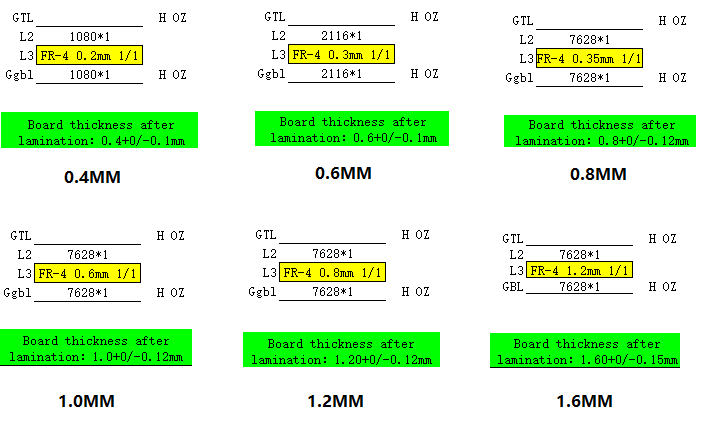
  2. Different copper thicknesses on different sided will cause the PCB twist finally if the stack up is double sided (See below double sided stack up)

But if the stack up is 2L (See below 2L stack up), the FR4 PCB is twisted then will affect the lamination for FR4 PCB and aluminum/copper base.

  1. Due to increase the difficulty of production, so the price will be increased too.
  2. Lead time will be longer than normal since the production process is much more completed.
  3. The reliability is not good.

Finally, it is better to do the same copper thickness for each layer for multi-layer MCPCB.

For knowing more knowledge about MCPCB, please email to sales8@www.bestpcbs.com

X-ray Inspection in PCB Assembly

June 15th, 2022

X-Ray Inspection’s Definition

X-ray inspection is a technology used to inspect the hidden features of the target objects or products. As for PCB inspection, X-ray is commonly used in the inspection of PCB assembly in order to test the quality and find the hidden defects, X-ray inspection is one of the most important steps for quality-oriented PCB manufacturers.

X-Ray Machine

X-Ray Inspection’s Working Principle

Generally, there are three elements in the X-ray devices.

  • X-ray tube—to generate the X-ray photons.
  • Operation platform—to move along with the sample so that the sample can be inspected from different angles and magnification.
  • Detector—it can capture the X-ray through the samples and then transfer it into the image so that we can find out whether there are defects on the printed circuit board.

The Hidden Defects that can be Identified by X-Ray

Since PCB has the higher density with the solder joints hidden and holes buried or blind, X-ray enable us to inspect the quality of the PCB and identify various hidden defects. And there are three common hidden defects that can be inspected by X-ray.

PCB’s Image Under X-Ray
  • Solder bridges—it is a common issue that will occur when the solder joints are so close that they create a connection which is not allowed. And usually, the solder bridges will be covered by some components on the PCB. But they can be easily found with the help of the X-ray device.
  • Solder voids—when gas or flux is entrained during welding, solder voids will be produced, which will lower the thermal conductivity at the solder joint and may cause physical defects. And X-ray can help to  identify the solder voids
  • Pin-hole fills—pin-hole fills issue is a common problem occurring in the plug-in components on the  printed circuit boards. The X-ray device can be used to identify these errors, and can even quantify the missing filling amount.

Our X-Ray Inspection Device

The maximum size of the board that can be put in the device’s operation platform is 510*430 mm, while the maximum inspection size of the device is 435*385 mm. So here is the manifestation of the operation platform’s function. When the size of PCB is over 435*385 mm, the operation platform will move along with the board so that the board can be inspected thoroughly.

And here is a video about operation of our X-ray inspection device.

So, this is the end of this article. In case if you have any questions, you are welcome to contact us via email at  sales@bestpcbs.com. We are fully equipped to handle your PCB  manufacturing requirements.

Types of Vias

May 20th, 2022

What is via?

A via plays an important role in multi-layer PCBs. It is used to make an electrical connection between the layers of a multi-layer PCB. Generally speaking, every hole in the printed circuit boards can be called as via.

A via is constructed by placing copper pads on each layer of the PCB and drilling a hole through them. And the hole is plated with copper that forms electrical connection through the insulation that separates the copper layers.

PCB Vias

Types of Vias

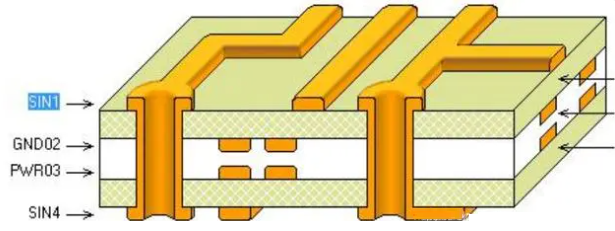
There are three main types of vias used in PCB: through-hole via, blind via and buried via.

Through-Hole Via

Through-hole via goes right through the printed circuit board from top to bottom and can be used to connect all the layers of a PCB. It is the most common via and is easiest to construct.

Blind Via

Blind via connects the outermost layer of a PCB to the next layer. Namely, it cannot be seen on the other side of the board and is therefore called blind via.

Buried Via

Buried via is used to connect internal layers of a PCB. And it cannot be seen on the surface of the board.

Via Types

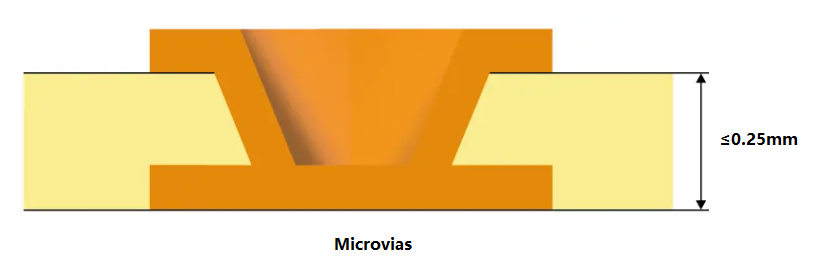
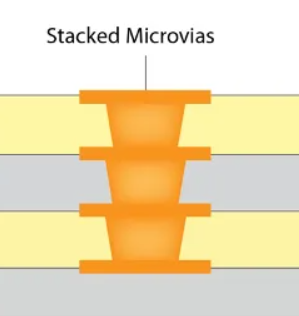
In addition, it is always better to use multiple smaller vias rather than one large via since smaller vias can reduce the inductance and also provide an additional path to the current flow in case any of the vias fail.

So, this is the end of this article. In case if you have any questions, you are welcome to contact us via email at  sales@bestpcbs.com. We are fully equipped to handle your PCB  manufacturing requirements.

Why is the MCPCB Widely Used in the LED Products?

April 30th, 2022

MCPCB refers to metal core printed circuit board. It has a good performance in heat dissipation, so it is often used in LED products.

The advantages of MCPCB

Prevent overheating: 

LEDs tend to get overheated very quickly. If a metal core printed circuit board is used, it solves overheating by transferring the energy from one side to another.

Improve the material’s reliability: 

The MCPCB plays a key role in the elements that heats up overly at times. It helps to divert the heat from one side to another where the heat has vanished, which improves the product’s life, making it much more durable.

Adapt to a high temperature: 

Unlike the FR4 technology, the metal core printed circuit board can adapt to products with a high temperature, hence it proves to be very useful for LED products.

LED PCB

Why is the MCPCB widely used in the LED products?

Since it is well-known that the LED products will emit a lot of heat. Based on the advantages, the metal core PCB can transfer heat quickly and prevent overheating. And Aluminum PCB is mostly used in metal core PCBs, for they can operate longer than other metals and longer shelf life.

Moreover, metal core PCB has a high conductive ability, hence there remains ample space for maximum LEDs, which allows producing sufficient light and achieving high performance.

Therefore, based on the advantages of the MCPCB, it is the prior option of the material for the LED products.

So, this is the end of the article. In case if you have any questions, you are welcome to contact us via email at  sales@bestpcbs.com. We are fully equipped to handle your PCB or MCPCB manufacturing requirements.

3M Epoxy Adhesive DP190-Gray & 3M Epoxy Adhesive DP190-Translucent

April 22nd, 2022

Both 3M Epoxy Adhesive DP190-Gray and 3M Epoxy Adhesive DP190-Translucent are a two-part epoxy adhesive that delivers exceptional performance with high shear and peel strength.

They can bond to a wide range of materials, such as metals, ceramics, wood, fiberboard, glass, rubber and many plastics. So, PCB is no exception. But what are the similarities and differences between them?

Similarities

  • Provide tough, strong bonds through high shear and peel strength.
  • Capable of bonding to a wide variety of different materials.
  • Deliver extended work-life, providing additional time for adjustment.
  • Exhibit good environmental aging properties, delivering long-term durability.

Differences

3M Epoxy Adhesive DP190-Gray has a moderately high modulus. With a 90-minute work-life, it reaches handling strength in approximately 10 hours and full cure in 7 days at room temperature.

Additionally, this epoxy adhesive has medium viscosity and self-leveling with a 1:1 mix ratio by volume. But its flexibility and elongation are moderate.

(3M Epoxy Adhesive DP190-Gray)

3M Epoxy Adhesive DP190-Translucent has a moderately low modulus. With an 80-minute work-life, it reaches handling strength in approximately 10 hours and full cure in 14 days at room temperature.

It has low viscosity and self-leveling with a 1:1 mix ratio by volume. Additionally, it features high flexibility and elongation.

3M Epoxy Adhesive DP190–Translucent

This is all about the similarities and differences between the 3M Epoxy Adhesive DP190-Gray and 3M Epoxy Adhesive DP190-Translucent. It is supposed that you have known about them.

But if you still have any questions about them or PCB, please feel free to contact us. Because at EBest Circuit (Best Technology), we are fully equipped to handle your PCB manufacturing requirements.

Thermal Conductivity—Aluminum PCB vs Ceramic PCB Series 2

April 19th, 2022

Last time we have talked about the structure difference between the aluminum PCB and ceramic PCB. So, based on the different structures, whose thermal conductivity is better?

We have known that a single layer aluminum PCB is made up of copper layer, dielectric layer and aluminum layer. Meanwhile, the dielectric layer is the decisive factor affecting the thermal conductivity.

Generally, its thermal conductivity ranges from 0.8 to 3.0 W/m-K, but can up to 8.0 W/m-K. So, in terms of heat dissipation, the aluminum substrate does much better than FR-4 substrate. And it is a good choice for LED lighting products with high power.

Aluminum PCB

However, the heat-conducting property of ceramic PCB is superior to that of the aluminum PCB.

Since ceramic itself is an insulating material with a great heat-conducting property, it does not need a dielectric layer. Therefore, the heat can be dissipated directly through the ceramic.

Because of its excellent performance in heat dissipation, it is particularly suitable for the lighting product with ultra high power and those products which have a high demand of heat dissipation.

Ceramic PCB

To summarize, clearly, we can know from the table below that ceramic PCB does better than aluminum PCB in terms of thermal conductivity and heat dissipation. And this is mainly because of the dielectric layer, which is related to the functions of bonding, insulation and heat conduction.

The better the heat conduction performance of the insulating layer, the more conducive it is to the diffusion of heat generated during the operation to the device, hence it will be more conducive to lower the operating temperature of the device. That is to say, aluminum PCB will be subject to the dielectric layer, while ceramic PCB will not be restricted.    

And, this is the end of the comparison of the thermal conductivity between aluminum PCB and ceramic PCB. If you still have any questions about them, please feel free to contact us.

Electrostatic’ s Power-Trivia Series 2

April 18th, 2022

Last time we have known that electrostatic discharge (ESD) account for the highest proportion of causes leading to the failure of high electrostatic sensitive devices and the generation of it. Therefore, today we are going to talk about what kind of damage the static will cause to the Printed Circuit Board and how to avoid it.

The Influence of Electrostatic

Under different circumstances, the electrostatic voltage carried by the human body ranges from hundreds of volts to thousands of volts. And when people touch the electronic components, there will be ESD, resulting in the damage to devices and the reduction of reliability. To make matters worse, ESD will break down the device and directly scrap the product.

PCBA

Besides, the ESD will lead to a large pulse current, which will generate a lot of heat in the chip and printed circuit board, making them burn out. Moreover, the integrated circuits (IC) are built with denser lithography lines than before so that their ability to withstand electrostatic discharge becomes weaker. Therefore, it is necessary to prevent it.

Elimination of Electrostatic

Since the static will has a great impact on the PCB and electronic components, it is extremely significant to take precautions against the electrostatic by taking some measures. And here are some measures carried for eliminating the electrostatic in our workshop.

  • Putting on anti-static clothes and hats. It is to prevent static existing in clothes and hair from influencing the board.
Anti-static Clothes and Hats
  • Wearing anti-static wrist straps. The principle is to discharge the static from the human body to the ground through the wrist strap and grounding wire.
Anti-Static Wrist Strap
  • Using static elimination instrument. What we have to do is to put just one hand on static elimination instrument, and do not leave our hand from it until the red light turns to green, which aims to eliminate the static existing in our body.
Static Elimination Instrument
  • Keeping a certain humidity in the workshop. Higher humidity is not prone to ESD. The higher the humidity is, the easier it is to conduct electricity. As a result, electrostatic cannot be stored in our body.
  • Using anti-static packaging. When packaging, we have different packaging ways, such as anti-static bags, anti-static bubble film and so forth. And what to be used in packaging is up to our clients.
Anti-static Bags

To sum up, electrostatic will cause damage to the Printed Circuit Board and electronic components so that it is necessary to take some measures to prevent it.

And this is the end of this trivia. If you would like to know more about PCB, you are welcome to contact us.