When designing circuits or selecting components for a project, many people wonder which is good, polarized vs non-polarized capacitor. Choosing the wrong type can lead to circuit failure, component damage, or even safety hazards.
This article breaks down the core differences, uses, symbols, and selection criteria for polarized and non-polarized capacitors, providing clear, actionable information to help you make the right choice every time.
Whether you’re working on a power supply circuit, audio equipment, or high-frequency applications, understanding polarized vs non-polarized capacitor is critical to ensuring circuit reliability and performance.
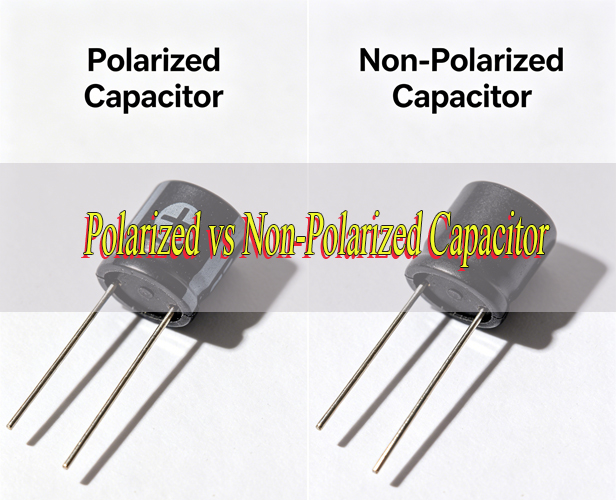
What Is a Polarized and Non-Polarized Capacitor?
A polarized capacitor is a type of capacitor with distinct positive and negative terminals that must be connected in a specific orientation to function properly. Its internal structure is asymmetric, typically using an electrochemically grown oxide layer as the dielectric.
Common types include aluminum electrolytic and tantalum capacitors. The dielectric layer forms only under a specific voltage polarity during manufacturing, so reversing the connection causes the dielectric to break down, leading to overheating, leakage, or even component failure.
A non-polarized capacitor, also known as a bipolar capacitor, has no fixed positive or negative terminals and can be connected in any direction in a circuit. Its internal structure is symmetric, with identical electrodes and dielectric materials on both sides.
This design allows it to handle bidirectional current flow, making it suitable for circuits where voltage polarity changes regularly. Common types include ceramic, film, and mica capacitors, which are valued for their stability across different frequencies and temperatures.
What Is the Symbol of a Polarized and Non-Polarized Capacitor?
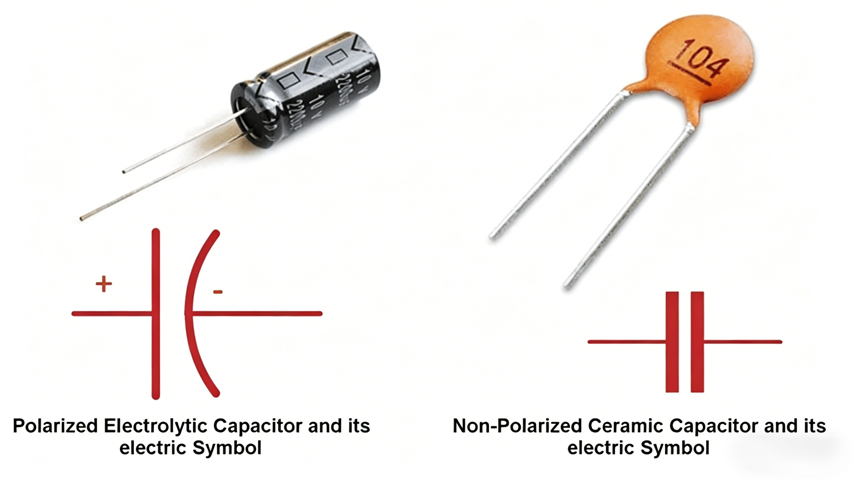
The symbols of polarized and non-polarized capacitors are clearly distinguishable, reflecting their polarity differences. Here is a detailed comparison:
Polarized Capacitor Symbol: Its symbol has clear positive and negative markings. It has two parallel lines representing capacitor plates, with one shorter line marked with a minus sign for the negative terminal and the longer line for the positive terminal.
Electrolytic and tantalum capacitors may have a curved line on the negative side to highlight polarity. This design ensures correct installation in DC circuits, as their dielectric layer only stabilizes under specific voltage polarity.
Non-Polarized Capacitor Symbol: It has no polarity markings and consists of two equal-length parallel lines with no distinction between positive and negative terminals. Its symmetric design matches its symmetric internal structure, allowing bidirectional current flow.
Ceramic, film and mica capacitors all use this standard symbol, making them easy to identify in circuit schematics, especially in AC or high-frequency circuits.
What Are Polarized and Non-Polarized Capacitors Used for?
Capacitors are essential for storing charge, filtering signals, and coupling circuits, but polarized and non-polarized capacitors are tailored to different application scenarios based on their structural differences. Their uses are distinct and closely tied to their polarity characteristics and performance advantages.
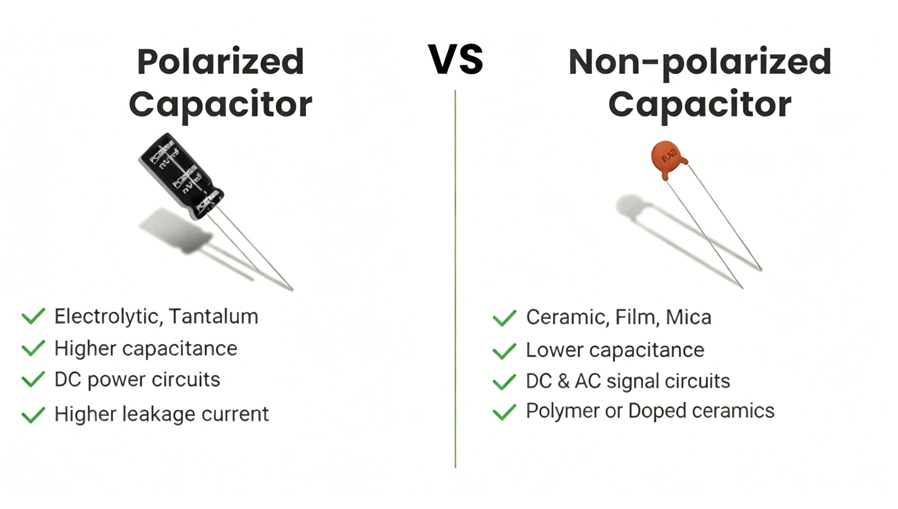
Polarized capacitorsare mainly used in DC circuits, leveraging their high capacitance advantage to store large amounts of electrical energy efficiently. They are widely applied in power supply filtering to smooth voltage fluctuations and reduce ripple, bulk energy storage for circuits needing sudden power bursts, and low-frequency signal coupling in audio amplifiers. Tantalum polarized capacitors, with their compact size, are also commonly used in small electronic devices like mobile phones and laptops.
Non-polarized capacitors, by contrast, are suitable for both AC and DC circuits, especially scenarios where voltage polarity changes regularly. Their excellent frequency stability and low equivalent series resistance make them ideal for high-frequency filtering, signal coupling (to separate AC and DC signals), oscillation circuits, and audio crossovers. Ceramic non-polarized capacitors are preferred for high-frequency applications, while film non-polarized capacitors are favored in audio circuits for low distortion.
What Is the Difference Between a Polarized and Non-Polarized Capacitor?
| Comparison Point | Polarized Capacitor | Non-Polarized Capacitor |
| Polarity Requirement | Must be connected with correct positive and negative orientation; reverse connection causes failure | No polarity requirement; can be connected in any direction |
| Capacitance Range | Higher capacitance (typically µF to thousands of µF) for bulk energy storage | Lower capacitance (typically pF to µF) for signal and high-frequency tasks |
| Voltage Rating | Lower voltage ratings (usually up to ~100V) due to delicate dielectric layer | Higher voltage ratings (up to several kV) for AC and high-voltage circuits |
| Equivalent Series Resistance (ESR) | Higher ESR, which can cause heat generation in high-current circuits | Lower ESR, making them more efficient in high-frequency applications |
| Temperature Stability | Less stable; performance degrades with temperature changes and aging | Better stability; consistent performance across a wide temperature range |
| Physical Size | Larger for similar capacitance due to internal structure | Smaller for lower capacitance; compact design for high-frequency use |
| Failure Mode | Reverse connection, overvoltage, or aging can cause leakage, overheating, or rupture | Rare failure; typically only fails due to extreme overvoltage or physical damage |
Which Is Safer to Use, Polarized vs Non-Polarized Capacitor?
Non-polarized capacitors are generally safer to use than polarized capacitors. Non-polarized capacitors have no polarity requirement, so there is no risk of reverse connection.
Their symmetric structure and stable dielectric materials make them less likely to fail catastrophically. Even if exposed to moderate overvoltage, they typically break down without causing fire, leakage, or explosion.
Polarized capacitors pose greater safety risks if not used correctly. Reverse connection causes the dielectric layer to dissolve, leading to high current flow, heat buildup, and potential component rupture.
Aluminum electrolytic capacitors may leak electrolyte when damaged, while tantalum polarized capacitors can catch fire if reverse-biased or exposed to excessive voltage. Proper installation with correct polarity and adherence to voltage ratings are essential to ensure safety when using polarized capacitors.
Are Non-Polarized Capacitors More Reliable Than Polarized Ones?
Non-polarized capacitors are generally more reliable than polarized capacitors in most circuit applications. Their symmetric design and lack of polarity requirement eliminate the risk of reverse connection failure, one of the most common causes of capacitor damage.
They also have better temperature stability and lower ESR, which reduces wear and tear over time.
Polarized capacitors are less reliable due to their internal structure. Aluminum electrolytic capacitors use liquid or gel electrolytes that evaporate over time, leading to reduced capacitance, increased ESR, and eventual failure.
Tantalum polarized capacitors are sensitive to surge currents and reverse voltage, which can cause permanent short circuits. Both types degrade faster in high-temperature environments, further reducing their reliability.
However, polarized capacitors are still reliable when used within their specifications and in circuits with stable DC voltage.
Which Has Higher Capacitance, Polarized vs Non-Polarized Capacitor?
Polarized capacitors have significantly higher capacitance than non-polarized capacitors. Polarized capacitors achieve high capacitance by using an extremely thin electrochemically grown oxide layer as the dielectric.
This thin dielectric allows for more charge storage in a compact space, with capacitance values ranging from microfarads to thousands of microfarads.
Non-polarized capacitors have lower capacitance due to their symmetric structure and thicker dielectric materials. Most non-polarized capacitors have capacitance values in the picofarad to microfarad range.
Achieving high capacitance with non-polarized capacitors would require a much larger physical size, making them impractical for applications that need bulk energy storage. For example, a 1000 µF polarized capacitor is compact, while a non-polarized capacitor with the same capacitance would be significantly larger and more expensive.
Which Is Cheaper, Polarized vs Non-Polarized Capacitor?
Polarized capacitors are generally cheaper than non-polarized capacitors, especially for high capacitance values. Aluminum electrolytic polarized capacitors are mass-produced and use low-cost materials, making them the most affordable option for bulk energy storage.
A 1000 µF aluminum electrolytic capacitor typically costs a few cents, making it ideal for cost-sensitive projects.
Non-polarized capacitors are more expensive, especially for higher capacitance or specialized applications. Ceramic non-polarized capacitors are affordable for low capacitance values, but film and mica non-polarized capacitors cost more due to their higher quality materials and manufacturing processes.
A non-polarized capacitor with the same capacitance as a polarized one can cost 10 to 20 times more. For example, a 1000 µF film non-polarized capacitor may cost $5 to $20, compared to $0.10 to $0.50 for an equivalent aluminum electrolytic polarized capacitor.
Which Is Good, Polarized vs Non-Polarized Capacitor?
There is no universal answer to which is good, polarized vs non-polarized capacitor, the right choice depends on the circuit requirements. Polarized capacitors are better for DC circuits that require high capacitance and bulk energy storage.
They are ideal for power supply filtering, low-frequency signal coupling, and applications where space is limited but high capacitance is needed. They are also cheaper, making them suitable for cost-sensitive projects.
Non-polarized capacitors are better for AC circuits, high-frequency applications, and circuits where voltage polarity changes. They are safer, more reliable, and have better temperature stability, making them ideal for signal coupling, high-frequency filtering, and oscillation circuits.
They are the best choice when polarity cannot be guaranteed or when circuit stability is a top priority. Understanding the specific needs of your circuit, such as voltage type, capacitance requirements, and environmental conditions is key to choosing between polarized vs non-polarized capacitor.
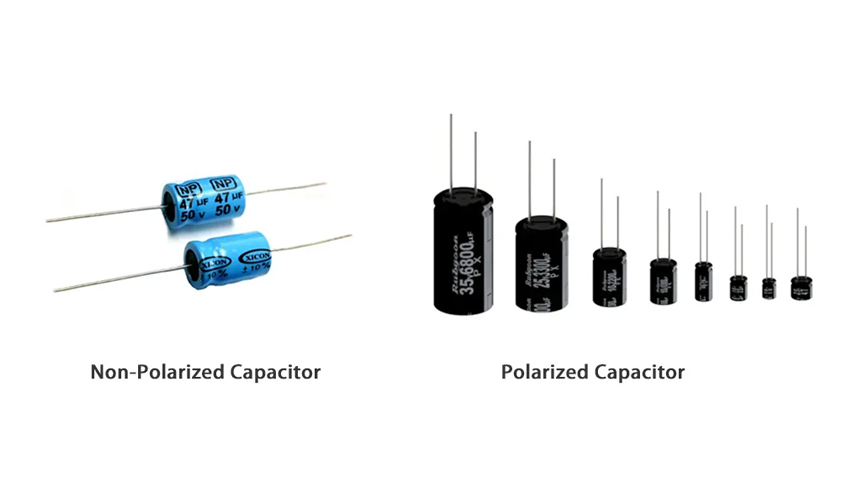
How to Tell if a Capacitor Is Polarized or Non-Polarized?
Identifying whether a capacitor is polarized or non-polarized is critical to avoid circuit damage and ensure proper performance. Below are simple, non-repetitive methods to distinguish the two types:
- Check polarity markings: Polarized capacitors have clear positive and negative indicators, such as a minus sign on the body, a longer lead for the positive terminal, an arrow pointing to the negative terminal (film types), or a plus sign (supercapacitors). Non-polarized capacitors have no such markings.
- Examine component shape: Aluminum electrolytic polarized capacitors are cylindrical with a ribbed negative side and an explosion-proof slot. Tantalum polarized capacitors are small and rectangular with polarity markings. Non-polarized capacitors are usually small, flat, and uniform with no terminal distinction.
- Review capacitor type: Aluminum electrolytic, tantalum, and conductive polymer capacitors are almost always polarized. Ceramic, film, and mica capacitors are nearly always non-polarized, with rare high-frequency ceramic exceptions needing datasheet confirmation.
- Inspect circuit schematic: Polarized capacitors have a symbol with a minus sign on one side. Non-polarized capacitors have two equal-length parallel lines with no polarity indicators.
- Check pin length and color: Through-hole polarized capacitors traditionally have a longer positive pin and shorter negative pin. Some film polarized capacitors use red pins for positive and black for negative.
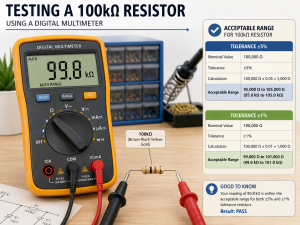
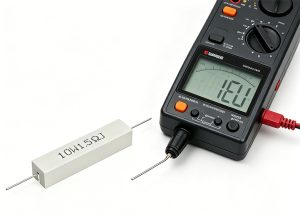
- Use a multimeter: Measure resistance in both directions. Polarized capacitors show significantly different resistance values forward and reverse. Non-polarized capacitors show nearly the same resistance (usually infinite) in both directions.
- Refer to the capacitor model: Search the model number in manufacturer manuals or online databases, which clearly indicate polarity and terminal positions, useful for capacitors with unclear markings.
- Observe circuit application: Capacitors for DC circuit filtering, bulk energy storage, or low-frequency coupling are usually polarized. Those for AC circuits, high-frequency filtering, or oscillation are usually non-polarized.
Can You Use a Non-Polarized Capacitor Instead of a Polarized One?
Yes, you can use a non-polarized capacitor instead of a polarized one, but only if you meet specific requirements. The non-polarized capacitor must have the same or higher capacitance value and voltage rating as the polarized capacitor it is replacing.
This ensures it can handle the same amount of charge and voltage as the original component.
However, there are practical limitations to consider. Non-polarized capacitors with high capacitance are larger and more expensive than polarized capacitors, making them impractical for many projects.
For example, replacing a 1000 µF polarized capacitor with a non-polarized one would require a much larger component, which may not fit in the circuit layout. Additionally, non-polarized capacitors have lower capacitance density, so they may not be suitable for applications that require high capacitance in a compact space.
When replacing a polarized capacitor with a non-polarized one, always check the datasheet to ensure compatibility with the circuit’s requirements.
FAQs About Polarized vs Non-Polarized Capacitor
Q1: Can Polarized Capacitors Be Used in AC Circuits?
A1: No, polarized capacitors cannot be used in AC circuits. Their dielectric layer is designed for DC voltage only; alternating polarity will break down the dielectric, causing overheating, leakage, and component failure. Non-polarized capacitors are designed for AC circuits and should be used instead.
Q2: What Happens if You Reverse a Polarized Capacitor?
A2: Reversing a polarized capacitor dissolves its dielectric layer, leading to high current flow and heat buildup. This can cause electrolyte leakage, component rupture, or even fire (especially with tantalum capacitors). Always check polarity markings before installation to avoid this issue.
Q3: Are Non-Polarized Capacitors Suitable for DC Circuits?
A3: Yes, non-polarized capacitors can be used in DC circuits for filtering, decoupling, and signal coupling. However, their lower capacitance makes them unsuitable for bulk energy storage, where polarized capacitors are more practical.
Q4: How Long Do Polarized vs Non-Polarized Capacitors Last?
A4: Non-polarized capacitors have a longer lifespan (10–20 years) due to their stable structure. Polarized capacitors last 2–10 years, as their liquid/gel electrolytes evaporate over time. High temperatures accelerate aging for both types, so proper heat management is key.
Q5: Which Type of Capacitor Is Better for High-Frequency Circuits?
A5: Non-polarized capacitors are better for high-frequency circuits. Their low equivalent series resistance (ESR) and strong temperature stability ensure reliable performance, with ceramic non-polarized capacitors being the top choice for minimal signal loss.
Q6: How to Verify Polarized Capacitor Polarity When Markings Are Blurred?
A6: For aluminum electrolytic capacitors, use the diode mode on a multimeter: connect the red test lead to one terminal and the black test lead to the other. If it shows 0.5–1V (gradually increasing to OL), the red test lead is connected to the positive terminal; swapping the test leads shows OL or a higher voltage. This is an auxiliary method, replace old capacitors with unclear markings for safety.
Q7: Are All Ceramic and Film Capacitors Non-Polarized?
A7: Almost all ceramic and film capacitors (such as polyester capacitors and polypropylene capacitors) are non-polarized and can be connected in any direction. Only a few high-frequency ceramic capacitors may have directional requirements, which need confirmation via datasheets.