What is acrylic conformal coating?
Acrylic conformal coating is a thin, transparent protective film applied over a printed circuit board to shield sensitive circuits from moisture, dust, light chemical exposure, salt mist, mild corrosion, and general environmental stress. In PCB assembly, it is often used when the electronics must remain reliable after leaving a clean factory environment and entering real operating conditions, such as industrial cabinets, medical devices, outdoor controls, automotive modules, LED systems, consumer electronics, and communication equipment.
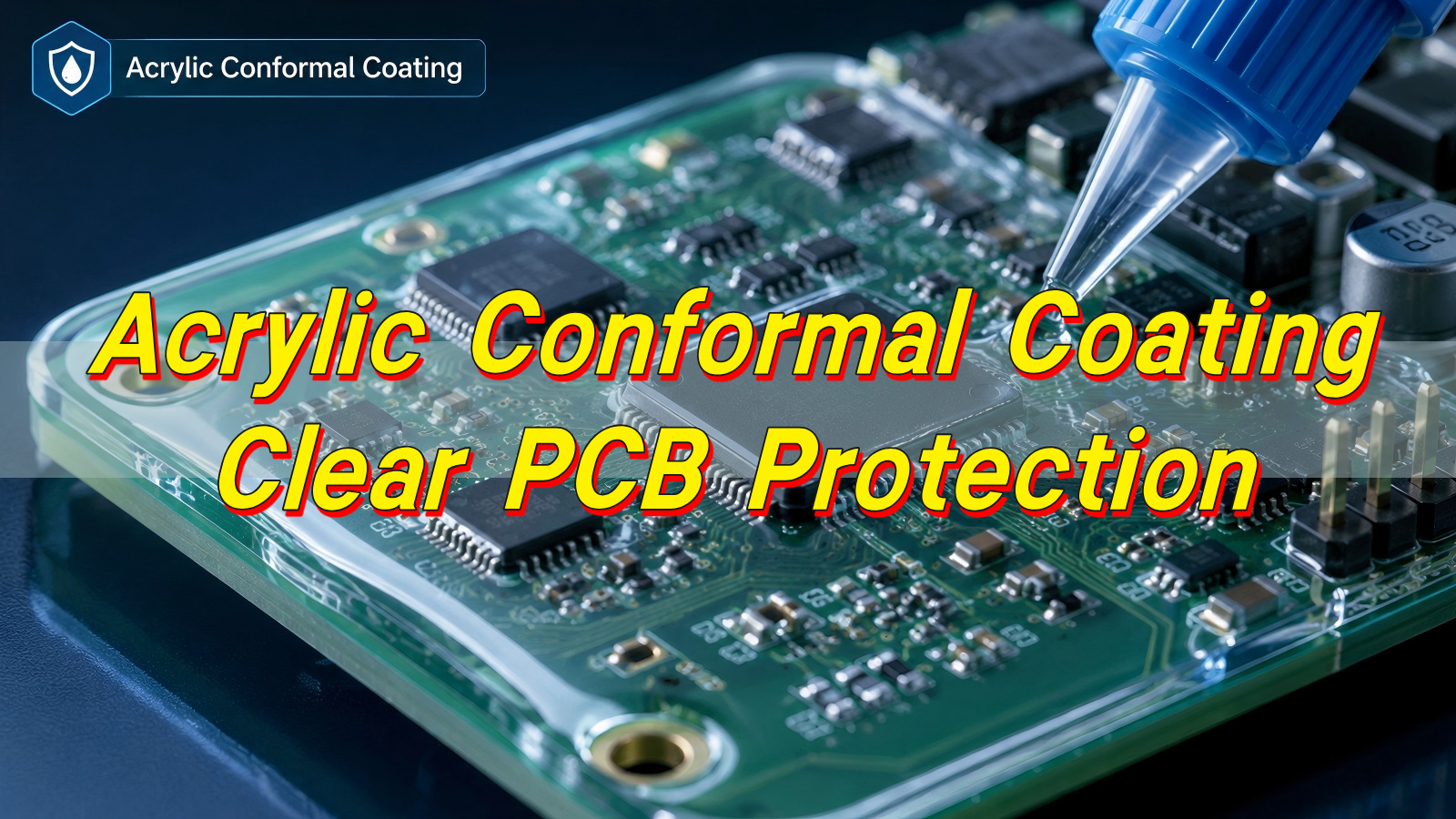
The coating is called “conformal” because it follows the shape of the PCB surface. It covers solder joints, component leads, copper traces, exposed pads, and surface-mounted devices with a uniform protective layer. Unlike potting compound, which fully encapsulates the circuit, acrylic coating remains relatively thin and lightweight. This makes it suitable for assemblies where space, weight, inspection, and repairability still matter.
The main resin system in this type of coating is acrylic. Once applied and dried, it forms a hard but flexible protective film. Most acrylic coatings are clear, which allows engineers and quality teams to inspect markings, solder joints, component orientation, and general workmanship after coating. This is one reason conformal coating acrylic materials are popular in PCBA production. They offer a clean visual finish while improving board-level protection.
In practical electronics manufacturing, acrylic coating is valued because it is easy to apply, dries quickly, and is easier to remove than many other coating families. This makes it attractive for prototypes, medium-volume production, and products that may need future rework. For example, when a component must be replaced, acrylic conformal coating removal is usually more straightforward than removing urethane or silicone coating. Technicians can often use compatible solvents, localized abrasion, or controlled repair methods depending on the coating chemistry and board design.
For PCB manufacturers and assembly partners such as EBest Circuit (Best Technology), acrylic coating can be part of a wider reliability strategy. A coating does not replace proper PCB design, soldering control, cleanliness, material selection, or testing. Instead, it works together with these process controls. When applied correctly, it helps create a more dependable assembly for customers who need stable performance in humid, dusty, or mildly corrosive environments.
Acrylic coating is commonly available in liquid form for brushing, dipping, and spraying. It can also be formulated as an acrylic conformal coating spray for convenient manual application or repair. Some advanced production lines use selective coating machines to apply the film only to defined areas while keeping connectors, test points, switches, sensors, heat sinks, and other keep-out zones free of coating.
In short, this coating is a practical, clear, and efficient PCB protection method. It is widely used because it balances protection, process speed, appearance, and reworkability. For many electronic products, that balance is more valuable than choosing the thickest or most chemically resistant material.
How to spray acrylic conformal coating?
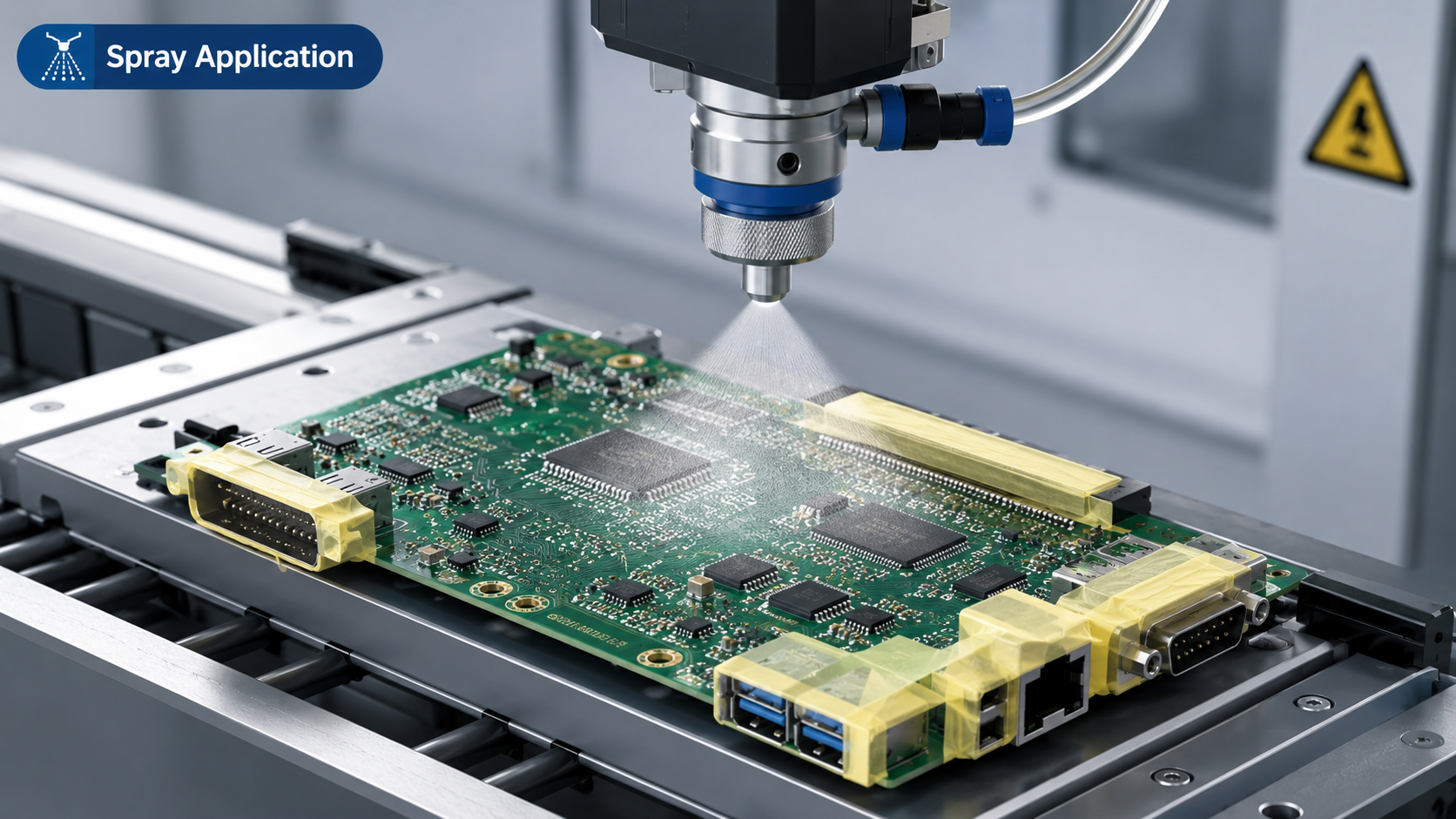
Spraying is one of the most common application methods for acrylic coating, especially when the production team wants a smooth, even, and visually clean finish. It can be done with aerosol cans, handheld spray guns, automated spray systems, or selective coating equipment. The right method depends on volume, board complexity, coating thickness requirement, masking needs, and quality expectations.
Before spraying, the PCB assembly must be clean and dry. This step is more important than many people realize. Flux residue, fingerprints, dust, moisture, ionic contamination, and handling marks can reduce coating adhesion and create cosmetic or electrical issues. A conformal coating layer is not a magic cover for poor cleaning. It performs best when the board surface is already controlled through a disciplined PCBA process.
A typical spray process starts with inspection and masking. Areas that should not be coated must be protected. These may include connectors, sockets, switches, programming ports, LEDs, display windows, RF shielding contact points, test pads, and mechanical grounding areas. Masking can be done with tapes, boots, caps, liquid mask, or custom fixtures. For higher-volume production, dedicated masking fixtures save time and improve repeatability.
After masking, the operator or machine applies the coating in thin, controlled passes. It is usually better to apply multiple light passes than one heavy wet layer. A heavy layer can trap solvent, cause bubbles, create edge buildup, or produce uneven coverage around tall components. A controlled spray angle also matters. Tall capacitors, transformers, relays, connectors, and shield cans can create shadowed areas. Operators often adjust spray direction to improve coverage around component bodies and solder joints.
A practical spray workflow may look like this:
- Clean and dry the assembled PCB before coating.
- Mask connectors, test points, switches, sensors, and other keep-out areas.
- Mix or prepare the coating according to the supplier’s technical data sheet.
- Spray thin, even passes across the board surface.
- Allow proper flash-off time between coats if multiple coats are needed.
- Inspect the coating under normal light and, if applicable, UV inspection light.
- Cure or dry the board under the recommended temperature and time conditions.
- Remove masking and complete final quality checks.
Acrylic conformal coating spray is convenient for engineering samples, repair work, and low-volume builds. It allows quick application without complex equipment. However, aerosol spraying requires good operator control. Distance, angle, speed, and overlap can all affect the final coating thickness. For production builds, spray guns or automated systems usually deliver better consistency.
In professional PCB assembly, coating thickness is often checked using wet film gauges, dry film measurement, witness coupons, or other approved methods. The target thickness depends on the coating material, design standard, operating environment, and customer requirement. A thicker coating is not always better. Excessive thickness may create stress, slow drying, affect component cooling, or interfere with connectors and moving parts. The objective is controlled coverage, not simply more material.
Ventilation and safety control are also part of the process. Many solvent-based acrylic coatings release vapors during spraying and drying. Operators should use proper extraction, personal protective equipment, and approved handling practices. The coating material’s safety data sheet should always guide storage, use, and disposal.
At EBest Circuit (Best Technology), coating process planning normally starts with the product application and assembly design. A board used in a medical monitoring device may require different masking, documentation, and inspection control than a lighting module or industrial sensor. Spray application can be highly effective, but it should be supported by clear drawings, coating keep-out definitions, and acceptance standards.
Why choose acrylic coating over other conformal coatings?
Acrylic coating is often selected because it offers a highly practical balance between protection, processing speed, cost control, visual clarity, and repairability. In many PCB projects, the best coating is not the most aggressive material. The better choice is the one that matches the actual operating environment, production process, inspection needs, and lifecycle expectations.
Conformal coating families commonly include acrylic, silicone, urethane, epoxy, parylene, and UV-curable materials. Each has its own strengths. Acrylic is popular because it is easier to apply and remove than many alternatives. It dries relatively fast, offers good moisture and dielectric protection, and creates a clear finish that supports inspection. For many indoor industrial, commercial, medical, control, and electronic assembly applications, this makes acrylic a smart and efficient option.
When people compare acrylic vs silicone conformal coating, the real question is usually about flexibility and temperature. Silicone coatings are often better for very high-temperature environments or assemblies exposed to strong thermal cycling. They remain soft and elastic. Acrylic coatings are harder, cleaner-looking, and easier to handle in many production environments. Acrylic is also generally easier to rework, which is valuable when the product may need component replacement or field repair.
When comparing acrylic vs urethane conformal coating, the discussion often centers on chemical resistance and removal. Urethane coatings are usually chosen for harsher chemical exposure and stronger abrasion resistance. Acrylic coatings are often preferred where fast drying, clean appearance, lower process complexity, and easier rework are more important. Urethane can be more difficult to remove, which may increase repair time.
Here is a clear comparison:
| Coating Type | Practical Strengths | Typical Considerations | Best-Fit Applications |
|---|---|---|---|
| Acrylic | Fast drying, clear finish, good moisture protection, easy inspection, easier removal | Moderate chemical resistance compared with urethane; may not be ideal for very high heat | General PCB protection, industrial controls, medical electronics, consumer devices, LED products |
| Silicone | Excellent flexibility, good high-temperature performance, strong thermal cycling tolerance | Softer surface, may attract dust, repair can be more process-sensitive | Automotive under-hood electronics, outdoor controls, high-temperature assemblies |
| Urethane | Strong chemical and abrasion resistance, durable film | Slower processing in some systems, more difficult rework | Harsh industrial environments, chemical exposure, ruggedized electronics |
| Epoxy | Tough, durable protection | Difficult removal, higher stress potential, less convenient for rework | High-protection applications where repair is less likely |
| Parylene | Very uniform vapor-deposited coating, excellent coverage | Specialized process, higher cost, limited simple rework | High-reliability medical, aerospace, miniature electronics |
For many engineers, acrylic coating becomes the preferred choice because it supports real production needs. It can be sprayed, dipped, brushed, or selectively applied. It dries quickly enough for efficient workflow. It keeps the board readable. It also allows rework when needed, which helps reduce service complexity.
This is especially useful in prototype-to-production projects. A team may still be optimizing BOM choices, connector positions, test methods, or enclosure design. Choosing a highly permanent coating too early can make debugging and changes more difficult. Acrylic gives engineers a useful middle ground. It offers dependable protection while keeping the product more serviceable.
EBest Circuit (Best Technology) often helps customers evaluate coating choices from a manufacturing viewpoint. The decision should consider operating temperature, humidity, chemicals, vibration, cleaning agents, expected service life, inspection requirements, and repair strategy. A material that looks strong on paper may create unnecessary complexity if it does not match the product’s real conditions.
What are the benefits of acrylic conformal coating for PCBs?
The benefits of acrylic coating for PCBs are strongest when the assembly needs clear, lightweight, and cost-conscious protection without making rework overly complicated. For many electronic products, this coating helps improve operational stability while keeping the manufacturing process efficient.
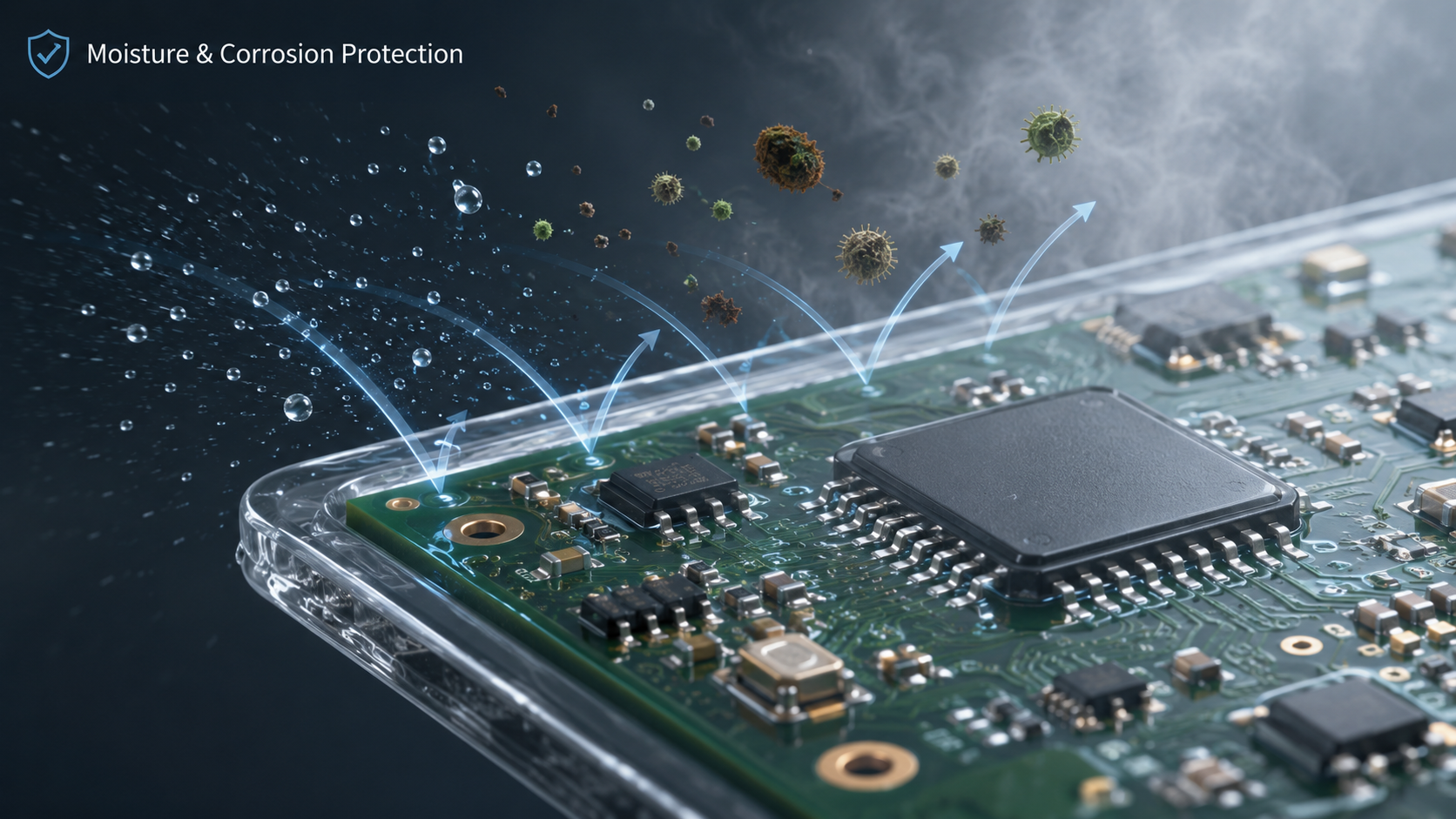
The first major benefit is moisture protection. PCBs may encounter humidity during shipping, storage, installation, or daily operation. Moisture can reduce insulation resistance, encourage corrosion, and create leakage paths between conductive features. A properly applied acrylic film helps reduce direct contact between the board surface and the surrounding environment.
The second benefit is corrosion resistance. Copper, solder joints, component leads, and exposed metal surfaces can be affected by moisture, salt, sulfur compounds, and airborne contaminants. Acrylic coating helps isolate these areas. This is useful for electronics used near coastal areas, factory floors, transportation systems, and equipment rooms where the environment is less controlled than a laboratory.
Another important benefit is dielectric protection. A conformal coating layer helps improve surface insulation between conductive points. This is useful on boards with fine-pitch components, high impedance circuits, compact layouts, and areas where condensation may be present. Good coating coverage helps the circuit maintain more stable electrical behavior over time.
Acrylic coatings also provide a clean visual finish. Since the film is usually transparent, board markings remain visible. This supports inspection, traceability, serial number reading, repair, and quality review. For customers who value tidy workmanship, the final coated board can look refined and professional.
Common advantages include:
- Clear appearance for easy inspection and product traceability.
- Fast drying compared with many traditional coating systems.
- Good protection against humidity, dust, and mild corrosion.
- Practical reworkability for component replacement or repair.
- Compatible with spray, brush, dip, and selective coating methods.
- Suitable for many commercial, industrial, medical, and control electronics.
- Lightweight protection without bulky encapsulation.
- Balanced cost and process efficiency for production builds.
Acrylic coating also supports manufacturability. It does not usually require the same process complexity as some highly specialized coatings. For many PCBA factories, this means faster line setup, more flexible application methods, and easier operator training. When production volume increases, the process can be upgraded from manual spray to selective coating equipment.
In terms of product design, acrylic coating can help extend the usable life of assemblies operating in humid or dusty conditions. It is especially useful for boards installed inside enclosures that offer some physical protection but are not fully sealed. Examples include control boards, sensor modules, power control boards, LED drivers, instrumentation boards, and medical monitoring electronics.
However, the real benefit depends on application quality. A thin, uniform, well-cured coating performs far better than a thick but poorly controlled layer. Masking, cleanliness, viscosity, spray pattern, curing time, and inspection all influence the result. This is why coating should be treated as an engineered process, not a simple finishing step.
At EBest Circuit (Best Technology), coating can be considered alongside PCB fabrication, component sourcing, assembly, testing, and reliability planning. This integrated view helps customers avoid late-stage surprises. For example, connector keep-out areas, test pad access, conformal coating inspection, and rework strategy can be discussed before mass production begins.
Is UV curable acrylic coating better for mass production?
UV curable acrylic coating can be an excellent choice for mass production when speed, controlled curing, and production throughput are top priorities. Traditional solvent-based acrylic coatings dry as solvents evaporate. UV curable systems cure rapidly when exposed to ultraviolet light. This can reduce waiting time, improve handling speed, and make production flow more predictable.
In high-volume PCBA manufacturing, curing time matters. A coating that takes a long time to dry may require more floor space, more racks, longer work-in-process time, and additional handling control. UV curing can help reduce these pressures. Once the coated board passes through a proper UV curing system, the film can become tack-free and ready for the next process much faster than many conventional materials.
That said, “better” depends on the product. UV curable acrylic coating is powerful when the board geometry allows sufficient UV exposure. Areas under tall components, inside shadowed regions, or beneath certain connectors may not receive enough UV light. Some UV systems use secondary moisture or thermal cure mechanisms to complete curing in shadowed zones. The coating supplier’s technical data must be reviewed carefully.
For mass production, UV systems can offer strong advantages in consistency. Automated dispensing or selective coating equipment can apply the material to defined areas, while UV curing equipment provides controlled energy exposure. This combination supports repeatability, which is valuable for customers with strict quality requirements.
Here is a practical comparison:
| Factor | Standard Acrylic Coating | UV Curable Acrylic Coating |
|---|---|---|
| Drying/Curing Method | Solvent evaporation or air drying, sometimes with heat assistance | UV exposure, sometimes with secondary cure for shadowed areas |
| Production Speed | Good for prototypes, low-volume, and medium-volume work | Very strong for high-volume production |
| Equipment Requirement | Lower; can use spray, brush, dip, or selective systems | Higher; needs UV curing equipment and process control |
| Shadowed Areas | Less affected by UV access, but still needs drying time | Requires attention to component shadows and coverage |
| Reworkability | Usually good | Depends on formulation; often still manageable |
| Process Control | Moderate to high, depending on application method | High when paired with automated coating and curing |
UV curable acrylic coating is especially attractive for products where production lines need fast movement from coating to inspection, packaging, or further assembly. It may also reduce solvent-related handling concerns in some formulations. For customers scaling from engineering samples to larger builds, UV technology can improve throughput when the coating design is properly validated.
However, a mass production decision should include testing. Engineers should confirm adhesion, thickness, coverage, curing completeness, environmental resistance, masking quality, and long-term reliability. It is also wise to run sample boards through the intended process before committing to full production. Coating materials can behave differently depending on board layout, component height, solder mask surface, cleaning chemistry, and curing equipment.
EBest Circuit (Best Technology) can support this type of evaluation by reviewing the assembly structure and coating objectives. For some products, standard acrylic spray may be the right answer. For others, UV curable acrylic may provide faster, cleaner, and more scalable production. The best selection is based on evidence from the product, not only on the coating category.
How fast does acrylic conformal coating dry and cure?
Acrylic coating is known for relatively fast drying, which is one reason it is widely used in PCB assembly. The exact drying and curing time depends on the coating formulation, solvent system, applied thickness, airflow, humidity, temperature, board geometry, and whether heat or UV curing is used.
For many solvent-based acrylic materials, the surface can become tack-free within minutes to less than an hour under suitable conditions. Full cure may take longer, often several hours or more depending on the product data sheet. Some coatings reach handling strength quickly but continue to build final film properties over time. This is why production teams should not rely only on touch. A coating may feel dry before it has achieved its final protective performance.
In practical terms, drying has two stages. The first stage is flash-off, where solvents begin to evaporate from the wet film. The second stage is curing or final film formation, where the coating reaches its intended mechanical and protective properties. If the coating is applied too thickly, the top surface can dry while solvent remains trapped underneath. This may lead to bubbles, cloudy appearance, weak adhesion, or longer cure times.
Temperature can speed up drying, but it must be controlled. Excessive heat may affect components, labels, plastics, batteries, displays, or other sensitive parts. Airflow also helps solvent evaporation, but strong uncontrolled airflow can carry dust or create uneven drying. In a professional coating process, drying conditions should be defined and repeatable.
Aerosol acrylic conformal coating spray may become touch-dry fairly quickly, which makes it convenient for repair and prototype work. However, final assembly, testing, packaging, or shipment should follow the recommended cure schedule. For products used in medical, industrial, or transportation environments, proper curing is part of reliability control.
UV curable acrylic systems are much faster when exposed to the correct UV intensity and wavelength. Some can cure within seconds in exposed areas. This makes them attractive for automated production. Still, shadowed areas require attention. If the coating supplier specifies secondary cure requirements, the production process must include them.
A simple way to think about drying speed is this: acrylic coating is usually fast enough for efficient production, but it still requires disciplined process control. The board should not be rushed into packaging or environmental testing before the film has reached the required condition. Handling too early may leave marks, trap solvent, or affect coating uniformity.
Quality teams often verify coating cure through visual inspection, tack testing, thickness measurement, adhesion checks, or process validation records. For more demanding projects, environmental tests may also be used. These can include humidity exposure, thermal cycling, salt mist testing, insulation resistance testing, or customer-defined qualification plans.
EBest Circuit (Best Technology) can help customers define realistic process windows during PCBA production. This is especially important when coating is used on boards with dense components, connectors, transformers, large capacitors, heat sinks, or mixed material surfaces. A good cure schedule protects both product quality and delivery efficiency.
Can acrylic coating protect PCBs from moisture and corrosion?
Yes, acrylic coating can protect PCBs from moisture and corrosion when it is properly selected, applied, cured, and inspected. It creates a protective barrier between the circuit surface and the external environment. This barrier helps reduce moisture contact, surface contamination, oxidation, and corrosion risk on metal features.
Moisture is one of the most common challenges for electronic assemblies. Even when a product is not directly exposed to rain or water, humidity can still enter enclosures. Temperature changes can cause condensation. Dust can absorb moisture. Ionic residues on the PCB surface can become conductive when damp. These conditions may lead to leakage current, corrosion, dendritic growth, unstable signals, or intermittent failures.
Acrylic coating helps by covering vulnerable areas with a continuous film. It protects solder joints, component terminations, copper features, and exposed conductive surfaces. It also helps maintain insulation resistance across the board surface. This is valuable for assemblies used in humid warehouses, industrial facilities, medical environments, HVAC systems, lighting equipment, transportation electronics, and outdoor-adjacent installations.
Corrosion protection is another reason engineers choose this coating. In real operating environments, PCBs may be exposed to airborne salts, cleaning chemicals, sulfur compounds, flux residue, skin oils, or industrial contaminants. A well-applied coating helps reduce direct contact between those contaminants and the board. This supports longer, more stable operation.
However, coating performance depends heavily on cleanliness. If ionic residue or moisture is trapped under the coating, the film may seal in a problem rather than solve it. That is why board cleaning, drying, and inspection must happen before coating. For no-clean flux processes, engineers should still verify compatibility between the flux residue and the coating material. Not every no-clean residue is automatically safe under every coating.
Coverage is also important. Moisture can enter through pinholes, thin edges, uncoated shadow areas, or poorly masked transitions. Sharp component leads, tall solder joints, and board edges may need special attention. Selective coating programs should include coverage checks around dense or high-risk areas.
For products with severe exposure to chemicals, fuel, oils, or continuous outdoor condensation, acrylic may not always be the strongest choice. In such conditions, silicone, urethane, parylene, or special hybrid coatings may be reviewed. Still, for a large range of commercial and industrial PCBs, acrylic coating provides dependable moisture and corrosion protection with a process-friendly profile.
In practical design reviews, it is useful to ask:
- Will the board be used indoors, outdoors, or inside a semi-sealed enclosure?
- Will it face condensation, salt air, cleaning fluids, or industrial fumes?
- Are there high-impedance circuits or fine-pitch components?
- Are connectors, switches, sensors, or test pads sensitive to coating contamination?
- Will the assembly need future rework or repair?
- What inspection and qualification tests are required?
These questions help define whether acrylic coating is the right fit. They also guide masking, thickness, cleaning, and testing requirements. EBest Circuit (Best Technology) can review these details during the early manufacturing stage, helping customers build a coating process that aligns with product use and reliability expectations.
Is acrylic conformal coating suitable for medical devices?
Acrylic coating can be suitable for medical device PCBs when the material, process, documentation, and quality controls match the device’s risk level and operating environment. It is commonly considered for medical monitoring equipment, diagnostic electronics, wearable health devices, control modules, sensor boards, power management boards, and user-interface assemblies.
Medical electronics require stable performance, clean workmanship, traceability, and disciplined process control. The coating material should not be chosen only because it is easy to apply. It should be reviewed in the context of the whole device. This includes enclosure design, sterilization method if applicable, operating temperature, humidity exposure, cleaning agents, electrical requirements, service strategy, and regulatory documentation needs.
For many non-implantable medical electronic assemblies, acrylic coating offers several practical benefits. It provides clear protection against humidity and contamination while allowing visual inspection of component markings and solder quality. It supports rework when properly managed. It also fits well with production processes where traceability and repeatability matter.
In medical PCB assembly, acrylic coating may be used to protect boards inside patient monitoring devices, portable diagnostic tools, test instruments, home healthcare electronics, control panels, and certain wearable devices. These products often operate in environments where cleaning, humidity, and repeated handling are expected. A protective coating can help improve reliability over time.
The suitability also depends on biocompatibility and exposure conditions. If the coating will have direct or indirect patient contact, the material requirements become more specific. If the board is fully enclosed and does not contact the patient, the focus may be more on electrical reliability, process cleanliness, and long-term performance. Engineering and regulatory teams should confirm the required standards for the exact device category.
Process documentation is especially important in medical electronics. A controlled coating process should define the material, batch traceability, application method, coating thickness, masking areas, inspection method, curing parameters, acceptance criteria, and rework procedure. This helps support consistent production and customer audits.
EBest Circuit (Best Technology) has experience supporting PCB and PCBA projects where reliability, documentation, and traceability are important. For medical device PCB assembly, coating should be part of a structured manufacturing plan. The goal is not only to apply a protective film. The goal is to deliver a repeatable, inspectable, and documented assembly that fits the customer’s device requirements.
Acrylic coating is especially useful when medical devices need clear PCB protection without sacrificing repairability. For example, if an engineering team expects future design revisions or component replacement during validation, acrylic is often easier to manage than a more permanent material. It allows teams to protect the board while keeping development practical.
Still, every medical product should be reviewed individually. A board used in a portable monitor may have different requirements from a board used in sterilization equipment or fluid-handling instruments. The right coating choice should come from the application environment, not from a generic material preference.
What industries commonly use acrylic conformal coatings?
Acrylic coatings are used across many industries because they provide clean, efficient, and serviceable PCB protection. They are especially popular in products that need improved resistance to humidity, dust, and mild corrosion while keeping manufacturing flexible.
In industrial electronics, acrylic coatings are often used on control boards, sensor modules, automation equipment, motor control boards, power supplies, and monitoring systems. These products may operate near machinery, dust, oils, vibration, and changing temperatures. A clear protective coating helps maintain circuit stability and supports easier inspection during maintenance.
Medical electronics also use acrylic coatings where the application conditions are appropriate. Patient monitoring devices, diagnostic tools, portable health devices, and laboratory equipment may benefit from moisture and contamination protection. The clear film allows markings and inspection points to remain visible, which is helpful for traceability and quality review.
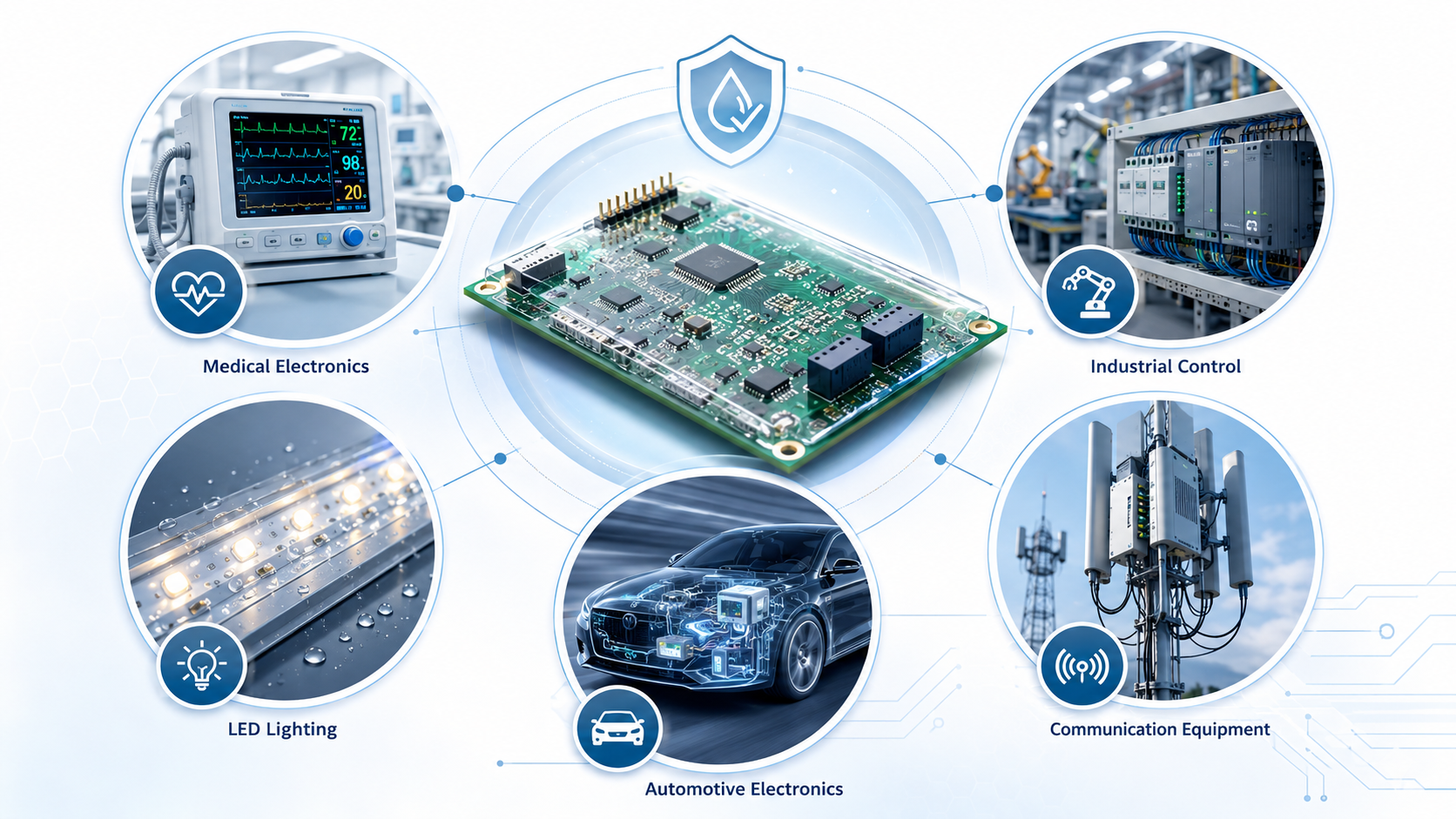
Automotive electronics may use acrylic coatings in interior modules, control electronics, lighting boards, battery management support boards, and sensor-related assemblies. For under-hood or high-temperature areas, silicone or other materials may sometimes be reviewed, but acrylic remains useful in many protected automotive locations.
Consumer electronics can benefit from acrylic coating when products face humidity, handling, sweat, or environmental dust. Examples include smart home devices, control panels, wearable accessories, audio equipment, handheld electronics, and appliance control boards. The coating improves durability without adding large weight or volume.
LED and lighting products are another common area. LED drivers, lighting control boards, signage modules, and outdoor-adjacent lighting electronics may need protection from moisture and condensation. Acrylic coating helps protect solder joints and circuits while keeping the board visually clean.
Aerospace and transportation applications may also use coating, although the material choice is usually based on strict qualification needs. Acrylic may be suitable for certain protected electronics, while other coating materials may be chosen for more demanding conditions. In these industries, documentation and process validation are extremely important.
Telecommunications and communication equipment often use coatings on control boards, signal boards, power modules, and outdoor cabinet electronics. Humidity and airborne contamination can affect long-term reliability, especially in remote installations or semi-protected environments.
Common industries include:
- Industrial control and automation.
- Medical electronics and diagnostic devices.
- Automotive interior and protected electronic modules.
- LED lighting and signage systems.
- Consumer and smart home electronics.
- Communication and telecom equipment.
- Instrumentation and measurement devices.
- Power electronics and control systems.
- Security electronics and access control devices.
- Transportation and equipment monitoring systems.
For each industry, the coating specification should be matched to the actual operating environment. A factory control board, wearable medical device, and LED streetlight driver may all use acrylic coating, but their process requirements may differ. Masking, thickness, cure schedule, cleanliness level, inspection method, and testing plan should be defined separately.
EBest Circuit (Best Technology) supports customers across multiple electronic manufacturing sectors, from PCB fabrication to PCBA assembly and engineering review. For customers using acrylic coatings, early communication is helpful. Coating drawings, keep-out zones, and environmental requirements should be shared before production. This allows the manufacturing team to prepare the correct process route and reduce avoidable delays.
How to apply acrylic conformal coating (spray/dip/brush)?
Acrylic coating can be applied by spray, dip, brush, or selective coating. Each method has its own role in PCB assembly. The best choice depends on production volume, board size, component layout, masking complexity, coating thickness control, cosmetic requirements, and budget.
Spray application is widely used because it produces a smooth and uniform finish. It is suitable for prototypes, batch production, and automated coating lines. Manual spray is flexible, while automated selective spray provides stronger repeatability. Spray is often chosen when the assembly has many components and needs an even coating without immersing the whole board.
Dip coating is efficient for boards that can be fully coated, especially when high throughput is needed and masking is manageable. The board is dipped into a coating tank and withdrawn at a controlled speed. This method can provide complete coverage, including edges and lower surfaces. However, it requires careful masking of connectors and other no-coat areas. It also needs good viscosity control and tank management.
Brush application is simple and useful for repair, prototypes, small areas, or localized touch-up. It does not require expensive equipment. However, brush marks and uneven thickness can occur if the operator is not careful. Brush coating is usually less suitable for high cosmetic requirements or large-volume production, but it remains valuable for engineering work and rework.
Selective coating is the preferred method for many professional production lines. A programmed machine applies coating only to specified areas. This reduces masking labor, improves consistency, and supports repeatable quality. Selective coating is especially useful for boards with many connectors, test points, switches, and coating keep-out zones.
Here is a practical comparison:
| Application Method | Main Advantage | Best Use Case | Process Notes |
|---|---|---|---|
| Spray | Smooth finish and flexible coverage | Prototypes, batch builds, automated production | Requires good control of spray distance, angle, and thickness |
| Dip | Efficient full-board coverage | Simple board designs and larger batches | Requires careful masking and viscosity control |
| Brush | Low-cost and convenient | Repair, touch-up, small prototypes | Operator skill strongly affects appearance and thickness |
| Selective Coating | High repeatability and reduced masking | Medium to high-volume PCBA production | Requires programming, fixtures, and process validation |
The application process should begin with design review. Engineers should identify where coating is required and where it must be avoided. Connectors, card edges, mechanical contacts, switches, heat dissipation surfaces, microphones, pressure sensors, optical sensors, and test points often need keep-out protection. Clear coating drawings reduce misunderstanding between the customer and manufacturer.
After design review, the board should be cleaned and dried if the process requires it. Cleaning compatibility should be confirmed with the flux system, components, labels, and coating material. Sensitive components should be reviewed before exposure to solvents or heat.
Masking comes next. In manual processes, tapes, boots, plugs, and temporary masks are often used. In selective coating, the program itself controls the coating path, but some areas may still require physical masking. Masking quality has a direct effect on final appearance and functionality.
The coating is then applied according to the selected method. Thickness should be controlled within the required range. After application, the board is dried or cured according to the material’s technical data sheet. Final inspection should check coverage, bubbles, cracks, delamination, bridging, coating on keep-out areas, and overall workmanship. UV tracer in many coatings can help inspection under UV light.
Acrylic conformal coating removal should also be considered during process planning. If future repair is likely, the manufacturer should define an approved removal method. Acrylic coating is often easier to remove than urethane or epoxy, which makes it practical for products that may need service. Repaired areas should be recoated and inspected to restore protection.
For customers working with EBest Circuit (Best Technology), coating requirements can be integrated into the full PCB and PCBA workflow. This includes PCB fabrication, assembly, component sourcing, cleaning, masking, coating, curing, inspection, and testing. When all steps are aligned, the finished assembly has better consistency and a more professional finish.
Acrylic coating is a clear and practical way to protect PCBs from moisture, dust, mild corrosion, and everyday environmental stress. It is fast to process, easy to inspect, and more repair-friendly than many heavier coating systems. For many industrial, medical, lighting, consumer, automotive, and communication electronics, it offers a dependable balance between protection and manufacturability. EBest Circuit (Best Technology) can support customers with PCB fabrication, PCBA assembly, coating process review, and production planning. For project discussion or coating-related manufacturing support, contact sales@bestpcbs.com