Do you know why even the most advanced SMT assembly lines rely on small copper dots called fiducial marks PCB? For any PCB undergoing automated assembly, fiducial markers are not optional, they are the foundation of precision, reducing defects, speeding up production, and ensuring your design meets strict manufacturing standards.
This guide breaks down everything you need to know about fiducial marks PCB, from their purpose and design rules to placement strategies and manufacturing preparation, to help you create reliable, assembly-ready PCBs.

Are Fiducial Marks Necessary For PCB?
Fiducial marks are essential for all PCBs using automated SMT assembly, and they are highly recommended for any design that requires precise component placement. Even with modern manufacturing technology, fiducials remain non-negotiable because they solve critical alignment challenges that alternative methods cannot address.
Without fiducials, assembly machines struggle to compensate for board stretch, rotation, or minor misalignment, leading to misplaced components, solder bridges, tombstoning, and high rejection rates. For through-hole-only boards or manual assembly, fiducials are not required, but they are still useful for future automation or inspection.
What is The Purpose Of Fiducial Marks On PCB?
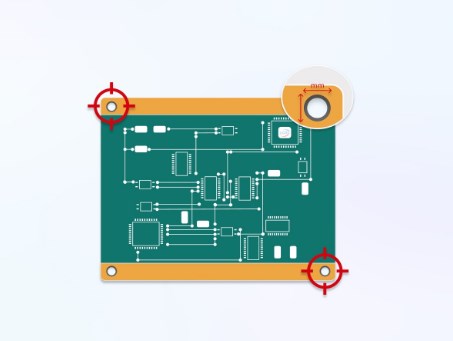
Fiducial marks are high-contrast, exposed copper reference points that act as a GPS for SMT machines, enabling precise alignment and calibration. Their core purpose is to provide a consistent, accurate reference for automated equipment, with three key functions:
- Board Alignment & Orientation: Vision cameras scan fiducials to calculate the PCB’s exact X/Y position, rotation angle, and scale (compensating for board stretch/shrinkage).
- Component Placement Precision: For fine-pitch parts (BGAs, QFPs, 01005 components), fiducials ensure placement accuracy down to 0.05mm, eliminating errors from manufacturing tolerances.
- Quality Control: AOI and SPI systems use fiducials to verify component placement and solder paste application, reducing false rejects and ensuring consistent quality.
Where To Place Fiducials On A PCB?
Fiducial placement directly impacts assembly accuracy, follow these rules for optimal results:
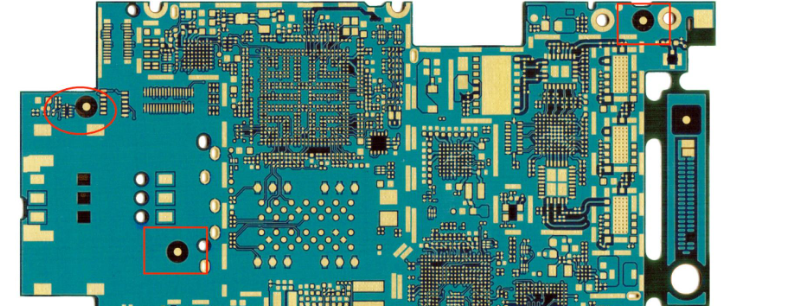
- Global Fiducials: Use 3 asymmetric marks in an L-shape (e.g., lower-left, upper-left, upper-right corners). Avoid symmetric layouts (all four corners) to prevent 180° orientation confusion.
- Edge Clearance: Maintain a minimum 5mm distance from the board edge to avoid obstruction by conveyor rails or clamping fixtures.
- Clearance Zone: Keep a 2–3mm radius around each fiducial completely free of traces, vias, silkscreen, or other copper features to ensure unobstructed vision recognition.
- Local Fiducials: For components with ≤0.5mm pitch (BGAs, QFPs), place 2 diagonal fiducials 1–3mm from the component’s corners.
- Double-Sided Boards: Add fiducials on both top and bottom layers (offset to avoid light interference).
How Do You Design A Good Fiducial Marker For PCB?
A well-designed fiducial ensures reliable machine vision detection and consistent assembly. Follow these design principles:
- Shape: Solid circle (preferred) for maximum rotational symmetry and recognition reliability. Avoid crosses, squares, or complex shapes unless verified with your assembler.
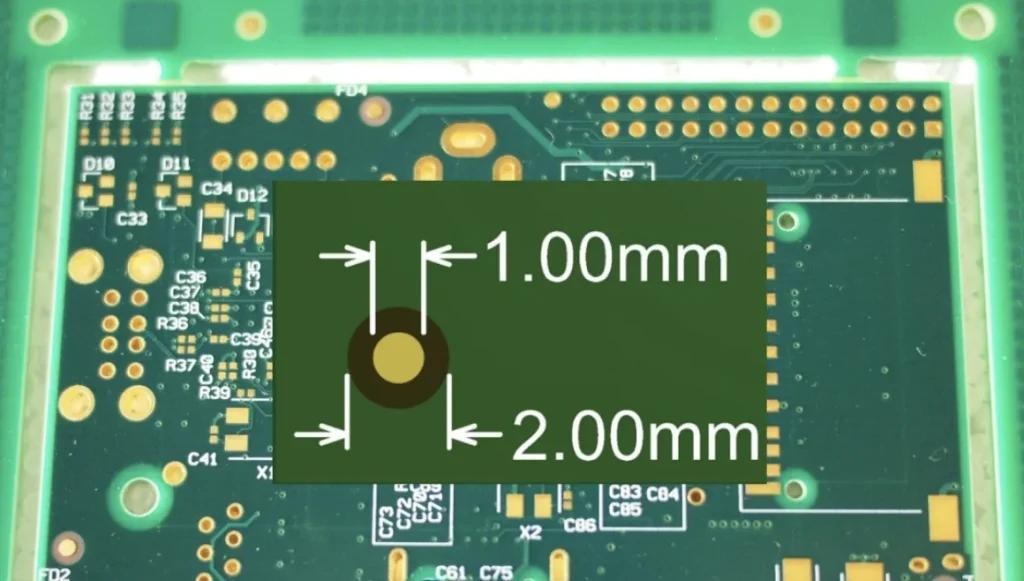
- Size: Standard copper diameter is 1.0mm (range: 0.8–1.5mm). Use 1.5–2.0mm for large boards or panels.
- Solder Mask Opening: Concentric opening 2.0mm (for 1.0mm copper) to create high contrast between exposed copper and solder mask.
- Surface Finish: Use ENIG (gold plating) or HASL (tin plating) for high reflectivity and oxidation resistance. Bare copper is acceptable but requires anti-oxidation coating.
- Consistency: All fiducials on the same board must be identical in size (±25µm tolerance).
How To Add Fiducial In PCB Design?
Adding fiducials is straightforward in all major EDA tools (Altium Designer, KiCad, Eagle). Follow this step-by-step process:
Step 1: Select Layer: Choose the copper layer (Top/Bottom Layer) where fiducials will be placed.
Step 2: Create Pad: Add a non-plated SMD pad with your chosen diameter (1.0mm standard).
Step 3: Solder Mask Opening: Draw a concentric circle on the solder mask layer (Top/Bottom Solder Mask) with a diameter twice the copper pad.
Step 4: Place Fiducials: Position 3 global fiducials in an L-shape, 5mm from board edges. Add local fiducials near fine-pitch components.
Step 5: Clearance Zone: Ensure 2–3mm radius around each fiducial is free of traces, vias, or silkscreen.
Step 6: Label & Verify: Label fiducials (FID1, FID2) and run DRC to check for violations.
Step 7: Export Files: Include fiducials in Gerber/ODB++ and pick-and-place data.
What is The Standard Fiducial Size For PCB?
The standard fiducial size follows IPC-7351 and SMEMA guidelines:
- Global Fiducials: 1.0mm copper diameter (most common) with 2.0mm solder mask opening.
- Local Fiducials: 1.0mm copper diameter (same as global).
- Large Boards/Panels: 1.5–2.0mm copper diameter for improved visibility.
- HDI/High-Density Designs: 0.8mm copper diameter (confirm with assembler).
- Clearance Zone: 3.0mm minimum radius (2–3× copper diameter).
What Do Fiducial Markers On PCB Look Like In Practical Applications?
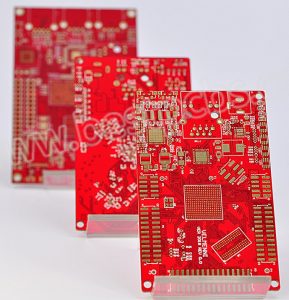
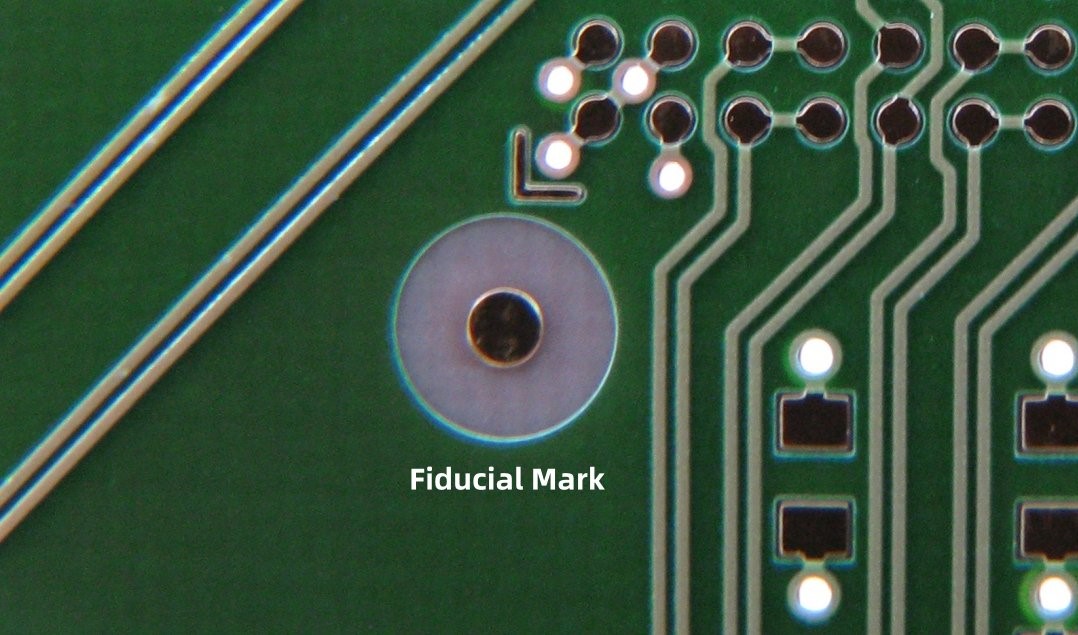
In practice, fiducial markers are small, round, exposed copper dots with a solder mask ring.
- Global Fiducials: Larger (1.0–2.0mm) placed on board corners.
- Local Fiducials: Smaller (1.0mm) near BGAs/QFPs.
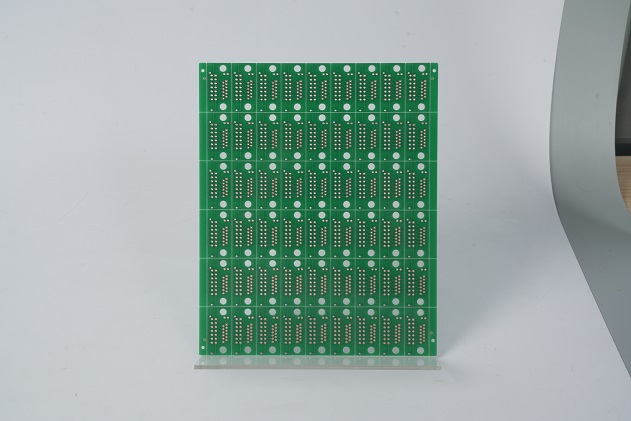
- Panel Fiducials: On panel rails for array alignment.
- Surface Finish: Gold or tin-plated for high contrast.
What Are The Different Types Of Fiducial Markers For PCB?
Fiducials are categorized by function and placement:
| Type | Location | Purpose | Quantity |
|---|---|---|---|
| Global Fiducials | PCB corners/edges | Board-level alignment, rotation, scale compensation | 3 (L-shape) |
| Local Fiducials | Near fine-pitch components (BGA/QFP) | Component-level precision | 2 per component |
| Panel Fiducials | Panel rails/frame | Entire array alignment | 3–4 per panel |
How Do You Prepare For Fiducial Markers On PCB Manufacturing?
Proper preparation ensures fiducials are manufacturable and recognizable:
- Design Review: Verify size, placement, and clearance zones meet assembler requirements.
- Surface Finish: Specify ENIG or HASL for high reflectivity.
- Gerber Files: Ensure fiducials are included in copper and solder mask layers.
- Fabrication Notes: Label fiducials as “Fiducial Markers” and specify size/clearance.
- Quality Check: Confirm no silkscreen/traces cover fiducials.
What Are The Key Considerations For Fiducial Marker Placement PCB?
Follow these critical rules to avoid common mistakes:
- Asymmetric Placement: 3 global fiducials in L-shape (not symmetric).
- Edge Distance: ≥5mm from board edges.
- Clearance Zone: 2–3mm radius free of all features.
- Consistent Size: All fiducials identical (±25µm).
- Double-Sided: Fiducials on both layers (offset).
- Panelization: Fiducials on each sub-board and panel rails.
FAQs About Fiducial Marks PCB
Q1: Do I need fiducial marks for a single-sided board?
A1: Yes. Even single-sided assembly requires global fiducials for stencil printing and pick-and-place alignment.
Q2: Can I use a via or tooling hole as a fiducial?
A2: No. Vias/holes are drilled separately, introducing registration errors. Fiducials are etched with copper traces for guaranteed accuracy.
Q3: How many fiducials do I need?
A3: 3 global fiducials (L-shape) are recommended. 2 minimum (diagonal). Add local fiducials for ≤0.5mm pitch components.
Q4: What happens if I omit fiducials?
A4: Assembly machines may reject the board or use alternative references, leading to misalignment, defects, higher costs, and longer production times.
Q5: Are fiducials needed for through-hole-only boards?
A5: No. Fiducials are for automated SMT assembly. Through-hole manual/automated insertion does not require them.
Q6: Can fiducials be covered by silkscreen?
A6: No. Silkscreen reduces contrast and causes recognition failures. Keep the entire fiducial area clear.
Q7: What is the minimum clearance around a fiducial?
A7: 2–3mm radius (2–3× copper diameter) free of traces, vias, silkscreen.
Q8: How do I add fiducials in Altium Designer?
A8: Place → Fiducial → Set size (1.0mm) → Place in L-shape → Add solder mask opening.