PCB manufacturing PCB manufacturing
Home > Blog

aluminum pcb

Aluminum pcb suppliers, High Quality&Customization
Monday, September 23rd, 2024

In the rapidly developing electronics industry, aluminum substrates, as a key electronic component carrier, have a direct impact on the reliability and stability of electronic products through their quality and performance. Choosing a reliable aluminum pcb suppliers is crucial for electronics manufacturers.

What is an aluminum substrate?

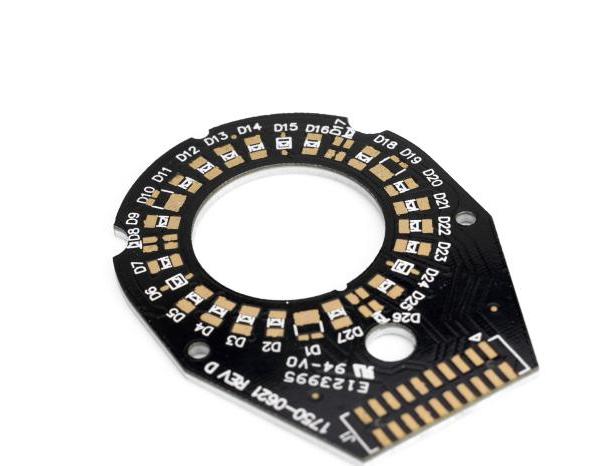
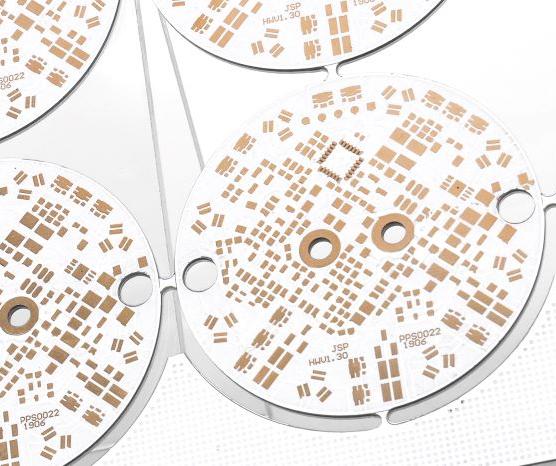
Aluminum substrate, the full name of which is aluminum-based copper clad laminate, has good heat dissipation, electrical insulation and mechanical processing performance. It is widely used in LED lighting, power modules, automotive electronics, communication equipment and other fields.
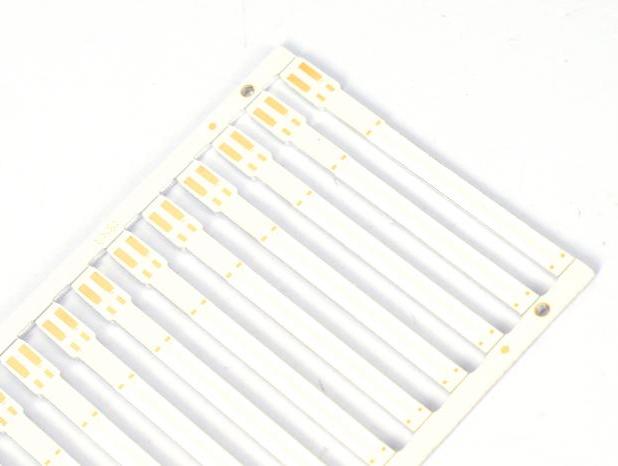
Aluminum pcb suppliers, High Quality&Customization

In these fields, aluminum substrates can effectively dissipate the heat generated by electronic components quickly, thereby ensuring the normal working temperature of electronic components and extending their service life. At the same time, the high insulation performance of aluminum substrates can prevent the occurrence of safety problems such as electrical short circuits and leakage.

In addition, the mechanical processing performance of aluminum substrates also enables it to adapt to various complex electronic equipment structure design requirements.

How to choose an aluminum pcb suppliers?

1. Conduct market research

  • Before choosing an aluminum pcb supplier, you need to conduct sufficient market research. Understand the product quality, technical strength, production capacity, service quality and price of different suppliers, and make comparisons and analyses.
  • You can get more information about suppliers through online searches, industry exhibitions, and consulting industry insiders. At the same time, you can also refer to the evaluations and recommendations of other customers to understand the reputation and credibility of the supplier.

2. On-site inspection of suppliers

  • After determining some potential suppliers, you can conduct on-site inspections. On-site inspections can give you a more intuitive understanding of the supplier’s production equipment, production processes, quality control systems, and management levels.
  • During the on-site inspection, you can communicate with the supplier’s technical personnel and management personnel to understand their technical strength and service level. At the same time, you can also view the supplier’s product samples to understand the quality and performance of the products.

3. Conduct sample testing

  • Before selecting an aluminum pcb supplier, you can ask the supplier to provide samples for testing. Sample testing can give you a more intuitive understanding of the supplier’s product quality and performance, and whether it meets your needs.
  • When conducting sample testing, you need to test according to your actual use requirements, such as heat dissipation performance, electrical insulation performance, mechanical processing performance, etc. At the same time, you also need to check the appearance quality of the sample to ensure that there are no obvious scratches, stains, and defects.

How strong is BEST Technology?

BEST Technology has a strict quality control system. From raw material procurement to production and processing to product testing, every link is strictly controlled. And BEST Technology’s products have passed many international certifications, such as ISO9001 quality management system certification, UL certification, etc.
Aluminum pcb suppliers, High Quality&Customization

BEST Technology also has a strong technical R&D team, which can continuously launch new products and technologies to meet the needs of the market and customers. For example, the high thermal conductivity aluminum substrate they developed has a heat dissipation performance that is more than 30% higher than that of traditional aluminum substrates, and has been widely praised by customers.

BEST Technology also has advanced production equipment and process technology, using automated production lines and advanced surface treatment technology to ensure product production efficiency and quality. Their production capacity is in a leading position in the industry and can ensure on-time delivery of orders.

What are the classifications of aluminum-based PCBs?

‌Aluminum-based PCB‌ (aluminum-based copper-clad laminate) is mainly divided into the following categories:

  • General-purpose aluminum-based copper-clad laminate‌: The insulation layer of this type of aluminum-based copper-clad laminate is composed of epoxy glass cloth bonding sheets, which is suitable for the manufacture of general electronic products, providing basic electrical insulation and certain heat dissipation performance.
  • ‌High heat dissipation aluminum-based copper-clad laminate‌: Its insulating layer is composed of highly thermally conductive epoxy resin or other resins, which is designed to provide better heat dissipation and is suitable for high-power electronic devices.
  • ‌Aluminum-based copper-clad laminate for high-frequency circuits‌: The insulating layer of this type of copper-clad laminate is composed of polyolefin resin or polyimide resin glass cloth bonding sheet, which is particularly suitable for electronic devices that require high-speed signal transmission and high integration.

What are the characteristics of aluminum-based PCBs?

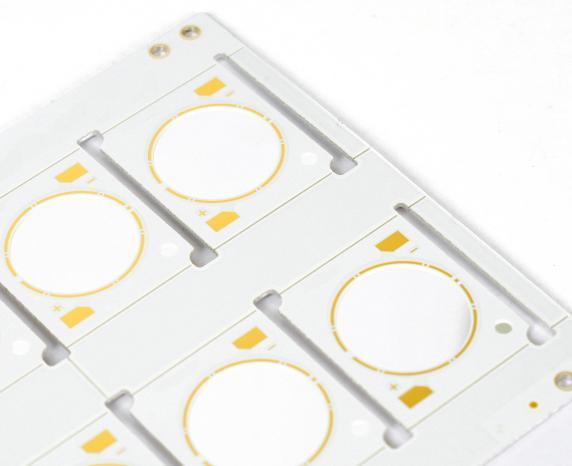
The characteristics of aluminum-based PCBs mainly include excellent heat dissipation, dimensional stability, insulation, durability, lightness and environmental protection. ‌
Aluminum pcb suppliers, High Quality&Customization
  • ‌Excellent heat dissipation‌: Aluminum-based PCBs have excellent thermal conductivity because they use aluminum as the base material, which can effectively transfer heat from heating devices or important devices, thereby improving the overall performance of the product‌.
  • ‌Dimensional stability‌: The dimensional stability of aluminum substrates is higher. Compared with printed boards made of insulating materials, the dimensional changes of aluminum substrates are smaller, which helps to improve the reliability and durability of products‌.
  • ‌Insulation‌: Aluminum substrates have good insulation properties and can provide the electrical isolation required by electronic devices. At the same time, they are hard and can replace easily broken ceramic plates, effectively reducing the actual area required for printed circuit boards, so that products do not need to install radiators, etc., thereby improving the heat dissipation of products and improving product efficiency and reducing costs.‌
  • Durability‌: Due to its high hardness, aluminum substrates can reduce the risk of accidental damage during production, handling and daily use, and provide strength, toughness and durability that glass fiber substrates cannot provide.‌
  • ‌Lightweight‌: Aluminum substrates enhance the strength and elasticity of products without adding extra weight, which helps to reduce the overall weight of products.‌
  • Environmental protection‌: Aluminum is non-toxic and recyclable, which helps to reduce the impact of electronic waste on the environment.‌

In summary, aluminum-based PCBs provide electronic products with multiple advantages such as efficient heat dissipation, dimensional stability, excellent electrical performance, durability, lightness and environmental protection through their unique physical and chemical properties, making aluminum-based PCBs widely used in high-end electronic devices.‌

What are the application scenarios of aluminum-based PCBs?​

The application scenarios of aluminum-based PCBs are very wide, mainly including the following aspects:

  • High-power LED lighting‌: Aluminum-based PCBs can quickly and effectively transfer the heat generated by LEDs to the external environment, reduce the impact of high temperature on the life of LED chips, and improve the life and reliability of lamps.
  • ‌Power supply equipment‌: Such as switching power supplies, DC/AC converters, voltage regulators and other high-power density power modules, aluminum-based PCBs can quickly dissipate heat to ensure stable operation of the circuit.
  • ‌Audio equipment‌: The heating elements in audio devices such as audio amplifiers, power amplifiers, and preamplifiers can be well managed by aluminum-based PCBs.
  • ‌Communication electronic equipment‌: Components in communication systems such as high-frequency devices, filters, signal transmission and reception circuits, etc., use aluminum-based PCBs to improve system reliability.
  • Computers and peripherals‌: Some areas on the motherboard, power supply modules, and hardware such as graphics cards may use aluminum-based PCBs to improve the heat dissipation effect.
  • Office automation equipment‌: Motor drivers and other components that require effective heat dissipation.
  • Automotive electronics‌: Including electronic speed regulators, ignition devices, power controllers and other vehicle-mounted applications.
  • ‌Industrial control field‌: High heat density circuit boards inside industrial control equipment such as frequency converters and inverters.

Aluminum-based PCBs are widely used in many fields due to their excellent heat dissipation and electrical insulation properties, especially in situations where efficient heat dissipation and stable operation are required.

Choosing a high-quality aluminum pcb supplier is crucial for electronics manufacturers. When choosing a supplier, it is necessary to consider the key points comprehensively. Choose a suitable aluminum pcb suppliers through market research, field visits and sample testing.
Aluminum pcb manufacturer, High Quality&Customization
Friday, September 20th, 2024

In today’s rapidly developing electronic technology, aluminum substrates, as a key electronic component carrier, play a vital role. Aluminum substrate manufacturers are an indispensable backbone in this field. They provide high-quality products to the electronics industry with advanced technology and strict quality control.

Reasons for the development of aluminum substrate

The continuous updating and improvement of aluminum substrate technology has provided a strong driving force for the development of manufacturers. In terms of thermal conductivity, in order to meet the application needs of different fields, the thermal conductivity of aluminum substrates has been continuously improved, and has now reached more than 180W/mK.

Aluminum pcb manufacturer, High Quality&Customization

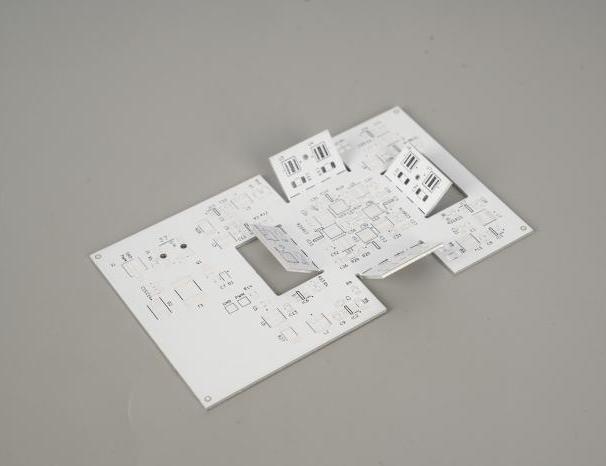
In terms of molding and processing technology, commonly used molding processes include cutting, punching and bending, and the continuously optimized molding and processing technology has improved the production efficiency and product quality of aluminum substrates.

In addition, technological innovation has also promoted the diversified development of aluminum substrate products, such as ultra-thin aluminum substrates, high-frequency and high-speed aluminum substrates, flexible aluminum substrates, composite functional aluminum substrates, environmentally friendly aluminum substrates and other new products have emerged continuously, meeting the needs of different industries and application fields.

What are the types of aluminum substrates?

(I) Flexible aluminum substrate

The material system of flexible aluminum substrate is usually a polyimide resin system with ceramic fillers, which can provide excellent electrical insulation, flexibility and thermal conductivity.

For example, in some portable electronic devices that require special shapes, flexible aluminum substrates can better adapt to the internal space of the device, eliminating expensive fixtures, cables and connectors, and reducing overall costs.

At the same time, due to its good flexibility, it can also play an important role in some bendable electronic products, such as foldable displays.

(II) Multilayer aluminum substrate

In the high-performance power supply market, multilayer aluminum substrates are made of multiple layers of thermally conductive dielectrics. These structures have one or more layers of circuits buried in the dielectric, and blind holes are used as thermal vias or signal paths.

Aluminum pcb manufacturer, High Quality&Customization

Although it is more expensive and less efficient to transfer heat with a single-layer design, they provide a simple and effective heat dissipation solution for more complex designs. For example, in some high-end server power supplies, industrial power supplies and other fields, the heat dissipation requirements are extremely high. Multilayer aluminum substrates can meet the heat dissipation needs of these complex electronic devices and ensure the stable operation of the equipment.

(III) Through-hole aluminum substrate

In the most complex structures, a layer of aluminum can form the “core” of a multi-layer thermal structure.

Before lamination, the aluminum is pre-plated and filled with dielectrics. Thermal materials or sub-assemblies can be laminated to both sides of the aluminum using thermal bonding materials. Once laminated, the completed assembly is similar to a traditional multi-layer aluminum substrate through drilling.

The plated through-holes pass through the gaps in the aluminum to maintain electrical insulation. Alternatively, the copper core can allow direct electrical connection as well as insulating through-holes. This complex structure makes it play an important role in some high-end electronic devices with extremely high requirements for electrical insulation.

What is the dielectric material of aluminum PCB?

The dielectric material selection of aluminum PCB is diverse, designed to meet different performance requirements. Epoxy resin is widely used for its toughness and heat resistance, while polyimide is known for its high temperature stability and chemical stability.

Polystyrene is favored for its low dielectric constant and dielectric loss tangent, while acrylic ester is selected for its excellent light transmittance. In addition, ceramic materials such as alumina, silicon nitride, zirconium oxide, etc. are also commonly used dielectric materials for aluminum PCBs due to their excellent insulation, thermal conductivity, oxidation resistance, and high-temperature stability.

Different dielectric materials have different dielectric constants and thermal properties, which are particularly important for applications in high-frequency and high-temperature environments. Polytetrafluoroethylene (PTFE) and ceramic substrates are particularly suitable for high-frequency and high-temperature environments due to their high temperature resistance and low dielectric constant.

In summary, there are a wide variety of dielectric materials for aluminum PCBs, including epoxy resin, polyimide, polystyrene, acrylic ester, alumina, silicon nitride, zirconium oxide, etc. These materials are selected based on their respective advantages to meet the performance requirements of aluminum PCBs in specific applications.

What is the thermal resistance of aluminum PCB?

The thermal resistance of aluminum PCBs ranges from 1℃/W to 2℃/W. ‌This data is in sharp contrast to the thermal resistance of FR4 PCBs, which ranges from 20℃/W to 22℃/W.

Aluminum pcb manufacturer, High Quality&Customization

This shows that aluminum PCB is significantly better than FR4 PCB in heat dissipation performance. Aluminum material has good heat dissipation effect, which can effectively reduce the heat generated by electronic equipment during operation and keep components running at a suitable working temperature, thereby improving the stability and service life of the equipment.

What are the production processes of aluminum substrates?

  • First, the material is cut, and the incoming material inspection is strengthened to ensure that the sheet with a protective film on the aluminum surface is used. After cutting, there is no need to bake the sheet, and it should be handled with care, paying attention to protecting the protective film on the aluminum base surface.
  • Next is drilling. The drilling parameters are the same as those of FR-4 sheet materials. At the same time, the aperture tolerance must be strictly controlled, especially for 4OZ-based Cu. Pay attention to controlling the generation of flash, and drill with the copper skin facing up.
  • Then enter the dry film optical imaging link, including incoming material inspection, grinding, filming, board clapping, exposure and development.
  • When inspecting the board, the circuit surface must be inspected according to MI requirements for various contents, and the dry film on the aluminum base surface must not have film falling or damage.
  • In the etching process, since the copper base is generally 4OZ, etching is difficult. After the aluminum surface without protective film is taken out of the film stripping liquid, it should be washed with water in time to prevent the alkali solution from biting the aluminum surface.
  • The production process of the green oil process is grinding the plate (only brushing the copper surface) → silk screen printing green oil (first time) → pre-baking → silk screen printing green oil (second time) → pre-baking → exposure → development → grinding machine pickling soft brush → post-curing → next process.
  • Before spraying tin, tear off the protective film of the aluminum substrate with protective film, hold the edge of the plate with both hands, and it is strictly forbidden to touch the inside of the plate directly with your hands. Pay attention to the operation to prevent scratches.

What are the characteristics of aluminum substrate manufacturers?

(I) Good processing and production effect

Aluminum substrate manufacturers can make full use of the material properties of the aluminum substrate itself according to the actual processing size to bring better processing and production effects for building material design.

(II) Stable and reliable quality

Aluminum substrate manufacturers focus on product quality and stability, and use high-quality raw materials and strict production standards. They have a complete production system and quality control system to ensure the quality and stability of products.

(III) Advanced production technology

Aluminum substrate manufacturers use advanced production technology and equipment to ensure product accuracy and stability. They have professional sales and technical teams that can provide high-quality products and technical support.

(IV) Energy saving and environmental protection

Aluminum substrate manufacturers focus on the energy saving and environmental protection of their products, and use energy-saving and environmentally friendly materials and production processes. They have strong R&D and technical strength, and continue to launch new energy-saving and environmentally friendly products and technological innovations.

What is the market prospect of aluminum substrate manufacturers?

The continuous emergence of new generation electronic products, such as smart phones, tablets, wearable devices, etc., has higher and higher requirements for heat dissipation performance and thinness. Aluminum substrates, as a metal-based copper-clad laminate with good heat dissipation function, just meet these needs.

The development of emerging technologies such as 5G has also brought new opportunities to the aluminum substrate market. Aluminum substrates, as a metal-based copper-clad laminate with good heat dissipation and electrical properties, just meet the needs of 5G communication technology.

The trend of lightweight vehicles and the expansion of the new energy vehicle market have also brought new opportunities to the aluminum substrate market. Aluminum substrates, as a metal-based copper-clad laminate with the characteristics of lightweight, high strength and corrosion resistance, just meet the needs of lightweight vehicles.

In short, aluminum substrate manufacturers play an important role in the electronics field. They provide high-quality aluminum substrate products to the electronics industry with advanced technology, strict quality control, continuous innovation and research and development, and good customer service.

What is an aluminum pcb? How is it made?
Friday, September 20th, 2024

In today’s era of rapid technological development, the performance and reliability of electronic equipment are attracting more and more attention. Among many electronic components, aluminum pcb have become an indispensable part of the electronics field with their excellent performance and wide application.

How do you make Aluminum PCB?

What is an aluminum pcb? How is it made?
  • 1. Cutting: Cut large-sized incoming materials into the size required for production. The process is picking materials-cutting.
  • 2. Drilling: Positioning and drilling holes in the plate to assist the subsequent production process and customer assembly. The drilling process is pinning-drilling-board inspection.
  • 3. Dry/wet film imaging: The part required for making the circuit is presented on the plate. The dry/wet film imaging process is grinding the plate-filming-exposure-development.
  • 4. Acid/alkaline etching: After dry/wet film imaging, the required circuit part is retained and the excess part outside the circuit is removed. The acid/alkaline etching process is etching-film stripping-drying-board inspection.
  • 5. Silkscreen solder mask and characters: solder mask is to protect the circuit that does not need soldering, preventing tin from entering and causing short circuit. Characters are used for marking. The silkscreen solder mask and character process is silkscreen – pre-baking – exposure – development – characters.
  • 6. V-CUT, gong board: V-CUT is to cut the single PCS circuit and the whole PNL board to leave a small part connected for easy packaging and removal. The gong board is to remove the excess part of the circuit board. The process of V-CUT and gong board is V-CUT – gong board – tearing the protective film – removing the flash.
  • 7. Test, OSP: Circuit test is to detect whether the completed circuit is working normally. Voltage resistance test is to detect whether the completed circuit can withstand the specified voltage environment. OSP allows the circuit to be better soldered. The test, OSP process is circuit test – voltage resistance test – OSP.
  • 8. FQC, FQA, packaging, shipment: FQC conducts full inspection and confirmation of the product, FQA conducts random inspection and verification, and packages and ships to customers as required. The process is FQC-FQA-packaging-shipping.

What are the layers of aluminum PCB?

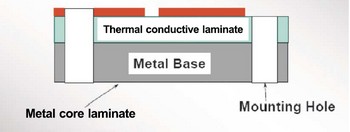
Aluminum-based circuit boards (PCBs) mainly consist of three layers, namely the circuit layer (copper foil), the insulation layer, and the metal base layer. This structure gives aluminum-based PCBs excellent heat dissipation performance and mechanical strength, making them particularly suitable for applications that require efficient heat dissipation and good mechanical properties.

What is an aluminum pcb? How is it made?

The circuit layer is usually made of copper foil, which is etched to form a printed circuit for assembly and connection of devices. The thickness of the copper foil can be between 1oz and 10oz to ensure the conductivity and load-bearing capacity of the circuit.

The insulation layer is the core technology of aluminum-based PCBs. It uses low thermal resistance thermal insulation materials with a thickness of 0.003″ to 0.006″ inches and has good bonding, insulation and thermal conductivity.

The metal base layer is generally aluminum or copper, which has good thermal conductivity and certain mechanical strength. It can quickly conduct the heat generated during device operation, effectively reduce the operating temperature of the device, and improve the power load and reliability of the module.

In addition, according to the specific application requirements, aluminum clad PCB can be designed as single-sided board, double-sided board or very few multi-layer boards. Single-sided board consists of three-layer structure, while double-sided board adds a circuit layer on this basis, forming a structure of circuit layer, insulation layer, aluminum base, insulation layer, circuit layer.

How thick is aluminum clad PCB?

The thickness of aluminum clad board usually ranges from 0.2mm to 10mm, and the specific choice depends on the number of layers and purpose of the circuit board.

0.2mm to 0.5mm aluminum clad board is suitable for making single-sided circuit boards, 0.5mm to 1.2mm is suitable for double-sided circuit boards, and 1.2mm to 2.0mm is suitable for multi-layer circuit boards.

In addition, common standard thicknesses also include 0.5mm, 1.0mm, 1.5mm, etc. For the PCB board itself, common thicknesses are 0.6mm, 1.0mm, 1.6mm, 2.0mm, 2.4mm, etc.

The standard PCB thickness ranges from 0.031 inches (0.78 mm), 0.062 inches (1.57 mm), and 0.093 inches (2.36 mm), with the most commonly used thickness being 0.063 inches (1.57 mm or 157 mm).

The thickness of conventional PCB finished products is generally between 0.8 mm and 1.6 mm, with 1.6 mm being the most common specification‌.

What are aluminum PCBs used for?

Aluminum substrate PCB (aluminum PCB) is a metal-based copper-clad board with good heat dissipation function. It consists of a circuit layer (copper foil), an insulating layer and a metal base layer. Sometimes it is also designed as a double-sided board or a multi-layer board structure.

The application of aluminum substrates is very wide, covering multiple fields and equipment, mainly including:

  • 1. Audio equipment: used for input and output amplifiers, balanced amplifiers, audio amplifiers, preamplifiers, power amplifiers, etc.
  • 2. Power supply equipment: including switching regulators, DC/AC converters, SW regulators, etc.
  • 3. Communication electronic equipment: suitable for high-frequency amplifiers, filtering appliances, signal transmission circuits, etc.
  • 4. Office automation equipment: such as motor drives, etc.
  • 5. Automotive electronics: used in electronic regulators, igniters, power controllers, etc.
  • 6. Computers: including CPU boards, floppy disk drives, power supply equipment, etc.
  • 7. Power modules: such as inverters, solid-state relays, rectifier bridges, etc.
  • 8. Lamps and lighting: As an advocate of energy-saving lamps, aluminum substrates are increasingly used in various color energy-saving LED lamps.
What is an aluminum pcb? How is it made?

Aluminum substrate PCBs are particularly favored in high-end electronic devices due to their excellent heat dissipation performance and reliability, and are widely used in various occasions that require efficient heat dissipation.

What are the disadvantages of aluminum PCB?

The main disadvantages of aluminum PCBs include high cost, usually only single-sided panels can be made, electrical strength and withstand voltage are more prone to problems, thermal conductivity test methods and test results are not matched, aluminum substrate material specifications are not unified, copper foil thickness does not meet the standard, and there are more defective products and shoddy work. ‌

  • 1. High cost: The price of aluminum substrates usually accounts for more than 30% of the product price, which is significantly higher than other types of PCBs.
  • 2. Production limitations: Aluminum substrates can usually only produce single-sided boards, and the process of producing double-sided boards is more difficult, which limits their use in some applications.
  • 3. Electrical strength and withstand voltage issues: Aluminum substrates are more prone to problems in electrical strength and withstand voltage, which may affect the safety and reliability of the product.
  • 4. Thermal conductivity test and material specification issues: The mismatch between the test methods and test results of thermal conductivity, as well as the lack of unified material specifications for aluminum substrates (there are CPCA industry standards, national standards, and international standards, etc.), all increase the complexity of production and quality control.
  • 5. Copper foil thickness and defective products: Failure to meet the copper foil thickness standards may lead to problems such as burning circuits. At the same time, due to cutting corners and increasing defective products, the quality control of aluminum substrates has become more difficult.

These shortcomings limit the application scope of aluminum substrates to a certain extent and increase the risks of production and use. Therefore, when choosing to use aluminum substrates, it is necessary to comprehensively consider their advantages and disadvantages, as well as specific application requirements and environmental conditions.

What temp can aluminum PCB withstand?‌

The high temperature resistance of aluminum substrates is related to the materials used, manufacturing process and working environment. Under normal circumstances, aluminum substrates can withstand a wide range of temperatures, but the specific temperature resistance is also affected by factors such as solder paste and lamp quality.

The temperature that aluminum substrates can withstand during welding can reach about 400 degrees Celsius, and the welding time is about 30 seconds to 50 seconds, of which the actual melting time is only 10 seconds, which shows that aluminum substrates can withstand higher temperatures in a short period of time without damaging the components.‌

In addition, aluminum substrates, like other types of PCB boards (such as FR4 boards, copper substrates, etc.), can withstand an ambient temperature range of -40℃ to +150℃.

However, in long-term use, the highest temperature that these boards can withstand is between 120℃ and 130℃‌. This shows that although aluminum substrates and other types of PCB boards can work in a wide temperature range, their performance and life will be affected to a certain extent when working in a high temperature environment for a long time.

In short, as an important component in the field of electronics, aluminum substrates have excellent performance and broad application prospects. I believe that in the future, with the continuous advancement of technology, aluminum substrates will play a more important role in the field of electronics.

Aluminum PCB LED Strip
Friday, March 20th, 2020

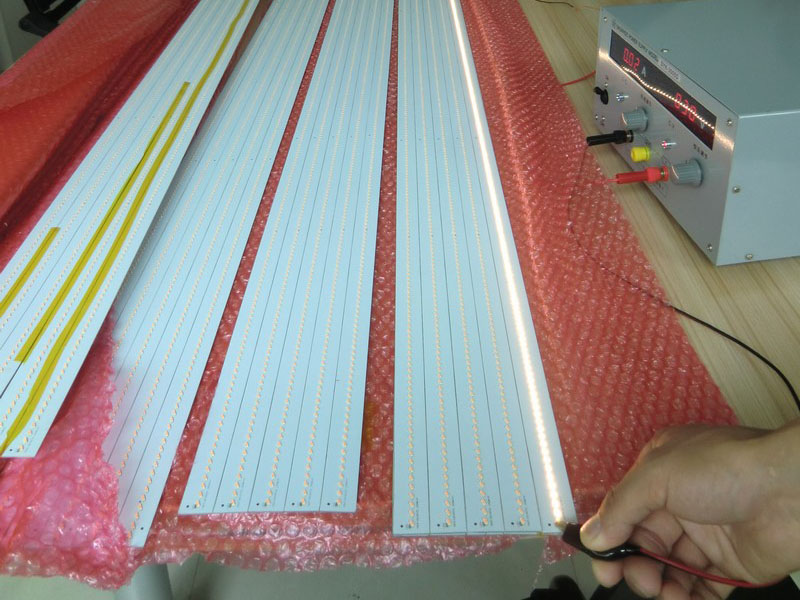
With the development of LED technology, LED power keeps increasing. This is closely related to heat dissipation. In order to resolve heat dissipation of LED with big power, aluminum-based copper-clad laminate is highly applied in led strip field.

Aluminum PCB(metal-based heat dissipation board) is a kind of unique metal-based copper-clad laminate. It has good head conductivity, electrical insulation and machining performance. Single-sided aluminum pcb consists of three layers of structures:circuit layer(copper foil), insulation layer and metal-based layer. Circuit layer requires large current-carrying capability, so we should use thick copper foil(generally 35um to 280um). The insulation layer for heat conduction is the core technology of aluminum pcb. It is general composed of special polymer filled with special ceramic. Small heat resistance, excellent viscoelasticity and anti-aging are all its advantages. And it is also able to bear mechanical and heat stress. Metal-based layer is the supporting component of aluminum pcb, and it needs to have high heat conductivity, so we generally use aluminum board, or copper board(which can provide higher conductivity). And it is suitable for regular machining such as drilling, punching and cutting. Techniques include gold plating, solder levelling, osp, ENIG, lead-free ROHS and so on.

single-layer-mcpcb-stackup

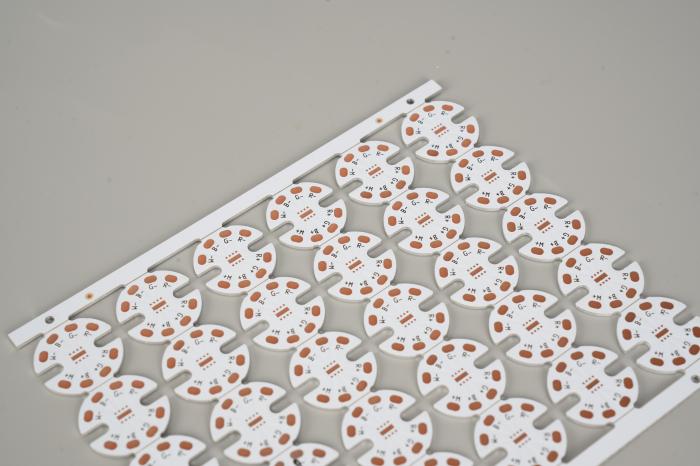
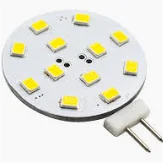
Aluminum pcb is commonly seen in LED products and has two sides(the front side and the reverse side). The white face is used to solder LED pin, and the other face presents natural color. It is generally painted with thermal conductivity paste and then contacted with heat conduction part. LED aluminum pcb is mainly used in power amplified mixed integrated circuits for STK series, motor cycles, automobile and electronics field.

There are many kinds of aluminum pcb for led tube, which varies based on the length and width of led tube. Aluminum pcb for led tube is popular with people due to its good quality, and durable and energy-saving features.

led strip
led strip

Aluminum pcb for led tube can save electricity as high as 70%. The light intensity of 12W Led tube is equal to 40w fluorescent tube. The service life of LED tube is is more than 10 times that of general fluorescent tube. It can be free of maintenance. Also, there is no need to change LED tube, barratter and starter frequently.

Generally, fluorescent tube has high temperature inside and needs to be used for more than 10 hours everyday in most cases. This problems are perfectly resolved by aluminum pcb for led tube.

If you have any queries, comments or suggestions on aluminum pcb for led, welcome to leave your message.