PCB manufacturing PCB manufacturing
Home > Blog

The technology and application of DBC ceramic PCB

June 17th, 2021

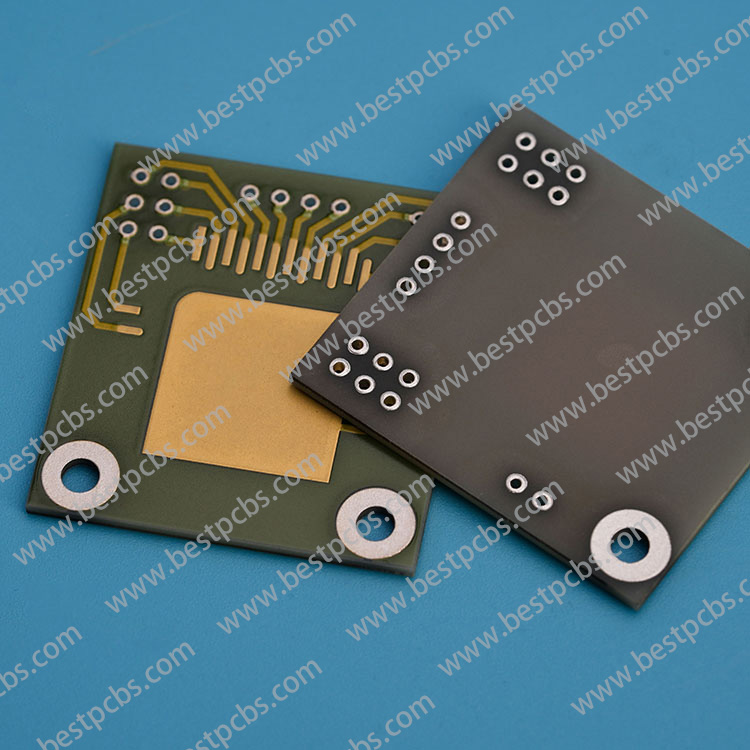
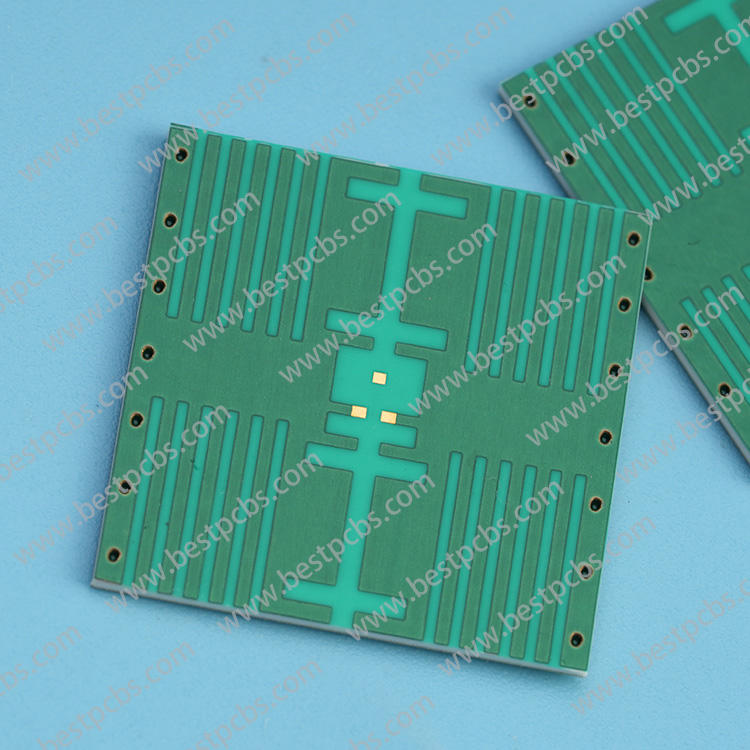
DBC means direct bonding copper, it is a ceramic surface metallization technology.

The copper is bonded on Alumina, Beryllium Oxide and Aluminum Nitride, Packaging applications for power electronic modules, semiconductor refrigeration and LED devices are widely used.

DBC-Ceramic-PCB

96% Al2O3 has good insulation, good chemical stability, high strength, and low price. It is the preferred material for DBC technology, but the thermal conductivity of aluminum oxide is low, and there is a certain thermal mismatch with the thermal expansion coefficient of Si.

BeO is a good ceramic material used in DBC technology. It has high low-temperature thermal conductivity. It can be used for medium and high power devices. In the application field and process, the toxicity caused by it should be properly protected.

AlN material is non-toxic, moderate dielectric constant, thermal conductivity is much higher than aluminum oxide, close to beryllium oxide, and thermal expansion coefficient close to SI. All kinds of chips and high-power devices can be directly attached to the AlN substrate. No transition layer of other materials is used. The prospects currently used in DBC technology are very promising.

There is no any layer between the metal and ceramic substrate, so the thermal diffusion ability is strong; the contact resistance is also low, which is conducive to the connection of high-power and high-frequency devices.     

The linking temperature is lower than the melting point of copper, and the DBC substrate maintains a stable geometric shape during the connection process. In some cases, the copper foil can be made into the required shape before the linking, and then the DBC preparation process is performed, eliminating the need After connecting the etching process.

The copper conductor part has a very high current-carrying capacity, so it has the ability to reduce the size of the intercepting medium and increase the power capacity.

If you want to know more about DBC ceramic PCB, please feel free to contact sales8@www.bestpcbs.com

Common Problems in SinkPAD Board Design

June 17th, 2021

1. What is the SinkPAD Board?

Sink Pad Board, also called Heat Sink or DTP (direct thermal path), it’s an alternative PCB technology to the conventional metal core PCB providing direct thermal path solutions for high power LED. 

The thermal conductive PAD is convexity area of copper core/pedestal, so that the thermal PAD of LED can touch the convexity area of metal core directly, and then the heat of LED will be dissipated into the air much faster and more efficient than conventional MCPCB.

Heat Sink

2. If only the LED pad can be made as SinkPAD?

Of course no, the pads of other chips or components also can be designed as Sink PAD, one of the most common is the IC pad. In some designs, IC needs to pass through the large current and it will emit a lot of heat, it would be best to design its pad as a thermal conductive pad at this time.

SinkPad Board after SMT

3. What is the thermal conductivity of a SinkPAD ?

The thermal conductivity could be 235 W/m.k to 400 W/m.k.

4. Can we use SinkPAD technology for any LED packages?

No, it’s designed to be used with the LEDs which has electrically neutral thermal pad. Such as Cree XPL/XML/XHP/XPG/XPE/XPC/XTE/XBD, Luxeon Rebel & Luxeon M from Philips Lumiled, Oslon SSL & Oslon square from Osram, Nichia N219, Seoul Semiconductor Z5P / Z5M, Samsung 3535, Bridgelux SM4, etc.

5. What is the Manufacturing Process for the SinkPAD Board?

Manufacturing process is the same as conventional MCPCB, please click here to see the manufacturing process status.

Shinkpad

6. How does SinkPAD Board compare to Conventional MCPCB?

Conventional MCPCB uses a thermally conductive dielectric layer to bond circuit layer with base metal (Aluminum or Copper) layer. The key to thermal performance of MCPCB lies in its dielectric layer. Even though thermally conductive dielectric has higher thermal performance compared to normal FR4, it’s still a weakest link in the conduction thermal path.

SinkPAD Board approach overcomes this limitation, which provides “Direct thermal path”, the LED Chip can directly contact the copper substrate, there’s no dielectric between LED thermal pads and the metal base, then the thermal resistance is very small.

7. Can the aluminum be made as the base of Heat Sink?

Actually yes, however, regarding of current technical conditions, since aluminum or aluminum alloy cannot directly react with acid, the reaction process is too complex and difficult to control, which will increase the difficulty of etching the LED pad platform.

Considering the scrap rate, the process of etching LED pad platform with aluminum is more complex and the overall cost is higher, and the copper also dissipates heat much better than aluminum, so copper is generally used as the substrate for Heat Sink in our company.

Copper Substrate

8. Does SinkPAD Board require special PCB design?

No, we can use your existing MCPCB Gerber data.

Welcome to contact us if you have other questions about Sink Pad Board. 

What is flying probe test printed circuit boards?

June 16th, 2021

Before leaving PCB manufacturing line, bare PCBs (Printed Circuit Boards) have to pass electrical tests so that it guarantee that boards go for high performance and high reliability after finish the SMT(Surface Mount Technology). Electrical tests are implemented to find out electrical and circuitry issues such as shorts, opens, resistance, capacitance etc. all of which indicate whether bare boards or assembled board are correctly fabricated.

shorts circuit

When test probes work, it moves quickly from test points to other test points as per instructions instructed by the computer set up program.  

probe flying test

Probe test is no need fixture, so it is very popular in the printed circuit boards manufacturing. The most significant reason is their cost. it is highly cost-effective for prototypes and low to mid-volume production. And the most important factor, the test reports can be provided for each board after finish tested and it is very easy to export from the computer, you can send to your customer very quickly for the test results of PCB.

Advantages of Flying Probe Test:

Low test cost (Eliminates fixturing costs and time)

Short test development time

Fast computer program development, easy integration of design changes

Rapid feedback provided to PCB design engineers at prototyping period

Process flexibility

Circuit access, even in the absence of test points

Controlled probe contact, programmable for any type of board

Different test solutions and approaches integrated in a single test system

Intrinsic positioning and measurement precision

Disadvantages of Flying Probe Test

Everything has two sides. Apart from obvious advantages, flying probe test have some disadvantages.

Since flying probes have direct physical contact with vias and test pads and small pits are easily caused on board surface, when flying probe tester is working on components without test pad, it’s possible that probes have contact with component leads so that loose leads or leads with badly-performed soldering may be missed.

In spite of the disadvantages mentioned, flying probe test is still regarded as a significant test method for PCB fabrication. Flying Probes have enhanced the competitive variable as lost time due to retooling has been removed. Prototype and Quick Turn product is the perfect match for Flying Probes as they carry out in low quantity orders and are quick to change jobs, unlike the long setup times with fixture testers.

By the way, to test circuit shorts, opens, EBest Circuit (Best Technology) also do AOI checking to make sure there is no issue for PCB manufacturing.

AOI test

Contact EBest Circuit (Best Technology) right now, to discuss more for printed circuit boards.

How to do SMT for ceramic PCB

May 19th, 2021

As we all know if ceramic PCB is very fragile, so it is not easy to do SMT for them.

But we can do the SMT for ceramic PCB easily because we do it every day and we have more than 15 years experiences for doing that.

For the almost SMD components (such as SMD rsistors, capacitors, diode etc), normally we will add the solder paste by using SMT stencil, then put the components by machine, finally do the oven reflow.

For some special components, we will need to solder it by hand, such as through connectors, but it can’t be soldered by hand directly, it need to be put on the heating table to keep the temperature is high enough to make the solder past at melt state. Because the ceramic material with very good heat dissipation, the solder paste will be solidification very easily if don’t put the ceramic PCB on heating table

For some small LED, it can’t be put by SMT machine, because no such small feeder to pick it up, then need to put it on board by hand.

We can do very well for the small BGA components too.

Below some photos of ceramic PCB.

If you would like to know more about ceramic and ceramic PCB SMT, please feel free to email me

Ceramic PCB with SMT 1
Ceramic PCB with SMT 2
Ceramic PCB with SMT 3
Ceramic PCB with SMT 4
Ceramic PCB with SMT 5

Aluminum vs Copper Core PCB

May 19th, 2021

In EBest Circuit (Best Technology), currently the most common metal used for Metal Core PCB manufacturer are Aluminum, Copper. Today let’s talk about the main differences between aluminum substrate and copper substrate, hoping to help you choose the right substrate in future design projects.

Although they both share similar properties and functions, there are still a few variations between the two kinds of metals. Some of the key differences between aluminium and copper core PCBs are explained in the points below.

1. Thermal Conductivity

The thermal conductivity of copper substrate is up to about 400(W/mK) and the thermal conductivity of aluminum substrate is generally about 200W(W/mK). The thermal conductivity is higher, the transfer efficiency will be better, and the heat dissipation will be better, then the working life will be longer.

 Thermal Conductivity

2. Electrical Conductivity

Both aluminum and copper, being metals, are electrical conductors of electricity, although the exact degree of this varies between the two metals. When it comes to electrical conductivity, copper has a clear advantage over aluminum. In other words, in applications where there is a need for efficient electrical conductivity, copper makes for an ideal pick.

 Electrical Conductivity

3. Electrical Resistance

Resistance is very important when it comes to PCB design, as it can have an effect on the overall function and stability of the component. Given that copper has a higher density than aluminum, it tends to have a lower resistance than aluminum, so copper is an better choice where there’s a requirement for thinner circuits and faster electricity transfer.

Electrical Resistance

4. Weight

Since copper has the higher density for per unit area, the weight of copper PCB is much heavier than aluminum PCB for the same design.

In applications where light-weight construction is required more than anything else, aluminum is the preferred material of choice. On the other hand, applications where weight is not much of an issue, tends to be the ones where copper is widely used.

Weight

5. Application

Copper core PCB is the best heat dissipation among all MCPCB, so it’s mostly used in automobile headlights, taillights and some high-tech electronic products (unmanned aircraft, mining machine) high-power lighting equipment. The aluminum core PCB is mostly used in indoor lighting, energy saving lighting, street lighting and other energy-saving lighting electronic products.

Application
Application

In conclusion, due to the above different parameters and performance, the cost of copper is generally more expensive than aluminum. If you have other questions about MCPCB, welcome to contact us .

How to Test for an Open Short Circuit on a PCB?

May 18th, 2021

Every printed circuit board need to do full test before ship to our customer. but you may have doubt, the PCB was made according to the original Gerber file, why finish the PCB production process, why the short Circuit will occur on a FR4 circuit board?

A short circuit may also occur during reflow soldering. the solder paste may accidentally connect two pins that are very close to each other. In some cases, errors can occur during the PCB design process because the wiring between different networks accidentally connects.

We believe every PCB manufacture have their own test method to do short circuit, but today I would like share how EBest Circuit (Best Technology) to Check for Short Circuits in a Printed circuit board.

Here are some important steps:

Step 1 Visual inspection

The first step for locating short circuits on PCB is to carefully look at the entire surface of the PCB. EBest Circuit (Best Technology) QC guys use a magnifying glass or low magnification microscope during the circuit board examination. We check the whole board surface to see if there are some traces break off. Any cracks or blobs of solder should get careful attention. Check all your vias. If you specified unplated vias, make sure that’s the case on the board. Poorly plated vias can create a short circuit between layers and leave you with everything tied to ground, VCC, or both.

visual inspection

All the testing work will carry out according to IPC 6012 class 2.

Step 2 Use a Digital Multimeter to find out where is the problem

To test a circuit board for a short circuit, you need to check the resistance between different points in the circuit. If visual inspection doesn’t reveal any clues as to the location or cause of the short circuit, grab a multimeter and try to track down the physical location on the printed circuit board. The multimeter approach gets mixed reviews in most electronics forums, but tracing your test points can help you figure out what isn’t the problem.

Step 3 use Probe flying Tester &E-tester

As long as you are in Printed Circuit board field, you are definitely known Probe flying test and E-Teter.

Flying probe test systems require no test fixture, it can serve both prototype and small production, providing maximum flexibility for PCB manufacturers and this job can complete in a short time.

probe flying test
probe flying test-1

But when your circuit board become to volume, you will need to open a test tooling/test fixture to test the Printed Circuit board to test the open short circuit.

E-tester

In my next blog in June, I will introduce Probe flying test to you in more detail.

If you have any question about printed circuit board, you are welcome to contact EBest Circuit (Best Technology).

It is our great pleasure to communicate with you for any issue for printed circuit boards.

What’s fiducial marks on the PCB?

April 24th, 2021

You may ever be recommended by some PCB manufacturers to add the fiducial holes on the board edge. Do you know what is fiducial marks and what’s the purpose for this kind of holes in a PCB?

Now, let me to show you something for what is the fiducial holes.

Fiducial holes, we also call it fiducials mark, while we assemble a PCB, it will need to locate the positions for each component, and it is positioned based on the fiducial mark as the reference point.

There are 3 types fiducial marks, first type is fiducial marks on a single board, second type is the fiducial marks on a PCB panel, third one is the fiducial marks for some single component on the board.

Here are the pictures for you to understand the types of the fiducials.

Fiducial holes types
Fiducial holes

Fiducial mark on a single board is designed for positioned all circuits features on a single board. It is necessary to have a fiducial mark on a single board.

And fiducial marks on a PCB panel is used to assist positioning the circuits. 

For the fiducial mark of a single component, it is designed to position the fiducial mark of a single component, which can improve the placement progress (For QFP, CSP, BGA and other important components must have the fiducial marks).

So, it is important to add the fiducial holes on a PCB board.

Also, while we make the panel for the PCB board, on the diagonal of the four corners, it is required to have 2 fiducial points at least on 2 diagonal corners.  you can also place 4 marks on the four corners, but generally, assembly plant will only need 2 marks for recognize.

See below a PCB panel for reference:

PCB panel drawing EBest Circuit (Best Technology)
Fiducial holes on a panel

In the other hand, while you design the PCB, please try not to put the silk screens, pads, traces etc. within 2mm of the optical fiducial marks. Otherwise, the SMT machine will not be able to recognize the optical fiducial on the PCB boards.

And if you add the fiducial holes on the area which without any circuits, to avoid the holes being etching while the process, so generally we suggest to add a metal circles around the fiducial holes, to make it more obviously on the boards.

If you have any new PCB design which you also want to add the fiducial marks.

You are welcome to contact EBest Circuit (Best Technology) for a help and we will show our best help for you.  

What’s the differences between thick film ceramic PCB and DPC ceramic PCB

April 21st, 2021

Ceramic PCB including Alumina PCB (Al2O3 PCB), Aluminum Nitride PCB (AlN), Bryllium Oxide PCB(BeO PCB) etc.

There are other differences except the substrate material is different.

  1. The method of making conductor is different.

The conductor for thick film ceramic is made by printing, but DPC is made by vacuum sputtering and plating.

  • The conductor is different.

The conductor for thick film ceramic PCB is Au or AgPd, but for DPC ceramic PCB, it is copper.

  • The thickness of conductor is different.

Normally, it is 10-20um for thick film ceramic PCB, copper thickness can be 10um-300um for DPC ceramic PCB.

  • The solder mask is different.

It is glass glaze for thick film ceramic PCB, the most popular color is greenish and blue. Glass glaze can withstand very high temperature, up to 850C

It is normal solder mask oil for DPC ceramic PCB, the most popular color is white.

The above is only simple introduction for the difference, if you want to know more differences between thick film ceramic PCB and DPC ceramic PCB or other details about ceramic PCB, please contact us

Why do MCPCB board have holes? What is PTH/NPTH

April 15th, 2021

If you look closely at a MCPCB board, you will see holes of different sizes in the board, each hole was designed for a purpose. These holes can be divided into PTH (Plating Through holes) and NPTH (Non-Plating Through holes). EBest Circuit (Best Technology)’s smallest drill tool is 0.5mm, so generally we require customers to design the minimum hole size of 0.5mm or more.

How to distinguish PTH and NPTH through holes?

In fact, it is very simple. Just look at the hole wall to see if there are bright plating traces (Copper). The holes with copper are PTH, and the holes without copper are NPTH.

PTH & NPTH

What is the NPTH used for?

If you pay a little attention, you will find that the size of NPTH is usually larger than the PTH, because most of NPTH are for positioning purposes, it can be divided into the following four types.

  1. 1) Countersink: It’s a cone-shaped hole that is cut into the PCB to allow the flat head of a socket cap screw to fit flush with the surface of the board.
  2. Counterbore: It’s a cylindrical flat-bottomed hole that is designed to house a hex head or socket head cap screw to be used to secure a PCB board.
Countersink & Counterbore
  • Screw hole: As shown as below.
As shown as below
  • Slot hole: Some components of the installation and positioning of the foot is rectangular or oval, we called this kind of irregular drilling as slot hole. During PCB machining, there are two types of drilling tools for plugins, one is called a drill cutter, which is used to drill round holes, and the other is called a routing bit, which is used to drill slot hole.
Slot hole

What is the PTH used for?

In order to connect the circuits between two or more layers, we need to design the PTH, which have following three main purposes.

  • Used for conducting electricity.
  • Used for heat dissipation.
  • Used for plug-in components.

If you have other questions about MCPCB, welcome to contact us

What is Blind Via and Buried Via for Printed Circuit Board?

April 15th, 2021

In the Printed Circuit Board industry, believe that you are familiar with blind via and buried via. What is blind via and buried via for PCB? And do you know is the Blind via or Buried Via have special application in your Printed Circuit Board?

In order to know more, we would like to share more information with you today.

EBest Circuit (Best Technology) is an experienced FR4 PCB manufacturer in China since year 2006, with more than 15 years design and fabricate experience for PCB, EBest Circuit (Best Technology) accumulated more than 1000 customers from all over the world.

Before start, we need to know what kinds of hole for FR4 Circuit Board, Via, Blind Via and Buried Via.

What is a Via?

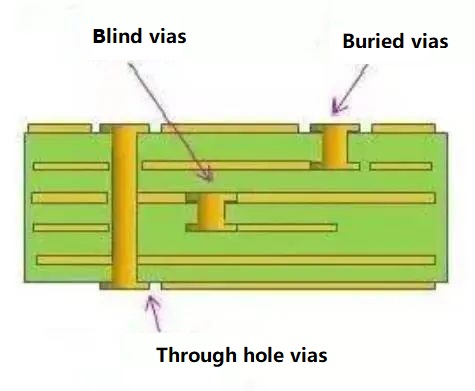
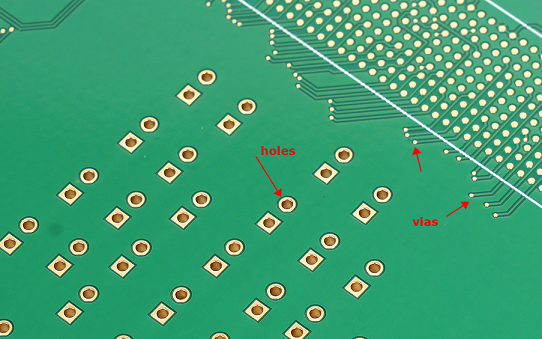
Vias are the copper-plated holes in the PCB that allows the layers to layer connection. The standard via is called a through-hole via, but there are several disadvantages to using through-hole vias in Surface Mount Technology (SMT). For this reason, we often use a blind via or buried via instead. A blind or buried via can be processed in a wide range of different measures, including plugged copper mask via, a plugged solder mask via, plated via or staggered via.

Via
staggered via

What is Blind Via?

The via connects the external layer to one or more inner layers of the PCB and is responsible for the interconnection between that top layer and the inner layers.

Blind Via

What is Buried Via?

For a buried via, is the inner HOLE, between both sides in the board up and down inside the layer after pressing is cannot see. So, it doesn’t have to take up the outer area.

Buried Via

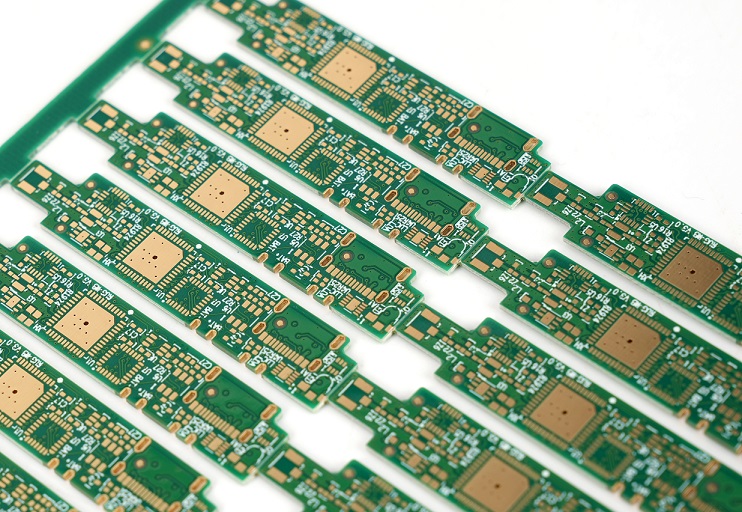
Blind and buried vias are particularly advantageous in HDI board because they optimize the density of the boards without increasing board size or the number of board layers you require. They are most commonly used in high-density PCB designs like, or in FPGA and custom chip packaging.Here is the photo which EBest Circuit (Best Technology) took from our production line to make HDI Printed Circuit Board for our USA customer.

HDI board under production
HDI process

EBest Circuit (Best Technology) is a very professional manufacturer in printed circuit board and HDI Board. If you are interesting to know more information of us, come to contact us and we are looking forward to discuss with you more for Printed Circuit Board.