PCB manufacturing PCB manufacturing
Home > Blog

Double Sided SinkPAD Board

March 24th, 2026

What Double Sided SinkPAD Board is?

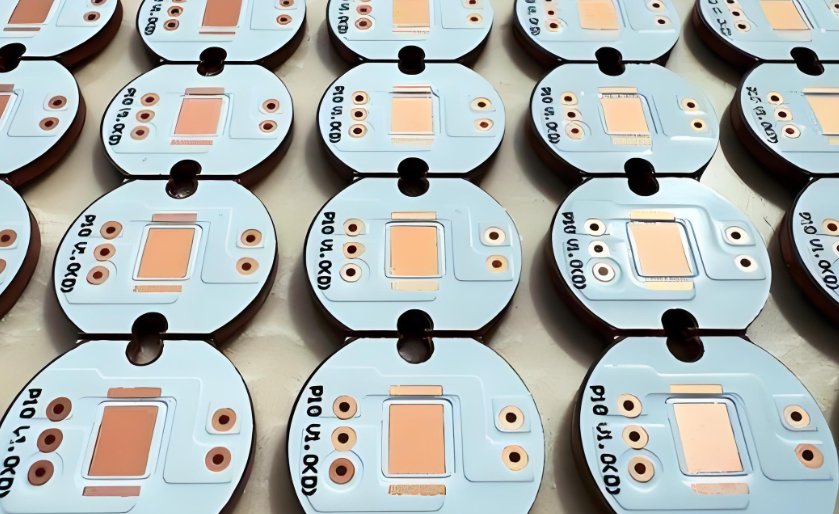
The Double sided SinkPAD board consists of at least two layers of trace circuit, and there’re at least one circuit layer on both top and bottom side of board, a dielectric (non-conducting) layer, a metal core/pedestal which normally is copper.

As there’re circuit layer on both sides, so engineer can put more (about 2 times, ideally) components on the same size circuit to realize more function, more complicated design, comparing to 1 Layer SinkPAD board or 2 layers SinkPAD board.
Double Sided SinkPAD Board

There’s no PTH (plated through hole) on double sided SinkPAD board, because the limitation of manufacturing process, which different from double sided Metal Core PCB which has a lot of PTH, and thermal PAD of LED will be put directly on copper core, also belonging to Direct Thermal Path (DTP) board too, but engineer needs to consider where the heat sink will be if he want more fast heat transferring, as there’re always components on both sides, and that make double sides SinkPAD board designing becoming more difficult & complex comparing to 1L SinkPAD board, or 2L SinkPAD board.

Stack up of Double Sided SinkPAD Board
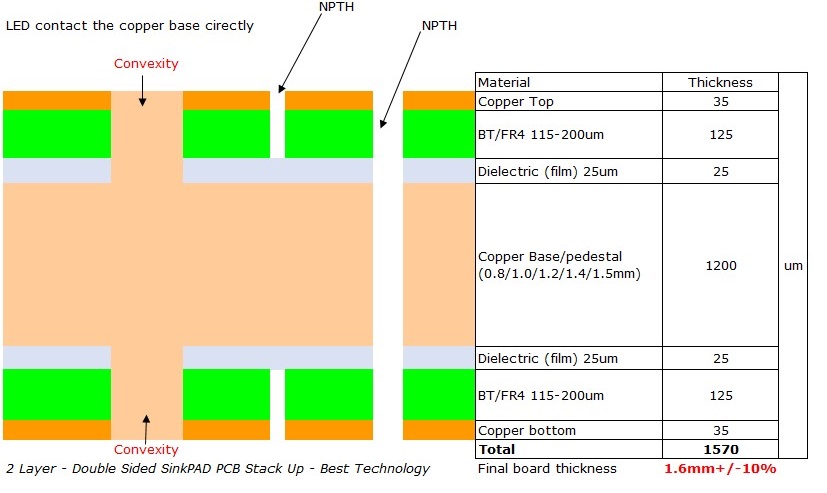
Double Sided SinkPAD Board

Advantages of Utilizing Double Sided SinkPAD Board:

  • Put more components on the both top and bottom, design more complicated circuit board.
  • It adopts the thermoelectric separation structure, the Lumens depreciation of the LED is minimized, and the life of the lamp is prolonged.
  • Suitable for matching single high-power lamp, such as Cree XPL, XML, XHP; Osram LED, etc., also COB package LED
  • High power semiconductors (transistors, thyristors, diodes) as well as resistors.
  • A variety of Surface Finishing are available according to different demands. (ENIG, OSP, Immersion Tin, ENEPIG, HAL) with excellent reliability of the surface treatment layer.

Application of Double Sided SinkPAD Board

  • High Power LED (up to 200W).
  • High semiconductors (transistors, thyristors, diodes) as well as resistors.

2 Layer SinkaPAD Board Capability

  • Base material: Copper: 0.8mm, 1.0mm, 1.2mm, 1.4mm, 1.5mm
  • Thermal Conductivity: 400 W/m.K.
  • Board Thickness: 1.0mm~2.0 mm (0.04″~0.08″)
  • Copper thickness: 0.5 OZ, 1.0 OZ, 2.0 OZ (specially 3-10 OZ)
  • Outline: Routing, punching, V-Cut
  • Soldermask: White/Black/Blue/Green/Red Oil
  • Legend/Silkscreen Color: Black/White/Yellow
  • Surface finishing: Immersion Gold, ENEPIG, Immersion Tin, OSP
  • Max Panel size: 600*500mm(23.62″*19.68″)
  • Packing: Vacuum/Plastic bag
  • Samples L/T: 1.5~2 weeks
  • MP L/T: 2-3 weeks

Click here to see the manufacturing process of double sided SinkPAD Board and other options.

If you want to customize double sided SinkPAD board, please contact EBest Circuit (Best Technology) today send your request for double sides SinkPAD PCB.

FAQs about Double-Sided SinkPAD Boards

1. What is a Double-Sided SinkPAD Board and how does it work?

A Double-Sided SinkPAD Board is a specialized Metal Core PCB (MCPCB) that provides a Direct Thermal Path (DTP) on both sides of the board. Unlike standard MCPCBs that use a dielectric layer to separate the circuit from the metal base, SinkPAD technology removes the dielectric under the component’s thermal pad. This allows the component (like a high-power LED) to sit directly on the copper or aluminum core, drastically reducing thermal resistance.

2. How does a Double-Sided SinkPAD differ from a standard Double-Sided MCPCB?

The primary difference is the thermal conductivity. In a standard double-sided MCPCB, heat must travel through a thermally conductive dielectric layer (typically 1–8 W/mĀ·K) to reach the metal core. In a SinkPAD board, the dielectric is bypassed entirely for the thermal pad, allowing for conductivity ratings as high as 400 W/mĀ·K (if using a copper core). Additionally, double-sided SinkPADs allow for higher component density by utilizing both the top and bottom layers for active circuitry.

3. Why would I choose a double-sided design over a single-layer SinkPAD?

Engineers choose double-sided SinkPADs when they need to maximize functional density in compact spaces. It allows for roughly twice the component population or more complex circuit routing compared to a 1-layer board. This is ideal for high-power applications where you need to mount LEDs or transistors on one side while placing control circuitry, connectors, or additional power components on the other.

4. Are there limitations to the Plated Through Holes (PTH) in double-sided SinkPADs?

Yes. Due to the unique manufacturing process where the metal core is “sunk” or embossed to meet the trace layer, standard Plated Through Holes (PTH) are often limited or more complex to implement than in traditional FR4 boards. Connections between sides are typically handled through specialized routing or assembly techniques, so it is crucial to consult with your manufacturer during the design phase to ensure the layout is compatible with the “thermoelectric separation” structure.

5. Which base material is better for SinkPAD boards: Aluminum or Copper?

  • Copper: Best for ultra-high-power applications. It offers superior thermal conductivity (approx. 400 W/mĀ·K) and is the most common choice for SinkPAD convexity because it is easier to etch and process for this specific technology.
  • Aluminum: More cost-effective and lighter. While it has good thermal properties, the chemical process for creating the SinkPAD convexity is more complex, often making it more expensive or difficult to produce than copper-based SinkPADs.

6. Can SinkPAD technology be used for components other than LEDs?

Absolutely. While most commonly used for high-power LEDs (Cree, Osram, etc.) to prevent lumen depreciation, SinkPAD boards are excellent for any high-power semiconductor that features an electrically neutral thermal pad. This includes power transistors, thyristors, diodes, and high-wattage resistors used in automotive, aerospace, or industrial power monitoring.
Multi Layer Metal Core PCB

March 24th, 2026

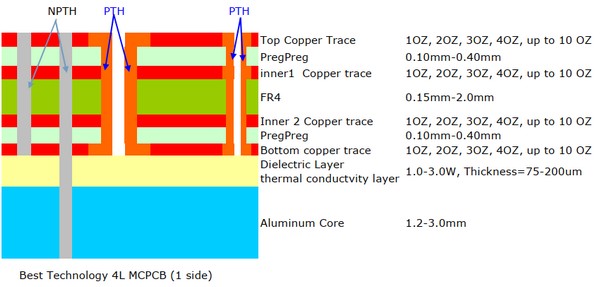
Just likeĀ FR4 PCB, we can also make boards with more than 2 layers of traces and we named it “Multi Layers MCPCB“. The structure is similar withĀ FR4 Multi Layers, but it much more complex to make.

You can populated more components on the boards, put signal and ground layer into seperated layers, to achieve better performance in electrical performance.

Compared with normal FR4, this sturcture need more technology and experience on laminating of more than two layers together with metal core and the cost is much higher than 2 layers MCPCB or double sided MCPCB.

Structure of Multi Layers MCPCB

Multi Layer Metal Core PCB

Capability of Multi Layers MCPCB

  • Base material: Aluminum/Copper/Iron Alloy
  • Thermal Conductivity (dielectrial layer): 0.8, 1.5, 2.0, 3.0 W/m.K.
  • Board Thickness: 0.8mm~3.0mm(0.02″~0.12″)
  • Copper thickness: 0.5 OZ, 1.0 OZ, 2.0 OZ, 3.0 OZ
  • Outline: Routing, punching, V-Cut
  • Soldermask: White/Black/Blue/Green/Red Oil
  • Legend/Silkscreen Color: Black/White
  • Surface finishing: Immersion Gold, HASL, OSP
  • Max Panel size: 600*500mm(23.62″*19.68″)
  • Packing: Vacuum/Plastic bag
  • Samples L/T: 15~18 Days
  • MP L/T: 15~20 Days

FAQs

1. What is a multi-layer MCPCB and how does it differ from standard FR4?

A multi-layer MCPCB consists of multiple copper conductive layers separated by high-thermal-conductivity dielectric layers, all bonded to a metal base (usually Aluminum or Copper). Unlike standard FR4, which relies on the epoxy glass substrate for structure, an MCPCB uses the metal base as a heat sink. While FR4 is an insulator with poor thermal management, the metal core in an MCPCB allows for heat dissipation rates that are significantly higher, making it essential for high-power electronics.

2. What are the typical thermal conductivity levels for multi-layer MCPCBs?

The thermal performance of a multi-layer MCPCB is primarily determined by the dielectric layer rather than the metal base itself. Standard dielectric materials offer conductivity between 1.0 W/mK and 3.0 W/mK. However, high-performance multi-layer stacks used in automotive or aerospace applications can reach 4.0 W/mK to 8.0 W/mK. Choosing the right dielectric is a balance between thermal efficiency and the breakdown voltage required for the circuit.

3. How many layers can be integrated into a Metal Core PCB?

Technically, “multi-layer” in the context of MCPCBs typically refers to 2-layer or 4-layer configurations. While it is possible to go higher, the complexity increases significantly because all heat must eventually pass through the dielectric layers to reach the metal base. In a 4-layer stack, the inner layers are further from the heat sink, which can lead to thermal bottlenecks if the design does not utilize thermal vias effectively.

4. Can you use plated through-holes (PTH) in a multi-layer MCPCB?

Yes, but the process is more complex than with standard PCBs. To prevent short-circuiting the signals to the metal core, the metal base must be pre-drilled and filled with an epoxy resin before the copper layers are laminated. Then, a smaller hole is drilled through the resin plug and plated. This creates an “insulated via” that allows signals to pass through the metal core safely.

5. What are the main applications for multi-layer MCPCB designs?

Multi-layer MCPCBs are the go-to solution when space is limited but power density is high. Common applications include:

  • Automotive: LED headlight systems and power converters (EV/HEV).
  • Power Supplies: High-voltage regulators and heavy-duty industrial rectifiers.
  • Aerospace: Power distribution units where weight and heat must be managed simultaneously.
  • Medical: High-intensity surgical lighting and imaging equipment.

6. What are the manufacturing challenges of multi-layer MCPCBs?

The primary challenge is coefficient of thermal expansion (CTE) mismatch. Metal bases (Aluminum/Copper) expand at different rates than the copper traces and dielectric during the lamination process. This can lead to delamination or bowing of the board. Precise control over the pressing cycle and the use of specialized “no-flow” or “low-flow” prepregs are required to ensure the structural integrity of the multi-layer stack.

Double Sided Metal Core PCB

March 20th, 2026

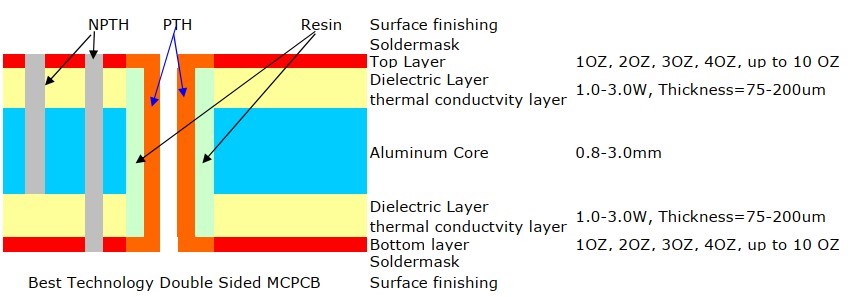
A double sided metal core PCB also has same two layers of copper conductor likeĀ Double layers MCPCB, but the metal core is in the middle of two conductor, so there’re conductors (trace) on both sides of metal core, and were connected to each other by Vias. So we named it “Double sided MCPCB”, and you can populated SMD on both top and bottom.

Different with Single layer MCPCB, double sided MCPCB also requires an additional pressing step to laminate the imaged thermal conductive laminate and metal core (also known as metal base) together. But sometimes, some raw Metal Clad material vendor will supply board material which already laminated.

Compared with normal FR4, this structure need more technology and experience on laminating of two layers together with metal core.

Structure of Double Sided MCPCB

Structure of Double Sided MCPCB

Capability of Double Sided MCPCB

  • Base material: Aluminum/Copper/Iron Alloy
  • Thermal Conductivity (dielectric layer): 0.8, 1.5, 2.0, 3.0 W/m.K.
  • Board Thickness: 0.5mm~3.0mm (0.02″~0.12″)
  • Copper thickness: 0.5 OZ, 1.0 OZ, 2.0 OZ, 3.0 OZ, 4.0 OZ, 5.0 OZ
  • Outline: Routing, punching, V-Cut
  • Solder mask: White/Black/Blue/Green/Red Oil
  • Legend/Silkscreen Color: Black/White
  • Surface finishing: Immersion Gold, HASL, OSP
  • Max Panel size: 600*500mm (23.62″*19.68″)
  • Packing: Vacuum/Plastic bag
  • Samples L/T: 10~15 Days
  • MP L/T: 12~15 Days

FAQs about Double sided Metal Core PCB

1. What is a double-sided metal core PCB?

A double-sided MCPCB consists of two circuit layers (top and bottom) with a metal core—typically aluminum or copper—sandwiched in the middle. Unlike standard FR4 boards, the metal core acts as a high-efficiency heat sink. The layers are connected using insulated through-holes or thermal vias to ensure electrical signals pass through without shorting against the metal base.

2. How does a double-sided MCPCB differ from a single-sided one?

The primary difference lies in component density and routing complexity.

  • Single-Sided: Components are on one side; the metal base is on the back. It is simpler and cheaper but limited in space.
  • Double-Sided: Allows for components and traces on both sides of the metal core. This is necessary for complex designs where high power density requires cooling for components on both surfaces of the board.

3. What materials are used for the core in double-sided PCBs?

The three most common materials are:

  • Aluminum (6061 or 5052): The most cost-effective and popular choice, offering good thermal conductivity and mechanical stability.
  • Copper: Offers superior thermal conductivity (nearly double that of aluminum) but is significantly heavier and more expensive.
  • Stainless Steel: Used primarily for its mechanical strength and corrosion resistance, though its thermal performance is lower than aluminum.

4. Why are double-sided MCPCBs used instead of standard FR4?

Standard FR4 is a poor thermal conductor. In high-power applications, heat builds up and can cause component failure. Double-sided MCPCBs are used because the metal core can dissipate heat at rates of 1.0 W/mK to 9.0 W/mK (or higher), whereas FR4 typically manages only 0.25 W/mK. This allows for smaller form factors without overheating.

5. What are the main applications for double-sided metal core PCBs?

These boards are a staple in industries where heat management is critical:

  • Automotive: LED headlights, power converters, and motor control modules.
  • Lighting: High-output street lights and industrial floodlights.
  • Power Electronics: Solid-state relays, rectifiers, and high-capacity power supplies.
  • Telecommunications: Signal amplifiers and high-frequency filtering equipment.

6. What are the manufacturing challenges of double-sided MCPCBs?

The most significant challenge is the drilling and insulation process. Because the core is conductive metal, every through-hole must be pre-drilled, filled with a specialized dielectric resin, and then re-drilled to prevent the copper pins from touching the metal core. This requires high precision and specialized lamination techniques to ensure the board does not delaminate under thermal stress.

COB MCPCB

March 20th, 2026

What is Chip On Board COB MCPCB?

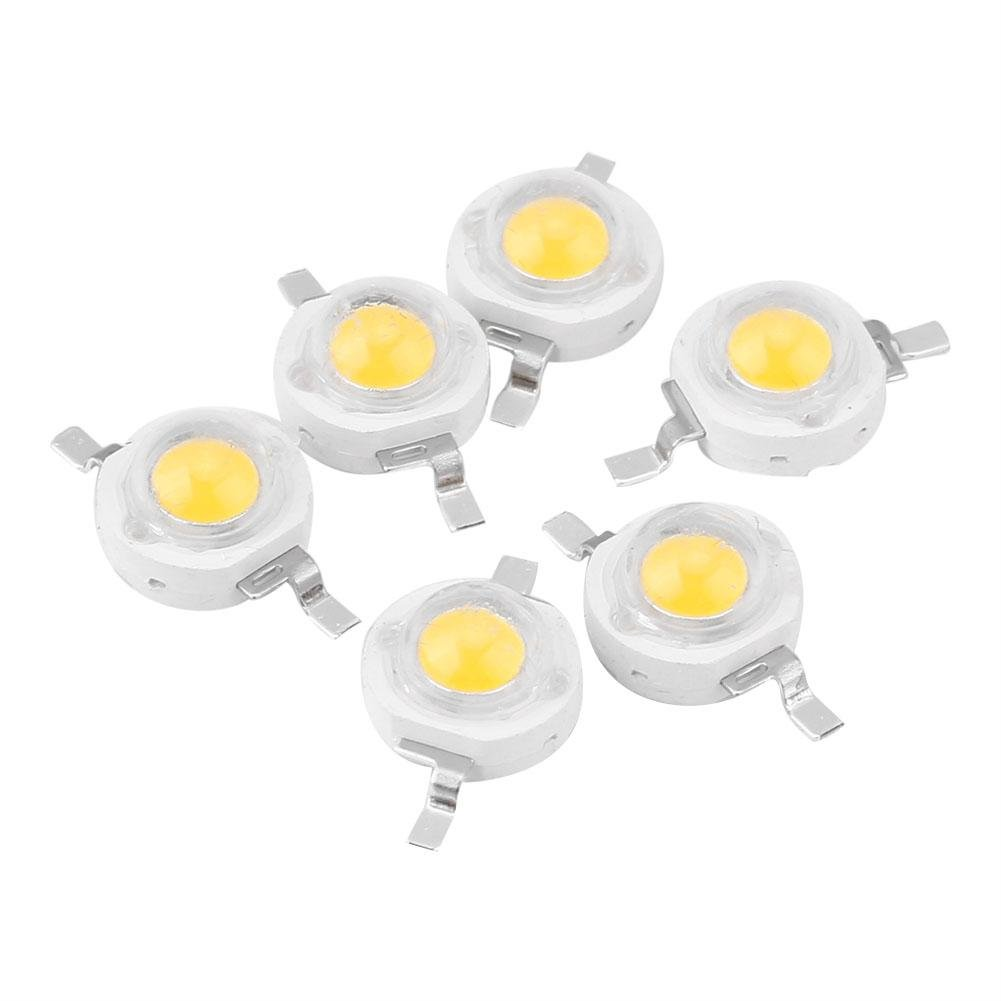
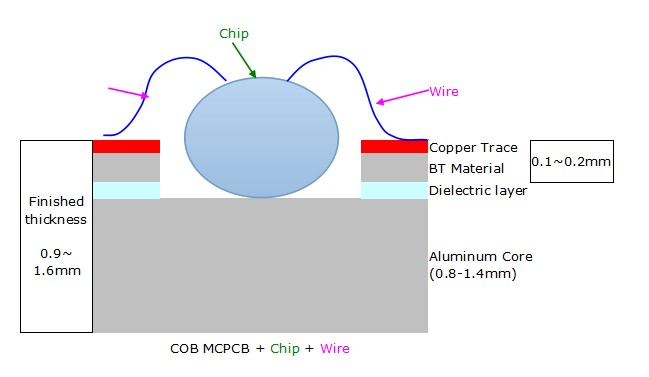
COB MCPCB, known as “Chip-On-Board” Metal Core PCB, is a type of MCPCB used in thermoelectric separation application. By using COB MCPCB, the micro-chip (also known as “die”) directly touch the metal core where the heat dissipate, and electrically interconnect the trace of circuit board (wire-bonding) so that power supply can be provided.

In normal MCPCB, there’s a dielectric layer between trace copper and metal core, and the thermal conductivity is limited by that dielectric layers, so value can only be 1~3 W/m.K. But using COB MCPCB, there’s no such dielectric layer because chip (die) direct touch the metal core, so thermal conductivity value of COB MCPCB will be almost the same one of metal core material itself. The normal material of metal core is aluminum, so thermal conduviity of COB MCPCB is more than 200W/m.K.

COB MCPCB

COB MCPCB (Chip on Board)

What are the COB Wire Bonding Processes?

COB process consists of three main categories to perform when manufacturing the Chip-on-Board:

1st: die mount or die attach;

2nd: wire bonding;

3rd: the encapsulation of die wires.

By using wire bonding & epoxy packaging then directly embedded on MCPCB, this practice can extend the lifespan of LED and unified light emission.

According to process and material, COB MCPCB applications can be categorized into two types: Mirror Aluminum and silver or gold platting aluminum, or silver plating mirror aluminum PCB.

Structure of COB MCPCB

Structure of COB MCPCB

Advantage of utilizing COB MCPCB

  • Excellent heat dissipation
  • High thermal conductivity: 137W/m.K
  • Higher reliability with better heat dispatch and small number of solder joint.
  • Provide enhanced reliability and lifespan of LED
  • Easy assembly for high powers LEDs
  • High quality material and production process allows easy assembly and substantial reduce the error percentage in assembly process
  • Substantially reduced space and cost
  • With better security protection (difficult to hack using reverse engineering)
  • Shorter time to the market

Application of COB MCPCB

  • High Power LED (up to 200W)
  • LED Backlight for LED TV
  • LED Front Light for E-Book
  • Agriculture & Horticulture Lighting
  • Street & Parking Lot Lighting
  • Automotive
  • Power Supply
  • ustomer Electronics Lighting
  • Other products that require thermal solutions
Application of COB MCPCB

FAQs about COB MCPCBs

1. What is the difference between a standard MCPCB and a COB MCPCB?

A standard MCPCB (Metal Core PCB) usually has SMT (Surface Mount Technology) components soldered onto a dielectric layer. In contrast, a COB (Chip-on-Board) MCPCB allows the LED semiconductor chip to be mounted directly onto the metal core or into a recessed “well.” This removes the thermal resistance of the LED package itself, allowing for much higher power density.

2. Why is thermal conductivity so important for COB MCPCBs?

Since COB LEDs pack many light-emitting diodes into a very small area, they generate intense localized heat. If this heat isn’t dissipated, the LED’s lifespan and brightness (luminous flux) drop rapidly. COB MCPCBs use materials like Aluminum or Copper to pull heat away from the chips at rates significantly higher than standard FR4 boards.

3. What are the common base materials used in COB MCPCBs?

  • Aluminum: The most common and cost-effective choice for general lighting.
  • Copper: Offers superior thermal conductivity but is heavier and more expensive; used for extreme high-power applications.
  • Stainless Steel: Occasionally used for high-strength requirements, though it has poorer thermal properties than Aluminum.

4. What is a “Mirror Aluminum” COB MCPCB?

A Mirror Aluminum COB MCPCB features a highly reflective, polished surface. This design ensures that light emitted from the sides of the LED chips is reflected forward, increasing the overall light output efficiency (Lumen/Watt) by reducing light absorption by the board itself.

5. Can COB MCPCBs be used with high-voltage applications?

Yes, but they require a specialized dielectric layer. This layer must be thin enough to allow heat to pass through to the metal core, but thick enough to provide electrical insulation (dielectric breakdown voltage) to prevent short circuits, especially in AC-driven LED modules.

6. What are the main applications for COB MCPCB technology?

Because they offer high brightness in a compact footprint, they are the industry standard for:

  • Automotive lighting (Headlights).
  • Industrial high-bay lighting.
  • Street lights and architectural floodlights.
  • Commercial downlights and track lighting.

Single Layer MCPCB

March 20th, 2026

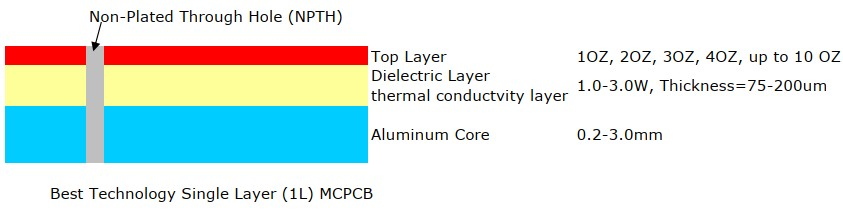
A simple layer single sided MCPCB consists of a metal base (usually aluminum, or copper alloy), Dielectric (non-conducting) Layer, Copper Circuit Layer, IC components and solder mask.

The prepreg dielectric provides excellent heat transfer from the foil and components to the base plate, while maintaining excellent electrical isolation. The base aluminum/copper plate gives the single-sided substrate mechanical integrity, and distributes and transfers the heat to a heat sink, mounting surface or directly to the ambient air.

The Single-Layer MCPCB can be used with surface mount and chip & wire components, and provides much lower thermal resistance than FR4 PWB. The metal core provides lower cost than ceramic substrates, and allows much larger areas than ceramic substrates.

Single Layer MCPCB

Single Layer MCPCB Capability

  • Base material: Aluminum/Copper/Iron Alloy
  • Thermal Conductivity (dielectrial layer): 0.8, 1.0, 1.5, 2.0, 3.0 W/m.K.
  • Board Thickness: 0.5mm~3.0mm(0.02″~0.12″)
  • Copper thickness: 0.5 OZ, 1.0 OZ, 2.0 OZ, 3.0 OZ, up to 10 OZ
  • Outline: Routing, punching, V-Cut
  • Soldermask: White/Black/Blue/Green/Red Oil
  • Legend/Silkscreen Color: Black/White
  • Surface finishing: Immersion Gold, HASL, OSP
  • Max Panel size: 600*500mm(23.62″*19.68″)
  • Packing: Vacuum/Plastic bag
  • Samples L/T: 4~6 Days
  • MP L/T: 5~7 Days

Single Layer MCPCB FAQs

1. What is a single layer MCPCB?

A single layer MCPCB consists of a metal base (typically aluminum or copper), a non-conductive dielectric layer, and a copper circuit layer. Unlike standard PCBs, the metal core acts as a primary heat sink, moving thermal energy away from high-power components to the environment or an external cooling system.

2. How does a single layer MCPCB differ from a standard FR4 PCB?

The primary difference is the substrate material. While FR4 uses fiberglass and epoxy, an MCPCB uses a metal base. This allows MCPCBs to have significantly higher thermal conductivity. While a standard FR4 board typically has a conductivity of around 0.25 W/mK, a single layer MCPCB can range from 1.0 W/mK to 9.0 W/mK depending on the dielectric material used.

3. What are the typical applications for single layer MCPCBs?

Single layer MCPCBs are most commonly used in the LED lighting industry (street lights, automotive headlamps, and backlight units) because LEDs generate significant heat that can degrade performance if not dissipated. They are also widely used in power conversion, solid-state relays, and the automotive sector for motor control modules.

4. Can you have plated through-holes (PTH) on a single layer MCPCB?

Generally, no. In a standard single layer MCPCB, the metal base is conductive, so through-holes would cause a short circuit between the signal layer and the base. Components are typically Surface Mount Devices (SMD). If through-hole components are required, specialized “COB” (Chip on Board) or complex insulated hole processes are needed, which significantly increases cost.

5. What are the layers of a single layer MCPCB?

A standard stack-up includes four main layers:

  • Solder Mask: Protects the copper circuit.
  • Circuit Layer: The copper foil used for traces.
  • Dielectric Layer: The most critical part; it provides electrical insulation while facilitating heat transfer.
  • Metal Substrate: Usually 1.0mm to 3.2mm of Aluminum (5052 or 6061) or Copper.

6. Is aluminum or copper better for the metal core?

Aluminum is the most popular choice because it is cost-effective and provides excellent thermal dissipation for most applications. Copper offers even higher thermal conductivity but is much heavier and more expensive. Copper is usually reserved for extremely high-power density applications where aluminum’s performance is insufficient.