If you work with soldered electrical and electronic assemblies, you’ve likely heard of IPC-J-STD-001, but do you truly understand what it entails, why it matters, and how it differs from other key standards like IPC-A-610? This guide breaks down everything you need to know about IPC-J-STD-001, from its definition and latest version to its requirements, certification process, and common FAQs. Whether you’re looking to ensure compliance, prepare for certification, or resolve common pain points with soldering standards, this resource delivers clear, actionable information designed to simplify complex technical concepts.
What Is IPC-J-STD-001?
IPC-J-STD-001 is the global industry standard for soldered electrical and electronic assemblies, developed and maintained by the IPC formerly known as the Institute of Printed Circuits. It establishes uniform requirements for soldering processes, materials, and acceptable practices across all electronic manufacturing sectors, from consumer electronics to aerospace and medical devices.
The standard is widely recognized as the benchmark for ensuring soldering quality, reliability, and consistency, helping manufacturers avoid defects such as cold joints, bridging, and insufficient solder coverage that can lead to product failure.
Unlike standards that focus on inspection alone, IPC-J-STD-001 emphasizes process control and preventive measures. It provides detailed guidelines for every stage of the soldering process, including material selection, equipment setup, temperature profiles, and operator training.
By following IPC-J-STD-001, manufacturers can reduce rework costs, improve product durability, and ensure compatibility with global market requirements. The standard is regularly updated to keep pace with technological advancements, such as the shift to lead free soldering and the miniaturization of electronic components.
What Does IPC J-STD-001 Stand For?
IPC J-STD-001 is an acronym that breaks down into clear, industry-specific terms, each with a distinct purpose in the electronic manufacturing landscape.
- IPC: Stands for the IPC, the global association that develops standards for the electronic interconnection industry.
- J-STD: Refers to a joint standard, meaning it is collaboratively developed by industry experts, manufacturers, and stakeholders to ensure broad applicability and consensus.
- 001: Designates it as the first standard in the J-STD series, which focuses specifically on soldering requirements.
Together, IPC J-STD-001 translates to the IPC Joint Standard 001, the foundational document for soldered electrical and electronic assemblies. This naming convention aligns with other IPC standards, creating a consistent framework for electronic manufacturing professionals to reference and follow.
What Is The Latest Version of IPC J-STD-001?
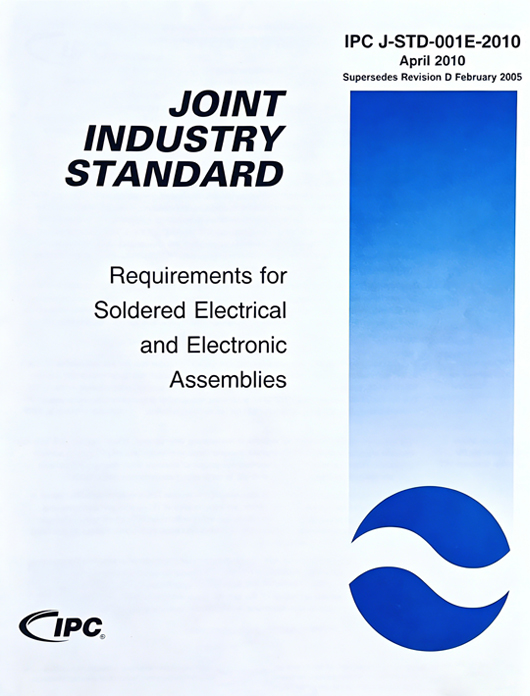
The latest version of IPC J-STD-001 is Revision H, commonly referred to as IPC-J-STD-001H. Released to address emerging technologies and industry needs, this version incorporates several key updates from previous revisions, including the integration of IPC-J-STD-001G-AM1 into the main document.
Revision H was developed with input from representatives from 27 countries, expanding its global relevance and ensuring it reflects current manufacturing practices.
Key Updates in IPC-J-STD-001H
- A new chapter on cleaning and residue requirements, replacing outdated guidance on solvent extractor resistivity testing.
- An appendix on using X ray for welding connection acceptance, addressing the need for non-destructive inspection of complex assemblies.
- Removal of references to international space station symbols to avoid confusion in general manufacturing applications.
- New standards for coil wound terminals, aligning with advancements in component design.
- A new automotive application appendix, providing tailored guidance for the automotive electronics sector’s unique reliability requirements.
Staying current with the latest version is critical for compliance, as older revisions may not address modern technologies like miniaturized components or lead free soldering processes. Manufacturers and professionals should always reference IPC-J-STD-001H to ensure their processes meet current industry standards.
What Are The IPC J-STD-001 Requirements For Soldered Electrical And Electronic Assemblies?
IPC J-STD-001 outlines comprehensive requirements for soldered assemblies, covering three main areas. These requirements are structured to ensure consistency, reliability, and performance across all soldered connections, regardless of the application or component type.
1. Material Requirements
The standard specifies strict criteria for all materials used in soldering, with clear guidelines for each material type:
- Solder Alloys: Must meet specific chemical composition and mechanical property requirements, with separate guidelines for lead containing and lead free options.
- Flux: Classified by activity level and halide content, with recommendations tailored to different soldering processes.
- Cleaning Agents: Must be compatible with assembly materials and effective at removing flux residues without damaging components.
IPC-J-STD-001H updates the cleaning requirements to align with modern environmental regulations, restricting harmful substances and providing clear guidelines for residue limits.
2. Process Requirements
Process requirements cover every step of the soldering process, from pre-solder preparation to post-solder inspection. Key process guidelines include:
- Pre-solder Preparation: Components and PCBs must be cleaned and dried to remove contaminants that could affect solder adhesion. Oxidation on component leads and PCB pads must be removed using appropriate methods.
- Temperature Profiles: Soldering temperatures must be carefully controlled based on the solder alloy and component type. For example, lead containing solder typically requires a temperature range of 350-400°C for hand soldering, while lead free solder requires higher temperatures (380-420°C).
- Soldering Methods: The standard provides guidelines for hand soldering, wave soldering, and reflow soldering. For wave soldering, contact time with the solder wave must be 3-5 seconds, and wave height should be 1.0-1.5mm to prevent bridging.
- Post-solder Cleaning: Residue removal is required unless the flux is designated as no-clean and meets residue limits specified in the standard. Ion contamination testing must be performed to ensure residue levels are below 6.45μg/cm² (per IPC-TM-650 2.3.26).
3. Quality Requirements
Quality requirements focus on acceptable solder joint characteristics, with clear criteria for compliance:
- Wetting Angle: Solder joints must have a wetting angle between 15° and 45°.
- Solder Fillet Shape: Solder fillets must fully cover the component lead and PCB pad.
- Defect Prevention: Defects such as cold joints, voids, bridging, and insufficient solder are not permitted, with stricter requirements for high reliability applications (Class 3).
What Is The Minimum Electrical Clearance For IPC J-STD-001?
IPC J-STD-001 does not specify a single minimum electrical clearance value. Clearance requirements vary based on the application voltage, component type, and environmental conditions. Instead, the standard references other IPC standards, such as IPC-2221, which provides detailed electrical clearance guidelines based on voltage levels and insulation type.
Common Minimum Electrical Clearance Values
- For most consumer and industrial applications operating at 50-250V:1.7mm for circuits before the fuse and 1.0mm after the fuse (air gap between conductors).
- For higher voltage applications (250-500V): 3.0mm before the fuse and 2.0mm after the fuse.
These values prevent electrical arcing and ensure safe operation. Note that electrical clearance (air gap) differs from creepage (surface path along insulation) — both must be considered for IPC J-STD-001 compliance, with additional clearance needed for high-reliability applications like aerospace and medical devices.
What Is The Difference Between J-STD-001 and IPC-A-610?
J-STD-001 and IPC-A-610 are complementary standards but address distinct stages of the electronic manufacturing process. The key differences are clearly outlined in the table below:
| Criteria | J-STD-001 | IPC-A-610 |
|---|---|---|
| Core Focus | Governs the soldering process and materials, outlining how to perform soldering correctly. | Defines the acceptability of the finished electronic assembly, focusing on inspection criteria. |
| Purpose | Prevent defects by establishing consistent, repeatable soldering processes. | Verify that the finished assembly meets acceptable quality levels. |
| Application Stage | Used during the manufacturing phase to guide soldering steps. | Used during the inspection phase to evaluate finished assemblies. |
| Key Guidelines | Material selection, equipment setup, temperature control, operator training. | Visual criteria for solder joints, component placement, and overall assembly quality. |
| Classifications | No specific classes; requirements align with application reliability needs. | Three classes (1: consumer, 2: industrial, 3: high reliability) for acceptability. |
Recent updates to both standards (IPC-J-STD-001H and IPC-A-610H) have aligned their requirements, with both adding new guidelines for coil wound terminals and removing outdated content. This alignment makes it easier for manufacturers to comply with both standards simultaneously.
Where Can I Get IPC J-STD-001 PDF?
The official IPC J-STD-001 PDF, including the latest Revision H, is available for purchase directly from the IPC website. The standard is not available for free download, as it is a copyrighted document developed through extensive industry collaboration and research.
Purchasing the official PDF ensures you have access to the most accurate, up-to-date content, including all updates and appendices.
Supplementary Resources
- IPC-J-STD-001H Redline document: Highlights changes between Revision H and the previous version (Revision G), useful for understanding specific updates.
- Authorized training providers: Some may include a digital copy of the standard as part of their training programs.
It is important to ensure any PDF obtained is an official, unaltered version to avoid relying on incorrect or outdated information. Unauthorized copies of the standard may contain errors or missing content, which can lead to non-compliance.
How To Prepare For IPC J-STD-001?
Preparing for IPC J-STD-001 compliance or certification requires a structured approach that covers training, process review, and documentation. Follow these steps to ensure full preparation:
1. Review the Latest Standard: Obtain the official IPC-J-STD-001H document and review all chapters. Pay special attention to updates related to cleaning requirements, X ray inspection, and automotive applications. Focus on sections relevant to your specific manufacturing processes (e.g., wave soldering, reflow soldering).
2. Train Personnel: Ensure all personnel involved in soldering, setup, and inspection receive formal IPC training. Training programs should cover the requirements of IPC J-STD-001, proper soldering techniques, and defect identification. Many authorized training providers offer courses specifically focused on IPC J-STD-001 compliance.
3. Review and Update Processes: Evaluate your current soldering processes against IPC J-STD-001 requirements. Check temperature profiles, material selection, cleaning procedures, and equipment maintenance. Make adjustments as needed—for example, updating flux selection to meet new residue limits or adjusting wave soldering parameters to prevent bridging.
4. Implement Quality Control Measures: Establish regular testing and inspection procedures to ensure ongoing compliance. This includes ion contamination testing, solder joint inspection, and process validation. Maintain detailed records of all tests and adjustments.
5. Prepare Documentation: Document all processes, materials, and training records to demonstrate compliance. This includes solder alloy specifications, flux data sheets, temperature profiles, and operator training certificates. Proper documentation is critical for certification and audits.
How Long Does It Take To Acquire IPC-J-STD-001?
The time required to acquire IPC-J-STD-001 certification varies based on several factors, including the size of the organization, the current state of existing processes, and the type of certification sought.
Individual Certification
- Typically takes 2-3 days of training followed by an exam.
- Most training programs are 2-3 days long, with the exam administered on the final day.
Organizational Certification
- Timeline is longer, typically 4-8 weeks.
- Includes reviewing and updating processes, training personnel, conducting internal audits, and scheduling an external audit by an authorized IPC certification body.
- The external audit itself usually takes 1-3 days, depending on the size of the facility and the scope of the certification.
Organizations with existing soldering processes that are already close to IPC J-STD-001 requirements may be able to complete the certification process in 4 weeks or less. Those with outdated processes or limited training may need 8 weeks or more to make necessary adjustments and prepare for the audit.
How Much Is IPC J-STD-001 Certification?
The cost of J-STD-001 certification varies based on the type of certification (individual vs. organizational) and the certification body. Below are typical cost ranges:
Individual Certification
- Costs typically range from $500 to $1,500 per person.
- Includes training materials, instruction, and the certification exam.
- Group discounts may be available for organizations training multiple personnel.
Organizational Certification
- Costs are higher, ranging from $3,000 to $10,000 or more.
- Includes application fees, audit fees, and any necessary process adjustments.
- Audit fees are typically calculated based on the number of audit days required, with each day costing$1,000 to $3,000.
Additional Costs
- Purchasing the official IPC J-STD-001 document ($150-$300).
- Training materials and equipment upgrades needed to meet the standard’s requirements.
- Ongoing costs: Recertification (required every 2-3 years) and training updates for new employees.
How To Get IPC J-STD-001 Certification?
Obtaining IPC J-STD-001 certification involves a structured process that varies slightly for individuals and organizations. Follow the step-by-step guides below:
Individual Certification
1. Choose an authorized IPC training provider: Select a training provider certified by the IPC to offer IPC J-STD-001 training. Ensure the provider offers courses for the latest version (Revision H).
2. Enroll in a training course: Complete a 2-3 day training course that covers all requirements of IPC J-STD-001. The course includes both classroom instruction and hands-on practice.
3. Pass the certification exam: At the end of the course, take the IPC J-STD-001 exam. The exam consists of multiple choice questions and practical assessments of soldering skills. A passing score of 70% or higher is typically required.
4. Receive certification: Upon passing the exam, you will receive an IPC J-STD-001 certification certificate, which is valid for 2-3 years. Recertification is required to maintain active status.
Organizational Certification
1. Prepare processes and documentation: Review and update all soldering processes to meet IPC J-STD-001H requirements. Prepare all necessary documentation, including process records, material specifications, and training records.
2. Conduct an internal audit: Perform an internal audit to identify any gaps in compliance. Address any issues found before proceeding to the external audit.
3. Select an authorized certification body: Choose an IPC authorized certification body to conduct the external audit. Ensure the body has experience with IPC J-STD-001 certification.
4. Schedule and complete the external audit: The certification body will conduct an on-site audit to verify compliance with IPC J-STD-001. The audit includes a review of processes, documentation, and personnel training.
5. Address non-conformities: If any non-conformities are identified during the audit, address them within the specified timeframe and provide evidence of correction.
6. Receive certification: Upon successful completion of the audit, the organization will receive an IPC J-STD-001 certification certificate, valid for 3 years. Regular surveillance audits are required to maintain certification.
FAQs About IPC-J-STD-001
Q1: Does IPC J-STD-001 require lead free soldering?
A1: IPC J-STD-001 does not mandate lead free soldering, but it provides detailed guidelines for both lead containing and lead free solder alloys. Many industries, such as automotive and consumer electronics, require lead free soldering due to environmental regulations, and IPC J-STD-001H includes specific requirements for lead free processes, including higher soldering temperatures and different flux requirements.
Q2: Is IPC J-STD-001 certification mandatory for electronic manufacturers?
A2: IPC J-STD-001 certification is not universally mandatory, but it is often required by customers, especially in industries like aerospace, medical devices, and automotive. Compliance with IPC J-STD-001 is also necessary to meet global market requirements and ensure product reliability. Many manufacturers pursue certification voluntarily to demonstrate their commitment to quality.
Q3: Can I use IPC J-STD-001 for both through hole and surface mount assemblies?
A3: Yes, IPC J-STD-001 applies to both through hole and surface mount soldered assemblies. The standard provides specific guidelines for each type of assembly, including solder joint requirements, temperature profiles, and material selection. It also includes guidance for mixed technology assemblies that combine both through hole and surface mount components.
Q4: How often is IPC J-STD-001 updated?
A4: IPC J-STD-001 is updated periodically to keep pace with technological advancements and industry needs. The average update cycle is 5-7 years, with minor amendments (addenda) sometimes released between major revisions. The latest major revision, H, was released in 2020, following the previous revision G released in 2014.
Q5: What is the difference between IPC J-STD-001 and IPC J-STD-003?
A5: IPC J-STD-001 focuses on soldering processes and requirements for electrical and electronic assemblies, while IPC J-STD-003 focuses on PCB solderability testing methods. IPC J-STD-003 provides guidelines for testing the solderability of PCB pads and component leads, including methods like board edge dipping and wave soldering simulation. The two standards work together to ensure both the process (J-STD-001) and the materials (J-STD-003) meet industry standards.
Q6: How does IPC J-STD-001 address component miniaturization?
A6: IPC J-STD-001H includes updated guidelines to address component miniaturization, such as 01005 components (0.4×0.2mm). The standard provides specific solder joint requirements for small components, including proper solder fillet formation and wetting requirements. It also includes guidance for using X ray inspection to verify solder joints on miniaturized components that are not visible to the naked eye.
Q7: What happens if my assembly fails to meet IPC J-STD-001 requirements?
A7: If an assembly fails to meet IPC J-STD-001 requirements, it must be reworked or scrapped. Rework must be performed according to IPC J-STD-001 guidelines, with proper documentation of the rework process. Failure to address non-compliant assemblies can lead to product failure, customer complaints, and loss of certification. Regular process monitoring and inspection can help prevent non-compliance.