PCB manufacturing PCB manufacturing
Home > Blog

sinkpad mcpcb

Double Sided SinkPAD Board
Tuesday, March 24th, 2026

What Double Sided SinkPAD Board is?

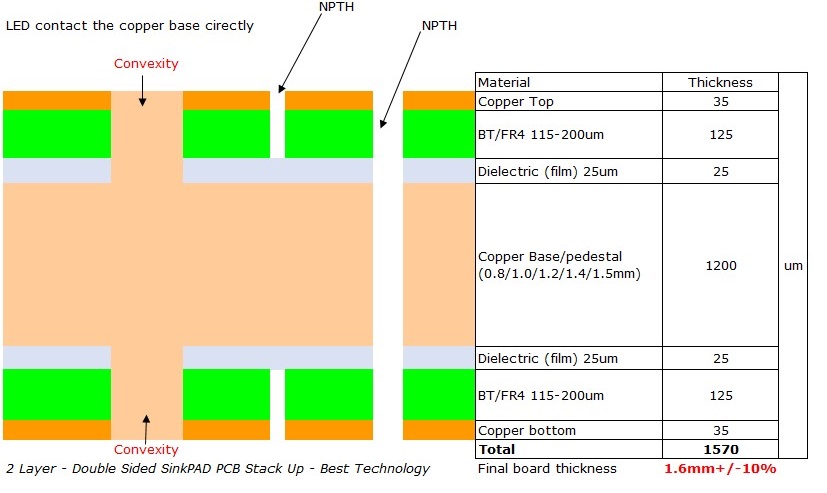
The Double sided SinkPAD board consists of at least two layers of trace circuit, and there’re at least one circuit layer on both top and bottom side of board, a dielectric (non-conducting) layer, a metal core/pedestal which normally is copper.

As there’re circuit layer on both sides, so engineer can put more (about 2 times, ideally) components on the same size circuit to realize more function, more complicated design, comparing to 1 Layer SinkPAD board or 2 layers SinkPAD board.
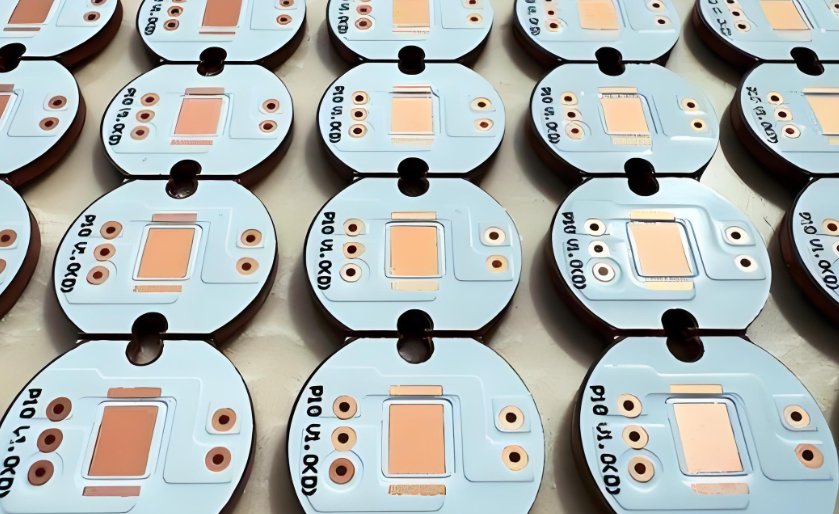
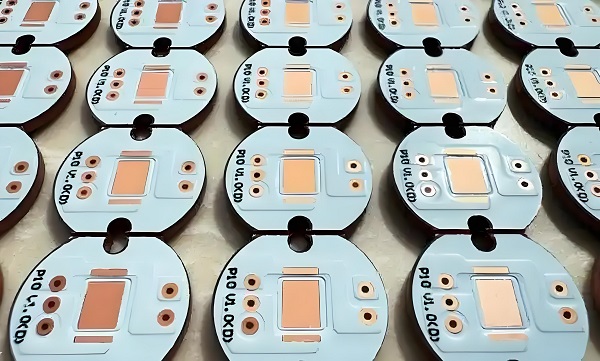
Double Sided SinkPAD Board

There’s no PTH (plated through hole) on double sided SinkPAD board, because the limitation of manufacturing process, which different from double sided Metal Core PCB which has a lot of PTH, and thermal PAD of LED will be put directly on copper core, also belonging to Direct Thermal Path (DTP) board too, but engineer needs to consider where the heat sink will be if he want more fast heat transferring, as there’re always components on both sides, and that make double sides SinkPAD board designing becoming more difficult & complex comparing to 1L SinkPAD board, or 2L SinkPAD board.

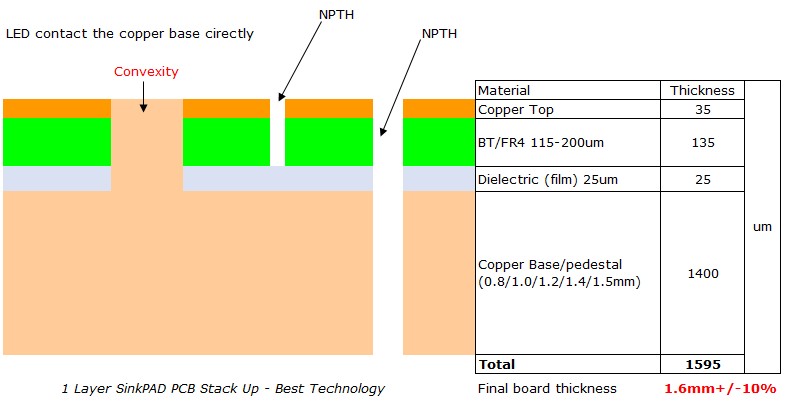
Stack up of Double Sided SinkPAD Board
Double Sided SinkPAD Board

Advantages of Utilizing Double Sided SinkPAD Board:

  • Put more components on the both top and bottom, design more complicated circuit board.
  • It adopts the thermoelectric separation structure, the Lumens depreciation of the LED is minimized, and the life of the lamp is prolonged.
  • Suitable for matching single high-power lamp, such as Cree XPL, XML, XHP; Osram LED, etc., also COB package LED
  • High power semiconductors (transistors, thyristors, diodes) as well as resistors.
  • A variety of Surface Finishing are available according to different demands. (ENIG, OSP, Immersion Tin, ENEPIG, HAL) with excellent reliability of the surface treatment layer.

Application of Double Sided SinkPAD Board

  • High Power LED (up to 200W).
  • High semiconductors (transistors, thyristors, diodes) as well as resistors.

2 Layer SinkaPAD Board Capability

  • Base material: Copper: 0.8mm, 1.0mm, 1.2mm, 1.4mm, 1.5mm
  • Thermal Conductivity: 400 W/m.K.
  • Board Thickness: 1.0mm~2.0 mm (0.04″~0.08″)
  • Copper thickness: 0.5 OZ, 1.0 OZ, 2.0 OZ (specially 3-10 OZ)
  • Outline: Routing, punching, V-Cut
  • Soldermask: White/Black/Blue/Green/Red Oil
  • Legend/Silkscreen Color: Black/White/Yellow
  • Surface finishing: Immersion Gold, ENEPIG, Immersion Tin, OSP
  • Max Panel size: 600*500mm(23.62″*19.68″)
  • Packing: Vacuum/Plastic bag
  • Samples L/T: 1.5~2 weeks
  • MP L/T: 2-3 weeks

Click here to see the manufacturing process of double sided SinkPAD Board and other options.

If you want to customize double sided SinkPAD board, please contact EBest Circuit (Best Technology) today send your request for double sides SinkPAD PCB.

FAQs about Double-Sided SinkPAD Boards

1. What is a Double-Sided SinkPAD Board and how does it work?

A Double-Sided SinkPAD Board is a specialized Metal Core PCB (MCPCB) that provides a Direct Thermal Path (DTP) on both sides of the board. Unlike standard MCPCBs that use a dielectric layer to separate the circuit from the metal base, SinkPAD technology removes the dielectric under the component’s thermal pad. This allows the component (like a high-power LED) to sit directly on the copper or aluminum core, drastically reducing thermal resistance.

2. How does a Double-Sided SinkPAD differ from a standard Double-Sided MCPCB?

The primary difference is the thermal conductivity. In a standard double-sided MCPCB, heat must travel through a thermally conductive dielectric layer (typically 1–8 W/m·K) to reach the metal core. In a SinkPAD board, the dielectric is bypassed entirely for the thermal pad, allowing for conductivity ratings as high as 400 W/m·K (if using a copper core). Additionally, double-sided SinkPADs allow for higher component density by utilizing both the top and bottom layers for active circuitry.

3. Why would I choose a double-sided design over a single-layer SinkPAD?

Engineers choose double-sided SinkPADs when they need to maximize functional density in compact spaces. It allows for roughly twice the component population or more complex circuit routing compared to a 1-layer board. This is ideal for high-power applications where you need to mount LEDs or transistors on one side while placing control circuitry, connectors, or additional power components on the other.

4. Are there limitations to the Plated Through Holes (PTH) in double-sided SinkPADs?

Yes. Due to the unique manufacturing process where the metal core is “sunk” or embossed to meet the trace layer, standard Plated Through Holes (PTH) are often limited or more complex to implement than in traditional FR4 boards. Connections between sides are typically handled through specialized routing or assembly techniques, so it is crucial to consult with your manufacturer during the design phase to ensure the layout is compatible with the “thermoelectric separation” structure.

5. Which base material is better for SinkPAD boards: Aluminum or Copper?

  • Copper: Best for ultra-high-power applications. It offers superior thermal conductivity (approx. 400 W/m·K) and is the most common choice for SinkPAD convexity because it is easier to etch and process for this specific technology.
  • Aluminum: More cost-effective and lighter. While it has good thermal properties, the chemical process for creating the SinkPAD convexity is more complex, often making it more expensive or difficult to produce than copper-based SinkPADs.

6. Can SinkPAD technology be used for components other than LEDs?

Absolutely. While most commonly used for high-power LEDs (Cree, Osram, etc.) to prevent lumen depreciation, SinkPAD boards are excellent for any high-power semiconductor that features an electrically neutral thermal pad. This includes power transistors, thyristors, diodes, and high-wattage resistors used in automotive, aerospace, or industrial power monitoring.
How Does the Cost of Sinkpad MCPCB Compare to Conventional MCPCB?
Thursday, May 22nd, 2025

What Is Sinkpad MCPCB?

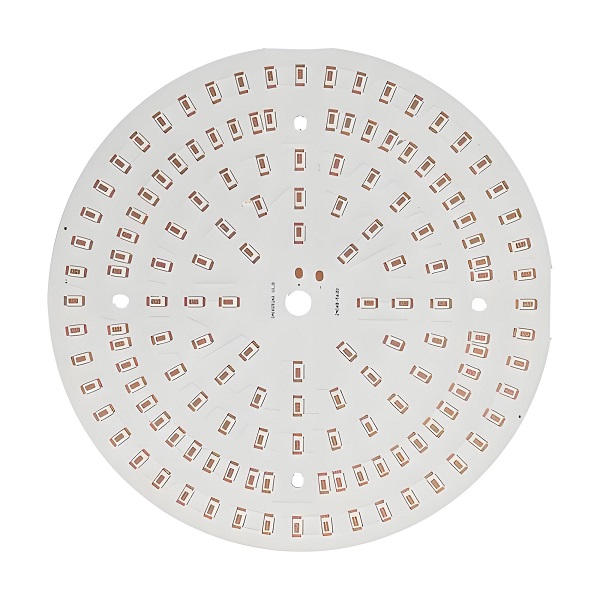
SinkPAD MCPCB is a special kind of metal core printed circuit board designed for excellent heat dissipation. It’s different from regular MCPCBs because it removes one major barrier—the insulating dielectric layer under the LED.

In simple terms, it allows heat to flow directly from the LED chip to the metal base. That means less heat build-up, more efficiency, and longer lifespan for your components.

You’ll often find SinkPAD MCPCBs in high-power LED applications—like automotive lighting, industrial lamps, medical equipment, and even UV curing systems. These are places where heat control isn’t just helpful—it’s essential.

What Is Sinkpad MCPCB?

Advantages of Sinkpad MCPCB

1. Direct Heat Flow

With no dielectric between the LED and metal core, SinkPAD boards offer a direct thermal path, reducing resistance and increasing efficiency.

2. Lower Operating Temperatures

By improving heat transfer, components stay cooler. For LEDs, this means stable brightness and a longer working life.

3. Consistent Light Output

Temperature spikes can dim or discolor LEDs. SinkPAD keeps the junction temperature stable, maintaining consistent color and brightness.

4. Compact Design

Thanks to better heat handling, you can reduce or eliminate bulky heatsinks, helping make designs smaller and lighter.

5. Durability in Harsh Conditions

SinkPAD boards resist thermal cycling, shock, and vibration, making them perfect for tough environments like aerospace or outdoor lighting.

So if your design involves powerful LEDs or components that get hot fast, this type of board can be a game-changer.

Base Materials of Sinkpad MCPCB

SinkPAD boards come with different base metals. Each one has its own strengths depending on your project.

  • Aluminum Core Sinkpad PCB

Aluminum is the more common choice. It’s lightweight, easy to work with, and keeps costs low. Its thermal conductivity is good—usually around 150-200 W/m·K. For applications where heat output isn’t extreme, aluminum SinkPAD PCBs are a great fit. You’ll find them in general LED lighting, backlit signs, and other consumer electronics.

They’re also a smart option if you’re trying to keep your SinkPAD MCPCB price in check. But actually, for consumer electronics, conventional metal core PCB can cover it.

Aluminum Core Sinkpad PCB
  • Copper Core Sinkpad PCB

Copper is all about performance. It has much higher thermal conductivity—around 385-400 W/m·K—which means it can handle intense heat. If your LEDs are pushing a lot of power or operating in a hot environment, copper is the better option. Some industrial like UV lights, high-performance lasers, or automotive headlights that stay on for long hours.

Copper Core Sinkpad PCB

Copper boards are heavier and more expensive than aluminum ones, but they deliver top-tier thermal results.

How Does Sinkpad MCPCB Work?

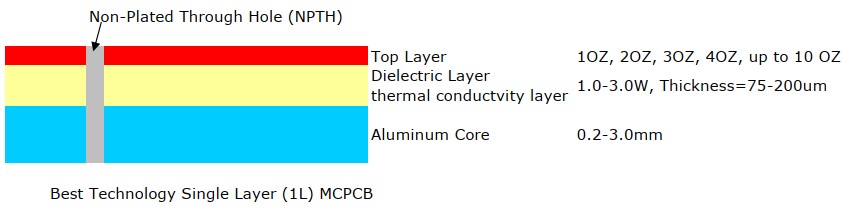
In a standard MCPCB, the LED sits on a copper trace. Under that trace is a dielectric layer. Below that is the metal core, its structure just like below. Heat has to travel through all of this to get out. That creates resistance.

How Does Sinkpad MCPCB Work?

However, sinkPAD skips the dielectric layer—at least under the LED’s thermal pad. Instead, the heat flows straight from the LED’s thermal pad into a thermal cavity that connects directly to the base metal. This structure is often called a Direct Thermal Path (DTP).

How Does Sinkpad MCPCB Work?

It’s like giving heat a shortcut out of the system. No extra layers. No slowdowns. Just fast, efficient cooling. This design improves overall thermal conductivity and gives you tighter control over junction temperatures.

Thermal Conductivity of Sinkpad MCPCB

Thermal conductivity is key when you’re dealing with LEDs and power electronics. The better the board can spread heat, the better your device performs.

With aluminum cores, you’ll typically see thermal conductivity in the 150–200 W/m·K range. That’s solid for most LED needs. With copper cores, you’ll reach up to 400 W/m·K, giving you elite heat handling.

Sinkpad MCPCB vs. Conventional MCPCB

So what are the differences between sinkpad metal core PCB and traditional metal core PCB? Here we made a comparison between them:

PropertySinkPAD MCPCBConventional MCPCB
Heat TransferDirect path (through convexity pad)Through dielectric
Thermal conductivityUp to 400W/m.kUp to 8W/m.k
Thermal Resistance0.4°C/W or lower1.0–2.0°C/W
Light StabilityHigh (because most use copper)Medium
LED LifespanExtendedShorter under heat
Space NeededNoLarger cooling required
CostSlightly higherLower upfront

SinkPAD boards give better performance and better results—especially when heat control is non-negotiable. They cost more, but what you get in return is worth it in critical applications.

Considerations When Using Sinkpad MCPCB

SinkPAD MCPCBs aren’t plug-and-play for every project. There are a few things you’ll want to keep in mind before designing with them.

1. Know Your Heat Load

If your LEDs don’t generate much heat, you might not need SinkPAD. But if your design involves high wattage, tight spaces, or long run times—then yes, it’s worth considering.

2. Choose the Right Core

Use aluminum if your budget is tight or if weight is a concern. Go with copper when you need every ounce of thermal performance you can get.

3. Plan for Heatsinks

Even though the board transfers heat well, it still needs a place to send that heat. Match your SinkPAD PCB with a proper heatsink or thermal interface.

4. Soldering Profiles

Because these boards transfer heat so quickly, your reflow or wave soldering profile might need to be adjusted. Too much heat too fast can be a problem.

5. Work With an Experienced Supplier

Not all board suppliers are familiar with SinkPAD technology. Make sure your manufacturer knows how to handle the convexity design and machining process correctly. If you are searching for a reliable sinkpad MCPCB manufacturer, do not miss out EBest Circuit (Best Technology). We have over 18 years experiences, and we have experienced engineers and operators to give you a high quality sinkpad copper core PCB.

How Does the Cost of Sinkpad MCPCB Compare to Conventional MCPCB?

So, how does the cost of sinkpad MCPCB compare to the conventional MCPCB? Actually, the price of sinkpad PCB is higher than that of a standard MCPCB. Because the process is more complex. There’s more precision involved in removing the dielectric under the LED. And if you’re using copper, that adds more to the cost.

Here’s what influences the price:

  • Core material (aluminum vs. copper)
  • Board size and thickness
  • Layer count
  • Volume of your order
  • Custom thermal pad design

But here’s the real question: does it save you money in the long run? For many, the answer is yes. Here’s why:

  • You don’t need oversized heatsinks
  • Your LEDs last longer
  • Fewer failures mean lower service costs
  • Your product performs better, with fewer returns

When you weigh the total system cost—not just the board—the extra investment often pays off.

SinkPAD MCPCBs offer a smart solution for thermal challenges in LED and power electronics. They bring something special to the table—direct heat transfer from the source to the metal base.

If your design involves strong heat loads, tight spaces, or critical reliability, this is the kind of PCB that can make a difference. In our next blog, we will share the factors affect the cost of sinkpad PCB. If you want to know more about sinkpad PCB, you are welcome to contact us at any time.

FAQs

1. What makes Sinkpad MCPCB more effective than a standard MCPCB?

    It creates a direct path from the LED to the metal core, removing the thermal barrier and increasing heat flow.

    2. Can I use aluminum Sinkpad MCPCB for high-power LEDs?

    Yes, if thermal output is moderate. For extreme power or heat, copper may perform better.

    3. Does it support double-layer designs?

    Sinkpad technology is usually single-sided due to its thermal cavity, but custom options are available.

    4. Is the cost justified in consumer products?

    In mid- to high-end products where longevity and brightness matter, yes. It reduces long-term failures and service needs.

    5. How do I choose between aluminum and copper Sinkpad cores?

    Look at the application. If weight and cost are more critical, aluminum works well. For demanding environments, copper is better.