





What Double Sided SinkPAD Board is?
The Double sided SinkPAD board consists of at least two layers of trace circuit, and thereā€™re at least one circuit layer on both top and bottom side of board, a dielectric (non-conducting) layer, a metal core/pedestal which normally is copper.
As thereā€™re circuit layer on both sides, so engineer can put more (about 2 times, ideally) components on the same size circuit to realize more function, more complicated design, comparing to 1 Layer SinkPAD board or 2 layers SinkPAD board.
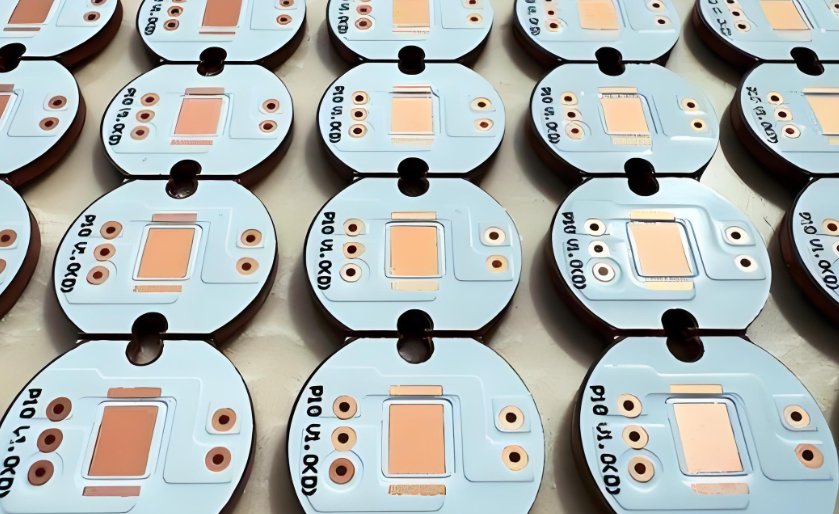
Double Sided SinkPAD Board
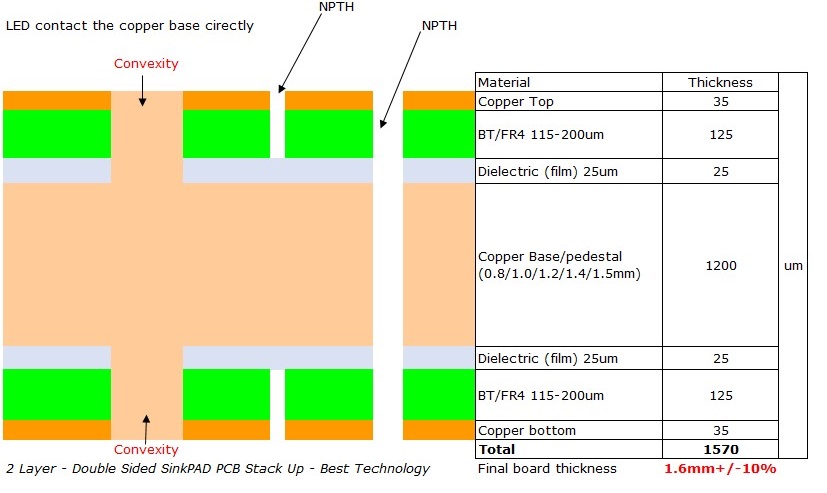
Thereā€™s no PTH (plated through hole) on double sided SinkPAD board, because the limitation of manufacturing process, which different from double sided Metal Core PCB which has a lot of PTH, and thermal PAD of LED will be put directly on copper core, also belonging to Direct Thermal Path (DTP) board too, but engineer needs to consider where the heat sink will be if he want more fast heat transferring, as thereā€™re always components on both sides, and that make double sides SinkPAD board designing becoming more difficult & complex comparing to 1L SinkPAD board, or 2L SinkPAD board.
Stack up of Double Sided SinkPAD Board
Advantages of Utilizing Double Sided SinkPAD Board:
- Put more components on the both top and bottom, design more complicated circuit board.
- It adopts the thermoelectric separation structure, the Lumens depreciation of the LED is minimized, and the life of the lamp is prolonged.
- Suitable for matching single high-power lamp, such as Cree XPL, XML, XHP; Osram LED, etc., also COB package LED
- High power semiconductors (transistors, thyristors, diodes) as well as resistors.
- A variety of Surface Finishing are available according to different demands. (ENIG, OSP, Immersion Tin, ENEPIG, HAL) with excellent reliability of the surface treatment layer.
Application of Double Sided SinkPAD Board
- High Power LED (up to 200W).
- High semiconductors (transistors, thyristors, diodes) as well as resistors.
2 Layer SinkaPAD Board Capability
- Base material: Copper: 0.8mm, 1.0mm, 1.2mm, 1.4mm, 1.5mm
- Thermal Conductivity: 400 W/m.K.
- Board Thickness: 1.0mm~2.0 mm (0.04″~0.08″)
- Copper thickness: 0.5 OZ, 1.0 OZ, 2.0 OZ (specially 3-10 OZ)
- Outline: Routing, punching, V-Cut
- Soldermask: White/Black/Blue/Green/Red Oil
- Legend/Silkscreen Color: Black/White/Yellow
- Surface finishing: Immersion Gold, ENEPIG, Immersion Tin, OSP
- Max Panel size: 600*500mm(23.62″*19.68″)
- Packing: Vacuum/Plastic bag
- Samples L/T: 1.5~2 weeks
- MP L/T: 2-3 weeks
Click here to see the manufacturing process of double sided SinkPAD Board and other options.
If you want to customize double sided SinkPAD board, please contact EBest Circuit (Best Technology) today send your request for double sides SinkPAD PCB.
FAQs about Double-Sided SinkPAD Boards
1. What is a Double-Sided SinkPAD Board and how does it work?
A Double-Sided SinkPAD Board is a specialized Metal Core PCB (MCPCB) that provides a Direct Thermal Path (DTP) on both sides of the board. Unlike standard MCPCBs that use a dielectric layer to separate the circuit from the metal base, SinkPAD technology removes the dielectric under the component’s thermal pad. This allows the component (like a high-power LED) to sit directly on the copper or aluminum core, drastically reducing thermal resistance.
2. How does a Double-Sided SinkPAD differ from a standard Double-Sided MCPCB?
The primary difference is the thermal conductivity. In a standard double-sided MCPCB, heat must travel through a thermally conductive dielectric layer (typically 1ā€“8 W/mĀ·K) to reach the metal core. In a SinkPAD board, the dielectric is bypassed entirely for the thermal pad, allowing for conductivity ratings as high as 400 W/mĀ·K (if using a copper core). Additionally, double-sided SinkPADs allow for higher component density by utilizing both the top and bottom layers for active circuitry.
3. Why would I choose a double-sided design over a single-layer SinkPAD?
Engineers choose double-sided SinkPADs when they need to maximize functional density in compact spaces. It allows for roughly twice the component population or more complex circuit routing compared to a 1-layer board. This is ideal for high-power applications where you need to mount LEDs or transistors on one side while placing control circuitry, connectors, or additional power components on the other.
4. Are there limitations to the Plated Through Holes (PTH) in double-sided SinkPADs?
Yes. Due to the unique manufacturing process where the metal core is “sunk” or embossed to meet the trace layer, standard Plated Through Holes (PTH) are often limited or more complex to implement than in traditional FR4 boards. Connections between sides are typically handled through specialized routing or assembly techniques, so it is crucial to consult with your manufacturer during the design phase to ensure the layout is compatible with the “thermoelectric separation” structure.
5. Which base material is better for SinkPAD boards: Aluminum or Copper?
- Copper: Best for ultra-high-power applications. It offers superior thermal conductivity (approx. 400 W/mĀ·K) and is the most common choice for SinkPAD convexity because it is easier to etch and process for this specific technology.
- Aluminum: More cost-effective and lighter. While it has good thermal properties, the chemical process for creating the SinkPAD convexity is more complex, often making it more expensive or difficult to produce than copper-based SinkPADs.
6. Can SinkPAD technology be used for components other than LEDs?
Absolutely. While most commonly used for high-power LEDs (Cree, Osram, etc.) to prevent lumen depreciation, SinkPAD boards are excellent for any high-power semiconductor that features an electrically neutral thermal pad. This includes power transistors, thyristors, diodes, and high-wattage resistors used in automotive, aerospace, or industrial power monitoring.