PCB manufacturing PCB manufacturing
Home > Blog

Posts Tagged ‘cold solder joint causes’

What Is a Cold Solder Joint? Meaning, Symptoms, Repair & Prevention Guide
Friday, January 2nd, 2026

A cold solder joint is one of the most common reliability defects in PCB and PCBA assemblies, and it continues to be a major source of intermittent failures across consumer electronics, industrial controls, medical devices, automotive modules, and aerospace hardware. At Best Technology, we see the long-term consequences of cold joints in incoming failure analyses from global customers—especially in assemblies where stable conductivity and mechanical strength are critical.

With 19 years of PCBA production experience across China and Vietnam, medical-grade and aerospace-grade certifications, and MES-controlled SMT lines, we understand how cold solder joints emerge, how to eliminate them, and how to engineer assemblies that remain stable throughout the product life cycle.

What Is a Cold Solder Joint?

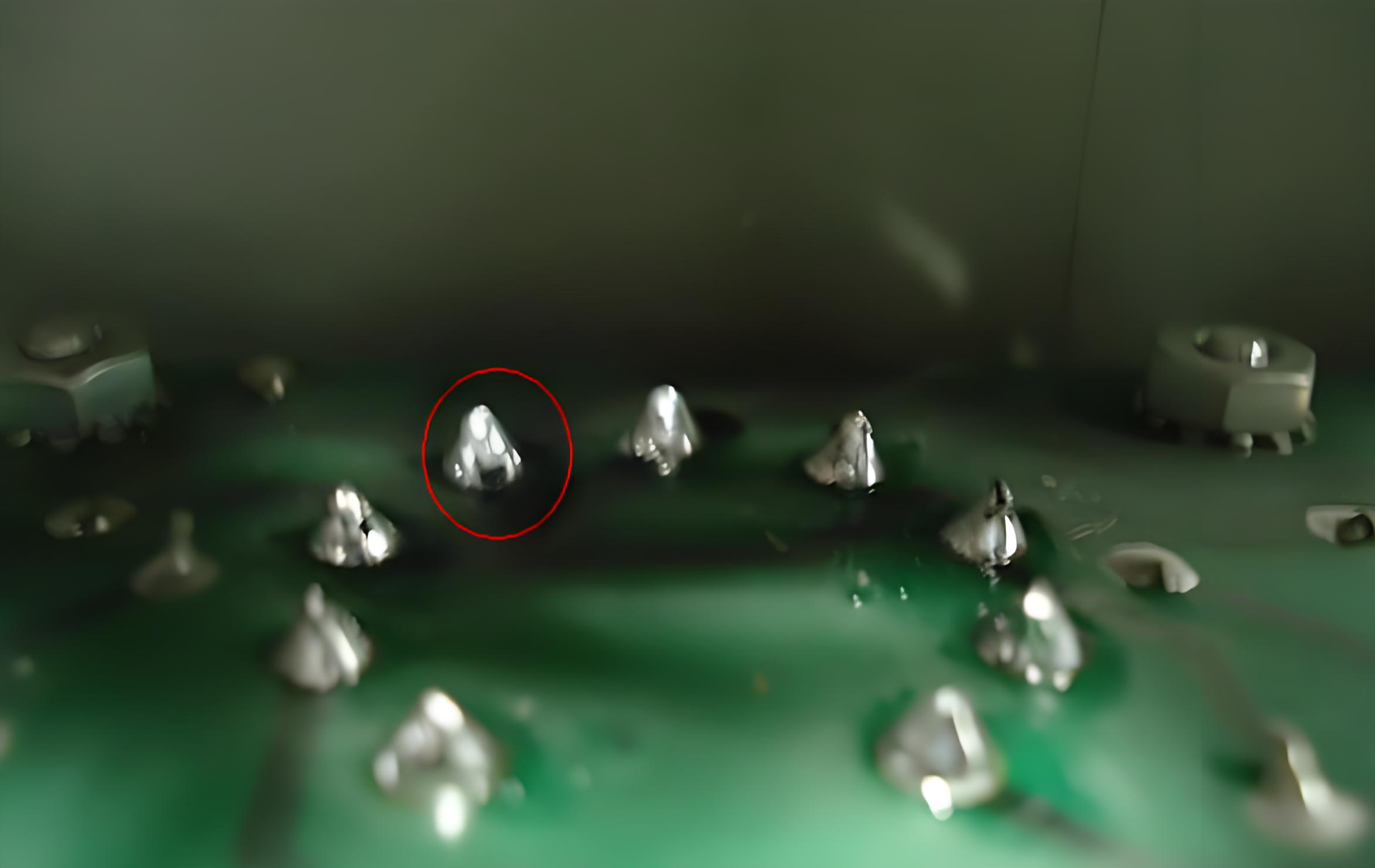
A cold solder joint forms when solder does not melt or wet the pad and component lead completely. Instead of creating a unified bond, the solder cools prematurely or never flows correctly, resulting in a dull, grainy, or uneven connection.

In the PCBA environment, cold joints are considered a process defect because they weaken the mechanical integrity of a soldered connection and create unstable electrical performance that deteriorates over time.

In high-reliability sectors—medical, industrial, aerospace—these defects are unacceptable and must be removed at the root cause: temperature control, surface condition, solder alloy behavior, and wetting characteristics.
What Is a Cold Solder Joint? Meaning, Symptoms, Repair & Prevention Guide

Do Cold Solder Joints Still Work?

Temporarily, yes. Reliably, no. A cold solder joint may appear functional during a quick test, then fail:

  • When the board heats during normal operation
  • When vibration or slight mechanical stress occurs
  • When humidity or temperature cycles change contact resistance
  • When current load increases

This unstable behavior is what makes cold joints one of the most misdiagnosed failure sources. Many customers approach Best Technology believing they have a “component issue” or “firmware bug,” when the real cause is inconsistent solder metallurgy.

Cold Solder Joint Symptoms

From a PCBA viewpoint, cold joints create early-life failures that escalate under stress. Common symptoms include:

  • Intermittent booting or power instability
  • Flickering LEDs, displays, or inconsistent sensor readings
  • Weak or noisy signals in communication lines
  • Overheating around a soldered component
  • Boards that only work when pressed or tapped
  • Modules that behave differently under temperature changes

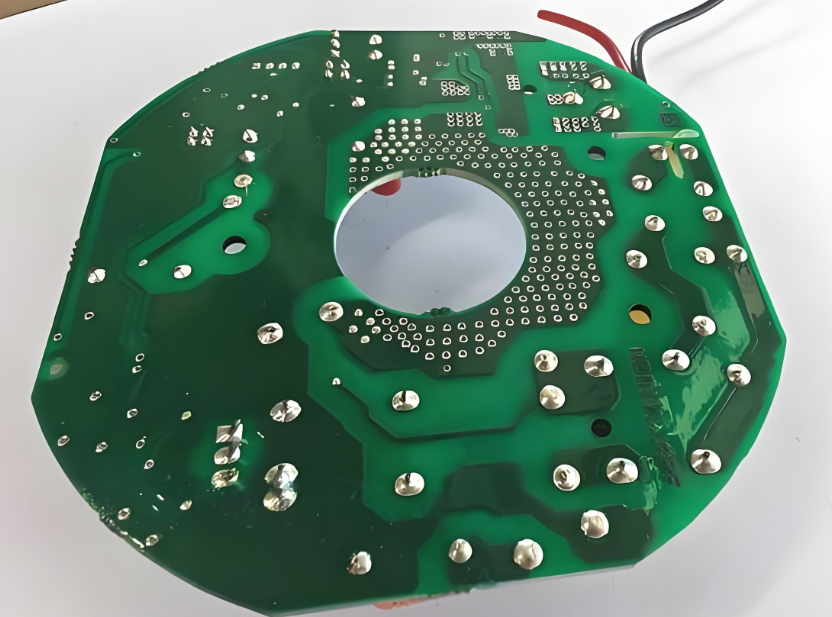
During incoming quality analysis at Best Technology, we often find that unstable BGA balls, hand-soldered connectors, and TH pins are common locations for cold joints.
Cold Solder Joint Symptoms

What Is the Difference Between a Cold Solder Joint and a Good Solder Joint?

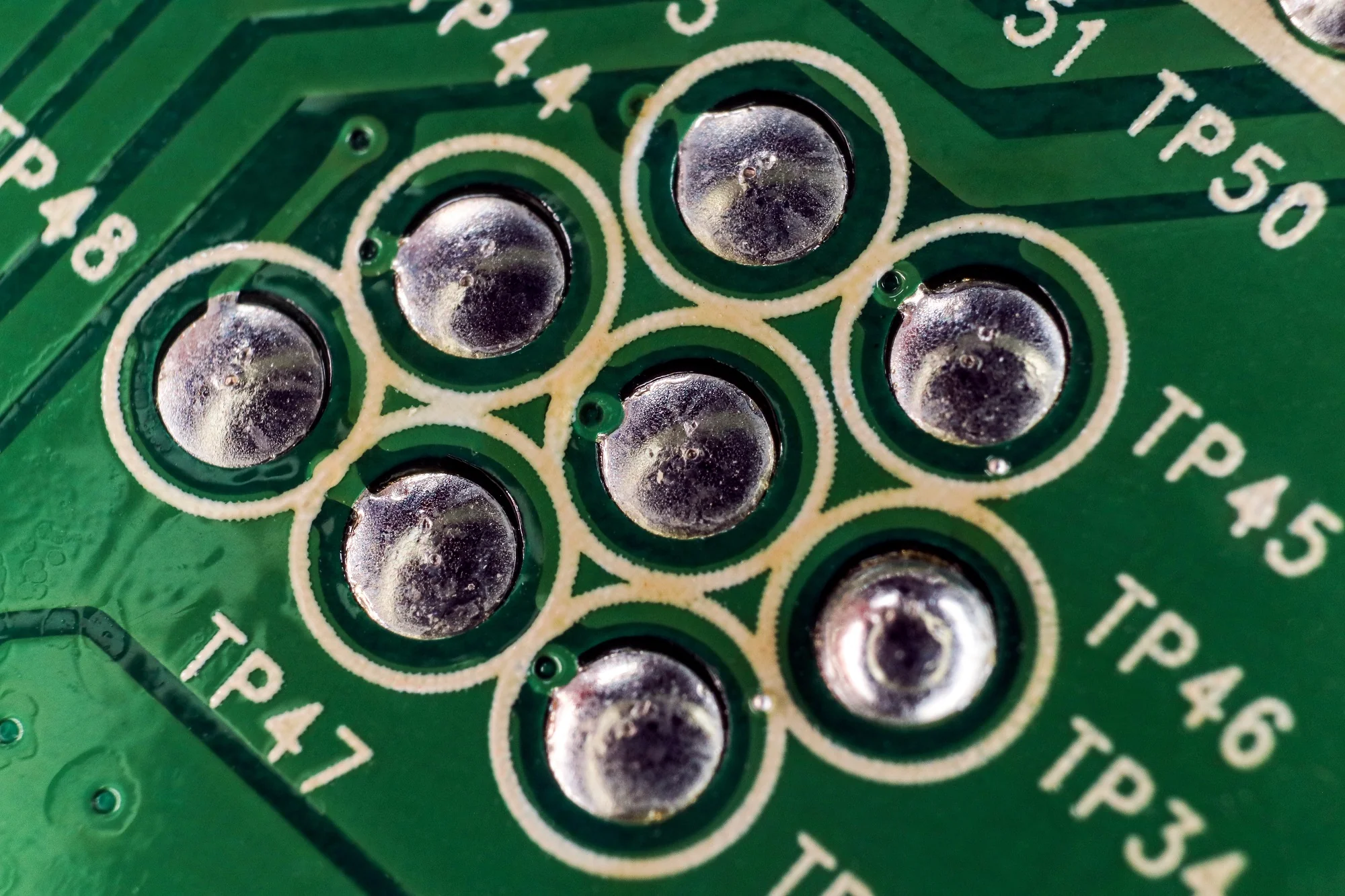
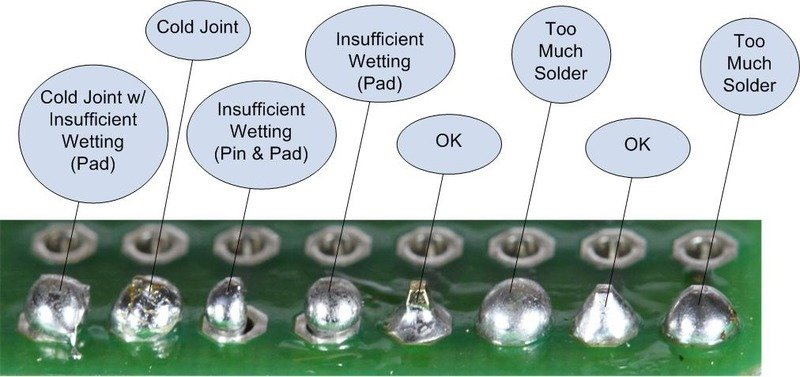
A good solder joint creates a smooth, bright, and uniform connection that wraps around the lead with full wetting.

A cold joint typically shows:

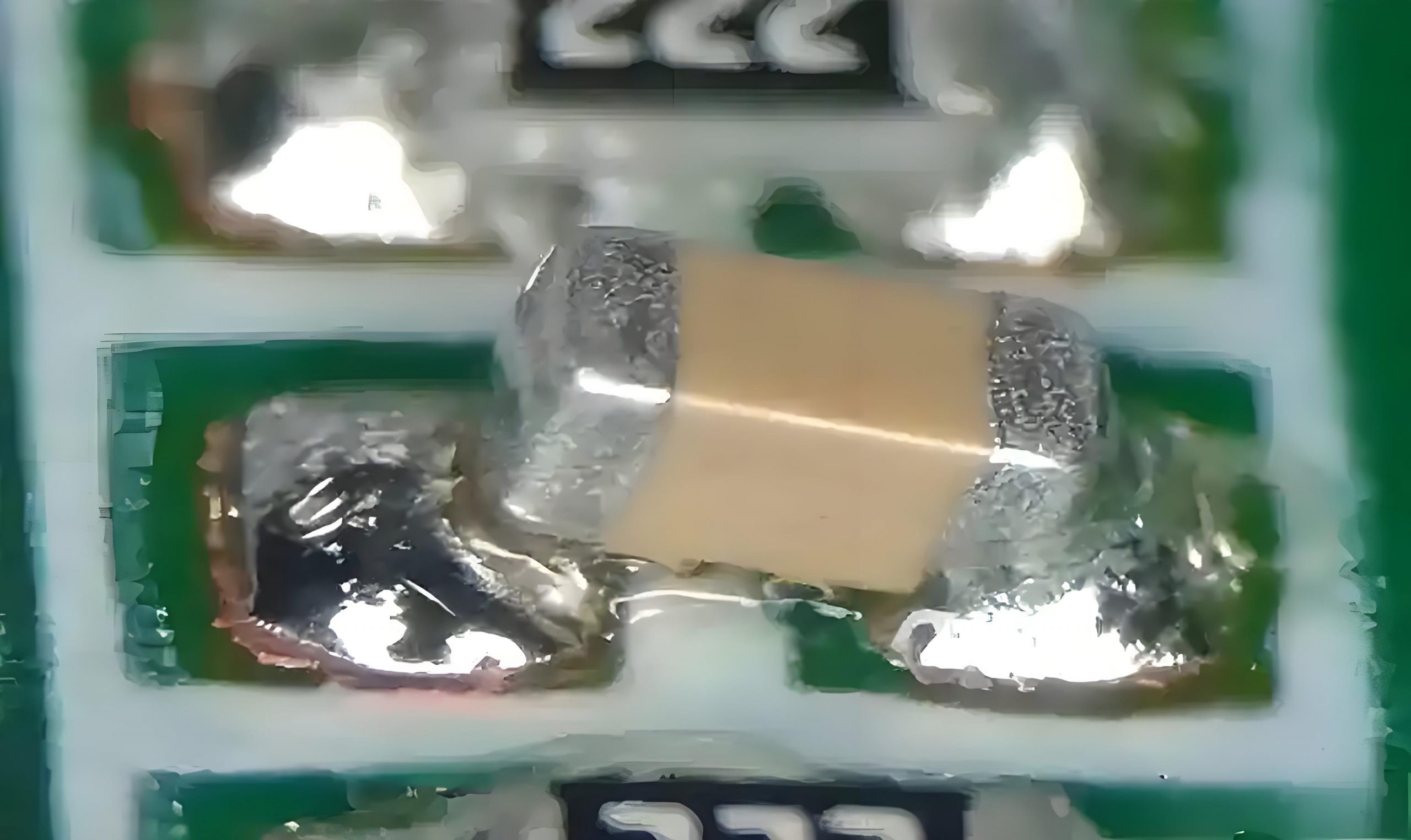
  • A dull or matte finish
  • Crystalline or grainy texture
  • A ring fracture around the lead
  • A small gap between solder and pad
  • Solder balled up instead of flowing

Experienced technicians immediately recognize these visual cues because they suggest weak mechanical support and unstable electrical conductivity.

How to Identify a Cold Solder Joint?

Both technicians and advanced PCBA factories rely on a few inspection methods:

  • Bright-light and angled inspection to reveal dull or frosted surfaces
  • Magnification to highlight cracks or gaps
  • Gentle mechanical pressure to detect movement
  • Thermal testing to expose resistance changes under heat
  • AOI or X-ray for lead-free and hidden joints
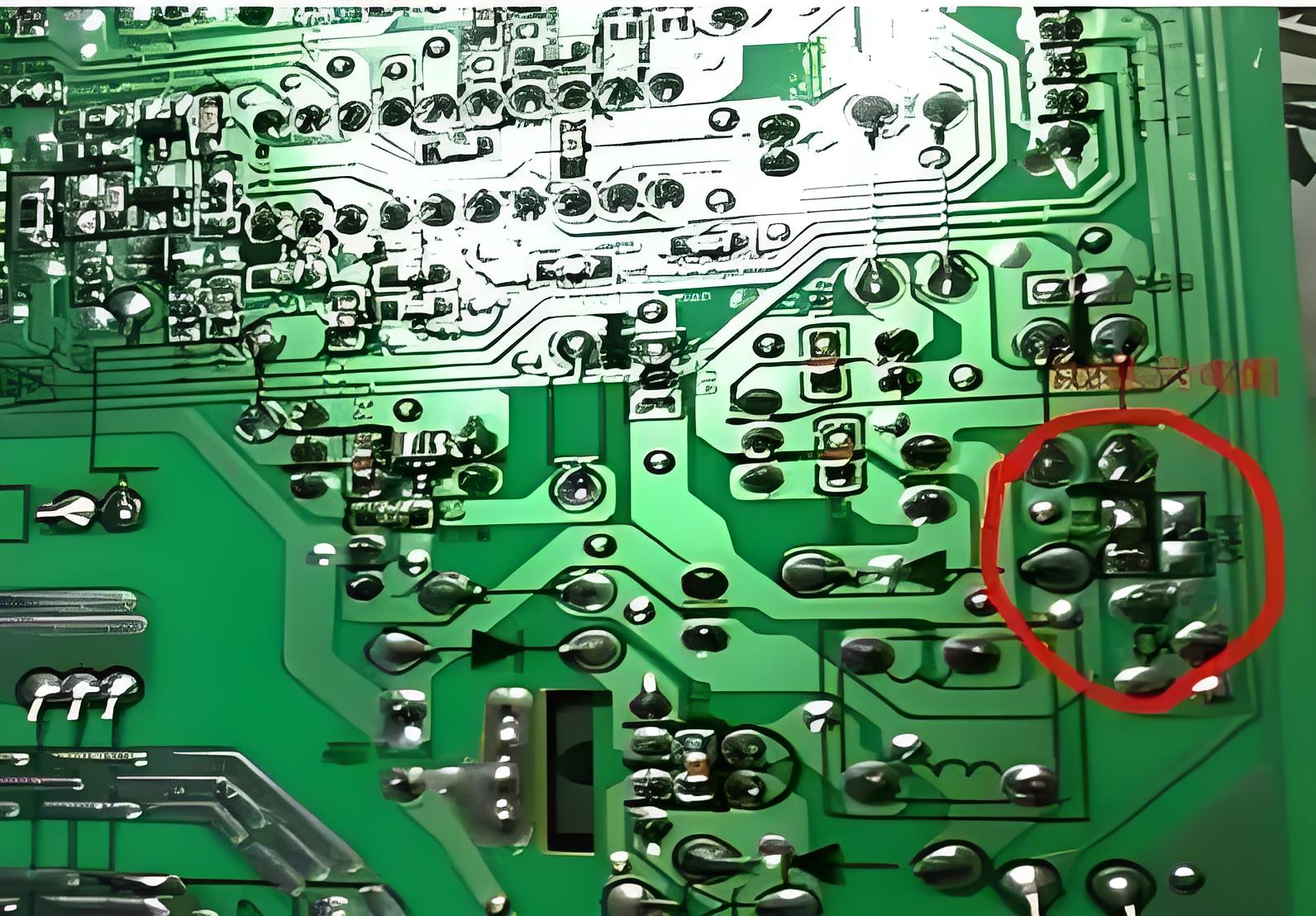
How to Identify a Cold Solder Joint?

In Best Technology’s MES-controlled lines, each soldering step—including reflow, wave, and selective solder—is tied to traceable profiles, making it easier to isolate and prevent cold joints during future builds.

Are Cold Joints Acceptable?

No. Cold solder joints are never acceptable in professional electronics.

They violate:

  • IPC-A-610 standards
  • Reliability requirements
  • Safety and quality regulations

Even in low-cost consumer electronics, cold joints significantly reduce product lifespan and reliability.

What Causes a Cold Solder Joint?

Cold solder joints originate from several process-related or operator-related factors:

  • Insufficient soldering temperature
  • Iron tip or nozzle unable to deliver stable heat
  • Oxidized pads, leads, or old components
  • Expired or poorly stored solder paste
  • Flux burnout or inadequate flux coating
  • Component movement during cooling
  • Large copper areas absorbing heat too fast
  • Incorrect reflow curve in SMT production

With our dual factories in China and Vietnam, Best Technology maintains strict humidity control, paste storage, stencil management, and reflow calibration—reducing these risks dramatically.

What Are the Risks of Cold Joints?

Cold solder joints introduce cascading reliability issues:

  • Intermittent electrical contact
  • Overheating of stressed joints
  • Noise, distortion, or unstable signals
  • Sudden shutdowns during operation
  • Premature component failure
  • Total system outages in critical environments

In medical, industrial, and aerospace PCBAs, even a single cold joint is considered a critical defect (CD level). Best Technology screens aggressively to ensure these defects never leave the factory.

How to Fix a Cold Solder Joint?

Repair is direct, but must be done properly:

1. Clean the joint with isopropyl alcohol.

2. Apply quality flux to re-activate the surface.

3. Reheat the joint until solder melts fully.

4. Add a small amount of fresh solder if needed.

5. Allow full cooling without movement.

6. Inspect visually to ensure proper fillet and wetting.

For SMD components (QFN, BGA, LGA), reflow or hot-air rework ensures even heating.

How to Avoid Cold Solder Joints?

Prevention stems from controlled process engineering:

  • Use calibrated, temperature-controlled soldering equipment
  • Maintain component and PCB cleanliness
  • Follow correct reflow temperature profiles
  • Apply flux or paste with proper wetting characteristics
  • Preheat heavy copper boards
  • Avoid vibration during cooling
  • Use AOI/X-ray to verify solder integrity
  • Enforce operator training and certification

At Best Technology, these practices are embedded into MES workflows, ensuring traceability and repeatability—from prototype to mass production.

FAQ About Cold Solder Joint

1. Can flux prevent cold solder joints?

    Flux improves wetting, but without proper temperature, cold joints still occur.

    2. Can a cold solder joint cause a short?

    Yes. Cracking or partial bonding may create unintended bridges.

    3. Why are cold solder joints more common in lead-free solder?

    Lead-free alloys require higher melting temperatures and tighter process control.

    4. Can a multimeter detect a cold solder joint?

    Sometimes, but intermittent faults often remain hidden until the board is heated or flexed.

    5. Can reheating permanently fix a cold solder joint?

    If the pad and lead are clean and properly wetted, reheating provides a permanent repair.

    6. Do professional PCBA manufacturers still encounter cold joints?

    Rarely, but only because inspection systems, controlled processes, and trained operators keep solder quality consistent.

    When to Consult a Professional or a PCBA Manufacturer?

    If your board shows repeated failures, unstable behavior, or numerous questionable joints, professional evaluation is the safest choice. Best Technology supports global customers with:

    • In-house FA (failure analysis)
    • X-ray and AOI inspection
    • Controlled reflow soldering
    • Medical-grade and aerospace-grade quality systems
    • MES-tracked production across China and Vietnam

    Whether you need prototype repair, DFX recommendations, or full PCBA manufacturing, our engineering teams ensure solder reliability at every stage of the product life cycle.
    What Is a Cold Solder Joint and How Do You Prevent It?
    Thursday, May 29th, 2025

    When a cold solder joint appears on a PCB, it might not fail immediately. But over time, it can cause real trouble—intermittent signals, unstable connections, or even complete circuit failure. These defects are often hidden, and if not caught early, they can waste time and money in rework.

    In this blog, you’ll learn:

    • What a cold solder joint looks like
    • What causes it
    • How to avoid and fix it
    • Why a trusted PCB assembly partner like EBest Circuit (Best Technology) matters

    What is a Cold Solder Joint?

    A cold solder joint or cold joint solder, is a defective connection between a component lead or terminal and a PCB pad during PCB assembly process. Unlike a properly formed solder joint, which provides a strong, reliable electrical and mechanical connection, a cold solder joint fails to fully bond the two elements together.​

    When soldering is done correctly, the solder melts completely and wets both the component lead and the PCB pad, creating a smooth, shiny, and concave surface. In the case of a cold solder joint, however, the solder doesn’t reach its optimal melting point or doesn’t flow properly. This results in a rough, dull, and often uneven surface. The joint may look like it’s attached, but in reality, the connection is weak and prone to failure. It might conduct electricity intermittently or not at all, leading to erratic behavior in the electronic device, from occasional glitches to complete breakdowns.​

    What Is a Cold Solder Joint and How Do You Prevent It?

    Cold Solder Joint Causes

    Several factors can contribute to the formation of cold solder joints. Understanding these causes is the first step in preventing them.​

    What Is a Cold Solder Joint and How Do You Prevent It?
    • Inadequate Soldering Temperature

    One of the primary culprits is insufficient soldering temperature. Each type of solder has a specific melting range, and if the soldering iron or reflow oven doesn’t reach and maintain the appropriate temperature, the solder won’t melt fully. For example, if the temperature is too low, the solder may only partially liquefy, leaving solid particles that prevent a proper bond.

    • Incorrect Soldering Time

    If the soldering iron is applied for too short a time, the solder won’t have enough time to melt and flow properly. On the flip side, overheating the joint by leaving the soldering iron on for too long can also cause problems. It can damage the component leads, PCB pads, or even change the properties of the solder itself, potentially leading to a cold solder joint.​

    • Poor Surface Preparation

    The cleanliness and condition of the surfaces to be soldered are vital. If the component leads or PCB pads are dirty, oxidized, or contaminated with oils, residues, or other substances, the solder won’t adhere properly. Oxidation, in particular, forms a thin layer on the metal surfaces that acts as a barrier to soldering.

    • Inappropriate Flux Usage

    Flux is a key component in the soldering process. It helps clean the surfaces, remove oxidation, and promote the flow of solder. However, using the wrong type of flux, too little flux, or applying it incorrectly can lead to cold solder joints. Some fluxes may not be compatible with certain solders or components, while insufficient flux won’t provide enough cleaning and wetting action.

    • Component Movement During Soldering

    When components move while the solder is still molten, it can disrupt the formation of a proper joint. This can happen due to vibrations during the soldering process, improper handling of the PCB, or insufficient securing of the components. Even a small movement can break the developing bond, resulting in a cold solder joint or a weak connection.​

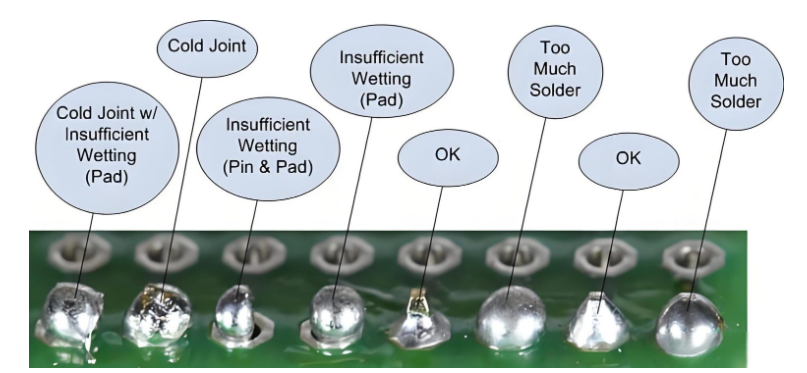
    Cold Solder Joint Pictures

    Visual aids can be extremely helpful in identifying cold solder joints. Here are common visual signs:

    • Dull, Grainy Appearance: A good joint is shiny and smooth. Cold ones look frosty or matte.
    • Cracks or Gaps: Visible separations or voids between the component and pad.
    • Ball-Like Shape: If the solder beads up instead of flowing smoothly, it likely didn’t bond.
    • Lifting Leads: Components that seem slightly off the pad may signal a cold joint underneath.

    Below are some typical colder solder joint pictures examples:​

    How to Identify Good Solder Joint​?

    Identifying a good solder joint is just as important as recognizing a cold one. A high-quality solder joint has several distinct characteristics:​

    1. Appearance​

      A good solder joint should have a smooth, shiny, and concave surface. The solder should flow evenly around the component lead and onto the PCB pad, forming a natural fillet.

      2. Wetting​

      Proper wetting is a key indicator of a good solder joint. The solder should spread and adhere evenly to both the component lead and the PCB pad, covering the surfaces completely. When the wetting is correct, there will be no gaps, voids, or bare spots where the metal surfaces are exposed.

      3. Strength​

      A well-soldered joint should be strong enough to hold the component in place firmly. Gently tugging on the component (with appropriate care not to damage it) should reveal a solid connection.

      How to Avoid Cold Solder Joints​?

      Prevention is better than repair. Here’s how to keep cold solder joints from happening in the first place:

      1. Use the Right Temperature

      Always set your soldering iron between 350°C to 400°C for standard lead-based solder. Higher temperatures may be needed for lead-free types.

      2. Pre-Clean Pads and Leads

      Use isopropyl alcohol to clean surfaces before soldering. Dirt and oxidation are invisible enemies.

      3. Don’t Skip the Flux

      Flux removes oxidation and improves solder flow. Many solder wires include it, but extra flux helps in difficult spots.

      4. Keep Steady Hands

      Hold the component and iron steady until the solder cools. Use clamps or tools if needed.

      5. Pick Quality Tools

      Poor-quality irons with unstable tips lead to inconsistent heat. Invest in a reliable soldering station with temperature control.

      6. Work in a Clean, Static-Safe Area

      Humidity, static, and poor lighting all raise the chances of making mistakes.

      How to Fix Cold Solder Joints​?

      Despite our best efforts, cold solder joints may still occur. Fortunately, there are ways to fix them:​

      1. Soldering​

        The first step in fixing a cold solder joint is often desoldering. Use a desoldering pump or wick to remove the existing solder from the joint. Heat the joint with the soldering iron to remelt the solder, and then use the desoldering tool to suck up or absorb the molten solder. Make sure to remove all the old solder completely to start fresh.​

        2. Cleaning​

        After desoldering, clean the surfaces again to remove any flux residues, oxidation, or other contaminants that may have accumulated. This step is crucial for ensuring a proper repair. Use a suitable cleaning solution and a clean brush or cloth to wipe the surfaces clean.​

        3. Resoldering​

        Once the surfaces are clean, it’s time to resolder the joint. Apply a small amount of fresh flux to the cleaned surfaces, and then heat the joint with the soldering iron. When the flux starts to bubble and activate, feed a small amount of solder into the joint.

        4. Inspection and Testing​

        After resoldering, inspect the joint visually to make sure it looks good and meets the criteria for a proper solder joint. Then, use testing equipment to verify the electrical connection. Check for continuity and make sure the joint is conducting electricity properly. If any issues are found, repeat the desoldering, cleaning, and resoldering process until the joint is fixed.​

        Trust PCB Assembly Service Provider – EBest Circuit (Best Technology)

        Avoiding cold solder joints isn’t just about skills—it’s also about choosing the right PCB assembly partner. At EBest Circuit (Best Technology), we follow strict quality processes to ensure every joint is clean, strong, and reliable. Here’s how we guarantee excellence:

        • Automated Soldering Equipment: Reflow ovens, selective soldering, and wave soldering eliminate manual errors.
        • X-ray and AOI Inspection: We detect hidden cold joints and ensure solid connections throughout.
        • Skilled Technicians: Our team is trained to international IPC standards, ensuring precision with every solder joint.
        • Fast Prototyping and Mass Production: Whether you’re scaling up or fine-tuning, we support your project at every stage.

        Need flawless assembly for your next project? Contact EBest Circuit (Best Technology) today for a quote or consultation. Let’s build something reliable—together.

        FAQs

        1. What is a cold solder joint in simple terms?

        It’s a weak or poorly connected solder point that didn’t heat properly and can fail over time.

        2. Are cold solder joints dangerous?

        Yes, they can cause circuits to fail, especially in safety-critical systems like medical or automotive electronics.

        3. Can cold solder joints be fixed easily?

        Yes, with the right tools, you can reheat and repair them quickly.

        4. What does a cold solder joint look like?

        It often appears dull, cracked, grainy, or uneven—unlike a shiny, smooth good joint.

        5. Can a PCB test miss a cold solder joint?

        Yes, especially if the fault is intermittent. That’s why visual inspection and X-ray are important.