





What Is a Multi-Layer SinkPAD Board?
A multi-layer SinkPAD board is a metal core PCB with more than two copper trace layers and a direct thermal path structure. The metal core is usually copper, and the thermal pad of the LED or power device is placed directly on the copper pedestal or copper core area. This allows heat to transfer quickly away from the component while the electrical circuits remain isolated through the dielectric layer.
Compared with a 1 layer SinkPAD board or a 2 layer SinkPAD board, the multi-layer version offers more routing space for complex circuits. The additional trace layers can be built on a single side or distributed on both sides of the board, depending on the product design.
Because of this structure, multi-layer SinkPAD boards combine two important functions in one compact platform: high-density circuit routing and efficient heat dissipation.
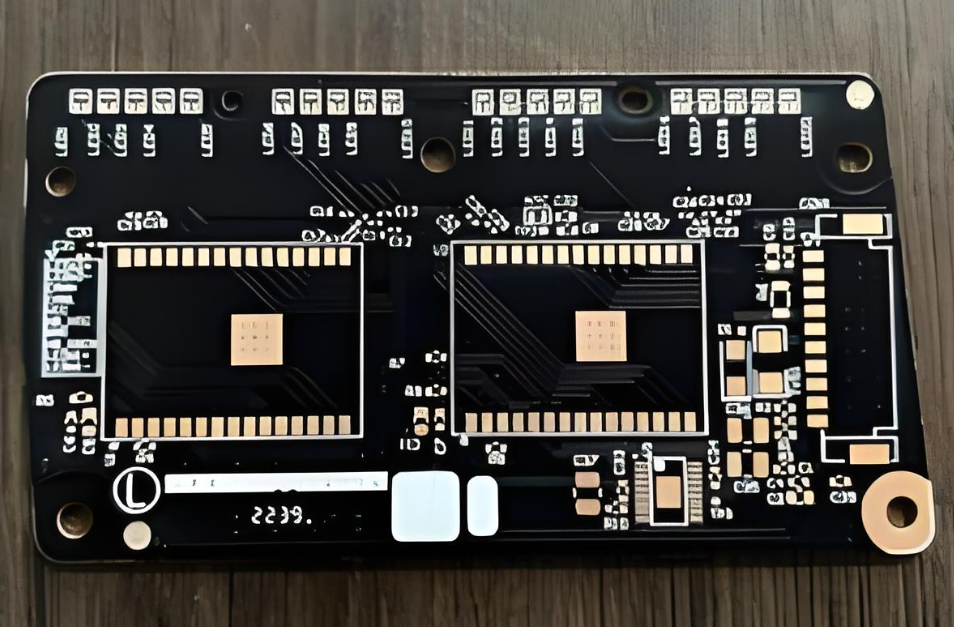
Multi-Layer SinkPAD Board
How Does a Multi-Layer SinkPAD Board Work?
The working principle of a multi-layer SinkPAD board is based on thermoelectric separation. The electrical current travels through the copper circuit layers, while the heat generated by the LED or semiconductor is transferred directly into the copper base through the thermal pad.
Since copper has very high thermal conductivity, around 400 W/m.K, heat can spread rapidly from the source to the metal base, and then into a heatsink, mounting surface, or surrounding air. This direct thermal path reduces thermal resistance and helps maintain lower operating temperatures.
At the same time, the extra routing layers allow engineers to build more sophisticated circuits in the same board area. This is useful when a product requires denser interconnections, control circuits, or more compact mechanical dimensions.
What Is the Difference Between Standard MCPCB and Multi-Layer SinkPAD Board?
A standard metal core PCB usually includes a dielectric layer between the heat source and the metal base. This provides insulation, but it also adds thermal resistance. In contrast, a multi-layer SinkPAD board uses a direct thermal path design, where the thermal pad of the LED or power device touches the copper core directly.
This difference offers several performance advantages:
- Lower thermal resistance
- Faster heat transfer
- Better thermal stability for high-power devices
- Higher routing density than basic SinkPAD boards
- More flexibility for compact and complex circuit design
For designs that require both thermal efficiency and advanced routing capability, a multi-layer SinkPAD board is often a stronger choice than a conventional MCPCB.
Common Structures of Multi-Layer SinkPAD Board
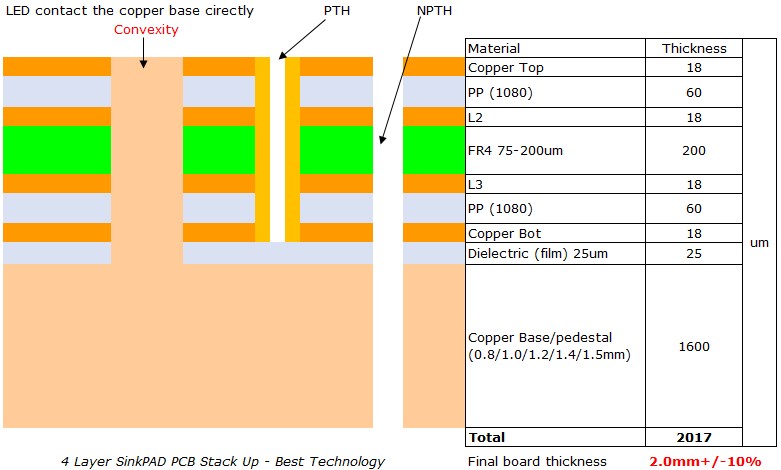
4 Layer SinkPAD Board on the Same Side
One common structure is the 4 layer SinkPAD board with four trace layers built on the same side of the copper base. This design allows engineers to place more traces in the same board size and create more complex layouts than with a 1 layer or 2 layer SinkPAD board.
This structure is useful when the design needs strong thermal performance but also requires increased circuit density on one side.
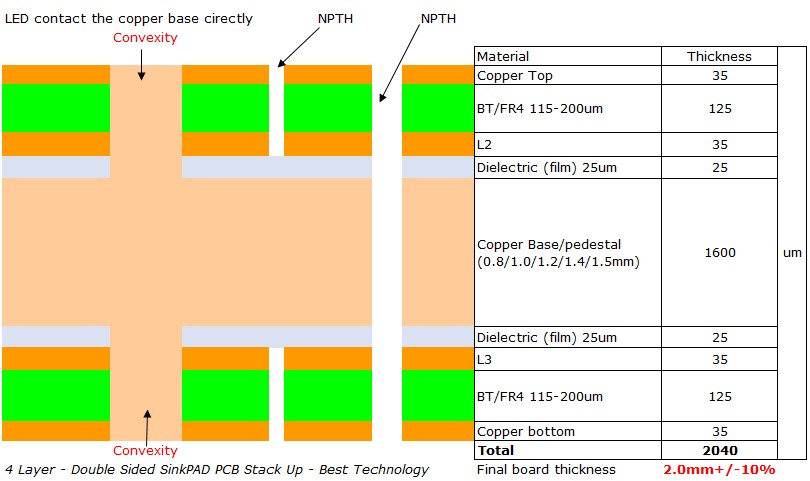
Double-Sided 4 Layer SinkPAD Board
Another option is the double-sided 4 layer SinkPAD board, where two trace layers are placed on the top side and two trace layers are placed on the bottom side. This structure increases usable routing area and supports more advanced product architectures.
However, this type of board is more difficult to design and manufacture. Since components may be mounted on both sides, engineers must carefully consider how heat will be transferred to the heatsink.
Design Considerations for Double-Sided Multi-Layer SinkPAD Board
A double-sided multi-layer SinkPAD board does not use plated through holes in the same way as traditional multi-layer metal core PCBs. This is due to process limitations in SinkPAD manufacturing. That also means the routing strategy, layer transition plan, and thermal structure need to be considered very carefully during design.
When engineers choose this structure, they usually need to evaluate:
- Where the heatsink will be located
- How heat will leave the copper base efficiently
- Whether components on both sides will affect thermal transfer
- How to maintain electrical routing without plated through holes
- Whether the added layout complexity is justified by the application
Because of these design challenges, multi-layer SinkPAD boards are generally used only when simpler SinkPAD structures cannot meet the routing needs of the product.
Multi-Layer SinkPAD Board Applications
Multi-layer SinkPAD boards are mainly used in products that combine high heat generation with more complex circuit requirements.
Typical applications include:
- High power LED modules up to 200W
- High-power semiconductor devices
- Power transistor circuits
- Thyristor and diode modules
- High-power resistor applications
- Compact thermal management systems
- Advanced lighting products with dense layout design
These boards are especially useful when product designers need to control heat effectively without giving up routing flexibility.
Multi-Layer SinkPAD Board Capability
| Item | Capability |
| Base Material | Copper |
| Copper Base Thickness | 1.2mm, 1.4mm, 1.5mm, 1.6mm |
| Thermal Conductivity | 400 W/m.K |
| Board Thickness | 1.6mm to 2.0mm |
| Copper Thickness | 0.5 oz, 1 oz, 2 oz, 3 oz |
| Outline Processing | Routing, Punching, V-Cut |
| Solder Mask Color | White, Black, Blue, Green, Red |
| Silkscreen Color | Black, White, Yellow |
| Surface Finish | Immersion Gold, ENEPIG, Immersion Tin, OSP |
| Max Panel Size | 600 x 500mm |
| Packing | Vacuum packing, plastic bag |
| Sample Lead Time | 3 to 4 weeks |
| Mass Production Lead Time | 4 to 6 weeks |
Why Choose a Multi-Layer SinkPAD Board?
A multi-layer SinkPAD board is a strong option when your product needs more than basic thermal management. It gives engineers more routing freedom while still preserving the direct thermal path needed for high-power components.
Compared with simpler SinkPAD structures, it supports more advanced circuit layouts. Compared with ordinary metal core PCB designs, it provides a more efficient thermal path. This makes it a practical solution for applications where both electrical complexity and thermal performance are important.
If your design requires compact size, high heat dissipation, and more circuit layers in the same board area, a multi-layer SinkPAD board can deliver clear advantages.