





Extra thin PCB refers to a printed circuit board with a significantly reduced thickness compared to standard FR4 boards, enabling compact, lightweight, and space-constrained electronic designs.
As modern devices become smaller and more integrated, ultra thin PCB solutions are increasingly used in smart cards, wearable devices, and miniature modules where every micron matters.
Are You Facing These Challenges?
Many customers come to us with similar design concerns:
- The product housing leaves very little board space
- Standard PCB thickness is too bulky for the assembly
- Flexible PCB is not necessary, but standard rigid PCB is too thick
- Thin boards may warp or become hard to handle in production
- Small electronic modules need a lighter and slimmer rigid solution
Our extra thin PCB service is built to solve these issues with practical FR4-based manufacturing support.
What Is an Extra Thin PCB?
An extra thin PCB is a rigid printed circuit board with a thickness significantly lower than a normal FR4 board. Standard PCB thickness is usually around 1.0 mm to 2.0 mm. In thinner conventional constructions, 1-layer or 2-layer boards may be made at 0.3 mm to 0.4 mm, while 4-layer boards are often around 0.6 mm.
When electronic products require an even slimmer profile, designers may specify thicknesses such as 0.25 mm, 0.20 mm, or 0.15 mm. These ultra-slim boards are commonly referred to as extra thin PCB, ultra thin PCB, or very thin PCB.
They are especially useful in products where every fraction of a millimeter affects housing design, connector fit, weight, or assembly clearance.
Click here to see more pictures of our ultra thin PCB boards.
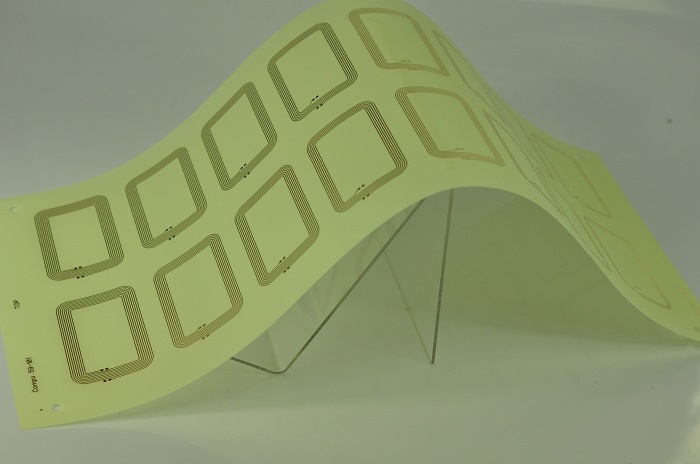
Extra Thin PCB
Why Use Extra Thin PCB?
As consumer and industrial devices continue moving toward lighter and more compact designs, extra thin PCBs are becoming more widely used. They help optimize the internal layout without forcing a full shift to flexible circuits.
Key benefits include:
- Reduced product thickness
- Lower overall weight
- Better fit for compact assemblies
- More rigid than flexible circuits
- More cost-effective than FPC in many simple designs
- Suitable for slim modules with limited installation space
In some applications, extra thin FR4 PCB can also provide slight bendability during assembly. It does not replace a true flex circuit, but it can offer more mechanical tolerance than a standard rigid board.
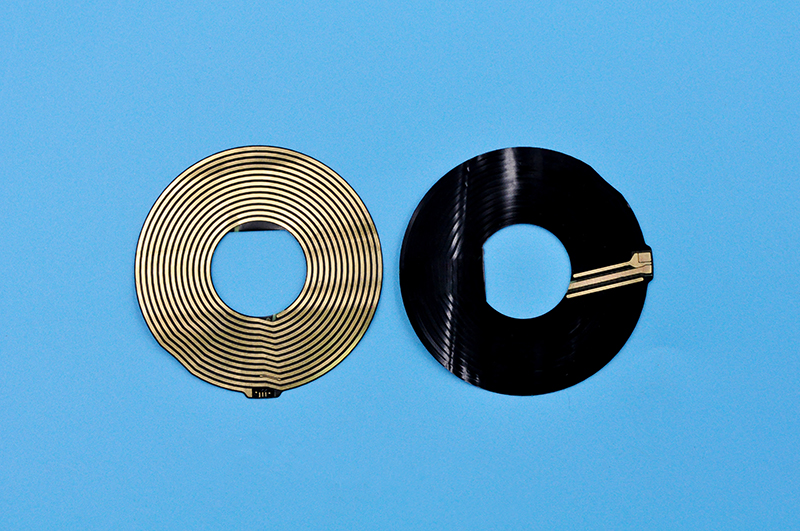
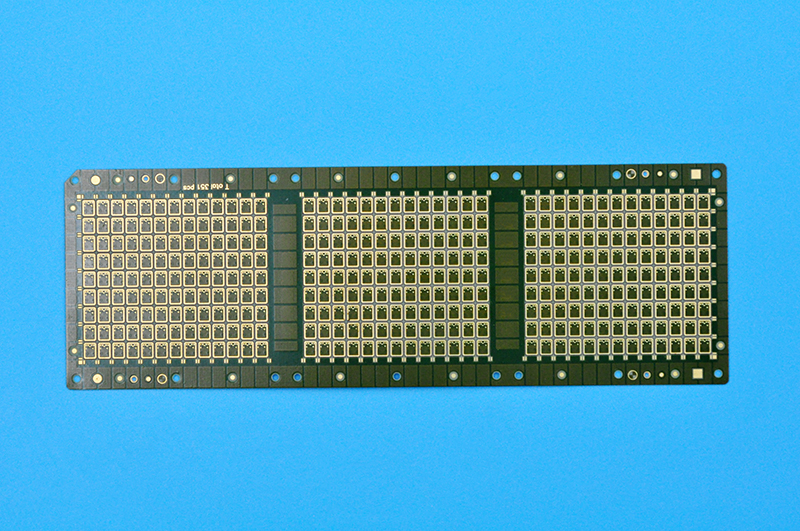
Extra Thin PCB Applications
Extra thin PCBs are commonly used in products that demand a slim form factor and stable board structure. Typical applications include:
- SIM card modules
- TF card modules
- NFC devices
- Mobile phone charging modules
- Wearable electronics
- Drawing tablets
- Metro coins or smart token devices
These products often have very limited internal clearance, making thin board construction an important part of the mechanical design.
Extra Thin PCB Manufacturing Capability
EBest Circuit provides extra thin PCB fabrication with the following capability range:
| Item | Capability |
|---|---|
| Base Material | FR4 Tg130, Tg170, Tg180 |
| Board Thickness | 0.10 mm to 0.30 mm |
| Copper Thickness | 0.5 oz, 1 oz, 2 oz, 3 oz |
| Outline Processing | Routing, punching, V-cut, laser cutting |
| Solder Mask | Bare, white, black, blue, green, red |
| Silkscreen Color | Black, white |
| Surface Finish | Immersion gold, OSP, ENEPIG, HAL-LF |
| Max Panel Size | 500 × 500 mm or 1000 × 350 mm |
| Min Panel Size | 3.5 × 3.5 mm |
| Min Single Size | 25 × 25 mm |
| Min Via Size | 0.10 mm |
| Min Trace / Space | 4/4 mil |
| Packing | Vacuum packing |
| Sample Lead Time | 7 to 9 days |
| Mass Production Lead Time | 8 to 10 days |
We can manufacture extra thin boards with or without solder mask, depending on the design and end-use requirement.
Extra Thin PCB vs Flexible PCB
Although they may look similar in ultra-slim products, extra thin PCB and flexible PCB serve different purposes.
Extra Thin PCB
- FR4-based rigid board
- Better structural support
- Easier for handling and assembly
- Usually lower cost than FPC in comparable simple layouts
- Suitable when slight thinness is needed, but repeated bending is not required
Flexible PCB
- Built on polyimide or other flexible materials
- Designed for dynamic bending or folding
- Better choice for extremely thin or moving interconnect structures
- Suitable when board thickness must go below 0.10 mm or when repeated flexing is required
If your design needs a board below 0.10 mm, a flex circuit is generally the better option. If you need a thin, stable, and economical rigid board, extra thin FR4 PCB is often the more practical solution.
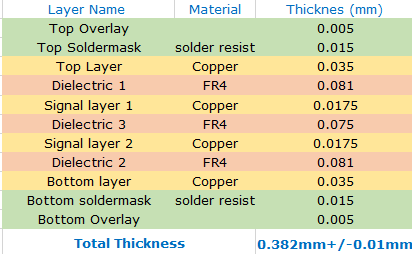
Stack-Up of Extra Thin PCB
The construction of extra thin PCB is similar to standard FR4 PCB, but the material system is thinner and the process window is tighter. The board uses thinner core materials and prepregs to achieve the required final thickness.
Because the structure is much thinner, stack-up design becomes more sensitive. Material choice, copper balance, and lamination control all affect flatness, handling strength, and final dimensional stability.
For 2-layer to 4-layer extra thin PCBs, the stack-up is usually simpler than conventional multilayer boards, but it must still be engineered carefully to maintain production consistency.
2L PCB structure for extra thin PCB
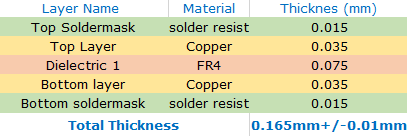
4L PCB structure for extra thin PCB
How Are Extra Thin PCBs Manufactured?
The basic fabrication flow is close to standard FR4 PCB manufacturing, but extra thin boards require tighter control at every stage. Thin materials are easier to deform during drilling, imaging, etching, lamination, routing, and transportation through the production line.
To support reliable production, EBest Circuit uses stricter handling methods and more precise process control for extra thin boards. In some operations, dedicated equipment or supporting fixtures are used to improve stability and reduce the risk of deformation or damage.
This is especially important for:
- Panel handling
- Warpage control
- Fine drilling accuracy
- Outline precision
- Surface protection
- Final packing and shipment stability
Careful process control helps ensure that the finished boards meet both dimensional and reliability requirements.
Why Choose EBest Circuit for Extra Thin PCB?
Choosing the right supplier for extra thin PCB is not only about whether thin boards can be produced. It is also about whether the manufacturer can keep those boards stable, consistent, and practical for real assembly conditions.
At EBest Circuit, we provide:
- Extra thin FR4 PCB fabrication for compact designs
- Thickness options from 0.10 mm to 0.30 mm
- Multiple copper weights and surface finishes
- Prototype and volume production support
- Engineering review before production
- Stable manufacturing control for delicate thin boards
- Fast lead times for samples and mass production
We understand the common manufacturing risks behind ultra-thin rigid boards and work to reduce handling issues before they become assembly problems.
Work with a Reliable Extra Thin PCB Manufacturer | EBest Circuit
If your project requires a thinner rigid board for compact electronics, EBest Circuit can help you move from design to production with stable manufacturing support.
We offer extra thin PCB solutions for card devices, wearable products, NFC modules, charging applications, and other slim electronic assemblies. Whether you need a prototype or volume production, our team can support your design with suitable materials, practical fabrication control, and responsive engineering service.
Looking for a dependable extra thin PCB manufacturer? Contact EBest Circuit today to discuss your project and request a quote.
FAQs About Extra Thin PCB
1. What is the thinnest PCB you can manufacture?
We can produce extra thin PCBs down to 0.10 mm using FR4 materials. For thinner requirements, flexible PCB is recommended.
2. Can extra thin PCB replace flexible PCB?
No. Extra thin PCB offers slight bendability but is not designed for dynamic flexing. For bending applications, FPC is required.
3. Is ultra thin PCB more expensive?
It is slightly higher than standard PCB due to tighter process control, but still more cost-effective than flexible PCB.
4. What copper thickness is supported?
We support 0.5 oz, 1 oz, 2 oz, and 3 oz depending on current and design requirements.
5. How do you prevent warpage in thin PCB?
We use optimized lamination parameters, panel support fixtures, and controlled handling processes to ensure flatness.
6. What industries use extra thin PCB the most?
Smart cards, wearable devices, consumer electronics, and compact modules are the most common applications.
Need Ultra Thin PCB for Your Project?
If your design requires a compact, lightweight, and reliable PCB solution, extra thin PCB is a practical choice.
Contact EBest Circuit today for a fast quote and free DFM review.
Email: sales@bestpcbs.com
Phone: +86-755-2909-1601
We help you turn complex thin PCB designs into stable, production-ready solutions.