





Choose EBest for Your Double sided PCB Needs: The Trusted Manufacturer
When looking for a reliable Double sided PCB manufacturer, EBest is your first and best choice. We prioritize your project’s success with fast delivery, uncompromising quality, industry-recognized certifications, cost-saving services, and dedicated support—all tailored to meet your custom Double sided PCB design and prototype needs.
- Delivery Speed: We offer accelerated production timelines for both Double sided PCB prototypes and mass production, ensuring your project stays on schedule with no delays.
- Unmatched Quality: Our Double sided PCB products undergo strict quality control checks at every stage, from material selection to final inspection, ensuring consistent performance and durability.
- Industry Certifications: We hold ISO 9001, IPC-A-600F, and UL certifications, guaranteeing our Double sided PCB manufacturing meets global industry standards for reliability and safety.
- Cost-Saving Support: Enjoy free DFM (Design for Manufacturability) analysis for all Double sided PCB designs, helping you avoid costly errors, and flexible prototype MOQ to support small-batch and trial projects.
- Dedicated Service: Our team of PCB engineers provides 24/7 technical support, guiding you through Double sided PCB design, prototype, and manufacturing processes to ensure your project meets all requirements.
What is a Double sided PCB?
A Double sided PCB is a printed circuit board with copper conductive layers on both the top and bottom surfaces, connected by plated through-holes (PTH) to enable electrical interconnection between layers. Unlike single-sided PCBs, double sided PCBs offer higher component density, more flexible routing options, and better signal integrity—making them ideal for mid-complexity electronic devices that require more functionality in a compact form factor.
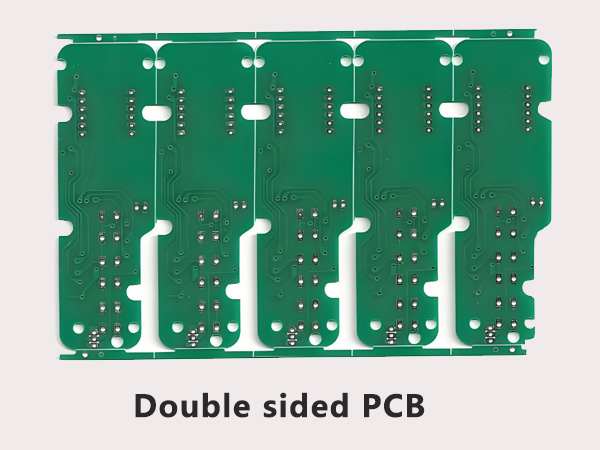
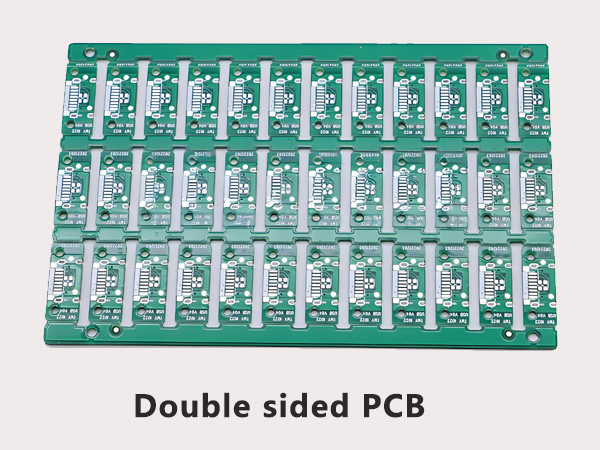
The core structure of a Double sided PCB includes a substrate (typically FR-4), copper layers on both sides, solder mask to protect the copper, and silkscreen for component labeling. This design balances cost-effectiveness and performance, making it one of the most widely used PCB types across industries.
Double sided PCB Manufacturing Process: Step-by-Step Guide
The Double sided PCB manufacturing process follows a precise sequence to ensure quality and consistency. Below is a detailed, easy-to-understand breakdown of each step:
- Substrate Preparation: Start with a high-quality substrate (most commonly FR-4), cut to the required size, and cleaned to remove dust, oil, and contaminants. This ensures strong adhesion of the copper layers to the substrate.
- Copper Lamination: The substrate is laminated with thin copper foil (typically 1oz, 35μm) on both sides using heat and pressure. This creates the conductive layers that form the Double sided PCB’s circuit paths.
- Circuit Patterning (Photolithography): A photoresist layer is applied to both copper surfaces, then exposed to UV light through a photomask (printed with the desired circuit pattern). The unexposed photoresist is removed, leaving the copper pattern that will become the circuit traces.
- Etching: The exposed copper (not protected by photoresist) is etched away using a chemical solution, leaving only the desired circuit traces on both sides of the Double sided PCB. The remaining photoresist is then stripped.
- Drilling: Holes (plated through-holes, PTH) are drilled through the PCB to connect the top and bottom copper layers. We use precision drilling equipment to ensure hole accuracy, with a minimum drill size of 0.3mm for standard applications.
- Plating: The drilled holes are metalized with copper (average thickness ≥20μm, minimum 18μm) to create electrical connections between the top and bottom layers. This step ensures reliable conductivity across the Double sided PCB.
- Solder Mask Application: A solder mask (usually green, but customizable) is applied to both sides of the PCB, covering all copper traces except for component pads, test points, and mark points. This protects the traces from oxidation and prevents short circuits during assembly.
- Silkscreen Printing: Component labels, part numbers, and polarity marks are printed on the solder mask using silkscreen. We follow standard specifications (30mil font height, 5mil font width) to ensure readability and avoid assembly errors.
- Final Inspection & Testing: The finished Double sided PCB undergoes rigorous inspection (visual and automated) to check for defects like short circuits, open circuits, or uneven solder mask. Electrical testing ensures all connections work as intended.
Double sided PCB Design Guide: Solve Pain Points & Ensure Success
Designing a Double sided PCB requires balancing component layout, routing, and manufacturability—common pain points that often lead to design errors, delayed production, or poor performance. Below, we break down the most critical design concerns and how EBest solves them for you.
What Are the Most Common Double sided PCB Design Pain Points?
- Wiring Congestion & Signal Crosstalk: With only two layers, routing complex signals (digital, analog, high-frequency) often leads to congestion and crosstalk, which degrades signal integrity.
- Via Mismanagement: Poor via selection or placement introduces parasitic inductance and capacitance, causing signal distortion and reliability issues.
- Component Interference: Placing components on both sides can lead to spatial interference, especially with tall components, affecting assembly and mechanical stability.
- Manufacturability Issues: Designing features (e.g., overly narrow line widths, small holes) that exceed manufacturing capabilities leads to rework and delays.
How EBest Solves Your Double sided PCB Design Challenges
- Wiring & Crosstalk Solutions: Our engineers recommend a “layer partitioning” strategy—place digital signals and power on the top layer, and analog signals and ground on the bottom layer. We also enforce minimum line spacing (≥8mil) and isolate high-frequency signals (≤10cm in length) to reduce crosstalk to ≤-30dB.
- Via Optimization: We guide you to select the right via type (standard 0.3-0.5mm for power/signals, microvias for high-frequency) and placement (≤2 vias per high-frequency path, ground vias within 0.3mm of signal vias) to minimize parasitic effects.
- Component Layout Support: We provide 3D layout checks to avoid component interference, recommend keeping tall components on one side, and ensure ≥2mm spacing between functional areas.
- Free DFM Analysis: Our team reviews your Double sided PCB design before production, identifying and fixing manufacturability issues (e.g., line width, hole size) to avoid rework and ensure a smooth production process.
For hassle-free Double sided PCB design, trust EBest’s engineering team to guide you from concept to final design. We ensure your design is optimized for performance, manufacturability, and cost-efficiency—contact us today to get started.
High-Quality Double sided PCB Prototype: Fast, Reliable & Customizable
A high-quality Double sided PCB prototype is critical to validating your design, identifying issues early, and accelerating time-to-market. However, prototype projects often face common pain points that slow down development—here’s how EBest solves them.
Common Double sided PCB Prototype Pain Points
- Long Lead Times: Many manufacturers take weeks to deliver prototypes, delaying design validation and project timelines.
- Poor Prototype Quality: Prototypes with inconsistent copper thickness, uneven solder mask, or faulty vias lead to inaccurate testing results.
- Inflexible Customization: Difficulty adapting prototypes to design changes forces costly rework or redesigns.
- Lack of Technical Support: Uncertainty about whether the prototype meets design requirements, with no guidance on testing or adjustments.
EBest’s Double sided PCB Prototype Solutions
- Fast Turnaround: We deliver high-quality Double sided PCB prototypes in days, not weeks, ensuring you can validate your design quickly and keep your project on track.
- Premium Quality Prototypes: Our prototypes use the same high-quality materials and manufacturing processes as mass-produced Double sided PCBs, with strict quality checks to ensure accurate performance testing.
- Flexible Customization: We support quick design changes and small-batch prototypes (flexible MOQ), allowing you to iterate on your design without costly delays.
- End-to-End Support: Our engineers provide testing guidance, review prototype results, and help you refine your design to ensure the final Double sided PCB meets all your requirements.
For fast, reliable, and customizable Double sided PCB prototypes, EBest is your trusted partner. We turn your design into a functional prototype quickly, helping you accelerate development and bring your product to market faster—contact us to request a prototype quote.
How to Choose Double sided PCB Raw Materials? (Comparison Table)
Choosing the right raw materials is critical to the performance, durability, and reliability of your Double sided PCB. Below is a detailed comparison of common materials, their properties, and ideal applications to help you make the right choice.
| Material Type | Key Properties | Tg Value | Flame Rating | Ideal Applications | EBest Recommendation |
|---|---|---|---|---|---|
| FR-4 (Epoxy Glass Cloth) | Excellent mechanical strength, good electrical insulation, cost-effective, easy to process | 130°C – 180°C+ | UL94 V-0 | Consumer electronics, industrial control, communication devices, computers | Most common choice for standard Double sided PCB projects |
| High-Tg FR-4 | Higher heat resistance, better dimensional stability, improved reliability at high temperatures | ≥170°C | UL94 V-0 | Automotive electronics, power electronics, high-temperature industrial applications | For projects exposed to high temperatures (≥150°C) |
| PTFE (Polytetrafluoroethylene) | Low dielectric loss, stable dielectric constant, excellent high-frequency performance | 260°C+ | UL94 V-0 | High-frequency communication devices, RF applications, aerospace | For high-frequency (≥100MHz) Double sided PCB designs |
| Aluminum Substrate | Excellent heat dissipation, good mechanical strength, electrical insulation | 130°C – 150°C | UL94 V-0 | LED lighting, power electronics, automotive LED modules | For heat-generating Double sided PCB applications |
Double sided PCB Applications: Industry Use Cases & Problem-Solving
Double sided PCBs are widely used across industries due to their balance of performance, cost, and compact design. Below are four popular industries, real-world case studies, and common application challenges—with EBest’s solutions.
1. Consumer Electronics
Common applications: Smartphones, tablets, wearables, LED TVs, and home appliances. Double sided PCBs enable compact designs with high component density, critical for modern consumer devices.
Case Study: We partnered with a consumer electronics brand to develop a Double sided PCB for a smartwatch. The challenge was fitting a battery management system, Bluetooth module, and sensors into a tiny form factor. Our solution: optimized component layout, 0.3mm vias, and a high-density routing strategy—resulting in a compact PCB that met all performance requirements and reduced assembly time by 20%.
Common Problem & Solution: Signal interference between Bluetooth and power circuits. We separated digital and analog signals on different layers, added ground copper shielding, and reduced via count to minimize parasitic effects—eliminating interference completely.
2. Automotive Electronics
Common applications: Infotainment systems, sensors, engine control units (ECUs), and LED lighting. Double sided PCBs must withstand high temperatures, vibration, and harsh environments.
Case Study: An automotive manufacturer needed a Double sided PCB for a dashboard infotainment system. The challenge was ensuring reliability in temperatures ranging from -40°C to 125°C. Our solution: high-Tg FR-4 material, thick copper traces (2oz), and reinforced vias—resulting in a PCB that passed all automotive environmental tests and had a 99.9% reliability rate.
Common Problem & Solution: PCB warping due to temperature changes. We used high-Tg FR-4 and optimized copper distribution (grid patterns on large copper areas) to reduce thermal stress—preventing warping and ensuring long-term reliability.
3. Industrial Control/Automation
Common applications: PLCs (Programmable Logic Controllers), sensors, motor drives, and industrial monitors. Double sided PCBs must handle high voltages, noise, and continuous operation.
Case Study: We worked with an industrial automation company to design a Double sided PCB for a motor drive controller. The challenge was isolating high-voltage (220V) and low-voltage (3.3V) circuits to avoid arcing. Our solution: 8mm spacing between high and low voltage areas, a blank isolation band, and grounded via arrays—ensuring safety and reducing noise by 35%.
Common Problem & Solution: Electrical noise affecting sensor signals. We added decoupling capacitors, optimized ground paths, and used shielded traces—improving signal accuracy by 40%.
4. Communication Devices
Common applications: Routers, modems, Bluetooth devices, and IoT sensors. Double sided PCBs must support high-frequency signals with minimal loss.
Case Study: A communication brand needed a Double sided PCB for a 5G router. The challenge was maintaining signal integrity for 5G frequencies (24-30GHz). Our solution: PTFE material, microvias (0.15mm), and controlled impedance routing—resulting in a PCB with signal loss ≤0.2dB per cm and meeting 5G performance standards.
Common Problem & Solution: High-frequency signal attenuation. We used low-loss PTFE material and minimized via count (≤1 via per signal path)—reducing signal loss by 50%.
What Are the Key Differences Between Double sided PCB and Single-Sided PCB?
Many designers wonder whether to choose a Double sided PCB or single-sided PCB for their project. The answer depends on component density, signal complexity, and space requirements—here’s a clear comparison to help you decide.
| Feature | Double sided PCB | Single-Sided PCB |
|---|---|---|
| Copper Layers | 2 layers (top and bottom), connected by vias | 1 layer (only top or bottom) |
| Component Density | High—components can be placed on both sides | Low—components only on one side |
| Routing Flexibility | High—crossing traces can be routed via vias | Low—traces cannot cross without rerouting |
| Signal Integrity | Better—supports high-frequency signals with less crosstalk | Poor—limited to low-frequency, simple signals |
| Ideal Applications | Consumer electronics, automotive, industrial control, communication devices | Simple devices (toys, remote controls, basic sensors) |
FAQ: Common Double sided PCB Questions & Solutions
Below are the most frequently asked questions about Double sided PCBs, with clear, concise answers to help you solve common problems and make informed decisions.
1. What is the minimum line width and spacing for a Double sided PCB?
The minimum line width and spacing for a Double sided PCB is 6mil (0.15mm), but we recommend 8mil (0.2mm) for most projects. 6mil is possible but increases manufacturing complexity and lead time. For high-current applications, use wider lines (e.g., 1mm line width for 2A current with 1oz copper).
2. How to prevent via failure in Double sided PCB?
To prevent via failure, ensure via plating thickness is ≥20μm (average), use a pad diameter 2-2.5 times the via diameter, and avoid dense via placement (minimum 1mm center-to-center spacing). Also, reinforce vias near the PCB edge (≥1mm from the edge) to prevent cracking during cutting.
3. Can Double sided PCB support high-frequency signals?
Yes, Double sided PCBs can support high-frequency signals (up to 100MHz+) with the right design and materials. Use low-loss materials (e.g., PTFE), minimize via count, keep high-frequency traces short (≤10cm), and add ground vias near signal vias to reduce parasitic effects.
4. What is the maximum temperature a Double sided PCB can withstand?
The maximum temperature depends on the substrate material: standard FR-4 Double sided PCBs can withstand continuous temperatures up to 130°C, high-Tg FR-4 up to 180°C, and PTFE up to 260°C. For automotive or high-temperature applications, choose high-Tg FR-4 or PTFE.
5. How to reduce crosstalk in Double sided PCB design?
Reduce crosstalk by separating digital and analog signals on different layers, maintaining minimum line spacing (≥1.5x line width), keeping high-frequency traces short, and adding ground copper shielding around sensitive signals. Also, avoid parallel routing of high-frequency traces for long distances.
6. What is the difference between plated through-holes (PTH) and non-plated through-holes (NPTH) in Double sided PCB?
PTHs are metalized (copper-plated) to connect the top and bottom copper layers electrically, used for component pins and signal interconnection. NPTHs are non-metalized, used for mechanical mounting (e.g., screws) and do not conduct electricity. We default to PTHs unless specified otherwise.
7. How long does it take to manufacture a Double sided PCB prototype?
At EBest, Double sided PCB prototypes are delivered in 2-5 business days, depending on complexity. Mass production lead times vary based on order quantity but typically range from 7-14 business days—we prioritize fast delivery without compromising quality.
Choose EBest for Your Double sided PCB Needs
We provide high-quality Double sided PCB design, prototype, and manufacturing services, tailored to meet the unique needs of your project. Whether you need a custom Double sided PCB for consumer electronics, automotive, industrial control, or communication devices, our team of engineers is here to guide you every step of the way. For reliable, fast, and cost-effective Double sided PCB solutions, contact us to place your order at sales@bestpcbs.com. EBest—your trusted partner for all Double sided PCB needs.