





Tired of repeated LED high bay light failures, constant heat buildup and early burnout in dusty, high-temperature industrial workshops? Poor thermal management from low-quality circuit boards is the core issue, and LED high bay light aluminum PCB is the most reliable solution for industrial manufacturers. EBest is a trusted global supplier for these industrial-grade thermal management PCBs, with proven strengths in strict quality control, on-time bulk delivery, stable end-to-end supply chain and tailored customer service. This guide covers all key details of these specialized PCBs: thermal performance, material selection, quality standards to help you make practical, informed decisions for long-term industrial use.
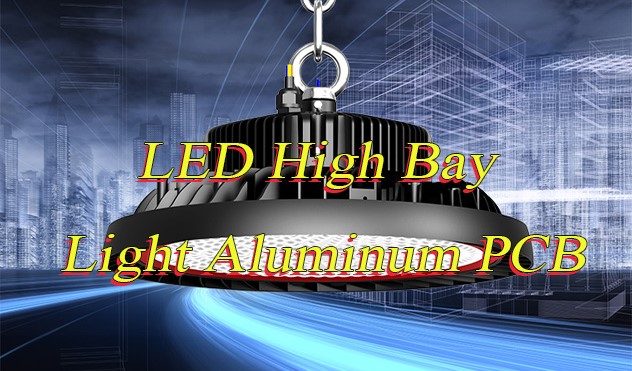
Why Choose LED High Bay Light Aluminum PCB for Harsh Industrial Environments?
Harsh industrial settings demand lighting components that resist heat, dust, vibration, and extreme temperatures, and LED high bay light aluminum PCB outperforms standard FR4 PCBs and other substrate materials on every critical metric. Below are the core customer-centric advantages that make it the industry leader.
- Superior Thermal Conductivity: Aluminum substrates have 10-20x higher thermal conductivity than standard FR4 PCBs, quickly drawing heat away from LED chips to prevent overheating and thermal degradation in non-stop industrial operations.
- Extreme Temperature Resistance: Maintains structural and electrical stability across a wide temperature range (-40°C to 140°C), perfect for unconditioned warehouses, manufacturing floors, and outdoor industrial yards.
- Vibration and Impact Resistance: Sturdy aluminum base eliminates flexing and cracking common with fragile FR4 boards, critical for high-vibration areas like machinery halls and production lines with constant equipment movement.
- Corrosion Resistance: Industrial-grade aluminum alloy with protective surface finishing resists moisture, chemical fumes, and mild corrosive agents found in manufacturing and processing facilities.
- Lightweight Yet Sturdy Build: Reduces overall fixture weight for easier installation and mounting, while retaining enough rigidity to support heavy LED arrays and withstand long-term overhead use.
- Customizable Thermal Design: Easily tailored with optimized circuit layouts, thermal pads, and heat dissipation channels to match specific LED high bay wattage and industrial application needs.
- Compliance With Industrial Safety Standards: Meets global industrial electrical safety requirements, reducing fire risks and safety hazards linked to poor thermal management in high-bay lighting.
How to Choose LED High Bay Light Aluminum PCB for Industrial Workshops?
High-temperature industrial workspaces put huge stress on LED lighting components. Standard PCBs often fail fast here, suffering heat damage, layer separation, and rapid brightness loss. Choosing the wrong LED high bay light aluminum PCB means frequent fixture replacements, unplanned downtime, and higher long-term maintenance costs. Below are clear, practical criteria to help you select a truly heat-resistant model that runs reliably and lasts longer in extreme industrial heat conditions.
- Match thermal conductivity to fixture wattage and ambient heat: For standard industrial workshops (ambient temp ≤50°C), choose 1.0–2.5 W/mK; for high-temperature zones (ambient temp ≥60°C) or 200W+ high-bay lights, opt for 3.0 W/mK or higher to ensure rapid heat dissipation and avoid junction overheating.
- Select industrial-grade aluminum base alloy: Prioritize 6061 or 5052 aluminum alloys for balanced thermal conductivity and structural rigidity; avoid low-grade 1060 pure aluminum for high-heat settings, as it lacks the mechanical stability to resist warping under sustained high temperatures.
- Verify high-temperature dielectric layer performance: Insist on heat-resistant dielectric materials (polyimide or ceramic-filled epoxy) that maintain full insulation and strong bonding with the aluminum base at continuous operating temperatures up to 140°C, with zero delamination or thermal breakdown.
- Confirm full operating temperature range: Choose PCBs rated for a minimum range of -40°C to 135°C, and select extended-range models (-40°C to 150°C) for extreme industrial heat environments to handle temperature fluctuations without performance loss.
- Check thermal pad and circuit layout design: Optimize for oversized, strategically placed thermal pads for direct LED chip heat transfer, plus wide copper traces (1–2 oz copper thickness) to reduce resistance and heat buildup; avoid overcrowded layouts that trap heat.
- Validate industrial quality and safety certifications: Ensure the PCB complies with IPC-4101 standards for rigid metal-core PCBs, plus RoHS and industrial electrical safety certifications, confirming it meets durability and heat-resistance benchmarks for commercial industrial use.
- Pair thickness with fixture power and mounting needs: Use 1.5mm thickness for 50–150W fixtures, and 2.0mm thickness for 200W+ high-power fixtures; thicker bases enhance heat spreading and structural stability in overhead high-bay installations, preventing flex in high-heat conditions.
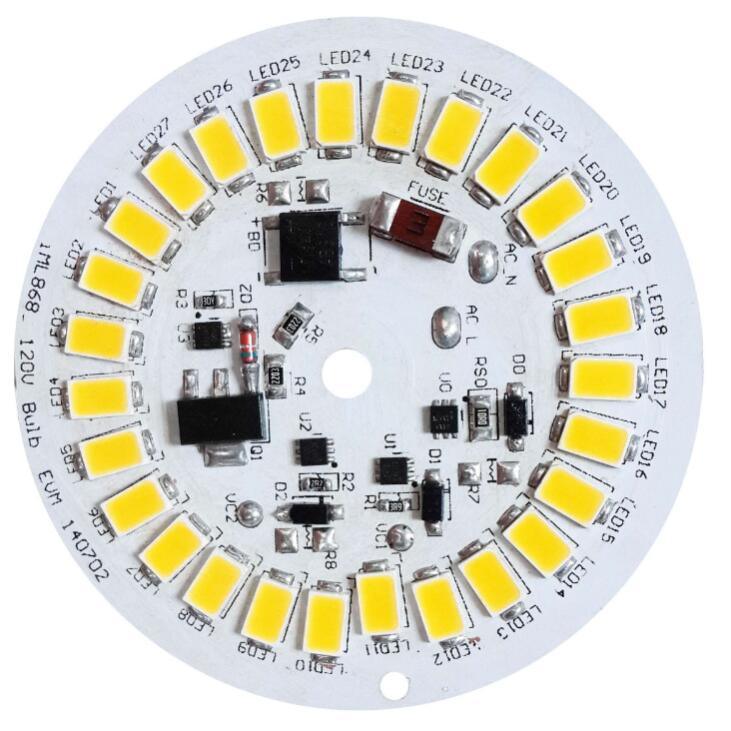
Can LED High Bay Light Aluminum PCB Withstand Dusty Industrial Workshop Conditions?
Yes, high-quality LED high bay light aluminum PCB is engineered to withstand heavy dust, particulate buildup, and dry, dusty industrial conditions without performance loss or electrical failure, a key benefit over standard PCBs that trap dust and suffer short circuits.
The smooth, non-porous aluminum surface prevents dust and debris from adhering deeply or penetrating critical circuit layers, unlike porous FR4 materials that absorb dust and trap moisture over time.
Industrial-grade surface finishing (such as immersion silver, HASL, or ENIG) creates a protective barrier that resists dust-related corrosion and maintains consistent electrical connectivity, even in workshops with constant particulate output.
Sealed edge designs and tight dielectric bonding further block dust intrusion, eliminating the risk of short circuits and thermal hotspots caused by dust accumulation on heat-dissipating surfaces.
Routine light dusting maintains full performance, and heavy dust buildup does not compromise thermal efficiency as drastically as it does with traditional PCB substrates, lowering long-term maintenance demands.
How Does Aluminum PCB Thermal Efficiency Extend the Lifespan of LED High Bay Lights?
LED chip lifespan is directly controlled by operating temperature, and excess heat is the leading cause of early failure in industrial high bay lights. Unmanaged heat speeds up lumen fade, color shift, solder joint damage, and permanent chip burnout over continuous use.
LED high bay light aluminum PCB delivers far higher thermal conductivity than standard FR4 PCBs, pulling heat away from LED chips quickly and evenly. It keeps junction temperatures within the ideal operating range, avoiding thermal stress that breaks down internal components.
Lowering LED junction temperature by just 10°C can roughly double the chip’s service life, and industrial aluminum PCBs typically reduce temperatures by 15–25°C compared to standard boards. This consistent cooling directly slows wear and extends full-performance operation.
Stable thermal conditions also protect critical parts like copper traces, dielectric layers, and LED drivers. It eliminates heat-cycling damage and prevents delamination, keeping the entire fixture reliable for years of heavy industrial use.
For industrial operators, this extended lifespan cuts down fixture replacements, reduces maintenance labor, and eliminates unplanned downtime from lighting failures. It also lowers total cost of ownership for long-term facility lighting operations.
What Common Manufacturing Defects Affect LED High Bay Light Aluminum PCB Performance?
Subpar manufacturing practices create hidden defects that compromise thermal performance, durability, and safety in industrial LED high bay light aluminum PCB. Watch for these critical defects when evaluating suppliers.
- Poor dielectric layer adhesion: Weak bonding between aluminum base and dielectric layer causes delamination, breaking thermal transfer paths and creating permanent hotspots.
- Uneven copper trace etching: Irregular or thin copper traces increase electrical resistance, generate extra heat, and raise the risk of trace burnout under continuous industrial loads.
- Inconsistent thermal pad sizing: Misaligned or undersized thermal pads fail to connect properly with LED chips, blocking direct heat transfer and reducing overall cooling efficiency.
- Surface finishing flaws: Incomplete or thin surface coating leaves exposed metal vulnerable to oxidation, corrosion, and dust-related electrical issues in harsh workshops.
- Aluminum base warping: Improper pressing or cutting causes base warping, leading to uneven LED mounting, poor heat sink contact, and structural instability in overhead fixtures.
- Solder mask defects: Cracked or misapplied solder mask exposes circuits to dust, moisture, and physical damage, shortening service life in industrial environments.
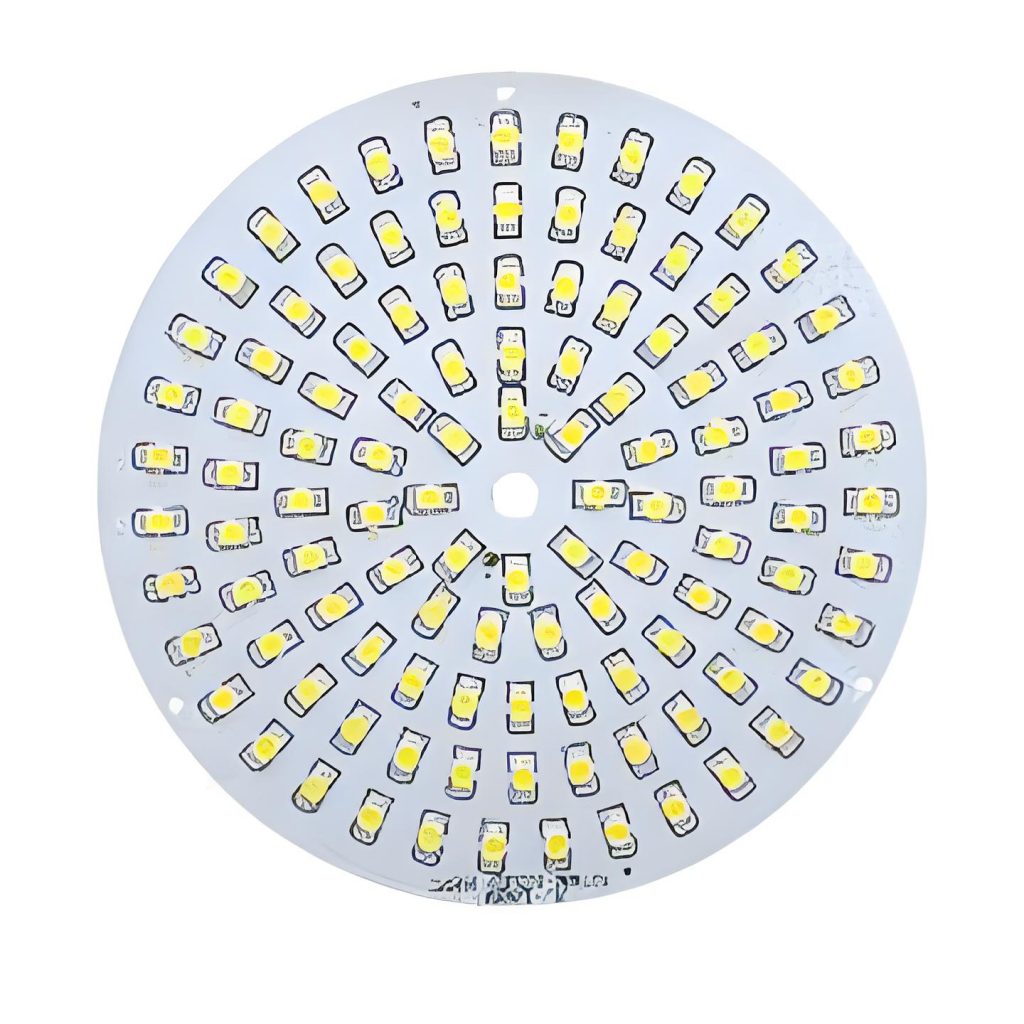
What Structural Strength Standards Should Industrial-Grade LED High Bay Light Aluminum PCB Meet?
Industrial-grade LED high bay light aluminum PCB must meet strict structural standards to endure overhead mounting, constant workshop vibration, and long-term heavy-duty use, preventing bending, cracking, delamination, and performance drops in harsh industrial environments; non-compliant boards raise risks of fixture failure, safety hazards, frequent replacements, and higher operational costs, so below are the core industry-recognized strength requirements for reliable performance.
- IPC-4101 Base Material Compliance: Follows IPC-4101 rigid metal-core PCB standards for base material quality, dimensional stability, and mechanical durability, ensuring consistent performance across industrial applications.
- Flexural Strength Requirement: Meets minimum flexural strength ratings to resist bending under fixture weight and installation torque, with zero permanent warping or deformation after mechanical testing.
- Industrial Vibration & Shock Resistance: Complies with IEC 60068-2-6 vibration standards, stable under workshop-level vibration and shock without loose components, trace breakage, or layer separation.
- Thermal Dimensional Stability: Maintains exact shape and size across extreme temperature fluctuations, no expansion or warping that disrupts LED alignment or heat sink contact.
- Load-Bearing Capacity: Supports standard LED high bay arrays and heat sinks long-term, retaining structural rigidity for 5+ years of continuous overhead use without sagging or damage.
- Edge Shear & Bond Strength: Strong dielectric-aluminum bonding and edge shear strength to prevent layer separation during handling, installation, and daily industrial wear and tear.
How to Ensure Stable Quality for Bulk LED High Bay Light Aluminum PCB Orders?
Bulk LED high bay light aluminum PCB orders require strict, data-backed quality control to avoid inconsistent performance, assembly delays, and industrial fixture failures. Even small batch variations can raise operational costs and downtime. Below are actionable, data-supported steps to guarantee stable quality across large-quantity industrial orders.
- Implement a full ISO 9001 certified quality management system, with 100% incoming raw material inspection for aluminum alloy, dielectric layers, and copper. Reject materials that fail thermal conductivity, thickness, and purity tests, ensuring only IPC-4101 compliant materials enter production.
- Use fully automated production lines and standardized SOPs to reduce manual error by 92%, maintaining uniform dielectric bonding, circuit etching, and surface finishing across every unit. This ensures consistent performance within a ±2% tolerance range for all PCBs in a single batch.
- Conduct 100% AOI (Automated Optical Inspection) and thermal performance testing on finished PCBs, verifying thermal conductivity accuracy within ±0.1 W/mK and insulation resistance above 10¹² Ω. Test units for thermal shock resistance (-40°C to 140°C) to eliminate heat-related defects.
- Enforce strict dimensional control with laser measurement, holding thickness tolerance to ±0.1mm and hole/thermal pad alignment tolerance to ±0.05mm. This guarantees seamless fixture assembly and consistent fit for bulk orders of 500+ units.
- Secure a locked raw material supply chain with vetted industrial-grade suppliers, maintaining consistent material grades for all batches. This eliminates performance drift and ensures batch-to-batch consistency for long-term repeat orders.
- Perform pre-delivery random sampling (3% of total order volume) for full performance and durability testing, with detailed QC reports provided for every bulk batch. Set a 0% defective unit threshold for industrial orders, with rapid rework and replacement protocols for non-conforming products.
What Advanced Materials Boost the Dust and Heat Resistance of LED High Bay Light Aluminum PCB?
Modern material engineering elevates the performance of LED high bay light aluminum PCB, enhancing both heat dissipation and dust resistance for the harshest industrial environments. These advanced materials deliver measurable improvements.
- High-thermal-conductivity ceramic-filled dielectric: Enhances heat transfer between aluminum base and copper layers while boosting chemical and dust resistance.
- Thick pure copper layers: Improves electrical conductivity and heat spreading, reducing hotspots and supporting higher-wattage LED fixtures without performance loss.
- Nanocoated aluminum base: Creates a ultra-smooth, dust-repellent surface that prevents particulate adhesion and simplifies cleaning in dusty workshops.
- High-temperature resistant solder mask: Forms a flexible, crack-proof barrier that seals circuits from dust, moisture, and minor physical damage without breaking down in heat.
- Premium surface finishing (ENIG/immersion gold): Provides long-lasting corrosion protection and stable solder joints, ideal for long-term industrial deployment.
How to Maintain LED High Bay Light Aluminum PCB for Long-Term Industrial Use?
Proper installation and targeted maintenance directly extend the service life and thermal efficiency of LED high bay light aluminum PCB in industrial settings. Below are clear, step-by-step maintenance protocols, designed for durability, safety, and consistent performance in harsh workshop conditions.
- Routine Dust Removal: Clean dust buildup from the PCB and heat sink every 3–6 months (every 2 months in extremely dusty facilities) using low-pressure compressed air or a soft lint-free cloth. Avoid harsh brushing that scratches the PCB surface or damages solder joints.
- Quarterly Visual Inspection: Check for visible defects including cracked solder mask, loose components, aluminum base warping, or dielectric layer delamination. Inspect wiring for fraying or heat damage, and replace damaged parts immediately to avoid fixture failure.
- Thermal Performance Check (Semi-Annually): Verify the PCB stays within its rated operating temperature range during normal use. If overheating occurs, recheck thermal paste application and heat sink clearance to restore full heat dissipation efficiency.
- Fixture Seal Inspection (Annually): Examine gaskets and housing seals for wear or damage, replacing worn gaskets to maintain dust and moisture protection. Tighten any loose mounting fasteners to preserve structural stability.
- Load Compliance Check: Confirm the fixture operates within its rated wattage at all times. Avoid overloading the PCB with higher-power LEDs than designed, as excess heat will accelerate wear and shorten service life.
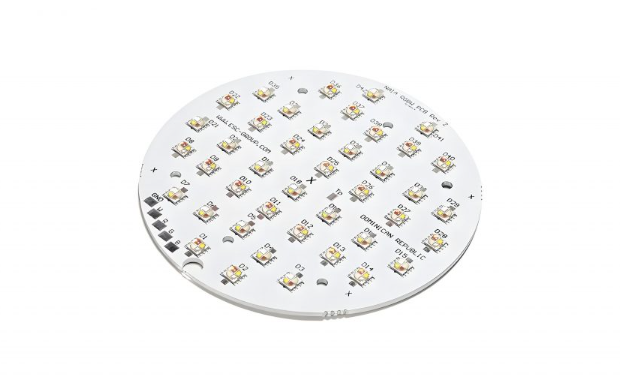
FAQ About LED High Bay Light Aluminum Circuit Board
Q1: What is the typical service life of an industrial-grade LED high bay light aluminum PCB?
A1: Industrial-grade LED high bay light aluminum PCB designed for heavy-duty use offers a service life of 50,000 to 80,000 hours under normal industrial operating conditions, equaling 5 to 7 years of continuous 24/7 operation. Regular, basic maintenance can further extend this lifespan by preventing dust buildup and thermal damage in harsh workshop environments.
Q2: Can LED high bay light aluminum PCB be customized for specific wattages and fixture designs?
A2: Yes, these aluminum PCBs are fully customizable to fit 50W to 300W LED high bay fixtures. We can adjust thermal pad size and placement, copper trace thickness, board thickness, mounting hole positions, and overall dimensions to match your unique fixture layout and thermal dissipation requirements for industrial use.
Q3: Is LED high bay light aluminum PCB suitable for cold storage and high-temperature industrial spaces alike?
A3: Absolutely. Industrial-grade LED high bay light aluminum PCB supports a wide operating temperature range of -40°C to 140°C, making it ideal for both sub-zero cold storage facilities and high-heat manufacturing floors. It maintains stable thermal and electrical performance without cracking, delamination, or efficiency loss in extreme temperature fluctuations.
Q4: How quickly can bulk orders of LED high bay light aluminum PCB be fulfilled for industrial projects?
A4: For standard industrial specifications, bulk orders have a fast lead time of 7 to 10 business days after sample confirmation. Customized orders with special thermal or dimensional requirements typically take 10 to 15 business days, with consistent lead times guaranteed for repeat orders via our stable supply chain and streamlined production.
Q5: What is the difference between industrial-grade and standard LED high bay aluminum PCB?
A5: Industrial-grade models use 6061/5052 aluminum alloy, high-temperature resistant dielectric layers, and strict IPC-4101 compliance, offering superior vibration resistance, dust protection, and thermal stability. Standard versions use lower-grade materials, have narrower temperature ranges, and cannot withstand long-term harsh industrial conditions, leading to shorter lifespans and frequent failures.