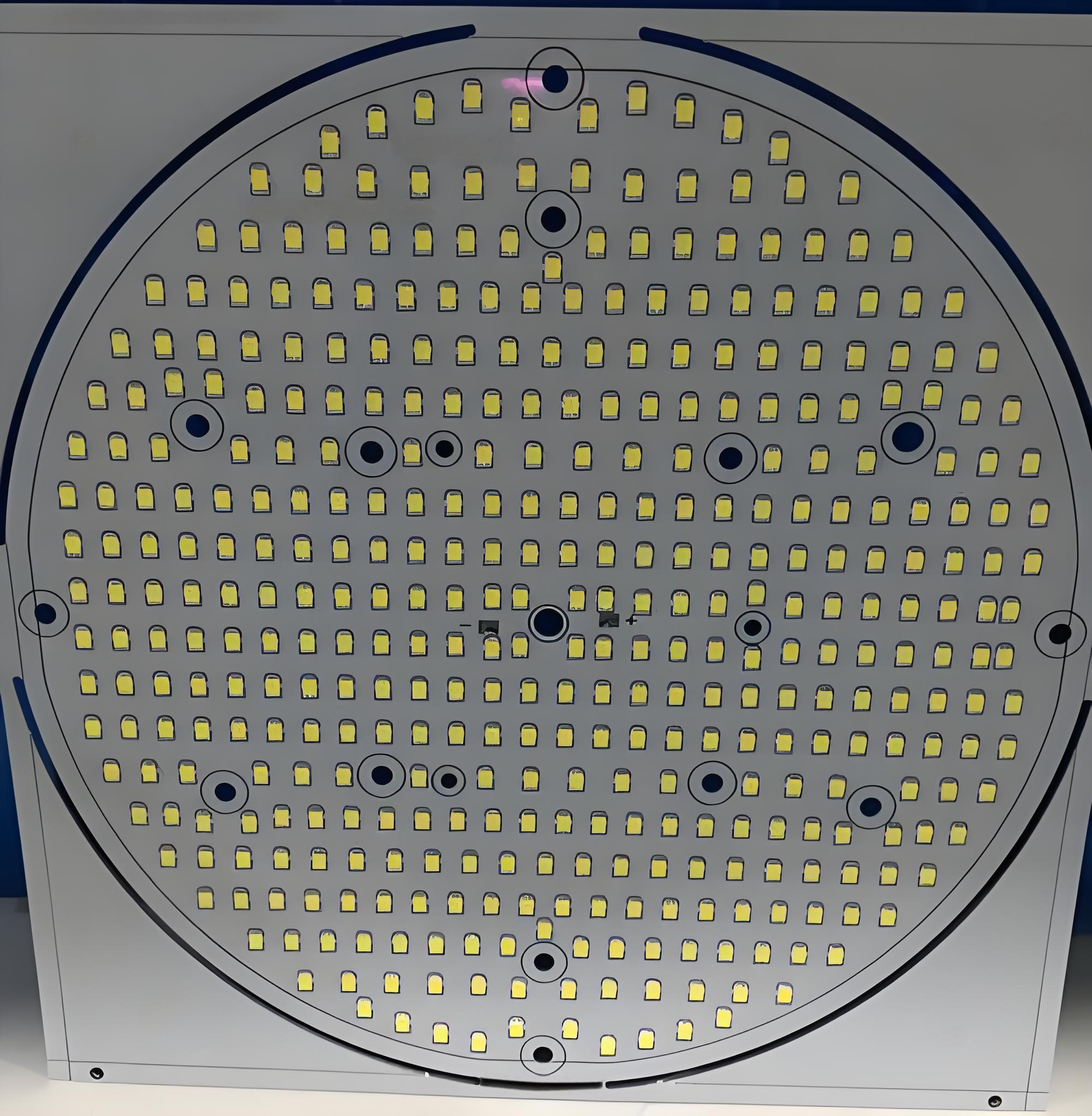
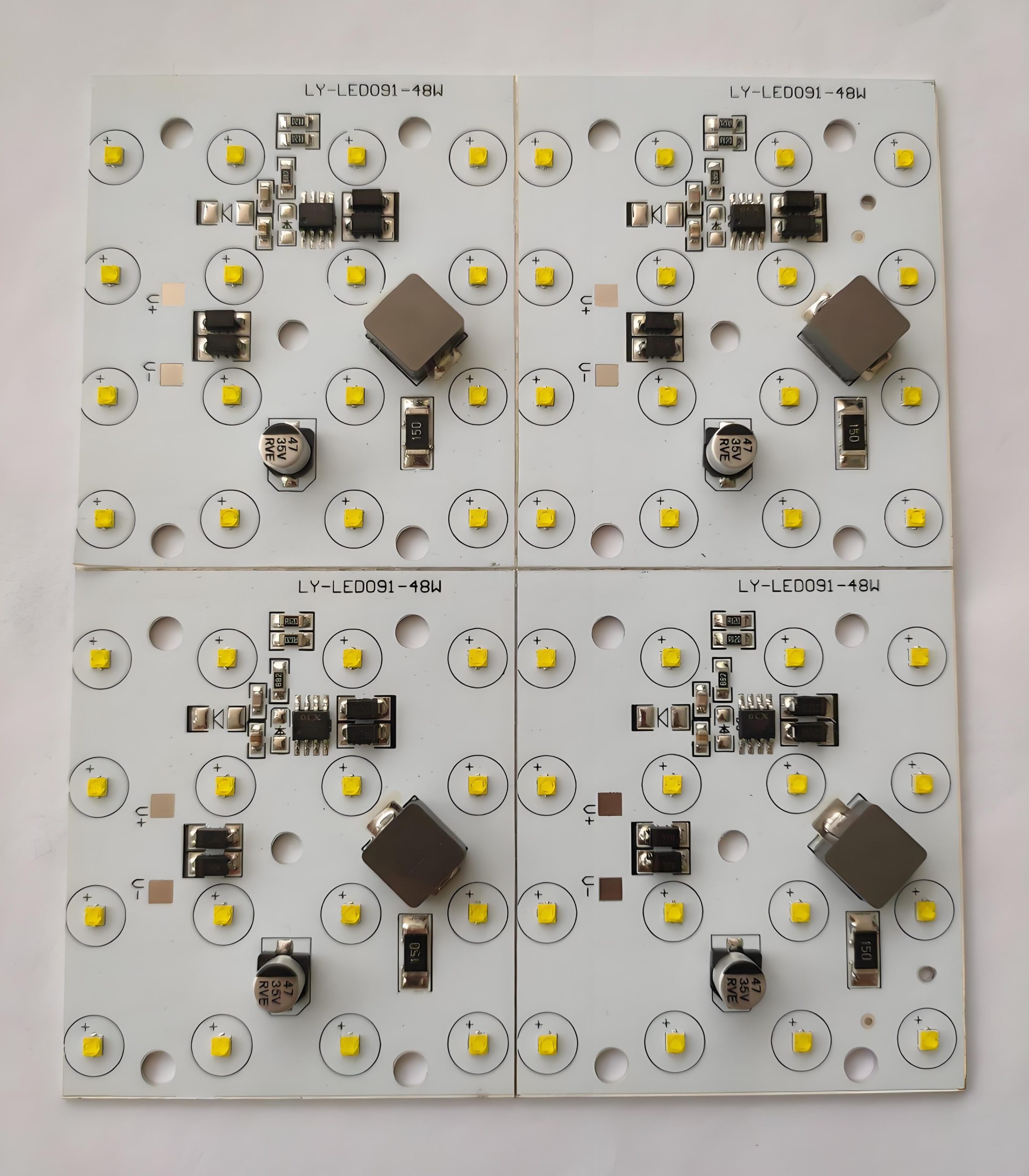
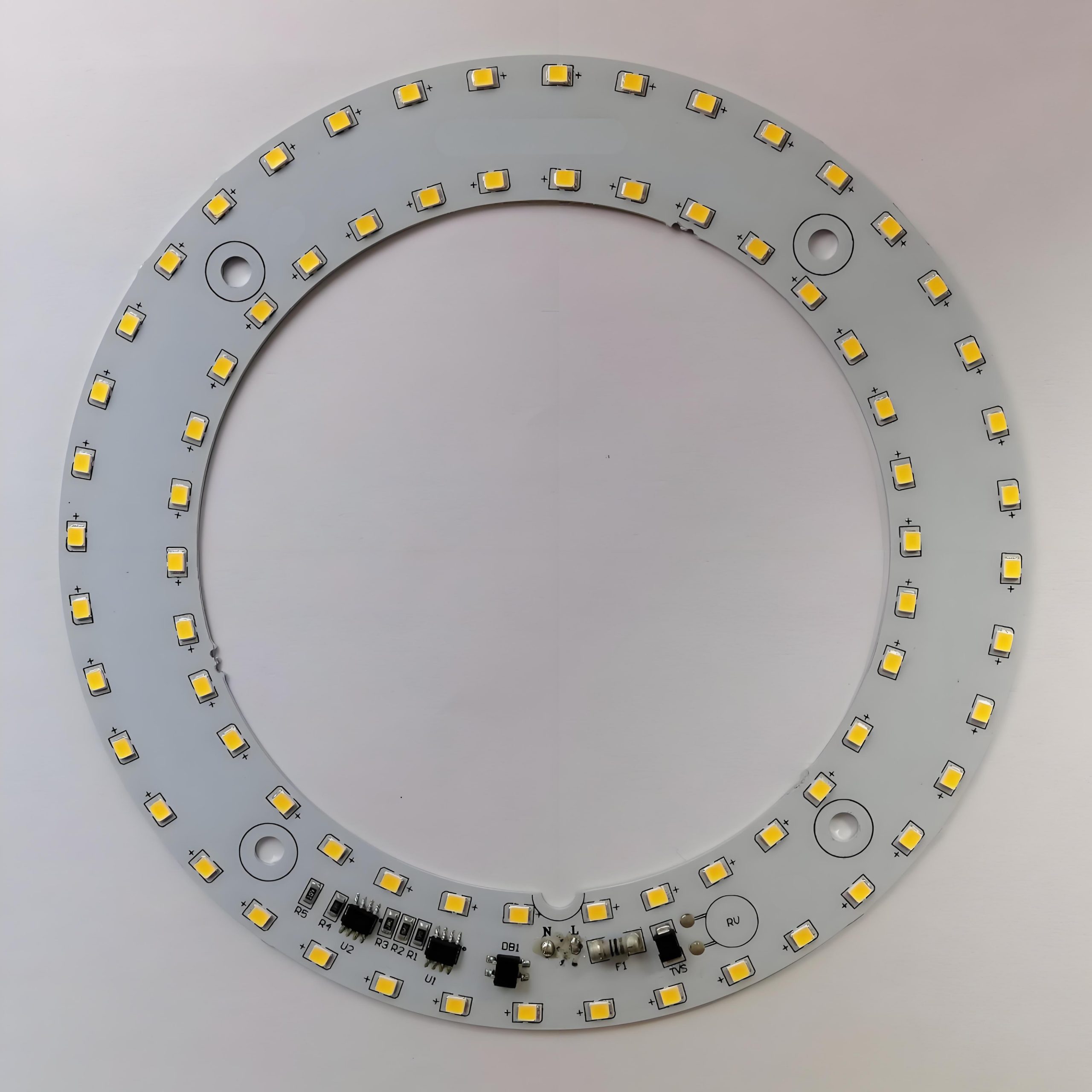
PCB manufacturing PCB manufacturing
Home > Blog

chip on board led

COB MCPCB
Friday, March 20th, 2026

What is Chip On Board COB MCPCB?

COB MCPCB, known as “Chip-On-Board” Metal Core PCB, is a type of MCPCB used in thermoelectric separation application. By using COB MCPCB, the micro-chip (also known as “die”) directly touch the metal core where the heat dissipate, and electrically interconnect the trace of circuit board (wire-bonding) so that power supply can be provided.

In normal MCPCB, there’s a dielectric layer between trace copper and metal core, and the thermal conductivity is limited by that dielectric layers, so value can only be 1~3 W/m.K. But using COB MCPCB, there’s no such dielectric layer because chip (die) direct touch the metal core, so thermal conductivity value of COB MCPCB will be almost the same one of metal core material itself. The normal material of metal core is aluminum, so thermal conduviity of COB MCPCB is more than 200W/m.K.
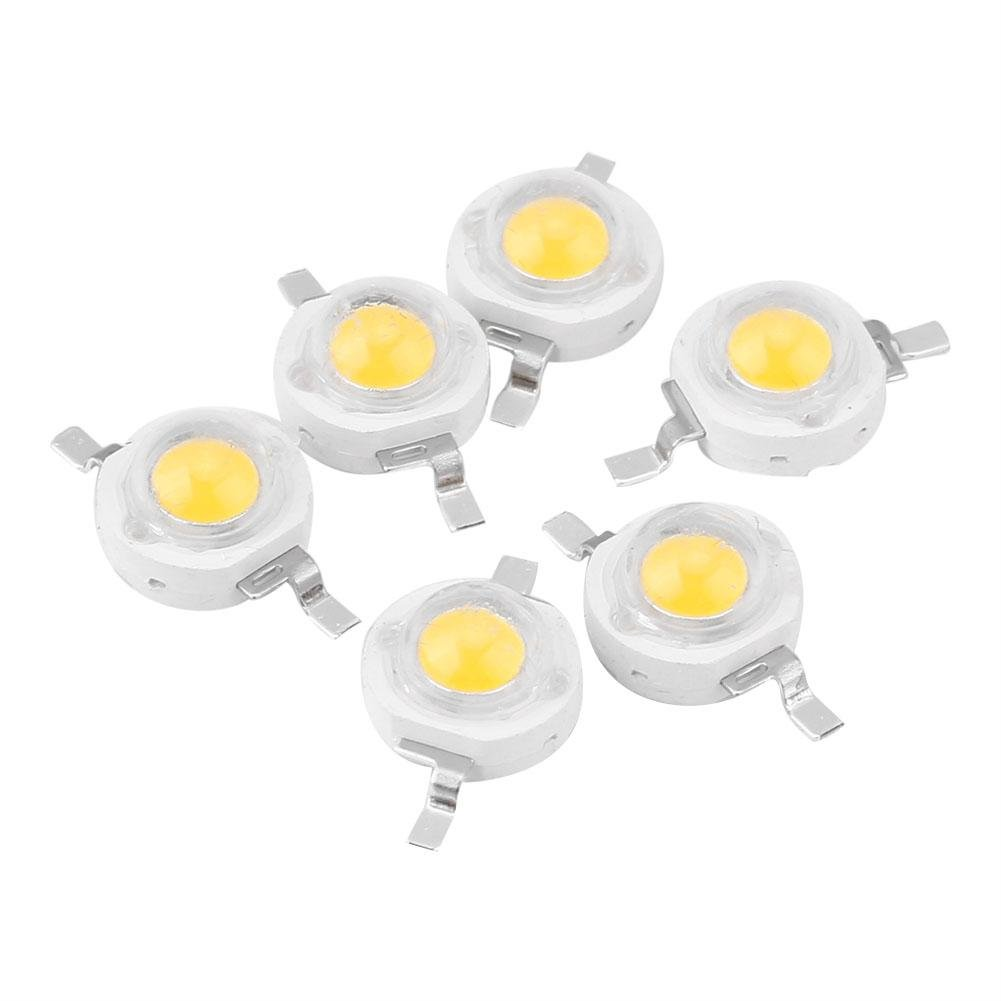
COB MCPCB

COB MCPCB (Chip on Board)

What are the COB Wire Bonding Processes?

COB process consists of three main categories to perform when manufacturing the Chip-on-Board:

1st: die mount or die attach;

2nd: wire bonding;

3rd: the encapsulation of die wires.

By using wire bonding & epoxy packaging then directly embedded on MCPCB, this practice can extend the lifespan of LED and unified light emission.

According to process and material, COB MCPCB applications can be categorized into two types: Mirror Aluminum and silver or gold platting aluminum, or silver plating mirror aluminum PCB.

Structure of COB MCPCB
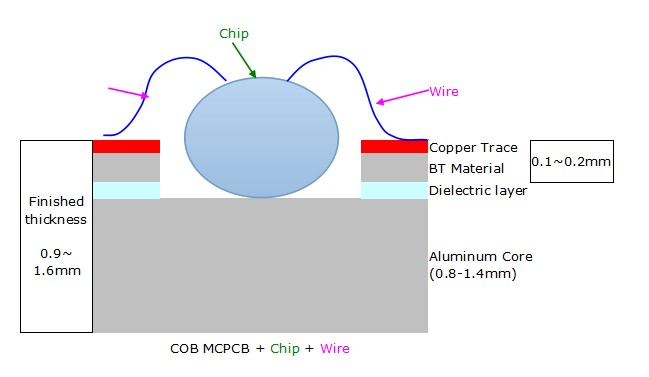
Structure of COB MCPCB

Advantage of utilizing COB MCPCB

  • Excellent heat dissipation
  • High thermal conductivity: 137W/m.K
  • Higher reliability with better heat dispatch and small number of solder joint.
  • Provide enhanced reliability and lifespan of LED
  • Easy assembly for high powers LEDs
  • High quality material and production process allows easy assembly and substantial reduce the error percentage in assembly process
  • Substantially reduced space and cost
  • With better security protection (difficult to hack using reverse engineering)
  • Shorter time to the market

Application of COB MCPCB

  • High Power LED (up to 200W)
  • LED Backlight for LED TV
  • LED Front Light for E-Book
  • Agriculture & Horticulture Lighting
  • Street & Parking Lot Lighting
  • Automotive
  • Power Supply
  • ustomer Electronics Lighting
  • Other products that require thermal solutions

Application of COB MCPCB

FAQs about COB MCPCBs

1. What is the difference between a standard MCPCB and a COB MCPCB?

A standard MCPCB (Metal Core PCB) usually has SMT (Surface Mount Technology) components soldered onto a dielectric layer. In contrast, a COB (Chip-on-Board) MCPCB allows the LED semiconductor chip to be mounted directly onto the metal core or into a recessed “well.” This removes the thermal resistance of the LED package itself, allowing for much higher power density.

2. Why is thermal conductivity so important for COB MCPCBs?

Since COB LEDs pack many light-emitting diodes into a very small area, they generate intense localized heat. If this heat isn’t dissipated, the LED’s lifespan and brightness (luminous flux) drop rapidly. COB MCPCBs use materials like Aluminum or Copper to pull heat away from the chips at rates significantly higher than standard FR4 boards.

3. What are the common base materials used in COB MCPCBs?

  • Aluminum: The most common and cost-effective choice for general lighting.
  • Copper: Offers superior thermal conductivity but is heavier and more expensive; used for extreme high-power applications.
  • Stainless Steel: Occasionally used for high-strength requirements, though it has poorer thermal properties than Aluminum.

4. What is a “Mirror Aluminum” COB MCPCB?

A Mirror Aluminum COB MCPCB features a highly reflective, polished surface. This design ensures that light emitted from the sides of the LED chips is reflected forward, increasing the overall light output efficiency (Lumen/Watt) by reducing light absorption by the board itself.

5. Can COB MCPCBs be used with high-voltage applications?

Yes, but they require a specialized dielectric layer. This layer must be thin enough to allow heat to pass through to the metal core, but thick enough to provide electrical insulation (dielectric breakdown voltage) to prevent short circuits, especially in AC-driven LED modules.

6. What are the main applications for COB MCPCB technology?

Because they offer high brightness in a compact footprint, they are the industry standard for:

  • Automotive lighting (Headlights).
  • Industrial high-bay lighting.
  • Street lights and architectural floodlights.
  • Commercial downlights and track lighting.
What is chip on board? & COB LED
Tuesday, February 11th, 2025

What is chip on board? Chip-on-board packaging is a process that directly adheres the bare chip to the PCB, connects the electrical signal through wire bonding or flip chip, and finally encapsulates it with protective materials. It is commonly used in consumer electronics, automotive electronics, industrial control and other fields.

What is Chip-on-Board (COB)?

Chip-on-Board (COB) is an advanced packaging technology that directly mounts semiconductor chips onto a printed circuit board (PCB) or substrate. The chips are then covered with an epoxy glob-top to protect them from environmental damage.

What is chip on board? & COB LED

COB technology enhances performance, reduces size, and improves thermal management, making it ideal for LEDs, sensors, and high-density electronic circuits. It is widely used in consumer electronics, industrial applications, and medical devices.

COB technology simplifies circuit design by eliminating traditional chip packaging, making electronic devices more compact and efficient. This method also allows for a higher density of chips on a single board, improving overall system performance.

Additionally, COB reduces signal interference, as the shorter wiring distances lead to faster signal transmission with minimal loss.

How to Make a Chip-on-Board?

The COB manufacturing process starts with substrate preparation. The substrate must be cleaned thoroughly to remove dust and contaminants before the die is attached.

Once the die is secured using conductive epoxy or eutectic bonding, precision wire bonding is performed using high-speed automated equipment.

The encapsulation process follows, where the chip is covered with an epoxy resin or silicone coating to protect it from moisture, dust, and mechanical damage.

After curing, functional tests ensure that the COB performs as expected before being integrated into devices.

What is the Process of Chip-on-Board Assembly?

COB assembly follows a structured procedure:

  • Die Attachment – The semiconductor die is placed onto the PCB or ceramic substrate using epoxy or eutectic bonding.
  • Wire Bonding – Tiny gold or aluminum wires connect the die pads to the board’s circuit.
What is chip on board? & COB LED
  • Encapsulation – A protective resin, covers the chip to prevent oxidation and mechanical damage.
  • Testing & Inspection – Each COB unit undergoes electrical testing to ensure proper functionality.

This streamlined process enhances durability and performance while reducing space requirements. COB technology eliminates the need for bulky component packaging, making it ideal for high-density applications.

In high-volume production, automated optical inspection (AOI) and X-ray inspection methods are used to detect defects at an early stage. These techniques improve quality control and reduce failure rates.

The encapsulation step can vary based on the application, with some requiring clear resin for optical applications like LED modules, while others use opaque coatings for protection in industrial environments.

What is the Material of Chip-on-Board?

COB technology primarily uses:

  • Substrate Materials: FR4, ceramic, or metal-core PCBs
  • Die Attach Adhesives: Epoxy resins or solder materials
  • Wire Bonding Materials: Gold (Au) or aluminum (Al) wires
  • Encapsulation: Epoxy or silicone resin

Each material is chosen to optimize thermal conductivity, reliability, and performance. The choice of substrate depends on the specific application requirements.

Ceramic substrates, such as aluminum oxide (Al₂O₃) or aluminum nitride (AlN), are commonly used for high-power applications due to their superior thermal conductivity.

Metal-core PCBs (MCPCBs) are another option, particularly in LED applications, where efficient heat dissipation is critical.

The selection of wire bonding materials also plays a crucial role in the performance of COB assemblies, with gold wires offering excellent conductivity and oxidation resistance, while aluminum wires provide a cost-effective alternative.

What Does a Chip-on-Board Do?

COB improves circuit efficiency by integrating chips directly onto the board. This minimizes electrical resistance and enhances heat dissipation.

COB is widely used in LED applications, automotive electronics, medical devices, and consumer electronics. By eliminating traditional chip packaging, COB enhances performance while reducing costs.

What is chip on board? & COB LED

COB technology is essential in miniaturized electronic devices, where space is a premium. It allows for higher functionality in a compact form factor, enabling the development of advanced applications such as wearable devices, biomedical implants, and high-speed communication systems.

The improved electrical performance of COB results in lower power consumption and higher reliability, making it suitable for mission-critical applications.

What Are the Advantages of Chip-on-Board?

COB offers several benefits:

  • Compact Design: Reduces overall device size.
  • Better Thermal Management: Direct chip-to-substrate contact improves heat dissipation.
  • Enhanced Performance: Shorter electrical paths enhance speed and efficiency.
  • Lower Production Costs: Eliminates the need for traditional packaging.
  • Improved Reliability: Protective coating shields against dust, moisture, and impact.
  • Higher Power Density: Ideal for high-performance applications requiring intense power output.

In addition to these advantages, COB also provides improved electromagnetic interference (EMI) performance.

Since the chip is mounted closer to the PCB, the overall signal path is shorter, reducing noise and improving signal integrity. This feature makes COB technology suitable for high-speed computing and RF communication applications.

Moreover, COB enables flexible and custom design options, allowing manufacturers to optimize layouts based on specific application needs.

How Does Chip-on-Chip Work?

Chip-on-Chip (CoC) is a stacking technology where multiple dies are placed on top of each other. This differs from COB, where chips are directly attached to the PCB.

CoC enhances computing power and is widely used in high-performance processors and memory modules.

CoC technology is often found in mobile devices, high-speed computing, and AI processors.

CoC is commonly used in multi-core processors, DRAM memory modules, and advanced image sensors. This technology enables efficient use of real estate on circuit boards, reducing latency and improving overall system performance.

Thermal management in CoC designs is critical, requiring advanced cooling solutions such as thermal vias and integrated heat spreaders.

What is Chip-on-Board LED?

COB LED technology integrates multiple LED chips onto a single substrate. This creates a high-intensity light source with uniform illumination. COB LEDs are commonly used in:

  • COB LED Strips: Flexible lighting solutions with consistent brightness.
  • COB LED Grow Lights: Efficient plant-growing illumination.
  • COB LED Panels: High-output lighting for commercial use.
What is chip on board? & COB LED

COB LEDs outperform traditional LEDs in brightness and heat dissipation. They are ideal for industrial, automotive, and commercial lighting applications.

COB LEDs are designed for high-efficiency applications, offering better lumen output per watt compared to traditional surface-mount device (SMD) LEDs. Their broad beam angle provides uniform light distribution, making them ideal for downlights, floodlights, and stadium lighting.

The compact nature of COB LEDs also allows for innovative designs, such as ultra-thin panel lights and high-intensity projectors.

What is the Difference Between PCB and COB?

A PCB is the foundation for electronic circuits, providing mechanical support and electrical connections for components. It can house surface-mounted or through-hole components. Traditional PCBs require additional chip packaging, leading to larger designs.

In contrast, COB (Chip-on-Board) technology eliminates chip packaging by mounting the semiconductor die directly onto the PCB. This method offers a more compact, high-performance alternative with better thermal management.

COB technology is especially beneficial for LED applications, sensors, and advanced electronics where space and efficiency are critical.

While standard PCBs cater to general electronics, COB is ideal for high-density applications requiring superior power efficiency and miniaturization.

COB technology reduces electrical resistance, shortens signal paths, and improves heat dissipation, making it a preferred choice for industries demanding high reliability and performance.

Conclusion:

COB technology revolutionizes modern electronics by improving efficiency, reducing costs, and enhancing performance. EBest Circuit (Best Technology) ensures top-tier quality in every COB and PCB solution, for inquiries, contact us at sales@bestpcbs.com