PCB manufacturing PCB manufacturing
Home > Blog

Posts Tagged ‘PCB Standard Thicknesses’

What Is the Standard PCB Thickness?
Monday, January 5th, 2026

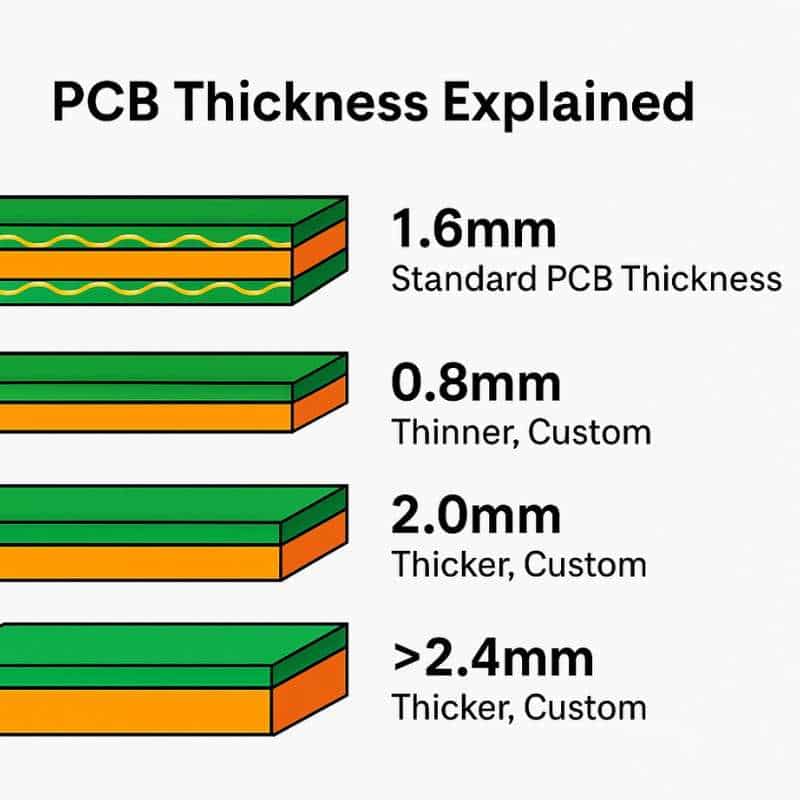
The standard PCB thickness is 1.6 mm (0.063 inch). This thickness has become the global default because it balances mechanical strength, electrical reliability, manufacturability, and cost. Most PCB fabs optimize their processes, materials, and tooling around 1.6 mm, making it the most economical and widely supported option.
What Is the Standard PCB Thickness?

What Are Standard PCB Thicknesses?

Standard PCB thicknesses are the most commonly produced finished board thickness values supported by mainstream fabrication lines. These values exist because materials, lamination presses, drilling tools, and surface finish processes are optimized around them.

For rigid boards, the most widely used finished thickness is 1.6 mm. This value has become the industry baseline. It offers a strong balance between rigidity, weight, and cost. Most connectors, card slots, and housings are designed with this thickness in mind.

Other standard thicknesses are also widely used:

  • 0.4 mm
  • 0.6 mm
  • 0.8 mm
  • 1.0 mm
  • 1.2 mm
  • 1.6 mm
  • 2.0 mm
  • 2.4 mm

These values are not arbitrary. They align with standard FR4 core thicknesses and prepreg build-ups.

For multilayer boards, the finished thickness results from stacking multiple cores and prepregs. A standard PCB thickness 4 layer design often ends up between 1.2 mm and 1.6 mm, depending on copper weight and dielectric choice.

Because these thicknesses are repeatable, they reduce process variation. That stability is one reason they remain dominant across consumer, industrial, and medical electronics.

Does PCB Thickness Matter?

PCB thickness is very important. It affects performance, assembly, and long-term reliability. A thicker board offers higher rigidity. This reduces flexing during handling and assembly. It also improves resistance to vibration in industrial environments.

  • A thinner board saves weight and space. This is valuable in compact products such as wearables or handheld devices. Thin boards also enable tighter stacking in multi-board assemblies.
  • Electrically, thickness influences impedance. Controlled impedance traces rely on precise dielectric spacing. Changing thickness without recalculating stack-up can shift impedance out of tolerance.
  • Thermally, thicker boards can dissipate heat more evenly. However, very thick boards may trap heat if copper distribution is poor.

In short, PCB thickness matters because it touches mechanics, electronics, and manufacturing at the same time.

How to Find PCB Thickness?

Finding PCB thickness is straightforward when documentation is available. Most fabrication drawings specify finished thickness in millimeters. Gerber files alone do not define thickness, so you must check the fabrication notes or stack-up table.

If you already have a physical board, thickness can be measured using a digital caliper. Measure at the edge, away from copper pours or surface finish buildup.

In production environments, thickness is verified during quality inspection. Fabricators use calibrated gauges to ensure boards fall within PCB thickness standard tolerances.

For legacy designs without clear records, cross-section analysis can reveal core and prepreg structure. This method is more involved but provides precise data.

What Is the Standard Thickness of a 2 Layer PCB?

The standard thickness of a 2 layer PCB is most commonly 1.6 mm. This configuration dominates simple control boards, power boards, and general electronics.

Other popular options include:

  • 1.0 mm for lighter, space-saving designs
  • 0.8 mm for compact modules
  • 2.0 mm for higher rigidity

A 2-layer board typically uses a single FR4 core with copper laminated on both sides. Because the structure is simple, thickness control is very stable.

Many designers choose 1.6 mm by default. It fits most connectors and mechanical fixtures. It also minimizes cost because suppliers stock it in large volumes.
What Is the Standard PCB Thickness?

What Is the Standard Thickness of FR4 PCB?

FR4 is the most widely used PCB material. Its standard PCB thickness options match the common rigid board values.

Typical FR4 finished thicknesses include:

  • 0.8 mm
  • 1.0 mm
  • 1.2 mm
  • 1.6 mm
  • 2.0 mm

The internal standard PCB core thicknesses are smaller. Common FR4 core thicknesses are:

  • 0.1 mm
  • 0.2 mm
  • 0.3 mm
  • 0.4 mm

By combining these cores with prepreg layers, fabricators achieve the final board thickness. Copper weight also plays a role. Heavy copper adds measurable thickness, especially in multilayer designs.

FR4 remains popular because it offers good electrical insulation, stable mechanical properties, and reasonable cost. Its standard thickness range supports almost every general application.

How Thick Is a Standard Flex PCB?

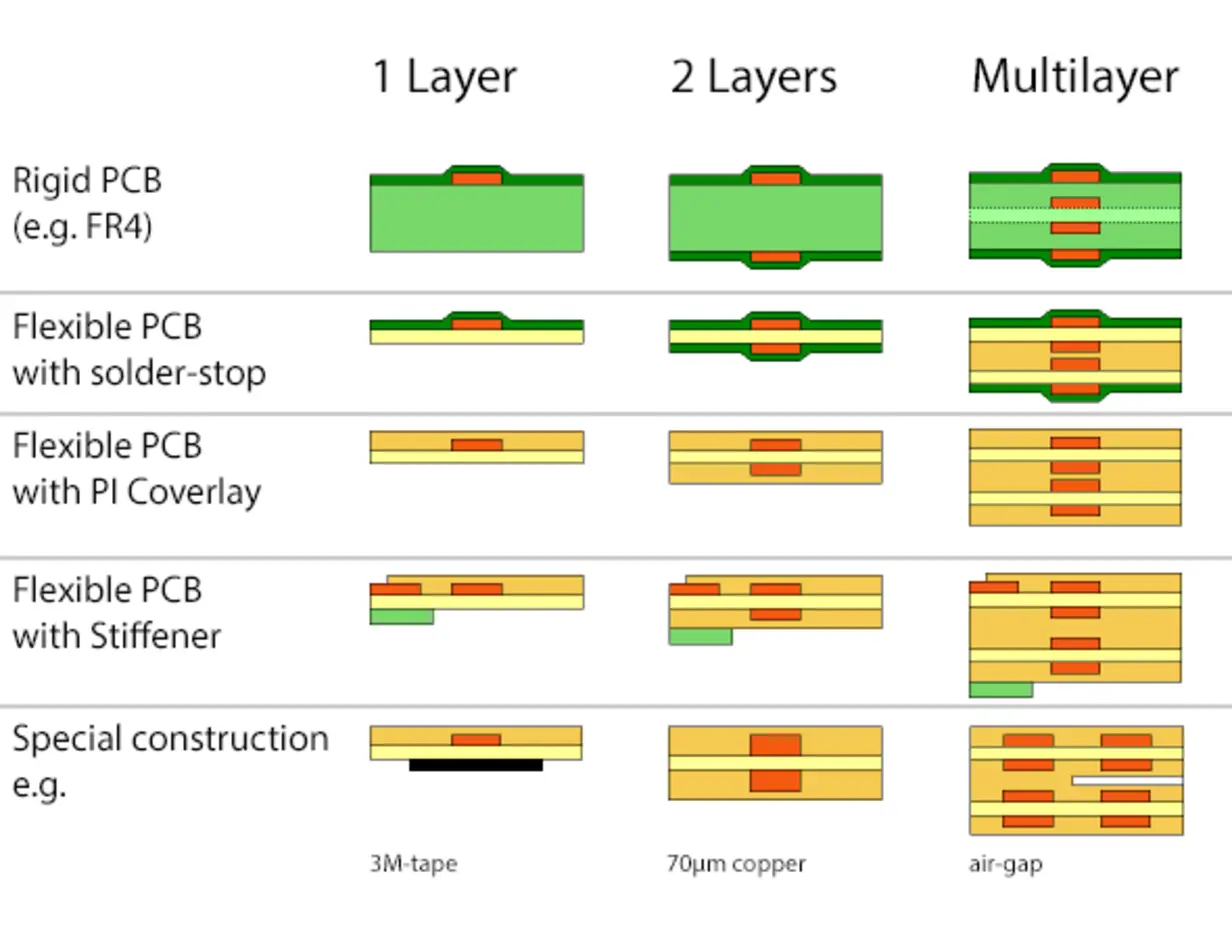
Flex PCBs follow different rules. Their thickness is much thinner because flexibility is the goal.

A standard flex PCB thickness often ranges from 0.05 mm to 0.3 mm, depending on layer count and stiffener use. Single-layer flex circuits are extremely thin. They use polyimide substrates rather than FR4.

Double-layer and multilayer flex boards add thickness but remain far thinner than rigid boards. Adhesives, coverlay, and copper weight all contribute to the final value.

When stiffeners are added, the thickness increases locally. This allows connectors to be mounted without sacrificing flexibility elsewhere.

Flex thickness must be chosen carefully. Too thin, and handling becomes difficult. Too thick, and flexibility is reduced.
What Is the Standard PCB Thickness?

How to Choose the Thickness of PCB?

Choosing PCB thickness should start with the application, not habit. While standard values simplify sourcing, the best thickness depends on real constraints.

  • First, consider mechanical requirements. Boards exposed to vibration or stress benefit from greater thickness. Boards mounted in tight enclosures may need to be thinner.
  • Next, review electrical needs. High-speed designs rely on precise impedance. Thickness affects dielectric spacing, so it must align with the stack-up calculation.
  • Thermal performance also matters. Power boards may need thicker substrates or heavier copper to spread heat.
  • Assembly is another factor. Thin boards can warp during reflow if not supported properly. Thicker boards resist warpage but increase weight.
  • Finally, cost and lead time matter. Standard thicknesses are faster and cheaper. Custom thicknesses may require special materials.

What Is the Standard Thickness Tolerance for PCB?

No PCB is perfectly uniform. Every board is produced within a tolerance range. Standard PCB thickness tolerance depends on board type and thickness.

For rigid FR4 boards, a typical tolerance is ±10% of the finished thickness. For a 1.6 mm board, this means a range of approximately 1.44 mm to 1.76 mm.

Thinner boards often have tighter absolute tolerances but similar percentage limits. Multilayer boards may show slightly more variation due to multiple lamination steps.

What Is the Minimum Core Thickness of a PCB?

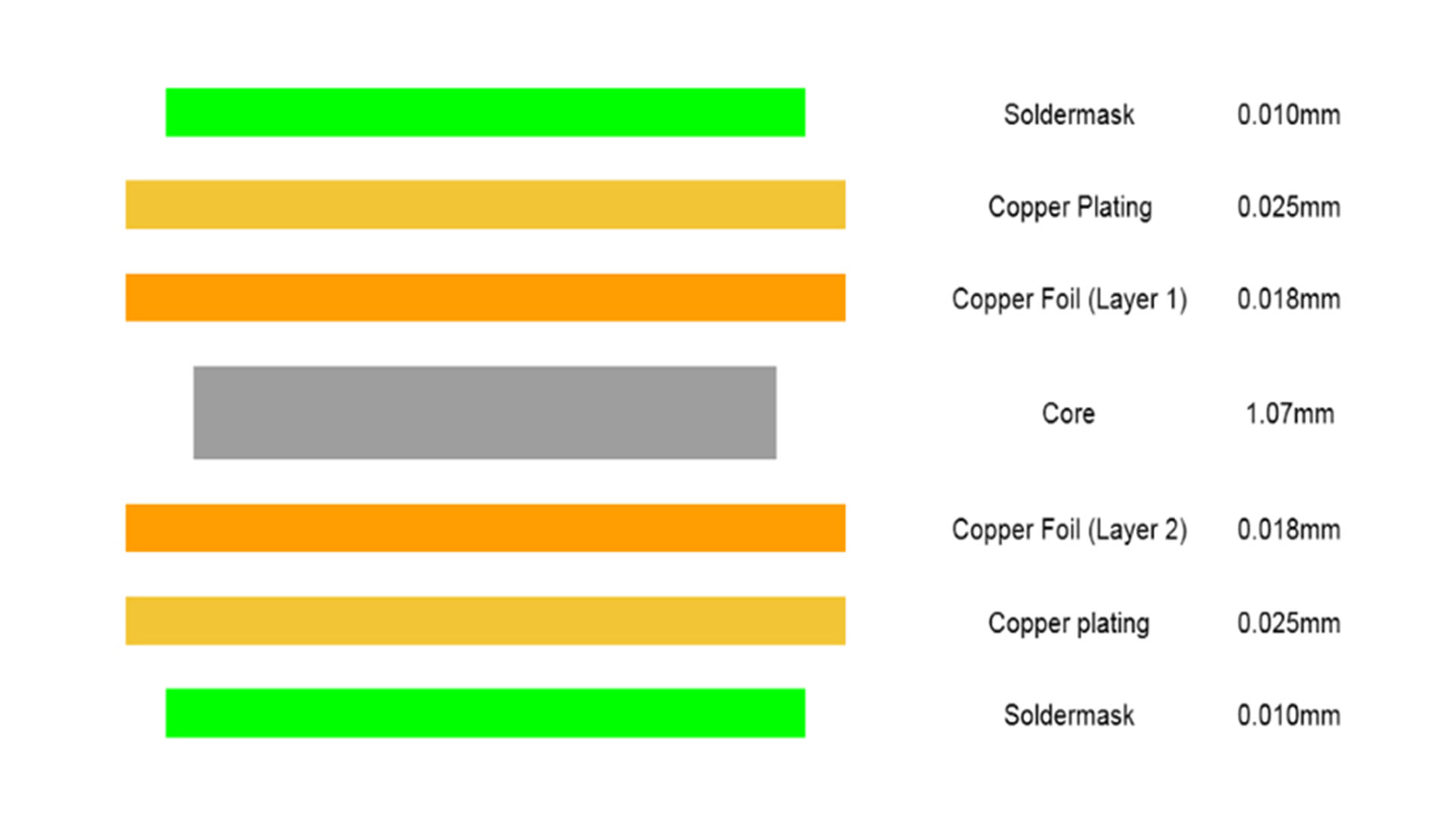
The minimum PCB thickness is limited by core material availability and handling constraints. In rigid boards, standard FR4 cores rarely go below 0.1 mm.

Ultra-thin cores exist, but they increase cost and risk. Thin cores are more fragile during drilling and lamination. They also increase the chance of warp.

In multilayer designs, thin cores are sometimes used to control impedance. This must be balanced against manufacturing yield.

For most applications, using standard core thicknesses improves reliability. It also shortens lead time because materials are readily available.
What Is the Standard PCB Thickness?

What Is the Most Common Size PCB?

Standard PCB sizes vary widely because board outlines depend on product design. There is no single universal size. However, certain dimensions appear frequently.

Small control boards often fall within 100 mm × 100 mm. This size is popular because it fits standard fabrication panels efficiently.

Larger boards are common in power supplies and industrial systems. Rectangular shapes dominate because they panelize well.

When discussing standard PCB board sizes, panel utilization matters more than absolute dimensions. Designing with panel efficiency in mind can reduce cost without changing functionality.

Conclusion:

PCB standard thicknesses are the foundation of reliable board design. Thickness influences mechanics, electrical performance, thermal behavior, and manufacturing yield.

If you need guidance on selecting the right standard PCB thickness, material stack-up, or tolerance for your project, our engineering team is ready to support you. Contact us: Email: sales@bestpcbs.com
Standard PCB Thickness Chart, PCB Standard Thicknesses
Tuesday, April 29th, 2025

PCB standard thicknesses play a huge role in how strong and reliable your final product will be. If you’re designing a PCB, picking the right thickness can affect performance, durability, and even cost. Whether you are choosing between 2-layer or 6-layer boards, understanding copper thickness, or dealing with tolerances, this guide is here to help you.

EBest Circuit (Best Technology) provides a one-stop PCB manufacture and assembly service, including NPI Support, DFM analysis, PCB design, quick PCB Prototyping, turn-key PCB assembly, and prompt post-sales. We have SMT factories in Vietnam and China respectively, which could support prototype PCB assembly, small-quantity PCB assembly, mid-volume SMT assembly, high-volume BGA assembly, etc. Every batch undergoes reliability tests like ‌first article inspection‌, ‌3D solder paste inspection‌, ‌AOI‌, ‌X-ray inspection‌, ‌visual inspection‌, ‌flying probe testing‌, ‌Manufacturing Defect Analysis (MDA)‌, ‌in-circuit testing (ICT)‌, and ‌functional testing‌. If any questions about standard PCB thickness in inches, or you have any PCB inquiries, just feel free to let us know at sales@bestpcbs.com.

Standard PCB Thickness Chart, PCB Standard Thicknesses

What Are the Standard PCB Thicknesses?

When designing a PCB, the first thing you might ask is: “What thickness should I choose?” Luckily, the industry offers several standard options. Here’s a quick view of typical sizes:

  • 0.8mm (31 mils)
  • 1.0mm (39 mils)
  • 1.2mm (47 mils)
  • 1.6mm (63 mils) — the most common
  • 2.0mm (79 mils)
  • 2.4mm (94 mils)
  • 3.2mm (126 mils)

Among these, 1.6mm is widely recognized in most applications. It balances strength, flexibility, and cost very well. The standard PCB thickness chart also covers sizes in both inches and millimeters. While 1.6mm suits many consumer electronics, heavier-duty applications like automotive or industrial boards may demand thicker PCBs. Moreover, PCB standard thickness mm is easier to reference internationally, while in the USA, people often refer to PCB standard thickness in inches. Choosing thickness depends on factors like:

  • Current carrying capacity
  • Mechanical strength
  • Space in your enclosure

Here’s a Standard PCB Thickness Chart that is commonly used in the industry:

PCB TypeStandard Thickness (mm)Standard Thickness (inches)Notes
Single-Layer PCB1.57 mm0.062 inMost common for simple designs
2-Layer PCB1.57 mm0.062 inStandard; other options available
4-Layer PCB1.6 mm0.063 inCommon for compact circuits
6-Layer PCB1.6 mm0.063 inBalanced between size and performance
8-Layer PCB2.0 mm0.079 inFor complex, high-speed designs
10-Layer PCB2.0 mm0.079 inHigh-density boards
Custom Thickness PCB0.2 mm – 3.2 mm0.008 in – 0.126 inBased on specific project needs

What Is the Standard PCB Copper Thickness?

Now, let’s talk about copper. Copper is what makes the magic happen — carrying electrical signals across your board. The standard PCB copper thickness usually comes in three levels:

  • 0.5 oz/ft² (about 17μm)
  • 1.0 oz/ft² (about 35μm)
  • 2.0 oz/ft² (about 70μm)

The “oz” refers to ounces of copper spread over one square foot.

Typically, 1 oz copper thickness is the go-to for most designs. It offers a solid balance between performance and cost. Thicker copper — like 2 oz or even more — is needed if your PCB must handle higher currents. In some cases, for heavy power PCBs, up to 6 oz/ft² copper can be used. However, thicker copper adds both to the board thickness and the price. Using a PCB thickness calculator helps when balancing copper thickness with overall board size and performance.

Copper WeightThickness (microns)Thickness (mil)
0.5 oz/ft²~17 μm~0.67 mil
1.0 oz/ft²~35 μm~1.37 mil
2.0 oz/ft²~70 μm~2.74 mil
3.0 oz/ft²~105 μm~4.1 mil

What Is the Standard Thickness of a 2-Layer PCB?

If you’re dealing with a simple project, a 2-layer PCB is a popular choice. The standard PCB thickness 2-layer is typically 1.6mm. However, thinner options like 1.0mm or thicker ones like 2.0mm are also common based on project needs. Here’s why you might pick different thicknesses:

  • Thinner PCBs (like 1.0mm) are good for lightweight, compact devices.
  • Thicker PCBs (like 2.0mm) offer more strength and are better for rugged use.

Also, when considering copper, many 2-layer boards use 1 oz copper thickness. It gives good electrical performance without driving up the costs.

At the same time, PCB standard sizes usually match common board sizes like 100x100mm, but custom options are widely available too.

How Thick Is Standard 4 Layer PCB?

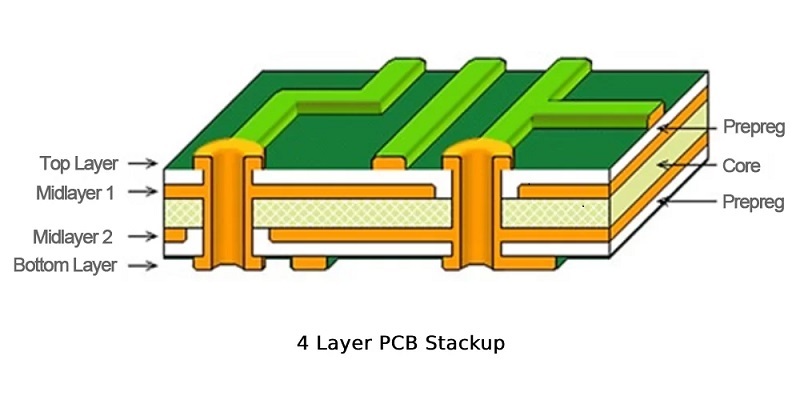
Moving into multi-layer territory, a 4-layer PCB opens up a lot of possibilities. The standard PCB thickness 4-layer often sticks close to 1.6mm. But depending on design needs, it can vary between 1.0mm and 2.4mm. Building a 4-layer PCB typically looks like this:

  • Signal layer
  • Ground layer
  • Power layer
  • Signal layer

The dielectric material between the layers, plus the standard prepreg thicknesses, affects the overall size. Choosing a thicker 4-layer board helps when more mechanical strength is needed. It also manages better thermal dissipation, which can be vital in complex circuits. When browsing through the standard PCB thickness chart, you’ll see that many companies offer flexible options for multi-layer designs.

Standard PCB Thickness Chart

How Thick Is a 6 Layer PCB?

If your design needs even more complexity, a 6-layer PCB could be the answer. The standard PCB thickness 6 layer generally ranges between 1.6mm and 2.4mm. However, advanced designs can go thinner or thicker. Inside a 6-layer PCB, the typical stack-up includes:

  • Top signal layer
  • Ground plane
  • Inner signal layer
  • Power plane
  • Ground plane
  • Bottom signal layer

6 layer PCB thickness matters a lot when working with high-speed signals. Having extra ground and power planes helps reduce noise and boosts signal integrity.

Additionally, if you use heavier copper, the final thickness can slightly increase. So always check specifications carefully.

For space-constrained applications, you might select a thinner 6-layer PCB. But when strength and performance matter more, a thicker design is better.

What Is the Standard Thickness Tolerance for PCB?

Even the best manufacturing process can’t guarantee perfect thickness every time. That’s where PCB thickness tolerance comes in. Typically, tolerance ranges around ±10% of the nominal thickness. That means a 1.6mm PCB could measure anywhere from about 1.44mm to 1.76mm. Factors affecting tolerance include:

  • Copper thickness variation
  • Prepreg material thickness
  • Lamination pressure

Also, standard PCB thickness tolerance might change depending on how many layers your board has. More layers often bring tighter control needs. Manufacturers usually list their tolerance ranges clearly. Always check before finalizing your design, especially for precision devices. If you want extra control over thickness, some suppliers offer tighter tolerances — but it may cost a bit more.

PCB Standard Thicknesses

What Is the Standard Thickness of Prepreg in PCB?

Prepreg plays a big role between PCB layers. It bonds the layers and affects electrical and mechanical properties. The standard prepreg thicknesses usually fall into these categories:

  • 106 prepreg: around ‌2 mils(0.05mm)
  • 1080 prepreg: around 2.5 mils(0.064mm)
  • 2116 prepreg: around ‌4.5 mils(0.114mm)
  • 7628 prepreg: around 6.5 mils (0.165mm)

The more prepreg you have between layers, the thicker your final board will be. Besides thickness, prepreg also impacts dielectric strength and signal performance. This is why choosing the right prepreg type is key, especially for high-speed circuits. In most standard boards, manufacturers use combinations of prepregs and cores to reach the target thickness.

Prepreg TypeThickness (μm)Thickness (mm)
106~50 μm~0.05 mm
1080~75 μm~0.075 mm
2116~110 μm~0.11 mm
7628~180 μm~0.18 mm

As you can see, understanding PCB standard thicknesses is critical to building a successful board. It influences electrical performance, mechanical strength, thermal behavior, and even how easy your PCB is to assemble. Choosing the right thickness depends on Number of layers, Copper weight, Device application, Space limitations, and Mechanical needs. If you’re unsure, the safest starting point is usually a 1.6mm board with 1 oz copper. However, your project’s needs might call for thicker or thinner options.

At EBest Circuit (Best Technology), we specialize in helping customers pick the perfect PCB thickness for their projects. Our team works closely with you, offering flexible options for 2-layer, 4-layer, 6-layer, or even more complex PCBs. We follow strict quality control systems, with certifications like ISO9001, ISO13485 for medical, IATF16949 for automotive, and AS9100D for aerospace industries. With top-notch engineering, and traceability through our MES system, EBest Circuit (Best Technology) is your trusted PCB partner. Contact EBest Circuit (Best Technology) at sales@bestpcbs.com to get the exact PCB thickness you need for your next PCB project!