





For RF engineers and PCB designers tackling high-frequency projects, the rogers ro4003 laminate datasheet is an indispensable tool—one that bridges the gap between design goals and real-world performance. Whether you’re validating material compatibility or fine-tuning signal integrity, the rogers ro4003 laminate datasheet packs critical details that save time, reduce reworks, and ensure your projects meet industry standards. This guide cuts through the jargon, addresses the Reddit community’s most common frustrations, and delivers actionable insights to make the most of this top-tier high-frequency laminate.
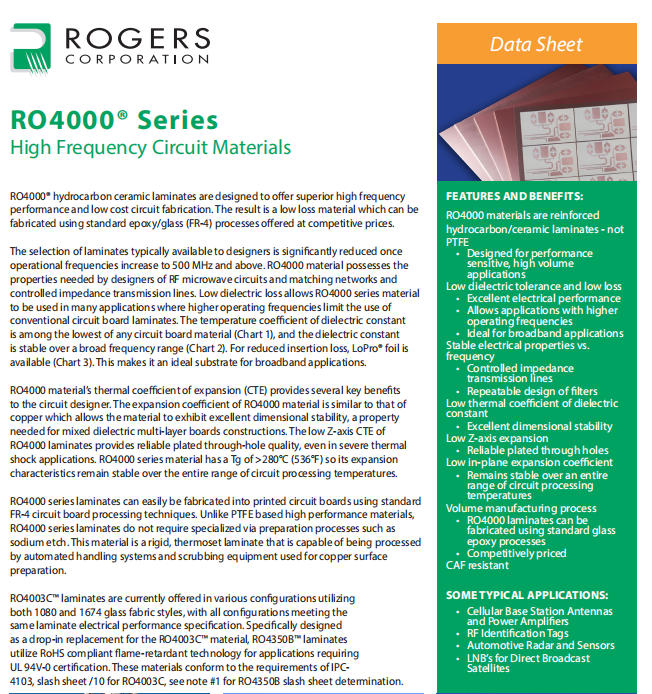
Rogers RO4003 Laminate Datasheet.pdf
Getting the official rogers ro4003 laminate datasheet.pdf is crucial—avoid sketchy third-party sites with outdated versions. Head straight to Rogers’ website (https://www.rogerscorp.com), navigate to “Products > Circuit Materials > High Frequency Laminates > RO4000 Series > RO4003C,” and download from the “Technical Documents” section. The latest PDF includes updated specs, processing tips, and MSDS for compliance. Save it as “Rogers-RO4003-Datasheet-Official.pdf” for easy reference, and cross-check with Rogers support if you’re confused about any section.
What is Rogers RO4003 Laminate? Key Characteristics
Material Composition & Core Advantages
Rogers RO4003 laminate is a ceramic-filled PTFE material built for high-frequency, high-speed applications—no surprise it’s a favorite among engineers tired of FR-4’s limitations. Its unique blend of PTFE resin and ceramic fillers delivers consistent dielectric properties, minimal signal loss, and impressive dimensional stability—even in harsh environments. Unlike some specialty laminates, it’s designed to work with standard PCB manufacturing processes, so you won’t need to overhaul your workflow to use it.
Why RO4003 Stands Out for High-Frequency Applications
When frequencies climb above 2 GHz, signal degradation and impedance drift become major headaches—and that’s where Rogers RO4003 laminate shines. With a dielectric constant (Dk) of 3.38 (at 10 GHz) and a dissipation factor (Df) of 0.0027, it outperforms FR-4 by a mile, keeping signals crisp and energy waste low. It’s also moisture-resistant (absorbing less than 0.04% water) and thermally stable up to 280°C, making it ideal for everything from 5G antennas to automotive radar systems. For engineers who need reliability without compromise, RO4003 is the go-to choice.
Critical Technical Specifications from Rogers RO4003 Datasheet
Dielectric Constant (Dk) & Dissipation Factor (Df)
The rogers ro4003 laminate datasheet highlights Dk and Df as make-or-break specs for high-frequency design. Dk sits at 3.38 ± 0.05 (10 GHz), staying consistent across 1 MHz–40 GHz—so you can predict impedance matching with confidence. Df (0.0027 at 10 GHz) remains low even at elevated temperatures, a game-changer for applications like industrial sensors or outdoor communication gear. These values translate to fewer design iterations and more reliable end products.
Thermal Performance & Mechanical Properties
Thermal stability is non-negotiable for high-stress applications, and the rogers ro4003 laminate datasheet delivers: a glass transition temperature (Tg) of 280°C, well above typical operating limits. Its coefficient of thermal expansion (CTE) matches copper (17 ppm/°C in x/y direction), reducing delamination risk during soldering. Mechanically, it’s tough too—flexural strength of 269 MPa (tensile) and 310 MPa (compressive) means it can handle the rigors of aerospace, automotive, and industrial use.
Electrical Resistivity & Water Absorption
Electrical resistivity (10¹⁴ Ω·cm surface, 10¹³ Ω·cm volume) ensures minimal leakage current, critical for high-voltage circuits. Water absorption below 0.04% (24 hours at 23°C/50% RH) prevents performance drops in humid environments—perfect for outdoor 5G base stations or marine communication modules. These specs, straight from the rogers ro4003 laminate datasheet, prove why RO4003 is trusted in mission-critical applications.
Rogers RO4003 Laminate Thickness Options & Selection Guide
Rogers RO4003 laminate comes in thicknesses from 0.203 mm (8 mils) to 3.175 mm (125 mils), with 0.813 mm (32 mils) and 1.524 mm (60 mils) being Reddit users’ top picks. Choosing the right one boils down to three factors: impedance needs, frequency, and durability. For 50 Ω microstrip lines in 5G devices, 0.813 mm hits the sweet spot between low loss and compact design. High-power radar systems? Go with 1.524 mm for better heat dissipation. Thinner options (0.203–0.305 mm) work for flexible PCBs but require careful handling—reference the rogers ro4003 laminate datasheet’s impedance calculator to avoid mistakes.
Processing Guidelines for Rogers RO4003 Laminate
Compatibility with FR-4 Manufacturing Processes
One of RO4003’s biggest perks (per the datasheet) is its compatibility with standard FR-4 workflows—no specialized equipment needed. For drilling, use carbide drills (130–140° point angle) and slow feed rates by 20% to prevent delamination. Etch with ferric chloride or ammonium persulfate below 40°C, and plate using standard electroless copper or tin processes—just make sure the laminate is thoroughly cleaned first. It’s a seamless transition for PCB shops, which is why so many engineers swear by it.
Soldering & Through-Hole Treatment Best Practices
Soldering Rogers RO4003 laminate requires temperature control: the datasheet recommends 260°C for 10 seconds (per IPC/JEDEC J-STD-020). Use lead-free SAC305 solder for RoHS compliance, and preheat PCBs to 150–180°C to reduce thermal shock. For through-hole components, use a nitrogen atmosphere in reflow ovens to minimize oxidation. Avoid prolonged heat above 280°C—this degrades the dielectric and hikes up Df, ruining performance.
Applications Where Rogers RO4003 Excels
Rogers RO4003 laminate is built for high-stakes, high-frequency applications. Top use cases include 5G base station antennas (low loss = longer coverage), automotive radar (24–77 GHz for collision avoidance), satellite communication modules (stable in extreme temps), IoT sensors (low power + compact), and medical diagnostic devices (signal integrity matters for accuracy). The rogers ro4003 laminate datasheet breaks down application-specific limits—like maximum power handling—so you can design with confidence.
Rogers RO4003 vs. RO4350B: Key Differences
Reddit users often debate Rogers RO4003 vs. RO4350B—here’s the quick breakdown from the datasheets. RO4003 (Dk=3.38) is cost-effective, works with FR-4 processes, and excels up to 20 GHz—perfect for volume production. RO4350B (Dk=3.48) has tighter Dk tolerance (±0.04) and lower Df (0.0037), making it better for mmWave (24–40 GHz) or aerospace. RO4350B also conducts heat better (0.6 W/m·K vs. 0.5), but costs more. If you’re balancing performance and budget, RO4003 is the smarter pick for most high-frequency projects.
Hybrid Stack-Up Design (Rogers RO4003 + FR4)
Reddit is full of questions about hybrid stack-ups (RO4003 + FR4) to cut costs—and the rogers ro4003 laminate datasheet has the answers. A typical setup: RO4003 for top/bottom signal layers (high-frequency), FR4 for inner power/ground layers. Use low-CTE FR4 (e.g., Isola FR408) to match RO4003’s 17 ppm/°C, and Rogers 2929 prepreg for adhesion. Keep RO4003 layers under 10% of total stack thickness to avoid warping, and place signal layers within 0.5 mm of ground planes to reduce crosstalk. It’s a budget-friendly way to get high-frequency performance.
Common Quality Issues & Troubleshooting Tips
Warping Prevention in Thin RO4003 Laminates
Thin RO4003 (≤0.305 mm) warps easily—Reddit’s #1 complaint. Fix it with datasheet-proven tips: use an FR-4 carrier during drilling/etching, laminate at 200–300 psi, and cool slowly (≤2°C/min). Avoid over-etching, and if warping happens, bake between steel plates at 150°C for 2 hours. These simple steps keep thin laminates flat and functional.
Reducing Signal Loss in High-GHz Applications
Above 20 GHz, signal loss creeps in—but the datasheet has fixes. Use wider traces (≥0.2 mm), shorten trace length, and add a ground plane under signal layers. Keep RO4003 dry (pre-bake at 120°C for 4 hours if exposed to humidity) and use thinner laminates (0.203–0.406 mm) for mmWave. These tweaks keep signals strong even at high frequencies.
FAQ: Rogers RO4003 Laminate Datasheet Questions
- Where can I get a reliable Rogers RO4003 laminate datasheet.pdf?
Only download from Rogers’ official website (https://www.rogerscorp.com) to avoid outdated or fake versions. - What thickness is best for 5G PCBs?
0.813 mm (32 mils) is ideal—balances low loss and compact design. High-power 5G gear uses 1.524 mm. - Does RO4003 work with standard FR-4 manufacturing?
Yes—minor adjustments to drilling feed rates and soldering temps (per datasheet) are all you need. - Can I mix RO4003 with FR4 in stack-ups?
Absolutely—use low-CTE FR4 and Rogers 2929 prepreg to prevent delamination. - What’s RO4003’s max operating temperature?
125°C continuous, 260°C for 10 seconds (soldering). - How is RO4003 better than FR-4 for high frequencies?
Lower Dk (3.38 vs. 4.4) and Df (0.0027 vs. 0.02) mean way less signal loss above 2 GHz. - How do I avoid warping thin RO4003?
Use an FR-4 carrier, control lamination pressure/cooling, and avoid over-etching. - Is counterfeit RO4003 a problem?
Yes—buy from authorized distributors (Digi-Key, Mouser) and verify lot numbers with Rogers.
Where to Source Authentic Rogers RO4003 Laminate
Counterfeit RO4003 fails to meet datasheet specs—so buy from authorized distributors like Digi-Key, Mouser, or Arrow (all listed on Rogers’ site). For volume orders, contact Rogers directly for regional partners. Always check the lot number (on packaging) with Rogers support to confirm authenticity. Avoid eBay/Alibaba sellers—their “RO4003” often has inconsistent Dk, poor adhesion, or high water absorption, which ruins designs. Stick to trusted sources to get the real deal.