





What is a 4 layer flex PCB? This blog is mainly about thickness, stackup, design requirements and guideline, production process, cost for 4 layer flex PCB.
Are you worried about these issues?
- How to avoid inter-layer interference and signal loss in 4-layer flexible PCBs with high routing density?
- Flexible Durability Challenge: How to ensure over 100,000 bend cycles in repeated flexing scenarios?
- How to balance quality and cost in multi-layer flexible PCB production?
As a 4 layer flex PCB manufacturer, EBest Circuit (Best Technology) can provide you service and solutions:
- Free DFM Analysis: Leveraging 20 years of expertise, we provide free DFM analysis to identify risks early, optimize layer stacking and routing schemes, boost signal integrity by over 40%, reduce design iterations by 50%, and achieve 98% first-pass success.
- Quality Enhancement: Using rolled annealed copper and adhesive-free FPC technology, our solution passes 200,000 dynamic bend tests (0.5mm radius, 30 cycles/min) with ≤5% resistance change and 30% reduced delamination risk, meeting 100,000 fold cycles for foldable smartphones.
- Efficient Production Collaboration: Through supply chain integration and patented automated bending devices, we shorten production cycles to 15 days, cut costs by 20%, maintain ≥99.5% batch yield, and support 5G/millimeter-wave high-frequency applications.
Welcome to contact us if you have any request for 4 layer flex PCB: sales@bestpcbs.com.
What Is A 4 Layer Flex PCB?
A 4 layer flex PCB is a flexible printed circuit board with four conductive layers sandwiched between insulating films. Unlike rigid boards, it bends, twists, and fits into tight spaces. Think of it as a high-tech sandwich: layers of copper traces, dielectrics, and cover layers stacked to handle complex circuits without cracking. It’s perfect for gadgets that move, like foldable screens or medical implants.

How Thick Is a 4 Layer Flex PCB?
The typical thickness range for a four-layer flexible PCB (flexible circuit board) is between 0.2mm and 0.6mm. The specific value depends on the material combination (such as polyimide substrate thickness, copper foil weight), adhesive type (with or without adhesive), and the choice of surface coating/protective film. The core influencing factor is the cumulative thickness of the dielectric layers between each conductive layer (including copper foil) and the lamination process. Thinner designs can be achieved by using ultra-thin substrates (such as 12.5μm) and 1/3 ounce copper foil.
4 Layer Flex PCB Stackup
1. Top Copper Foil Layer
- Thickness: 17-35μm electrolytic copper foil.
- Function: Surface circuit layer, used for component soldering and signal transmission.
2. First Dielectric Layer
- Material: Polyimide or epoxy resin; Thickness: 50-100μm.
- Function: Insulating and isolating inner copper foil layers.
3. First Inner Layer
- Thickness: 17-35μm electrolytic copper foil.
- Function: Internal signal layer.
4. Second Dielectric Layer(Core Layer)
- Material: Polyimide; Thickness: 100-200μm.
- Function: Main supporting structure for inner copper foil layers.
5. Second Inner Layer
- Thickness: 17-35μm electrolytic copper foil.
- Function: Internal power/ground layer.
6. Third Dielectric Layer
- Material: Polyimide or epoxy resin.
- Thickness: 50-100μm.
- Function: Insulation and isolation.
7. Bottom Copper Foil Layer
- Thickness: 17-35μm electrolytic copper foil.
- Function: Surface circuit layer.
4 Layer Flexible PCB Design Technical Requirements
| Parameter Name | Recommended Value/Requirement |
| Standard Stackup Order | TOP (Signal) – GND – PWR – BOTTOM (Signal) |
| FR4 Stiffener Width at Rigid-Flex Area | ≥5mm |
| Flexible Area Bend Radius | ≥10×Board Thickness (Dynamic Bending Scenario) |
| Substrate Type | Polyimide (PI) |
| Copper Thickness (Signal Layers) | 0.5–1oz |
| Copper Thickness (Power/Ground Layers) | 1–2oz |
| Board Thickness Range | 0.1mm–0.3mm (Optional Thicker PI Reinforcement) |
| Minimum Trace Width/Spacing | 50μm/50μm (2mil/2mil) |
| Signal Trace Spacing (3W Rule) | ≥3×Trace Width |
| Power Layer Retraction (20H Rule) | 40–80mil (≈1.0–2.0mm) |
| Trace Direction in Flexible Area | Perpendicular to Bending Direction |
| Impedance Tolerance | ±7% |
| Distance Between Inner Signal Layer and Reference Layer | ≤0.1mm |
| Dynamic Bending Life | ≥1 Million Cycles (Curvature Radius 1mm) |
| Static Bending Angle | ≤90° (Avoid Sharp Bends) |
| Interlayer Dielectric Thickness | ≥0.1mm |
| Blind/Buried Via Tolerance (Backdrilling) | ±0.05mm |
| Warpage | ≤0.75% |
| Interlayer Insulation Resistance | ≥10¹²Ω (500VDC) |
| Temperature Test Range | -55℃~125℃ (Military Standard) |
4 Layer Flex PCB Design Guideline
A detailed design guideline for 4 layer flex PCB:
1. Stackup Strategy
- Classic stackup: Top Signal – Ground Plane – Power Plane – Bottom Signal, prioritized for high-speed signal requirements. Alternative stackup (for high-current scenarios): Top Signal – Power Plane – Ground Plane – Bottom Signal, requiring trade-offs in high-speed performance.
- Copper thickness symmetry control: Outer layers use 0.5–1oz rolled copper (superior bending resistance to electrolytic copper). Inner layers use 1oz electrolytic copper. TOP/power layer thickness difference ≤0.5oz to prevent warpage.
2. Rigid-Flex Area Design
- FR4 stiffener width ≥5mm: Use ≤45° stepped pressing to distribute stress. Components/vias ≥1.5mm from bend line to avoid solder joint cracking.
- Flex zone copper treatment: Large copper areas converted to mesh copper (opening ratio ≥70%). Trace direction perpendicular to bend axis. Dynamic bend radius ≥10× board thickness (e.g., 0.2mm board thickness requires ≥2mm radius).
3. Routing Rules
- Geometric constraints: Minimum trace width/spacing 50μm/50μm (2mil/2mil). High-speed differential pairs prefer curved routing. No sharp 90° traces; flex zone corner radius ≥3× trace width.
- Power integrity: Power plane retraction (20H rule) 1.0–2.0mm to suppress edge radiation. Decoupling capacitors placed ≤2mm from each IC power pin.
4. Via Reliability Design
- Through-hole vias only for static areas, hole diameter ≥0.2mm, pad ≥0.4mm. Blind vias for high-speed signals (e.g., USB) connecting top-layer to L2, depth tolerance ±0.05mm.
- Reinforce flex zone vias with teardrop pads. Buried vias only for clock signals between L2-L3 (cost increase 0.8%/via).
5. Material & Manufacturing Requirements
- Substrate: Polyimide (PI) withstands >260°C, superior bending life to FR4. Coverlay thickness ≥0.1mm, covering pad edges ≥0.1mm.
- Panel design: Flex boards spaced ≥2mm apart. Add 0.5mm stamping holes for depaneling. Process edge width ≥5mm for fixture clamping.
6. Pre-Fabrication Verification
- Impedance control: High-speed lines (USB/HDMI) tolerance ±7%, reference layer spacing ≤0.1mm.
- 3D bend simulation: Check component interference in Altium Designer (View > 3D Mode). Dynamic bend test ≥1 million cycles (curvature radius 1mm).
- DFM confirmation: Components ≥3mm from rigid-flex edge to ensure manufacturability.
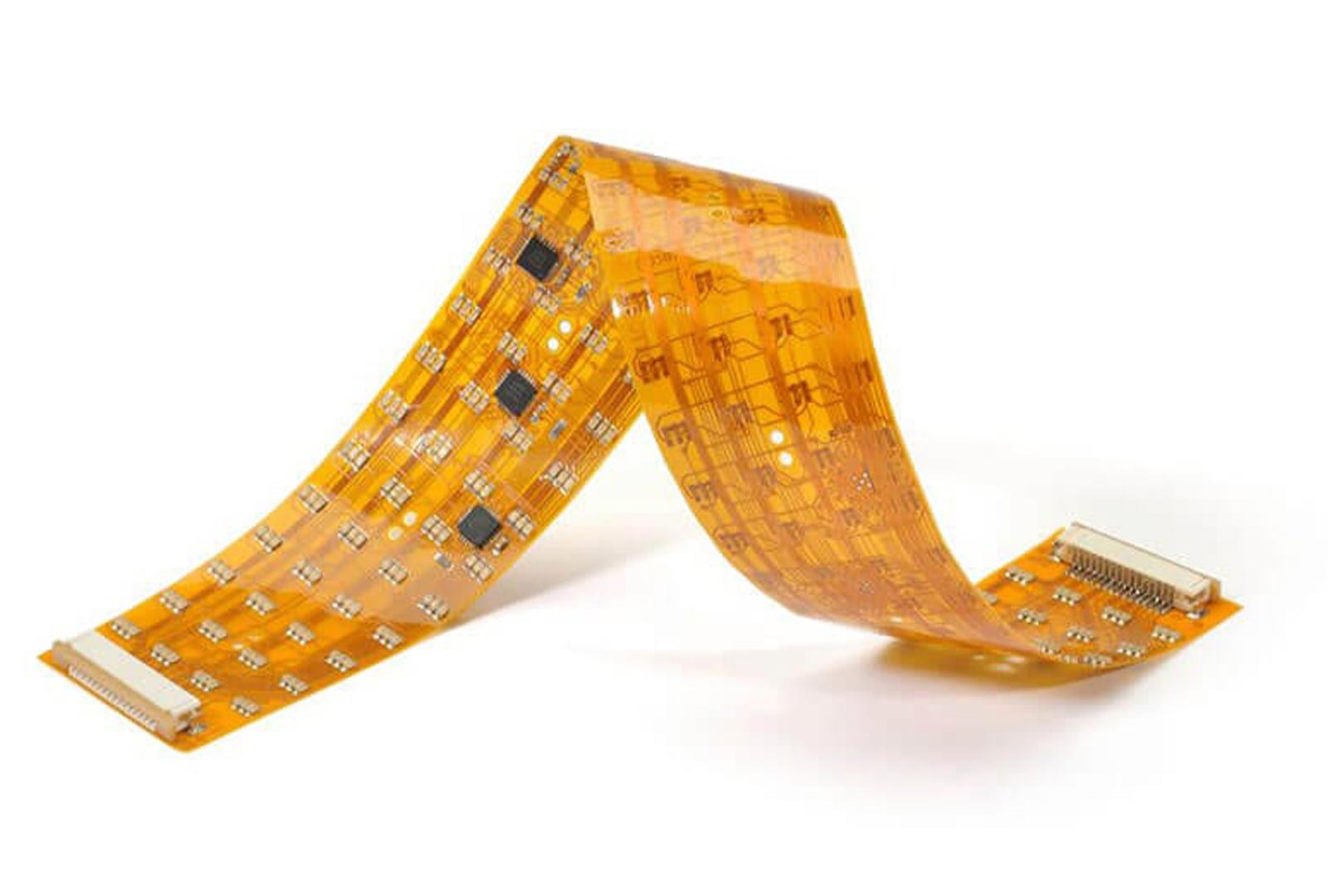
4-Layer Flex PCB Manufacturing Process
1. Material Preparation & Inner Layer Processing
- Flexible zone substrate: Polyimide (PI) film, thickness 25–50μm, temperature resistance >260°C.
- Rigid zone stiffener: FR-4, glass transition temperature (Tg) value ≥170°C.
- Copper foil selection: Outer layer rolled annealed copper 0.5–1oz (anti-bending fatigue), inner layer electrolytic copper 1oz (cost-conductivity balance).
- Pattern transfer: Dry film lamination at 110±5°C, pressure 0.4–0.6MPa. LDI laser exposure accuracy ≤10μm (eliminates alignment deviation).
- Etching control: 1oz copper line width compensation +15μm. Minimum trace width/spacing 50μm/50μm (additional 10% width in flexible zone).
2. Multilayer Lamination Steps
- Interlayer alignment: Rigid-flex zone uses PIN positioning system, interlayer offset ≤75μm. Coverlay window opening is 0.1mm larger than pad edge on one side (prevents tearing).
- Lamination parameters: Heating rate 2–3°C/min, peak 185±5°C. Pressure 15–20kg/cm² (high pressure embrittles PI, low pressure causes delamination). High-temperature holding time 45–60min.
- Flexible zone treatment: Pre-press at 0.5MPa low pressure for degassing, then high-pressure lamination (avoids bubble residue).
3. Drilling & Metallization Process
- Hole types: Mechanical drilling diameter ≥0.2mm (rigid/through-holes). Laser drilling blind hole diameter 0.1mm (top-layer to L2 high-speed signal).
- Hole position accuracy: Rigid-flex zone tolerance ±50μm (requires X-ray target correction).
- Hole metallization: Electroless copper thickness ≥0.3μm. Pulse plating copper thickness uniformity error ≤15% (reduces hole necking).
- Flexible zone reinforcement: Via pads with teardrop shape, pad diameter ≥ hole diameter ×2.2.
4. Outer Layer & Surface Finish
- Coverlay instead of solder mask: PI coverlay thickness 0.1mm, adhesive flow control ≤0.3mm. Flexible zone window opening distance from trace edge ≥0.15mm (prevents stress concentration).
- Surface finish: ENIG preferred for flex boards (nickel 3–5μm, gold 0.05–0.1μm for optimal solder joint ductility). Avoid HASL (prevents PI delamination).
5. Quality Validation & Reliability Testing
- AOI inspection: Flexible zone trace width tolerance ±10%, rigid zone ±15% (zone-specific parameters).
- 3D X-ray inspection: Blind hole fill ratio ≥85% (eliminates void soldering).
- Dynamic bending test: Curvature radius 1mm, frequency 1Hz, cycles ≥500k (industrial standard).
- Thermal shock test: -40°C↔125°C cycling, 1000 cycles later conduction resistance change ≤10%.
Why Choose EBest Circuit (Best Technology) as 4 Layer Flex PCB Manufacturer?
Reasons why choose EBest Circuit (Best Technology) as 4 layer flex PCB manufacturer:
- 19 Years of Flex PCB Expertise: Decades of specialized experience in 4-layer flex PCBs translate to optimized stack-ups, impedance control, and material selection—saving engineers trial-and-error time.
- Medical/Aerospace-Grade Certifications: Compliance with ISO 9001, IATF 16949, medical ISO 13485, and RoHS ensures seamless approval for regulated industries. Certifications reduce compliance headaches for international clients.
- Cost-Sensitive Design Optimization: We engineer competitive pricing through DFM (Design for Manufacturing) analysis, eliminating costly design flaws before prototyping. Free DFM reports reduce iteration costs by up to 30% for cost-conscious projects.
- Transparent Pricing Model: No hidden fees. Clear per-panel/material pricing with volume discounts helps engineers budget accurately for both prototypes and production runs.
- 24-Hour Rapid Prototyping for Urgent Needs: Emergency orders receive 24-hour turnaround on 4-layer flex PCB samples, critical for hardware startups and medical device developers racing against launch deadlines.
- 99.2% On-Time Delivery Reliability: Our supply chain excellence guarantees 99.2% of orders ship on schedule, minimizing project delays for engineers working under tight timelines.
- 100% Batch Inspection: Every 4-layer flex PCB undergoes rigorous AOI, X-ray, and electrical testing. Full batch inspection eliminates hidden defects—a must for high-reliability applications like automotive and aerospace.
- Turnkey One-Stop Solution: From design consultation and material sourcing to assembly and testing, we handle every step. Engineers save time by consolidating vendors into a single trusted partner.
- Global Logistics & Customs Support: Our export-focused team navigates international shipping, tariffs, and documentation—critical for North American/European engineers sourcing from Asia.
How Much Does A 4-Layer Flex PCB Cost?
- Consumer electronics field: Bulk purchase unit price is approximately $13-$20 per square meter, while prototyping costs increase to $138-$207 per square meter;
- Automotive electronics/industrial control field: Due to high reliability requirements, the unit price generally rises to $25-$40 per square meter;
- High-end medical/communication equipment field: Customized products using processes such as immersion gold and blind/buried vias can reach unit prices of over $50 per square meter.
Welcome to contact us if you have any other issue for 4-layer flex PCB: sales@bestpcbs.com.