
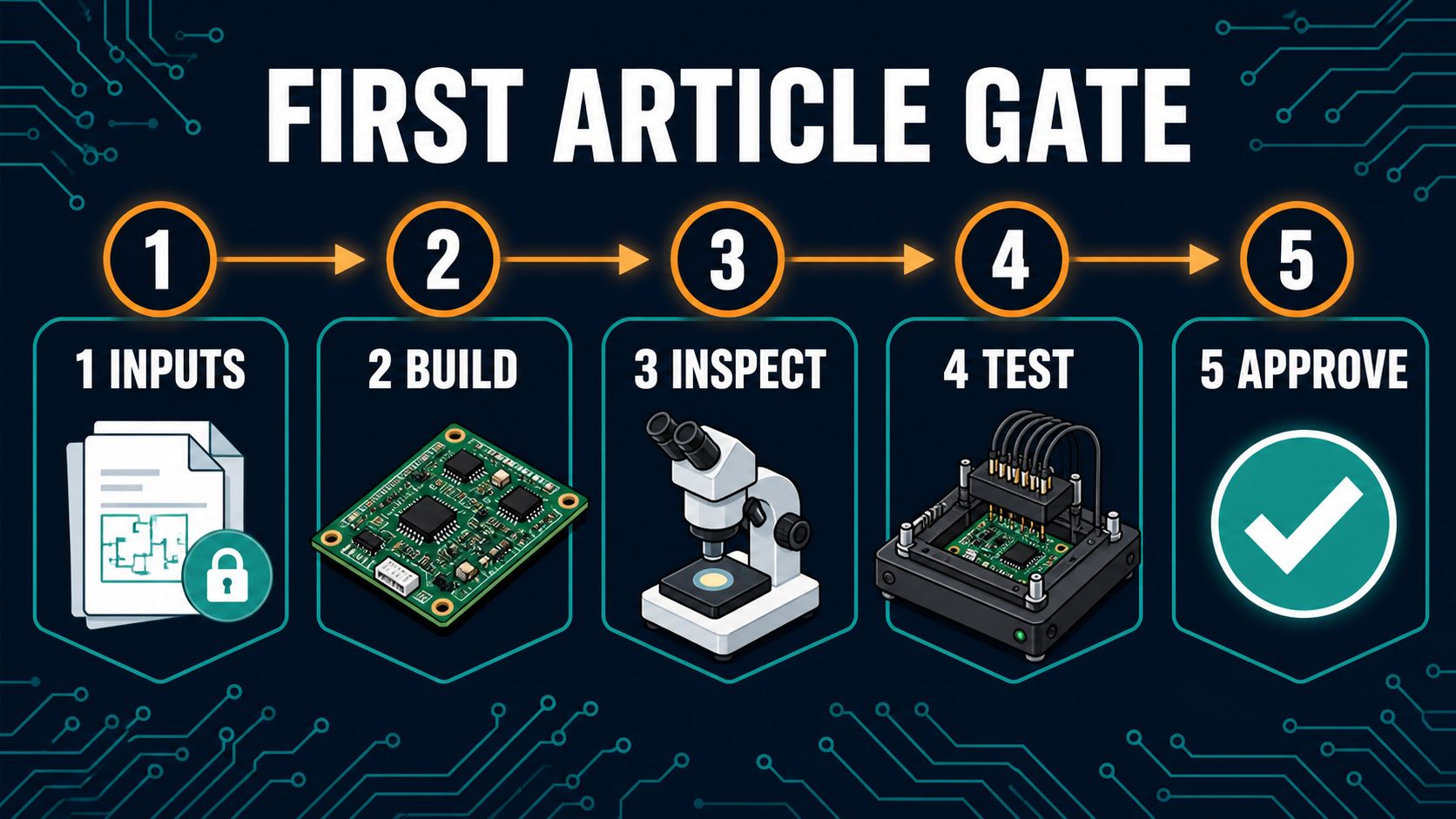
PCB assembly first article inspection is a documented production gate that checks whether the first build represents the released design and manufacturing package before more units are allowed to proceed. It is not a ceremonial photograph of one completed board and it is not a substitute for process control or product validation.
The inspection should connect the revision, parts, placement, solder, mechanics, programming, test, deviations, and approval state. Its exact scope depends on product risk, customer requirements, volume, novelty, and the evidence already created during design and prototype validation.
Will the first article report let an engineer decide “build, correct, or stop” without guessing which revision, part lot, measurement, test program, or deviation produced the unit?
If not, the report is an inspection scrapbook rather than a production-release record.
EBest Circuit can review Gerber or ODB++, BOM, AVL, CPL/centroid, drawings, approved deviations, inspection characteristics, programming and test requirements, quantity, traceability, and approval workflow before confirming a project-specific first article plan.
No universal EBest FAI form, sampling level, measurement system, report standard, or approval scope should be assumed without that review.
Use First Article Inspection as a Production Gate
Define the hold point, responsible reviewer, required evidence, response time, and permitted work while approval is pending. The gate should stop the defect multiplier: a wrong revision, rotated part, unapproved substitute, incorrect program, or mechanical mismatch should be found before the same error reaches the full lot.
State whether only the first unit is held, whether a small setup quantity may be built, and which operations must wait. Production urgency does not remove the need for a clear release authority.
Separate FAI From Prototype Testing and Routine Inspection
A prototype proves design questions, routine inspection monitors production, and FAI verifies that a defined manufacturing baseline produced an acceptable representative unit. These activities can share evidence but they do not have identical purposes.
A prototype hand-built with temporary parts may not represent the production route. The prototype-to-production assembly page explains why the manufacturing handoff needs its own controls.
Freeze the Revision and Acceptance Baseline
List every controlled input used for the first article. Include PCB fabrication data, assembly drawing, schematic reference, BOM/AVL, CPL or centroid, polarity data, mechanical model, work instructions, programs, test specifications, approved deviations, and customer notes.
Record revision identifiers and release dates. A report cannot prove conformance when it references “latest files” or combines documents from different releases.
Verify the Bare PCB and Fabrication Inputs
Confirm the board identity and the fabrication characteristics that can affect assembly or fit. Review part number and revision, outline, thickness where required, holes and slots, finish, markings, panel or breakaway condition, damage, cleanliness, and any controlled dimensional or electrical records.
The FAI need not repeat every supplier inspection, but it must identify the evidence relied upon and verify characteristics critical to the assembled product.
Reconcile BOM, AVL, Lot, and Substitution Status
Compare every fitted and intentionally unpopulated reference against the released BOM and approved source list. Verify manufacturer part, value, package, quantity, lot/date code restrictions, customer-supplied material, substitutions, and deviation authorization.
A correct-looking package can still be the wrong electrical grade or source. Link component evidence to the first unit and preserve the comparison method.
Inspect Placement, Polarity, Orientation, and Hardware
Check reference designators, presence, absence, polarity, pin-one, orientation, offsets, seating, connector alignment, fasteners, spacers, heat sinks, labels, and other mechanical items against released data. Include manual and secondary operations, not only SMT placement.
The AOI quality guide helps separate automatable visible checks from characteristics that require another method or human judgment.
Evaluate Solder Joints and Hidden Connections
Use inspection methods matched to joint visibility and product risk. Visible solder can be assessed for wetting, bridging, opens, excess, insufficiency, disturbance, and damage; hidden BGA, QFN, bottom-terminated, or shielded joints may need suitable indirect or X-ray evidence.
Do not claim that a top-side photograph proves a hidden interface. The automated X-ray inspection guide explains what buyers should specify and what X-ray cannot prove alone.
Measure Mechanical, Fit, and Interface Requirements
Identify dimensions and interfaces that can stop enclosure fit, mating, cooling, fastening, optical alignment, cable routing, or service access. Define datum, tool, method, tolerance, unit, sample, and record for each required characteristic.
Use the actual assembly state required by the drawing. A measurement taken before hardware installation may not predict the completed product.
Verify Programming, Electrical Test, and Product Function
Record firmware or configuration identity, programming result, fixture and program revision, limits, measured data where required, and first-pass/final outcome. Include continuity, power, interface, calibration, or functional checks appropriate to the product.
The PCB assembly testing services guide helps define fixtures, limits, logs, retest, and failure disposition.
Build a First Article Report That Supports a Decision
For each controlled characteristic, show the requirement, source, method, result, status, evidence reference, reviewer, and disposition. Add unit identity, build date, PCB lot, component lots as required, document revisions, equipment identification where applicable, photographs, test files, deviations, and signatures or electronic approvals.
Structure the report so a reviewer can distinguish “not required,” “not inspected,” “not measurable,” “failed,” and “passed.” Blank cells are not evidence.

Contain Deviations Before More Units Are Built
When the first unit does not conform, stop affected work, identify scope, preserve evidence, and route the issue to the authorized owner. Record the requirement, actual result, affected unit, suspected cause, correction, reinspection, test, and decision.
Do not quietly edit the report, replace a part, or rerun a test until it passes. First-pass evidence helps distinguish setup errors, design ambiguity, component issues, and unstable process conditions.
Define Approval, Conditional Approval, and Rejection
Use explicit states with explicit permissions. Approval may release the defined production scope; conditional approval should list open items, quantity/time limits, containment, owner, and due date; rejection should identify the hold and required corrective evidence.
Link approval to the exact unit and baseline. An email saying “looks good” is risky when it cannot be connected to the report revision and unresolved deviations.
Define the baseline, evidence, hold point, and approval authority before the first unit is built.
Send Gerber or ODB++, BOM, AVL, CPL, drawings, mechanical data, approved deviations, programming and test requirements, characteristics, quantity, traceability, and response target.
Files | BOM | CPL | Inspect | Test | Deviate | Approve
Trigger Re-FAI When a Change Can Alter the Result
Define which changes require full or partial first article repetition. Examples may include PCB revision, component substitution, footprint or program change, new fixture, process route change, new manufacturing location, long production gap, corrective action, or customer-directed review.
Use risk and affected characteristics to set the scope. Preserve the relationship between original approval, change record, new evidence, and release.
Compare FAI Quotes by Evidence and Hold Time
Normalize planning, setup quantity, inspection characteristics, measurement programming, AOI/X-ray or other evidence, electrical/functional test, report format, engineering review, customer hold time, corrections, reinspection, and exclusions. First article inspection cost depends on evidence scope, not just one board.
Ask what happens while approval is pending and how schedule changes if the first unit fails. A low FAI price may exclude the measurements or report the customer actually expects.
Send an RFQ Package That Defines First Article Release
Provide one controlled package. Include PCB and assembly data, BOM/AVL, CPL, drawings, schematic reference, mechanical model, workmanship and dimensional requirements, approved substitutions, critical characteristics, programming, test, traceability, report format, approver, response time, production hold, quantity, forecast, and delivery date.
Use the traceability requirements guide to define how the first unit, files, material, process, inspection, test, deviation, and approval remain linked.
PCB Assembly First Article Inspection FAQ
What is the purpose of first article inspection?
It verifies that the released design and manufacturing package produced an acceptable representative unit before broader production is released.
Is FAI the same as prototype testing?
No. Prototype work answers design questions; FAI verifies a defined production baseline and route, although some evidence may be reused.
Does FAI mean inspecting every feature?
The required characteristics come from product risk, drawings, specifications, customer requirements, and the agreed plan; do not assume a universal scope.
What documents should be frozen?
Freeze PCB data, BOM/AVL, CPL, drawings, programs, test requirements, deviations, and any acceptance sources used by the build.
Should hidden solder joints be inspected?
Use a method appropriate to visibility and risk; a top-side image alone cannot prove a hidden interface.
What should an FAI report contain?
Include unit identity, baseline revisions, requirements, methods, results, evidence, status, deviations, reviewers, and approval.
Can production continue while FAI is pending?
Only within the explicitly agreed hold and risk rule. Define what may proceed, quantity limits, and who accepts that risk.
When is re-FAI required?
Repeat the affected scope when a design, material, program, fixture, route, location, corrective action, or other change can alter the approved result.
Does EBest use one universal FAI standard and report?
No default should be assumed. Submit the customer and product requirements so scope, evidence, report, and approval can be confirmed.
What files are needed for an FAI quote?
Send PCB and assembly files, BOM/AVL, CPL, drawings, deviations, critical characteristics, programming, test, traceability, quantity, and schedule.
Turn the first unit into a controlled production decision.
Email Gerber or ODB++, BOM, AVL, CPL, drawings, inspection characteristics, programming/test plan, approved deviations, report requirements, quantity, hold point, approver, and delivery target. EBest Circuit will confirm project-specific support.
Baseline | Build | Inspect | Test | Report | Approve
You may also like








Tags: First Article Inspection, PCB Assembly, Quality Control