





What is a ceramic core PCB?
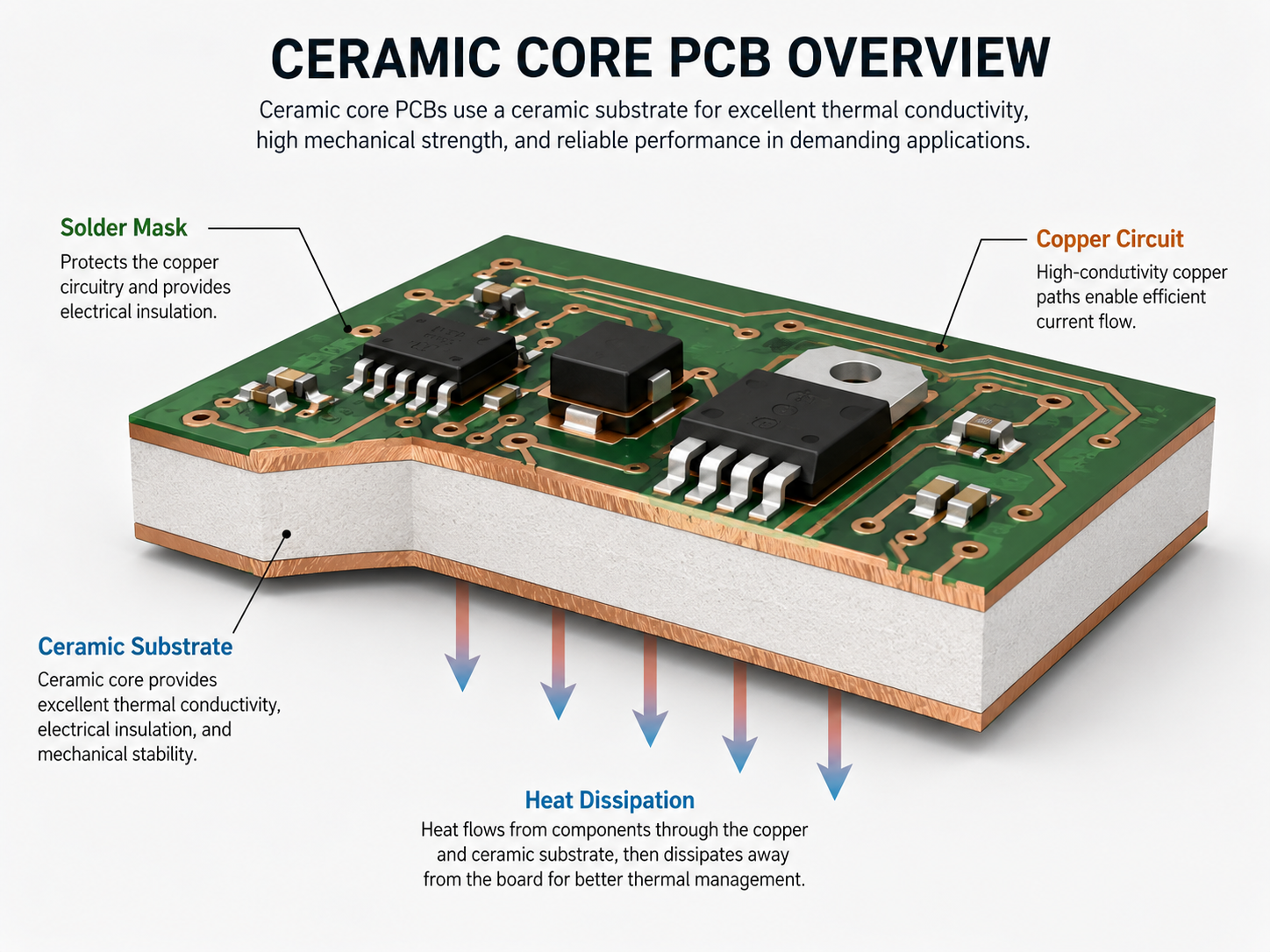
Ceramic core PCB is a printed circuit board built on a ceramic substrate instead of a conventional organic laminate such as FR4. In this type of board, the ceramic layer works as the main supporting base and thermal pathway. It gives the circuit strong heat transfer, stable electrical insulation, and excellent dimensional consistency under demanding operating conditions.
Unlike standard PCB materials that rely on glass fiber and resin, ceramic PCB boards use inorganic ceramic materials such as alumina, aluminum nitride, or silicon nitride. These materials are valued in high-power, high-frequency, high-temperature, and high-reliability electronics.
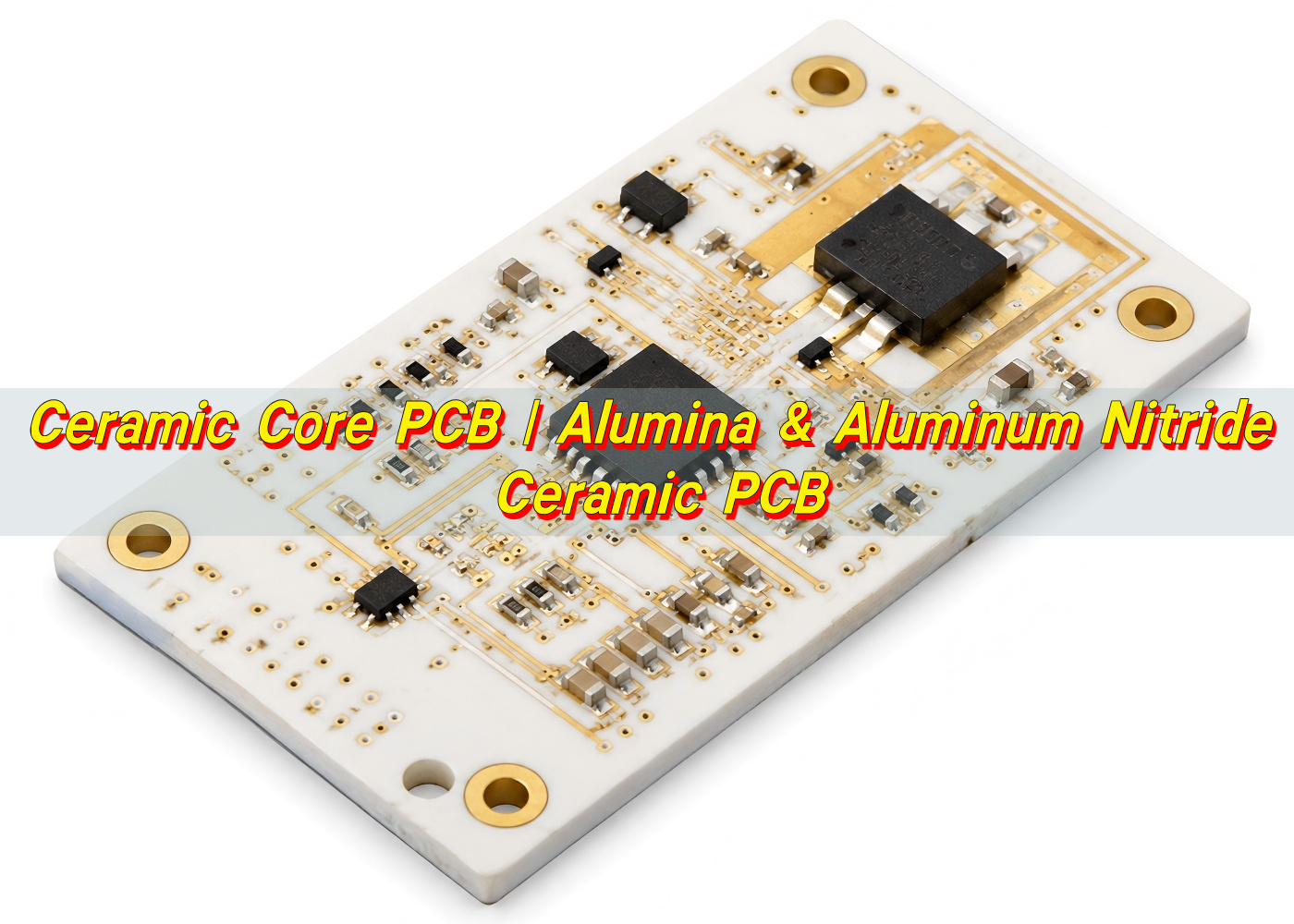
In the PCB industry, ceramic core PCB is often used for applications where ordinary laminates cannot provide enough thermal conductivity or long-term stability. The board may support thick copper, thin-film circuits, DPC copper plating, DBC bonding, or AMB structures, depending on the electrical and mechanical requirements of the project.
EBest Circuit (Best Technology) supports ceramic PCB manufacturing for engineers who need more than a basic circuit board. With experience in alumina PCB, aluminum nitride PCB, DPC ceramic PCB, DBC ceramic substrate, AMB ceramic substrate, and customized ceramic PCB boards, EBest Circuit helps customers move from early design review to production with practical engineering support.
What is the difference between ceramic and FR4?
Ceramic PCB and FR4 PCB are both widely used in electronics, but they are designed for different performance levels. FR4 is the most common PCB substrate because it is cost-effective, easy to process, and suitable for many consumer, industrial, and general electronic products. Ceramic PCB is selected when the circuit needs higher thermal conductivity, better temperature resistance, and stronger dimensional stability.
FR4 is made from woven fiberglass cloth and epoxy resin. It performs well in standard electronic assemblies, but its thermal conductivity is limited. Ceramic boards, by contrast, use inorganic ceramic substrates that conduct heat much more efficiently while keeping excellent insulation. This is why ceramic core PCB is commonly found in LED modules, laser equipment, power electronics, sensors, medical devices, automotive electronics, and aerospace-related systems.
| Item | Ceramic Core PCB | FR4 PCB |
|---|---|---|
| Main material | Alumina, aluminum nitride, silicon nitride, or other ceramic materials | Glass fiber reinforced epoxy laminate |
| Thermal conductivity | High, suitable for heat-sensitive and power applications | Low to moderate, suitable for general electronics |
| Temperature resistance | Excellent stability at elevated temperatures | Good for standard operating environments |
| Mechanical behavior | Hard, stable, and rigid, but requires careful handling | Tougher and more flexible during standard assembly |
| Electrical insulation | Very strong insulation performance | Reliable insulation for common circuit designs |
| Typical applications | High-power LEDs, RF modules, power devices, sensors, automotive electronics | Consumer electronics, control boards, communication devices, general PCBA |
| Cost level | Higher due to material and process complexity | Lower and highly scalable |
The choice should not be based only on price. If the circuit generates a high amount of heat or must keep stable performance in a harsh environment, ceramic PCB can provide a stronger technical foundation.
What’s the difference between alumina PCB and aluminum nitride PCB?
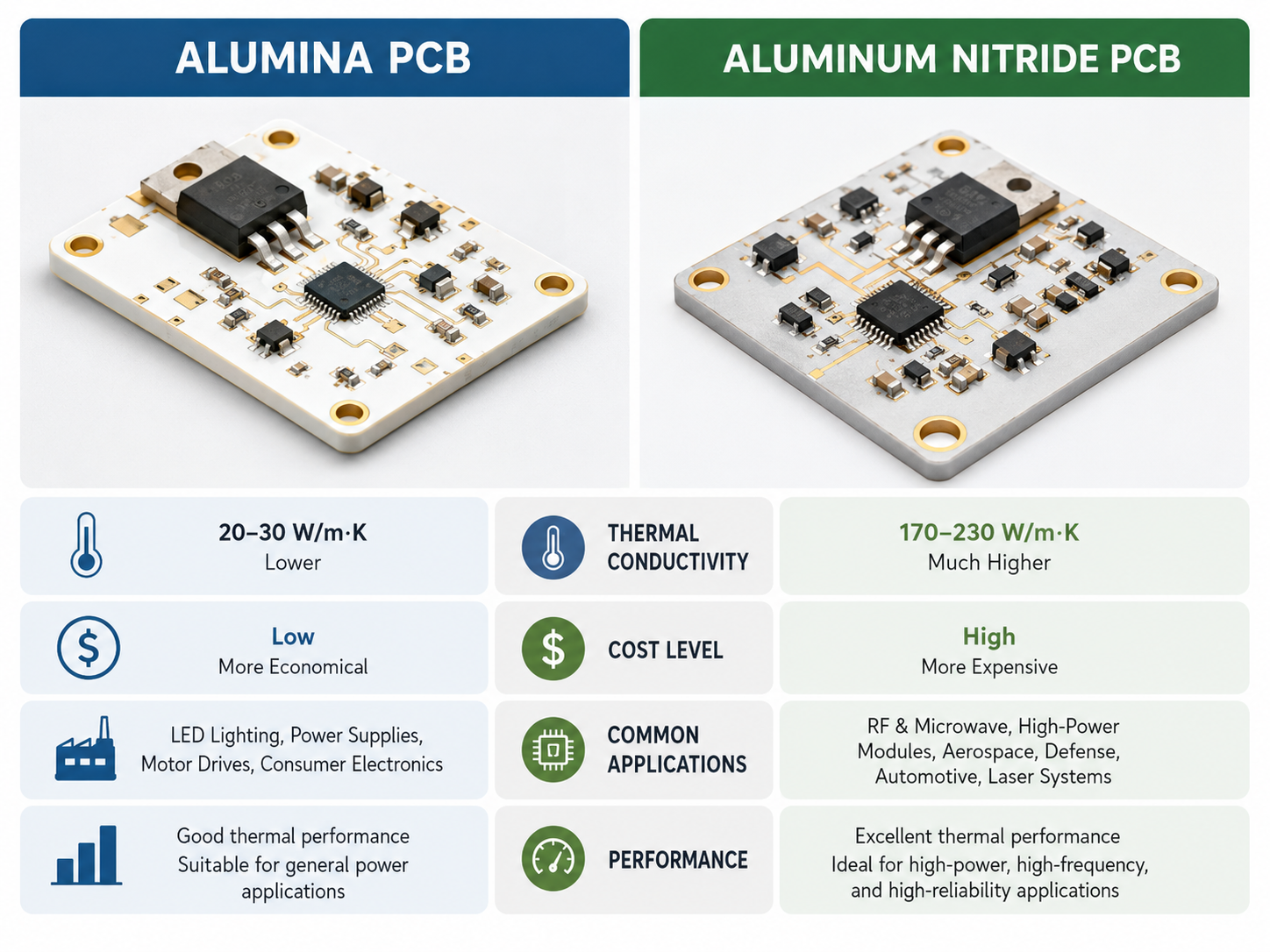
Alumina PCB and aluminum nitride PCB are two of the most common ceramic PCB materials. Both provide good insulation, stable structure, and better thermal performance than FR4. The key difference is thermal conductivity. Alumina is widely used because it offers a balanced combination of price, process maturity, and electrical performance. Aluminum nitride is chosen when the design needs much higher heat dissipation.
Alumina PCB usually refers to ceramic boards made from aluminum oxide. Common grades include 96% alumina and 99.6% alumina. It is a practical choice for many LED, sensor, power module, and industrial electronic applications. It has good mechanical strength, stable electrical insulation, and a more accessible ceramic board price compared with aluminum nitride.
Aluminum nitride PCB is often used in more demanding thermal designs. Its thermal conductivity can be several times higher than alumina, making it highly suitable for power semiconductors, high-brightness LEDs, laser diodes, automotive power modules, and compact high-power assemblies. It is usually more expensive than alumina because the raw material, sintering process, and manufacturing control are more demanding.
| Item | Alumina PCB | Aluminum Nitride PCB |
|---|---|---|
| Material | Aluminum oxide ceramic | Aluminum nitride ceramic |
| Thermal conductivity | Good, commonly used for medium to high thermal needs | Excellent, suitable for high-power heat dissipation |
| Cost | More economical among ceramic PCB options | Higher due to material and process requirements |
| Mechanical strength | Strong and mature in production | Strong, with careful process control needed |
| Electrical insulation | Excellent | Excellent |
| Typical use | LED modules, sensors, heaters, industrial controls, power circuits | Power modules, laser devices, high-power LEDs, RF and automotive electronics |
EBest Circuit can help customers compare ceramic PCB materials during DFM review, so the final design matches both technical needs and production cost targets.
Why use ceramic PCB?
Ceramic PCB is used because it solves several practical engineering problems at the same time. It helps remove heat, keeps circuits electrically insulated, supports high-density layouts, and performs well in high-temperature environments.
One of the strongest reasons to use ceramic PCB is thermal management. As electronic products become smaller and more powerful, heat has less room to escape. If heat remains around chips, LEDs, or power components, performance can drop over time. A ceramic board gives heat a faster path away from the source, helping the assembly work in a more stable condition.
Ceramic PCB also supports excellent electrical properties. It can provide low dielectric loss, high insulation resistance, and stable performance across demanding operating conditions. This is important for RF circuits, sensor modules, high-voltage electronics, and power devices.
- High thermal conductivity for better heat spreading
- Strong electrical insulation for compact circuit layouts
- Excellent temperature resistance for harsh environments
- Stable dimensions during thermal cycling
- Good compatibility with power devices, LEDs, sensors, and RF modules
- Long service life in high-reliability electronic products
For manufacturers, ceramic PCB also brings value in quality consistency. The substrate has stable physical properties, which helps reduce performance drift in precision electronics. For engineers, it allows a cleaner thermal design and can reduce the need for bulky heat sinks in some compact products.
How much does a ceramic PCB cost?
Ceramic PCB cost is usually higher than standard FR4 PCB cost because the material, processing method, copper bonding, laser drilling, metallization, and quality control are more specialized. In high-power or high-reliability products, better heat transfer and longer operating stability can reduce the risk of field problems and improve product performance.
The ceramic board price depends on several technical factors. Material selection is one of the biggest cost drivers. Alumina PCB is generally more economical, while aluminum nitride PCB costs more because it provides much higher thermal conductivity. Board size, thickness, copper thickness, circuit precision, via structure, surface finish, tolerance control, and production quantity also affect the final quotation.
| Cost Factor | How It Affects Ceramic PCB Cost |
|---|---|
| Ceramic material | Alumina is usually more economical; aluminum nitride is higher in cost but stronger in thermal performance. |
| Board size | Larger ceramic boards use more raw material and may require tighter handling control. |
| Substrate thickness | Special thickness requirements may increase material preparation and processing cost. |
| Copper thickness | Thicker copper improves current capacity but increases plating or bonding complexity. |
| Line width and spacing | Fine circuits require more precise manufacturing control. |
| Via structure | Filled vias, laser vias, and conductive vias can raise process complexity. |
| Surface finish | ENIG, immersion silver, nickel gold, or other finishes may affect pricing. |
| Order quantity | Prototype cost per piece is higher; batch production usually improves unit cost. |
For a reliable ceramic PCB quotation, engineers should provide Gerber files, drawings, material requirements, board thickness, copper thickness, surface finish, tolerance needs, and expected quantity. If the design is still being evaluated, EBest Circuit can review the technical requirements and suggest a practical manufacturing route before final pricing.
Can ceramic core PCB be customized in size and layout?
Yes, ceramic core PCB can be customized in size, layout, thickness, copper pattern, surface finish, and structure. Customization is one of the main reasons ceramic PCB is used in advanced electronic products.
Custom ceramic PCB does require careful design planning. Ceramic materials are hard and stable, but they are processed differently from FR4. Features such as hole size, edge shape, slot position, via design, copper thickness, and board outline should be reviewed before production. A strong DFM check helps improve manufacturability and keeps the finished board aligned with the original electrical and thermal goals.
Common customization options include:
- Alumina PCB or aluminum nitride PCB substrate selection
- Custom board outline, size, and ceramic thickness
- Single-sided, double-sided, or multilayer ceramic PCB structure
- Thin-film or thick-film circuit design
- DPC, DBC, or AMB ceramic core manufacturing process
- ENIG, nickel gold, silver, or other surface finish options
- Laser drilling, via filling, and precision routing
- Thick copper design for higher current carrying capacity
EBest Circuit works with customers on customized ceramic PCB projects where standard PCB materials may not deliver enough thermal or mechanical stability. The engineering team can assist with material selection, stack-up review, ceramic core manufacturing process evaluation, and production feasibility checks.
How are ceramic cores made?
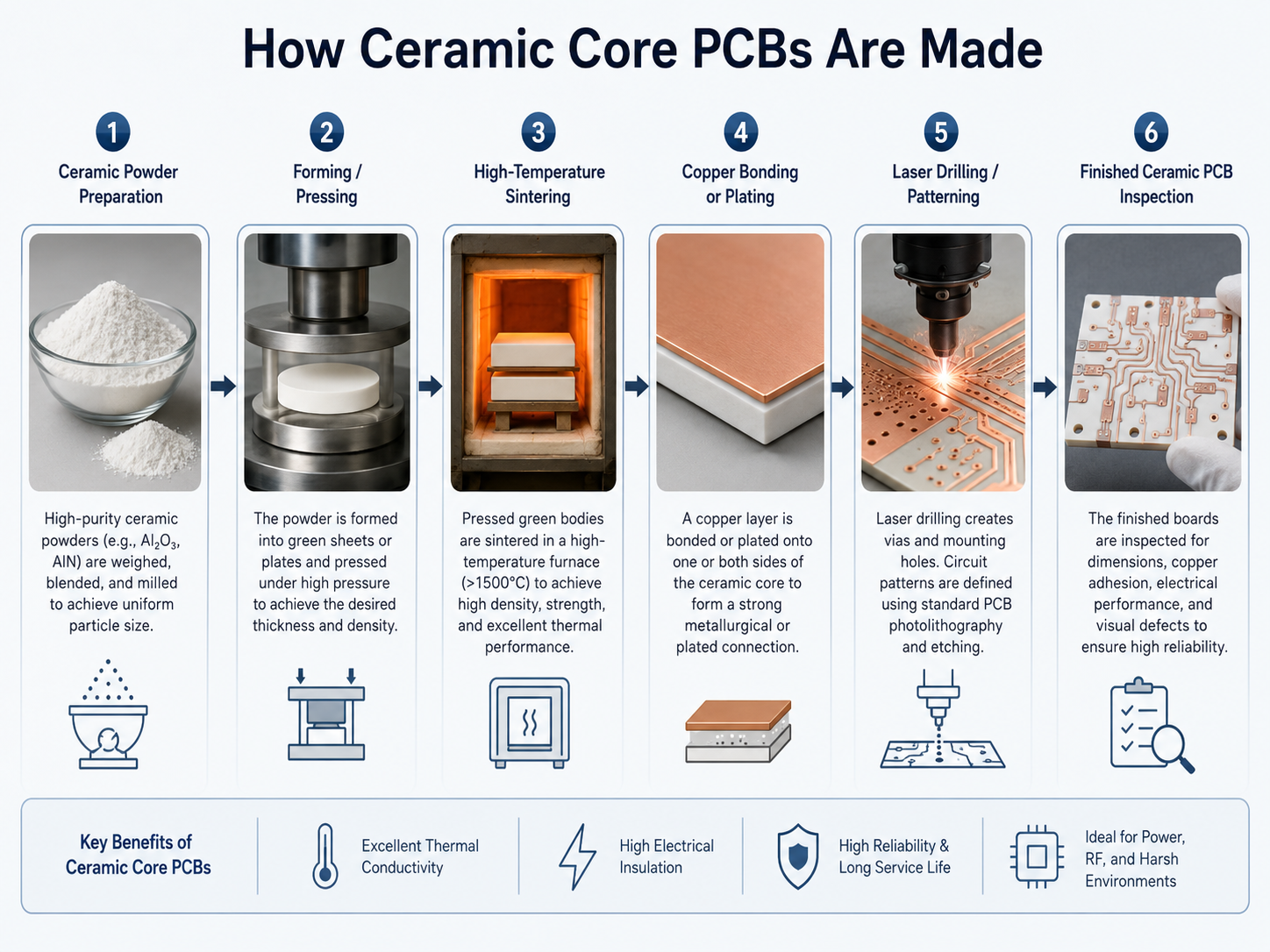
Ceramic cores are made through a controlled process that starts with ceramic powder preparation and ends with a dense, stable substrate suitable for circuit formation. The exact process depends on the material and final PCB structure.
In a typical ceramic substrate process, ceramic powder is mixed with binders and additives to form a workable material. The material is shaped into sheets or pressed forms, then dried and sintered at high temperature. Sintering gives the ceramic its hardness, density, and stable physical properties. After that, the substrate may be lapped, polished, laser drilled, metallized, plated, etched, and finished according to the PCB design.
For circuit formation, different ceramic PCB technologies can be used. DPC, or Direct Plated Copper, is often chosen for fine circuits and high-precision designs. DBC, or Direct Bonded Copper, bonds copper directly onto the ceramic surface and is often used for power modules. AMB, or Active Metal Brazing, provides very strong bonding and is suitable for high-reliability power electronics.
| Process Type | Main Feature | Typical Application |
|---|---|---|
| DPC ceramic PCB | Uses copper plating technology for fine circuits and precision patterns | LED modules, sensors, optical devices, high-density ceramic circuits |
| DBC ceramic PCB | Direct copper bonding provides strong thermal and current capacity | Power modules, IGBT substrates, high-power electronics |
| AMB ceramic PCB | Active brazing creates strong copper-to-ceramic bonding | Automotive power modules, high-reliability energy electronics |
| Thick-film ceramic PCB | Conductive paste is printed and fired onto ceramic | Heaters, sensors, hybrid circuits, industrial modules |
| Thin-film ceramic PCB | High-precision metal layers are deposited on ceramic | Microwave circuits, precision sensors, RF electronics |
A professional ceramic PCB manufacturer must control material quality, sintering conditions, copper adhesion, surface flatness, circuit accuracy, and inspection standards. EBest Circuit combines process knowledge with practical PCB engineering support, helping customers choose the right ceramic core manufacturing process for the final product environment.
What thermal performance does ceramic core PCB deliver?
Ceramic core PCB delivers much stronger thermal performance than standard FR4 boards. The main advantage is that ceramic materials can transfer heat efficiently while still providing electrical insulation.
Alumina PCB offers good thermal conductivity for many industrial and LED applications. Aluminum nitride PCB provides a much higher level of heat transfer and is often used where thermal density is more demanding. With the right copper thickness, layout, and mounting structure, ceramic PCB boards can move heat away from components quickly and help maintain stable operating temperatures.
Thermal performance is not only about the ceramic material itself. The final result also depends on copper design, substrate thickness, dielectric path, via structure, solder joint quality, component placement, and heat sink contact.
| Material | General Thermal Performance | Best-Fit Applications |
|---|---|---|
| FR4 | Limited thermal conductivity | General electronics and low-to-medium power circuits |
| Alumina ceramic | Good thermal conductivity with balanced cost | LEDs, sensors, industrial modules, moderate power electronics |
| Aluminum nitride ceramic | Excellent thermal conductivity | High-power LEDs, laser modules, power semiconductors, automotive electronics |
| Silicon nitride ceramic | Strong thermal and mechanical reliability | High-reliability power modules and harsh operating environments |
For thermal-sensitive designs, EBest Circuit can support layout review and material comparison. This is helpful when customers need to decide between alumina PCB and aluminum nitride PCB, or when they want to optimize the balance between ceramic PCB cost, heat dissipation, and long-term reliability.
What are ceramic cores used for?
Ceramic cores are used in electronic products that need better thermal control, high insulation, stable structure, and reliable performance under demanding conditions. They are especially useful where compact size and high power must coexist. Because ceramic materials can transfer heat efficiently while maintaining electrical separation, they are widely used in modern power, lighting, automotive, medical, and communication systems.
In LED products, ceramic PCB helps move heat away from LED chips and supports stable brightness. In power electronics, ceramic substrates are used for modules that handle high current and high voltage. In RF and microwave circuits, ceramic materials can provide stable electrical characteristics. In medical and aerospace electronics, ceramic PCB boards support reliability, precision, and long service life.
- High-power LED modules and lighting engines
- Laser diode modules and optical devices
- Power semiconductor packages and IGBT modules
- Automotive electronics and electric vehicle power modules
- RF, microwave, and communication circuits
- Medical sensors and monitoring devices
- Industrial control modules and high-temperature electronics
- Aerospace, UAV, and high-reliability electronic assemblies
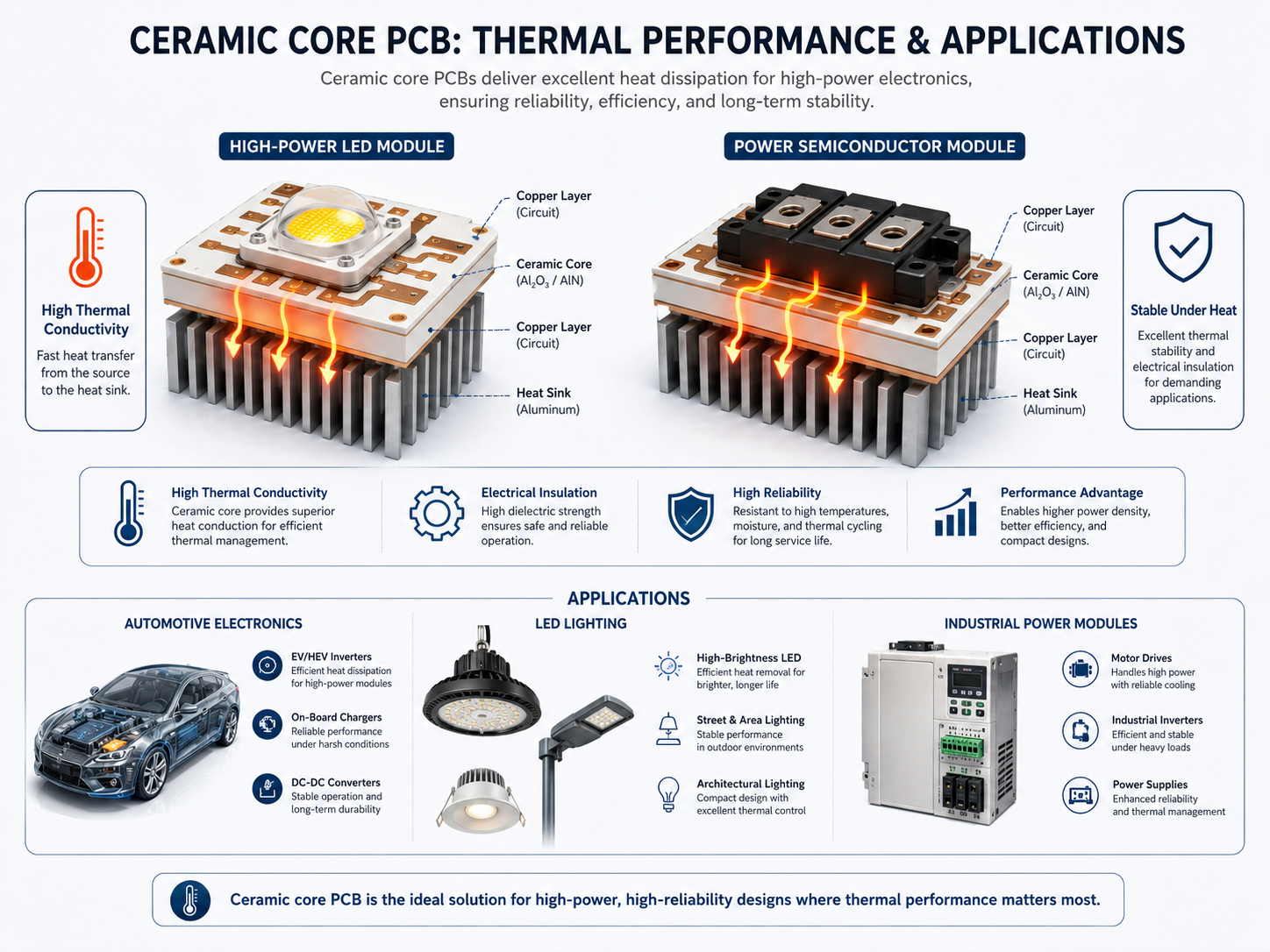
Ceramic core PCB is a strong choice when the product needs more than ordinary PCB performance. Alumina PCB is suitable for balanced thermal and cost requirements, while aluminum nitride PCB is ideal for stronger heat dissipation. For custom ceramic PCB boards, ceramic PCB materials, ceramic PCB cost evaluation, and ceramic core manufacturing process support, EBest Circuit (Best Technology) can help engineers build a practical path from prototype to production.
Summary:
Ceramic core PCB is not simply a premium version of FR4. It is a specialized circuit platform for products that need excellent heat transfer, high insulation, stable operation, and compact design. If your project requires alumina PCB, aluminum nitride PCB, or custom ceramic PCB manufacturing support, you can contact sales@bestpcbs.com for project discussion and quotation support.
You may also like


Tags: Alumina PCB, aluminum nitride pcb, ceramic core PCB, ceramic PCB boards, Ceramic PCB manufacturer