





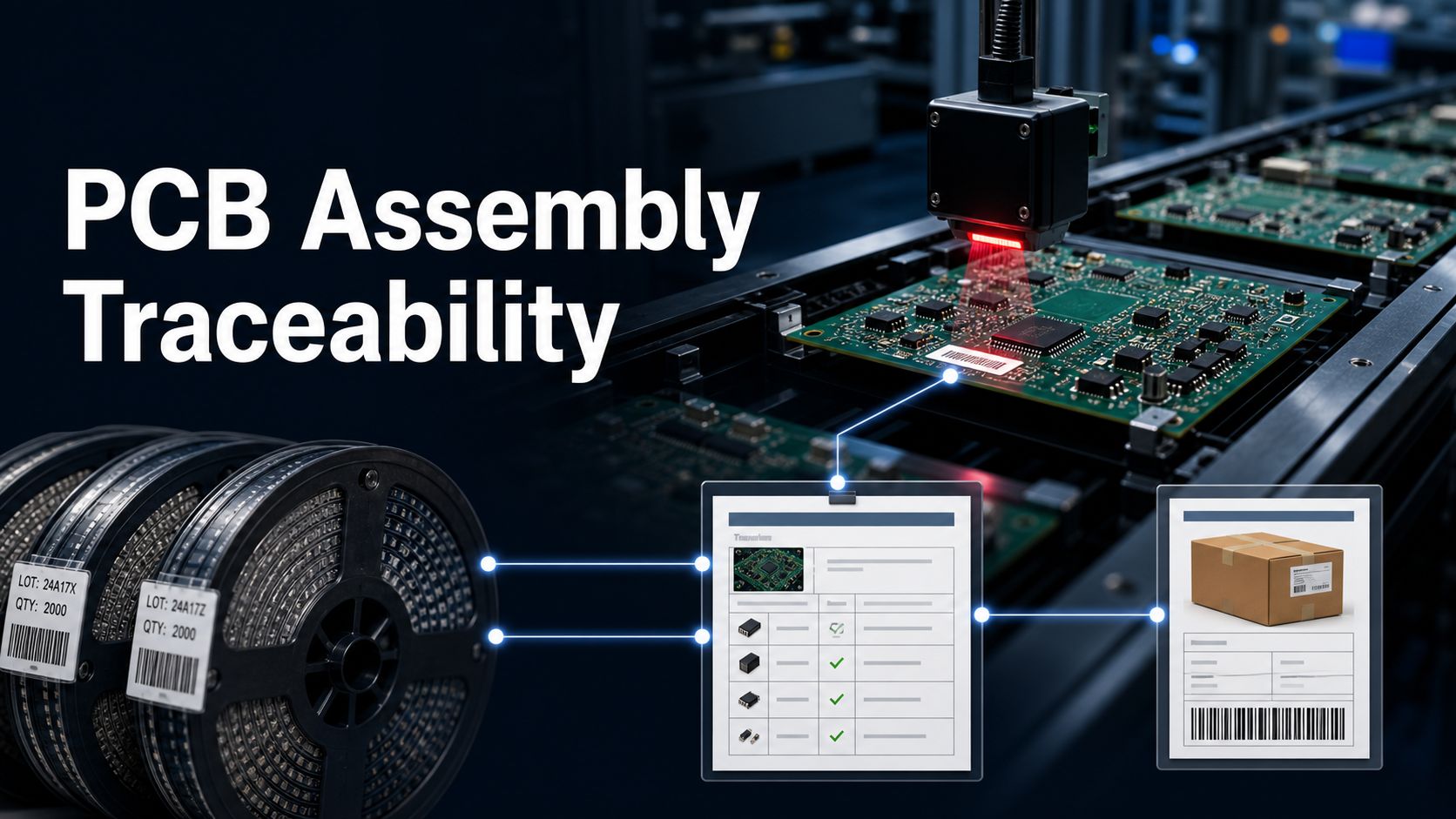
PCB assembly traceability requirements should define what must be identified, which records must be linked, how quickly they must be retrieved, and how long they must remain available. A barcode by itself is not traceability. The label becomes useful only when it points to controlled material, process, software, test, rework, and shipment evidence.
The correct depth depends on product risk, customer contract, quantity, supply chain, field-support needs, and applicable obligations. This guide shows how to turn those needs into a quote-ready matrix instead of requesting a vague “full traceability” service.
If a field failure identifies one serial number, can your supplier retrieve the affected material lots and neighboring units?
Ask what identity is captured at receiving, kitting, assembly, inspection, programming, test, repair, packing, and shipment. Then verify whether the records can support containment rather than merely prove that data exists somewhere.
EBest Circuit can review a customer-defined traceability matrix before confirming the project scope.
Send the BOM and approved alternates, assembly data, required identification level, record fields, label rules, firmware and test requirements, reporting format, retention period, quantity, and target schedule. The exact capture method, coverage, and deliverables must be agreed for the actual build.
What PCB Assembly Traceability Requirements Must Answer
A usable requirement answers identity, linkage, retrieval, retention, and response. Identify the tracked object: component lot, material batch, panel, PCBA lot, individual unit, package, or shipment. Define which upstream and downstream records link to it. State who can retrieve them, in what format, within what time, and for how long.
Also define the business action. Traceability may support first-article approval, process control, recall containment, warranty analysis, counterfeit-risk review, change management, or customer reporting. Without that purpose, teams often collect expensive data that cannot answer the failure question.
Start With Risk, Contract, and Customer Requirements
Do not copy a universal traceability checklist into every PCBA order. Start with contractual deliverables, product criticality, field exposure, component availability, repair strategy, and customer-specific obligations. Then choose the minimum data set that supports those decisions.
One prototype may need revision, BOM, firmware, and test-result linkage. A repeat production program may also need component lot/date code, feeder or kit identity, material status, station, process recipe, inspection images, serial-level measurements, deviation history, and shipment genealogy.
If an external standard or regulation applies, name the exact document, revision, clause, and required evidence in the purchase package. Do not ask the assembler to infer legal or quality obligations from an industry label.
Define Unit, Lot, Batch, and Revision Identity
Every record needs a stable key. Decide whether the manufacturing identity is assigned per panel, lot, individual PCBA, enclosure, or finished product. Define the format, symbology, placement, readability, duplicate prevention, and relationship to the customer part number.
A serial number identifies one instance; a part number identifies the design or item family. The serial-number versus part-number guide explains why these fields must not be interchanged.
Revision identity is equally important. Link the unit to PCB revision, BOM revision, approved deviation, assembly drawing, program, test procedure, and label format. If the same unit key can point to mixed revisions, later retrieval becomes ambiguous.
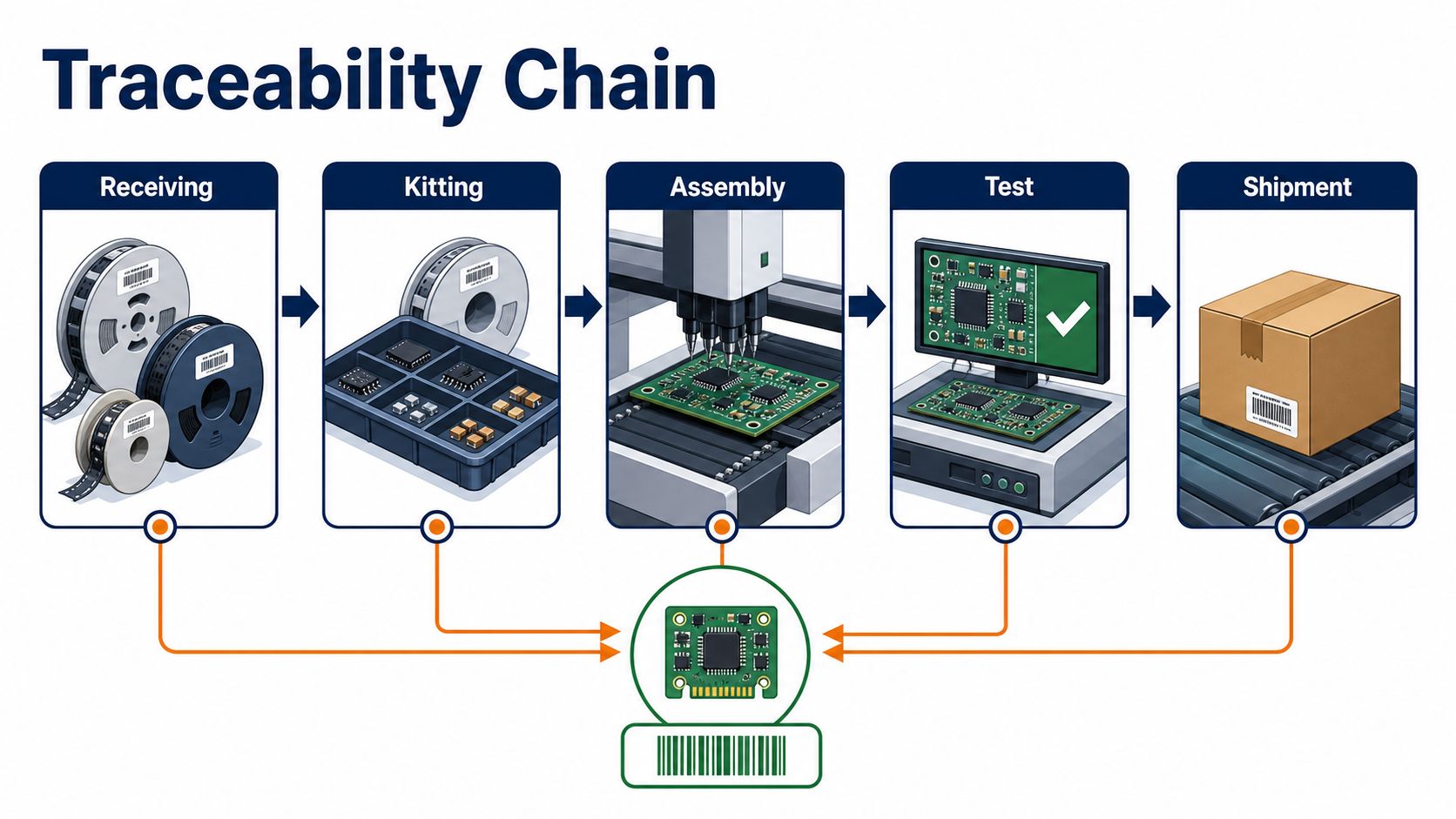
Trace Components From Receiving Through Kitting
Component genealogy starts before the reel reaches the placement machine. Receiving records may include manufacturer, manufacturer part number, supplier, purchase order, lot or date code, quantity, incoming status, packaging condition, and inspection outcome.
Kitting must preserve the relationship between the accepted source and the production order. If a reel is split, combined, returned, or substituted, the system should maintain a defensible link rather than create an undocumented material change. The component sourcing service page provides the sourcing context; the traceability matrix defines the records required for this particular order.
Link Moisture, Date-Code, Lot, and Substitution Records
Material condition can matter as much as material identity. For moisture-sensitive or shelf-life-controlled items, define which receipt, storage, exposure, bake, reseal, and use records are required. Do not request fields that the product risk does not justify, but do not omit them when material condition affects assembly reliability.
For substitutions, link the approved manufacturer part number, approval authority, effective lot or serial range, BOM revision or deviation, and affected test plan. The alternative-components guide explains why electrical fit alone is insufficient for an approved change.
Connect Bare PCB, Stencil, Program, and Process Revisions
The assembly record should show which controlled production inputs created the unit. These may include bare-board supplier lot, fabrication revision, solder paste lot, stencil revision, placement program, reflow recipe, selective-solder or wave program, work instruction, and fixture revision.
The requirement does not need to store every machine setting if the controlled recipe ID and revision can retrieve the approved settings. What matters is an unbroken link between the unit and the released process baseline.
Record SMT and Through-Hole Process Evidence
Process records should support release and diagnosis. Depending on scope, useful fields may include work order, line or station, timestamp, operator or authorization, paste and stencil identity, program revision, inspection status, reflow profile reference, soldering recipe, and first-piece approval.
More data is not always better. Record what can show that the approved process was used, reveal affected units when a process issue is found, and support corrective action. If a value cannot influence a decision or be retrieved reliably, challenge why it is collected.
Link Inspection and Test Results to the Unit
Inspection and test evidence should carry the same identity used by the assembly record. Link relevant SPI, AOI, X-ray, electrical, programming, and functional outcomes to the lot or serial level required by the customer.
Define whether the record stores pass/fail only, measurements, images, program version, station identity, failure code, or complete logs. The PCB assembly testing services guide explains how method, limits, logs, and retest rules shape the evidence.
Control Firmware and Calibration Data
Firmware is part of the manufactured configuration when it is programmed during assembly. Record the approved file name, checksum or controlled identifier, version, device location, configuration, programming outcome, and any security or lock operation required by the procedure.
If unit-specific calibration values are generated, define how those values link to the serial number, where they are stored, how a replacement board is handled, and which software revision interprets them. A shipment should not mix software states under one unlabeled hardware revision.
Track Rework, Deviations, and Nonconformances
Traceability must preserve the original condition and the authorized disposition. Record the first failure, affected reference designator or symptom, nonconformance code, review authority, repair instruction, parts used, operator, post-rework inspection or test, and final disposition as required.
A unit that passes after intervention should not erase its first-pass history. Also link temporary deviations and concessions to the exact lot or serial range so a later investigation can separate standard production from an approved exception.
Preserve Packaging and Shipment Genealogy
The traceability chain should continue through packing and delivery. Link finished units to package identity, quantity, packing date, shipment, delivery document, and any customer-required release record. This allows a suspect material lot or process condition to be mapped to affected shipments.
If labels are reprinted or packages are split, define authorization and duplicate controls. The physical label must remain readable for the expected handling environment, but the database link remains the source of the complete genealogy.
Define the traceability evidence before the first lot is built.
Send the tracked identity level, required component and process fields, revisions, firmware, test logs, rework history, retention, report format, quantity, and schedule. EBest Circuit can review the matrix and confirm a project-specific scope.
Identity | Materials | Revisions | Test | Rework | Retention | Reports
Design the Data Model Before Choosing Labels
Start with relationships, then select barcode, QR, data-matrix, RFID, or human-readable marking. A practical record model connects the unit or lot to materials, revisions, operations, firmware, test, deviations, disposition, and shipment.
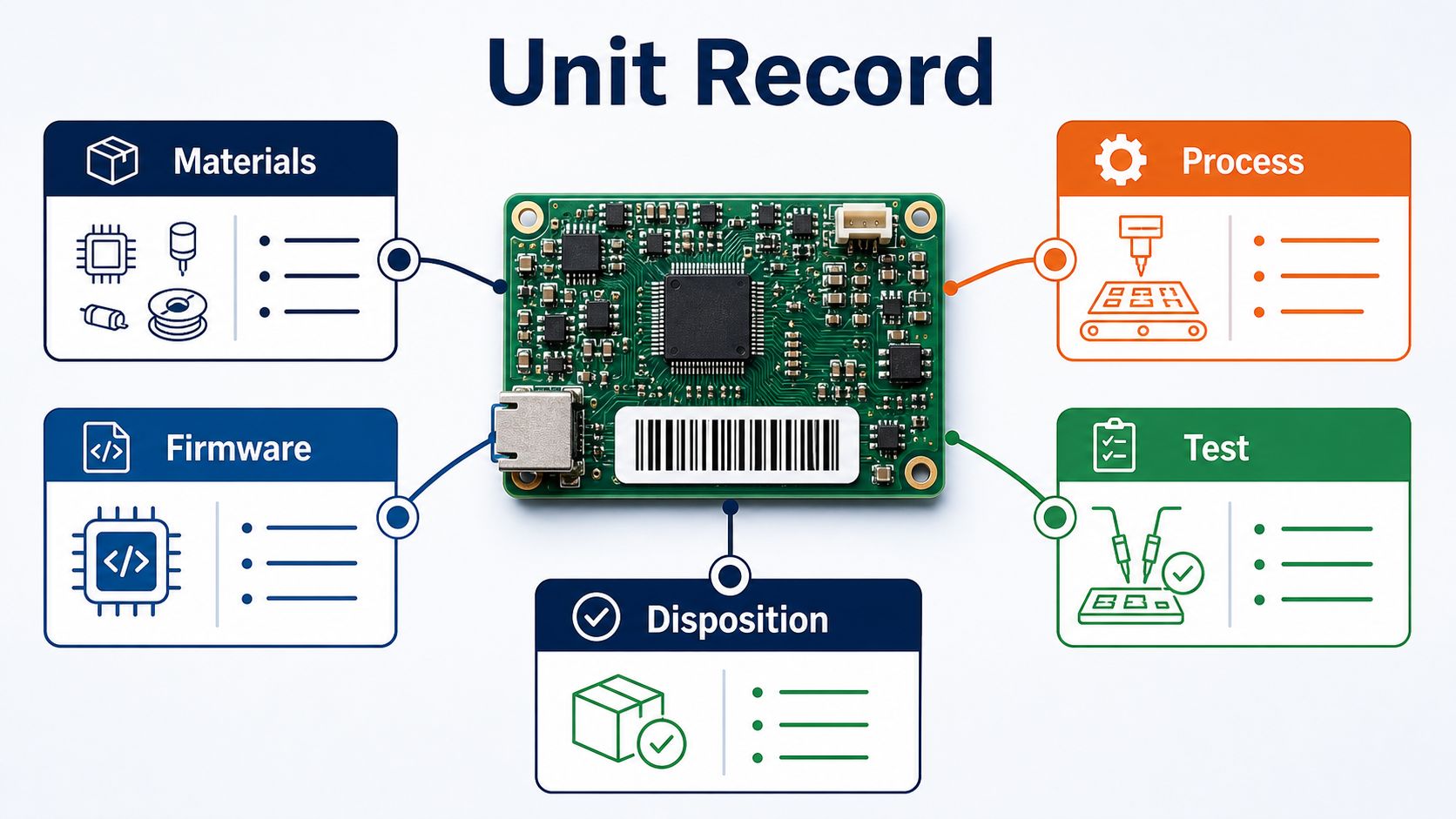
Define required and optional fields, allowed values, revision rules, parent-child relationships, missing-data behavior, and export format. Label capacity and scanning method should serve this model—not determine it.
Audit Retrieval Speed and Record Retention
A traceability system should pass a retrieval test before production approval. Select a sample serial or lot and ask the supplier to retrieve its material sources, revisions, process status, firmware, test result, rework history, and shipment link. Then start from a suspect component lot and identify affected units and shipments.
Specify retention in the contract, including the start point, data format, accessibility, backup expectation, and what happens when the program ends. “Records available on request” is incomplete without a defined period and output.
Compare Traceability Scope in PCBA Quotes
Normalize the promised evidence before comparing price. One supplier may include work-order and lot-level records; another may include serial-level component, process, software, and measurement genealogy. Those are not equivalent services.
| Quote Field | Define | Evidence to Receive |
| Identity level | Panel, lot, unit, package, shipment | Sample identifier and relationship map |
| Material genealogy | Which component, PCB, solder, and controlled-material fields | Sample receiving-to-unit lookup |
| Process and revision | Programs, recipes, drawings, work instructions, deviations | Unit history or controlled revision report |
| Test and software | Pass/fail, measurements, logs, firmware, calibration | Sample serial-level result |
| Retention and retrieval | Period, response time, format, backup | Export example and contractual statement |
| NRE and recurring cost | Labels, programming, integration, reports, storage | Separated line items and exclusions |
Send a Traceability RFQ Matrix Suppliers Can Price
Put requirements in a field-by-field matrix instead of a paragraph. Include the tracked object, identifier format, label location, required data field, capture stage, source, link key, retention, report/export format, retrieval-time target, and responsible party.
Attach Gerber or ODB++, BOM, CPL, drawings, approved-alternate policy, firmware and checksum, test procedure, labeling specification, quantity, forecast, packaging plan, and schedule. Use the first build to validate the record chain before releasing repeat production; the NPI manufacturing guide explains that baseline discipline.
PCB Assembly Traceability Requirements FAQ
What is PCB assembly traceability?
It is the ability to connect a PCB assembly identity to its materials, revisions, manufacturing history, software, inspection, test, rework, disposition, and shipment records at the agreed level.
Is a serial-number label enough?
No. The identifier must retrieve controlled records and support containment. A label without a reliable data relationship is only marking.
Should every component be traced by lot?
Not automatically. Define coverage from product risk, contract, supply-chain concerns, and the decisions the record must support.
What is lot-level versus serial-level traceability?
Lot-level records apply to a production group; serial-level records identify one unit. Some evidence may be lot-level while firmware, calibration, and test results are serial-level.
How are component substitutions traced?
Link the approved part, approval authority, BOM revision or deviation, effective unit range, receiving lot, and any changed process or test requirement.
Should firmware be included?
Yes when programming occurs during assembly. Record a controlled file identifier or checksum, version, device, configuration, and result.
How should reworked boards be recorded?
Preserve the first failure, repair authorization, action, replaced parts, operator, post-rework verification, and final disposition.
How long should PCBA records be retained?
The customer should define the period from contract, product lifecycle, risk, and applicable obligations. Do not assume a universal duration.
How can buyers test a supplier’s traceability?
Run a forward lookup from a material lot to affected units and shipments, and a backward lookup from one serial to its materials, revisions, test, and disposition.
What should be sent for a traceability quote?
Send the data matrix, identifier and label rules, assembly files, BOM and alternates, firmware, test/report needs, retention, quantity, forecast, and schedule.
Make your PCBA history retrievable before production starts.
Email the assembly files, BOM, traceability matrix, label rules, firmware, test requirements, report format, retention, quantity, and target delivery. EBest Circuit will review open fields and confirm what can be included in the project quotation.
BOM | Identity | Labels | Firmware | Test | Retention | Export
You may also like








Tags: PCB Assembly, Quality Control, Traceability