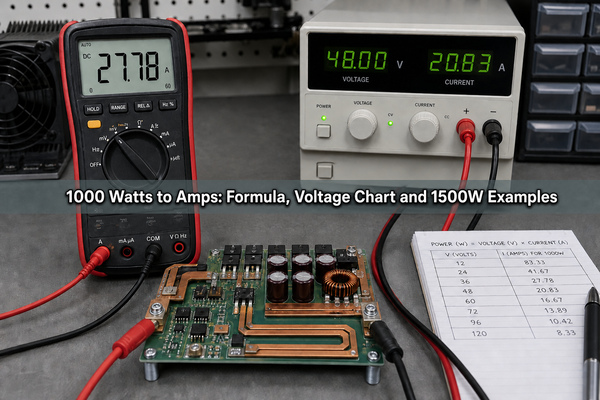
1000 watts to amps is not one fixed value because current depends on voltage and circuit type. At 120 V with a power factor of 1, 1000 W equals 8.33 A; at 240 V it equals 4.17 A; and at 12 V DC it equals 83.33 A. This guide gives the corresponding 1500 W results, the correct formulas for DC and AC systems, and the limits that must be checked before using a calculated current for a breaker, conductor, connector, or PCB trace.
How Many Amps Is 1000 Watts?
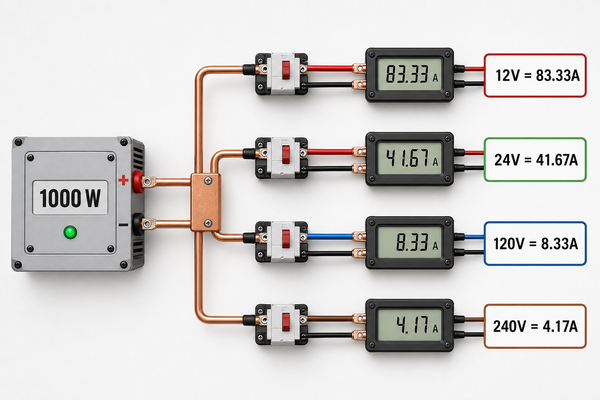
At 120 V, 1000 watts is 8.33 amps when the load is DC or a purely resistive single-phase AC load. The same 1000 W equals 83.33 A at 12 V, 41.67 A at 24 V, 9.09 A at 110 V, 4.55 A at 220 V, 4.35 A at 230 V, and 4.17 A at 240 V.
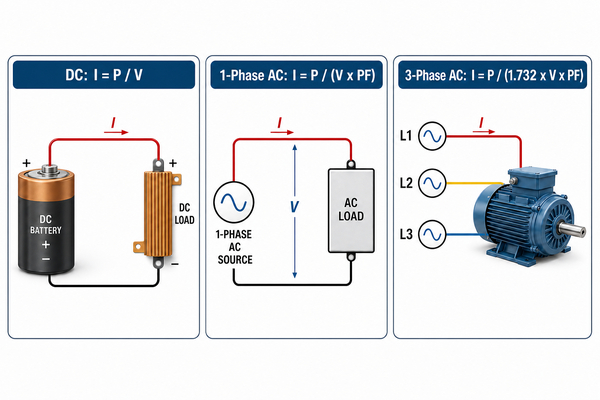
The simple calculation is current = power / voltage, or I = P / V. For an AC motor, transformer, or switching power supply, divide by power factor as well. A lower power factor produces a higher current for the same real power.
How Many Amps Is 1500 Watts?
At 120 V and power factor 1, 1500 watts equals 12.5 amps. It equals 125 A at 12 V DC, 62.5 A at 24 V DC, 13.64 A at 110 V, 6.82 A at 220 V, 6.52 A at 230 V, and 6.25 A at 240 V.
These values describe the current associated with 1500 W under the stated electrical conditions. The device nameplate may show a different input current if the advertised wattage is output power, if conversion efficiency is below 100%, or if an AC load has a power factor below 1.
Why Can’t Watts Be Converted to Amps Without Voltage?
Watts measure power, while amps measure current, so voltage is required to connect the two quantities. One thousand watts can be delivered as high current at low voltage or lower current at high voltage. For example, 1000 W requires 83.33 A at 12 V but only 4.17 A at 240 V when no other correction factor applies.
This distinction matters because current, rather than wattage alone, drives conductor heating, connector contact loss, fuse selection, voltage drop, and PCB copper requirements. Always identify the operating voltage at the same point in the system where the current will be evaluated.
How to Convert Watts to Amps?
Identify the real power in watts, the operating voltage, and whether the circuit is DC, single-phase AC, or three-phase AC. For AC loads, obtain the power factor from the nameplate or datasheet. Then select the matching formula and keep all values in watts, volts, and amperes.
- Confirm whether the listed wattage is input power or output power.
- Use the actual operating voltage, not only the nominal system label.
- Select the DC, single-phase AC, or three-phase AC equation.
- Include power factor and efficiency when the rating requires them.
- Compare the result with the equipment nameplate and measured current.
What Is the Watts-to-Amps Formula for DC Circuits?
For a DC load whose input power is known, use I = P / V. A 1000 W load on a 24 V DC bus therefore draws 41.67 A in the ideal calculation: 1000 / 24 = 41.67.
If 1000 W is the converter’s output power rather than its input power, include efficiency. At 24 V and 90% efficiency, the estimated input current is I = Pout / (V x efficiency), so 1000 / (24 x 0.90) = 46.30 A. Battery voltage also changes with state of charge and load, so minimum operating voltage is often the more demanding design point.
What Is the Watts-to-Amps Formula for Single-Phase AC?
For single-phase AC real power, use I = P / (V x PF), where PF is power factor. A 1000 W resistive heater at 120 V and PF 1 draws 8.33 A. A 1000 W load at 120 V and PF 0.80 draws 10.42 A.
Do not substitute efficiency for power factor. Power factor describes the relationship between real power and apparent power, while efficiency describes losses between input and useful output. A motor or power converter calculation may require both, depending on which power rating is supplied.
What Is the Watts-to-Amps Formula for Three-Phase AC?
For a balanced three-phase load using line-to-line voltage, use I = P / (sqrt(3) x VLL x PF). For 1500 W at 400 V and PF 0.85, the line current is 1500 / (1.732 x 400 x 0.85) = 2.55 A.
This equation assumes a balanced system and uses line-to-line voltage. If the available specification uses phase voltage, or if the load is unbalanced, calculate the phases according to the actual connection and verify each conductor rather than applying the balanced shortcut.
What Is the 1000 Watts to Amps Chart at Common Voltages?
The table below uses I = 1000 / V. It is exact for DC input power and for a single-phase resistive AC load with PF 1; other AC loads require a power-factor correction.
| Voltage | Calculation | Current at 1000 W | Typical context |
|---|---|---|---|
| 12 V | 1000 / 12 | 83.33 A | Battery, automotive, low-voltage inverter input |
| 24 V | 1000 / 24 | 41.67 A | Battery bank, control or mobile power system |
| 48 V | 1000 / 48 | 20.83 A | Telecom, battery storage, DC distribution |
| 110 V | 1000 / 110 | 9.09 A | Nominal AC supply |
| 120 V | 1000 / 120 | 8.33 A | North American single-phase supply |
| 220 V | 1000 / 220 | 4.55 A | Nominal AC supply |
| 230 V | 1000 / 230 | 4.35 A | Common international single-phase supply |
| 240 V | 1000 / 240 | 4.17 A | Single-phase appliance or equipment circuit |
What Is the 1500 Watts to Amps Chart at Common Voltages?
The same calculation applied to 1500 watts to amps produces the following ideal values. Use the AC formulas above when power factor is not 1.
| Voltage | Calculation | Current at 1500 W |
|---|---|---|
| 12 V | 1500 / 12 | 125.00 A |
| 24 V | 1500 / 24 | 62.50 A |
| 48 V | 1500 / 48 | 31.25 A |
| 110 V | 1500 / 110 | 13.64 A |
| 120 V | 1500 / 120 | 12.50 A |
| 220 V | 1500 / 220 | 6.82 A |
| 230 V | 1500 / 230 | 6.52 A |
| 240 V | 1500 / 240 | 6.25 A |
How Does Power Factor Change the Amp Calculation?
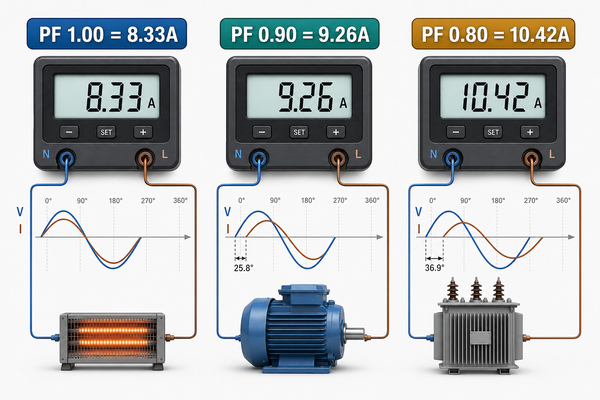
A lower power factor increases RMS current for the same real power and voltage. At 120 V, a 1000 W load draws 8.33 A at PF 1, 9.26 A at PF 0.90, and 10.42 A at PF 0.80. The additional current affects conductor loss, connector heating, protective-device loading, and upstream component ratings.
Use the power factor specified for the operating condition. Motors can have different values at startup and partial load, while electronic power supplies may use power-factor correction. If only apparent power in volt-amperes is provided, current is VA divided by voltage; do not treat VA and W as interchangeable.
Can 15 Amps Handle 1000 Watts?
At 120 V, a 1000 W resistive load draws about 8.33 A, so it is below a 15 A circuit’s nominal current rating. At 110 V it draws about 9.09 A. The complete circuit load still matters: other devices on the branch circuit, continuous-operation rules, wiring method, ambient temperature, connector ratings, and local electrical code can reduce the usable margin.
For a continuous load, some codes apply an 80% loading rule, which corresponds to 12 A on a 15 A circuit. That is not a universal permission to select a breaker from wattage alone. Verify the equipment nameplate and use the requirements of the governing code and a qualified electrical professional.
What Size Breaker Do I Need for 1500 Watts?
A 1500 W resistive load draws 12.5 A at 120 V, 13.64 A at 110 V, and 6.25 A at 240 V. On a 120 V system, 12.5 A exceeds the 12 A continuous-load level associated with an 80% limit on a 15 A circuit, so a properly designed 20 A branch circuit is commonly considered for continuous operation.
The breaker must protect the installed conductors and must match the equipment, receptacle, load duration, startup current, and local code. Do not replace a breaker with a higher rating unless the entire circuit is designed for that rating. For heaters and other high-duty loads, the nameplate and installation instructions take priority over a generic conversion.
How Do Watts-to-Amps Calculations Affect PCB Design?
The calculated current is an input to PCB conductor and interconnect design, but it is not the finished trace-width specification. Copper thickness, external or internal layer placement, allowable temperature rise, trace length, ambient temperature, airflow, terminal resistance, via arrays, duty cycle, and current sharing all change the result.
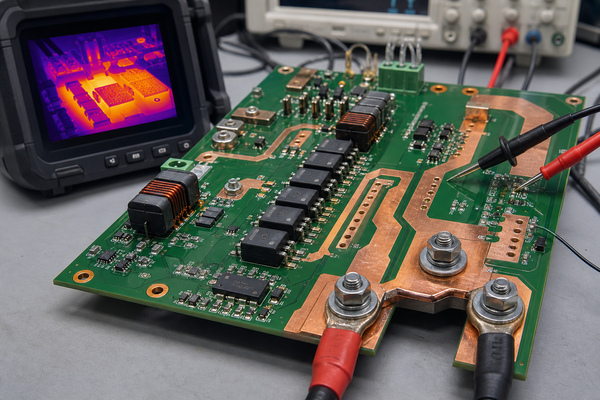
A 1000 W converter can present very different board challenges on its low-voltage and high-voltage sides. A 12 V, 1000 W path may exceed 80 A before efficiency losses, while a 240 V path carries only a few amperes but requires greater clearance and insulation coordination. Review high-current PCB construction, heavy copper PCB for power electronics, and custom PCB power supply layout as separate but connected design decisions.
Before release, validate current paths with the appropriate trace-current method, copper build, thermal model, connector data, fuse behavior, and temperature testing. EBest Circuit (Best Technology) can review PCB fabrication and assembly details against the actual stackup and current path rather than treating the wattage conversion as a complete design rule.
What Common Watts-to-Amps Mistakes Cause Wrong Results?
Most wrong answers come from using the correct arithmetic with the wrong electrical inputs. Check the rating context before trusting the result.
- Missing voltage: watts alone cannot determine current.
- Wrong circuit formula: DC, single-phase AC, and three-phase AC are not interchangeable.
- Assuming PF 1: inductive and many electronic loads draw more current than the resistive calculation.
- Confusing input and output power: conversion losses increase upstream input current.
- Using nominal voltage only: battery and supply voltage can vary under load.
- Ignoring startup or surge current: motors, transformers, heaters, and capacitive inputs can briefly draw more than steady-state current.
- Mixing W and kW: convert 1 kW to 1000 W before applying the formula.
- Treating the result as a component rating: breakers, wire, connectors, fuses, and PCB traces require additional design checks.
FAQ About 1000 and 1500 Watts to Amps
1. How many amps does it take to run a 1500 watt electric heater?
A 1500 W resistive heater draws 12.5 A at 120 V, 13.64 A at 110 V, 6.52 A at 230 V, or 6.25 A at 240 V. Confirm the heater nameplate because controls, fans, and nominal voltage can change the listed input current.
2. How many amps is 1500 watts DC?
Divide 1500 W by the DC voltage. The result is 125 A at 12 V, 62.5 A at 24 V, and 31.25 A at 48 V. If 1500 W is output power, divide by efficiency as well when estimating source current.
3. How many watts can a 20 amp breaker handle?
The arithmetic maximum is voltage multiplied by current: 2400 W at 120 V or 4800 W at 240 V. Usable continuous power may be lower under applicable code, and the breaker must match the conductor, receptacle, equipment, and installation.
4. How many watts is a 15-amp load?
At PF 1, 15 A corresponds to 1800 W at 120 V and 3600 W at 240 V. A continuous-load limit, other loads on the circuit, and power factor can reduce the permitted real power.
5. Is 1 amp always the same number of watts?
No. One amp equals 12 W at 12 V, 120 W at 120 V, and 240 W at 240 V when PF is 1. Watts always depend on both current and voltage, plus power factor for applicable AC calculations.
Conclusion
The correct 1000 watts to amps result is 8.33 A at 120 V, 4.17 A at 240 V, or 83.33 A at 12 V under the simple PF 1 calculation. For 1500 W, the corresponding values are 12.5 A, 6.25 A, and 125 A. Always confirm voltage, circuit phase, power factor, efficiency, and whether the wattage is an input or output rating before selecting electrical or PCB hardware. For PCB fabrication and PCBA support around power and high-current designs, contact EBest Circuit (Best Technology) at sales@bestpcbs.com.
You may also like






Tags: 1000 watts to amps, 1500 watts to amps, High Current PCB, power factor, watts to amps, watts to amps calculator