
A heavy copper PCB manufacturer should be evaluated by copper weight capability, stackup review, resin fill control, thermal behavior, inspection plan and RFQ discipline, not only by a headline copper number. Heavy copper boards carry higher current and heat than standard boards, so the buyer needs an engineering review before comparing price.
This guide is written for engineers and purchasing teams comparing suppliers for power electronics, drive boards, industrial controls, LED drivers, battery systems and other high-current PCB projects. It explains what to ask, what files to prepare and how to compare bestpcbs with other manufacturers without turning unverified capability claims into assumptions.
Heavy Copper PCB Manufacturer at a Glance
The right heavy copper PCB manufacturer is the supplier that can review copper weight, conductor width, spacing, board thickness, heat path, drill structure, solder mask and testing as one manufacturing problem. A thick copper board is not just a normal PCB with more copper added.
| Buyer decision | What to confirm | Why it matters |
|---|---|---|
| Copper target | Finished copper weight by layer and whether copper is balanced | Current handling and etching limits depend on layer structure. |
| Stackup | Material, dielectric, board thickness and layer count | Thick copper changes lamination and spacing decisions. |
| Thermal path | Heat source, copper area, vias, base material and airflow | Heat must be reviewed with the application, not guessed from Gerbers. |
| Inspection | Electrical test, cross-section, dimensional checks and visual criteria | Thick copper boards need clear acceptance criteria. |
| RFQ package | Gerber or ODB++, drawing, copper note, current target, BOM and test needs | Missing requirements can make quotes look cheaper than they are. |
Is Your Heavy Copper PCB Quote Missing Current and Thermal Risk Review?
Heavy copper PCB buyers need a supplier to review current load, copper spacing, resin fill, drilling and thermal requirements before production.
| Customer Pain Point | Project Risk | How bestpcbs Helps |
|---|---|---|
| Copper weight is quoted without current context | The board may not meet electrical or thermal expectations | bestpcbs asks for current load, copper weight, board thickness and critical net information before confirming the quote. |
| Spacing and resin fill risks are overlooked | Heavy copper features can increase fabrication difficulty and defect risk | bestpcbs reviews copper distribution, spacing, drill data and fill expectations during DFM review. |
| Assembly heat is not considered | High copper mass can affect soldering and component reliability | bestpcbs checks assembly requirements and component placement when the project needs PCBA. |
| Testing requirements are unclear | The buyer may not know whether critical circuits were verified | bestpcbs confirms electrical and project-specific test scope before production. |
Heavy Copper PCB Buyer Priorities Before Quote
Heavy copper PCB buyers should confirm current load, copper weight, thermal behavior, spacing, resin fill, drilling and test expectations before accepting a quote. Heavy copper boards are more sensitive to process assumptions than standard copper builds.
Prepare drawings that show copper requirements, critical nets, operating current, heat dissipation needs, board thickness, finish and assembly constraints. A useful supplier will review manufacturability and reliability risks before moving the job into production.
When Heavy Copper PCB Is the Right Board Type
Heavy copper PCB is the right board type when current, heat, mechanical strength or conductor durability make standard copper insufficient. It is commonly considered for high-current paths, power conversion, motor drives, charging systems, LED power stages and industrial control circuits.
Bestpcbs has a dedicated heavy copper PCB product page. The page describes heavy copper PCB as boards with copper conductors generally in the 3 oz/ft2 to 10 oz/ft2 range, while extreme heavy copper is a higher category. Treat those descriptions as a starting definition; exact build feasibility still depends on layer position, board structure, trace width, spacing and review of the latest process data.
Heavy Copper vs Thick Copper vs Extreme Heavy Copper
Heavy copper, thick copper and extreme heavy copper are often used differently by suppliers, so the RFQ should state the actual copper requirement instead of relying on the label. A buyer should write the copper weight needed on each layer and explain the current or heat objective.
| Term in supplier pages | How to use it in an RFQ | Risk if unclear |
|---|---|---|
| Heavy copper PCB | State finished copper weight by inner and outer layer | Supplier may quote a different copper assumption. |
| Thick copper PCB | Use as a synonym only after confirming the exact oz value | Search results use the term inconsistently. |
| Extreme heavy copper PCB | Flag as a special process requiring project review | Higher copper changes spacing, resin fill and cost. |
| High current PCB | Provide current, temperature rise and copper path requirements | Current capacity cannot be judged by the keyword alone. |
Copper Weight, Trace Width and Spacing Checks
Copper weight affects the minimum practical trace width, spacing, etching control, solder mask bridge and finished board cost. As copper gets thicker, narrow features become harder to manufacture consistently.
The process capability index includes line width and spacing examples for different copper weights in the company capability files, including heavier copper rows that must be checked against the original Excel sheet before quoting. For public content, the safe buyer recommendation is to send the target copper, current path, spacing, board thickness and drawings for DFM review rather than assuming one universal limit.
Stackup and Resin Fill Review Before Quoting
Heavy copper stackup needs early review because thick copper changes resin flow, dielectric control, lamination pressure and copper balance. A quote based only on board size and layer count can miss important manufacturing risk.
Ask the supplier to review copper distribution, plane balance, prepreg selection, dielectric thickness, via reliability, board thickness tolerance and whether the copper shape creates void or lamination concerns. For heavier structures, include a fabrication drawing instead of leaving requirements in a short email note.
Thermal and High-Current Design Questions
A heavy copper PCB manufacturer needs the current and thermal target because copper thickness alone does not define operating temperature. Trace width, copper area, air movement, enclosure, heat sink contact and duty cycle all affect the result.
- What current will each high-current path carry?
- Is the current continuous, pulsed or startup-only?
- What temperature rise is acceptable in the real enclosure?
- Does the board connect to a heat sink, metal chassis or metal core structure?
- Are high-current pads, connectors or bus bars part of the design?
If a copper bus structure is being considered, the bus bar PCB page is a useful internal reference for power distribution projects.
FR4 Heavy Copper, Metal Core and Copper Base Options
FR4 heavy copper, metal core PCB and copper base PCB solve different problems, so they should not be treated as interchangeable options. FR4 heavy copper is often used for high-current circuits, while metal core boards focus on heat spreading through a metal base.
The company capability index includes MCPCB data with aluminum, copper and stainless steel base material options and conductor thickness information for metal core structures. That does not mean every FR4 heavy copper design uses the same limits. Keep FR4, metal core and copper base assumptions separate during RFQ review.
Assembly and Component Sourcing for Heavy Copper Boards
Heavy copper PCB assembly needs early planning because large copper areas, heat sinking and high-current terminals can affect soldering and inspection. The board may need different thermal relief, pad design, preheat control or manual process review.
For turnkey projects, send the BOM and CPL with the fabrication data so the supplier can review component availability, package size, polarity, terminal current, connector stress and test access. Bestpcbs can connect the bare-board build with PCB assembly service when the project needs both fabrication and PCBA.
DFM Review Before Heavy Copper Manufacturing
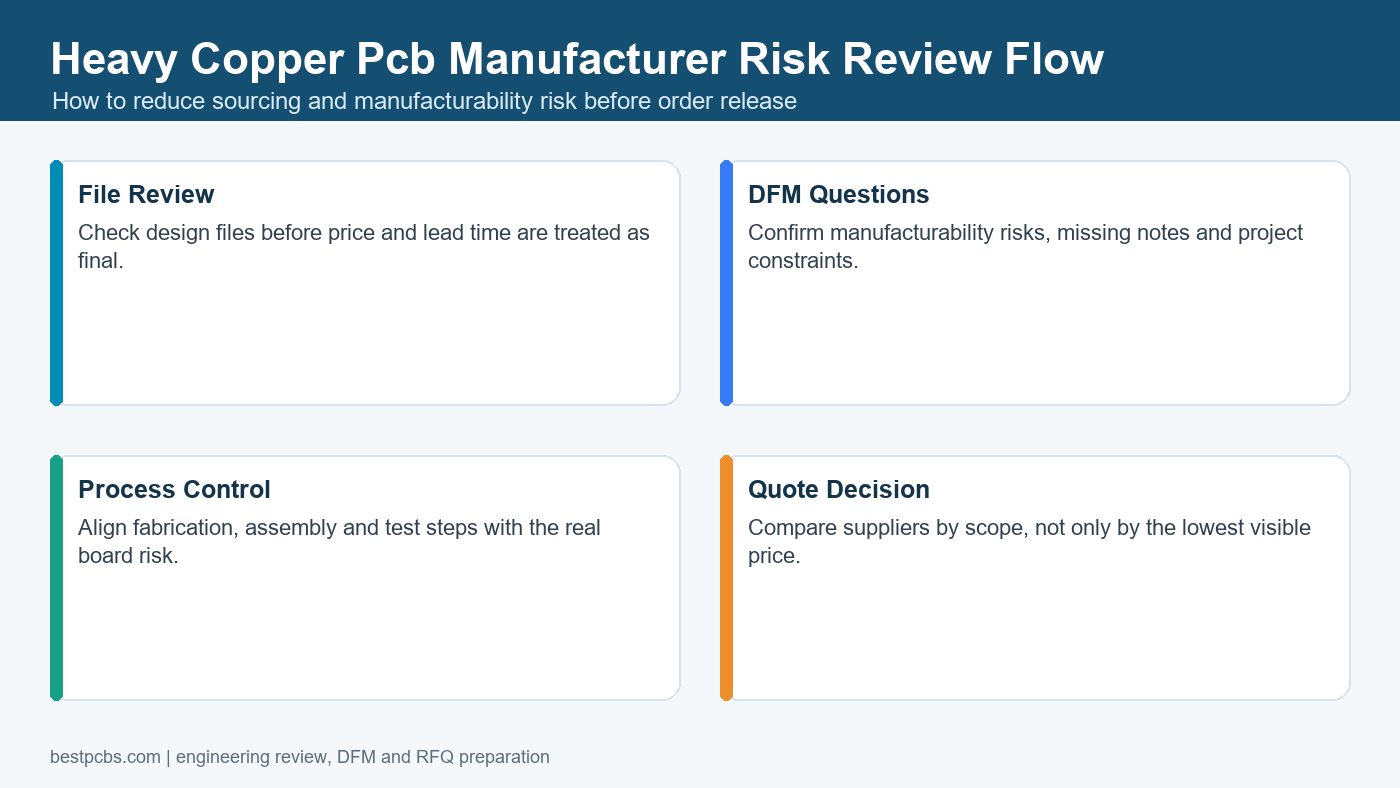
DFM review is a hard requirement for heavy copper PCB projects because copper thickness changes several manufacturing rules at once. The design should be checked before the quote is treated as final.
- Check copper-to-copper spacing on inner and outer layers.
- Review annular ring, drill aspect ratio and via current needs.
- Confirm solder mask bridge and clearance around large copper features.
- Review copper balance to reduce bow, twist or lamination issues.
- Confirm whether high-current pads need mechanical support or special plating notes.
- Use the heavy copper PCB design guide as a supporting reference when preparing design rules.
Testing and Quality Control for Thick Copper PCBs
Testing and quality control should match the failure risk of the heavy copper board, not a generic PCB checklist. Thick copper designs can need special attention to copper continuity, plating, insulation, solder mask, dimensions and thermal expectations.
| Quality item | What to define | Why it matters |
|---|---|---|
| Electrical test | Netlist, continuity and isolation criteria | Confirms the bare board matches the design data. |
| Cross-section or sample review | Plating, resin fill or copper structure when required | Helps verify difficult heavy copper features. |
| Dimensional check | Board outline, slots, holes, thickness and panel notes | High-current boards often have mechanical constraints. |
| Assembly inspection | AOI, X-ray if needed, solder joint acceptance and terminal review | Thermal mass can affect soldering behavior. |
What Determines Heavy Copper PCB Cost?
Heavy copper PCB cost is driven by copper weight, board size, layer count, spacing, material, surface finish, drilling, inspection, assembly scope and quote completeness. The lowest first price is often not the best comparison if the quote leaves out difficult requirements.
| Cost factor | Why it changes the quote | How to reduce uncertainty |
|---|---|---|
| Copper weight | Thicker copper affects etching, lamination and cycle time | State finished copper by layer. |
| Minimum spacing | Tight spacing is harder with thick copper | Send design rules and critical gaps. |
| Board thickness and material | Stackup and dielectric choices change processing | Provide target thickness and material notes. |
| Testing | Special inspection adds setup and labor | Define required reports and acceptance criteria. |
| Assembly | Thermal mass and high-current terminals can affect soldering | Send BOM, CPL and assembly drawings early. |
How to Compare Heavy Copper PCB Manufacturers
Compare heavy copper PCB manufacturers by engineering review quality and quote assumptions before comparing unit price. A supplier that asks detailed questions may be reducing risk rather than making the process slower.
- Can the supplier explain how copper weight changes spacing and DFM?
- Do they ask for current, temperature rise and application information?
- Do they separate FR4 heavy copper from metal core or copper base assumptions?
- Can they support assembly review if the board includes high-current components?
- Do they define inspection scope and quote exclusions clearly?
- Do they avoid unsupported claims about universal copper limits, lead time or yield?
Files to Prepare for a Heavy Copper PCB RFQ
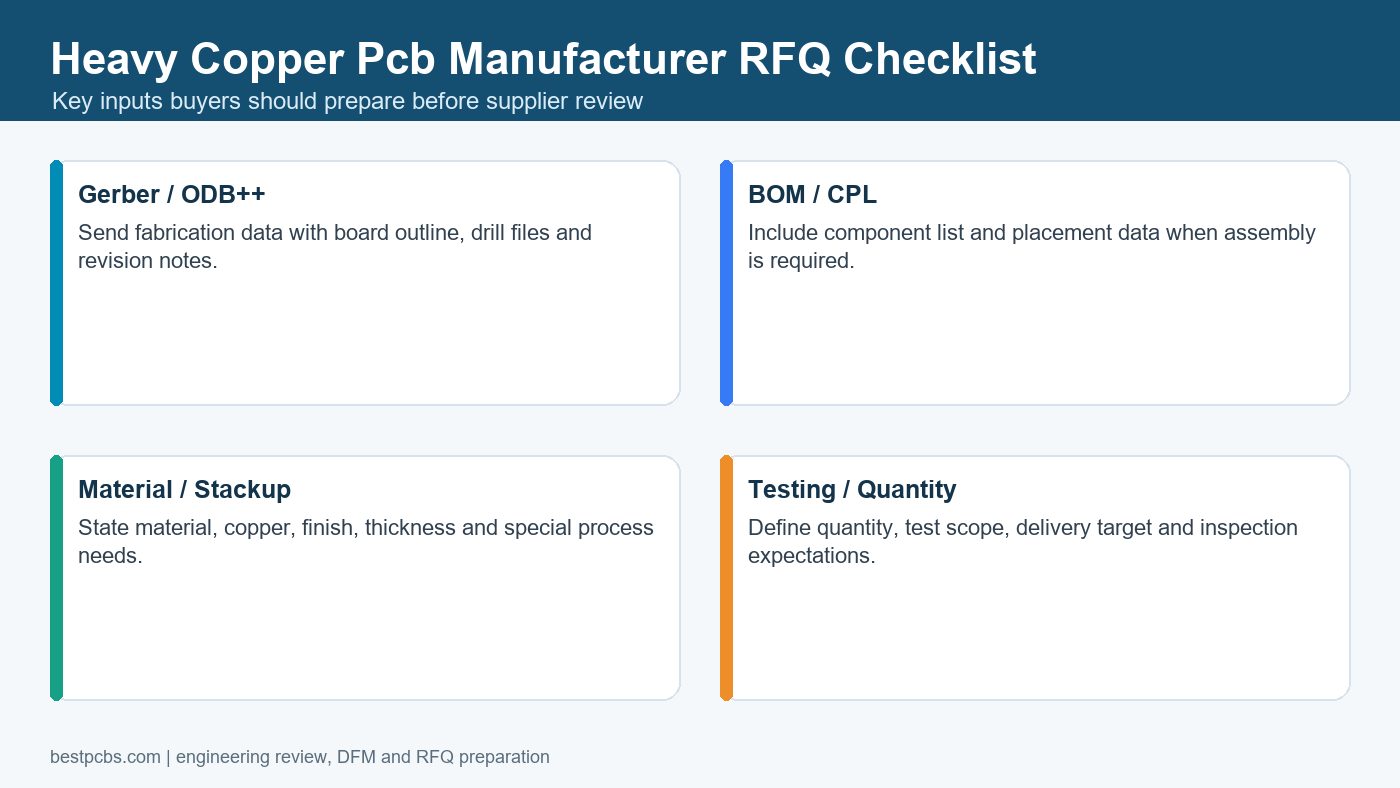
A complete heavy copper PCB RFQ should include the files and engineering targets that let the supplier evaluate manufacturability, current path and inspection scope. Missing data usually creates quote revisions later.
- Gerber or ODB++ fabrication files and drill data.
- Fabrication drawing with copper weight by layer, board thickness and finish.
- Stackup notes, material target and controlled impedance requirements if any.
- Current path, expected current, temperature rise target and application notes.
- BOM, CPL and assembly drawing if PCBA is required.
- Test, inspection, packaging and reporting requirements.
- Quantity, revision, project stage and target delivery timing.
Common Sourcing Risks to Avoid
The biggest sourcing risk is treating a heavy copper PCB as a commodity order before the copper, spacing, stackup, thermal and testing assumptions are verified. That can turn a cheap quote into a late engineering problem.
- Do not ask for “heavy copper” without an exact copper target.
- Do not compare suppliers if one quote includes testing and another does not.
- Do not mix FR4 heavy copper, MCPCB and copper base capability claims.
- Do not ignore solder mask, spacing and drill limits when copper increases.
- Do not leave current or temperature targets out of the RFQ.
Frequently Asked Questions About Heavy Copper PCB Manufacturers
What is a heavy copper PCB manufacturer?
A heavy copper PCB manufacturer fabricates printed circuit boards that use thicker copper conductors for higher current, heat spreading or mechanical strength. The useful supplier question is whether the manufacturer can review copper weight, spacing, stackup, thermal requirements and inspection scope for the actual project.
How much copper counts as heavy copper PCB?
Supplier definitions vary. Bestpcbs product information describes heavy copper PCB as generally using 3 oz/ft2 to 10 oz/ft2 copper conductors, with extreme heavy copper as a higher category. For quoting, state the exact finished copper requirement by layer instead of relying only on the label.
Can heavy copper PCB be assembled?
Yes, but assembly should be reviewed early. Large copper areas and high-current components can affect soldering heat, terminal stress, inspection access and test planning. Send BOM, CPL and assembly drawings with the fabrication files.
Is heavy copper PCB always better for high current?
No. Heavy copper can help current handling and heat spreading, but layout width, copper area, thermal path, airflow, connectors and enclosure design also matter. The best approach is a project-specific DFM and thermal review.
Final RFQ Recommendation
Before choosing a heavy copper PCB manufacturer, prepare a quote package that explains the electrical and thermal reason for the copper target. The supplier should be able to review copper weight, stackup, trace and spacing, drill structure, solder mask, material, assembly and testing before the order is released.
For a heavy copper PCB quote, send Gerber or ODB++ files, drill data, fabrication drawing, copper weight by layer, board thickness, material and surface finish, current and temperature targets, BOM, CPL, assembly drawings, testing requirements, quantity and target lead time to sales@bestpcbs.com. Best Technology / bestpcbs can review the files, confirm which requirements need project-specific checking and help compare the build as bare board fabrication, PCBA or a high-current production RFQ.
You may also like







Tags: heavy copper pcb, High Current PCB, PCB Supplier Selection