EBest Circuit is a certified ISO 9001 PCB manufacturer in China supporting bare PCB fabrication, component sourcing, PCB assembly, inspection planning, traceability, and prototype-to-volume production. Buyers can qualify the company, manufacturing scope, technical capability, and order-specific quality records through one RFQ instead of treating the certificate as the only supplier-selection criterion.
Send your released PCB data, quantities, application requirements, acceptance criteria, and required records to sales@bestpcbs.com. EBest Circuit can return a manufacturability review and quotation that identifies the proposed construction, production scope, open engineering questions, inspection plan, and shipment documents.

What Does ISO 9001 Mean for a PCB Manufacturer?
ISO 9001 certification confirms that the manufacturer’s quality-management system has been independently audited within the legal entity, site, and service scope shown on the certificate. For a PCB order, that system should control requirements, files, approved materials, production instructions, inspection records, nonconformities, corrective actions, and changes.
- Customer requirements: The quotation, engineering questions, approvals, and purchase order should be reviewed before production release so the build starts from one agreed requirement set.
- Document control: Gerber or ODB++, drill, stackup, drawing, BOM, centroid, assembly, and test files need identifiable revisions and controlled release status.
- Supplier control: Laminates, copper-clad materials, surface-finish chemistry, and purchased components should come from evaluated sources under defined acceptance controls.
- Process control: Fabrication and assembly steps need work instructions, trained personnel, maintained equipment, and monitoring appropriate to the product risk.
- Corrective action: When a nonconformity occurs, the manufacturer should contain affected material, determine cause, implement action, and verify that the action works.
ISO 9001 does not define the layer count, laminate, copper thickness, via structure, impedance tolerance, surface finish, IPC class, or test limits for an individual board. These product requirements still belong in the fabrication package, purchase order, and acceptance plan. The commercial value of certification is therefore a controlled route for executing the order, not a substitute for the order itself.
How Can Buyers Verify an ISO 9001 PCB Manufacturer’s Certificate?
Verify that the certificate covers the legal entity, production site, and service scope proposed for your PCB order. Record the standard reference, certification body, accreditation information, issue date, and validity status, then match the certified name and address to the quotation and manufacturing route.

| Certificate Field | Buyer Check | Risk if Unclear |
|---|---|---|
| Legal Entity | Match the certified name to the quotation, contract, and invoice entity. | A related company may be certified while the contracting entity is outside the scope. |
| Certified Site | Confirm that the fabrication or assembly location proposed for the order is covered. | A headquarters certificate may not cover a separate production site. |
| Service Scope | Check whether the wording covers relevant manufacturing or assembly activities. | The certificate may apply to sales, design, or another service rather than the quoted process. |
| Standard and Validity | Record the full standard reference and confirm current status with the issuer or an accredited database. | An obsolete, suspended, or unverifiable certificate cannot support current qualification. |
| Certification Body | Identify the issuing body and any stated accreditation. | A certificate image alone may not establish independent, accredited certification. |
ISO’s certification verification guidance explains that certification is performed by independent certification bodies, not by ISO itself. If the issuer, site, or scope cannot be verified, resolve the discrepancy before approving the supplier.
What PCB Manufacturing Capabilities Does EBest Circuit Provide?
EBest Circuit provides defined process ranges for FR4 and HDI fabrication, metal-core PCBs, and ceramic PCBs. Buyers evaluating an ISO 9001 PCB manufacturer can use the table below to screen layer count, board thickness, size, trace and space, hole diameter, aspect ratio, impedance, and thermal requirements before submitting the released stackup for an order-specific feasibility review.
| Specification | FR4 and HDI PCB | MCPCB | Ceramic PCB |
|---|---|---|---|
| Maximum Layers | 32 layers | 10 layers | Thick film: 10 layers DCB: 2 layers |
| Maximum Thickness | 2 layers: 6.0 mm 4 layers and above: 8.0 mm |
4.0 mm | Thick film: 1.5 mm DCB: 1 layer 1.3 mm; 2 layers 1.6 mm |
| Maximum Board Size | 610 × 610 mm 100 × 1,300 mm |
610 × 1,625 mm | Thick film: 200 × 200 mm DCB: 138 × 178 mm |
| Minimum Trace / Space | Standard: 4/4 mil HDI: 2/2 mil |
6/6 mil | Thick film: 6/8 mil DCB: 12/12 mil |
| Minimum Hole Diameter | Standard: 0.20 mm HDI: 0.10 mm |
0.30 mm | 0.10 mm |
| Maximum Aspect Ratio | 8:1 | 12:1 | 8:1 |
| Impedance Control | >50 Ω: ±10% ≤50 Ω: ±5 Ω |
Not specified | Not specified |
| Thermal Conductivity | 0.30–0.45 W/m·K | Standard: 0.8–1.5 W/m·K High: 2.0–3.0 W/m·K |
Al₂O₃: ≥24 W/m·K AlN: ≥170 W/m·K |
These values describe separate process limits and must not be combined into one assumed build. Submit the stackup, material system, copper distribution, via structure, board dimensions, tolerances, finish, quantity, and acceptance criteria for a marked-up feasibility response. For bare boards, IPC printed-board standards can supply product-level criteria when the purchase documents identify the applicable standard, revision, class, and exceptions.
How Does an ISO 9001 PCB Manufacturer Manage DFM and Engineering Changes?
DFM should convert manufacturing questions into approved, traceable decisions before CAM release. Verbal assumptions and uncontrolled email attachments increase the risk of building the correct data incorrectly or building an obsolete revision correctly.
Step 1: Establish the released input set. Identify the controlling Gerber or ODB++, drill, netlist, drawing, stackup, and order revision. The manufacturer should record receipt and stop release if file names, revision marks, or dimensions conflict.
Step 2: Review manufacturability against the proposed process. Check annular rings, copper-to-edge clearances, drill relationships, solder-mask openings, controlled-impedance structures, panel rails, and any special material or finish notes. Each question should reference the affected feature and proposed disposition.
Step 3: Obtain documented buyer approval. The approved engineering response should state whether the source data changes, whether the manufacturer applies a controlled CAM adjustment, and which revision becomes production authority. Silence must not be treated as approval.
Step 4: Lock the manufacturing dataset. After approval, release one controlled dataset to production and withdraw superseded files from use. If a later change arrives, repeat impact review for tooling, work in progress, materials, assembly files, and test data.
Step 5: Verify the first output. Compare initial-lot evidence with the released drawing and agreed checks. Record discrepancies and disposition before the same process is used for repeat orders or higher volume.
An ISO 9001 PCB manufacturer should retain the approved engineering response with the released production data so later lots can be checked against the same decision history.
How Does an ISO 9001 PCB Manufacturer Control PCB Quality During Production?
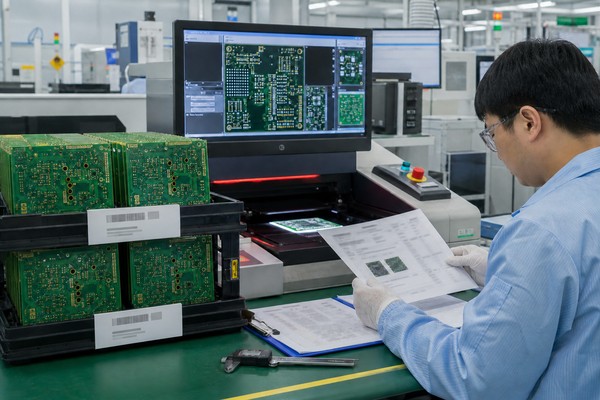
PCB quality control must connect the released data to material acceptance, process checks, product inspection, electrical verification, and shipment release. The RFQ should identify which controls are standard for the proposed route and which order-specific inspections or reports need additional planning.
- Incoming control: Match laminates, copper-clad materials, solder mask, surface-finish inputs, and purchased components to approved specifications or alternatives before use.
- CAM and process release: Release one approved dataset, stackup, tooling package, and traveler after engineering questions are closed.
- In-process verification: Define the measurements or coupons used to monitor dimensions, drilling, plating, registration, solder mask, controlled impedance, and other order-critical features.
- Bare-board inspection and test: State visual and dimensional criteria, electrical-test coverage, sampling, measurement locations, limits, and required report identity.
- Assembly controls: When PCBA is included, identify incoming component checks, solder-paste inspection, AOI, X-ray, programming, or functional test only where the design and acceptance plan require them.
- Release and change control: Link accepted lots and shipment documents to the approved revision, then require authorization for changes identified in the purchase agreement.
Electrical test confirms conductor-network continuity against the design data but does not replace dimensional, material, workmanship, or assembly checks. The inspection plan should therefore identify the risk addressed by each method and the evidence used for lot release.
How Does ISO 9001 Improve PCB Traceability and Production Consistency?
A controlled traceability plan connects the released revision, approved material, production route, inspection results, and shipped lot. Define the identification depth during quotation so the prototype records can become the controlled baseline for pilot and volume production.
| Order Stage | Control Objective | Expected Output |
|---|---|---|
| Prototype | Confirm design feasibility, manufacturing assumptions, and inspection access. | Resolved engineering questions, released files, and documented build observations |
| Pilot or Low Volume | Verify repeatability, approved materials, process settings, and record completeness. | Stable route, first-article results, controlled deviations, and production-ready documentation |
| Volume Production | Maintain the released baseline while monitoring lots, changes, and nonconformities. | Lot-linked inspection, test, release, and shipment records at the agreed level |
Traceability depth should match the product and contractual risk. A commercial prototype may need basic lot and revision identification, while a regulated or high-reliability program may require material batches, process route, operator or equipment records, inspection results, deviations, and shipment identity. Ask the supplier to demonstrate how a reported defect would be traced to the affected lot and released data.
What Quality Documents Can You Request From an ISO 9001 PCB Manufacturer?
Request the records needed to approve the lot, investigate a failure, or demonstrate compliance with the purchase requirements. Each document should identify the order or lot, applicable revision, test or inspection method, result, and acceptance basis.
- Certificate of conformance: Identify the purchase order, part number, revision, shipment lot, and requirement set covered by the declaration.
- Electrical-test record: Define test coverage, method, netlist identity, result, and board or lot relationship for opens-and-shorts verification.
- Visual and dimensional report: State the inspected drawing features, sampling, measured values, workmanship criteria, and acceptance limits.
- Material evidence: Request laminate, copper, finish, or other material certificates only where material identity is contractually controlled.
- Microsection or impedance report: When required, identify coupon or board location, measured features, target, tolerance, frequency, and acceptance result.
- PCBA inspection or test record: For assembly orders, define applicable AOI, X-ray, programming, functional test, fixture, firmware, test limits, and result format.
The certificate of conformance should identify the order or lot and the applicable requirement set. If raw measurement data, material evidence or inspection images are required, include them in the RFQ so the supplier can plan record generation and retention.
How Much Does It Cost to Work With an ISO 9001 PCB Manufacturer?
ISO 9001 certification is not a standalone line-item price; cost and lead time are driven by the board, order scope and evidence package operated within the QMS. Incomplete or conflicting inputs cause quote revisions because the manufacturer cannot select a stable process and inspection plan.
| Cost Driver | Commercial Impact | RFQ Input |
|---|---|---|
| Board Construction | Layer count, material, copper, via structure, finish, and tolerances determine process steps and yield margin. | Released stackup, fabrication drawing, and data package |
| Order Quantity | Tooling, engineering, and setup are distributed differently across prototype and production quantities. | Prototype, pilot, and forecast quantities |
| Inspection and Test | Coupons, microsections, impedance, special sampling, fixtures, and reports add planned work. | Method, frequency, limits, and required records |
| Documentation | Customer-specific certificates, raw data, retention, and approval packages require preparation and review. | Shipment-document checklist and retention period |
| Components and Assembly | Availability, approved alternatives, package types, programming, and functional test affect the PCBA route. | BOM, CPL, drawings, substitution rules, and test package |
| Schedule | Material procurement, engineering closure, fabrication, sourcing, assembly, inspection, and transport have separate durations. | Required delivery date and priorities |
Compare quotations only after confirming that suppliers priced the same specifications, quantities, inspection scope, documentation, and delivery point. A lower quote based on missing records or an unapproved material assumption is not the same offer.
An ISO 9001 PCB manufacturer can quote more accurately when technical requirements and shipment records are defined before engineering review rather than added after production planning.
Why Choose EBest Circuit as Your ISO 9001 PCB Manufacturer in China?
EBest Circuit combines an ISO 9001:2015-certified quality system with PCB engineering, fabrication, component sourcing, assembly, and prototype-to-volume support in China. The advantage is a single manufacturing response that connects technical feasibility, production scope, quality records, and commercial quotation to the same released project.
- Verified quality-system foundation: Buyers can review EBest Circuit’s ISO 9001:2015 certificate together with the legal entity, site, and service scope used for the order.
- Defined fabrication ranges: The current matrix covers FR4 and HDI fabrication, metal-core PCBs, and ceramic PCBs, including board size, thickness, trace and space, hole, aspect-ratio, impedance, and thermal limits that can be checked against the released design.
- One-stop PCB and PCBA scope: PCB design support, prototyping, fabrication, component sourcing, assembly, inspection planning, and shipment documentation can be coordinated through one supplier response.
- Controlled DFM and release: Engineering questions, proposed manufacturing adjustments, approved revisions, and superseded data can be resolved before production release.
- Prototype-to-volume continuity: Material, process, inspection, traceability, and document requirements can be identified during prototyping and retained as quantities increase.
- Order-specific evidence: Certificates, inspection results, electrical-test records, material evidence, and PCBA test records can be quoted according to the actual acceptance package rather than assumed after shipment.
Request EBest Circuit’s current ISO 9001:2015 certificate together with a marked-up stackup, manufacturing route, inspection plan, traceability fields, and deliverable list. This gives engineering, procurement, and quality teams one comparable package for supplier approval and quotation review.
What Files Should You Send to an ISO 9001 PCB Manufacturer?
Send one revision-aligned package that defines the product, quantity, acceptance criteria and required deliverables. The manufacturer can then return specific engineering questions and a quote based on an identifiable scope.
- Bare PCB: Gerber or ODB++, NC drill, netlist where available, fabrication drawing, stackup, controlled-impedance information, and panel requirements.
- Optional assembly scope: If PCBA is included, add the BOM with approved manufacturer part numbers, centroid or pick-and-place data, assembly drawings, polarity notes, and special handling requirements.
- Commercial: Prototype and production quantities, delivery destination, required date, and any forecast relevant to material planning.
- Quality: Applicable standards and class, inspection and test methods, sampling or full-test requirements, traceability level, and deviation-approval route.
- Deliverables: Certificate of conformance, test report, inspection data, material evidence, or other records required with the shipment.
If one item is not finalized, mark it as an open decision rather than leaving the supplier to infer it. The quotation should identify the assumption, its cost or schedule effect, and the approval needed before release.
FAQs About ISO 9001 PCB Manufacturers
Q1: Is ISO 9001 certification mandatory for every PCB purchase?
A1: Certification is required only when the contract, market, risk controls, or approved-supplier policy calls for it. When ISO 9001 is a sourcing requirement, identify the acceptable standard reference, legal entity, production site, service scope, and verification evidence before requesting or approving a quotation.
Q2: Can an ISO 9001 PCB manufacturer provide PCB assembly services?
A2: PCB assembly can be included when the supplier’s controlled scope supports the required PCBA processes. Confirm component sourcing, approved alternatives, workmanship criteria, inspection, programming, functional testing, traceability, and shipment records so the assembly quotation covers the complete acceptance package.
Q3: Does one ISO 9001 certificate cover every branch or factory?
A3: Coverage is limited to the entities and sites identified by the certificate and its scope. If quotation, fabrication, assembly, inspection, or shipment involves another location, request written confirmation of that site’s role, quality-system coverage, transferred requirements, and retained records before supplier approval.
Q4: Does ISO 9001 guarantee defect-free PCBs?
A4: ISO 9001 does not guarantee a defect-free PCB. Product conformity still depends on complete design inputs, capable manufacturing processes, appropriate inspection and testing, clear acceptance limits, and effective containment and corrective action when a nonconformity is found.
Q5: What certifications may matter in addition to ISO 9001?
A5: Additional credentials must match the market, product, and contract. Buyers may evaluate IATF 16949 for automotive supply chains, ISO 13485 for medical-device quality systems, AS9100D for aerospace quality management, UL recognition, RoHS, or REACH evidence where applicable. Verify the entity, site, scope, validity, and order relevance of each item.
Q6: Can the manufacturer substitute an equivalent laminate?
A6: A laminate substitution is acceptable only when the released requirements or buyer approval route permits it. The supplier should identify the proposed material, property comparison, stackup effect, impedance impact, availability, and approval status before purchasing or releasing the alternative to production.
Q7: How often should a supplier’s ISO 9001 certificate be rechecked?
A7: Recheck the certificate whenever its identity or validity may affect supplier approval. Minimum triggers include initial qualification, approaching expiry, a legal-entity or site change, a revised service scope, and the periodic interval defined by the approved-supplier program. Record the certificate identity, source, verification date, and reviewer.
Q8: Does an ISO 9001-certified supplier still need an initial-lot review?
A8: An initial-lot review remains necessary when the drawing, product risk, or buyer procedure requires it. The review checks whether the approved data, material, process route, inspection plan, and records produce an acceptable board before repeat orders or a higher-volume release.
Q9: Can a certificate of conformance replace detailed test reports?
A9: A certificate of conformance is sufficient only when the purchase agreement accepts it as the complete release evidence. If measured results, raw data, inspection images, impedance reports, or material certificates are required, list each document separately in the RFQ, quotation, and shipment-document checklist.
Q10: Who should approve a PCB manufacturing deviation?
A10: The buyer representative named by the contract or change-control procedure must approve the deviation. The documented disposition should identify the affected requirement, part and revision, quantity, lot, temporary or permanent status, acceptance rationale, expiry or review point, and required follow-up action.
Conclusion
EBest Circuit offers buyers a certified PCB manufacturing partner in China with defined process ranges for FR4 and HDI fabrication, metal-core PCBs, and ceramic PCBs, plus PCBA services, controlled engineering release, traceability, and order-specific records. The RFQ should connect the applicable process range to the exact board construction, quantities, acceptance criteria, changes, and evidence required for the project.
Send your Gerber or ODB++ package, drawing, stackup, BOM if assembly is required, quantities, acceptance criteria, and record list to sales@bestpcbs.com. Ask EBest Circuit for a marked-up manufacturing response, applicable certificate, inspection plan, and quotation tied to the released PCB or PCBA requirements.
You may also like




Tags: ISO 9001 PCB Manufacturer, pcb manufacturing in China, PCB Quality Control, PCB Traceability