
Industrial PCB manufacturing means building circuit boards for equipment where reliability, repeatability, traceability, and production readiness matter more than a simple low-cost board order. For buyers, the useful question is not only how a PCB is made. The better question is what must be checked before an industrial board is released to fabrication, assembly, inspection, and field use.
This guide is written for engineers, purchasing teams, and product teams preparing PCB builds for industrial controls, power modules, automation equipment, test instruments, LED systems, sensors, and embedded electronics. It gives a practical checklist for DFM, material choices, manufacturing files, inspection, supplier questions, and RFQ preparation.
Industrial PCB Manufacturing at a Glance
Industrial PCB manufacturing should connect design review, bare board fabrication, assembly planning, testing, and supplier communication into one controlled workflow. A board may pass a basic electrical test and still create problems if the stackup, thermal path, soldering method, component sourcing, or field environment was not reviewed early.
| Area | What to confirm | Why it matters for industrial projects |
|---|---|---|
| Design files | Gerber or ODB++, drill file, stackup, notes, drawing | Prevents missing data, wrong layer interpretation, and quote delays. |
| Build requirements | Layer count, copper, thickness, surface finish, impedance, material | Controls manufacturability, heat, mechanical fit, and repeatability. |
| Assembly inputs | BOM, CPL, polarity, placement notes, special soldering needs | Reduces component, orientation, soldering, and rework risk. |
| Quality control | Inspection method, test points, acceptance criteria, packaging | Improves consistency before boards reach equipment integration. |
When This Manufacturing Checklist Fits Your Project
This checklist fits projects where the PCB must work reliably inside industrial equipment, not only prove a circuit concept on a bench. It is useful when a failed board can stop a machine, create service cost, delay installation, or cause repeated field troubleshooting.
Use it before releasing boards for automation controllers, power conversion modules, control panels, instrumentation, industrial lighting, sensor interfaces, and other equipment that needs stable production. If your project also needs mounted components, compare the PCB build notes with the PCBA and PCB assembly service requirements before sending the RFQ.
Start With the Real Use Environment
The operating environment should guide PCB material, copper, spacing, coating, assembly, and testing decisions before the quote is finalized. Industrial boards may face heat, vibration, current load, dust, humidity, long service life, or maintenance constraints. These conditions can change the safest build approach.
Share the expected operating temperature range, enclosure type, airflow, power load, vibration exposure, connector stress, and installation environment where possible. Avoid turning these into vague notes such as “industrial grade” without explaining what the board must survive.
DFM Review Before Industrial PCB Production
DFM review checks whether the design can be manufactured consistently, inspected properly, and assembled without avoidable process risk. For industrial boards, DFM should happen before the purchase order, not after the supplier has already opened the job.
Important review points include annular ring, drill-to-copper clearance, solder mask bridges, copper balance, panelization, board outline, slot and cutout instructions, edge clearance, component-to-board edge distance, silkscreen clarity, test point access, and thermal copper behavior. The PCB design for manufacturability checklist is a useful supporting guide for the design-side review.
PCB Materials and Stackup Decisions
Material and stackup decisions should match the electrical, thermal, mechanical, and assembly needs of the industrial product. Standard FR-4 can be suitable for many projects, while high-Tg, high-frequency, metal-core, ceramic, flex, rigid-flex, or heavier copper constructions may be needed for specific operating conditions.
Do not rely on a supplier to guess the material path from the Gerber files alone. Provide target board thickness, copper weight, layer count, impedance needs, surface finish, soldering temperature exposure, and any thermal or mechanical constraints. Exact capability limits should be confirmed from the latest Best Technology process capability files before quoting, especially for special materials or non-standard structures.
Copper, Heat and Current-Carrying Requirements
Industrial PCB reliability often depends on whether the copper design, thermal path, and current load are treated as manufacturing requirements instead of late-stage troubleshooting topics. Power traces, connectors, MOSFETs, LEDs, relays, motor control sections, and high-current paths need early review.
For current-heavy or heat-sensitive designs, provide target current, expected temperature rise limits, copper weight expectations, thermal interface notes, enclosure information, and whether the board contacts a heat sink or metal chassis. This helps the supplier identify when heavier copper, wider traces, thermal vias, metal-core material, or layout changes may be needed.
Surface Finish, Solder Mask and Special Processes
Surface finish and special process choices should be selected for assembly method, shelf life, pad geometry, and product environment. The right finish for one prototype may not be the best choice for a production board with fine-pitch components, connectors, or repeated field service.
| Decision | Buyer question to ask | Risk if ignored |
|---|---|---|
| Surface finish | Does the finish match fine pitch parts, soldering method, shelf life, and cost target? | Poor solderability, pad flatness issues, or unnecessary cost. |
| Solder mask | Are mask dams, clearances, and openings suitable for the component pitch? | Solder bridging, exposed copper, or inspection confusion. |
| Special processing | Are slots, countersinks, impedance, peelable mask, or selective finish needs documented? | Quote revisions and manufacturing holds. |
Assembly Planning for Industrial PCB Builds
Assembly planning should connect BOM, CPL, placement drawings, soldering method, inspection access, and test coverage before production starts. Even when the first order is for bare boards, future assembly needs can influence panel design, fiducials, test pads, and connector placement.
For PCB assembly, prepare a clean BOM, CPL, assembly drawing, polarity notes, substitute approval rules, and packaging requirements. If the supplier is also expected to help source components, use the component sourcing service as a reference point for BOM availability, alternates, and purchasing constraints.
Inspection and Testing Requirements
Testing requirements should be defined before the order because industrial PCB quality depends on what is inspected, how defects are caught, and what acceptance criteria apply. A generic “test before shipment” request is not precise enough for many production boards.
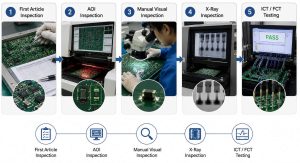
Common checks may include visual inspection, automated optical inspection, electrical test for bare boards, X-ray for hidden solder joints when needed, dimensional checks, and customer-defined functional testing. If functional testing is required, provide the test method, fixture needs, firmware, pass/fail limits, connector access, and safety precautions.
How to Compare Industrial PCB Manufacturing Suppliers
Compare suppliers by their ability to prevent production risk, not only by the lowest unit price. A suitable supplier should ask clarifying questions, flag missing data, explain manufacturing constraints, and document quote assumptions clearly.
- Can the supplier review Gerber or ODB++ files before production?
- Can they explain material, finish, copper, and stackup tradeoffs?
- Can they support both bare board fabrication and assembly when needed?
- Can they discuss inspection and testing based on the actual board risk?
- Do they provide clear communication when a requirement needs engineering confirmation?
- Do they avoid unsupported promises about lead time, certification, or yield?
What Determines Industrial PCB Manufacturing Cost?
Industrial PCB cost is shaped by board complexity, material choice, copper, finish, testing, assembly requirements, quantity, and how complete the RFQ package is. A cheap first quote can become expensive when missing assumptions are corrected later.
| Cost factor | Why it changes price | How to reduce quote uncertainty |
|---|---|---|
| Layer count and stackup | More layers and controlled builds need more process control. | Provide stackup expectations and impedance notes early. |
| Material and copper | Special materials and heavier copper affect sourcing and processing. | State material targets, copper weight, and thermal needs. |
| Surface finish | Finish affects assembly, shelf life, pad flatness, and cost. | Choose based on component pitch and product needs. |
| Testing | More inspection or functional checks add setup and labor. | Define the exact pass/fail criteria and test method. |
| Assembly and sourcing | BOM availability and assembly method affect schedule and price. | Send BOM, CPL, approved alternates, and sourcing rules. |
Files to Prepare for an Industrial PCB RFQ
A complete RFQ package lets the supplier quote the real project instead of quoting a partial guess. The more industrial risk your board carries, the more important it is to include the build notes and test expectations with the design files.
- Gerber or ODB++ fabrication data
- Drill files and board outline drawing
- Stackup, material, copper, finish, and thickness notes
- Controlled impedance requirements if applicable
- BOM, CPL, assembly drawing, and polarity notes for PCBA
- Quantity, prototype or production stage, and target delivery window
- Inspection, electrical test, functional test, packaging, and labeling requirements
If you prefer to prepare an online quote package first, the PCB manufacturer online guide explains how buyers can organize the same information before contacting a supplier.
Common Industrial PCB Manufacturing Risks
The most common risks are incomplete files, unclear operating conditions, weak DFM review, BOM uncertainty, unverified special processes, and vague testing requirements. These risks usually appear as quote revisions, production holds, rework, or field issues.
Do not hide uncertainty in short notes. If a requirement is not final, label it as a target and ask the supplier to confirm feasibility. If a component may change, define who approves substitutions. If a board has thermal or vibration exposure, explain the real use case instead of assuming the supplier will infer it from the layout.
Frequently Asked Questions About Industrial PCB Manufacturing
Is industrial PCB manufacturing different from standard PCB fabrication?
Yes. The fabrication steps may look similar, but industrial projects usually need more attention to operating environment, DFM, repeatability, material choices, current load, inspection, and long-term reliability.
Can one supplier handle both PCB manufacturing and assembly?
Yes, when the supplier supports both fabrication and PCBA. A combined path can reduce handoff problems because Gerber, BOM, CPL, assembly notes, and testing requirements can be reviewed together.
What should I send for an industrial PCB quote?
Send Gerber or ODB++, drill files, stackup notes, material and finish requirements, quantity, target schedule, and any testing or packaging requirements. For assembly, also send BOM, CPL, and assembly drawings.
Should I choose the cheapest industrial PCB supplier?
Not automatically. Low price is useful only when the quote includes the real material, process, inspection, assembly, and testing requirements. Compare assumptions before comparing unit price.
Final RFQ Recommendation
Before placing an industrial PCB manufacturing order, prepare the files and risk notes that let the supplier review the project as a real production build. A strong RFQ package should include Gerber or ODB++, drill data, stackup, material, copper, finish, BOM, CPL, drawings, quantity, testing requirements, packaging notes, and target delivery timing.
For an engineering review or quotation, send your Gerber or ODB++ files, BOM, CPL, mechanical drawings, quantity, material expectations, surface finish, test requirements, and target lead time to sales@bestpcbs.com. The Best Technology / bestpcbs team can review the manufacturing path, confirm what needs project-specific checking, and help you prepare the next industrial PCB build without relying on hidden assumptions.
You may also like



Tags: industrial pcb, pcb manufacturing, PCB Quality Control