





Circuit board ground plane is a key part of PCB stackup design, not just a large copper area connected to GND. It can be a bottom-side copper pour on a 2-layer PCB, a full internal ground layer in a multilayer PCB, or a mixed layer that combines GND copper with signal routing. For PCB and PCBA projects, the real question is not only what a ground plane is, but whether the design provides a stable ground reference for signal quality, EMC performance, impedance control, production reliability, and long-term use.
At EBest Circuit, also known as Best Technology, our engineering team helps customers review ground plane design together with PCB stackup, copper thickness, Core and Prepreg selection, impedance requirements, via structure, EMC risk, and manufacturability before production. We support FR4 PCB, high Tg PCB, impedance control PCB, heavy copper PCB, aluminum PCB, ceramic PCB, rigid-flex PCB, and turnkey PCBA services. If your project needs stackup review, grounding optimization, DFM checking, or PCB assembly support, please send your Gerber files, BOM, drawings, or technical requirements to sales@bestpcbs.com for a practical engineering review.
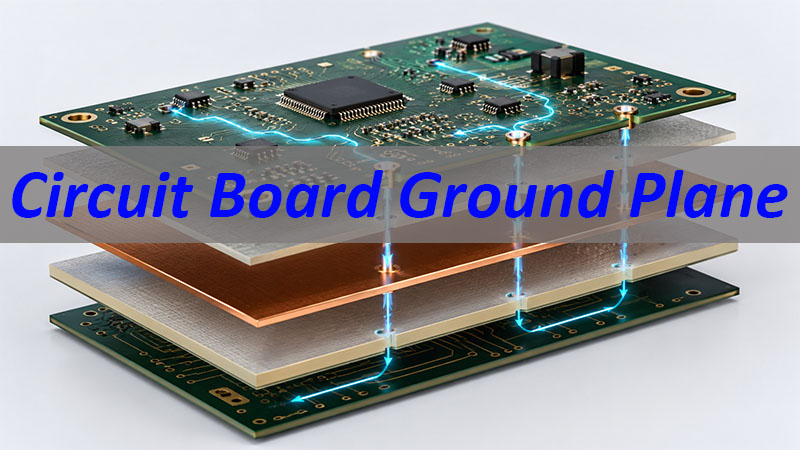
What Is a Circuit Board Ground Plane?
A circuit board ground plane is a copper area or copper layer connected to the GND net of a PCB. It provides a stable reference for signals and a low-impedance return path for current.
In a 2-layer PCB, the ground plane is usually a copper pour on one side of the board. In a 4-layer or multilayer PCB, it is often a dedicated inner ground layer. This dedicated layer is usually more stable because it is less interrupted by routing traces, pads, and component placement.
From a customer’s point of view, the most important thing is not whether the design has “some GND copper.” The key is whether the ground copper is continuous enough to support the signal, power, EMC, and manufacturing requirements of the product.
A ground plane should be reviewed together with PCB layer count, board thickness, copper thickness, Core, Prepreg, impedance requirements, via structure, and copper balance.
Why Does a Ground Plane Matter to PCB Buyers?
A good ground plane helps reduce electrical and production risks before the PCB enters fabrication.
- For electrical performance, it provides a stable signal reference. High-speed traces, clock lines, RF circuits, ADC/DAC circuits, and communication interfaces all need a clean reference plane. If the reference is broken, the signal may become unstable, noisy, or difficult to control.
- For EMC, the ground plane helps reduce current loop area. Smaller loop area usually means lower radiation and better noise control. This is important for industrial control, medical electronics, automotive electronics, power supplies, and products that need EMC testing.
- For manufacturing, the ground plane also affects copper distribution and lamination. A large copper area may influence resin flow, board flatness, and copper balance. This is why PCB manufacturers check ground layers together with stackup and material structure, not only as an electrical net.
In short, the ground plane affects both how the PCB works and how the PCB is built.
How Do PCB Manufacturers Check the Ground Plane from Customer Files?
When a PCB factory reviews a project, engineers usually check Gerber or ODB++ files, drill files, stackup drawings, impedance tables, fabrication notes, and customer specifications together.
They mainly look for four things.
- First, they confirm which layer is GND, which layer is power, and which layer is signal. If the layer naming is unclear, the engineering team may need to pause the review and ask the customer for confirmation.
- Second, they check whether the ground plane is continuous under important signal traces. A high-speed trace routed over a split or broken ground plane may cause return path and EMI problems.
- Third, they check whether the ground plane can support impedance control. Controlled impedance traces need a clear reference plane. If the reference plane has gaps or mixed copper, the final impedance may not match the expected value.
- Fourth, they check whether copper distribution is manufacturable. Large copper areas, heavy copper, and uneven residual copper can affect lamination and warpage.
A complete file package helps reduce these questions. For complex boards, customers should provide Gerber or ODB++, drill files, stackup drawing, board thickness, copper thickness, impedance requirement, material notes, and any EMC or high-current requirements.
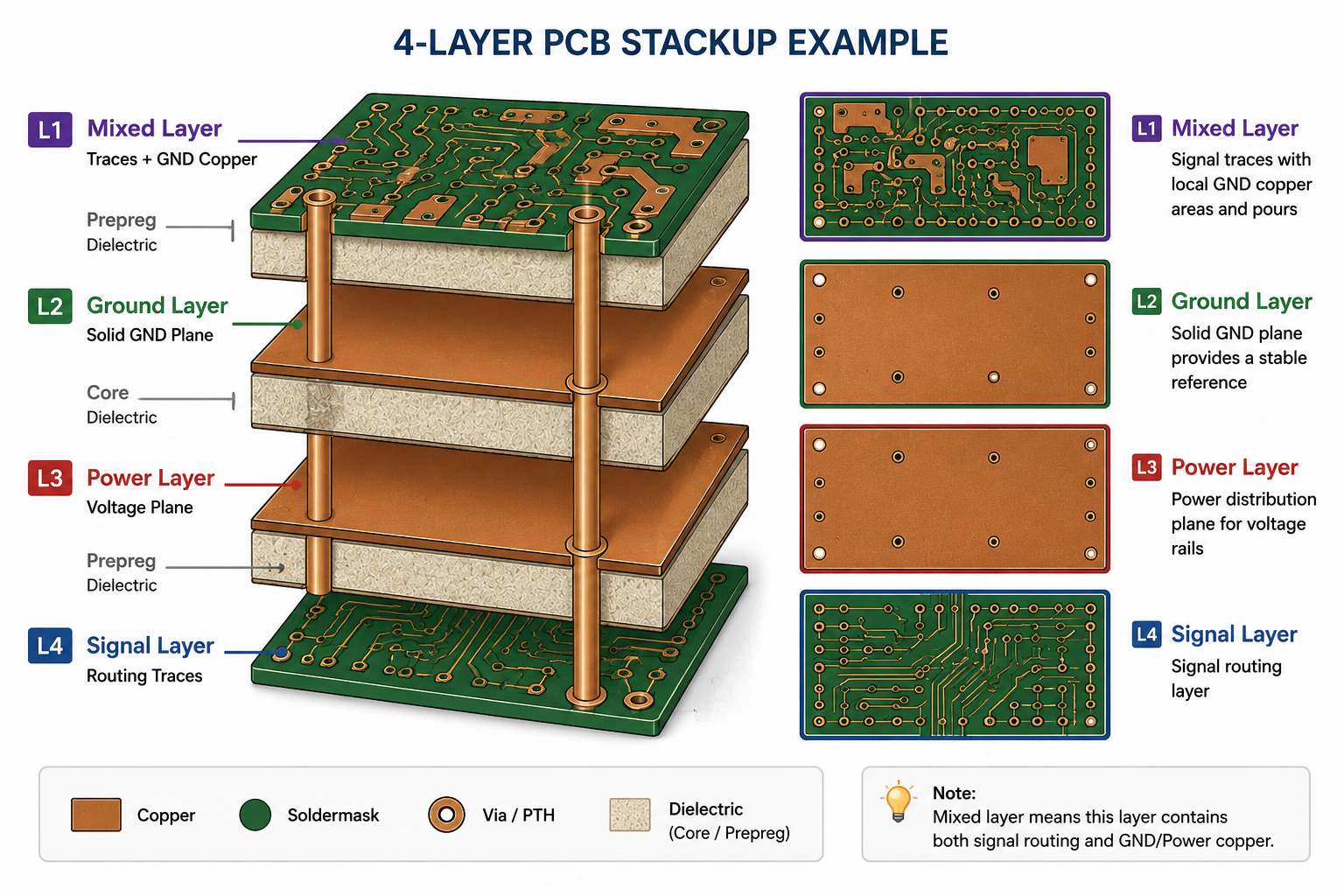
Ground Layer, Power Layer, Signal Layer, and Mixed Layer: What Should Customers Know?
In a PCB stackup, not every copper layer has the same purpose.
- A Ground Layer is connected to GND and usually works as the main reference plane.
- A Power Layer distributes voltage such as 3.3V, 5V, 12V, or other power rails.
- A Signal Layer carries routing traces for digital, analog, RF, clock, or control signals.
- A Mixed Layer contains signal routing together with GND or power copper.
This distinction is important because a mixed layer should not automatically be treated as a full ground plane. If signal traces cut through the GND copper, the return path may become less stable. If an impedance trace references a mixed layer with copper gaps, the impedance result may change.
For customers, the key check is simple: each important signal layer should have a clear and stable reference plane. This is especially important for high-speed, impedance-controlled, RF, and EMC-sensitive boards.
When Does a PCB Need a Dedicated Ground Plane?
Not every PCB needs a dedicated internal ground plane. Some simple products can work well with a 2-layer board and a good ground pour. But when the product has higher signal speed, higher current, stronger noise, or stricter EMC requirements, a dedicated ground layer becomes much more useful.
| PCB Condition | Better Ground Strategy |
|---|---|
| Simple low-speed board | 2-layer ground pour may be enough |
| Switching power circuit | Keep power loop and GND return short |
| USB, Ethernet, HDMI, DDR, RF | Use a dedicated ground layer |
| Controlled impedance PCB | Use a clear reference plane |
| Medical, automotive, industrial PCB | Prefer stable multilayer GND reference |
| Heavy copper or high-current PCB | Review copper thickness, PP, and lamination |
A 4-layer PCB is often a practical upgrade from a 2-layer PCB. A common structure is top signal layer, inner ground layer, inner power layer, and bottom signal layer. This gives important signals a nearby reference plane and makes EMC control easier.
For customers, the decision should not be based only on PCB unit price. If a 2-layer board causes repeated EMC failure, signal instability, or layout redesign, the total project cost may become higher than using a proper multilayer stackup from the beginning.
How Does the Ground Plane Affect Return Path and Impedance?
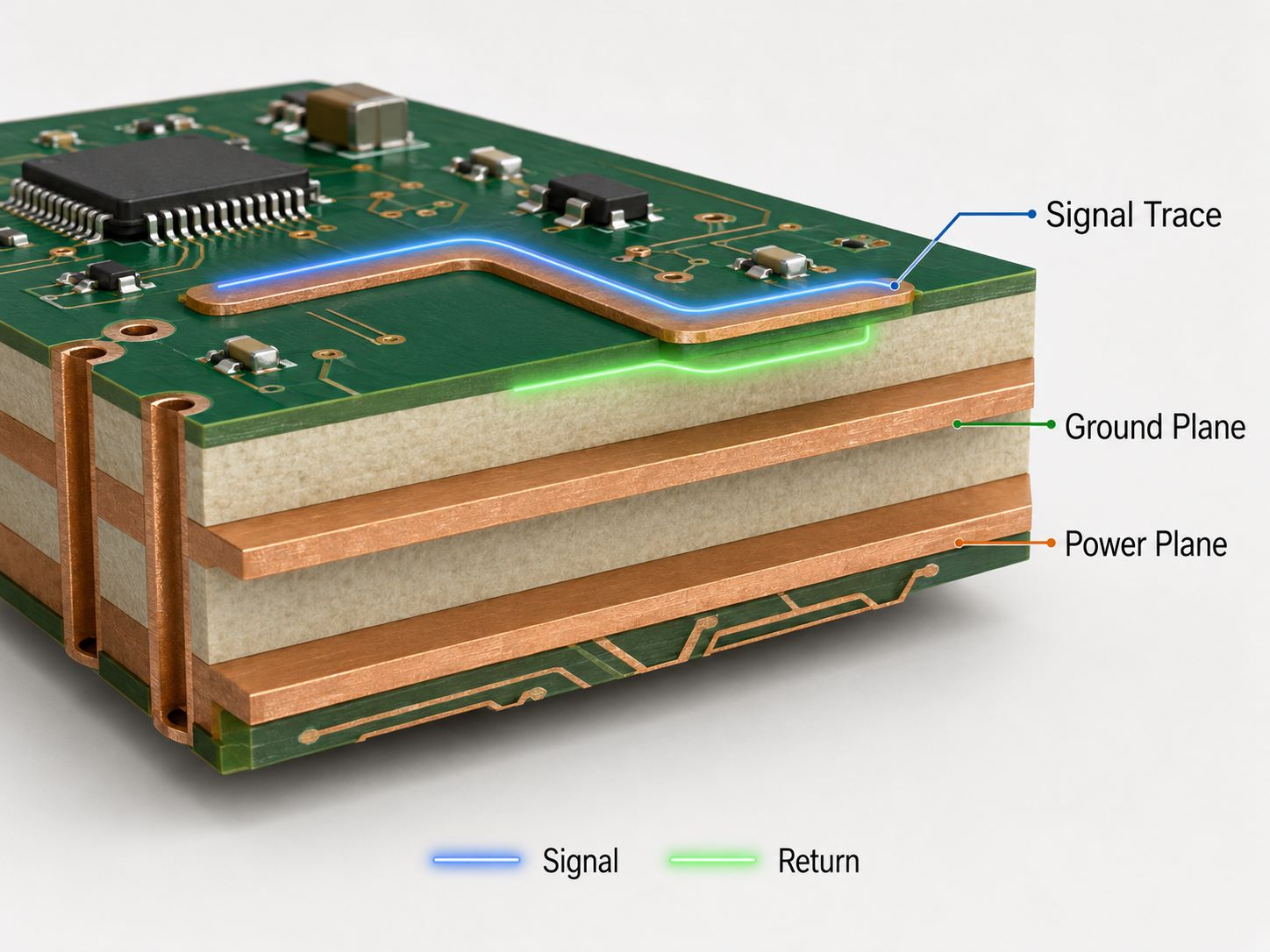
Every signal current needs a return path. In high-speed PCB design, the return current usually flows through the nearest reference plane, often directly under the signal trace.
If the signal has a continuous ground plane nearby, the return path is short and predictable. This reduces loop area, lowers radiation, and improves signal stability.
If the ground plane is cut, split, or missing under the trace, return current must detour. The trace may look fine in the layout, but electrically the loop becomes larger. This may cause EMI, crosstalk, impedance discontinuity, or unstable communication.
For impedance control, the ground plane is part of the transmission structure. Trace width, spacing, copper thickness, dielectric thickness, material dielectric constant, and distance to the reference plane all affect impedance. If the reference plane is not stable, impedance control becomes less predictable.
For layer changes, ground vias are also important. When a high-speed trace changes layers through a via, nearby GND vias help provide a clean return path between reference planes.
How Does a Circuit Board Ground Plane Affect EMC?
A circuit board ground plane affects EMC by controlling return current and reducing loop area. Large current loops behave like small antennas. When return current is forced to travel through a long or broken path, the PCB may radiate more noise.
This is where the importance of ground plane in PCB EMC design becomes clear. Ground plane design is not only about shielding. It also affects return current, common-mode noise, connector grounding, cable radiation, decoupling performance, and high-frequency stability.
Many EMC problems do not happen because the board has no GND. They happen because the GND path is poorly controlled. Typical examples include high-speed traces crossing split ground, switching current returning through a large loop, weak connector grounding, or shield copper with too few ground vias.
A good ground plane helps, but it cannot solve EMC alone. It must work with proper stackup, routing, decoupling capacitors, filtering, shielding, enclosure design, and cable grounding.
For PCBA projects, connector areas deserve special attention. Cables can easily become radiation paths. Stable ground copper, suitable via stitching, and a clear chassis ground strategy can reduce this risk.
Can a Large Ground Plane Create Manufacturing Problems?
Yes, if it is not reviewed properly.
- A large ground plane is usually good for electrical performance, but it may affect manufacturing when copper distribution is unbalanced or copper thickness is high.
- One concern is copper balance. If one layer has a nearly full copper plane while another layer has very little copper, the board may become less balanced during lamination. This can increase warpage risk, especially for thin, large, multilayer, or heavy copper boards.
- Another concern is resin filling. For heavy copper ground planes, Prepreg resin must flow properly between copper areas during lamination. If the resin amount is not enough, the board may face voids, weak bonding, or reliability issues. When copper thickness reaches 2oz or above, the stackup may need higher-resin PP or a suitable PP combination.
- Large ground copper can also affect soldering. Pads directly connected to large copper areas may lose heat quickly during assembly. For some pads, thermal relief can improve solderability. For high-current terminals, solid connection may still be required. The choice depends on current, heat, assembly, and reliability needs.
This is why a PCB manufacturer reviews the ground plane not only as a GND net, but also as part of the physical stackup.
What Ground Plane Mistakes Are Common in DFM Review?
Several ground plane issues often appear during DFM or engineering review.
- A high-speed trace crosses a split ground plane. This breaks the return path and may create EMI or signal integrity problems.
- A 2-layer board has too many traces cutting through the bottom GND copper. The board may pass continuity testing, but the return path becomes long and weak.
- A copper island is left floating. Floating copper can pick up or radiate noise, so it should be removed or connected to GND with enough vias.
- Ground vias are too few. Weak via connection between GND copper areas may reduce shielding and return path continuity.
- Connector grounding is incomplete. Since cables can radiate noise, connector ground, shield pins, chassis ground, and nearby GND vias should be reviewed carefully.
- Heavy copper GND is not matched with proper PP selection. This may increase resin filling or lamination risk.
These issues are not always obvious from a simple PCB screenshot. They require checking Gerber layers, stackup, copper distribution, via placement, and design intent together.
What Should Customers Confirm Before PCB Production?
Before production, customers should confirm the information that directly affects ground plane performance and manufacturability.
The most important items are board thickness, layer count, ground layer position, power layer position, copper thickness, Core and Prepreg structure, dielectric spacing, impedance requirements, via structure, material grade, and copper balance.
- For controlled impedance boards, the customer should clearly state the impedance value, tolerance, routing layer, trace width, spacing, and reference plane.
- For high-current PCB boards, the customer should mark current paths, finished copper thickness, via requirements, thermal pads, connector areas, and any special soldering needs.
- For EMC-sensitive boards, the customer should provide grounding, shielding, connector, chassis ground, and testing requirements if available.
- For special materials or non-standard stackups, early confirmation is important. Many PCB factories use common Core, PP, and copper foil materials to shorten lead time. Non-standard material may increase cost or delivery time.
Clear information helps the PCB manufacturer review the design faster and reduces repeated engineering questions.
FAQs about Circuit Board Ground Plane
Q1: What is a circuit board ground plane?
A circuit board ground plane is a copper area or copper layer connected to GND. It provides a stable reference and a low-impedance return path for current.
Q2: Is ground copper pour the same as a ground plane?
Not always. Ground copper pour can act as a ground area, especially on a double layer PCB. A dedicated ground plane usually means a more continuous copper layer in a multilayer PCB.
Q3: Does every PCB need a dedicated ground plane?
No. Simple low-speed PCBs may use ground pour only. High-speed, RF, controlled impedance, automotive, medical, and EMC-sensitive PCBs usually benefit from a dedicated ground layer.
Q4: Why does a ground plane matter for impedance control?
Controlled impedance traces need a clear reference plane. The trace width, copper thickness, dielectric spacing, and distance to the ground plane all affect impedance.
Q5: Can a power plane replace a ground plane?
Usually not. A power plane can sometimes act as an AC reference when properly coupled with ground, but it should not be treated as a direct replacement for a continuous ground plane.
Q6: Should analog ground and digital ground be split?
It depends on the circuit. Poorly split ground can break return paths and increase noise. Careful placement and controlled return current are often more important than simply cutting the ground plane.
Q7: What is PCB ground plane via stitching?
Via stitching means using multiple GND vias to connect ground copper across layers. It improves grounding, shielding, and return path continuity.
Q8: Can a large ground plane affect PCB manufacturing?
Yes. Large or heavy copper ground planes may affect copper balance, resin filling, lamination stability, warpage, and soldering behavior.
Q9: What should I send to a PCB manufacturer for ground plane review?
Send Gerber or ODB++ files, drill files, stackup drawing, board thickness, copper thickness, impedance requirements, material notes, and any EMC or high-current requirements.
In closing, a circuit board ground plane is not just a copper area connected to GND. For real PCB and PCBA projects, it affects stackup design, return path control, EMC performance, impedance stability, copper balance, solderability, and manufacturing reliability.
For simple low-speed boards, a 2-layer ground pour may be enough. For high-speed, RF, controlled impedance, medical, automotive, industrial, power electronics, or EMC-sensitive products, a dedicated ground layer in a clear multilayer stackup is usually the safer choice.
The most practical approach is to review the ground plane together with layer assignment, Core, Prepreg, copper thickness, dielectric spacing, via structure, impedance requirements, copper distribution, and DFM rules before production.
EBest Circuit, also known as Best Technology, provides PCB manufacturing and PCB assembly services for FR4 PCB, high Tg PCB, impedance control PCB, aluminum PCB, copper core PCB, ceramic PCB, heavy copper PCB, rigid-flex PCB, and turnkey PCBA. If your project needs stackup review, grounding optimization, impedance control, EMC improvement, or manufacturability checking, you can send your Gerber files, BOM, drawings, and technical requirements to our engineering team for a practical review.
You may also like




Tags: Circuit Board Ground Plane, Ground Plane, ground plane circuit board