





High current PCB assembly is essential for power electronics that are becoming smaller, faster, and more demanding. From EV charging systems and industrial control boards to battery management systems, inverters, LED drivers, and energy storage equipment, many products need to carry higher current while maintaining stable electrical and thermal performance. Compared with standard PCB assembly, it requires closer attention to copper thickness, trace width, copper area, component layout, soldering method, thermal path, connector strength, and final testing.
EBest Circuit provides high current PCB assembly service for power electronics, EV, industrial control, energy storage, and high-power applications. We support heavy copper PCB, copper core PCB, aluminum PCB, ceramic PCB, copper busbar structures, SMT assembly, DIP assembly, selective soldering, functional testing, and engineering review before production. If your project involves high current, heat dissipation, thick copper, power terminals, or complex PCBA assembly, you can send your Gerber files, BOM, drawings, or technical requirements to sales@bestpcbs.com for a practical review.
What Is High Current PCB Assembly?
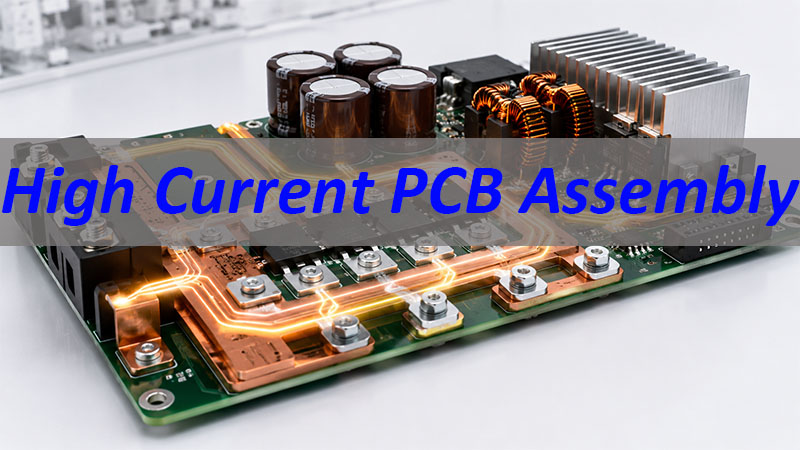
High current PCB assembly refers to the manufacturing and assembly of printed circuit boards designed to carry higher electrical current than standard PCBs. These boards are often used in power conversion, power distribution, motor control, battery systems, automotive electronics, and industrial equipment.
In a normal PCB, copper traces are mainly used for signal transmission and moderate power delivery. In a high current design, copper paths must carry larger current with controlled voltage drop and acceptable temperature rise.
A high current PCBA may include:
- Heavy copper PCB
- Copper busbar PCB
- Copper core PCB
- Aluminum PCB
- Thick copper traces
- Wide power planes
- High-current terminals
- Power connectors
- MOSFETs, IGBTs, relays, inductors, and large capacitors
- Heat sinks, thermal pads, or metal substrates
The goal is simple: the assembled board should conduct current safely, dissipate heat efficiently, and maintain stable performance during long-term operation.
High current PCB assembly is not only an SMT process. It often combines PCB manufacturing, power component assembly, through-hole soldering, wave soldering, selective soldering, manual soldering, thermal design review, and functional testing.
When Do You Need High Current PCB Assembly Service?
You may need a high current PCB assembly service when your product involves high power, high load, or high temperature operation.
Typical signs include:
- The PCB carries several amps to hundreds of amps
- The design uses thick copper or large copper areas
- The board includes power terminals, relays, MOSFETs, or IGBTs
- Heat generation is a key design concern
- The product is used in EV, energy storage, industrial control, or power supply systems
- The PCB requires copper busbars or embedded copper structures
- The board needs both PCB fabrication and complete assembly support
Many customers come to a supplier only after they already have Gerber files and BOM. For high current projects, it is better to involve the supplier earlier. A practical engineering review before production can help check trace width, copper thickness, solder pad design, component spacing, current path, heat dissipation, and assembly feasibility.
This is especially important when the board includes large terminals, high-power connectors, tall components, metal parts, or mixed SMT and DIP assembly. These details may influence stencil design, solder paste volume, fixture design, reflow profile, wave soldering process, and final inspection.
What Makes High Current PCBA Different from Standard PCBA?
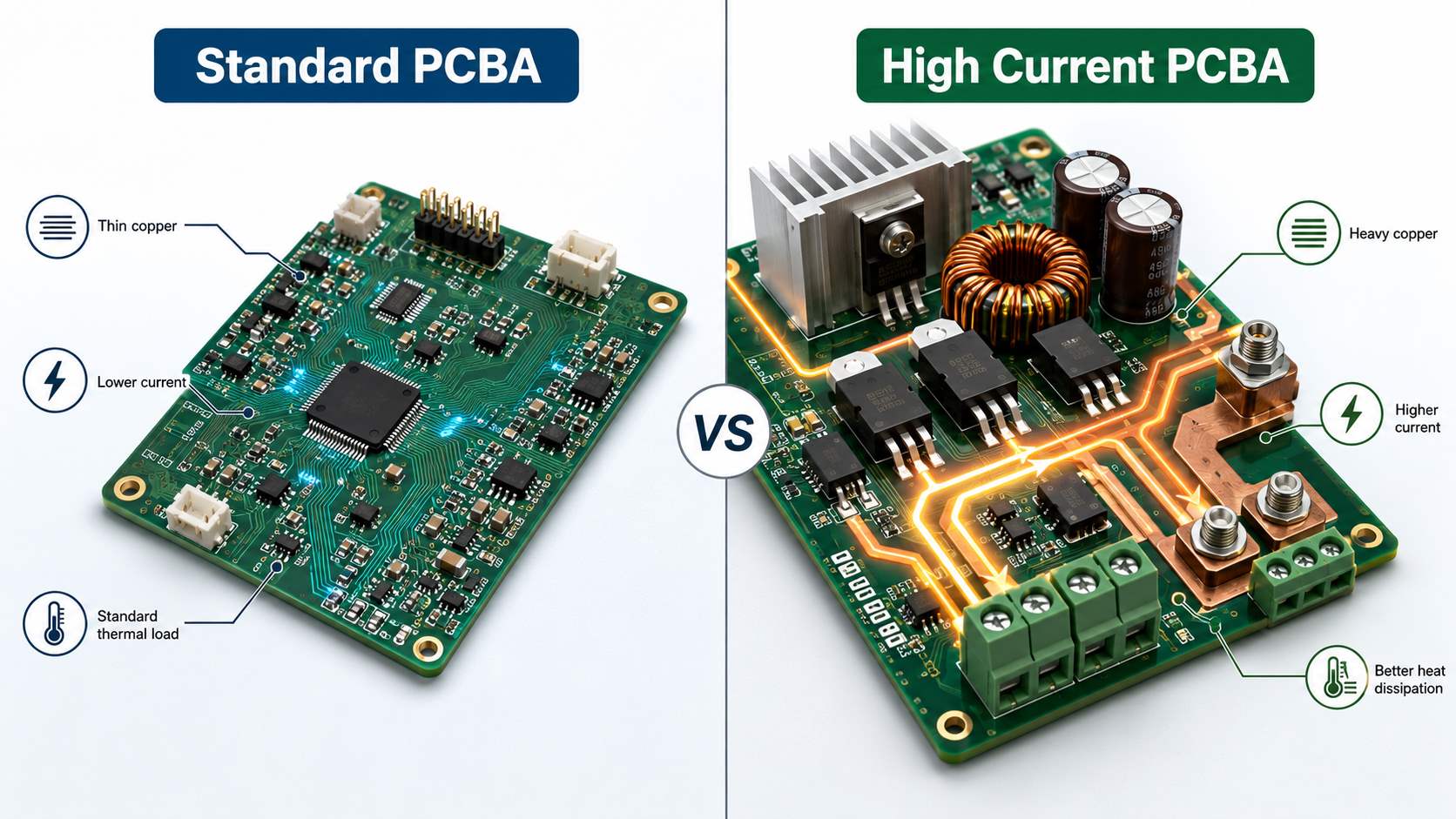
The main difference is that high current PCBA must manage both electrical load and thermal stress.
A standard PCBA focuses more on component placement, signal connection, soldering quality, and functional performance.
A high current PCBA must also answer several engineering questions:
- Can the copper path carry the required current?
- Is the voltage drop acceptable?
- Will the board temperature remain within the safe range?
- Are connectors and terminals strong enough for repeated use?
- Can large components be soldered reliably?
- Is the heat path short and efficient?
- Can the assembled board pass functional and load testing?
In high current PCB assembly, copper design is only one part of the solution. Assembly quality also matters. Large copper areas can absorb more heat during soldering. Thick copper boards may need adjusted reflow profiles. Large components may require stronger mechanical support. Power terminals may need selective soldering, wave soldering, or hand soldering depending on the structure.
The inspection process is also different. Besides AOI and visual inspection, high current PCBA may require:
- X-ray inspection for hidden solder joints
- First article inspection
- Continuity test
- Functional test
- Load test
- Thermal check
- Solder joint strength review
- Connector and terminal inspection
For this reason, choosing a supplier only by unit price may create hidden risks. A reliable high-current PCBA supplier should understand how PCB structure, assembly process, and testing work together.
What PCB Structures Are Used in High Current Applications?
Different high current applications need different PCB structures. There is no single structure that fits every project. The right choice depends on current level, voltage, heat generation, board size, mechanical space, cost target, and application environment.
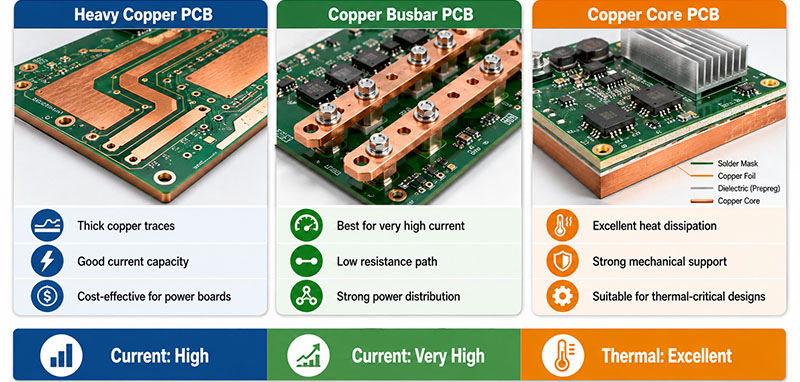
Heavy Copper PCB
Heavy copper PCB is one of the most common choices for high current circuits. It uses thicker copper than standard PCB, such as 2 oz, 3 oz, 4 oz, 6 oz, or even higher copper thickness depending on the design.
Heavy copper helps:
- Carry higher current
- Reduce conductor resistance
- Improve heat spreading
- Strengthen power traces and pads
- Support robust power electronics design
It is widely used in power supplies, industrial control, automotive electronics, battery systems, and high-current control boards.
Copper Busbar PCB
Copper busbar PCB uses copper bars or thick copper conductors to carry large current. Compared with ordinary traces, a copper busbar provides a stronger and more direct current path.
This structure is suitable for applications where current is too high for standard copper traces alone. It can be used in power distribution boards, EV systems, energy storage, battery packs, and high-power modules.
Copper busbar PCB can help reduce resistance, improve current distribution, and support compact power designs.
Copper Core PCB
Copper core PCB uses a copper base or copper core as part of the board structure. It provides excellent thermal conductivity and mechanical strength. This type of PCB is useful when both high current and heat dissipation are critical.
Copper core PCB is often used in power modules, LED systems, automotive electronics, motor controllers, and other high-thermal-load applications.
Aluminum PCB
Aluminum PCB is commonly used when heat dissipation is more important than complex multilayer routing. It is widely applied in LED lighting, power supplies, automotive lighting, and industrial power products.
Compared with copper core PCB, aluminum PCB usually offers a more cost-effective thermal solution. But copper has better thermal and electrical conductivity, so copper-based structures are preferred for more demanding power designs.
Hybrid High Current PCB Structures
Some projects may use a combination of structures, such as heavy copper plus copper busbar, copper core plus FR4 layers, or metal substrate plus power terminals. These hybrid structures are often used when the board must balance current capacity, signal routing, heat dissipation, and mechanical assembly.
For this type of project, early communication between the customer and supplier is very important.
Heavy Copper PCB, Copper Busbar PCB, or Copper Core PCB: Which Is Better?
The best structure depends on the actual working conditions. Buyers should not choose only by material name. They should choose according to current, heat, structure, space, and cost.
| PCB Structure | Main Advantage | Suitable Applications |
|---|---|---|
| Heavy copper PCB | Higher current capacity and stronger copper traces | Power supply, industrial control, battery systems |
| Copper busbar PCB | Excellent current path for very high current | EV, energy storage, power distribution |
| Copper core PCB | Strong thermal conductivity and mechanical support | Power modules, automotive, high-power LED |
| Aluminum PCB | Cost-effective heat dissipation | LED lighting, power boards, automotive lighting |
| Standard FR4 PCB | Good for general electronics and control circuits | Low to medium power PCBA |
If your design needs moderate high current, heavy copper PCB may be enough. If the current is much higher and space is limited, copper busbar PCB may be more suitable. If heat is the biggest concern, copper core PCB or aluminum PCB may be better.
In many real projects, the final solution is not decided by one parameter. For example, a power control board may need heavy copper for current carrying, thermal vias for heat transfer, large pads for MOSFETs, and selective soldering for high-current terminals.
A good supplier should help review the complete structure instead of simply producing the file as received.
How Does High Current PCB Assembly Improve Power and Thermal Performance?
High current PCB assembly improves performance by optimizing the current path, reducing resistance, and supporting better heat dissipation.
In a power circuit, high resistance can create heat and voltage drop. Wider traces, thicker copper, copper planes, and busbar structures help reduce resistance. This allows current to flow more smoothly and supports better power efficiency.
Thermal performance is another key point. High-power components generate heat during operation. If heat stays around MOSFETs, IGBTs, diodes, resistors, or connectors, the board may age faster or become unstable. A well-designed high current PCBA uses proper copper distribution, thermal vias, metal substrates, heat sinks, and component spacing to move heat away from critical areas.
Assembly also affects thermal performance. Poor solder joints, insufficient solder volume, weak terminal soldering, or uneven heating during production can increase risk. For large copper boards, the soldering process must be controlled carefully because copper absorbs heat quickly.
Important assembly considerations include:
- Proper stencil thickness and aperture design
- Suitable solder paste volume for power pads
- Reflow profile adjustment for thick copper boards
- Strong soldering for high-current terminals
- Fixture design for heavy or tall components
- Inspection of solder wetting and joint strength
- Functional and load testing after assembly
A reliable process helps the PCBA maintain stable electrical and thermal performance in real working conditions.
What Should Buyers Check Before Choosing a High-Current PCBA Supplier?
When choosing a high-current PCBA supplier, buyers should look beyond basic SMT capability. High current projects need stronger engineering support.
Here are the key points to check.
PCB Manufacturing Capability
- The supplier should support heavy copper PCB, thick copper plating, copper busbar PCB, copper core PCB, aluminum PCB, or other power PCB structures. If the supplier only provides standard FR4 PCB assembly, they may not be suitable for complex high current projects.
DFM and Engineering Review
- A good supplier should review Gerber files, BOM, stack-up, copper thickness, component layout, current path, solder pad size, and assembly process before production. This step helps reduce design and production risks.
Component Assembly Capability
- High current PCBA often includes large capacitors, relays, connectors, terminals, transformers, inductors, MOSFETs, and heat sinks. The supplier should support SMT, DIP, wave soldering, selective soldering, manual soldering, and mixed assembly.
Thermal Management Experience
- The supplier should understand thermal paths, copper area design, metal substrates, thermal vias, heat sink assembly, and material selection. Thermal experience is especially important for EV, industrial, power supply, and LED applications.
Testing Capability
- High current boards often require more than standard visual inspection. Ask whether the supplier can support AOI, X-ray, first article inspection, functional test, continuity test, load test, and customized test fixtures.
Supply Chain and BOM Support
- Power components may have long lead times or special sourcing requirements. A capable supplier should help review BOM availability, alternative parts, package compatibility, and assembly risk before production.
Communication Quality
- For high current projects, clear communication saves time. The supplier should be able to understand technical drawings, current requirements, thermal requirements, and assembly notes. Fast quotation is useful, but accurate engineering feedback is more valuable.
Common Applications of High Current PCB Assembly
High current PCB assembly is widely used in products that require stable power delivery and reliable thermal management.
EV and Automotive Electronics
- Electric vehicles, charging piles, battery systems, motor controllers, and automotive power modules often require high current PCBA. These applications need strong current carrying ability, stable connections, and reliable heat dissipation.
Energy Storage Systems
- Energy storage equipment uses high current boards for battery management, power distribution, charging control, and protection circuits. Copper thickness, connector strength, and thermal design are important for long-term operation.
Industrial Control
- Industrial equipment often works under continuous load. High current PCBA is used in motor drives, automation systems, control cabinets, power controllers, and heavy-duty electronic modules.
Power Supplies and Inverters
- Switching power supplies, DC-DC converters, AC-DC modules, UPS systems, and inverters all require reliable power paths. Good PCB assembly helps improve efficiency and reduce thermal stress.
LED Power and Lighting Systems
- High-power LED products need effective heat dissipation and stable current control. Aluminum PCB, copper core PCB, and high current assembly are often used in LED drivers, automotive lighting, street lighting, and industrial lighting.
Medical and Communication Equipment
- Some medical devices and communication systems include power modules that require stable current output. For these applications, reliability and process control are especially important.
High Current PCBA Manufacturing and Assembly Capabilities
High current PCB assembly requires more than standard SMT production. It needs the right PCB structure, copper thickness, soldering process, thermal design, and testing method. EBest Circuit supports customers from PCB fabrication to PCBA assembly, helping reduce risks before production.
Our high current PCBA capabilities include:
- PCB fabrication support
We support FR4, high Tg FR4, halogen-free FR4, heavy copper PCB, copper core PCB, aluminum PCB, ceramic PCB, and multilayer PCB structures. - Heavy copper and power PCB manufacturing
We can support heavy copper PCB requirements, copper busbar structures, copper core designs, and other power PCB solutions according to current, heat, and layout needs. - Multilayer PCB production
We support multilayer PCB manufacturing for designs that combine power circuits, control circuits, and signal layers in one board. - SMT and DIP assembly
We provide SMT assembly, DIP assembly, and mixed assembly for high current PCBA projects with both small electronic components and large power parts. - Power component assembly
We can assemble MOSFETs, IGBTs, relays, inductors, transformers, large capacitors, screw terminals, power connectors, heat sinks, and thermal pads. - Soldering process support
We support reflow soldering, wave soldering, selective soldering, and manual soldering for special components or high-current terminals. - Thermal management review
Our team can review copper area, trace width, thermal vias, heat sink position, material selection, and component layout to improve heat dissipation. - Inspection and testing
We support AOI inspection, X-ray inspection, visual inspection, first article inspection, continuity testing, functional testing, and customized test fixture support. - Engineering review before production
Before production, we can review Gerber files, BOM, pick-and-place files, assembly drawings, copper thickness, current requirements, thermal requirements, and testing needs.
For high current PCB assembly projects, complete technical information helps us provide a more accurate review. You can send your Gerber files, BOM, drawings, current requirements, and thermal requirements to sales@bestpcbs.com for an engineering review and quotation.
Case Study: How EBest Circuit Supports High Current PCB Assembly Projects
High current PCB assembly requires careful review before production. Copper thickness, stack-up, via structure, hole tolerance, soldering process, and testing requirements can all affect current carrying, heat dissipation, and long-term reliability.
One project we supported was a 12-layer PCB using FR4 Tg180 material, 2.0 mm board thickness, ENIG surface finish, IPC Class 3 standard, blind vias, buried vias, and resin-filled vias with plated-over copper. Before production, EBest Circuit prepared the production stack-up and manufacturing documents for customer confirmation.
During the engineering review, our team checked key details such as outer-layer copper thickness, via tolerance, test coupon requirements, warpage risk, and hole plating thickness. When some specifications were not fully clear, we confirmed them with the customer through engineering questions before manufacturing started.
This process is also important for high current PCBA projects. If the board includes thick copper, power terminals, MOSFETs, IGBTs, relays, large capacitors, heat sinks, or copper busbar structures, both PCB fabrication and PCBA assembly must be reviewed together.
For high current PCB assembly, EBest Circuit can help review:
- Copper thickness and current path
- PCB stack-up and material selection
- Blind vias, buried vias, and plated-through holes
- Resin-filled via and plated-over process
- Hole tolerance and plating requirements
- High-current component pads and terminals
- Heat dissipation design
- Assembly and testing requirements
By reviewing these details before production, EBest Circuit helps customers reduce manufacturing risks and improve production consistency. If your project involves high current, thick copper, copper busbar, copper core PCB, or complex power PCBA, you can send your Gerber files, BOM, drawings, and technical requirements to sales@bestpcbs.com for an engineering review and quotation.
Why Choose EBest Circuit for High Current PCB Assembly Service?
EBest Circuit supports high current PCB and PCBA projects from prototype to production. Our team can provide PCB fabrication, component sourcing, SMT assembly, DIP assembly, testing, and engineering review for power electronics applications.
We support different PCB structures used in high current designs, including heavy copper PCB, copper core PCB, aluminum PCB, ceramic PCB, FR4 PCB, rigid-flex PCB, and special copper structures. For projects with higher current or thermal requirements, we can help review copper thickness, stack-up, trace width, component placement, soldering method, and heat dissipation design before production.
Our high current PCB assembly service is suitable for:
- Power electronics PCBA
- EV and automotive electronics
- Battery management systems
- Energy storage systems
- Industrial control PCBA
- LED power boards
- Motor control PCBA
- Power supply modules
- High-current connector boards
- Copper busbar PCB assembly
Before mass production, our engineering team can check your Gerber files, BOM, assembly drawings, and testing requirements. This helps reduce production risk and improve assembly reliability.
If your project involves large current, high temperature, thick copper, copper busbar, copper core PCB, or complex power components, EBest Circuit can provide practical support from design review to final assembly.
FAQs About High Current PCB Assembly
What is high current PCB assembly?
High current PCB assembly is the fabrication and assembly of circuit boards designed to carry higher current than standard PCB assemblies. It often uses heavy copper, copper busbars, copper core materials, wide traces, power connectors, and enhanced thermal design.
What is the difference between high current PCB and standard PCB?
A standard PCB mainly handles signal transmission and normal power levels. A high current PCB is designed for larger current, lower resistance, better heat dissipation, stronger solder joints, and more robust power connections.
When should I use heavy copper PCB for PCBA?
Heavy copper PCB is suitable when the circuit needs higher current capacity, stronger power traces, improved heat spreading, or better mechanical strength for power components.
Is copper busbar PCB better than heavy copper PCB?
Copper busbar PCB is better for very high current paths or compact power distribution. Heavy copper PCB is often enough for moderate high current designs. The best choice depends on current level, board size, heat, cost, and mechanical structure.
Can high current PCB assembly use SMT components?
Yes. Many high current PCBA projects use SMT components such as MOSFETs, diodes, resistors, ICs, and controllers. They may also use DIP components, terminals, connectors, heat sinks, and other power parts.
Why is thermal management important in high current PCBA?
High current creates heat when resistance exists in copper traces, solder joints, terminals, and components. Good thermal management helps protect components, improve stability, and extend product life.
What files are needed for high current PCB assembly quotation?
Customers usually need to provide Gerber files, BOM, pick-and-place files, assembly drawings, PCB stack-up, current requirements, thermal requirements, and testing requirements.
How do I choose a high-current PCBA supplier?
Choose a supplier with PCB fabrication, heavy copper capability, power assembly experience, DFM review, thermal management knowledge, testing support, and clear engineering communication.
Can EBest Circuit support prototype and low-volume high current PCBA?
Yes. EBest Circuit can support prototype, small batch, and production projects for high current PCB assembly, depending on the design structure, material requirements, component availability, and testing needs.
To conclude, high current PCB assembly is more than placing components on a board. It requires the right PCB structure, copper thickness, power layout, soldering process, thermal design, and testing method. For power electronics, EV systems, energy storage, industrial control, LED power, and automotive applications, these details directly affect product reliability.
When choosing a high-current PCBA supplier, buyers should focus on engineering capability, not only assembly price. A supplier who understands heavy copper PCB, PCB copper busbar fabrication, copper core PCB, thermal management, component assembly, and functional testing can help reduce risks before production.
EBest Circuit provides high current PCB assembly service for customers who need reliable power electronics PCBA solutions. You can send your Gerber files, BOM, drawings, and current requirements to sales@bestpcbs.com for an engineering review and quotation.
You may also like

Tags: High Current PCB Assembly, high-current PCB assembly service, high-current PCBA supplier