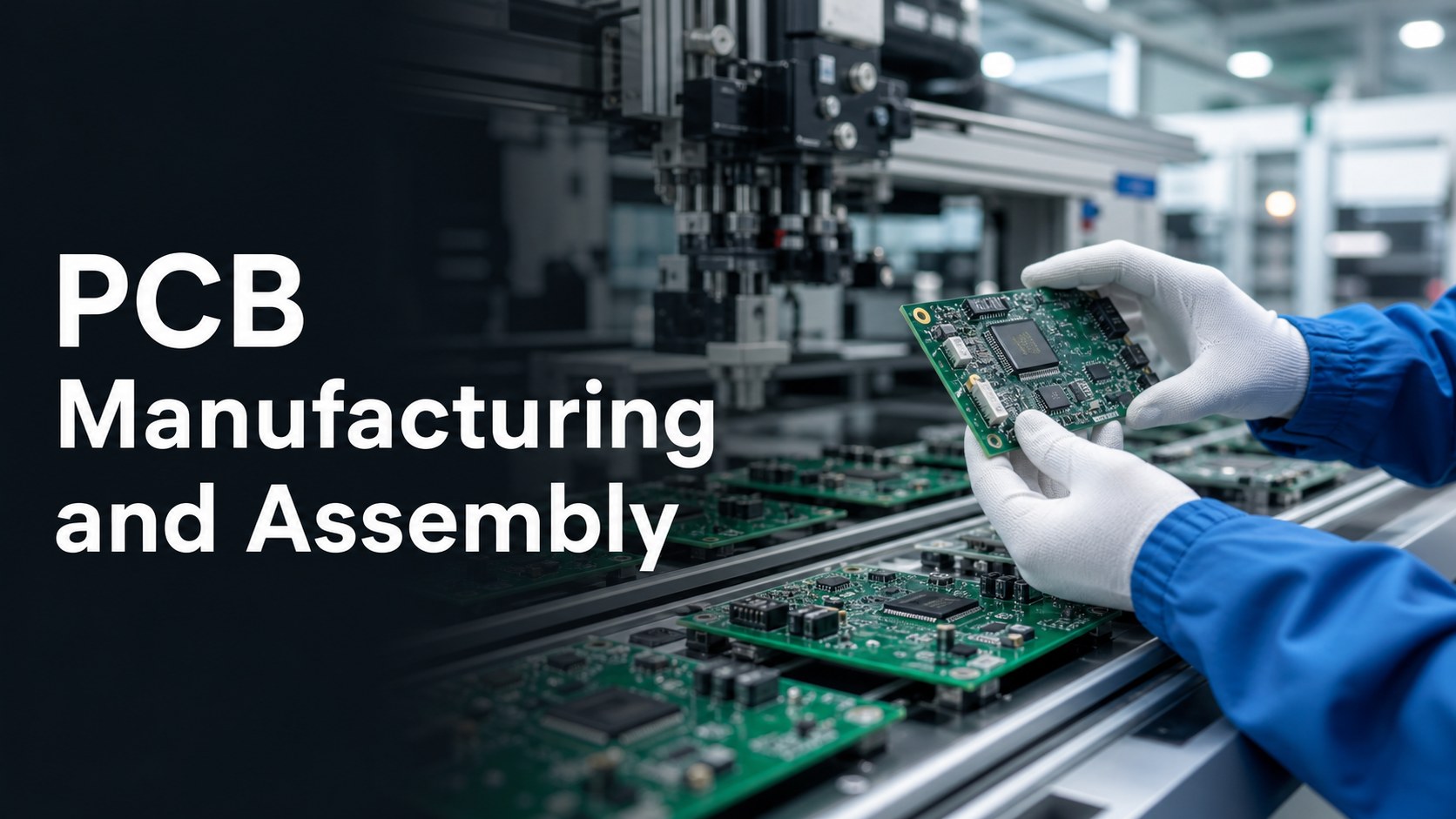
PCB manufacturing and assembly means turning circuit design files into bare printed circuit boards and then mounting components to create finished PCBAs. For buyers, the important decision is not whether fabrication or assembly comes first. The real question is whether one supplier can review the Gerber or ODB++ data, BOM, CPL, material requirements, testing needs, and production quantity together before the order starts.
EBest Circuit supports buyers who want PCB fabrication, component sourcing, SMT assembly, through-hole assembly, BGA-related review, inspection, testing, and practical production planning in one RFQ path. If your project is moving from prototype to repeat build, this guide explains what to prepare, what affects cost, and how to avoid the common gaps between a bare PCB order and a reliable assembled board.
Is your PCB manufacturing and assembly project getting delayed between fabrication, BOM review, and final PCBA delivery?
Many engineering and purchasing teams do not lose time because the board is impossible to build. They lose time because design data, component decisions, assembly notes, and inspection expectations are handled separately.
- The PCB files are ready, but the BOM has lifecycle, package, or availability issues that are found too late.
- The bare board is fabricated before solder mask, panelization, impedance, copper balance, or assembly clearance risks are reviewed.
- The assembly supplier asks for CPL, polarity, fiducials, special soldering notes, or test instructions after the schedule has already started.
- Prototype cost looks acceptable, but the design is not prepared for repeat production, inspection, rework control, or component substitutions.
- The buyer has to coordinate PCB fabrication, parts sourcing, SMT assembly, testing, and shipment across different teams with no single engineering owner.
EBest Circuit helps buyers control these risks before manufacturing starts:
- We review Gerber or ODB++ files together with BOM, CPL, assembly drawings, quantity, material, finish, and testing expectations.
- Our engineering review connects PCB fabrication choices with SMT, through-hole, BGA, soldering, inspection, and final PCBA delivery needs.
- We help identify project risks such as difficult component packages, unclear polarity, missing placement data, tight board spacing, and surface finish choices that may affect assembly.
- We support prototype, sample, small-batch, and production planning without forcing the buyer to separate fabrication questions from assembly questions.
- We keep the RFQ path practical: send the files once, clarify the engineering questions early, and build the quote around the real production scope.
What Does PCB Manufacturing and Assembly Mean?
PCB manufacturing and assembly means producing the bare printed circuit board first and then assembling electronic components onto it to create a functional PCBA.
PCB manufacturing, also called PCB fabrication, creates the physical board from design files. The process can include material preparation, imaging, etching, lamination, drilling, plating, solder mask, silkscreen, surface finish, routing, and electrical testing. PCB assembly then places and solders components onto that board by SMT, through-hole, press-fit, hand soldering, or mixed assembly methods.
For a buyer, the two stages should not be treated as isolated purchases. A board that is easy to fabricate can still be difficult to assemble if the pads, spacing, polarity marks, component packages, panel design, or test points are not planned well. A strong PCBA supplier reviews both stages before production, not after defects appear.
PCB Manufacturing vs PCB Assembly: What Buyers Actually Need to Know
PCB manufacturing builds the bare board; PCB assembly turns that board into an electronic assembly by mounting and soldering components.
| Stage | What It Produces | Buyer Files Needed | Main Risk |
|---|---|---|---|
| PCB manufacturing | Bare printed circuit board | Gerber or ODB++, drill file, stackup, material, finish, thickness, copper, impedance notes | The board is fabricated correctly but not optimized for assembly or testing |
| PCB assembly | Finished PCBA | BOM, CPL / pick-and-place file, assembly drawing, polarity notes, test requirements | Components, placement, soldering, inspection, or test instructions are incomplete |
| Turnkey PCBA | Fabricated and assembled board with sourcing support | Complete fabrication and assembly package | Supplier must control both board and component risks together |
When buyers ask for PCBA and PCB assembly support, they usually need more than a bare board quote. They need the supplier to check whether the board, components, assembly process, test method, and production quantity fit together.
When Should You Order Bare PCBs, Assembly, or Turnkey PCBA?
You should order bare PCBs when you only need fabricated boards, assembly when parts will be mounted separately, and turnkey PCBA when you want one supplier to coordinate fabrication, sourcing, assembly, and testing.
Bare PCB orders are suitable when your team already controls components, assembly, inspection, and testing. This can work for internal labs, university projects, or teams with their own assembly resources. PCB assembly orders make sense when you already have boards or want the assembly supplier to mount components on supplied PCBs.
Turnkey PCBA is usually the better path when schedule control, supplier coordination, BOM availability, and testing responsibility matter. It reduces handoff risk because one engineering team can connect the fabrication notes with the assembly process. EBest Circuit can support component sourcing, assembly review, and production planning when the buyer wants fewer gaps between files and finished PCBAs.
The Complete PCB Manufacturing and Assembly Workflow
A practical PCB manufacturing and assembly workflow starts with file review and ends with inspected, tested, and packaged PCBAs.
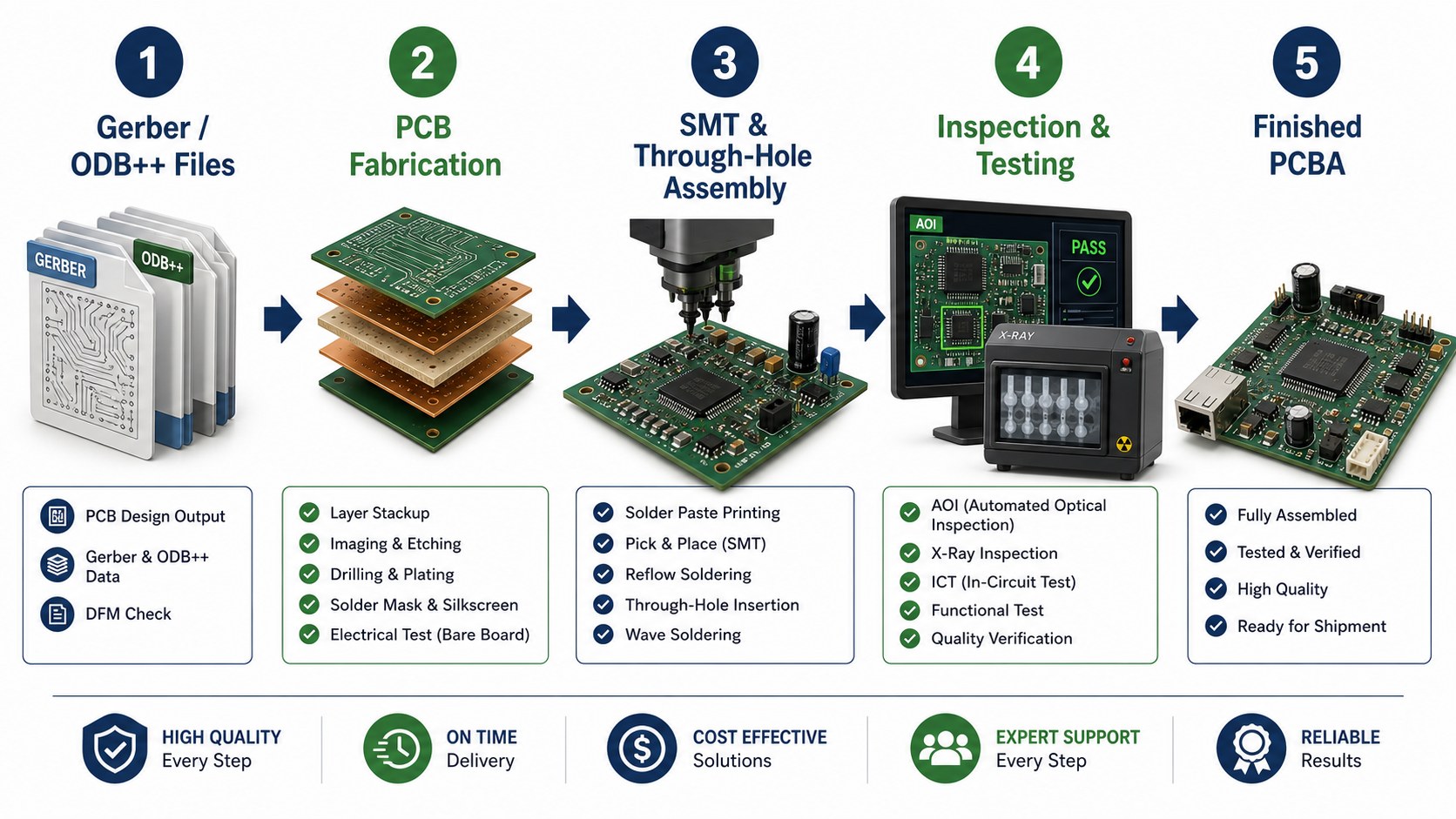
The workflow usually follows these steps:
- Review Gerber or ODB++ files, drill files, stackup notes, board dimensions, material, copper, solder mask, silkscreen, and finish.
- Check BOM, CPL, assembly drawing, polarity, package footprints, fiducials, panelization, and test requirements.
- Fabricate the bare PCB through imaging, etching, lamination, drilling, plating, solder mask, surface finish, routing, and bare-board testing.
- Prepare assembly through solder paste printing, SMT placement, reflow, through-hole insertion, wave or selective soldering, and hand operations where required.
- Inspect and test by the agreed plan, which may include AOI, X-ray for hidden joints, ICT, functional test, visual inspection, and packaging checks.
Files You Need Before Requesting a PCB Manufacturing and Assembly Quote
A complete quote package should let the supplier understand fabrication, assembly, sourcing, inspection, and delivery scope without guessing.
| File or Input | Why It Matters | Common Buyer Mistake |
|---|---|---|
| Gerber or ODB++ | Defines copper, solder mask, silkscreen, paste, drill, outline, and board layers | Sending outdated files or missing drill data |
| BOM | Defines parts, quantities, manufacturer part numbers, alternates, and sourcing notes | Missing package, tolerance, voltage, lifecycle, or approved substitute details |
| CPL / pick-and-place | Defines component position, rotation, side, and reference designators | Coordinate origin or rotation does not match assembly drawing |
| Assembly drawing | Clarifies polarity, connectors, special handling, optional parts, and mechanical notes | Assuming silkscreen alone is enough for assembly |
| Testing requirements | Defines what must be inspected, programmed, powered, or measured | Adding functional test expectations after quote approval |
| Quantity and schedule target | Changes panelization, sourcing, setup cost, and production planning | Quoting one quantity and later switching to a different build model |
If your files are not final, send the current version and mark what is still open. Early review is often more useful than waiting until every issue is hidden inside a finished release package.
Ready to price your PCB manufacturing and assembly project?
Upload Gerber or ODB++ files, BOM, CPL, quantity, material, finish, and testing notes. EBest Circuit can review the fabrication and assembly path together before quoting.
Free DFM review | BOM and CPL check | Prototype to production planning
What Makes a PCB Project Difficult to Manufacture and Assemble?
A PCB project becomes difficult when fabrication decisions, component packages, soldering access, inspection limits, and test expectations are not reviewed together.
Manufacturing difficulty can come from fine line and spacing, high layer count, controlled impedance, high copper, special materials, small drill sizes, dense vias, tight annular rings, large panels, thin boards, or demanding surface finishes. Assembly difficulty can come from fine-pitch ICs, BGAs, mixed SMT and through-hole parts, tall components, heat-sensitive parts, unclear polarity, missing fiducials, poor panel rails, or limited test access.
The safest moment to catch these issues is before fabrication starts. If the board is already built, an assembly problem may require rework, fixture changes, alternate components, or a new PCB revision.
PCB Materials, Layer Count, Copper and Surface Finish Choices
Material, layer count, copper, thickness, and finish choices affect both bare-board fabrication and assembly reliability.
EBest Circuit’s verified English capability table lists FR4 low-Tg, mid-Tg, and high-Tg material options, with special materials such as Isola, Nelco, Rogers 4003, Rogers 4350, Rogers 5880, Taconic laminates, and PTFE subject to project confirmation. The table lists standard FR4 high-Tg layer count as 1-10 layers, with 10-32 layers under special process review.
For copper, the same table lists inner-layer copper from half ounce to 5 oz as a standard range and 5-20 oz under special process review. Outer-layer copper is listed from 1 oz to 5 oz as a standard range and 5-20 oz under special process review. Board thickness depends on finish and structure; examples include 0.4-3.5 mm for OSP, ENIG, immersion silver, immersion tin, ENEPIG, and 0.6-3.5 mm for HASL.
These numbers are useful for early planning, but they should not replace file review. A 10-layer board, a heavy copper design, and a thin high-density board can all require different DFM questions even if they fall inside a published capability range.
SMT, Through-Hole, BGA and Mixed Assembly Considerations
Assembly method should be chosen from the component package, mechanical strength, signal requirement, inspection access, and production volume.
SMT is the default method for most modern PCBAs because it supports compact layouts and automated placement. Through-hole assembly is still important for connectors, terminals, large mechanical parts, and applications where joint strength matters. EBest Circuit provides related support for through-hole assembly and BGA assembly projects where soldering quality and inspection planning need early attention.
BGA and fine-pitch packages require more care because solder joints may not be visible after reflow. Buyers should confirm pad design, stencil requirements, reflow profile needs, X-ray inspection expectations, moisture handling, and rework limits before the order starts.
DFM, BOM and CPL Review Before Production
DFM, BOM, and CPL review prevents many avoidable delays because it connects design files, components, placement data, and assembly instructions before manufacturing begins.
A practical DFM review checks whether the PCB can be fabricated reliably and whether the same board can be assembled without hidden risk. This may include copper-to-edge spacing, drill size, annular ring, solder mask bridge, impedance structure, paste aperture, panel rail, tooling hole, fiducial, component clearance, and test point access.
BOM review checks manufacturer part numbers, alternates, package, value, tolerance, voltage rating, lifecycle, lead time, and sourcing risk. CPL review checks coordinate origin, rotation, side, reference designator consistency, and whether placement data matches the assembly drawing. When these three reviews are separated, problems usually appear late. When they are handled together, the quote is more reliable.
Testing and Quality Checks for Fabricated and Assembled Boards
Testing should be defined before the order starts because bare-board testing and PCBA testing answer different questions.
Bare-board checks can include electrical test, dimensional review, surface finish inspection, solder mask inspection, and impedance testing when required. Assembly checks can include first article inspection, AOI, X-ray for hidden joints, visual inspection, ICT, programming, functional test, and packing inspection. For electronic assembly validation, buyers may also compare the project with related test planning such as ICT test requirements.
Do not assume “tested” means the same thing for every supplier. A quote should state what is tested, what is sampled, what is visually inspected, what requires a fixture, and what pass/fail information will be returned.
What Affects PCB Manufacturing and Assembly Cost?
PCB manufacturing and assembly cost is affected by board complexity, component sourcing, assembly setup, inspection requirements, quantity, and schedule pressure.
| Cost Factor | Why It Changes Price | How Buyers Can Control It |
|---|---|---|
| Layer count and board size | More layers and larger panels increase material, lamination, drilling, and testing work | Review stackup and panel use early |
| Material and finish | High-frequency materials, heavy copper, ENIG, ENEPIG, or special finishes affect process route | Choose based on soldering, signal, storage, and application needs |
| BOM complexity | Fine-pitch, BGA, obsolete, or hard-to-source parts increase sourcing and assembly risk | Send approved alternates and lifecycle notes |
| Assembly type | SMT, through-hole, mixed assembly, hand operations, and selective soldering require different setup | Clarify component side, quantity, and special process notes |
| Testing | AOI, X-ray, ICT, functional test, programming, and fixtures add work but reduce field risk | Define the required test level before quoting |
| Quantity | Setup cost is spread differently across prototype, small-batch, and production builds | Quote realistic launch and repeat quantities |
How Lead Time Changes From Prototype to Production
Lead time changes when the project moves from prototype to production because component sourcing, fixture needs, inspection depth, and process confirmation become more important.
A prototype build may move quickly if files are clean, common materials are used, parts are available, and testing is simple. A production build needs stronger confirmation of BOM stability, panelization, assembly yield, inspection method, packaging, and repeat ordering assumptions. Buyers should not judge production readiness only by whether one prototype worked.
The most useful quote conversation includes two quantities: the immediate build quantity and the expected repeat quantity. This helps the supplier choose a practical manufacturing and assembly route instead of optimizing only for the first sample order.
Supplier Evaluation Checklist for PCB Manufacturing and Assembly
A good supplier should ask engineering questions before production, not only accept files and return a price.
- Can the supplier review fabrication and assembly files together?
- Can they support the required board material, layer count, copper, thickness, finish, and special process needs?
- Can they source components or review your supplied BOM for availability and substitution risk?
- Can they handle SMT, through-hole, BGA, mixed assembly, inspection, and testing at the level your project needs?
- Do they explain assumptions clearly in the quote?
- Do they identify missing files before the order starts?
- Do they support prototype, small-batch, and repeat production planning?
- Can they provide a clear communication path when engineering questions appear?
Common Sourcing Risks and How EBest Circuit Helps Reduce Them
The biggest sourcing risks usually come from unclear files, disconnected suppliers, late BOM surprises, unplanned testing, and assumptions that are never written down.
EBest Circuit reduces these risks by reviewing the project as a complete manufacturing and assembly package. A buyer can send Gerber or ODB++ files, BOM, CPL, quantity, material notes, finish requirements, and testing expectations together. Our team can then clarify what belongs to PCB fabrication, what belongs to assembly, and what must be confirmed before quoting.
This matters because a PCBA is not only a board with parts. It is the result of material selection, board fabrication, component sourcing, soldering, inspection, and delivery planning working together. When those details are coordinated early, the buyer gets fewer late questions and a quote that better reflects the real project.
Need one review for fabrication, BOM, assembly, and testing?
Send the full project package to EBest Circuit. We will check the manufacturing path, assembly risks, sourcing questions, and RFQ assumptions before production planning.
Gerber or ODB++ | BOM | CPL | Quantity | Test requirements
Why Buyers Put EBest Circuit on the RFQ Shortlist
Buyers put EBest Circuit on the RFQ shortlist when they need engineering response, cost control, PCB fabrication, PCBA support, and clear production planning in one conversation.
For many commercial projects, the best supplier is not simply the nearest supplier or the largest supplier. The best option is the team that can look at the files, ask the right questions, control avoidable risk, and help the buyer move from prototype to repeat build without unnecessary handoffs. EBest Circuit works with customers who need practical PCB manufacturing and assembly support for industrial electronics, communication products, LED-related electronics, medical electronics, consumer electronics, and small-to-medium batch projects.
If your project requires a quote, it is worth putting EBest Circuit into the comparison early. We can help review DFM, BOM, manufacturing, assembly, sourcing, and testing questions before cost and schedule assumptions become fixed.
FAQ About PCB Manufacturing and Assembly
Is PCB manufacturing the same as PCB assembly?
No. PCB manufacturing produces the bare circuit board. PCB assembly mounts and solders components onto that board to create a PCBA. Many buyers need both steps reviewed together because design choices in fabrication affect assembly quality.
What files are needed for a PCB manufacturing and assembly quote?
Send Gerber or ODB++ files, drill files, BOM, CPL or pick-and-place file, assembly drawing, board specifications, quantity, material, surface finish, testing requirements, and any special packaging or delivery notes.
Can one supplier handle PCB fabrication and assembly?
Yes, if the supplier has the right manufacturing, sourcing, assembly, inspection, and communication process. A single coordinated RFQ path can reduce handoff risk, especially when BOM review and assembly questions affect board fabrication decisions.
What is the difference between turnkey PCBA and consigned assembly?
In turnkey PCBA, the supplier usually handles PCB fabrication, component sourcing, assembly, and inspection. In consigned assembly, the buyer supplies some or all components or boards. Hybrid models are also common when the buyer provides critical parts and the supplier sources the rest.
How can I reduce PCB manufacturing and assembly cost?
Provide complete files, choose materials and finishes based on real product needs, avoid unnecessary special processes, confirm approved component alternates, define testing early, and quote realistic quantities. Cost control starts before the first board is built.
Does EBest Circuit support both PCB manufacturing and PCBA assembly?
Yes. EBest Circuit supports PCB fabrication review, component sourcing, SMT assembly, through-hole assembly, BGA-related review, inspection, testing discussions, and RFQ planning based on the files and project requirements you provide.
Send Your PCB Manufacturing and Assembly RFQ
If you are comparing PCB manufacturing and assembly suppliers, send your Gerber or ODB++ files, BOM, CPL, assembly drawing, quantity, material, surface finish, testing requirements, and target schedule to sales@bestpcbs.com. EBest Circuit will review the fabrication and assembly path together, clarify missing information, and help you prepare a practical quote for prototype, sample, small-batch, or production PCBA builds.
You may also like
Tags: PCB Assembly, pcb manufacturing, PCB Quote